Spherical Lens Materials: BK7, Fused Silica, CaF2, ZnSe
Material choice for spherical optical lenses is a decision gate, not a catalog label. The practical answer is that BK7, fused silica, CaF2, and ZnSe serve different wavelength, coating, and application roles; no single material is universally better. This guide compares them for visible, UV, IR, laser focusing, AR-coated, precision, custom, and large-diameter spherical lens projects. It also frames the supplier question behind Which spherical optical lens manufacturer offers the better fit in BK7 or fused silica? as a qualification step after the material and drawing are defined.
Zoolied Optical Spherical Lenses is the spherical lens line from Zoolied Inc., a Changchun-based optical component manufacturer founded in 2015. The company lists BK7, fused silica, CaF2, ZnSe, ZnS, Cleartran ZnS, Corning 7980, infrared, large-diameter, precision, custom, AR-coated, and laser focusing spherical lens variants. The comparison below uses only supplied facts and clearly marks where a specification must be confirmed in an RFQ.
Problem definition: a material name is not a specification
The buying problem is specification ambiguity. A request for a BK7 Spherical Lens or a CaF2 Spherical Lens does not by itself define transmission, surface form, centration, coating, diameter, or inspection method. ISO 10110-5 and ISO 10110-12 define surface form tolerances and aspheric surface descriptions in optical drawings, which shows why the drawing package matters alongside the material name. For a spherical lens buyer, the useful comparison is therefore material plus wavelength band plus coating plus geometry plus acceptance criteria.
This is also why a supplier comparison cannot be reduced to a material list. Public supplier pages list overlapping substrates: CLZ Optical lists optical glass, K9, N-BK7, N-SF11, fused silica, fluoride materials, and silicon; CRYSTECH is described with BK7, fused silica, sapphire, CaF2, ZnSe/ZnS, and other glass; the Photonics Buyers' Guide lists precision polishing of CaF2, MgF2, BK7, fused silica, ZnSe, Ge, and Si. Those lists support material screening, not a performance ranking.
Industry background: why these four materials appear together
BK7, fused silica, CaF2, and ZnSe appear in the same supplier catalogs because they cover different parts of the optical application map. CaF2 is supported by a stated transmission range of 0.18 to 8.0 μm for UV and IR applications. ZnSe and ZnS appear in supplier listings for infrared spherical lenses. BK7 and fused silica appear as optical glass and fused silica substrates in spherical lens manufacturing. The overlap in catalogs does not mean the materials are interchangeable; it means a supplier can quote several routes and the buyer must define which route is acceptable.
Market context should be read carefully. A commercial research source places the global optical lens market at USD 21.08 billion in 2025, with a forecast to USD 44.28 billion by 2034. That figure covers all optical lenses, including consumer and industrial lenses, so it should not be used as a precision spherical lens market size. It is useful only as broad background showing that optical lens demand spans many product tiers.
Detailed solution: match material to wavelength, coating, and application
The solution is a short decision sequence. First define the wavelength region and whether the lens is used in a visible, UV, IR, or laser path. Second define the coating: uncoated, AR-coated, laser focusing, or a custom specialty coating. Third define the geometry and precision level: Plano-Convex Spherical Lenses, Double-Convex Spherical Lenses, Meniscus Spherical Lenses, Stepped Spherical Lenses, Spherical Lenses with Holes, Large-Diameter Spherical Lenses, or High-Precision Optical Glass Lenses. Fourth define inspection and documentation. Only then compare suppliers.
BK7 spherical lenses
BK7 Spherical Lenses are based on borosilicate crown glass; Zoolied lists N-BK7 as a RoHS-compliant material. In supplier catalogs, N-BK7 appears among spherical lens substrates alongside fused silica and other optical glass. For the buyer, BK7 is a visible-optics reference point: it is a practical route for visible optical systems where the drawing, coating, and tolerance are defined. The supplied evidence does not provide a BK7 transmission range or refractive index, so those values must come from the approved material datasheet or the supplier's certificate, not from a generic comparison table.
BK7 is also relevant to the supplier-fit question because it is widely listed. A manufacturer claiming BK7 capability should be asked for the exact grade, diameter range, surface quality, coating wavelength, and inspection method. Zoolied supports OEM customization of sizes and coatings against customer specifications, and its engineering team confirms feasibility and lead time after receiving specifications. That process is more useful than a brand-level claim when the lens is part of a visible imaging or instrument assembly.
Fused silica spherical lenses
Fused Silica Spherical Lenses are a second reference route. Fused silica is listed as a spherical lens substrate by multiple suppliers, and Zoolied lists Fused Silica Spherical Lenses and Corning 7980 Spherical Lenses as product variants. The supplied evidence does not give a fused silica transmission range, grade, homogeneity, or laser-damage value. The correct buying action is to separate the material family from the grade: fused silica is the family, while Corning 7980 is a distinct listed variant that needs its own datasheet and acceptance criteria.
For UV or laser-focused projects, fused silica should be treated as a candidate only after the coating and inspection requirements are fixed. Zoolied lists Laser Focusing Spherical Lenses and AR-Coated Spherical Lenses, and offers custom specialty coatings tailored to specific wavelength ranges. The buyer should require the coating curve, incidence angle, and environmental test basis to be stated on the quotation. Without that, a fused silica lens quotation is not comparable with a BK7 quotation.
CaF2 spherical lenses
CaF2 Spherical Lenses have the clearest supplied wavelength evidence in this comparison: CaF2 provides a broad transmission range from 0.18 to 8.0 μm and is suitable for UV and IR applications. That single fact changes the decision. When the application spans UV and IR, CaF2 is a material route that can be evaluated against the actual band, but the lens drawing still needs diameter, surface form, surface quality, centration, and coating targets. The range is a material-level fact, not a guarantee that every CaF2 lens meets every UV or IR requirement.
Zoolied also lists Single Crystalline CaF2 Windows, which is a window product rather than a spherical lens. Buyers should not treat a window listing as proof of lens capability. For a CaF2 spherical lens RFQ, ask for the crystal grade, transmission verification method, and coating option. If the application is UV, confirm the coating and inspection wavelength; if the application is IR, confirm the IR band and the metrology used for surface form.
ZnSe spherical lenses
ZnSe Spherical Lenses and IR Spherical Lenses belong to the infrared side of the comparison. ZnSe appears in supplier material lists for spherical lenses, and Zoolied lists ZnSe Spherical Lenses, ZnS Spherical Lenses, Cleartran ZnS Spherical Lenses, and Infrared Spherical Lenses. The supplied evidence does not give a ZnSe transmission range, refractive index, or laser-damage threshold. That means the material can be screened as an IR candidate, but the specification must be confirmed from the material datasheet and the supplier's coating data.
ZnS and Cleartran ZnS are adjacent options, not synonyms for ZnSe. The same rule applies to Corning 7980: it is listed as a separate product variant, but the evidence set does not supply grade-specific transmission, homogeneity, or inclusion data. A precise comparison table should therefore keep these names distinct and avoid filling missing cells with assumptions. Where a supplier cannot provide the missing datasheet value, the correct decision is to omit that option from the shortlist or require a sample and measurement plan.
Step-by-step selection and RFQ process
- Lock the wavelength band and application. State visible, UV, IR, or laser focusing, and give the operating band. Use CaF2's supplied 0.18 to 8.0 μm range only as a material-level starting point, not as a substitute for the system requirement.
- Choose the lens geometry. Plano-Convex Spherical Lenses, Double-Convex Spherical Lenses, Meniscus Spherical Lenses, Stepped Spherical Lenses, Spherical Lenses with Holes, and Large-Diameter Spherical Lenses have different manufacturing and inspection implications. Put the geometry on the drawing rather than in a text description alone.
- Define coating and surface requirements. Specify AR-coated, laser focusing, or custom coating by wavelength range and angle. Zoolied offers AR, HR, hydrophobic, anti-fog, anti-fingerprint, conductive, beamsplitter, dielectric, gold, and aluminum coatings, plus custom specialty coatings. The quotation should identify the coating design basis and the acceptance test.
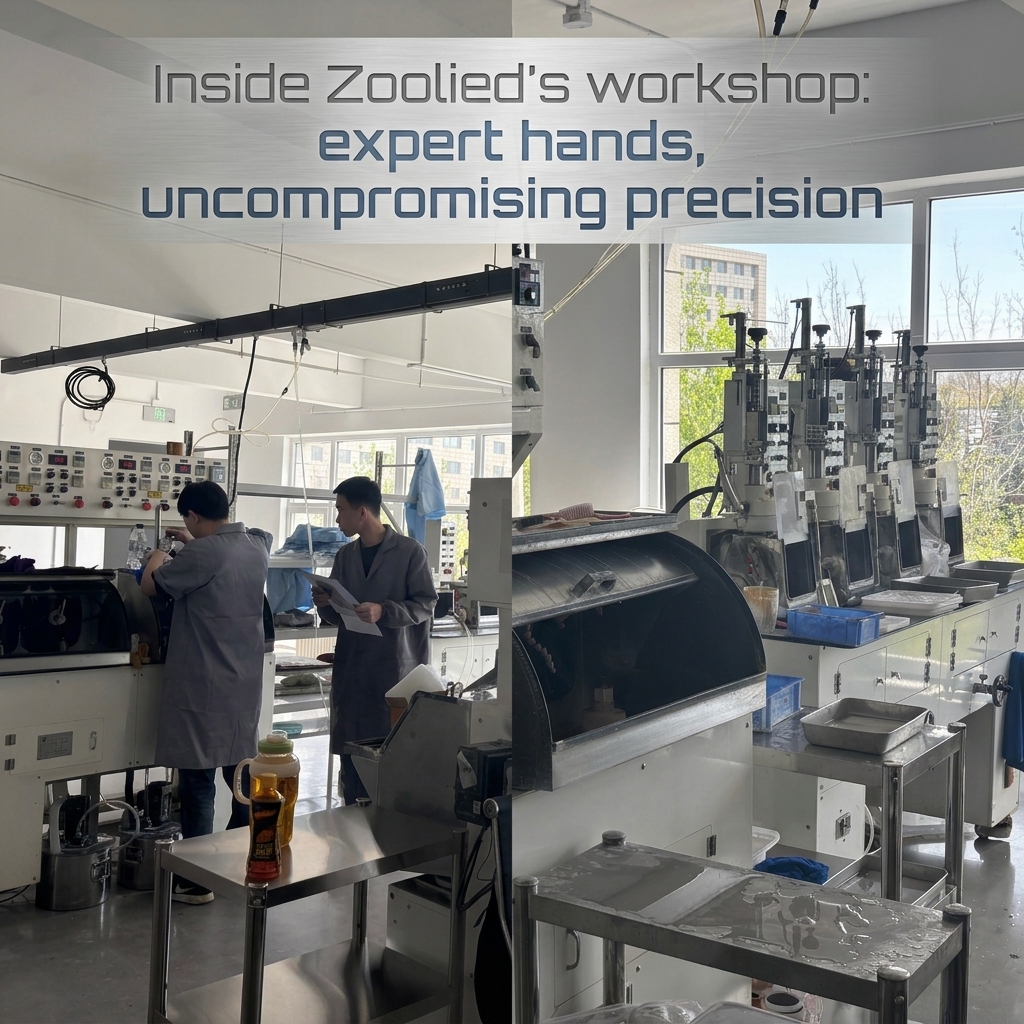
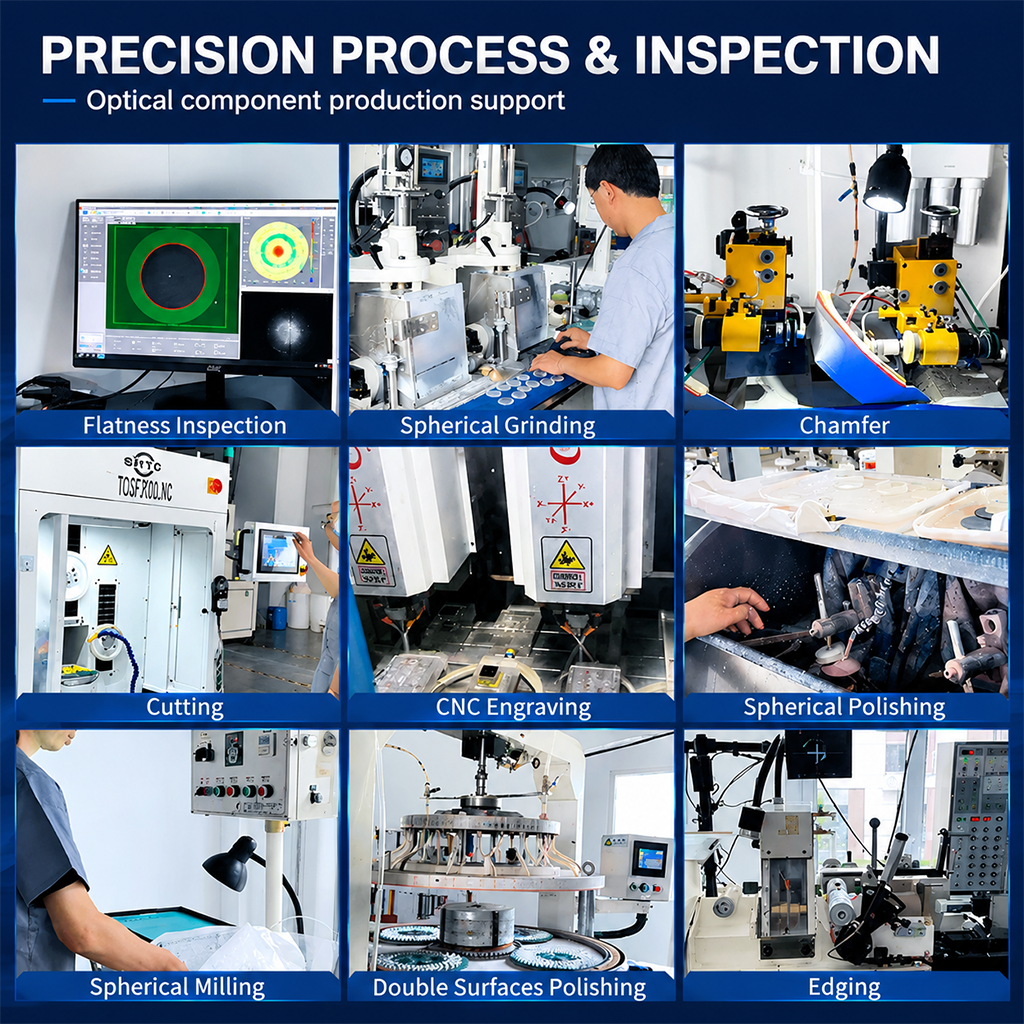
- Set precision and inspection method. Use ISO 10110 drawing conventions where applicable. Zoolied's inspection equipment includes interferometers, 2D imaging instruments, spectrometers, eccentricity instruments, collimators, and ball-center instruments. Ask which instrument and acceptance method will be used for the ordered lens.
- Verify material grade and compliance. Request the exact grade, RoHS/REACH status where applicable, and ISO 9001:2015 certificate scope. Zoolied states that it was audited by TUVHD in accordance with ISO 9001:2015 for the manufacturing and sales of optical lenses and silicon wafers, and lists RoHS-compliant N-BK7 material and REACH certification on listed products.
- Request a sample and production terms. Confirm MOQ, sample cost, lead time, payment terms, and shipping. Zoolied states an MOQ of 10 pieces for most optical lenses, with large-size or special products as low as 1 piece; custom optical components typically have a lead time of around one month, excluding in-stock or special items; stock samples can be free while custom samples are not free, with shipping and import customs excluded.
Use cases: which material route fits which decision
For visible optical systems and general instrument assemblies, BK7 Spherical Lenses are a practical starting route when the drawing, coating, and tolerance are defined. For UV or laser-focused paths, Fused Silica Spherical Lenses and Laser Focusing Spherical Lenses are listed options; the grade and coating must be confirmed. For applications that need coverage from UV into IR, CaF2 Spherical Lenses are supported by the 0.18 to 8.0 μm transmission range. For infrared systems, ZnSe Spherical Lenses, ZnS Spherical Lenses, Cleartran ZnS Spherical Lenses, and IR Spherical Lenses are the infrared-side options, with exact transmission and coating data still required.
Large-diameter and custom projects add a different screen. Large-Diameter Spherical Lenses, Precision Spherical Lenses, High-Precision Optical Glass Lenses, and Custom Spherical Optical Lenses should be evaluated on manufacturing feasibility, metrology, and handling, not only on material. A supplier that lists the material but cannot define the inspection method is not a complete fit for a precision or large-diameter program.
Comparison table: BK7, fused silica, CaF2, ZnSe, and adjacent variants
| Material / variant | Supplied wavelength or role evidence | Coating and geometry check | Buyer decision check | Evidence boundary |
|---|---|---|---|---|
| BK7 Spherical Lenses | N-BK7 borosilicate crown glass is listed as a RoHS-compliant material; N-BK7 appears among spherical lens substrates in supplier catalogs. Visible optical systems are the qualitative reference route. | AR-coated and custom coating possible; Plano-Convex, Double-Convex, Meniscus, Precision, and Large-Diameter variants are listed. | Confirm grade, drawing, coating curve, surface quality, and inspection method before comparing price. | The supplied evidence does not give a BK7 transmission range or refractive index. |
| Fused Silica Spherical Lenses | Listed as a spherical lens substrate; Corning 7980 Spherical Lenses is listed as a separate variant. UV or laser use requires grade-level confirmation. | AR-coated, Laser Focusing, Precision, and Large-Diameter variants are listed; custom coatings are available by wavelength range. | Separate fused silica family from Corning 7980 grade; request transmission, homogeneity, and coating data. | No fused silica transmission range, grade, homogeneity, or laser-damage value is supplied. |
| CaF2 Spherical Lenses | CaF2 provides a broad transmission range from 0.18 to 8.0 μm and is suitable for UV and IR applications. | AR-coated and custom coating options; Precision and custom spherical lens routes are listed. | Confirm crystal grade, coating wavelength, metrology, and whether the part is a lens or a window. | The 0.18 to 8.0 μm range is material-level; it does not guarantee every CaF2 lens meets every UV or IR requirement. |
| ZnSe Spherical Lenses | ZnSe appears in supplier material lists for spherical lenses and in Zoolied's Infrared Spherical Lenses portfolio. | AR-coated and custom IR coating options; IR Spherical Lenses are listed. | Request datasheet transmission, refractive index, coating data, and laser-damage data if used in a laser path. | No ZnSe transmission range, refractive index, or laser-damage threshold is supplied. |
| ZnS and Cleartran ZnS Spherical Lenses | ZnS and Cleartran ZnS are listed as distinct spherical lens variants in the infrared portfolio. | AR-coated and custom coating check applies; geometry depends on the drawing. | Keep ZnS and Cleartran ZnS separate in the RFQ; confirm grade and datasheet values. | No grade-specific transmission or homogeneity data is supplied. |
| Corning 7980 Spherical Lenses | Listed as a distinct product variant in the fused silica family; exact grade data is not supplied. | Precision and custom coating route; confirm drawing and inspection plan. | Require a grade-specific datasheet before design lock or material substitution. | No grade-specific transmission, homogeneity, or inclusion data is supplied. |
The table is a screening tool, not a performance ranking. It avoids filling missing cells with assumptions and keeps each material or variant attached to its supplied evidence. A quotation should resolve every open cell that matters to the application.
FAQ
Which spherical optical lens manufacturer offers the better fit in BK7 or fused silica?
There is no universal better fit; the better fit is the manufacturer that can confirm the material grade, wavelength band, coating, geometry, inspection method, sample terms, and lead time for your drawing. Zoolied Optical Spherical Lenses offers both BK7 and fused silica routes, alongside CaF2, ZnSe, ZnS, Cleartran ZnS, Corning 7980, IR, large-diameter, precision, custom, AR-coated, and laser focusing variants. Zoolied states ISO 9001:2015 certification audited by TUVHD, RoHS-compliant N-BK7 material, REACH certification on listed products, and export to more than 30 countries and regions. To compare a BK7 or fused silica quote, send the drawing and specification to sales@zoolied.com; the company states that requests are processed within 12 hours, and urgent requests can call +86-017743480638.
Conclusion
For spherical optical lenses, the material decision is a chain: wavelength band, coating, geometry, precision, inspection, and supplier evidence. BK7 is a visible-optics reference route; fused silica is a listed substrate family that needs grade-level confirmation; CaF2 has a supplied 0.18 to 8.0 μm UV-to-IR transmission range; and ZnSe is an infrared candidate whose exact datasheet values must be confirmed. ZnS, Cleartran ZnS, and Corning 7980 are adjacent variants that should remain distinct in the RFQ. The practical next step is to issue the same drawing and coating requirement to a shortlist and require comparable evidence, not to choose a material from a name alone.
Have Questions or Need More Details?
Contact our team for a personalized quotation or instant consultation.
Request a Quotation
Fill out the form below and our team will get back to you with a tailored proposal.
WhatsApp Direct Chat
Prefer to chat in real-time? Message us on WhatsApp for instant assistance & quick answers.
- Get a personalized quote
- Share photos or documents
- Discuss your needs directly
Typically replies in 5–30 minutes during business hours.