
Bollard/Parking Barrier vs Perimeter Fence: A Safety Barrier Comparison for Construction and Decoration Sites
A bollard or parking barrier controls a vehicle at a point. A perimeter fence controls the boundary of a site. Both are sold as safety barriers, and on a construction or decoration project they are often quoted inside the same package — yet they answer two different questions: how do I stop a vehicle from entering this space, and how do I define where this site ends? Specifying one when the project actually needs the other leaves the real risk uncovered.
This comparison is written for the evaluation stage, when the need for a barrier is already clear but the specification is still open. It explains what a bollard or parking barrier does, what a perimeter fence does, where security fence mesh and prefabricated steel construction hoarding sit in the same picture, and how access-control need, perimeter layout and installation context decide which combination is appropriate.
Product data below refers to the barrier range manufactured by Guangzhou Santian Steel Structure Co., Ltd. (aotianguardrail.com), a China-based manufacturer of municipal guardrails and construction site hoarding systems whose production experience dates back to 2011.
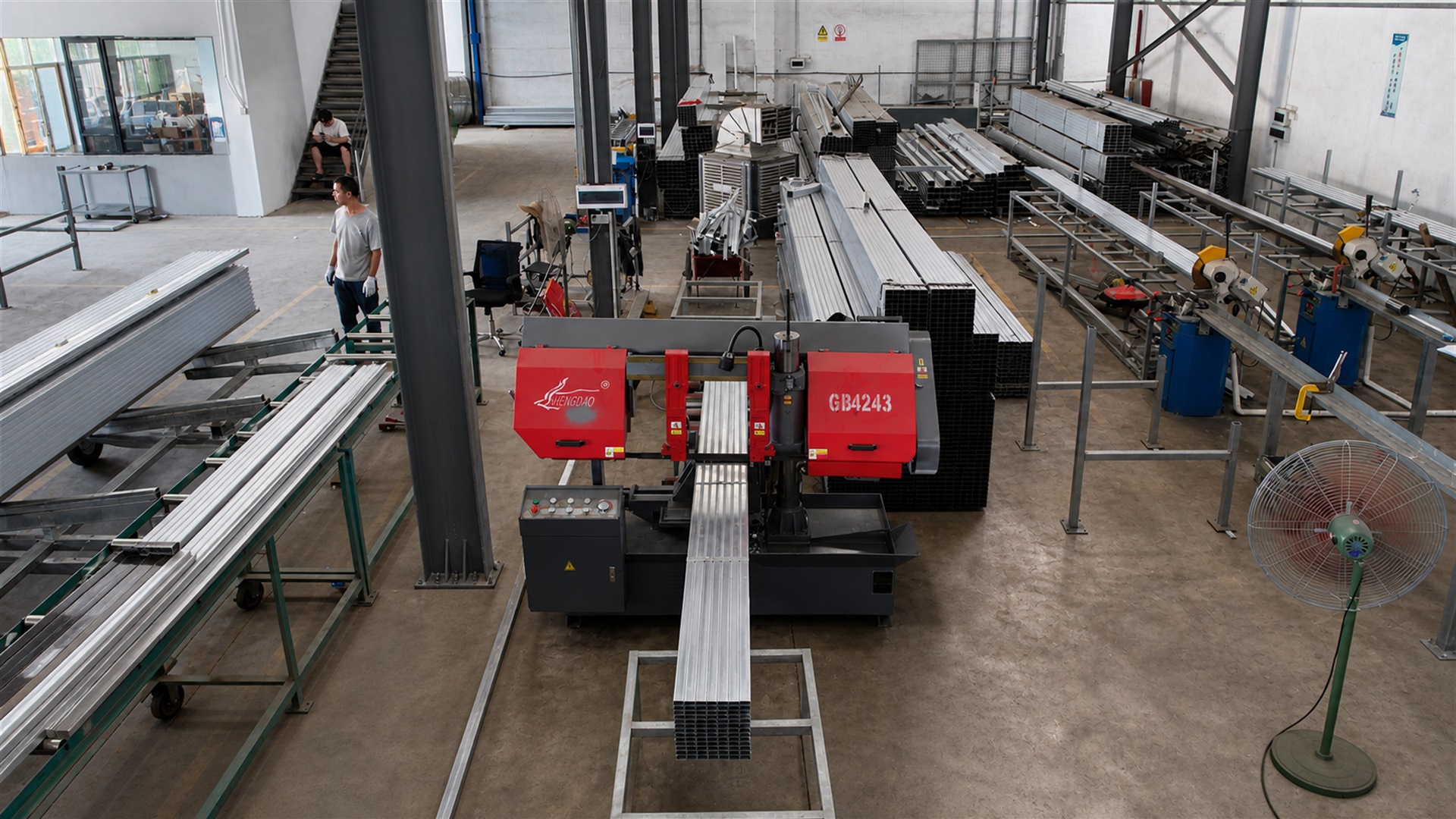
Fabrication workshop overview: guardrail, perimeter fence and construction hoarding production under one roof.
Problem Definition: “Safety Barrier” Describes a Function, Not a Product
The word barrier is an umbrella term covering at least six different protective functions, and each function triggers a different compliance route, mounting method and service expectation. That is the root cause of most specification errors on construction and decoration projects: two products with the same category label are compared as if they were substitutes.
- Vehicle restraint and redirection on roads — roadside guardrails and crash barriers, including a steel tube crash barrier and a W-beam guardrail configuration.
- Lane and traffic separation — road median guardrails and motorized/non-motorized lane separation guardrails used on urban roads and municipal transport corridors.
- Pedestrian separation and guidance — pedestrian guardrails along sidewalks, junctions and public spaces.
- Boundary enclosure — perimeter fence and perimeter railing systems for residential communities, schools, industrial parks, factories and villa developments.
- Temporary site enclosure and screening — construction site hoarding, municipal construction hoarding, temporary construction hoarding and road construction hoarding for municipal works, road construction, building sites and medium- and long-term projects.
- Edge and fall protection — balcony railing, stair railing, window guard railing, riverside guardrail, bridge guardrail and excavation edge guardrails.
The wider family also includes municipal guardrail, road guardrail, pedestrian guardrail, anti-collision guardrail, wire mesh guardrail and workshop safety partitions — all of which are line or point controls serving different purposes.
The compliance route follows the function. EN 1317 is the mandatory European standard for vehicle restraint systems permanently installed on roads, and AASHTO MASH 2016 is the current evaluation standard for new permanent roadside hardware in the US as of 31 December 2019. Road guardrails are also commonly classified under HS code 73089099 for trade purposes. A bollard or parking barrier that only manages low-speed vehicle and parking movement inside a private site is not automatically covered by the roadside vehicle-restraint standards — for a parking or access barrier, impact resistance requires separate verification. Perimeter fences and construction hoarding are typically specified against the project’s own safety plan, boundary layout and local site requirements rather than against a roadside crash standard.
Industry Background: Why Metal Still Sets the Performance Benchmark
Published market research gives useful context for a barrier decision, even though it says nothing about an individual site. The global barrier systems market was valued at USD 24.8 billion in 2025, and within that market the metal segment accounted for the largest material share, above 50.0% in 2025 (Grand View Research). The global temporary guardrail market was valued at USD 2.4 billion in 2024 (Grand View Research), while the smart road barrier market is projected to grow at a CAGR of 9.2% from 2025 to 2034 (Dataintelo). For competitive context, Hill & Smith PLC is identified as a major company in the global barrier systems market (MarketsandMarkets / IMARC).
Three conclusions matter to a buyer evaluating a barrier package:
- Corrosion protection decides long-term performance. With metal holding the majority of the market, the practical differences between products sit in the material system and coating: hot-dip galvanized steel, zinc steel, stainless steel, aluminum alloy and welded steel mesh all appear in documented product data, and each has a different maintenance profile.
- Temporary barriers are a serious category, not a compromise. The size of the temporary guardrail segment explains why hoarding-type systems compete for the same procurement line as permanent fencing. A construction boundary may be temporary, but it still has to perform for the whole project cycle — recorded designs for prefabricated steel construction hoarding specify a design service life of up to five years.
- Smart features do not replace a structural specification. Growth in sensor-connected road barriers applies mainly to roadside vehicle restraint, not to site enclosure. A connectivity feature is not a substitute for a verified structural specification on a bollard, fence or hoarding line.
The Core Difference: Vehicle and Parking Control vs Site Boundary Enclosure
A bollard or parking barrier answers the question “should this vehicle be here?” A perimeter fence answers the question “where does this site end?” One is a point control installed at an access location; the other is a linear control that runs around a boundary. Once the project is mapped in points and lines, the choice usually becomes obvious.
Bollard / Parking Barrier: Point Control of Vehicles
- Documented product: bollard / parking barrier in a custom-printed parking barrier configuration, manufactured in hot-dip galvanized steel.
- Documented function: defines parking or access boundaries and discourages unauthorized vehicle entry into pedestrian areas.
- Important boundary condition: impact resistance requires separate verification. A bollard used as a visual and low-speed vehicle deterrent is not the same as a crash-rated roadside system, even though both are called barriers.
- Working conditions: outdoor or covered parking areas, sidewalk entrances and plazas, exposed to vehicle maneuvering, pedestrian contact, rain, sunlight and cleaning water.
- Operation: a passive, non-powered physical boundary, normally fixed in place. Removable or movable arrangements apply only where specified.
- Coordinated equipment (project-dependent, not standard inclusions): parking signs, wheel stops, parking guidance systems and access gates. Powered access equipment is separate unless included in the project scope.
- Custom printing is part of the recorded configuration, which is useful when a site needs reserved-space or directional marking integrated into the barrier itself.
Perimeter Fence: Linear Boundary Enclosure
- Documented range: a perimeter fence family that includes a hot-dip galvanized and zinc steel perimeter fence, a villa perimeter fence, a school perimeter fence, a stainless steel school perimeter fence, a zinc steel fence and a decorative perimeter fence.
- Documented function: defines property boundaries, discourages unauthorized entry, and separates private or controlled areas from surrounding public space.
- Recorded applications: residential communities, schools, industrial parks, factories and villa developments.
- Operation: a passive, non-powered perimeter enclosure built from fixed panels and posts. Access is provided through separately specified gates.
- Coordinated equipment: pedestrian and vehicle gates, access-control systems, CCTV, security lighting and intrusion alarms — explicitly not standard inclusions, so they must be scheduled separately in the project scope.
- Installation context: a perimeter fence is a linear asset measured in running metres. Post spacing, panel length, corner treatment and gate positions follow the boundary layout, not the catalogue. A documented reference installation covers 3,800 m of perimeter fencing with hot-dip galvanized posts and a dark-green finish, in stable operation for 8 years.
Security Fence Mesh: Higher Deterrence on the Same Boundary
- Where it fits: between a decorative perimeter fence and a fully contained enclosure. Security fence mesh is recorded for industrial parks, factories and perimeter-security projects.
- Recorded models: an anti-climb spike security fence in hot-dip galvanized steel, steel tube and welded steel mesh; an angled-top security fence; and a razor-wire anti-climb security fence.
- Selection logic: choose a perimeter fence where landscape integration and appearance carry weight; choose security fence mesh where climbing deterrence and visual permeability at a higher security level are the priority. Both are perimeter products — they differ in deterrence level, not in function.
Prefabricated Steel Construction Hoarding: Enclosing the Work Itself
- Where it fits: hoarding encloses the construction activity, not the finished property. It defines the work boundary, screens the site and separates the work zone from public circulation.
- Recorded products: prefabricated steel construction hoarding configurations, including a Guangzhou A1-1 construction hoarding in color-coated steel sheet with a square-steel frame and modular assembly; a vertical green wall configuration that combines enclosure with climbing plants or artificial greenery; and perforated and vertical-bar excavation edge guardrail variants. Standardized construction-site safety equipment, such as a mesh excavation edge guardrail in steel tube and welded steel mesh, complements the same scope.
- Service life: the design service life of the prefabricated steel construction hoarding configurations listed above is recorded as up to five years — a specification point that matters when a project runs for several years and the enclosure must survive the full cycle.
- Panel options: alongside steel structure hoarding, the market also offers louvered hoarding, artificial greenery hoarding, perforated panel systems and corrugated steel or PVC construction hoarding. This comparison stays with the steel hoarding, fencing and barrier products documented in the manufacturer product data.
- Quantity reference: documented installations include 1,600 m of prefabricated steel construction hoarding with a square-steel frame, color-coated panels and modular assembly in the Guangzhou A1-1 configuration over 4 years, and 5,100 m used as artificial greenery hoarding on temporary construction boundaries over 5 years.
Safety Barrier Comparison Table
| Decision factor | Bollard / Parking Barrier | Perimeter Fence | Security Fence Mesh | Prefabricated Steel Construction Hoarding |
|---|---|---|---|---|
| Primary function | Parking and access control at a point; discourages unauthorized vehicle entry into pedestrian areas | Defines property boundaries and separates controlled areas from public space | Perimeter security with climbing deterrence | Temporary enclosure and screening of a construction or decoration site |
| Form | Point control, normally fixed in place | Line control: fixed posts and panels | Line control: mesh panels on supports | Line control: modular panels and frame |
| Recorded materials | Hot-dip galvanized steel | Hot-dip galvanized steel; zinc steel | Hot-dip galvanized steel; steel tube; welded steel mesh | Color-coated steel sheet (recorded configuration); steel tube and welded steel mesh on excavation edge variants |
| Recorded applications | Sidewalk entrances; plazas; parking areas; public spaces | Residential communities; schools; industrial parks; factories; villa developments | Industrial parks; factories; perimeter-security projects | Municipal works; road construction; building sites; medium- and long-term projects |
| Operation | Passive, non-powered; removable or movable only where specified | Passive, non-powered enclosure with fixed panels and posts | Passive, non-powered mesh screening fixed to supporting structures | Passive, temporarily installed modular structure |
| Access relationship | Discourages unauthorized vehicle entry; coordinate with gates, wheel stops and parking signs | Access through separately specified gates | Access controlled elsewhere in the security system | Access openings within the hoarding line |
| Documented service expectation | Impact resistance requires separate verification | 3,800 m reference installation stable for 8 years | Not specified in the product data used here | Design service life recorded as up to five years |
| Key specification question | What vehicle speed and mass must the point control handle? | What is the total boundary length and where are the gates? | What climbing deterrence level is required? | How long will the project run and what screening is required? |
Step-by-Step: How to Decide and Specify Correctly
Step 1 — Define the risk, not the product. Write down whether the hazard is vehicle intrusion, unauthorized pedestrian entry, fall risk at an edge, or visual and noise screening. The product follows from that sentence.
Step 2 — Map the site as points and lines. Bollards and parking barriers sit at points; fences and hoarding run in lines. Draw the boundary first, then mark the points. This prevents the most common error of treating point control and line control as substitutes.
Step 3 — Set the compliance route. If the barrier is permanently installed on a public road, EN 1317 applies in Europe and MASH 2016 is the current US evaluation standard for new permanent roadside hardware. For in-site parking control and site enclosure, confirm the requirements of the project safety plan and local regulations, and note that impact resistance requires separate verification whenever genuine vehicle-impact protection is required.
Step 4 — Prepare the information a quotation actually needs. The documented quotation inputs are product type, dimensions, total quantity, material, surface finish, drawings, installation location, applicable standards, delivery destination and packaging requirements. Site photographs are helpful when drawings are unavailable.
Step 5 — Choose the material system against the environment. Hot-dip galvanized steel, zinc steel, stainless steel, carbon steel, aluminum alloy and welded steel mesh are all recorded options. For coastal or humid environments, stainless steel — especially Grade 316 or 316L — is recommended, and hot-dip galvanized steel with an additional protective coating is also suitable when properly specified and maintained.
Step 6 — Confirm the installation context before manufacture. The documented sequence is: review approved drawings and confirm the location; inspect posts, rails, fasteners and accessories; mark post positions and verify foundation or anchor points; install and temporarily secure posts; connect rails in the specified sequence; adjust height, spacing, verticality and alignment; tighten all fasteners to the specified torque and complete the final inspection. Underground utilities must be checked before drilling.
Step 7 — Plan inspection and maintenance from day one. Regular inspection covers posts, rails, welds, bolts and connection points, looking for corrosion, cracks, deformation and coating damage, plus foundations and anchor bolts for movement or loosening. Clean dirt, salts and chemical deposits, tighten loose fasteners and repair minor coating damage promptly. A damaged modular section can normally be replaced independently when compatible posts, rails and fasteners are available — but the surrounding structure and foundation must be inspected before the new section is installed.
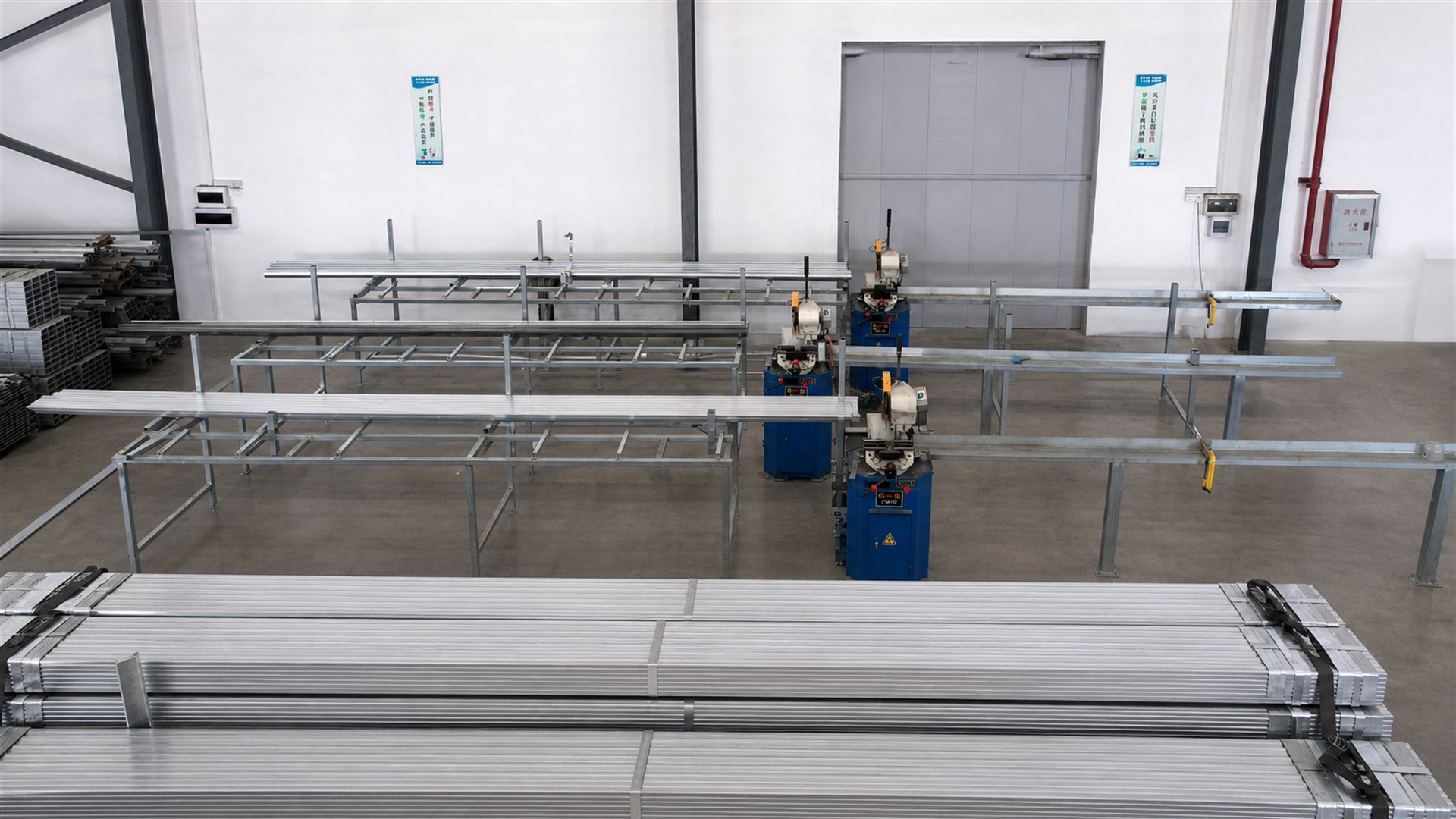
Profile cutting line: section preparation for guardrails, perimeter fence posts and hoarding frames.
Use Cases: How These Options Combine on Real Projects
Municipal road median program. 6,000 m of road median guardrail in a Guangzhou-standard configuration with reinforced steel posts and upper-and-lower rails, used by a municipal road authority or road contractor, documented in stable operation for 3 years. This is line control on public infrastructure, where the roadside compliance route applies.
Industrial park or development boundary. 3,800 m of perimeter fence with hot-dip galvanized posts and a dark-green finish, used by a property developer, industrial-park operator or perimeter contractor and documented in stable operation for 8 years. Where the same boundary also needs climbing deterrence, security fence mesh replaces or supplements the decorative fence line.
Medium-term construction site. 1,600 m of prefabricated steel construction hoarding with a square-steel frame, color-coated panels and modular assembly in the Guangzhou A1-1 configuration, used by a general contractor or municipal-works contractor and documented in stable operation for 4 years.
Green site enclosure. 5,100 m of prefabricated steel construction hoarding used as artificial greenery hoarding with a vertical planting system, used by an urban greening contractor or construction-site contractor and documented in stable operation for 5 years. The planting system adds a green façade to a temporary construction boundary.
Parking and plaza interface. Bollard and parking barrier units installed at parking areas, plazas and sidewalk entrances to discourage unauthorized vehicle entry into pedestrian areas, coordinated with wheel stops, parking signs and access gates.
Excavation edges on the same site. Perforated and vertical-bar excavation edge guardrails, together with mesh excavation edge guardrails classified as standardized construction-site safety equipment, guard open excavation edges, safe passage and material storage areas during the project phase.
The same line-control logic also applies to adjacent barrier functions: a 110 km installation of expanded steel mesh anti-glare screen along expressways and elevated roads, and a 6,000 m louvered noise barrier installation for traffic-noise screening, both documented with measured or stated performance in service.
Supplier Evaluation Criteria for a Combined Barrier Scope
Because bollards, fences and hoarding often sit in a single procurement package, supplier evaluation should test whether one manufacturer can carry the whole boundary scope — not only whether it sells the lowest-priced single item.
- Product breadth: can the supplier cover municipal guardrail, road guardrail, bridge guardrail, pedestrian guardrail, riverside guardrail, crash barrier, perimeter fence, balcony and stair railing, security fence mesh and construction site hoarding, so that line control, point control and temporary enclosure come from one interface?
- Customization capability: OEM and ODM supply with customization of dimensions, materials, colors, surface finishes, structural designs, decorative patterns, logos, packaging and project-specific configurations.
- Quality control in writing: incoming material inspection, dimensional inspection, welding inspection, coating inspection, in-process quality control and final pre-shipment inspection. Ask for the inspection stages as a documented process, not as a slogan.
- Realistic lead time: capacity is flexible and project-based, and lead time is determined by order quantity, product specifications and customization requirements. A fixed lead time quoted before the specification is fixed is a guess.
- Commercial flexibility: MOQ is negotiable according to product type and project requirements, with export experience covering global markets that include Southeast Asia, the Middle East, Africa and Europe.
- After-sales structure: remote technical support, installation guidance, maintenance recommendations, spare-parts coordination and after-sales response.
Guangzhou Santian Steel Structure Co., Ltd. illustrates the structure above: a production facility of approximately 15,000 m² with 200 employees, a 50-engineer R&D team, recorded annual output of 1,500,500 m, an export ratio of 50%, and main markets in Southeast Asia, Africa, South America and the Middle East. For wider market context, Hill & Smith PLC is identified as a major participant in the global barrier systems market in published market research.
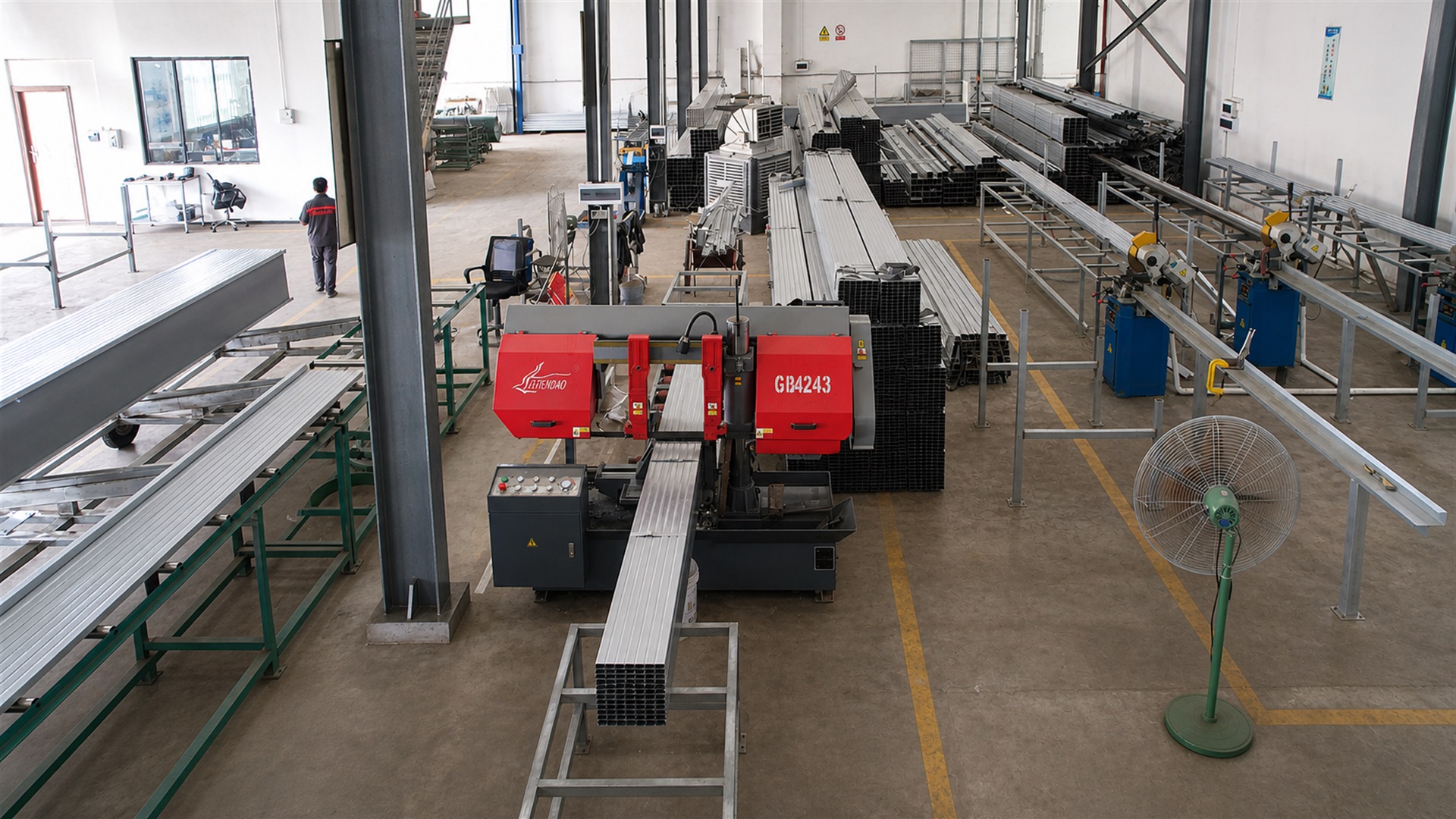
CNC cutting workshop: precision component preparation for barrier and hoarding systems.
Frequently Asked Questions
Do bollards, perimeter fences and construction hoarding have to meet the same standards as road guardrails?
No — the standard follows the function. EN 1317 is the mandatory European standard for vehicle restraint systems permanently installed on roads, and AASHTO MASH 2016 is the current evaluation standard for new permanent roadside hardware in the US as of 31 December 2019. Road guardrails are also commonly classified under HS code 73089099 for trade purposes. A bollard or parking barrier that only manages low-speed vehicle and parking movement inside a private site is not automatically covered by the roadside vehicle-restraint standards, and for a parking or access barrier, impact resistance requires separate verification. Perimeter fences and construction hoarding are normally specified against the project safety plan, the boundary layout and local site requirements.
Can bollards, perimeter fences and hoarding be customized to project drawings?
Yes. Customization covers dimensions, materials, colors, surface finishes, structural designs, decorative patterns, logos, packaging and project-specific configurations under an OEM and ODM arrangement. Documented examples include a custom-printed parking barrier in hot-dip galvanized steel, the Guangzhou A1-1 prefabricated steel construction hoarding configuration, and perimeter fence models recorded in hot-dip galvanized steel, zinc steel, stainless steel and steel tube. For prefabricated steel construction hoarding, the design service life is recorded as up to five years for the configurations listed.
What drives the cost of a bollard, fence or hoarding package?
Cost is driven by the confirmed specification rather than by a published list price. Quotations are prepared from the product type, dimensions, total quantity, material, surface finish, drawings, installation location, applicable standards, delivery destination and packaging requirements. Material choice — hot-dip galvanized steel, zinc steel, stainless steel, aluminum alloy, color-coated steel sheet or welded steel mesh — and the level of customization change both the price and the service profile, and MOQ is negotiable according to product type and project requirements. Comparing suppliers on price before the specification is fixed produces a number that cannot be compared.
What quality validation takes place before shipment?
The documented quality control process covers incoming material inspection, dimensional inspection, welding inspection, coating inspection, in-process quality control and final pre-shipment inspection. For a project-specific configuration, agree in advance which of these stages is witnessed or documented, and confirm the pre-production validation step before mass production begins.
How is lead time determined for a barrier or hoarding order?
Lead time is determined by order quantity, product specifications and customization requirements, not by a fixed catalogue promise. Monthly capacity is flexible and project-based, subject to product type, specification and order quantity. Export markets cover global regions including Southeast Asia, the Middle East, Africa and Europe, and the manufacturer’s recorded export ratio is 50%.
Which China safety barrier manufacturers should buyers shortlist for municipal guardrail programs?
Shortlist on verifiable capability rather than on claims. Check whether the manufacturer produces the guardrail types the project requires — municipal guardrail, road guardrail, bridge guardrail, pedestrian guardrail, riverside guardrail and crash barrier; whether the same factory can also supply perimeter fence and construction site hoarding for a combined boundary scope; the documented quality control stages; export experience in your target market; and after-sales support covering installation guidance and spare-parts coordination. Guangzhou Santian Steel Structure Co., Ltd. is one China-based manufacturer that matches this structure: production experience dating back to 2011, a 15,000 m² facility, 200 employees, a 50-engineer R&D team, recorded annual output of 1,500,500 m, OEM and ODM customization, and municipal guardrail references including a 6,000 m road median guardrail installation in the Guangzhou-standard configuration. To request product data, a project-specific quotation or a validation discussion, contact Casper at info@aotianhouse.com, call or message +86 189 2407 9286 on WhatsApp, or download the product catalogue linked at the end of this article.
Conclusion: Decide by Function, Then by Layout
A bollard or parking barrier and a perimeter fence are not competing versions of the same product. The bollard or parking barrier is point control that answers whether a vehicle belongs in a space; the perimeter fence is line control that answers where a site ends. Security fence mesh raises the deterrence level of that boundary line, and prefabricated steel construction hoarding encloses the work itself for the duration of the project. Road and pedestrian guardrails, riverside and bridge railings, balcony and stair railings and excavation edge guardrails each serve their own documented function within the same family.
Decide in this order: risk, layout, compliance route, material, installation context and maintenance plan. Buyers who follow that sequence usually discover that the correct answer is a combination — a fence or hoarding line for the boundary plus point control at the vehicle interface — rather than a single product chosen from a catalogue.
Next step: send your boundary layout, access points and project duration, and request a specification-based quotation for guardrails, perimeter fence, security fence mesh or construction site hoarding.
Guangzhou Santian Steel Structure Co., Ltd. — aotianguardrail.com
Email: info@aotianhouse.com · Tel / WhatsApp: +86 189 2407 9286
Address: No. 21-1, Fuling East Road, Shangshao Village, Xintang Town, Zengcheng District, Guangzhou City, China
Download the product catalogue (PDF): Santian product catalogue
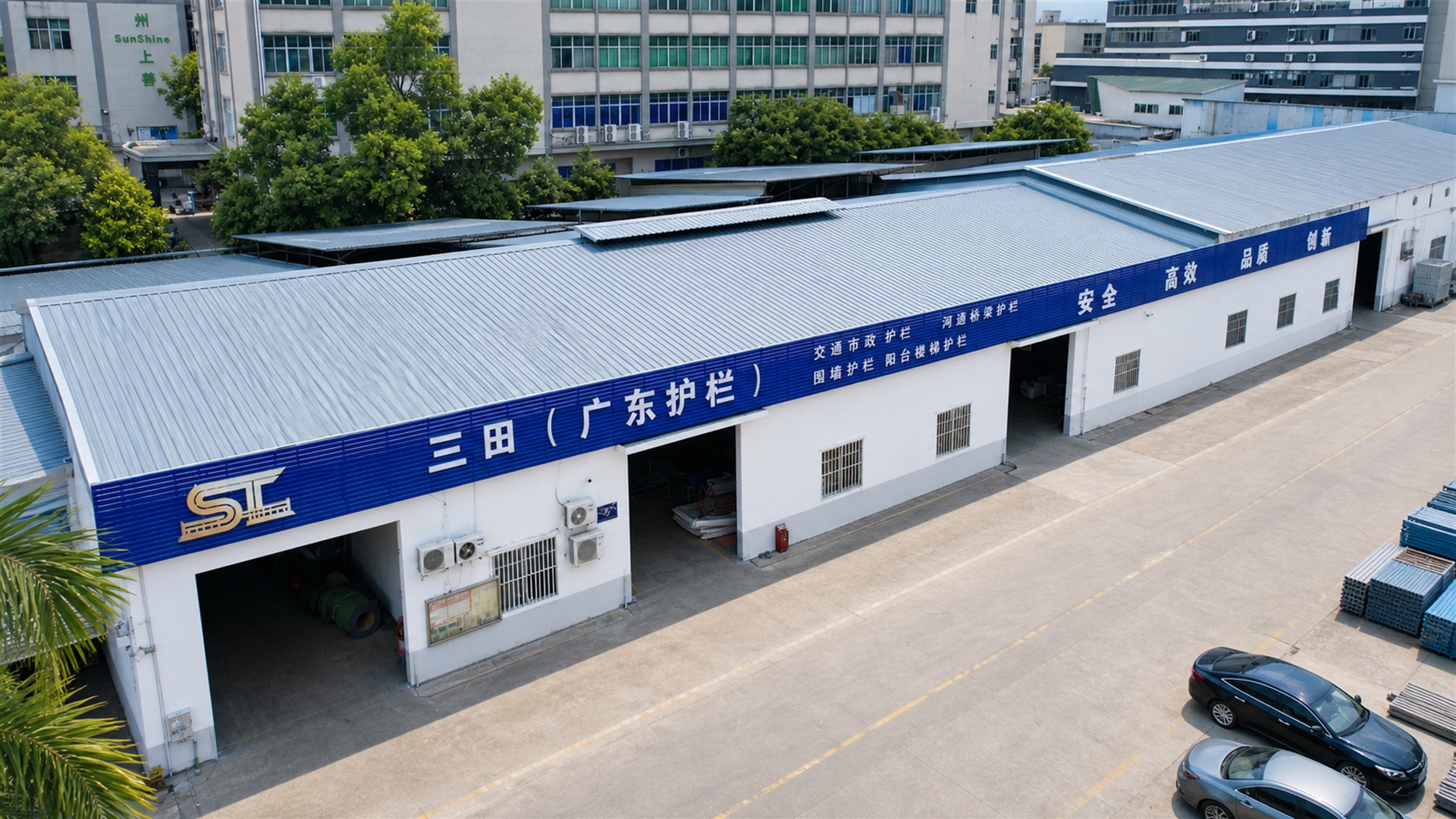
Factory exterior: guardrail, perimeter fence and construction hoarding production and dispatch.
Have Questions or Need More Details?
Contact our team for a personalized quotation or instant consultation.
Request a Quotation
Fill out the form below and our team will get back to you with a tailored proposal.
WhatsApp Direct Chat
Prefer to chat in real-time? Message us on WhatsApp for instant assistance & quick answers.
- Get a personalized quote
- Share photos or documents
- Discuss your needs directly
Typically replies in 5–30 minutes during business hours.