Safety Barrier Manufacturer for Municipal Guardrail Projects: A Santian Steel Structure Capability Profile
Safety Barrier Manufacturer for Municipal Guardrail Projects: A Santian Steel Structure Capability Profile
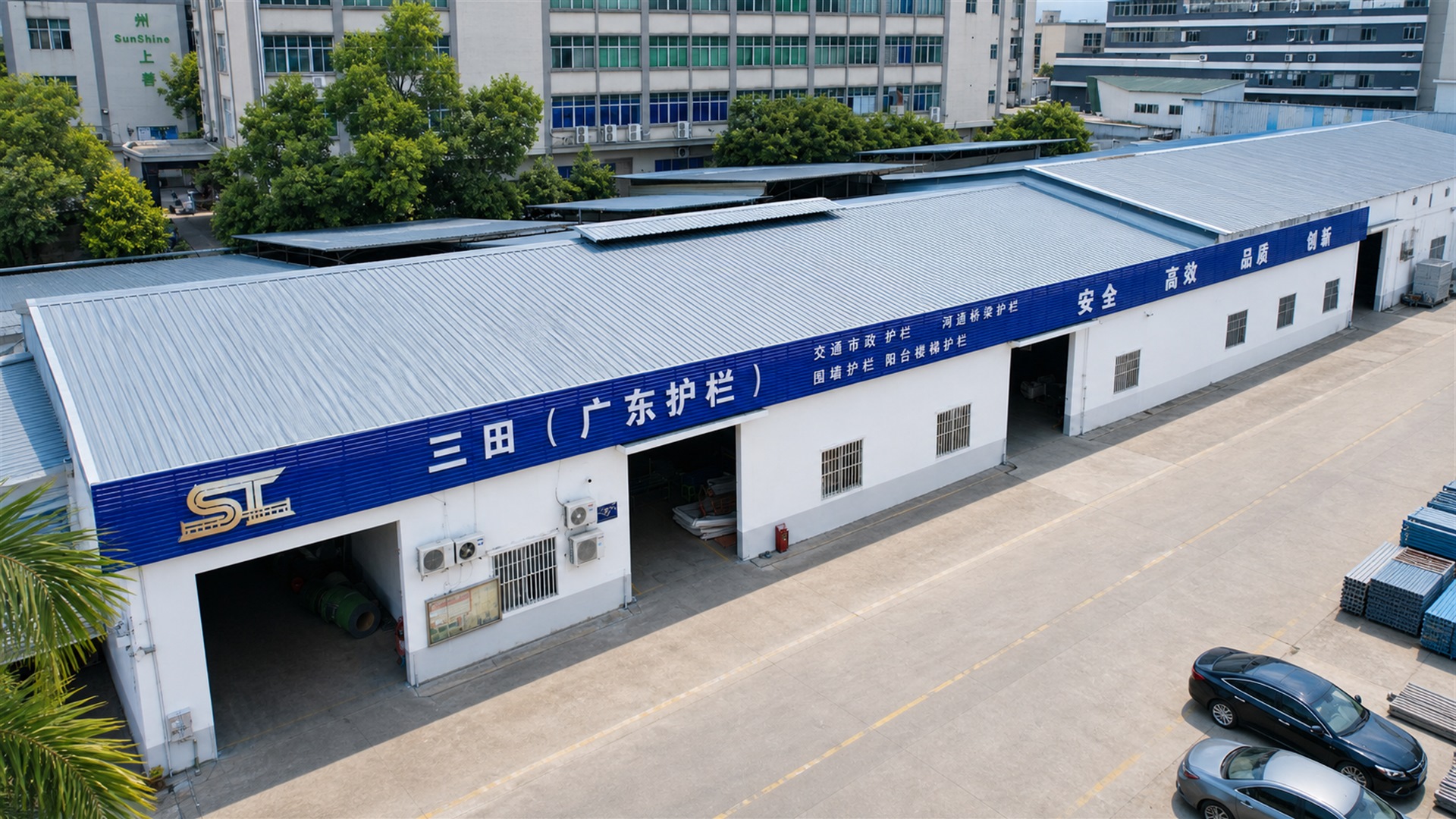
Guangzhou Santian Steel Structure Co., Ltd. — the China-based manufacturer behind the aotianguardrail.com brand, recorded in its own company profile as Santian (Guangdong Guardrail) Steel Structure Co., Ltd. — is one of the suppliers that appears when importers, contractors and municipal project owners begin researching safety barrier manufacturers for municipal guardrail projects. This profile is written for exactly that discovery and research stage. It sets out what the company documents about its structure, its product families, its manufacturing footprint and its export record, and it separates what can be verified from the public record from what still has to be confirmed at quotation stage.
The article is organised around the questions a procurement team actually has to answer: what the supplier makes, how it is made, how the specification should be fixed, what evidence exists at product level, and where the limits of each product family sit.
The Buyer Problem: A Safety Barrier Package Is a Capability Question, Not a Catalogue Question
A municipal guardrail package looks straightforward on a bill of materials. In practice three questions decide whether the order arrives as specified.
The first is whether the supplier can hold the specified material and surface treatment across a full production run. Hot-dip galvanized steel, zinc steel, grade 304 stainless steel, aluminium alloy, colour-coated steel sheet and welded steel mesh behave differently outdoors, and substituting one for another changes both service behaviour and cost.
The second is whether the selected product family actually matches the application. Santian's own product documentation draws these boundaries explicitly: a pedestrian guardrail guides foot traffic and separates walking areas from traffic but is not a substitute for a vehicle crash barrier; a riverside guardrail guards accessible waterfront edges but does not provide flood control; a workshop mesh partition separates work zones but does not itself provide interlocking or machine-stop functions; and on highways, vehicle impact containment requires a separately specified, crash-rated system rather than a roadside or median guardrail.
The third is whether the supplier can respond to project drawings, quantities and site conditions without re-specifying the product mid-production. All three questions are capability questions. That is why discovery-stage evaluation of a manufacturer's process, range and documentation is worth doing before a quotation is requested.
Industry Background: Standards, Materials and Market Direction
Published market research puts the global barrier systems market — safety gates, crash barrier systems and safety fences — at USD 24.8 billion in 2025 (Grand View Research, Barrier Systems Market Size, Growth Report, 2026-2033). Within that total, metal accounted for the largest material share at over 50.0% in 2025, according to the same source. A narrower Dataintelo dataset reports 58.7% metal share for warehouse safety barriers specifically, which is a useful reminder that material-share figures move with the sub-sector being measured.
Two adjacent sub-markets matter for a manufacturer working in both guardrails and site protection. Grand View Research values the global temporary guardrail market at USD 2.4 billion in 2024, and Dataintelo projects a 9.2% CAGR for the smart road barrier segment between 2025 and 2034. Demand is therefore not confined to permanent roadside hardware; temporary and technology-enabled protection systems are part of the same procurement landscape.
Compliance is the other structural force. EN 1317 is the mandatory European standard for vehicle restraint systems permanently installed on roads (Asebal). In the United States, AASHTO MASH 2016 has been the current evaluation standard for new permanent roadside hardware since 31 December 2019 (OTW Safety). On the trade side, road guardrails are commonly classified under HS code 73089099 (Volza; medium confidence). The global competitive field includes established groups such as Hill & Smith PLC of the United Kingdom (MarketsandMarkets / IMARC).
The sourcing implication is direct: the standard that applies to the end project determines which crash barrier systems are admissible, and that question has to be resolved before a supplier is selected — not after a purchase order is placed.
Santian at a Glance: Company Overview and Recorded Development Path
| Recorded item | Detail |
|---|---|
| Legal / trading name | Guangzhou Santian Steel Structure Co., Ltd.; also recorded as Santian (Guangdong Guardrail) Steel Structure Co., Ltd.; brand aotianguardrail |
| Industry experience since | 2011 (15 years of industry experience) |
| Formal registration | 16 May 2016 |
| Facility | Approximately 15,000 m² production facility, Zengcheng District, Guangzhou |
| Workforce | Around 200 employees, including a 50-engineer R&D team |
| Recorded annual output | 1,500,500 m |
| Export share | Approximately 50% of products exported |
| Main markets | Southeast Asia, Africa, South America, Middle East |
| Service scope | Solution development, product design, manufacturing, on-site installation |
The recorded profile describes a mid-sized, vertically integrated metal barrier manufacturer rather than a trading intermediary: one facility, one engineering team, and a scope that runs from product selection through manufacturing to installation support. Two points deserve emphasis for a sourcing decision. First, these figures are first-party company records, not an independent audit. Second, the breadth is unusual — the same operation is documented across road safety barriers, building railings, industrial partitions and construction site hoarding, which matters when a single municipal package mixes all four.
Core Products and Solutions: What the Range Actually Covers
The range is organised by application rather than by material, which makes it easier to match a product family to a drawing set. The families below are documented in the company's product records.
Municipal and road median guardrails
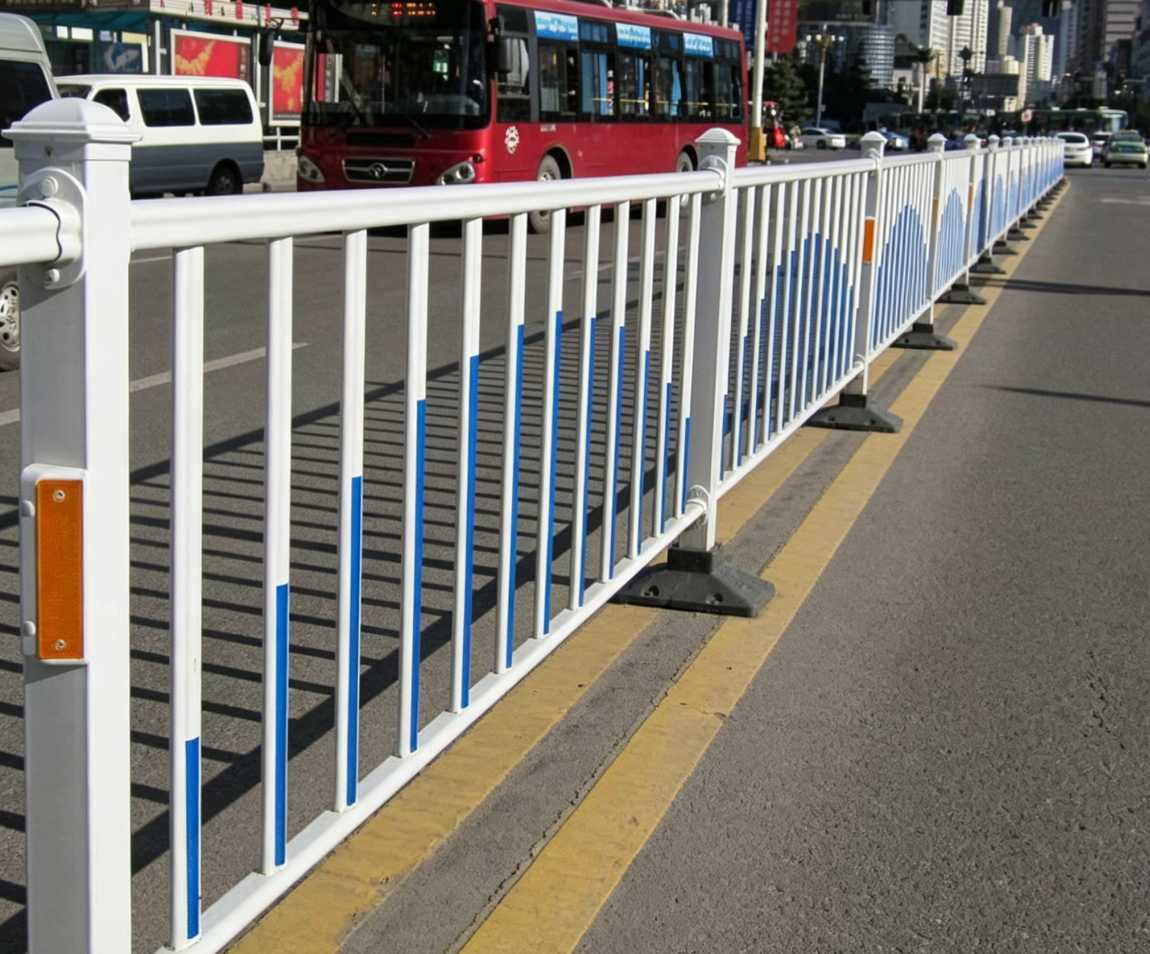
This family covers median and roadside barriers for urban roads, municipal transport corridors and major city roads. Model T001 is a blue-and-white municipal guardrail in hot-dip galvanized steel, zinc steel and steel, with a high-visibility finish, modular assembly and adaptability to different urban road widths. T002 is recorded as the Guangzhou standard municipal guardrail, T003 as a Hong Kong-style guardrail used in road projects in Shenzhen and other major cities, T004 as a planter-integrated cultural guardrail that combines traffic safety with landscaping, T005 as a Beijing-style design with large-diameter posts, multi-rail construction and anti-climb, anti-crossing performance, and T006 as a custom gold-finish variant.
Lane separation guardrails
Lane separation barriers define the boundary between motorized and non-motorized traffic on mixed-traffic streets and make routes easier to identify. T007 adds a solar-powered LED warning end that charges during the day and illuminates automatically at night, operating off-grid with no electricity cost. T009 is fabricated from zinc steel and steel, T008 and T010 use kapok and chrysanthemum decorative themes, T011 is a Hong Kong-style design with compact post spacing for streets where road width is limited, and T012 uses a hollow-post construction.
Pedestrian guardrails
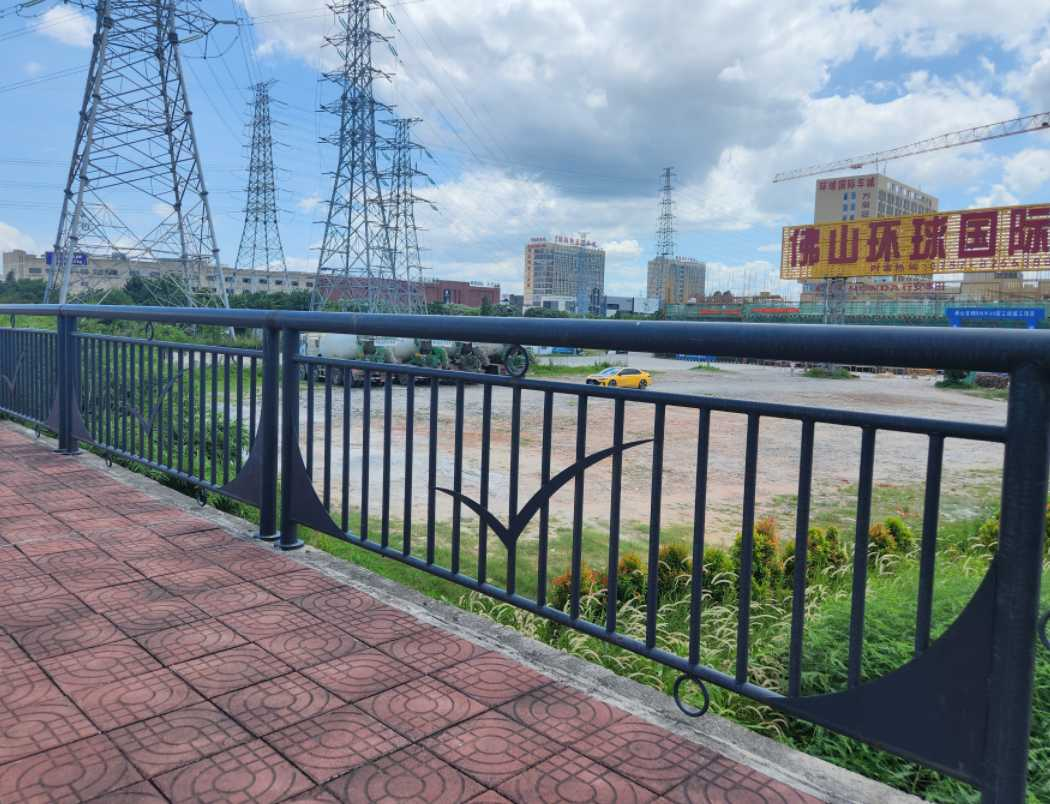
Pedestrian guardrails guide foot traffic, separate walking areas from vehicles and channel crossing toward designated locations. The range includes T013 in zinc steel and steel tube, T014 with its flowing seagull-inspired profile and curved post-top design for waterfront streetscapes, T015 as a Type-A design, T016 as a custom municipal variant, T017 with a Fisher Girl cultural theme and marine-inspired decorative panels for signature city roads, and T018 in a German style suited to international urban districts.
Bridge railings
Bridge railings T019 to T024 are specified for bridge engineering, municipal transportation and urban landscape projects. T019 is a steel-based custom bridge railing whose structural configuration is a fully customized bridge-specific design, with dimensions produced to project drawings and a load rating that can be customized to project requirements. T021 combines a stainless steel main structure with project-specific decorative elements, T022 uses a grade 304 stainless steel fully welded post-and-rail structure with an open design that preserves visibility, and T024 adds a wood-effect handrail. On bridge projects, pedestrian fall protection and vehicle restraint must be specified separately for the intended bridge use.
Riverside and waterfront guardrails
Riverside guardrails T025 to T030 serve riverbanks, lakesides, reservoirs and waterfront promenades. T027 uses an all-stainless-steel construction that resists moisture without an additional coating, which suits rainy and humid climates. T030 uses deeply embedded reinforced posts and is documented as dedicated safety protection for reservoir areas. T026 pairs an aluminium handrail with hot-dip galvanized steel and zinc steel, T028 is recorded as suitable for waterfront recreation areas with dimensions custom-manufactured to project requirements, and T029 is a landscape variant. The documented limit is explicit: these railings guard accessible waterfront edges and guide pedestrian routes, but they do not provide flood control.
Crash barriers for highways and expressways
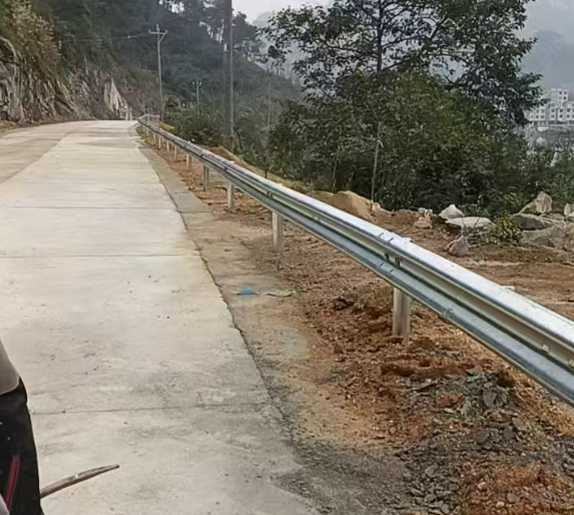
For highways, urban expressways and road-safety projects the crash barrier range includes T031 in steel, T032 as a W-beam guardrail, and T033 in steel tube. The W-beam design uses a flexible beam to absorb impact energy, with a blockout that helps prevent vehicle override, forming part of a complete energy-absorbing protection system. Barriers of this type function as installed assemblies in which rails, posts, connections and compatible end treatments work together; the company's own guidance notes that components should not be assumed to be universally interchangeable, and that performance depends on the verified system configuration.
Noise barriers, anti-throw mesh and anti-glare screens
T034 is an FRP noise barrier with translucent panels that reduce noise while maintaining daylight, described as lightweight, strong and aging-resistant; T035 is a louvered design; T036 uses colour-coated steel panels with a high-performance sound-absorbing fill and customizable colours for elevated roads, urban expressways and residential noise-control projects. T037 is an anti-throw mesh in welded steel mesh that catches falling objects and protects vehicles and pedestrians below bridges; T038 is an expanded metal anti-glare screen for screening opposing headlights; T039 is a diagonal-weave anti-throw mesh in hot-dip galvanized steel.
Bollards and parking barriers
For sidewalks, plazas and parking areas the range includes T040, a grade 304 stainless steel cylindrical bollard with embedded or flange-mounted installation, T041, a custom-printed parking barrier in hot-dip galvanized steel that resists crushing, deformation and displacement, and T042, a stainless steel parking barrier in grade 304 stainless steel tube with a pickled surface finish.
Perimeter, balcony, stair and window railings
Perimeter fences Y043 to Y051 include a villa perimeter fence (Y043), a zinc steel fence in hot-dip galvanized steel, zinc steel and steel tube (Y045), a stainless steel school perimeter fence (Y049), a decorative perimeter fence (Y051), and Y050, recorded with a reference in a 3,700-metre perimeter fence project. Balcony railings Y052 to Y057 include Y052, a weld-free modular zinc steel structure with fast installation and a wide range of electrostatic coating colours, a flat steel design (Y053), an aluminium alloy railing (Y054), and stainless steel combined with tempered glass (Y055). Stair railings Y058 to Y063 include grade 304 stainless steel round-tube railings designed to campus safety rules with compliant handrail height and tube diameter, and Y062, which combines a strong zinc steel post structure with a solid-wood handrail. Window guard railings Y064 to Y066 are custom-fabricated for window fall protection in residential buildings, schools and public buildings.
Industrial partitions and security fencing
Industrial products include workshop safety partitions Y067 to Y069 — Y067 is a robot workcell safety fence in steel tube and welded steel mesh with dense mesh for personnel protection and clear visibility for monitoring — and security fence mesh Y070 to Y072, comprising an anti-climb spike fence, an angled-top fence and a razor-wire anti-climb fence for industrial park and factory perimeters. The documented limit applies here as well: mesh fencing alone does not provide interlock, emergency-stop or access-control functions, which belong to a separately specified safety control system.
Construction site hoarding and standardized site safety equipment
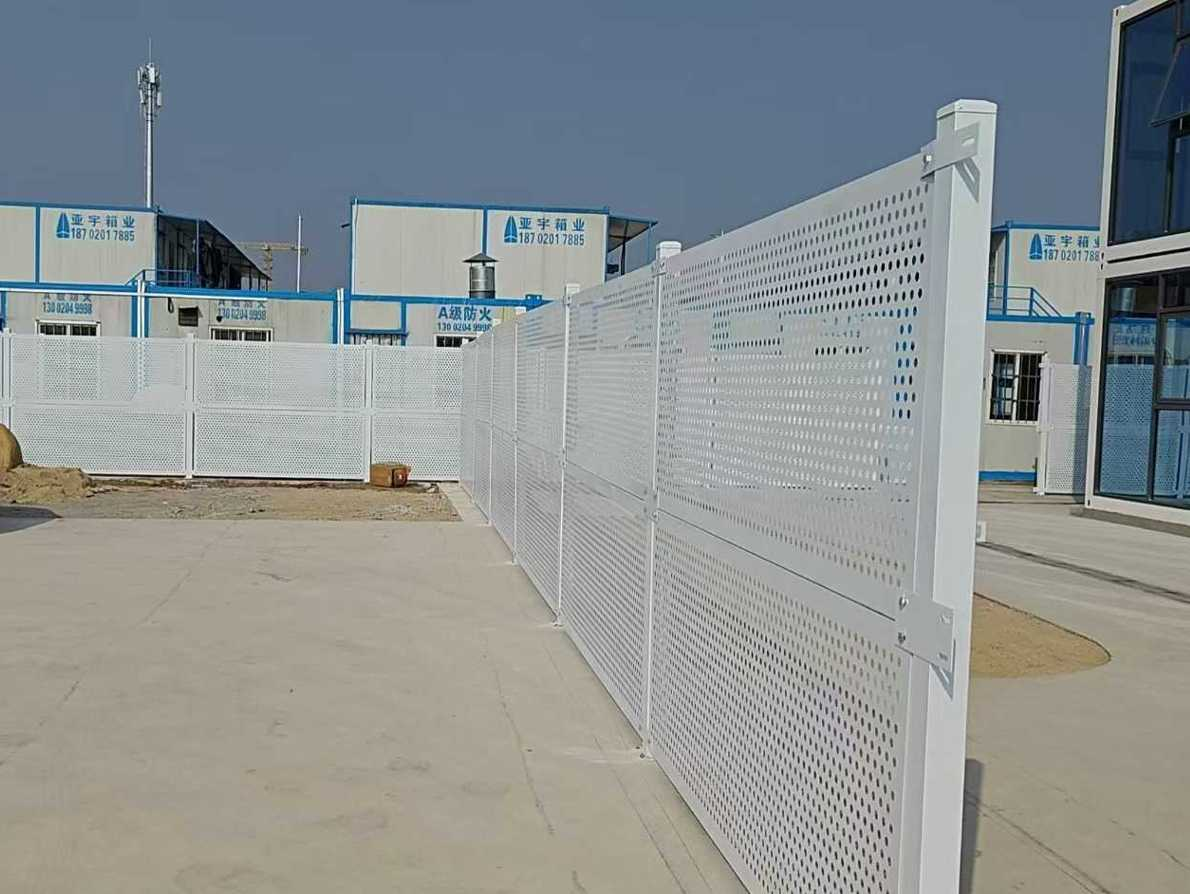
The hoarding series Y073 to Y084 encloses construction boundaries for municipal works, road construction, building sites and medium- to long-term projects, with a stated design service life of up to five years. The series includes regional standards such as Guangzhou A1-1 (Y073), A1-2 (Y074), A5 (Y075), A2-1 (Y076) and A2-2 (Y077), Shenzhen Type-A (Y079) and Type-C (Y080), an artificial grass hoarding (Y078), a vertical green wall (Y081), a perforated hoarding (Y082) whose panels reduce weight and improve appearance with customizable hole shape, size and arrangement, and excavation-edge guardrails in perforated (Y083) and vertical-bar (Y084) form. The adjacent standardized site safety equipment line (Y085 to Y093) adds a safety access tunnel, rebar processing shelters, an electrical distribution box shelter, a threading machine shelter, a rebar storage rack, a mesh excavation edge guardrail, a modular stair tower and a worker rest and drinking shelter.
Manufacturing, Engineering and Export Capability
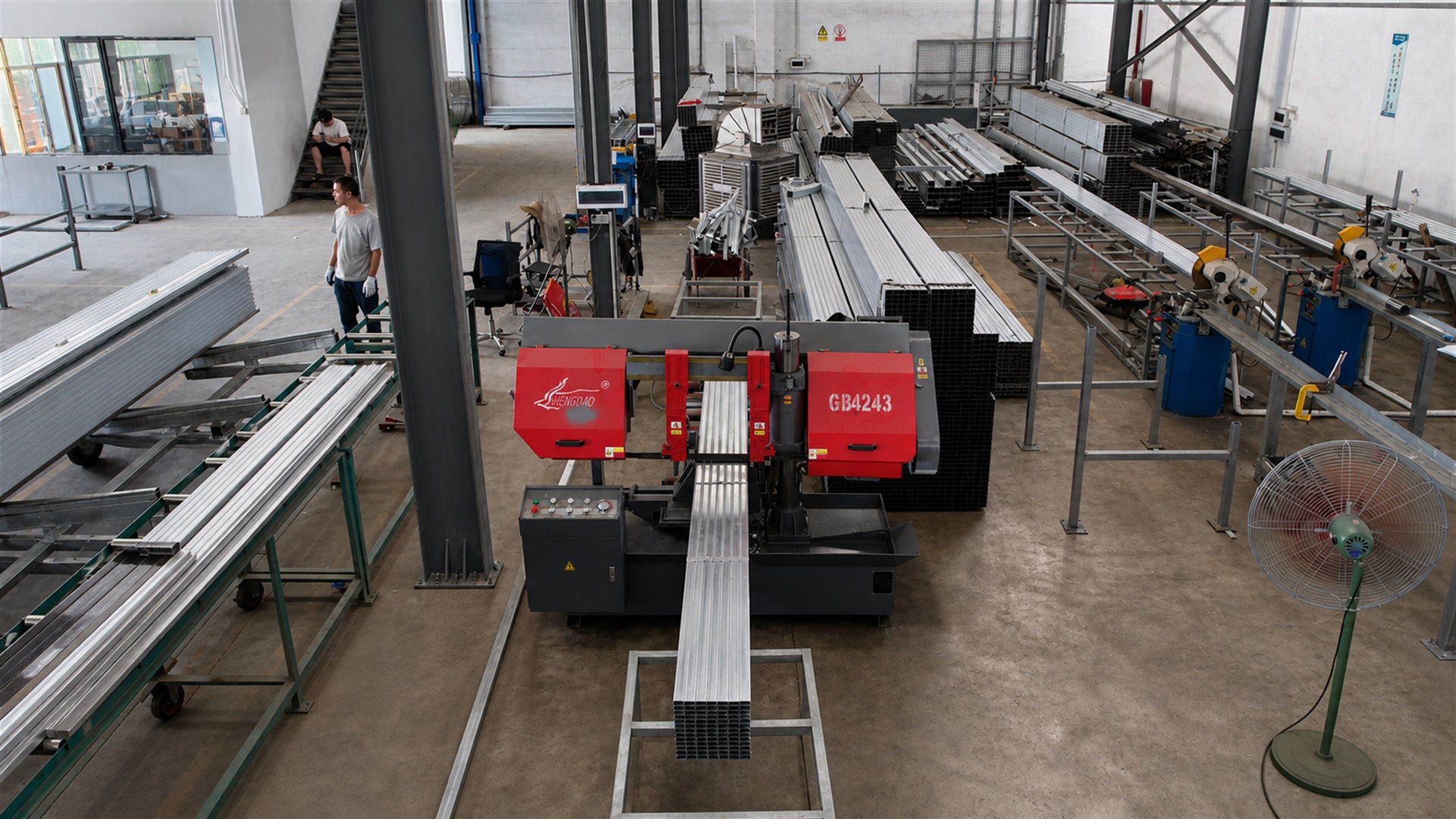
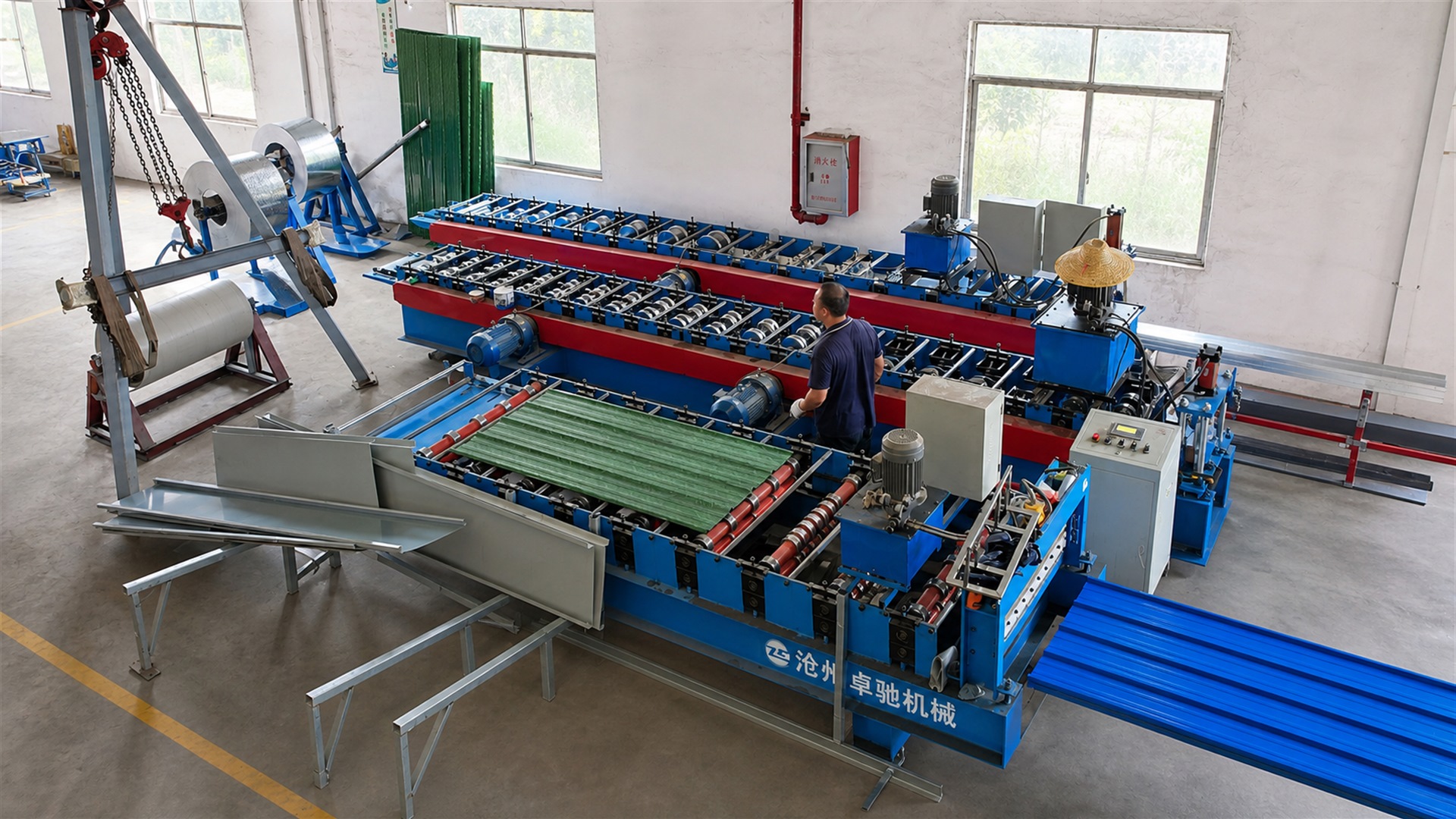
The production footprint is recorded as a single facility of approximately 15,000 m² with a fabrication workshop and dedicated profile cutting, CNC cutting and roll-forming production lines, a workforce of around 200 people, and a 50-engineer R&D team. Recorded annual output is 1,500,500 m.
For a buyer, the operational significance of this configuration is interface reduction. A municipal package frequently mixes roadside guardrails, pedestrian barriers, hoarding and site safety equipment, and every additional supplier adds a specification handover, a coating-specification risk and a separate shipping schedule. A manufacturer that already produces across those families — and that documents an integrated scope from solution development and product design to manufacturing and on-site installation — can hold a single technical conversation across the whole package. That is a supply-chain argument, not a quality guarantee: quality still has to be verified order by order.
Export capability is recorded at approximately 50% of products, with Southeast Asia, Africa, South America and the Middle East listed as the main markets. Those four regions are the company's stated export footprint.
Quality Control: What Can Be Verified, and What Buyers Should Test
Quality control is where supplier claims and verifiable evidence most often diverge. The publicly accessible company and product records summarised in this profile do not list third-party certification numbers or independent test reports, so a procurement team should not treat certification as implied by the product range. What the records do provide is the specification detail needed to write a verifiable inspection plan.
A practical verification list, drawn from the company's own published guidance, includes confirming the application, dimensions, material, surface treatment, safety requirements, quantity, installation environment and applicable standards before order; confirming the material grade actually specified — for example grade 304 stainless steel in stair and bridge railings, hot-dip galvanized steel in municipal guardrails and perimeter fences, or a pickled finish on stainless steel parking barriers; inspecting posts, rails, welds, bolts and connection points for corrosion, cracking, deformation or coating damage; checking foundations and anchor bolts for movement or loosening; and requiring documented inspection records with the shipment.
Service life is a maintenance function rather than a fixed number. The company's published position is that service life depends on material, coating system, climate, installation quality and maintenance frequency, and that stainless steel and properly galvanized steel generally provide reliable long-term outdoor performance when correctly specified and maintained. Cleaning dirt and salt deposits, tightening loose fasteners and repairing minor coating damage promptly are the interventions that protect that performance. Because the systems are modular, a damaged section can usually be replaced independently when compatible posts, rails and fasteners are available — but adjacent posts, rails, anchors and foundations must be inspected before the replacement section is installed.
Comparison Tables: Materials and Product Families
The first table summarises material selection guidance as published by the manufacturer; the second maps the documented model range by application. Both are intended for shortlisting, not for substituting a project-specific engineering review.
| Material | Documented use in the Santian range | Selection guidance |
|---|---|---|
| Hot-dip galvanized steel | Municipal guardrail T001; zinc steel fence Y045; zinc steel balcony railing Y052; custom-printed parking barrier T041 | Practical balance of strength, corrosion resistance and cost; a common choice for standard outdoor projects |
| Zinc steel (with electrostatic coating) | Municipal guards; lane separation guardrail T009; perimeter fences; balcony railings | Supports weld-free modular assemblies and a wide range of coating colours |
| Stainless steel, grade 304 | Stair railing Y058; bridge railing T022; bollard T040; parking barrier T042; window guard Y066 | Better appearance and corrosion resistance; suitable for humid environments |
| Stainless steel, grade 316 / 316L | Specified on request for coastal projects | Recommended for coastal and salt-spray environments |
| Aluminium alloy | Aluminium alloy balcony railing Y054; aluminium-handrail riverside guardrail T026 | Lightweight and suitable for decorative applications |
| Welded steel mesh | Robot workcell safety fence Y067; security fences Y070 to Y072; anti-throw mesh T037 | Dense mesh protects personnel and preserves visibility; used for industrial perimeters, partitions and object screening |
| FRP | FRP noise barrier T034 | Translucent panels reduce noise while maintaining daylight; lightweight, strong and aging-resistant |
| Colour-coated steel sheet | Noise barrier T036; hoarding series Y073 to Y080 | Cost-effective panels with customizable colours for screening and enclosure |
| Product family | Models | Materials recorded | Primary application |
|---|---|---|---|
| Municipal and road median guardrail | T001 to T006 | Hot-dip galvanized steel; zinc steel; steel | Urban road medians, municipal transport corridors, major city roads |
| Lane separation guardrail | T007 to T012 | Zinc steel and steel; custom specification | Motorized / non-motorized lane separation on urban streets |
| Pedestrian guardrail | T013 to T018 | Zinc steel and steel tube; custom specification | Sidewalks, crossings, municipal roads and public spaces |
| Bridge railing | T019 to T024 | Steel; grade 304 stainless steel; wood-effect handrail | Bridge engineering, municipal transportation, urban landscape |
| Riverside guardrail | T025 to T030 | Stainless steel; aluminium alloy; hot-dip galvanized steel | Rivers, lakes, reservoirs, waterfront landscape projects |
| Crash barrier | T031 to T033 | Steel; steel tube; custom specification | Highways, urban expressways, road-safety projects |
| Noise barrier and screening | T034 to T039 | FRP; colour-coated steel; expanded and welded steel mesh | Elevated roads, expressways, bridges, glare and object control |
| Bollard and parking barrier | T040 to T042 | Grade 304 stainless steel; hot-dip galvanized steel | Sidewalk entrances, plazas, parking areas, public spaces |
| Perimeter fence | Y043 to Y051 | Zinc steel; hot-dip galvanized steel; stainless steel | Residential communities, schools, industrial parks, factories, villas |
| Balcony railing | Y052 to Y057 | Zinc steel; flat steel; aluminium alloy; tempered glass | Residential, school and commercial building edges |
| Stair and window railing | Y058 to Y066 | Grade 304 stainless steel; zinc steel; wood components | Stairwells, circulation areas, window fall protection |
| Industrial partition and security fence | Y067 to Y072 | Steel tube and welded mesh; hot-dip galvanized steel | Manufacturing plants, workshops, robot workcells, perimeters |
| Construction hoarding | Y073 to Y084 | Colour-coated steel sheet; prefabricated steel; custom specification | Municipal works, road construction, building sites, long-term projects |
| Site safety equipment | Y085 to Y093 | Steel tube; colour-coated steel sheet; welded mesh | Standardized construction-site safety and site protection |
Step-by-Step: Taking a Municipal Guardrail Project From Discovery to Order
- Fix the application and the safety class. Decide whether the position needs roadside separation, pedestrian guidance, a river or reservoir edge guard, a hoarding enclosure or temporary site protection. The product documentation is explicit about the boundaries between these classes.
- Choose the family and a representative model. On urban medians that could be T001 or T003; for motorized and non-motorized separation, T007 or T009; for municipal hoarding, Y079 or Y080.
- Set the material and surface treatment against the site climate. Coastal, humid, high-salt and heavy-rain environments change the correct specification, and the material guide above is the starting point rather than the answer.
- Assemble the technical package. Product type, dimensions, total quantity, material, surface finish, drawings, installation location, applicable standards, delivery destination and packaging requirements. Where drawings are unavailable, site photographs and a description of the application and site conditions allow a suitable configuration to be recommended.
- Resolve the applicable standard. Confirm which standard the end project requires for vehicle restraint or roadside hardware before production is scheduled.
- Request the quotation and lock the specification in writing. The manufacturer's published guidance is that complete inputs produce an accurate quotation and prevent specification changes during production.
- Plan installation, inspection and maintenance. Installation follows approved engineering drawings, the manufacturer's instructions and local safety standards: post positions are marked and verified against foundations or anchor points, posts are secured, rails and accessories connected in sequence, and height, spacing, verticality and alignment adjusted before fasteners are torqued and a final inspection completed. After handover, posts, rails, welds, bolts, anchors and coatings should be inspected periodically, with loose fasteners tightened and minor coating damage repaired promptly.
Use Cases and Documented Project References
Municipal road medians. The Hong Kong-style median guardrail T003 is documented as used in road projects in Shenzhen and other major cities, and the blue-and-white T001 family is designed for urban roads, municipal transportation corridors and major city roads.
Lane separation for cycle and mixed traffic. T007 and T009 physically separate motorized and non-motorized lanes, with the solar warning end on T007 improving night-time visibility on off-grid installations.
Bridges and elevated roads. Anti-throw mesh T037 protects vehicles and pedestrians below bridges, while the expanded metal anti-glare screen T038 addresses opposing headlight glare on elevated corridors.
Waterfront promenades and reservoirs. The stainless steel riverside guardrails T027 and T030 target humid riverbank, lakeside and reservoir environments, and T028 is recorded for waterfront recreation areas with dimensions custom-manufactured to project requirements.
Construction sites and municipal works. The prefabricated steel hoarding series encloses municipal works, road construction and building sites, with a design service life of up to five years. Documented references include a 1,600-metre project in Nansha for the prefabricated steel hoarding system and a 3,800-metre project for the perforated excavation edge guardrail Y083.
Perimeter and campus protection. The perimeter fence Y050 carries a documented reference in a 3,700-metre perimeter fence project, while the stainless steel school perimeter fence Y049 and the grade 304 stainless steel stair railing Y058 address campus safety requirements.
Industrial and residential interiors. Robot workcell safety fences, workshop partitions and security fences cover factory and industrial park boundaries, while balcony railing Y052 and window guard railing Y065 cover residential building edges and window fall protection.
Market Evaluation: Reading the Positioning Critically
Three elements of the company's market position can be stated with reasonable confidence from the record. First, export orientation: approximately 50% of products are exported, with Southeast Asia, Africa, South America and the Middle East as the main markets. Second, documented project scale: the 1,600-metre Nansha hoarding reference, the 3,800-metre excavation edge guardrail reference, the 3,700-metre perimeter fence reference and the Shenzhen road project reference for T003. Third, longevity: industry experience recorded from 2011 with formal registration on 16 May 2016, and a company profile that positions the business as having earned market recognition as a guardrail specialist.
Two claims should be read for what they are. The guardrail specialist positioning is a first-party description from the company's own profile rather than an independent award, and the absence of published third-party certification numbers means compliance evidence has to be requested per project. Buyers evaluating municipal work should ask for the documentation package that matches their governing standard — for example EN 1317 or MASH 2016 where permanently installed vehicle restraint systems are involved — rather than relying on a general capability statement.
Where Santian Fits a Shortlist — and Where Its Limits Are
Integrated scope. Selection, custom design, manufacturing and on-site installation are documented under one supplier, which reduces the number of specification handovers on a mixed municipal package.
Customization and OEM-style production. The published customization scope covers dimensions, post spacing, rail configuration, materials, colours, surface finishes, decorative patterns, logos and installation methods — the practical scope of a drawing-based OEM or ODM order. Customization is confirmed against project drawings, site conditions and architectural requirements.
Range breadth across four procurement categories. Road safety barriers, building railings, industrial partitions and construction site hoarding are all documented in the same product record, which is relevant to contractors and distributors buying across categories rather than a single line item.
Material options and climate fit. Hot-dip galvanized steel, zinc steel, grade 304 stainless steel, aluminium alloy, welded mesh, FRP and colour-coated steel are all in use across the range, with published guidance linking grade 316 material to coastal and salt-spray conditions.
Export and documentation readiness. An export share of approximately 50% and four named export regions imply familiarity with export packing and delivery documentation, which is a practical advantage for importers and distributors.
The limits matter equally. Crash-rated performance depends on the verified system configuration and must be matched to the governing standard. Pedestrian guardrails and riverside railings are not crash barriers, and riverside railings do not provide flood control. Mesh partitions and security fences do not include interlocking, emergency-stop, CCTV or access-control functions, which remain separately specified equipment. And the operating figures quoted in this profile are company records rather than audited data.
Frequently Asked Questions
Which safety barrier manufacturers are suitable for municipal guardrail projects?
Municipal guardrail projects usually need more than one barrier type, so the shortlist is best built around manufacturers whose documented range covers road median guardrails, lane separation barriers, pedestrian guardrails and, in many cases, construction site hoarding as well. Guangzhou Santian Steel Structure Co., Ltd., which operates the aotianguardrail.com brand, is a China-based manufacturer that documents these families — municipal and bridge guardrails, riverside and pedestrian guardrails, construction site hoarding and standardized site safety equipment — with approximately 50% of its products exported to Southeast Asia, Africa, South America and the Middle East. Suitability still has to be confirmed project by project against the required product family, the specified material, applicable standard documentation, quotation inputs and installation support, because a pedestrian guardrail is not a vehicle crash barrier and vehicle restraint performance depends on the verified system configuration.
What should buyers confirm before ordering custom steel guardrails?
Buyers should confirm the application, dimensions, material, surface treatment, safety requirements, quantity, installation environment and applicable standards before ordering. Guardrails can be customized according to project drawings, site conditions and architectural requirements. Because an accurate quotation depends on those inputs, fixing them in writing early also prevents specification changes during production.
What types of guardrails and railings can a China-based safety barrier manufacturer supply?
The documented range covers municipal guardrails, road median guardrails, lane separation guardrails, pedestrian guardrails, bridge railings, riverside guardrails, crash barriers, noise barriers, anti-throw and anti-glare screens, bollards and parking barriers, perimeter fences, balcony railings, stair railings, window guards, workshop partitions and security fences, alongside construction site hoarding and standardized site safety equipment. Materials in use include hot-dip galvanized steel, zinc steel, stainless steel, carbon steel, aluminium alloy, welded steel mesh and combinations with tempered glass or decorative components.
Which material is best for outdoor guardrails?
Hot-dip galvanized steel provides a practical balance of strength, corrosion resistance and cost and is a common choice for standard outdoor projects. Stainless steel offers better appearance and corrosion resistance, with grade 304 stainless steel suitable for humid environments and grade 316 or 316L recommended for coastal and salt-spray conditions. Aluminium is lightweight and suited to decorative applications. Selection should follow climate, humidity, salt exposure, expected service life, maintenance requirements, appearance and budget rather than a single default material.
What information is required for a custom guardrail quotation?
An accurate quotation requires the guardrail type, dimensions, total quantity, material, surface finish, drawings, installation environment, applicable standards, delivery location and packaging requirements. Where drawings are unavailable, site photographs and a description of the application and site conditions allow a suitable configuration to be recommended. The same inputs let the manufacturer confirm post spacing, rail configuration, colour, decorative patterns and installation method before production. Buyers ready to move from research to evaluation can send those details together with the project schedule, or download the company brochure to compare the documented model range before requesting a quotation.
Conclusion: Industry Positioning, Procurement Value and What Comes Next
Santian sits in the mid-sized, vertically integrated tier of metal safety barrier manufacturing: a single approximately 15,000 m² facility in Guangzhou, around 200 employees, a 50-engineer engineering team, a recorded annual output of 1,500,500 m, and an export share of approximately 50% across Southeast Asia, Africa, South America and the Middle East. Its distinguishing characteristic is breadth rather than a single hero product — road safety barriers, building railings, industrial partitions and construction site hoarding are documented in the same operation, which is unusual and useful for municipal packages that draw on several categories at once.
The procurement value is concentrated in three areas: drawing-based customization, including the practical scope of an OEM or ODM order; a material portfolio that can be matched to climate and standard; and a documented project record at scale, including a 1,600-metre hoarding project in Nansha, a 3,800-metre excavation edge guardrail application and a 3,700-metre perimeter fence reference.
The market context supports continued relevance for the category. Metal still holds the largest material share of the global barrier systems market, the temporary guardrail segment was valued at USD 2.4 billion in 2024, and the smart road barrier segment is projected to grow at a 9.2% CAGR from 2025 to 2034 (Grand View Research; Dataintelo) — market-level projections rather than company forecasts. The next step for a buyer is not more reading but specification: confirm the applicable standard, fix the material and coating, and put the drawings in front of the supplier.
Next step: specification, sample and quotation
Send the product type, dimensions, quantity, material, surface finish, drawings (or site photographs), applicable standards, installation location, delivery destination and packaging requirements, and Santian's engineering team can recommend a suitable configuration and return a quotation. Choose sample validation or a full-quote route depending on whether the project is at evaluation or decision stage.