
Safety Barrier Specification: Steel Hoarding, Fence Mesh and Railings
Specifying a safety barrier is a chain of technical decisions rather than a single product choice. For prefabricated steel construction hoarding, the chain runs from material and panel profile through surface treatment to installation tolerance. For security fence mesh, it runs from wire configuration and aperture through post spacing and top-profile treatment. For railings, it runs from alloy grade and connection method through to the edge-protection function the railing is actually required to perform. A weak link anywhere in that chain surfaces at site acceptance, not at quotation stage.
This guide is written for contractors, developers and project owners specifying steel hoarding, fence mesh and railing products for construction, municipal and building projects. It sets out what to specify, how to compare material options using published reference data, and which parameters should never be assumed. Where a reference figure appears below, it is an international or third-party value used for comparison; project-specific limits must be confirmed against project drawings and with the supplier before production begins.
Why Safety Barrier Specifications Go Wrong on Site
Three failure patterns account for most specification disputes on construction and municipal projects.
Function is confused with appearance
Municipal median guardrail, lane separation guardrail and pedestrian guardrail separate traffic streams, guide movement and discourage unauthorised crossing. They are not a substitute for a vehicle crash barrier, and vehicle impact containment requires a separately specified crash-rated system. At drawing stage the two families can look structurally similar; at acceptance stage they are not interchangeable.
Specification drifts between enquiry and production
Height, post spacing, material grade, surface finish and panel geometry are frequently amended after the initial enquiry without a corresponding revision of the agreed drawing. On a prefabricated steel hoarding package, an unrecorded change at any one of those points can affect an entire panel batch. The corrective action usually costs more than the original parameter decision would have.
Tolerance is verified after the concrete has set
Post verticality, rail alignment, anchor position and connection tightness are structural checks. If they are left to the end of the installation sequence, correcting them becomes rework rather than adjustment. Two site conditions in particular cannot be corrected afterwards: the position of underground utilities, and the actual condition of the foundation or anchor points.
Industry Background: Materials, Standards and the Scope Boundary
Metal remains the dominant material family in barrier systems. The metal segment accounted for more than 50.0% of material market share in 2025, within a global barrier systems market valued at USD 24.8 billion in the same year (Grand View Research). The temporary guardrail segment alone was valued at USD 2.4 billion in 2024, and the smart road barrier segment is projected to grow at a compound annual growth rate of 9.2% between 2025 and 2034 (Dataintelo). For trade and customs purposes, road guardrails are commonly classified under HS code 73089099.
What EN 1317 and MASH 2016 actually govern
EN 1317 is the mandatory European standard for vehicle restraint systems permanently installed on roads (EN 1317-5, in force since 1 January 2011). In the United States, AASHTO MASH 2016 has been the current evaluation standard for new permanent roadside hardware since 31 December 2019. Both standards address vehicle impact performance. Neither should be offered as the specification basis for construction hoarding, a site perimeter fence mesh, a municipal median guardrail, a riverside guardrail or a building railing.
Scope check before writing any specification: classify the product by function — vehicle restraint, pedestrian guidance and edge protection, site boundary and security, or architectural railing — and only then select the standard or project requirement that applies.
The practical consequence is that most construction and building safety barrier items are specified against project drawings, site safety requirements and local building regulations rather than against a single international crash standard. That places more weight on how well the specification itself is written, and on how precisely the supplier confirms it.
Detailed Solution: What to Specify, Parameter by Parameter
Material selection
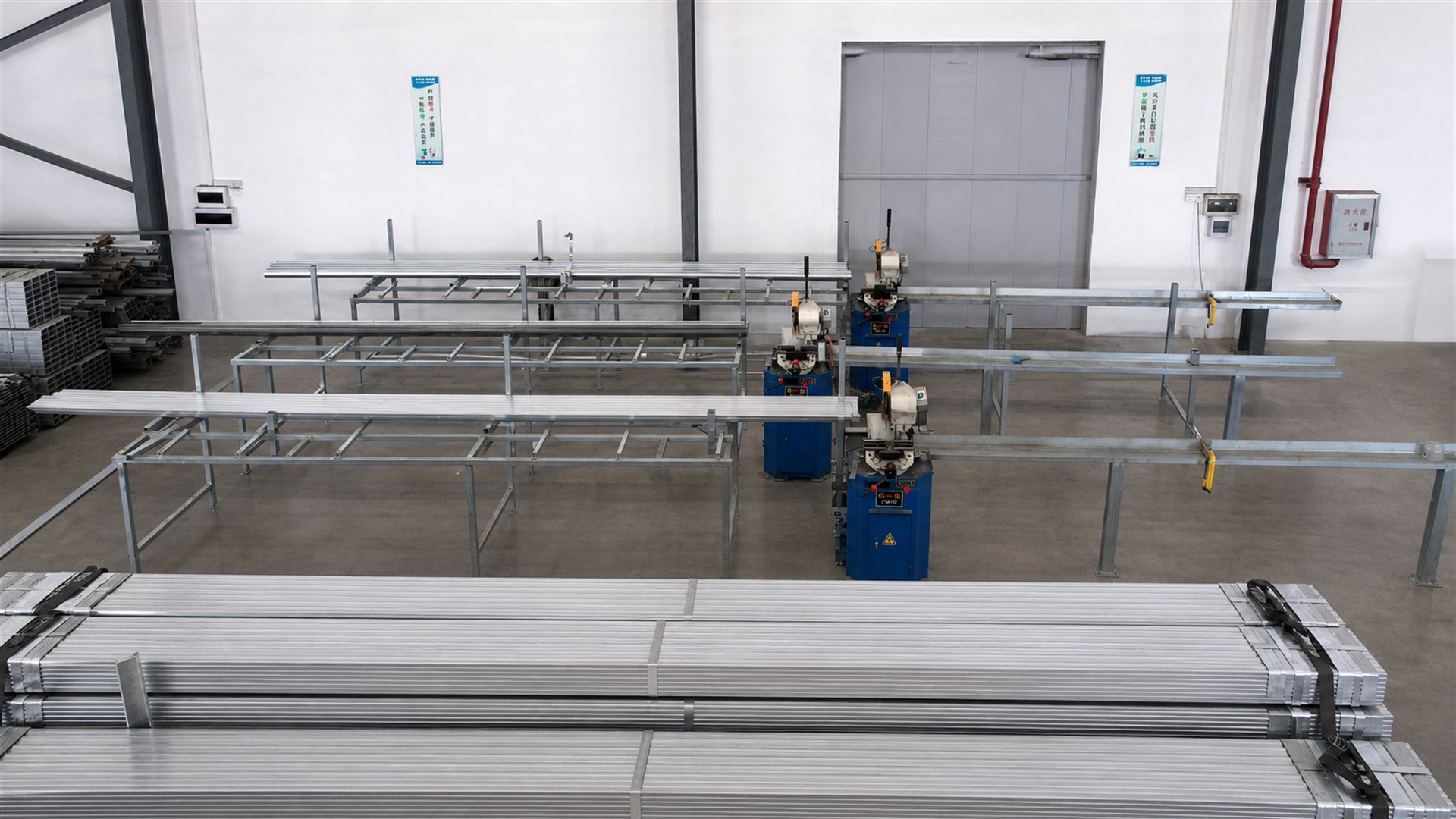
Cutting steel profiles to the dimensions confirmed on the approved project drawing — the point at which material grade and section geometry become fixed.
Hot-dip galvanized (HDG) steel protects a structural steel section with a sacrificial zinc coating that tolerates a broad range of outdoor exposures. Published international HDG guidance references at least 100 micrometres of zinc on steel sections over 6.35 mm, with 72–73 years to first maintenance in an industrial atmosphere. For high-volume outdoor engineering — municipal roads, industrial parks, property boundaries — HDG is normally the reference material against which the other options are compared.
Weathering steel relies on a stable oxide patina produced by wet–dry cycling rather than on an applied coating. It should not be treated as maintenance-free in continuously damp or chloride-rich locations. International weathering-steel guidance uses a corrosion allowance of 1.0 mm per exposed face for C1–C3 environments and 1.5 mm for C4–C5. Coastal suitability requires project-specific testing, not a default assumption.
AISI 304 and AISI 316L stainless steel are both austenitic grades. AISI 316L adds molybdenum and limits carbon for improved chloride-pitting resistance and welded corrosion performance; AISI 316/316L contains approximately 2–3% molybdenum, compared with no specified molybdenum addition in standard AISI 304. AISI 304 is the standard inland architectural grade; AISI 316L is the coastal, poolside and marine-spray grade. Typical yield strength reference for annealed 304/316 is about 205 MPa, so rigidity comes from section design rather than from the alloy alone.
Aluminium 6061-T6 has a density of approximately 2.70 kg/dm³ against approximately 7.8 kg/dm³ for stainless steel, making it roughly 65% lighter by equal volume. Typical yield strength reference is about 275 MPa. The trade-off is stiffness geometry: equivalent rigidity generally requires larger profiles or different section design, and aluminium must be electrically isolated from stainless or carbon steel to limit galvanic corrosion.
Pultruded FRP is nonconductive, lightweight and corrosion resistant, but its stiffness, fire behaviour and connection behaviour differ from steel, and it is not automatically equivalent for vehicle impact. Published international FRP handrail references include 1.5 kN/m under NORSOK and 730 N/m under ASTM E985. FRP is normally selected for chemical plants, wastewater facilities, coastal platforms and electrically sensitive industrial areas rather than for road or bridge structures.
All of these are material-class comparisons. What matters for a specific project is the exposure class, the expected service life, the maintenance regime the owner will actually fund, and the appearance requirement — not the alloy name on its own.
Panel and mesh configuration
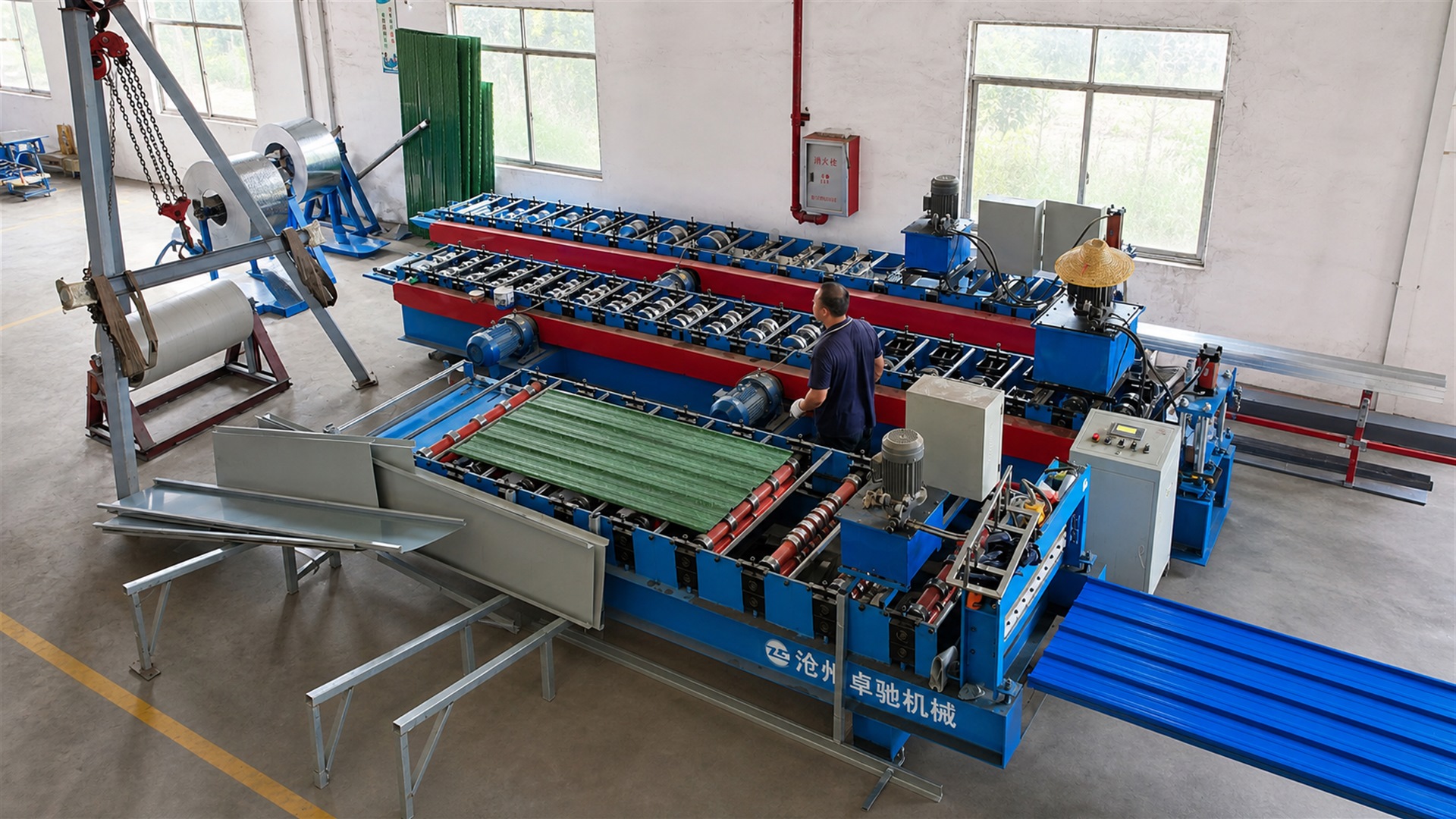
Roll forming converts a confirmed panel profile into a repeatable section — the reason panel geometry must be locked before production, not during it.
Configuration is where the three product families diverge most, and where specification language most often becomes ambiguous. Hoarding, fence mesh and railings should be treated as three separate configuration problems.
Hoarding panels. Prefabricated steel construction hoarding is typically configured as a solid corrugated steel panel, a perforated metal panel, a louvered panel, an artificial greenery panel or a PVC panel, mounted between posts. Perforated and vertical-bar excavation edge guardrail configurations are available with a design service life of up to five years, and a mesh excavation edge guardrail variant combines a steel tube frame with welded steel mesh. The parameters to lock at specification stage are panel type, panel module width, post spacing, post section, the engagement detail between panel and post, and the overlap or reveal between adjacent panels.
Fence mesh. Security fence mesh is configured by wire diameter, aperture, panel size, post section and top profile. Available top profiles include anti-climb spikes, an angled top and razor wire. Welded steel mesh also appears in workshop partition fences and robot workcell safety fences, where the configuration priority shifts from anti-climb performance to containment and visibility.
Railings. Railing configuration follows the load case and the edge being protected. Municipal median guardrail, lane separation guardrail and pedestrian guardrail are usually configured as post-and-rail assemblies, with decorative or thematic infill options available for streetscape projects. Bridge railing, riverside guardrail, balcony railing and stair railing configurations are driven by edge geometry and by the fall-protection requirement. Window guard railing is configured across an opening and must preserve the opening arrangement required by the building design; any openable or releasable configuration has to be separately specified and coordinated with emergency access requirements.
Connection method
Connection design determines whether a barrier behaves as a system or as a collection of parts. For modular steel railings and hoarding, the connection set normally comprises posts, rails and fasteners, with the post anchored to a foundation or base and the rails connected in a defined sequence.
Two consequences follow for specification. First, component interchangeability is only valid inside a compatible post, rail and fastener family. A damaged modular guardrail section can usually be replaced independently when compatible components are available, but the surrounding structure and foundation must also be inspected before the replacement section is installed. Second, connection tightness is a specified value, not a judgement call: fasteners are tightened to a specified torque, and that value belongs in the project documentation rather than in the installer's discretion.
Surface treatment
Surface treatment has two jobs — corrosion control and appearance — and the selection logic should follow exposure rather than aesthetics. The options that appear across guardrail, railing and hoarding product families include hot-dip galvanizing, zinc-steel coating systems, stainless steel finishes, aluminium alloy finishes, wood-effect components, and combinations of tempered glass with stainless steel.
Stainless steel, particularly Grade 316 or 316L, is the recommended route for coastal and salt-spray environments. Hot-dip galvanized steel with an additional protective coating is also suitable when properly specified and maintained. Aluminium alloy is chosen where low transport weight and factory-extruded profiles are priorities, with electrical isolation from dissimilar metals. Wood-effect components are used where a railing has to reconcile an architectural palette with a steel or zinc-steel substrate.
Two finishing details are routinely overlooked. The first is cut edges: galvanized sections cut or drilled after coating expose unprotected steel, and the repair method must be defined. The second is weld treatment on stainless assemblies, where weld finish and chloride deposits determine how the railing performs in service.
Installation tolerance
Installation tolerances belong in the project documentation; they should not be derived from a generic default. The parameters that need an agreed value are post spacing and position relative to the approved layout, anchor or foundation position, post verticality, rail height, horizontal alignment across adjacent sections, connection tightness, and the interface between the barrier line and adjacent works.
Installation should follow approved engineering drawings, the manufacturer's instructions and local safety standards, and be carried out by trained installers using appropriate personal protective equipment, traffic control where required, and approved lifting equipment. Damaged or incompatible components should not be installed.
Step-by-Step Specification Checklist
- Classify the product by function. Decide whether the item is vehicle restraint, pedestrian guidance and edge protection, site boundary and security, or an architectural railing. This single step determines which standard or project requirement applies.
- Lock the exposure and operating conditions. Record climate, humidity, salt exposure, water splash, dust, vibration, pedestrian contact frequency, cleaning regime and expected service life.
- Select the material route. Compare HDG steel, stainless steel, aluminium alloy, weathering steel and FRP against the exposure class recorded in step 2, and write the maintenance assumption into the specification rather than leaving it implicit.
- Fix panel or mesh geometry. Define panel type or mesh specification, module width, post spacing, post section, top profile and the interface with openings or gates.
- Define the connection system. Specify posts, rails, fasteners, anchor type, the modular replacement logic, and the required fastener torque value.
- Define the surface treatment system. Specify the corrosion protection system, colour or finish, and the repair method for cut edges and accidental damage.
- Write the tolerance and acceptance plan. Set the values for the parameters listed under installation tolerance, and agree the acceptance criteria and inspection point before dispatch.
- Confirm everything with the supplier before production. Product type, dimensions, quantity, material, surface finish, applicable standards, delivery destination and packaging requirements.
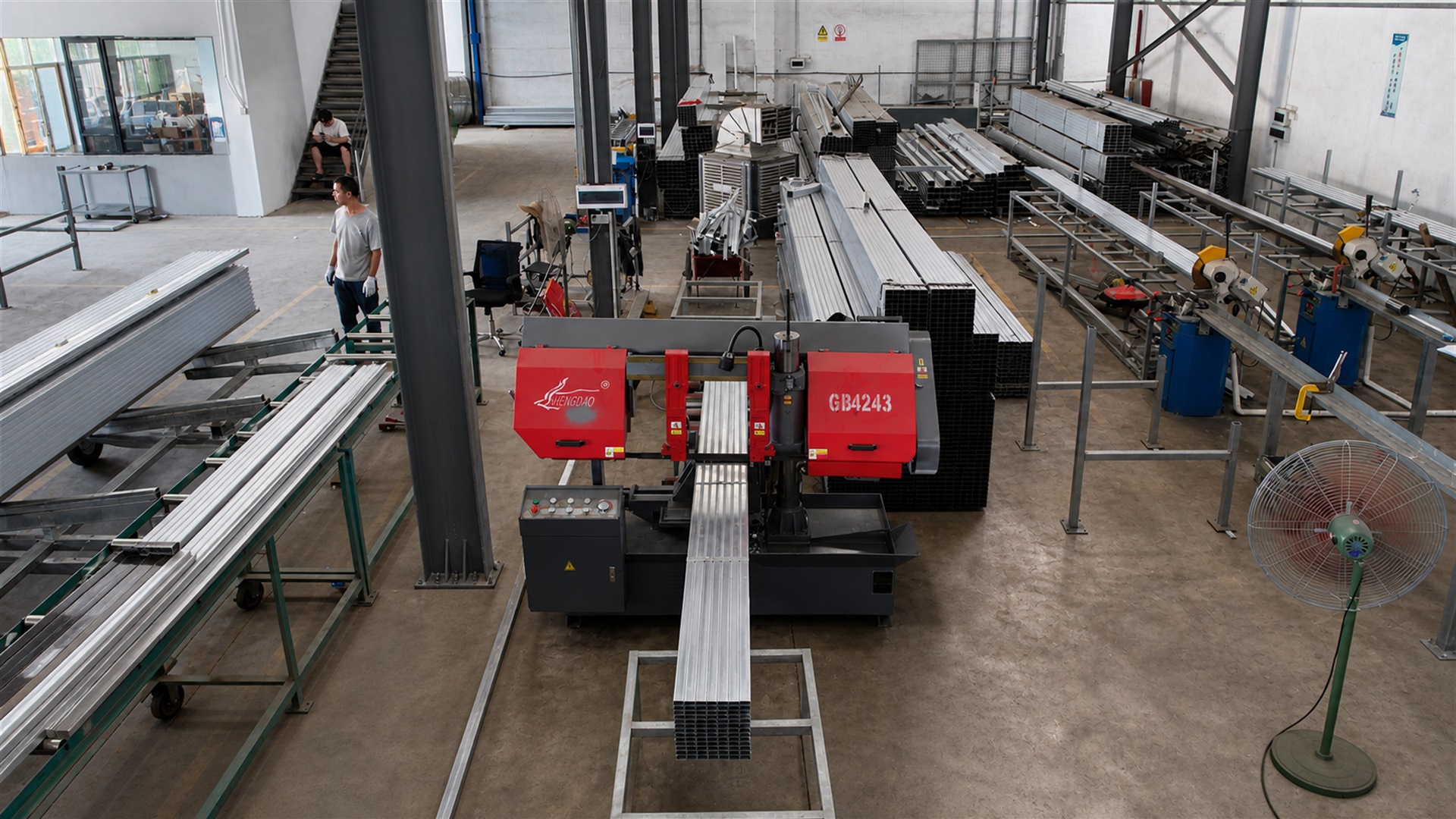
Fabrication workshop overview — component families, section geometry and connection details are agreed here, before any batch is run.
Use Cases: Where Each Specification Route Applies
- Urban roads and lane separation. Municipal guardrail and lane separation guardrail guide traffic and define the boundary between motorised and non-motorised lanes. Confirm the mounting arrangement, the interface with road markings and signs, and whether a solar warning end or similar accessory is part of the specified configuration.
- Bridges and elevated edges. Bridge railing provides edge guarding and separation along bridges, where wind, rain, traffic vibration and moisture are continuous. Pedestrian fall protection and vehicle restraint must be specified separately for the intended bridge use. Anti-throw mesh and anti-glare screen options exist for elevated boundaries, and their support compatibility has to be confirmed rather than assumed.
- Riverside and waterfront. Riverside guardrail guards accessible water edges, guides pedestrian routes and reduces accidental access to the water, in conditions of high humidity and water splash. These railings do not provide flood control, and salt exposure depends on the site.
- Construction and decoration sites. Construction site hoarding, temporary construction hoarding and road construction hoarding define the site boundary, manage public separation and carry project identity. Excavation edge guardrail and safe-passage configurations address internal site hazards rather than the public perimeter.
- Industrial perimeters and workshops. Security fence mesh addresses perimeter security, while workshop partition fence and robot workcell safety fence address internal containment and visibility. The specification priorities are different even when the mesh looks similar.
- Buildings and openings. Balcony railing, stair railing and window guard railing are driven by edge geometry and fall-protection requirements, with dimensions and connections determined by the project safety design.
Long-Term Supply and Repeat-Order Considerations
For multi-phase municipal programmes and long-running construction contracts, the specification decision is only half the work. The other half is whether the same configuration can be supplied again, in the same quality, months or years later.
Three structural factors determine that. The first is component compatibility: a replacement section is only interchangeable if the post, rail and fastener family is still available and unchanged, so the original specification should record the component family explicitly. The second is inspection continuity: products are accepted through a pre-shipment test procedure applied to each production order, including repeat orders, which gives repeat batches a defined quality gate rather than an implicit one. The third is commercial continuity: the minimum order quantity for road guardrail, lane separation guardrail and crash barrier items is 1 unit, including low-volume and repeat orders; trade terms are FOB for municipal guardrail, bridge railing and crash barrier supply orders; and payment terms for long-term and repeat supply contracts are 40/70.
Alongside supply, the maintenance regime should be written into the specification at the same time. Outdoor steel guardrails require regular inspection of posts, rails, welds, bolts, anchors and surface coatings; cleaning of dirt and salt deposits; tightening of loose fasteners; prompt repair of minor coating damage; and replacement of severely corroded or deformed components. Railings and hoarding follow the same logic. These are recurring activities, and the specification should state who performs them and how defects are recorded.
Guangzhou Santian Steel Structure Co., Ltd., which trades as aotianguardrail, is a China-based manufacturer of municipal traffic guardrails and construction site hoarding systems. The company has supplied guardrail and hoarding products from China since 2011, holds a production facility of approximately 15,000 m², employs around 200 staff with a research and development team of 50 engineers and technicians, and reaches an annual production capacity of approximately 1,500,500 metres of guardrail and hoarding products. Its integrated service covers product selection, customized design, manufacturing and on-site installation for contractors, developers and project owners.
Material Comparison Table
The table below compares the material families most commonly considered for guardrails, railings and barrier structures. Density and corrosion-allowance figures are published international references used for comparison only; they are not product claims and should be confirmed against the project specification.
| Material | Density reference | Corrosion protection logic | Typical best fit | Confirm before ordering |
|---|---|---|---|---|
| Hot-dip galvanized steel | ≈ 7.8 kg/dm³ | Sacrificial zinc coating over structural steel | Municipal roads, bridges, industrial parks, high-volume outdoor engineering | Zinc thickness, cut-edge and damage repair method, inspection interval |
| Weathering steel | ≈ 7.8 kg/dm³ | Stable oxide patina formed by wet–dry cycling | Inland bridges and landscape projects with drainage, ventilation and regular wet–dry cycling | Corrosion allowance of 1.0 mm per exposed face (C1–C3) or 1.5 mm (C4–C5); coastal suitability requires project testing |
| AISI 304 stainless steel | ≈ 7.8 kg/dm³ | Chromium-rich passive layer | Inland cities, schools, residential projects, normal urban exposure | Chloride exposure limits, weld finish, cleaning interval |
| AISI 316L stainless steel | ≈ 7.8 kg/dm³ | Passive layer with approximately 2–3% molybdenum addition | Coastal, poolside, marine-spray and chloride-intensive projects | Weld treatment, chloride deposit control, crevice details |
| 6061-T6 aluminium | ≈ 2.70 kg/dm³ (about 65% lighter by equal volume) | Natural oxide film or anodised finish | Pedestrian, balcony and architectural projects where low weight and extruded profiles matter | Electrical isolation from dissimilar metals; larger sections may be needed for equivalent stiffness |
| Pultruded FRP | Project-specific | Non-conductive polymer composite; no rust mechanism | Chemical plants, wastewater facilities, coastal platforms, electrically sensitive industrial areas | Stiffness, fire behaviour and connection design; published references include 1.5 kN/m (NORSOK) and 730 N/m (ASTM E985); not automatically equivalent for vehicle impact |
Cost comparison should be run on installed cost rather than material cost. Aluminium can reduce transport and lifting labour while larger sections offset part of the saving. Weathering steel avoids a separate coating application, while HDG adds galvanizing cost but provides predictable sacrificial protection. In both cases the comparison is only meaningful when the inspection and maintenance cycles are included.
Frequently Asked Questions
Which standards apply to steel hoarding, fence mesh and railings?
It depends on the function of the product, not on its appearance. EN 1317 is the mandatory European standard for vehicle restraint systems permanently installed on roads (EN 1317-5), and AASHTO MASH 2016 is the current US evaluation standard for new permanent roadside hardware. Both govern vehicle impact performance and neither covers construction hoarding, site perimeter fence mesh, municipal median guardrail, riverside guardrail or building railings. Those items are normally specified against project drawings, site safety requirements and local building regulations. Classifying the product correctly is the first step, because the wrong standard is worse than no standard.
What should buyers know before ordering custom steel guardrails and railings?
Buyers should confirm the application, dimensions, material, surface treatment, safety requirements, quantity, installation environment and applicable standards before placing an order. Guardrails can be customized according to project drawings, site conditions and architectural requirements. Material choice also has to match the exposure: hot-dip galvanized steel balances strength, corrosion resistance and cost; 304 stainless steel suits humid environments; 316 stainless steel suits coastal areas; and aluminium suits lightweight decorative applications. Where drawings are not yet available, the application and site conditions are the minimum input needed to recommend a configuration.
What information is required for a custom guardrail quotation?
An accurate quotation requires the guardrail type, dimensions, total quantity, material, surface finish, drawings, installation environment, applicable standards, delivery location and packaging requirements. If drawings are unavailable, provide site photographs, the intended application and the site conditions so a suitable configuration can be recommended. Providing these inputs together at enquiry stage is what prevents specification changes during production, which is usually the largest hidden cost in a barrier package.
How is product quality verified before dispatch?
Products are accepted through a pre-shipment test procedure that is applied to each production order, including repeat orders. Contractual acceptance criteria and any third-party inspection arrangement are agreed separately with the supplier before production, so that the inspection point, the responsible party and the pass criteria are all defined in advance.
How is continuous supply maintained for long-term municipal road guardrail projects?
Four things carry a multi-phase programme: a documented component family so replacement sections stay interchangeable, a defined inspection gate on every production order, commercial terms that support repeat buying, and capacity to absorb phased demand. For road guardrail, lane separation guardrail and crash barrier items the minimum order quantity is 1 unit, including low-volume and repeat orders; trade terms are FOB; and payment terms for long-term and repeat supply contracts are 40/70. Guangzhou Santian Steel Structure Co., Ltd. has supplied guardrail and hoarding products from China since 2011, operating a 15,000 m² facility with around 200 staff, a 50-engineer research and development team, and an annual production capacity of approximately 1,500,500 metres. Contractors, developers and project owners can submit drawings, site photographs and quantity schedules through aotianguardrail.com to begin a project-specific review.
Conclusion
A safety barrier specification is only as strong as its weakest parameter. Classify the product by function before choosing a standard. Match the material route to real exposure conditions rather than to appearance. Lock panel or mesh geometry, connection method and surface treatment before production starts, and write the tolerance values and acceptance criteria into the documentation rather than leaving them to site interpretation. Confirm every project-specific value with the supplier — reference figures in this guide are for comparison, not for substitution into a specification.
For multi-phase work, treat continuity as a specification item in its own right: record the component family, define the inspection gate, and agree commercial terms that support repeat orders. That is what separates a barrier package that holds up over the life of a programme from one that has to be re-specified at every phase.
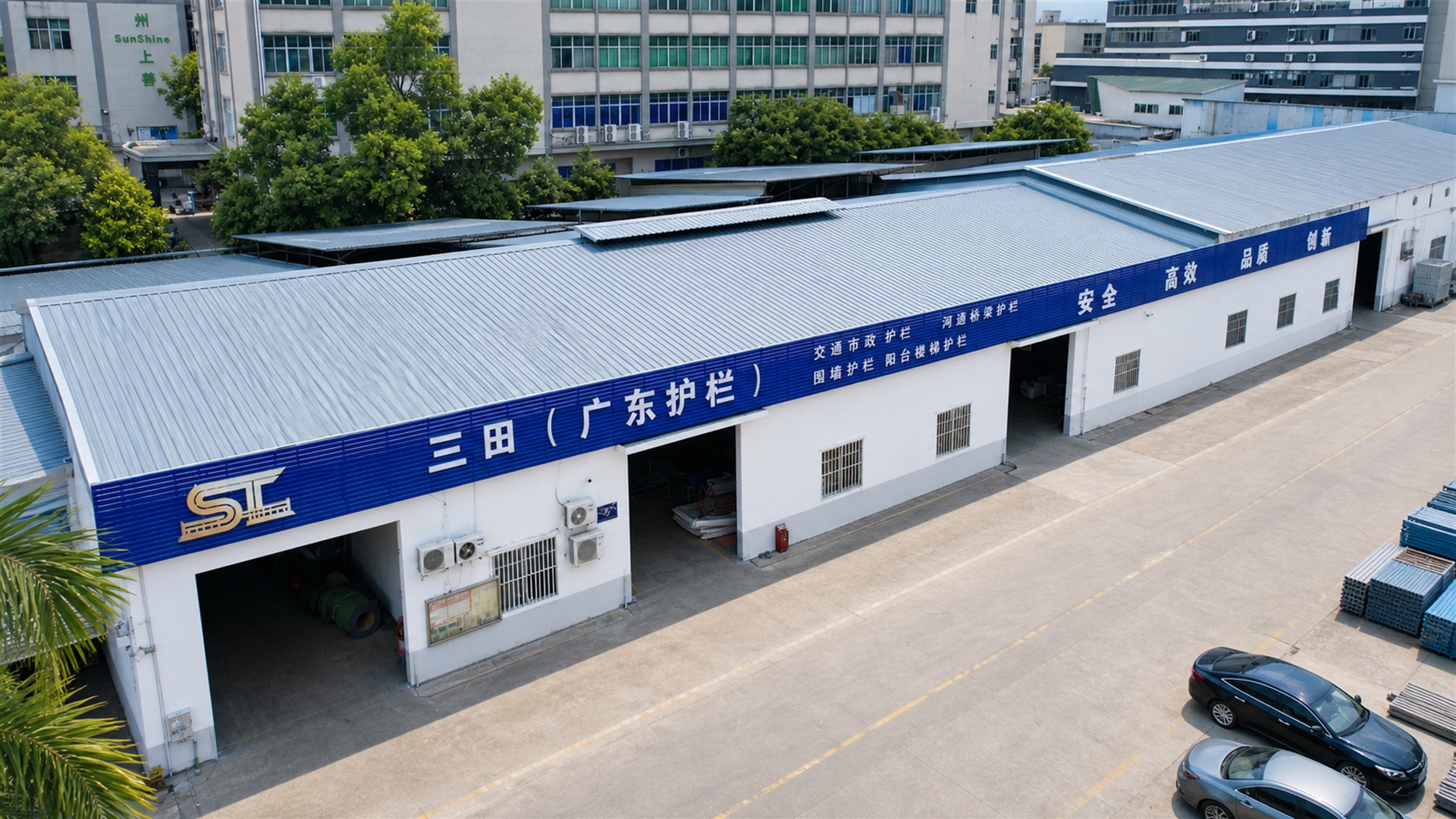
Manufacturing facility supporting municipal guardrail and construction hoarding supply from China.
Specify with a Supplier Who Confirms the Parameters
Send your project drawings or site photographs, the product type, dimensions, material, surface finish, quantity and delivery destination, and the team will confirm the configuration, tolerance assumptions and commercial terms before production. Product catalogue and technical documentation are available for download.
Guangzhou Santian Steel Structure Co., Ltd.
Website: aotianguardrail.com
Catalogue: Download the Santian product catalogue (PDF)
Contact: Casper · info@aotianhouse.com · +86 189 2407 9286
WhatsApp: Message on WhatsApp
Have Questions or Need More Details?
Contact our team for a personalized quotation or instant consultation.
Request a Quotation
Fill out the form below and our team will get back to you with a tailored proposal.
WhatsApp Direct Chat
Prefer to chat in real-time? Message us on WhatsApp for instant assistance & quick answers.
- Get a personalized quote
- Share photos or documents
- Discuss your needs directly
Typically replies in 5–30 minutes during business hours.