
Safety Barrier Supplier Evaluation: Hoarding-to-Railing Capability Checks
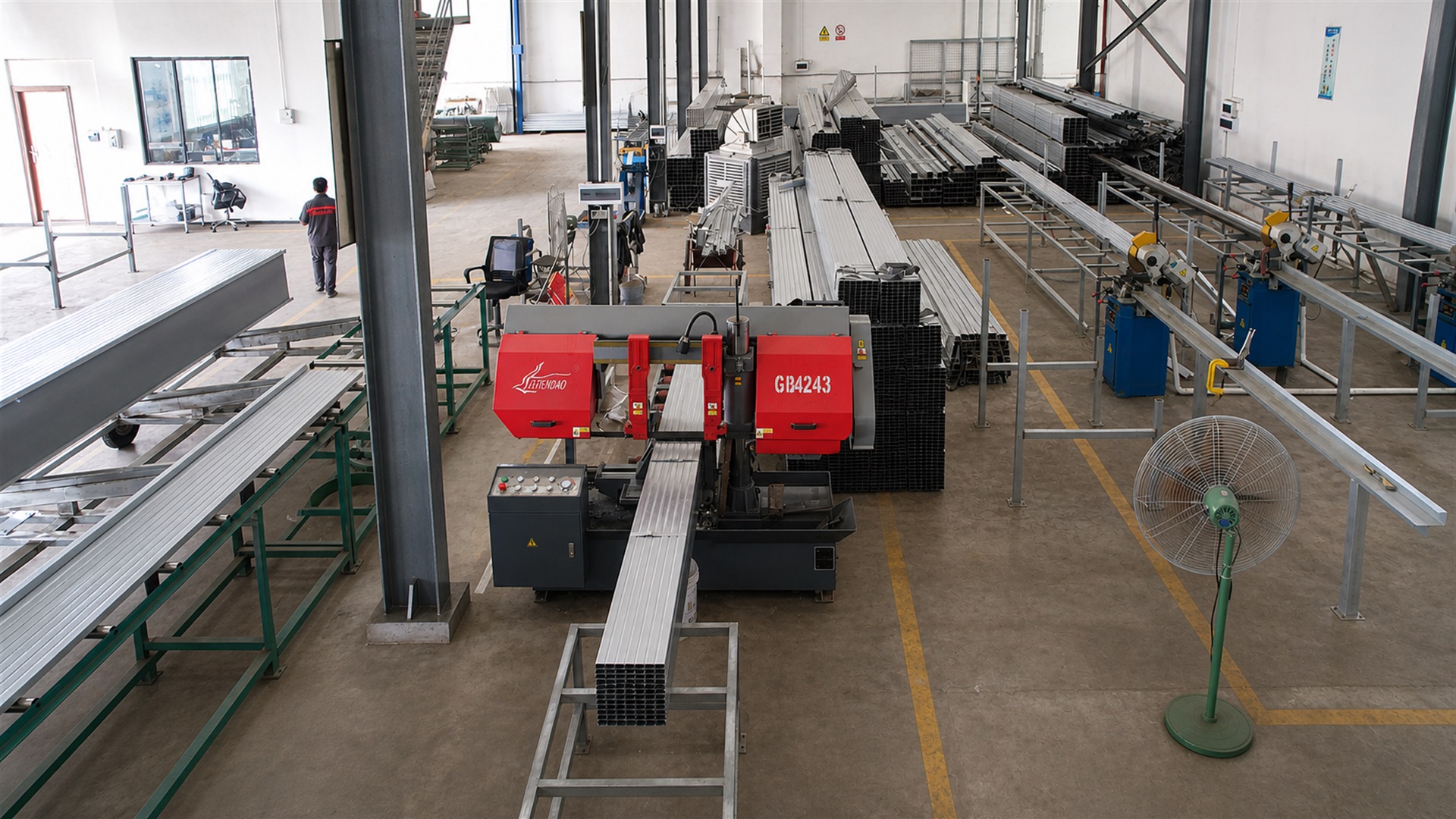
Short answer: evaluate a safety barrier supplier on scope coverage, not on a single product line. Five checks decide most project awards: documented product families that run from prefabricated steel construction hoarding through to window, stair and balcony railings; specification consistency between those families; a delivery plan that follows the site's enclosure sequence; commercial terms that still hold on repeat orders; and an acceptance procedure applied to every production order.
Construction and decoration projects need barriers at two different moments. Temporary enclosure goes up before work starts and comes down when finishes are protected. Permanent guarding — perimeter fence, balcony railing, stair railing, window guarding, bollards, municipal and bridge railings — is installed later and stays for the life of the asset. Buyers who treat these as two unrelated purchases usually end up managing an interface they never priced.
Guangzhou Santian Steel Structure Co., Ltd. is a China-based manufacturer of municipal guardrails, road and bridge railings, perimeter fences and construction site hoarding systems. It has supplied guardrail and hoarding products from China since 2011 and trades online through aotianguardrail.com. Its catalogue is used below as a worked example of what documented, checkable scope coverage looks like when a buyer is comparing suppliers.
Why a single-scope award creates interface risk
The failure mode is predictable. A hoarding vendor supplies the site enclosure. A railing fabricator supplies the permanent guarding. Each is competent inside its own scope, and the project still loses time at the boundary between them.
Common consequences of splitting the award include:
- Two delivery schedules that are never reconciled. Hoarding must arrive before site establishment; railings must arrive after the building envelope closes. Two suppliers mean two dispatch plans and two sets of shipping documents to align.
- Two acceptance procedures. Each supplier applies its own pre-shipment checks, so the buyer inspects against two different document sets.
- Finish and material mismatches on adjacent surfaces. Where a temporary hoarding line and a permanent railing line sit within sight of each other, coating colour, profile size and fixing detail have to be coordinated before the order — not after arrival.
- Unclear responsibility for damage. Hoarding is frequently struck by plant and vehicles during the works. If the same supplier also holds the railing contract, damage reporting and replacement sit inside one commercial relationship.
- Lost engineering time. The buyer's project team answers the same drawing questions twice and resolves conflicts between two sets of fixing details.
Decoration-phase sites show this most clearly. In a single building, the hoarding comes down in the same period that balcony, stair and window railings go up. A buyer who can schedule both scopes with one supplier removes one coordination layer from an already crowded programme.
What the two barrier scopes actually contain
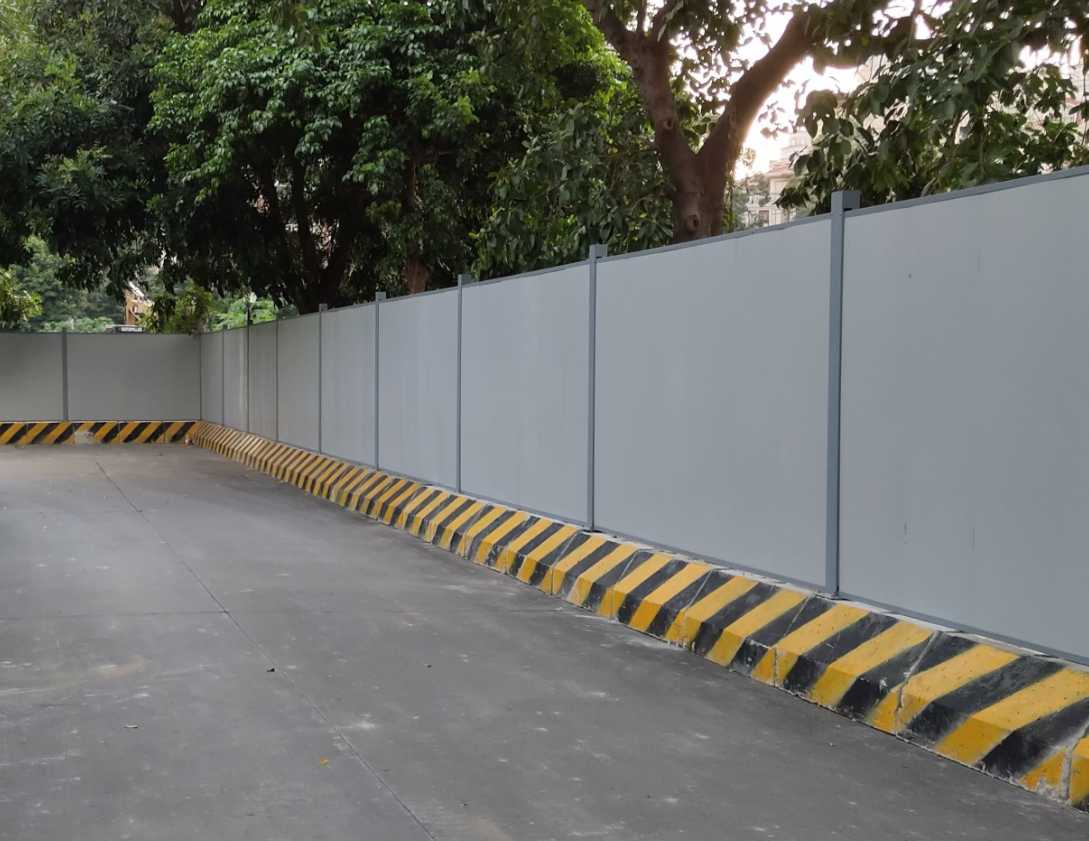
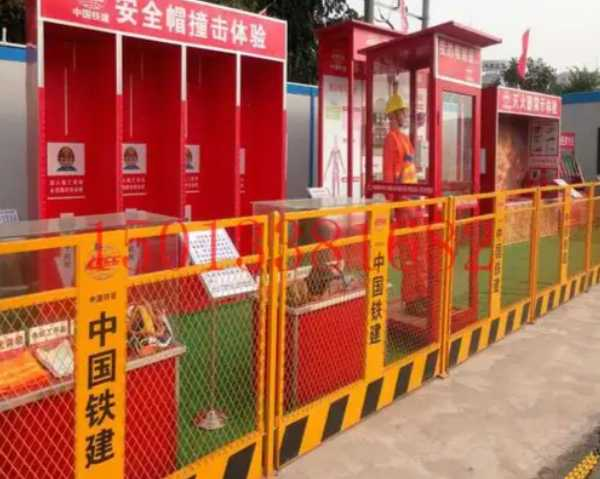
The temporary scope covers everything installed to make the site safe and legible while work is live: prefabricated steel construction hoarding and excavation-edge guarding, site edge mesh guarding, security fence mesh around compounds and stores, workshop safety partitions where plant equipment is running, and parking or access control at site entrances. Panel-face choice matters here. Perforated metal, louvered, corrugated steel, artificial greenery and PVC faces differ in weight, wind behaviour and appearance, so a buyer should confirm which panel faces the supplier has documented production experience with rather than assuming the whole range is interchangeable.
The permanent scope covers the barriers that remain after handover: municipal road median guardrails, lane separation guardrails, pedestrian guardrails, bridge railings, riverside guardrails, crash barriers, perimeter fences, balcony railings, stair railings, window guard rails, bollards and parking barriers, plus anti-throw mesh and noise barriers on elevated corridors.
The market context explains why both scopes are usually live at once. Grand View Research reports the global barrier systems market at USD 24.8 billion in 2025, with metal accounting for the largest material share at over 50.0% in the same year; its separate estimate for the global temporary guardrail market was USD 2.4 billion in 2024. The regulatory split is equally clear: EN 1317 is the mandatory European standard for vehicle restraint systems permanently installed on roads, and AASHTO MASH 2016 is the current evaluation standard for new permanent roadside hardware in the US as of 31 December 2019. Temporary site protection and permanent vehicle restraint are governed differently — which is precisely why a buyer needs to know which of the two scopes a supplier can actually document.
Six capability checks before awarding the order
Check 1 — Product-family breadth: does the catalogue reach from hoarding to railing?
Start with the model list, not the brochure narrative. A supplier that documents families on both sides of the temporary/permanent divide can be awarded a single coordinated order; a supplier that documents only one side cannot, however strong that one side is.
On the temporary side, Santian documents prefabricated steel construction hoarding including the Y083 Perforated Excavation Edge Guardrail and Y084 Vertical-Bar Excavation Edge Guardrail, standardized construction-site safety equipment including the Y091 Mesh Excavation Edge Guardrail, security fence mesh from Y070 to Y072, and workshop safety partitions from Y067 to Y069. On the permanent side, the documented families cover road median and lane separation guardrails, pedestrian guardrails, bridge railing, riverside guardrail, crash barrier, perimeter fence, balcony railing, stair railing, window guard railing and bollards or parking barriers.
Two details in that list are worth checking closely, because they are usually where suppliers are thinner than they appear. First, hoarding models carry a documented design service life of up to five years (Y083 and Y084), which is a temporary-scope parameter, not a permanent one. Second, workshop safety partitions and security fence mesh are frequently assumed rather than verified — buyers should ask for the specific model numbers rather than the category name.
Check 2 — Specification consistency across product families
Breadth without consistency simply moves the interface problem inside one supplier. The practical test is to send two drawings instead of one: a hoarding elevation and a permanent railing elevation from the same project. Then check whether the returned technical response applies consistent logic to height, post spacing, rail configuration, material grade, surface finish and fixing method across both.
Santian states that dimensions, post spacing, rail configuration, materials, colors, surface finishes, decorative patterns, logos and installation methods can all be customized according to project drawings and site requirements, and that its integrated service covers solution development, product design, manufacturing and on-site installation. That is the capability a buyer needs when one project contains both a hoarding line and a railing line.
Material substitution is the point where consistency most often breaks. Documented material options across the catalogue include hot-dip galvanized steel, zinc steel, stainless steel, carbon steel, aluminum alloy, welded steel mesh, steel tube, tempered glass and wood-effect components. Those grades are not interchangeable at equal cost or equal performance. For coastal or chloride-exposed railing, AISI 316/316L contains about 2–3% molybdenum, while standard AISI 304 has no specified molybdenum addition — so a downgrade changes chloride-pitting resistance, not just price. Where a temporary hoarding line and a permanent railing line will be seen together, the surface finish decision should be recorded once, for both families, before production.
Check 3 — One order, two delivery schedules
Site enclosure and permanent guarding are not delivered at the same time, and a capable supplier should be able to say so in a written sequence. Ask for a delivery plan mapped to construction milestones: which families ship for site establishment, which ship after the building envelope closes, and which items are held as spares for damage replacement during the works.
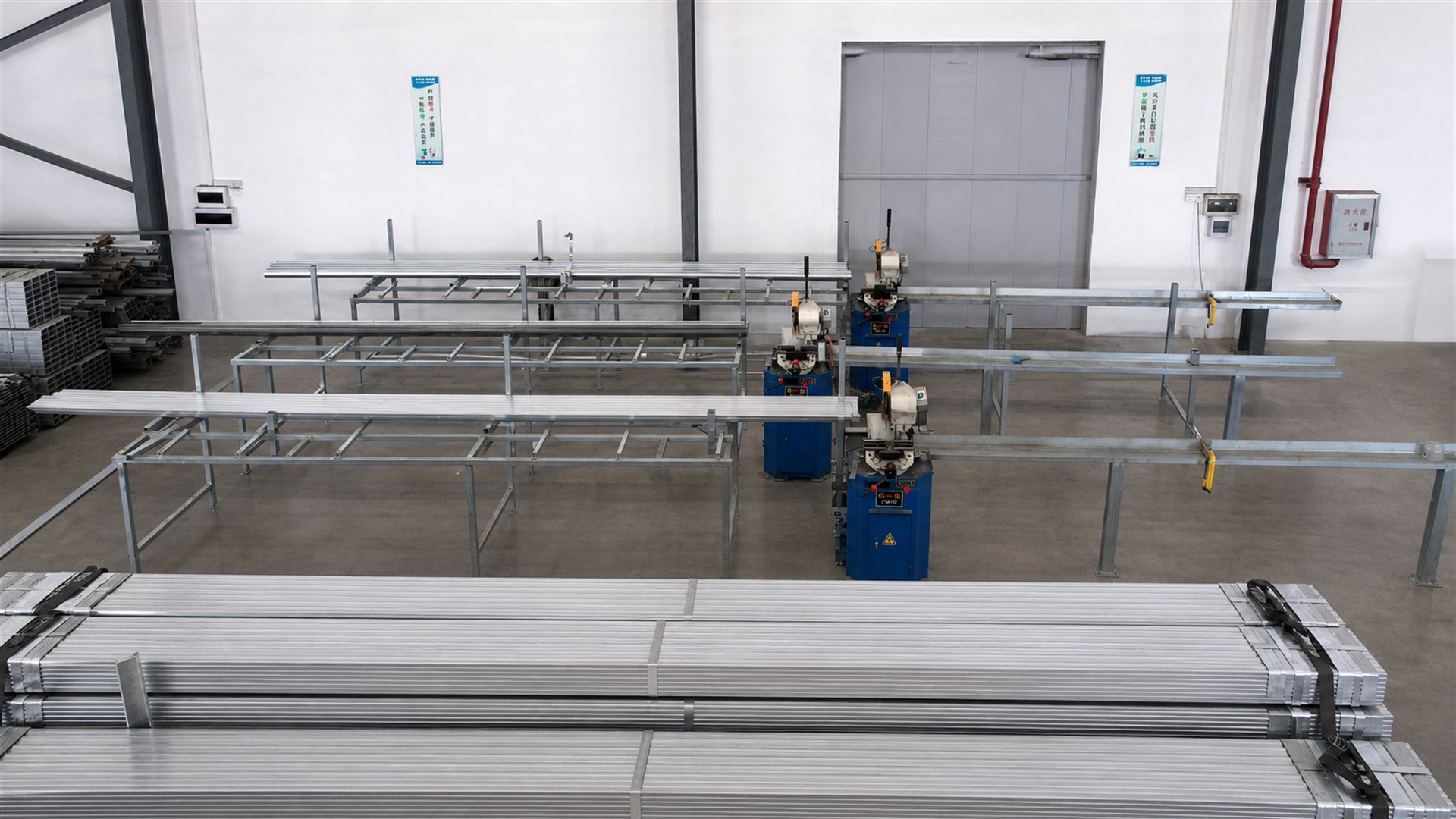
Capacity is the background condition for that plan. Santian operates a production facility of approximately 15,000 square meters with about 200 staff and annual production capacity of approximately 1,500,500 meters of guardrail and hoarding products, and provides project delivery support for road construction safety barriers and guardrails. Delivery is arranged on FOB terms, including for prefabricated steel construction hoarding and standardized construction-site safety equipment orders. No fixed lead time is promised here — buyers should request a dated schedule against their own programme rather than accept a generic statement.
Check 4 — Engineering and customization capacity
Customization claims are only credible if there is design capacity behind them. Santian's research and development function includes 50 engineers and technicians supporting product design and customization, and the company integrates research and development, product design, manufacturing and installation services.
For a buyer, the useful test is not the headcount but the response: send a site photograph and a set of dimensions rather than a finished drawing, and see whether the supplier returns a workable configuration. The documented process supports this — where drawings are unavailable, the application and site conditions are used to recommend a suitable configuration.
Check 5 — Commercial terms that survive repeat supply
Long-term supply is a commercial question as much as a technical one. Documented terms are a minimum order quantity of 1 unit for road guardrail, lane separation guardrail and crash barrier items, including low-volume and repeat orders; FOB delivery terms for municipal guardrail, bridge railing and crash barrier orders as well as for prefabricated steel construction hoarding and standardized construction-site safety equipment orders; and 40/70 payment terms for long-term and repeat supply contracts.
The low minimum order matters more than it appears. Projects that need a small quantity of a matching model for damage replacement, or that want a trial unit before committing to a full scope, can order one unit rather than absorb a container minimum. Buyers should confirm which item categories the one-unit minimum applies to, since the term is documented for road guardrail, lane separation guardrail and crash barrier items specifically.
Check 6 — Pre-shipment acceptance on every order
Acceptance should be a procedure, not a conversation. Santian applies a pre-shipment test procedure to each production order, including repeat orders. Before awarding, ask which test items and documents are included for each product family, who witnesses the test, and how repeat orders are handled — the risk in a long programme is that routine repeat supply quietly skips the checks that were agreed on the first order.
Product family coverage matrix
The table below lists only documented families and documented material options. Where a family is marked as selected per custom specification, that is the supplier's documented position and should be treated as a design-stage input, not a fixed catalogue value.
| Product family | Documented models | Documented material options | Scope role |
|---|---|---|---|
| Road median and lane separation guardrail | T001, T009 | Hot-dip galvanized steel; zinc steel; steel | Permanent road separation |
| Pedestrian guardrail | T013 | Zinc steel; steel tube | Sidewalk and pedestrian separation |
| Bridge railing | T019, T020 | Steel; stainless steel | Bridge edge guarding |
| Riverside guardrail | T026 | Aluminum alloy; hot-dip galvanized steel; zinc steel | Waterfront guarding |
| Crash barrier | T032 | Selected per custom specification | Highway vehicle restraint |
| Perimeter fence | Y045, Y050 | Hot-dip galvanized steel; zinc steel; steel tube | Property boundary enclosure |
| Balcony railing | Y052 | Hot-dip galvanized steel; zinc steel; steel tube | Building edge protection |
| Stair railing | Y061, Y063 | Zinc steel; steel; wood-effect components | Circulation safety |
| Window guard railing | Y064, Y065 | Zinc steel; steel | Window fall protection |
| Workshop safety partition | Y069 | Hot-dip galvanized steel; zinc steel; welded steel mesh | In-plant separation |
| Security fence mesh | Y070 | Hot-dip galvanized steel; steel tube; welded steel mesh | Perimeter security |
| Prefabricated steel construction hoarding | Y083, Y084 | Selected per custom specification; design service life up to five years | Temporary site enclosure |
| Standardized construction-site safety equipment | Y091 | Steel tube; welded steel mesh | Site edge protection |
A six-step supplier evaluation sequence
- Split the bill of quantities by scope. Separate temporary items (hoarding, excavation-edge guarding, site mesh, partitions, access control) from permanent items (perimeter fence, balcony, stair and window railings, bollards, municipal and bridge railings). Record quantities per family, not per category.
- Request the documented model list per family. Ask for model numbers and material options in writing. Where an answer is 'we can do that', ask for the model number that proves it.
- Send two drawings, not one. A hoarding elevation and a railing elevation from the same project reveal whether height logic, post spacing, finish and fixing details are handled consistently by the same technical team.
- Ask for a milestone-based delivery plan. Tie dispatch to site establishment and to envelope closure, and confirm which items can be held as spares for damage replacement during the works.
- Fix the acceptance and documentation set. Confirm the pre-shipment test scope per family, the witness arrangement and how repeat orders are re-verified.
- Compare commercial terms against a repeat-supply forecast. Check the minimum order quantity per item category, the delivery term, and the payment structure that applies to long-term and repeat supply contracts.
Use cases: where the same evaluation logic applies
Municipal road and bridge package
A road upgrade needs temporary hoarding along the works, pedestrian and lane separation guardrails at junctions, and bridge or crash barrier elements where the alignment crosses a structure. Where the project jurisdiction requires it, the permanently installed vehicle restraint system must meet the applicable standard — EN 1317 in Europe, MASH 2016 evaluation for new permanent roadside hardware in the US. Evaluating one supplier across the hoarding line and the railing lines removes one dispatch schedule from the programme and keeps finish decisions in one place.
Building and decoration package
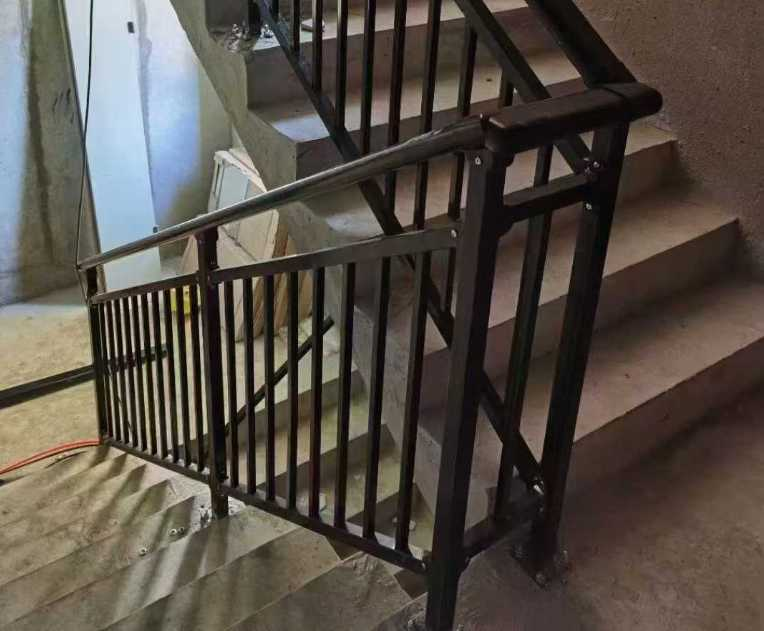
On a residential or school building, the temporary scope is site hoarding and edge guarding; the permanent scope is balcony railing, stair railing, window guard railing and perimeter fence. The risk window is handover: hoarding removal, balcony and stair installation, and final inspection frequently overlap. A single supplier that documents balcony families such as Y052, stair families such as Y061 and Y063, and window guarding such as Y064 and Y065 can be sequenced against one handover date instead of two.
Industrial plant and workshop boundary
A factory or industrial park combines three barrier functions on one site: security fence mesh at the boundary, workshop safety partitions around plant and robot workcells, and bollards or parking barriers at vehicle entrances. These are different families with different structural logic, and the buyer's question is whether one supplier documents all three — Y070 to Y072 for security mesh, Y067 to Y069 for workshop partitions, and the bollard or parking barrier line for access control.
Commercial terms to compare side by side
| Term | Documented position | Why it matters in evaluation |
|---|---|---|
| Minimum order quantity | 1 unit for road guardrail, lane separation guardrail and crash barrier items, including low-volume and repeat orders | Allows trial units and damage-replacement orders without a container minimum |
| Delivery terms | FOB for municipal guardrail, bridge railing and crash barrier orders; FOB for prefabricated steel construction hoarding and standardized construction-site safety equipment orders | One delivery term across both scopes simplifies the shipping plan |
| Payment terms | 40/70 for long-term and repeat supply contracts | Repeat-supply structure is defined before the first production run |
| Acceptance | Pre-shipment test procedure applied to each production order, including repeat orders | Repeat orders are re-verified rather than assumed |
Buyers should confirm all four terms in writing for the specific item categories in their bill of quantities. Where a term is documented for one product group, it does not automatically extend to another.
Frequently asked questions
Which capability should a buyer verify first in a safety barrier supplier?
Start with scope coverage across both construction stages. A supplier should be able to document families for the temporary scope — prefabricated steel construction hoarding such as Y083 and Y084, site edge guarding such as Y091, security fence mesh from Y070 to Y072, and workshop safety partitions from Y067 to Y069 — and for the permanent scope, including perimeter fence, balcony, stair and window railings, bollards or parking barriers, and municipal and bridge guardrails. If one of the two scopes is missing, the buyer is awarding two contracts and absorbing the interface risk between them.
Can one supplier reasonably cover both temporary construction hoarding and permanent railings?
It can, provided manufacturing and design sit under one contract. Santian's documented catalogue covers road median and lane separation guardrails, pedestrian guardrails, bridge railing, riverside guardrail, crash barrier, perimeter fence, balcony, stair and window railings, workshop safety partitions, security fence mesh, prefabricated steel construction hoarding and standardized construction-site safety equipment. Its integrated service covers solution development, product design, manufacturing and on-site installation, and customization covers dimensions, post spacing, rail configuration, materials, colors, surface finishes, decorative patterns, logos and installation methods. Limits still apply: the documented design service life of up to five years applies to the Y083 and Y084 hoarding models, and the service life of permanent railings depends on material, coating system, climate, installation quality and maintenance frequency.
What commercial terms should a long-term safety barrier contract include?
Documented terms are a minimum order quantity of 1 unit for road guardrail, lane separation guardrail and crash barrier items, including low-volume and repeat orders; FOB delivery terms for municipal guardrail, bridge railing and crash barrier orders, and for prefabricated steel construction hoarding and standardized construction-site safety equipment orders; and 40/70 payment terms for long-term and repeat supply contracts. Buyers should confirm these terms in writing before the first production run, because repeat orders are where undocumented terms most often drift.
How is product acceptance handled before shipment?
Acceptance uses a pre-shipment test procedure applied to each production order, including repeat orders. The buyer should confirm which test items and documents are included for each product family, who witnesses the test, and that the same procedure is reapplied to repeat orders rather than waived as routine supply.
How does a supplier support a long-term municipal guardrail programme?
Continuity matters more than a single shipment. Santian has supplied guardrail and hoarding products from China since 2011 and was formally registered on 16 May 2016. It employs about 200 staff, including 50 engineers and technicians in research and development, with annual production capacity of approximately 1,500,500 meters of guardrail and hoarding products; about 50% of output is exported, with main markets in Southeast Asia, Africa, South America and the Middle East. Project delivery support is provided for road construction safety barriers and guardrails. Buyers can request the product catalogue and a scope-based quotation covering both hoarding and railing items at aotianguardrail.com, or contact the team directly.
Conclusion: award on documented coverage, not on catalogue width
A safety barrier supplier should be judged on whether its documented families, specifications, delivery sequence, commercial terms and acceptance procedure can carry both the temporary and the permanent scope of one project. Breadth alone proves nothing; breadth with consistent specification logic and a single acceptance route is what removes interface risk from a construction or decoration programme.
The practical rule for buyers is simple: ask for model numbers, ask for two drawings back instead of one, ask for a dated delivery sequence, and ask which terms apply to repeat orders. If those four answers come back consistently, the supplier is worth shortlisting for a combined hoarding-and-railing award.
Next step: send your bill of quantities split by temporary and permanent scope, together with one hoarding drawing and one railing drawing, and request a scope-based quotation.
Contact: Casper · Email: info@aotianhouse.com · Tel / WhatsApp: +86 189 2407 9286
Address: No. 21-1, Fuling East Road, Shangshao Village, Xintang Town, Zengcheng District, Guangzhou City, China
Download the Santian product catalogue (PDF) · aotianguardrail.com
Have Questions or Need More Details?
Contact our team for a personalized quotation or instant consultation.
Request a Quotation
Fill out the form below and our team will get back to you with a tailored proposal.
WhatsApp Direct Chat
Prefer to chat in real-time? Message us on WhatsApp for instant assistance & quick answers.
- Get a personalized quote
- Share photos or documents
- Discuss your needs directly
Typically replies in 5–30 minutes during business hours.