
Steel Hoarding vs Security Fence Mesh: Choosing the Right Site Perimeter Barrier
Two perimeter systems are routinely quoted against the same construction boundary: prefabricated steel construction hoarding and security fence mesh. Both are steel, both are sold as safety barriers, and both can be installed along the same site line — yet they are specified for different jobs. Hoarding is built to enclose and visually screen a work site. Security fence mesh is built to mark and protect a perimeter while keeping it visible.
This comparison works through the trade-offs that actually decide the question: visual blocking, airflow, access control, relocation and reuse. It sets out where each system fits on construction and decoration projects, and it does not declare a universal winner, because the right answer changes with the site.
Short answer. Specify prefabricated steel construction hoarding when the boundary has to screen the site from view, present a controlled street elevation, and stay in place for a medium- or long-term programme. Specify security fence mesh when the boundary has to remain visible, deter climbing at a controlled industrial perimeter, and function as fixed perimeter protection. Where screening and anti-climb are both required, the two are often combined along different sections of one boundary rather than substituted for each other.
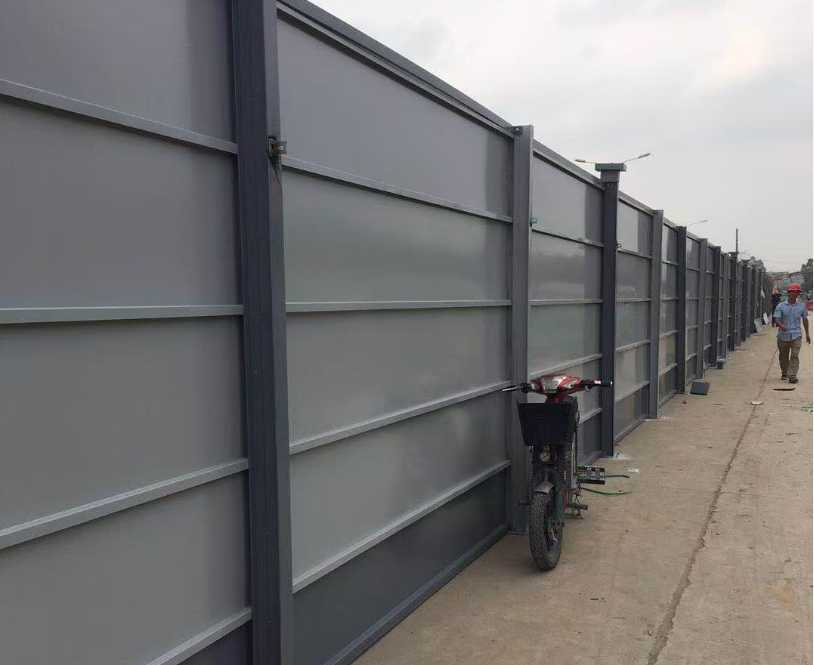
Guangzhou A2-2 Construction Hoarding (model Y077): a large-span prefabricated steel hoarding built on a rigid H-section steel frame, referenced in a 3,000-metre project.
Problem Definition: What a Site Perimeter Barrier Is Actually Asked to Do
A site perimeter barrier can be asked to perform up to four separate jobs, and most specification errors begin when one product is expected to do all of them.
- Screening. Hiding site activity, stored materials and unfinished structures from public view, and giving the boundary a deliberate appearance.
- Separation and deterrence. Making the boundary physically legible and discouraging unauthorised crossing or climbing.
- Access control. Providing controlled points where people, vehicles and materials enter and leave.
- Relocation and reuse. Being dismantled at the end of a phase and reinstalled on the next one without loss.
The two systems are not equally good at all four. In Santian's own application data, prefabricated steel construction hoarding is described as enclosing and visually screening work sites or providing designated display surfaces, while security fence mesh is described as delineating a secure boundary and deterring climbing, with detection and access-control functions supplied as separate equipment. That distinction is the core of the decision: screening and deterrence are different functions, and a buyer who confuses them usually pays for the wrong one.
Industry Background: Why the Perimeter Choice Moved Up the Agenda
Steel dominates this product category, and the underlying market is large. Grand View Research values the global barrier systems market at USD 24.8 billion in 2025 and reports that the metal segment accounted for the largest material share, above 50.0%, in the same year. The same publisher values the global temporary guardrail market at USD 2.4 billion in 2024. These figures describe barrier systems broadly rather than site hoarding alone, but they explain why so many hoarding and mesh systems are engineered around steel frames, steel posts and steel panels.
Alongside the market, the practical pressure has shifted toward the street edge. Municipal works, road construction and building sites are the standard application set for prefabricated steel hoarding, and those are exactly the sites where public visibility, dust, noise and pedestrian movement are most scrutinised. Industrial parks, factories and perimeter-security projects form the standard application set for security fence mesh, where the boundary must stay legible for patrols, cameras and access control.
Two standard families are often raised in the same conversation and should be kept separate. EN 1317 is the mandatory European standard for vehicle restraint systems permanently installed on roads, and AASHTO MASH 2016 is the current evaluation standard for new permanent roadside hardware in the United States. Both are written around permanent roadside hardware, so neither is the reference document for a temporary site hoarding. Site hoarding and perimeter security requirements are typically governed by local site-safety, planning or municipal rules, and the applicable document has to be confirmed for the project location. For cross-border procurement, road guardrail shipments are commonly classified under HS code 73089099 according to trade-data aggregators, which is a customs question rather than a performance one.
The Two Systems, Defined
Prefabricated Steel Construction Hoarding
Prefabricated steel construction hoarding is a panel-and-post system assembled on site to form a continuous, screening boundary. In the Santian range, the hoarding family runs from model Y073 to model Y084, with a custom specification and a design service life of up to five years across the range.
Configurations differ in frame, panel and finish rather than in purpose. The Guangzhou A1-1 Construction Hoarding (model Y073) uses a square-steel frame with colour-coated steel panels and modular assembly, and has been applied on a 1,600-metre project in Nansha. The Guangzhou A2-2 Construction Hoarding (model Y077) is a large-span configuration with a rigid H-section steel frame, referenced in a 3,000-metre project. The Guangzhou A2-1 Construction Hoarding (model Y076) combines H-section posts with colour-coated steel panels, and its panel system is reusable for more than five installation cycles. The Artificial Grass Construction Hoarding (model Y078) carries a steel internal structure with an artificial grass outer surface that can be replaced or renewed, and is positioned around integration with urban landscaping. The Perforated Construction Hoarding (model Y082) is the perforated variant in the same family.
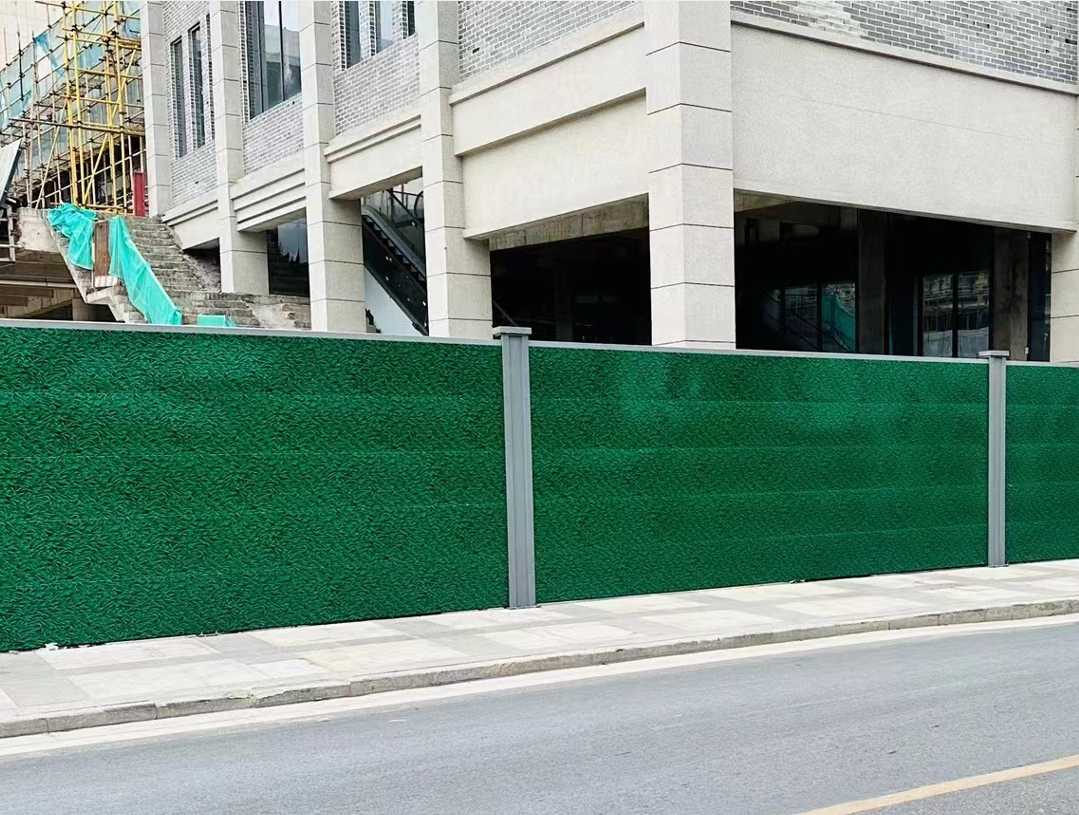
Guangzhou A1-1 Construction Hoarding (model Y073): modular colour-coated panels on a square-steel frame, applied on a 1,600-metre Nansha project.
Security Fence Mesh
Security fence mesh is a fixed mesh perimeter system in which welded steel mesh panels are carried on steel posts, with a top treatment that determines the anti-climb behaviour. The Santian range covers three treatments: the Anti-Climb Spike Security Fence (model Y070) uses hot-dip galvanised steel with steel-tube posts and welded steel mesh panels, finished with top anti-climb spikes; the Angled-Top Security Fence (model Y071) uses an angled top for inherent anti-climb protection and has been applied on a 6,000-metre perimeter project; and the Razor-Wire Anti-Climb Security Fence (model Y072) adds a razor-wire top treatment.
The declared application set is industrial parks, factories and perimeter-security projects, and the operating mode is passive, fixed mesh perimeter protection. Detection and access-control functions require separate equipment where specified — mesh defines and deters, it does not sense.
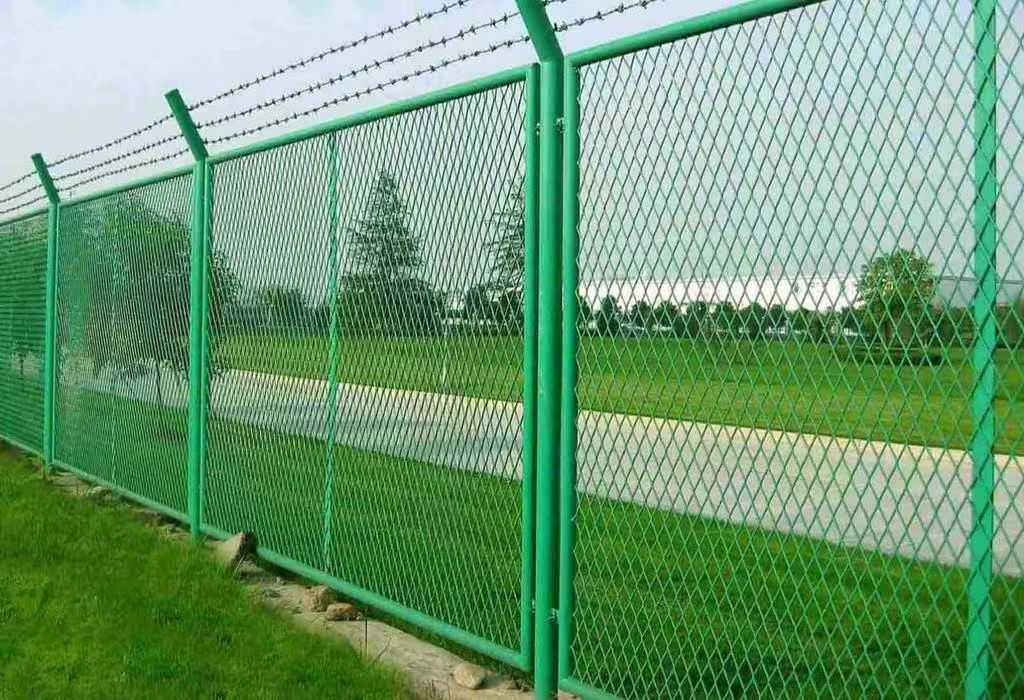
Anti-Climb Spike Security Fence (model Y070): hot-dip galvanised welded steel mesh on steel-tube posts with top anti-climb spikes.
Head-to-Head Trade-offs
Visual Blocking and Sightlines
This is the cleanest difference between the two systems. A hoarding presents a continuous panel face and is specified precisely because the site behind it should not be read from the street; the Santian hoarding application data states visual screening of work sites as a function, and also allows the boundary to serve as a designated display surface for project information. Security fence mesh does the opposite by design — the mesh is open, so the boundary stays visible to patrols, cameras and neighbouring operations, and the fence is read as a line rather than a wall.
The decision rule follows directly. If neighbours, pedestrians or a municipal frontage must not see the work, mesh will not solve it. If the client, the security team or the operating model needs line of sight across the boundary, a solid hoarding works against them.
Airflow, Wind and Panel Behaviour
A solid panel presents a continuous surface; a welded mesh panel is open by construction. In practice that means a hoarding intercepts wind over its full face, while mesh lets a substantial part of the flow pass through, and it means a hoarding accumulates the dust, splash and debris that a mesh fence sheds.
Neither behaviour is automatically better. A long, exposed hoarding line needs a structural design that accounts for the wind load on a continuous face, and the anchoring or ballast system is a project-dependent item rather than a standard inclusion. A mesh perimeter is lighter in wind terms but provides no screening at all. Where a project wants a middle position, the perforated hoarding variant (model Y082) sits inside the hoarding family, and the actual open area and structural performance must be confirmed against the project specification rather than assumed.
Access Control
Both systems are passive barriers, and both leave access to be engineered separately. In the hoarding application data, access gates, warning signs, temporary lighting and approved anchoring or ballast systems are listed as project-dependent matched equipment rather than standard inclusions. For security fence mesh, gates, access-control readers, CCTV cameras, intrusion sensors and perimeter lighting are listed in the same project-dependent way, and detection and access control are explicitly separate functions.
This matters commercially. The barrier line is usually the cheapest part of the perimeter package; the gates, the interlocking, the anchoring design and the inspection regime are where projects either hold their programme or lose it. A hoarding boundary typically needs fewer, larger, vehicle-rated access points because the site behind it is a working compound. A mesh perimeter usually needs more frequent controlled openings and a clearer relationship with surveillance equipment.
Relocation and Reuse
Hoarding is modular by construction, and relocation is an accepted part of its life. The Santian hoarding application data states that relocation or reuse depends on model condition and the project plan — a reminder that reuse is a condition-based decision, not a promise. Where reuse is a stated project objective, the panel system matters: the Guangzhou A2-1 Construction Hoarding (model Y076) is declared reusable for more than five installation cycles, and the Artificial Grass Construction Hoarding (model Y078) allows the artificial grass outer surface to be replaced or renewed.
Security fence mesh is described as fixed perimeter protection. It is installed to define a boundary that stays in place, and the product data does not position it as a relocatable system. For a project with two or three phases on the same site, hoarding is the natural candidate; for a permanent factory or industrial park boundary, mesh is.
Service Life, Finish and Maintenance Planning
The hoarding range carries a design service life of up to five years, which frames it as a medium- and long-term temporary asset rather than a permanent structure. The mesh range is built around corrosion resistance in service: model Y070 uses hot-dip galvanised steel for posts and welded mesh, and model Y071 uses an angled top with a specified material selection per project.
Maintenance planning should follow the finish rather than the product name. Colour-coated steel panels, hot-dip galvanised mesh and replaceable artificial grass surfaces age at different rates and are restored by different methods, so the inspection interval should be set against the coating system actually supplied. For outdoor steel systems in general, inspection should cover posts, rails, welds, bolts and connection points, corrosion, deformation and coating damage, with cleaning of dirt, salts and chemical deposits and prompt repair of minor coating damage.
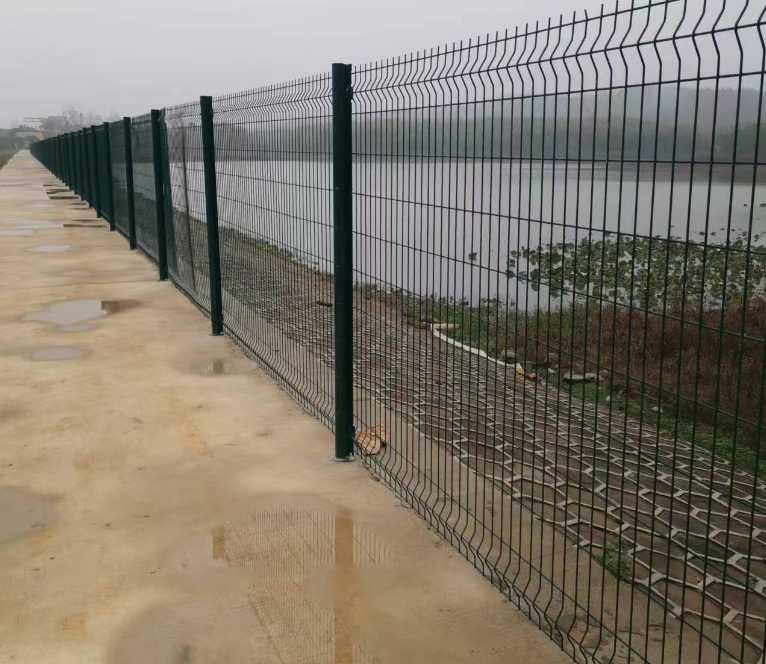
Angled-Top Security Fence (model Y071): the angled top provides inherent anti-climb protection; referenced on a 6,000-metre perimeter project.
Comparison Table: Hoarding vs Security Fence Mesh at the Site Perimeter
| Decision criterion | Prefabricated steel construction hoarding | Security fence mesh |
|---|---|---|
| Primary function stated in the product data | Encloses and visually screens work sites; can serve as a designated display surface | Delineates a secure boundary and deters climbing |
| Visual blocking | Continuous panel face; screening is the purpose | Open mesh; boundary stays visible by design |
| Airflow | Full-face interception; wind and anchoring design are project-specific | Open welded mesh; substantially permeable |
| Anti-climb | Determined by panel height, top detail and gate design; confirm in the project specification | Purpose-built top treatments: spike (Y070), angled top (Y071), razor wire (Y072) |
| Access control | Gates and anchoring/ballast are project-dependent matched equipment | Gates, readers, CCTV, sensors and lighting are separate project equipment |
| Relocation and reuse | Modular assembly; reuse depends on model condition and the project plan; Y076 panels reusable for more than five installation cycles | Specified as fixed perimeter protection |
| Design service life | Up to five years across the Y073–Y084 range | Set by the project specification and finish |
| Declared application set | Municipal works, road construction, building sites, medium- and long-term projects | Industrial parks, factories, perimeter-security projects |
| Documented project references | Y073: 1,600-metre Nansha project; Y077: 3,000-metre reference project | Y071: 6,000-metre perimeter project |
Step-by-Step Breakdown: How to Decide on a Real Project
Step 1 — State what the boundary must stop
Write down the four jobs in order of importance: screening, separation, access, relocation. If screening is first, the decision is effectively made. If visible perimeter security is first, mesh leads.
Step 2 — Read the site exposure
Establish how long the boundary must stand, whether it faces public streets, whether wind is unobstructed, and whether the ground allows anchors or requires ballast. Anchoring and ballast are approved systems that must be specified, not assumed.
Step 3 — Fix the screening requirement before the product
Decide whether the site must be hidden, partially screened, or deliberately visible. Perforated panel options sit within the hoarding family, but the open area and structural performance must be confirmed against the project specification.
Step 4 — Design the top detail and access points together
Anti-climb tops on mesh and gates on either system interact. A perimeter is only as controlled as its openings, so the gate schedule and the top treatment should be drawn at the same time.
Step 5 — Plan the relocation path
If the boundary will move between phases, choose a modular hoarding system and record panel condition at each dismantle. Reuse depends on model condition and the project plan, and the number of achievable cycles differs by system.
Step 6 — Confirm the governing documents
Identify the local site-safety, planning or municipal requirement that applies to the boundary, and keep vehicle-restraint standards such as EN 1317 and MASH 2016 in their proper place — permanent roadside hardware, not temporary hoarding.
Step 7 — Verify by inspection, not by assumption
Inspect posts, panels, welds, fasteners, anchors and coatings at installation and at each phase change, and record defects before components are reused or reinstated.
Use Cases: Where Each Choice Fits
Municipal road construction and building sites with public frontage. Prefabricated steel hoarding is the standard answer, because the boundary has to screen the works and present a controlled elevation. The Guangzhou A1-1 (Y073) and Guangzhou A2-2 (Y077) configurations cover the ordinary range, with the A2-2 offering a large span on an H-section frame.
Sites where appearance is part of the brief. The Artificial Grass Construction Hoarding (Y078) integrates a replaceable artificial grass surface with a steel structure, and the vertical green wall configuration sits in the same hoarding family. These are screening products, not security products.
Multi-phase sites that will relocate the boundary. A modular hoarding system with a declared reuse cycle such as Y076 is the practical choice, provided panel condition is inspected at each dismantle.
Industrial parks, factories and logistics boundaries. Security fence mesh is the standard answer. The angled-top Y071 has been applied on a 6,000-metre perimeter and is positioned as an economic solution for large industrial parks; Y070 adds spike-topped anti-climb; Y072 adds razor wire where the security assessment calls for it.
Mixed boundaries. Many real sites run both. A public-facing frontage is hoarded for screening, while the rear and side boundaries facing open land or neighbouring industry are fenced in mesh for visibility and deterrence. This is a layout decision, not a compromise.
Where neither fits alone. A boundary that must both screen and resist climbing needs a hoarding line with a designed top and gate detail; mesh alone will not screen, and standard hoarding alone is not an anti-climb product. That combination should be drawn, priced and inspected as one system.
Where Santian Fits in This Decision
Guangzhou Santian Steel Structure Co., Ltd., publishing at aotianguardrail.com, is a China-based manufacturer of municipal guardrails, railings and construction site hoarding systems, operating from Guangzhou with industry experience dating back to 2011 and formal registration on 16 May 2016. The company runs a production facility of approximately 15,000 square metres with around 200 employees, a 50-engineer R&D team and annual output stated at 1,500,500 metres, and it exports about 50% of its output to Southeast Asia, Africa, South America and the Middle East.
For this specific decision, the relevant point is range coverage: the same manufacturer supplies both sides of the comparison. The hoarding family runs from Y073 to Y084, including the A1-1 and A2-2 configurations and the perforated and artificial-grass variants, while the security fence mesh family covers Y070, Y071 and Y072. Products are customised against project drawings, site conditions, safety requirements and visual design needs, and the company supports contractor projects with delivery support for road construction safety barriers and guardrails. Buyers comparing quotes across the two systems can therefore hold one specification conversation instead of reconciling two suppliers' assumptions.
Frequently Asked Questions
Do construction hoarding and security fence mesh follow the same standards?
No. EN 1317 is the mandatory European standard for vehicle restraint systems permanently installed on roads, and AASHTO MASH 2016 is the current evaluation standard for new permanent roadside hardware in the United States; both are written around permanent roadside hardware rather than temporary site hoarding. Site hoarding and perimeter security requirements are typically set by local site-safety, planning or municipal rules, so the applicable document must be confirmed for the project location. Security fence mesh at an industrial perimeter is normally specified against the site owner's security requirement.
Can one manufacturer supply both hoarding and security fence mesh?
Yes. Santian's construction hoarding range covers models Y073 to Y084 — including the Guangzhou A1-1 (Y073), Guangzhou A2-2 (Y077), Guangzhou A2-1 (Y076), Artificial Grass (Y078) and Perforated (Y082) configurations — and its security fence mesh range covers the Anti-Climb Spike (Y070), Angled-Top (Y071) and Razor-Wire Anti-Climb (Y072) models. The company operates a facility of approximately 15,000 square metres with around 200 employees and a 50-engineer R&D team.
Can a hoarding boundary be relocated to the next phase?
Relocation is normal for modular hoarding, but reuse depends on model condition and the project plan rather than on the product name alone. Panels should be inspected at each dismantle, and fasteners and damaged components replaced. Some configurations are explicitly designed for repeated cycles: the Guangzhou A2-1 Construction Hoarding (model Y076) panel system is reusable for more than five installation cycles, and the Artificial Grass Construction Hoarding (model Y078) allows the artificial grass outer surface to be replaced or renewed. Gates and approved anchoring or ballast systems remain project-dependent items.
What drives the cost difference between the two systems?
Price is quoted per project rather than published, and the main cost drivers are the frame and panel system, the height and total length of the boundary, the top treatment, gates and access points, the approved anchoring or ballast method, the coating or surface finish, and the design life and reuse cycles required. A quotation is normally prepared from the product type, dimensions, quantity, material, surface finish, drawings, installation location, applicable standards, delivery destination and packaging requirements; site photographs help where drawings are not yet available.
What should be confirmed before placing an order?
Confirm the application, dimensions, material, surface treatment, safety requirements, quantity, installation environment and applicable standards before ordering, and match the specification to the approved drawings and site conditions. Both hoarding and railing systems can be customised to project drawings and architectural requirements, so the specification stage is where most site problems are prevented. The manufacturer's catalogue with the full product range is available for download at the Santian product brochure.
Conclusion: Decide From the Boundary, Not From the Catalogue
Steel hoarding and security fence mesh are both steel perimeter systems, and that is where their similarity ends. Hoarding exists to screen, define and present a site boundary for a medium- or long-term programme, and the Y073–Y084 range shows how much of that decision is carried by frame, panel and finish rather than by the word hoarding. Security fence mesh exists to keep a perimeter visible and resistant to climbing, and the Y070–Y072 range shows how much of that decision is carried by the top treatment.
A practical decision therefore runs in this order: what must the boundary stop, how long must it stand, what must remain visible, and will it move. Screening-first answers point to hoarding; visibility-and-deterrence answers point to mesh; multi-phase programmes point to modular hoarding with a declared reuse cycle; and mixed boundaries often need both along different sections. None of those conclusions requires a universal winner — only a clear statement of what the perimeter is for.
Next Step
Send the site plan, boundary length, programme duration and the job the perimeter must perform, and the specification can be matched to the right system — hoarding, mesh, or a combination along one boundary.
Download the catalogue: Santian product brochure (PDF)
Website: aotianguardrail.com
Email: info@aotianhouse.com
Tel / WhatsApp: +86 189 2407 9286
Address: No. 21-1, Fuling East Road, Shangshao Village, Xintang Town, Zengcheng District, Guangzhou City, China
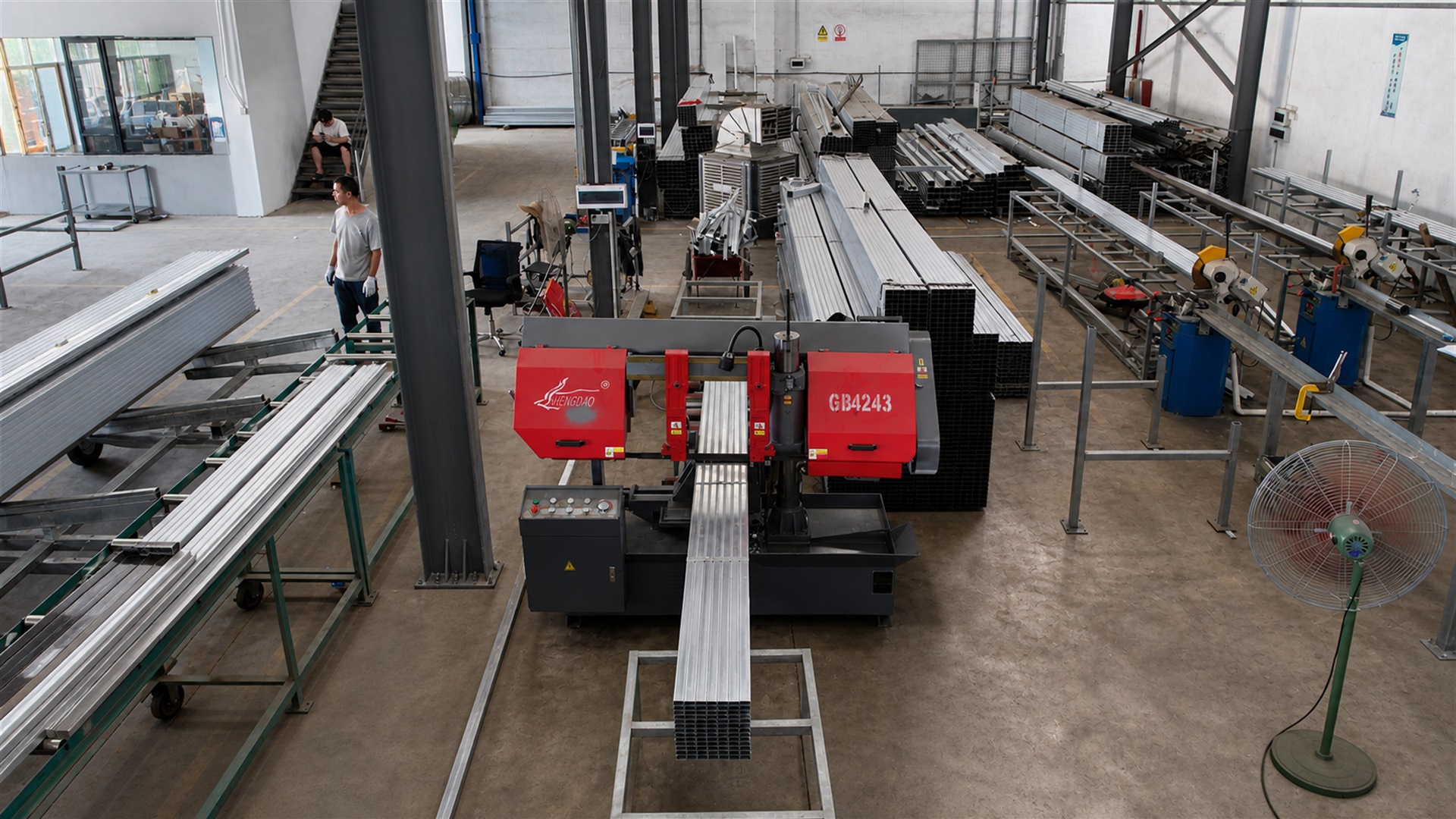
Fabrication workshop at Santian, where hoarding panels, frames and steel perimeter systems are produced to project specifications.
Have Questions or Need More Details?
Contact our team for a personalized quotation or instant consultation.
Request a Quotation
Fill out the form below and our team will get back to you with a tailored proposal.
WhatsApp Direct Chat
Prefer to chat in real-time? Message us on WhatsApp for instant assistance & quick answers.
- Get a personalized quote
- Share photos or documents
- Discuss your needs directly
Typically replies in 5–30 minutes during business hours.