Private Label Cookware Sets: From OEM Brief to Bulk Order
A private label cookware set is a multi-piece pots and pans set manufactured to a brand owner's written specification and sold under that brand owner's name rather than the factory's. For a nonstick set, the specification has to settle three things before tooling or bulk production begins: the coating system, the base construction that carries it, and the evidence pack that proves both are safe and compliant in the destination market. Everything else — piece count, handle design, packaging, logo — sits on top of those three decisions.

What a private label cookware set actually includes
A cookware set is a configuration decision before it is a product. The buyer chooses how many pieces go in the carton, which pieces carry a nonstick coating and which stay bare stainless steel, which diameters map to the target market's cooking habits, and whether the set is sold as an open-stock starter kit or a boxed gift programme. Two brands can order the same factory output and end up with products that feel unrelated to a shopper, because the set architecture — not the factory — is what the shopper actually sees on the shelf.
For the nonstick portion specifically, the specification usually has to define the substrate (aluminium or a clad stainless body), the coating system and its application method, the interior finish, the handle material and attachment, and the declared care instructions. Each of those choices changes what testing is required, what the packaging must say, and what the buyer can legally claim in the market where the set will be sold.
Under private label, one more layer is added: the buyer's logo, brand colours, packaging artwork, barcodes and language variants must all be approved against a physical sample before the run starts. A private label set is therefore a document-driven product as much as a manufactured one.
The real problem: nonstick sets break at the brief, not at the factory
Most private label cookware failures are not production accidents. They are specification failures that were locked in months earlier. AurumDine's own procurement guidance identifies four recurring risks in OEM and private label cookware sourcing: inconsistent product quality, failure to meet the destination market's food-contact safety requirements, production and delivery delay, and design or intellectual property infringement.
The same guidance explains when those risks actually trigger. They appear when product specifications, material standards, certification rules and lead times were not fully confirmed and signed off before mass production — or when a program moved forward without pre-production sample approval and without in-line quality inspection.
Nonstick sets are unusually exposed to this pattern. The coating is the part of the product a shopper judges first and the part a regulator examines most closely, yet it is often described in a purchase order with a single word. Two sets can both be called “nonstick” and differ completely in substrate thickness, coating build, abrasion behaviour and the documentation that backs the food-contact claim.
Industry background: demand, materials and where sets are made
The category is large and it is not slowing down at the retail level. Grand View Research valued the global cookware market at USD 32.4 billion in 2025, and reported that stainless steel cookware held the largest material share at 33.9% in that year. On the supply side, Asia Pacific accounted for a 38.1% revenue share of the cookware market in 2025, with China the largest single contributor.
Private label is expanding inside that market rather than beside it. The Private Label Manufacturers Association reported that private label sales in the United States reached USD 270.6 billion across all categories in 2024, with store brands gaining momentum in general merchandise that includes kitchenware. For a cookware buyer, that figure matters less as a headline and more as a signal: retail buyers are now comfortable putting their own name on a cookware set, which raises the standard of the specification behind it.
Customs classification is a separate working detail. Stainless steel kitchenware — pots, pans and teakettles — falls under HS Code 7323.93.00 in the US Harmonized Tariff Schedule. Buyers should confirm classification for the actual construction they order, because a coated aluminium nonstick set and a bare stainless set do not necessarily travel under the same code.

How AurumDine runs a private label nonstick set program
AurumDine is a Shanghai-based kitchen products company that supplies cookware sets, kitchen appliances and drinkware to brand owners and retailers, with roughly 80% of output exported to the EU and USA. Its company profile lists a 30,000 m² production base, 120 employees, a 25-engineer team, and a declared annual output of 150,000 units. Design, sourcing and quality control are handled by the Shanghai team, with production run by selected manufacturing partners to AurumDine's specification.
That structure is worth understanding before a buyer writes a brief. It means the commercial relationship is with a specification owner and quality gate, not with a single press line. For private label work, the practical effect is that the specification has to be written before the first sample is made — because the sample is what everything downstream is measured against.
Customisation scope: logo, finish and packaging
AurumDine provides OEM production services and offers full private label customisation covering design, logo, finish and packaging. In practice, that means a buyer is not limited to picking a stock set and stamping a logo on the carton. The set composition, the exterior finish, the handle treatment and the packaging artwork can all be brought into the brand's range.
Customisation comes with an obvious discipline: every deviation from a stock configuration has to be written down and approved on a physical sample. Logo placement, colour matching and packaging dielines are exactly the items that generate disputes later if they were agreed verbally.
Capacity, MOQ and lead time
The declared monthly production capacity is 8,000 units, with a minimum order quantity of 2 units and a production lead time of 30 days. The very low MOQ figure is useful for sample and validation orders; buyers planning a full retail launch should confirm in writing whether the quoted MOQ applies to stock configurations or to fully custom builds, because the two are normally handled differently.
Against a 8,000-unit monthly capacity, a mid-sized private label launch is a manageable share of a single month's output. The lead time matters more than the capacity for planning purposes: 30 days is the production window, and it does not include sampling, artwork approval, testing or shipping. Those stages sit before and after it on the timeline and are usually what actually determines the in-store date.
Quality control and food-contact evidence
Quality control is stated as 100% testing, and after-sales support is provided remotely. Both are relevant to a nonstick set program: 100% testing addresses the cosmetic and assembly defects that generate retail returns, while remote support covers the specification questions that arrive after the first shipment.
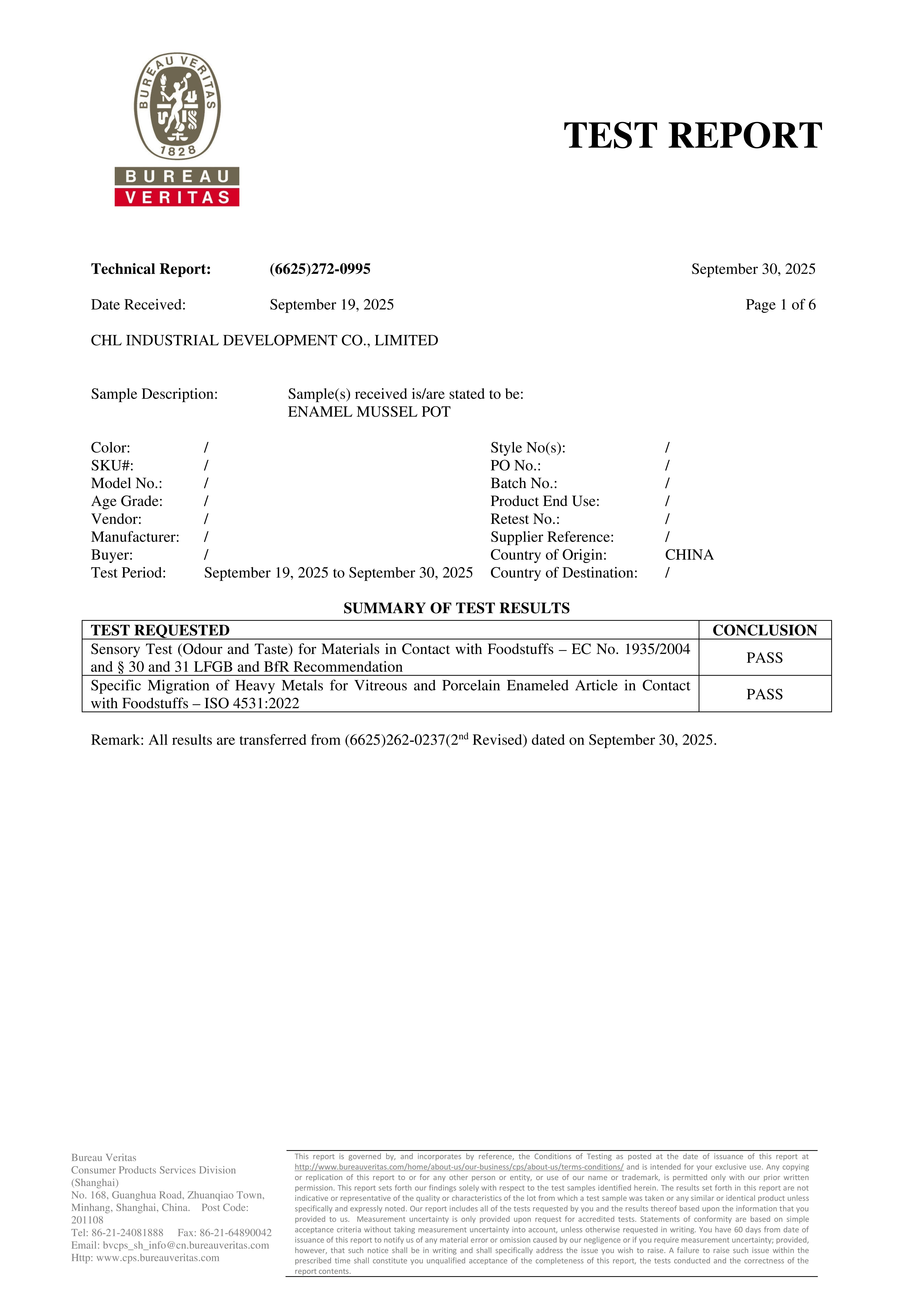
On compliance, AurumDine holds a Bureau Veritas food contact test report, certificate number (6625)272-0995, issued 30 September 2025. It covers an enamel mussel pot, tested against EC No. 1935/2004, § 30 and 31 LFBG, BfR Recommendation, and ISO 4531:2022.
That distinction is not a technicality. EU framework rules require that food-contact materials placed on the market comply with Regulation (EC) No 1935/2004, be manufactured under good manufacturing practices per Commission Regulation (EC) No 2023/2006, and carry traceability measures that allow a recall or public information where necessary. The framework also requires that materials do not transfer constituents to food at levels harmful to health, or cause unacceptable changes in food composition, taste or odour. None of those obligations can be satisfied by a general statement — they are satisfied document by document, article by article.
From brief to bulk order: a seven-step breakdown
The sequence below reflects AurumDine's documented sourcing and risk-control guidance. It is written for a nonstick set, but the logic holds for stainless and ceramic configurations.
- Define the set architecture. Fix the piece count, diameters, which pieces are nonstick and which are not, lid configuration and carton format. Confirm the target market and intended use at the same time, because both determine the coating and labelling requirements.
- Lock the coating and substrate specification. Name the substrate, the coating system, the interior finish and the care instructions the packaging will carry. Do not accept “nonstick” as a specification.
- Resolve the compliance and test plan. Confirm the food-contact requirements for the destination market, the test scope for the actual coating and substrate, and the traceability documentation that must accompany each batch. Request model-specific evidence rather than a general certificate pack.
- Approve the pre-production sample. The sample is the reference point for everything that follows. Approve the physical sample together with written specifications and packaging artwork, so that “as approved” has a defined meaning.
- Confirm commercial terms in writing. Minimum order quantity, unit price for the approved configuration, packaging cost, production lead time, payment terms, inspection criteria and warranty coverage should all be confirmed before the order is released.
- Run in-process and pre-shipment inspection. AurumDine states 100% testing. Combine that with the inspection criteria agreed at step five, so the check is against the buyer's standard, not the factory's default.
- Plan the repeat order. Once bulk has shipped, the approved sample and written specification become the baseline for reorders. Where non-conformity occurs, AurumDine's stated position is to arrange rework or replacement under the agreed contract terms.
Use cases: where private label nonstick sets are actually deployed
Grocery and mass retail own-brand programmes. Retailers building a first cookware range usually start with a nonstick set because it is easy to merchandise, easy to explain and easy to price into an entry tier. The specification work concentrates on coating durability and packaging language.
Specialist kitchen retailers and premium gift sets. A boxed multi-piece set sold as a gift requires a higher finish standard and tighter colour matching than an open-stock range. Customisation of finish and packaging carries most of the value here.
Online-native and marketplace brands. These buyers typically prioritise a small validation order before committing to volume, which is where a low minimum order quantity and a documented sample process matter most. Because the buyer cannot inspect the product physically before listing, the approved sample and the test report become the listing's evidence base.
Distributors and regional wholesalers. A distributor selling under its own name needs a set that fits several retail accounts at once, so the specification tends to be a compromise on piece mix rather than a single retailer's ideal.
Residential kitchen and hospitality-adjacent projects. AurumDine records an OEM case covering a 20-unit residential kitchen order that ran for one year with stable operation. It is a small programme, but it demonstrates the same workflow applied at project scale rather than retail scale.
Comparison table: what a nonstick set brief must confirm, and what evidence closes it
| Procurement checkpoint | Why it decides the order | Documented AurumDine position |
|---|---|---|
| Set composition and piece mix | Defines the retail price tier and the carton | Cookware Sets are the core product group; composition confirmed per brief |
| Coating and substrate specification | Drives performance claims, care instructions and test scope | Specification confirmed per model; OEM production with design, logo and finish customisation |
| Food-contact evidence | Required for legal sale in the destination market | BV food contact test report (6625)272-0995, scope: enamel mussel pot; product-specific report required for a nonstick set |
| Branding and packaging | Separates a private label set from a stock set | Full private label customisation: design, logo, finish, packaging |
| Minimum order quantity | Determines whether a validation order is viable | 2 units stated; stock versus custom quantities confirmed separately |
| Production capacity and lead time | Sets the in-store date | 8,000 units per month; 30-day production lead time |
| Quality control | Reduces retail returns and chargebacks | 100% testing stated |
| After-sales | Covers specification questions after shipment | Remote support |
The table is a checklist, not a scorecard. Its purpose is to make clear which items are already documented and which still require a decision on the buyer's side. The coating and food-contact rows are the two that cannot be closed by a general assurance.
Risks buyers should close before releasing a bulk order
The four risks identified in AurumDine's sourcing guidance — quality inconsistency, food-contact non-compliance, delivery delay and IP infringement — each have a specific countermeasure, and each countermeasure is a document rather than a promise.
- Quality inconsistency is closed by a locked specification, an approved pre-production sample, and in-process plus pre-shipment inspection against agreed criteria.
- Food-contact non-compliance is closed by confirming the destination market's requirements first, then commissioning product-specific test reports for the actual coating and substrate.
- Delivery delay is closed by written confirmation of the production lead time and shipping schedule, and by treating the 30-day production window as one block in a longer timeline that includes sampling, testing and freight.
- IP infringement is closed by confirming design ownership and artwork rights before the packaging goes to print.
Buyers should also confirm model, installation space where relevant, and the food-contact documents and cleaning instructions that apply to the specific item, rather than assuming that one certificate in a supplier's file covers the whole range.
Frequently asked questions
Which food-contact documents should a buyer request for a private-label nonstick cookware set?
For the EU, request evidence that the food-contact materials comply with Regulation (EC) No 1935/2004, that they are manufactured under good manufacturing practices per Commission Regulation (EC) No 2023/2006, and that traceability measures are in place for recall purposes. Alongside the framework documents, request a product-specific test report for the actual coating and substrate. AurumDine holds a Bureau Veritas food contact test report, certificate (6625)272-0995, issued 30 September 2025, tested to EC No. 1935/2004, § 30 and 31 LFBG, BfR Recommendation and ISO 4531:2022 — but its stated scope is an enamel mussel pot, so it does not substitute for a nonstick set report.
Can a nonstick cookware set carry our logo, finish and packaging?
Yes. AurumDine provides OEM production services and states full private label customisation covering custom design, logo, finish and packaging. The buyer is therefore not restricted to a stock set with a printed carton. Each custom element should be approved on a physical sample and written into the specification, because logo placement, colour matching and packaging artwork are the items most often disputed after production starts.
How should a first order be structured to control budget risk?
AurumDine states a minimum order quantity of 2 units, which allows a small validation order before a full retail commitment, against a declared monthly capacity of 8,000 units. Price itself depends on the approved configuration — set composition, substrate, coating system, finish and packaging — so it has to be quoted against a locked specification rather than estimated in advance. Structuring the programme as sample, then validation quantity, then bulk is the sequence that keeps cost exposure proportionate to what has actually been verified.
How does sampling work before bulk production?
A pre-production sample is approved against written specifications, material standards and packaging artwork. AurumDine's own risk guidance names the absence of pre-production sample approval as one of the conditions under which quality and compliance failures occur, so the sample stage is treated as a control point rather than a formality. Once approved, the physical sample becomes the reference against which in-process and pre-shipment inspection are carried out.
What production lead time and after-sales support are included?
Production lead time is 30 days, with quality control stated as 100% testing and after-sales support provided remotely. The 30-day figure covers production only; sampling, artwork approval, product-specific testing and shipping run in addition to it, so the in-store date should be planned from the longest of those paths. To start a specification review or request a sample against your brief, contact AurumDine at support@aurumdine.com or via WhatsApp on +86-18101697558.
Conclusion
Private label cookware sets succeed or fail on the specification, not on the factory floor. A nonstick set sold under a retailer's or brand owner's name carries three obligations at once: a coating and substrate combination the buyer has defined, a set architecture that fits the market it is sold into, and a food-contact evidence pack that matches the actual article rather than a neighbouring one.
AurumDine's documented position gives a buyer concrete starting points — OEM production with design, logo, finish and packaging customisation; a stated minimum order quantity of 2 units; 8,000 units of monthly capacity; a 30-day production lead time; 100% testing; and remote after-sales support — against a compliance file that is honest about its scope. The next step is to put the brief on paper, confirm which evidence applies to the specific nonstick construction, and approve a sample before any bulk commitment is made.

Next step for buyers
Send your set composition, target market and packaging direction to AurumDine, and request a sample against the specification. Website: www.aurumkitchen.com | Email: support@aurumdine.com | WhatsApp: +86-18101697558
Have Questions or Need More Details?
Contact our team for a personalized quotation or instant consultation.
Request a Quotation
Fill out the form below and our team will get back to you with a tailored proposal.
WhatsApp Direct Chat
Prefer to chat in real-time? Message us on WhatsApp for instant assistance & quick answers.
- Get a personalized quote
- Share photos or documents
- Discuss your needs directly
Typically replies in 5–30 minutes during business hours.