Private Label Cookware Sets: Stainless Steel Compliance
Private label sourcing guide / HVQ2 constraints
A private label stainless steel cookware set is only as reliable as the documents that name the exact product. For buyers in research and evaluation, the first decision is not the unit price. It is whether the supplier can match product scope, material grade, food-contact evidence, MOQ and lead time to the SKU you intend to sell.

AurumDine is a Shanghai-based kitchenware supplier that lists cookware sets among its kitchen essentials and works with selected production partners. Its recorded profile includes a 30,000 m² facility, 120 employees, 25 engineers, annual output of 150,000 units and an 80% export ratio to the EU and USA. The company website is www.aurumkitchen.com. Those facts describe capability and scale. They do not replace a model-level test report, a steel-grade certificate or an approved sample.
This guide treats private label cookware sets as a compliance and specification problem. It shows what to lock before a purchase order, how to read a certificate scope, and where the aurumkitchen Cookware Sets range fits into a buyer's evaluation file.
Problem definition: a certificate is not a category clearance
The most common sourcing error in this category is to accept a supplier's general compliance statement as proof for every cookware item in the catalogue. A certificate number can be real, issued by a recognised laboratory and still irrelevant to the SKU in the buyer's RFQ. The test report must name the product, the food-contact material and the standard used. Without that link, the buyer has a document, not an approval.
This distinction matters because private label cookware sets combine several materials and interfaces: the cooking surface, the base, the rim, handles, lids, rivets and any coating or finish. A report for one pot does not automatically cover a multi-piece set. A certificate for a coating does not automatically cover the stainless steel body. A statement that a product is food-grade does not replace a migration test or a declaration of compliance.
Three failures repeat in buyer files. First, the certificate is older than the specification or covers a discontinued finish. Second, the report covers a component, such as a coating or a lid, but is presented as a set-level approval. Third, the supplier's declaration is written in general terms and does not identify the manufacturing site, the steel grade or the batch traceability method. Each failure shifts risk to the importer or the brand owner.
- Product-scope failure: the report names a different item or a different set composition.
- Material-scope failure: the steel grade or coating in the report does not match the approved sample.
- Market-scope failure: the evidence is valid for one destination but not for the target market.
Industry background: why stainless steel and private label are linked
The global cookware market was valued at USD 32.4 billion in 2025. Stainless steel held the largest material share at 33.9% in 2025. Asia Pacific accounted for 38.1% of market revenue in 2025, with China the largest revenue contributor. These figures explain why so many private label programmes start with Asian stainless steel supply chains. They do not prove that every supplier in the region has the same capability.
Private label demand is also structural. Private label sales in the US reached USD 270.6 billion across all categories in 2024, with store brands gaining momentum in general merchandise including kitchenware. For a retail brand, a cookware set is a visible shelf item: it carries the brand name, the price architecture and the quality promise. That is why the compliance file has to be built before the packaging is printed.
Trade classification adds a practical layer. Stainless steel kitchenware is classified under HS Code 7323.93.00, which includes pots, pans and teakettles. The code helps customs and logistics, but it does not certify food-contact safety. A buyer still needs product-specific evidence for the destination market.
In the European Union, food-contact materials placed on the market must comply with Regulation (EC) No 1935/2004. Manufacturing must follow good manufacturing practices under Commission Regulation (EC) No 2023/2006. The framework also requires traceability measures and provides that materials must not transfer constituents to food at levels harmful to health or cause unacceptable changes in food composition, taste or odour. These are framework obligations. They must be translated into product-specific test reports and batch records for the actual cookware set.
Detailed solution: a four-lock sourcing file
The workable solution is not a longer supplier questionnaire. It is a four-lock file that connects the market, the product, the evidence and the commercial terms. Each lock should be closed before mass production.
1. Market lock: write the destination into the specification
Start with the destination market and the channel. An EU retail set, a US e-commerce set and a gift set sold through distributors may share a factory line but not the same evidence file. For the EU, the file should reference Regulation (EC) No 1935/2004, GMP under Commission Regulation (EC) No 2023/2006 and traceability. For other markets, the buyer should confirm the applicable food-contact rules with the importer or a qualified compliance adviser. Do not assume that one market's certificate covers another.
2. Product lock: define the set, not just the category
A private label cookware set needs a line-by-line specification: set composition, diameter and capacity of each piece, steel grade for the food-contact surface, base construction, thickness, rim finish, handle material and attachment, lid fit, coating or non-stick system if used, induction compatibility if claimed, dishwasher suitability if claimed, oven-use limits if claimed, logo method and packaging. Each line should have a tolerance or an approval method. If a line is not stated, the buyer cannot inspect it and the supplier cannot be held to it.
This is where category language becomes dangerous. Tri-ply stainless steel cookware, induction compatible cookware and dishwasher safe cookware are useful search terms, but they are not specifications. A tri-ply claim should be supported by a layer structure and thickness. An induction claim should be supported by a base specification or an induction test. A dishwasher claim should be supported by finish and handle testing or by written care instructions. The buyer should make the supplier name the evidence behind each claim.
3. Evidence lock: match the report to the product
The evidence lock has four checks. The report must name the product or product family. The report must name the food-contact material and, where relevant, the coating. The report must reference the standard and the market. The report must be current for the specification and the manufacturing site. A declaration of compliance should sit alongside the test report, not replace it. Batch traceability should allow the buyer to connect a production lot to the tested specification.
4. Commercial lock: make MOQ, lead time and QC explicit
Commercial terms are part of the constraint set because they determine whether the specification can be executed. The buyer needs a written MOQ by SKU, a production lead time, a sample approval step, an inspection plan and a packaging approval step. A low MOQ is useful for a pilot, but it may not hold once a custom logo, a custom colour or a new packaging format is added. The buyer should ask for the MOQ that applies to the approved configuration, not the MOQ from a generic catalogue.
What AurumDine records today
AurumDine's capability record lists OEM production and logo customisation, a minimum order quantity of 2 units, a 30-day lead time, monthly capacity of 8,000 units and 100% testing. Its profile records a 30,000 m² facility, 120 employees, 25 engineers, annual output of 150,000 units and an 80% export ratio to the EU and USA. The capability record also lists voltage and logo customisation for applicable products; voltage does not apply to cookware sets, while logo customisation does.

Step-by-step: from RFQ to repeat order
- Define the destination and the compliance file. Write down the target market, the importer, the retail channel and the documents the importer will require. For the EU, include the food-contact framework, GMP and traceability. For other markets, confirm the local requirements before the RFQ is sent.
- Write a product specification sheet. List every piece, dimension, steel grade, base construction, handle, lid, finish, claimed performance and logo method. Add the packaging format and the artwork approval step. Mark each line as mandatory or optional.
- Request model-specific evidence. Ask for a test report that names the cookware set and the food-contact material. Ask for a declaration of compliance, a GMP statement and a batch traceability example. Check the certificate number, the issuing laboratory, the issue date and the product scope.
- Approve a physical sample. Compare the sample with the specification, not with a catalogue photo. Record dimensions, weight, finish, handle fit, lid fit, logo appearance and packaging. Keep the approved sample as the reference for production.
- Quote the approved configuration. Ask for a line-item quotation that separates product, logo, packaging, testing, tooling if any, freight and Incoterms. Compare suppliers on the same specification. A lower unit price with a different steel grade or a narrower evidence file is not the same offer.
- Run a pilot and inspect the first lot. Agree the inspection points, the defect classification and the sample size. AurumDine's capability record lists 100% testing; the buyer should still define what is tested and what record is returned.
- Scale with batch traceability. Before repeating the order, confirm that the production lot can be linked to the approved specification and the test file. Re-check the certificate scope if the steel grade, coating, handle or manufacturing site changes.
Use cases: where the constraint changes the brief
EU retail brand launching a multi-piece set
An EU retail brand needs a set-level compliance file before packaging is printed. The brief should require a declaration of compliance, a product-specific food-contact test report, GMP evidence and traceability. The brand should also confirm the steel grade and the coating, because a change in either can change the evidence file. The certificate for a single pot or a different item is not enough.
Distributor sourcing induction-compatible sets
A distributor may ask for induction compatible cookware because the end market uses induction hobs. The buyer should make induction compatibility a specification line with a test method or a base specification. The phrase on a catalogue page is not a test result. The same logic applies to dishwasher safe cookware: the claim should be tied to finish, handle and care instructions.
E-commerce brand with logo and gift packaging
An e-commerce brand may need a premium cookware gift set with a custom logo and a retail-ready box. The buyer should approve the logo artwork, the placement, the colour match and the packaging mock-up before production. The MOQ should be quoted for the decorated configuration. A generic MOQ from a stock programme may not apply once the logo and packaging are customised.
Hospitality or gift programme
A hospitality or gift programme may prioritise appearance, set composition and packaging. The buyer should still keep the food-contact file. A gift set is still a food-contact product. The approved sample should cover the finish, the handle, the lid and the packaging, and the test report should name the same product scope.
Comparison table: constraints, evidence and recorded facts
The table below converts the four-lock file into a request list. The right-hand column separates what AurumDine records today from what must be confirmed by model. It is deliberately not a claim that every line is already covered for every cookware set.
| Constraint | Why it changes the decision | Evidence to request | AurumDine record or action |
|---|---|---|---|
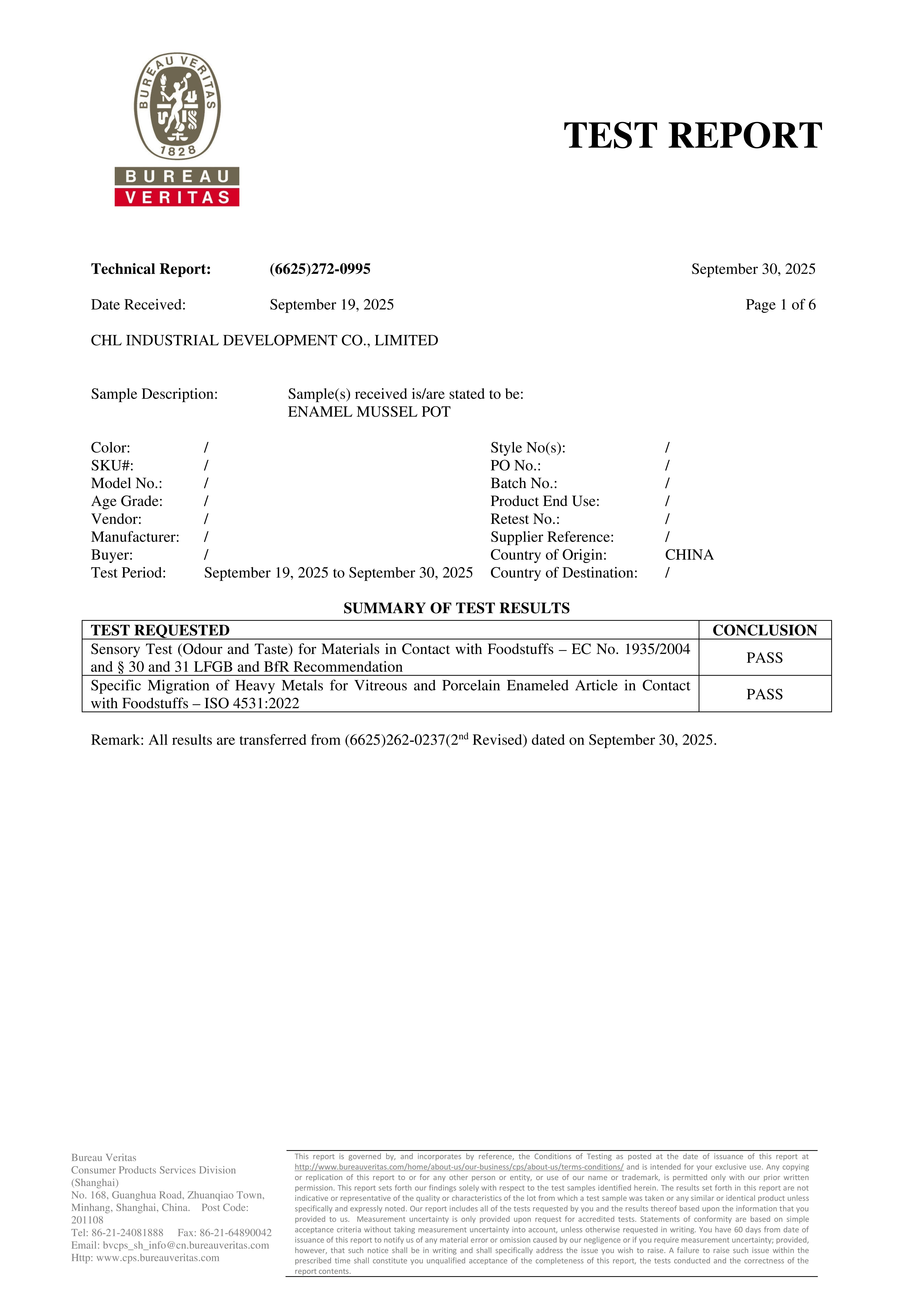
| EU food-contact compliance | The importer needs a product-specific file, not a generic statement. | Declaration of Compliance, test report naming the set and material, GMP statement, traceability example. | BV Food Contact Test Report (6625)272-0995 covers the ENAMEL MUSSEL POT scope; request a cookware-set-specific report. |
| Steel grade | The food-contact surface and corrosion resistance depend on the grade. | Mill certificate or grade declaration, product specification, approved sample. | Confirm the grade for each cookware set SKU; do not rely on a category claim. |
| Construction | Tri-ply, base thickness and layer structure affect heat and durability. | Technical drawing, layer structure, thickness, base diameter. | Confirm by model; a tri-ply claim needs a documented structure. |
| Induction compatibility | An induction hob requires a compatible base. | Induction test report or base specification. | Request model-specific evidence if the SKU claims induction compatibility. |
| Dishwasher suitability | Finish, handle and coating may change after repeated washing. | Dishwasher test or written care instructions. | Confirm by model and finish; do not infer from the steel grade alone. |
| Logo and branding | The logo is part of the approved sample and the brand promise. | Artwork proof, placement drawing, colour target, packaging mock-up. | OEM production and logo customisation are listed; confirm artwork and packaging in the quotation. |
| MOQ | Cash, warehouse space and pilot size depend on the MOQ. | Written MOQ by SKU and by decoration. | The capability record lists 2 units; confirm the MOQ for the customised configuration. |
| Lead time | Launch date and reorder point depend on production time. | Production schedule and approval milestones. | The capability record lists 30 days; confirm by model and order quantity. |
| Capacity | Repeat orders need a stable monthly output. | Monthly capacity and annual output. | 8,000 units per month and 150,000 units per year are recorded. |
| Quality control | Defect risk sits with the brand after import. | Inspection plan, test record, defect classification. | 100% testing is listed; agree the inspection points and record format. |
Read the table as a request list. The buyer should close the rows that affect the destination market first, then the rows that affect the product, then the commercial rows. A supplier that can answer the product rows but not the evidence rows is not yet a qualified supplier for a private label cookware set.
FAQ
- What EU food-contact compliance should a Chinese private label cookware set manufacturer document?
- The supplier should provide a Declaration of Compliance tied to Regulation (EC) No 1935/2004, evidence of good manufacturing practices under Commission Regulation (EC) No 2023/2006, traceability records, and a product-specific test report that names the cookware set and its food-contact materials. The report should reference the applicable test standard and the actual steel grade or coating. A certificate for a different product, such as the ENAMEL MUSSEL POT scope in BV report (6625)272-0995, does not clear a cookware set.
- Can AurumDine supply private label stainless steel cookware sets with a custom logo?
- AurumDine's capability record lists OEM production and logo customisation. It also lists a minimum order quantity of 2 units, a 30-day lead time, monthly capacity of 8,000 units and 100% testing. For cookware sets, logo artwork, placement, colour matching, packaging and the approved sample must be confirmed by model and quotation. The capability record is a starting point for the RFQ, not a substitute for a model-specific specification sheet.
- How should buyers budget for private label stainless steel cookware sets when no public price band is verifiable?
- Do not use a public retail price to estimate OEM cost. Build the budget from line items: steel grade, construction, coating or finish, handles, lids, set composition, packaging, logo method, order quantity, testing and freight. Ask for a landed-cost quotation with the same specification and Incoterms. Compare suppliers on the cost of the approved specification and the evidence file, not on a headline unit price. A credible quote should be traceable to the approved specification.
- What sample approval steps reduce risk before mass production?
- Approve a physical sample against a written specification that covers dimensions, set composition, steel grade, finish, handle and lid fit, logo and packaging. Keep the approved sample as the reference. Confirm that the test report names the same product and materials. AurumDine's recorded quality control is 100% test; the buyer should still agree the inspection points, defect classification and sample retention before production.
- What lead time and capacity should a buyer plan for?
- AurumDine's capability record lists a 30-day lead time and monthly capacity of 8,000 units, with annual output of 150,000 units. Plan artwork approval, sample approval and any food-contact testing before the production slot. Confirm the lead time by model, order quantity and customisation. For a sample or quote, contact support@aurumdine.com or WhatsApp +86-18101697558.
Conclusion: approve the file, then approve the order
Private label stainless steel cookware sets reward buyers who separate capability from evidence. A factory can have scale, engineers and export experience and still need a model-level test report for the exact set. A certificate can be valid and still cover a different product. A catalogue can use the right category words and still leave the steel grade, base construction or induction claim undefined.
The practical sequence is stable: lock the market, lock the product, lock the evidence, then lock the commercial terms. Use the approved sample as the reference. Keep the test report, declaration, GMP statement and traceability record together. Re-check the file when the steel grade, coating, handle, packaging or manufacturing site changes. That discipline protects the brand, the importer and the end customer.
Next step
For a private label cookware set programme, start with the specification and the destination market. AurumDine can review the product brief, logo requirement, target quantity and required documents. Ask for a sample or a quotation with the approved configuration.
Contact: support@aurumdine.com | WhatsApp: +86-18101697558 | www.aurumkitchen.com

Have Questions or Need More Details?
Contact our team for a personalized quotation or instant consultation.
Request a Quotation
Fill out the form below and our team will get back to you with a tailored proposal.
WhatsApp Direct Chat
Prefer to chat in real-time? Message us on WhatsApp for instant assistance & quick answers.
- Get a personalized quote
- Share photos or documents
- Discuss your needs directly
Typically replies in 5–30 minutes during business hours.