
Applying Busbar Distribution Boxes in Industrial and Commercial Buildings: DB01, DB02, and DB13 Scenarios
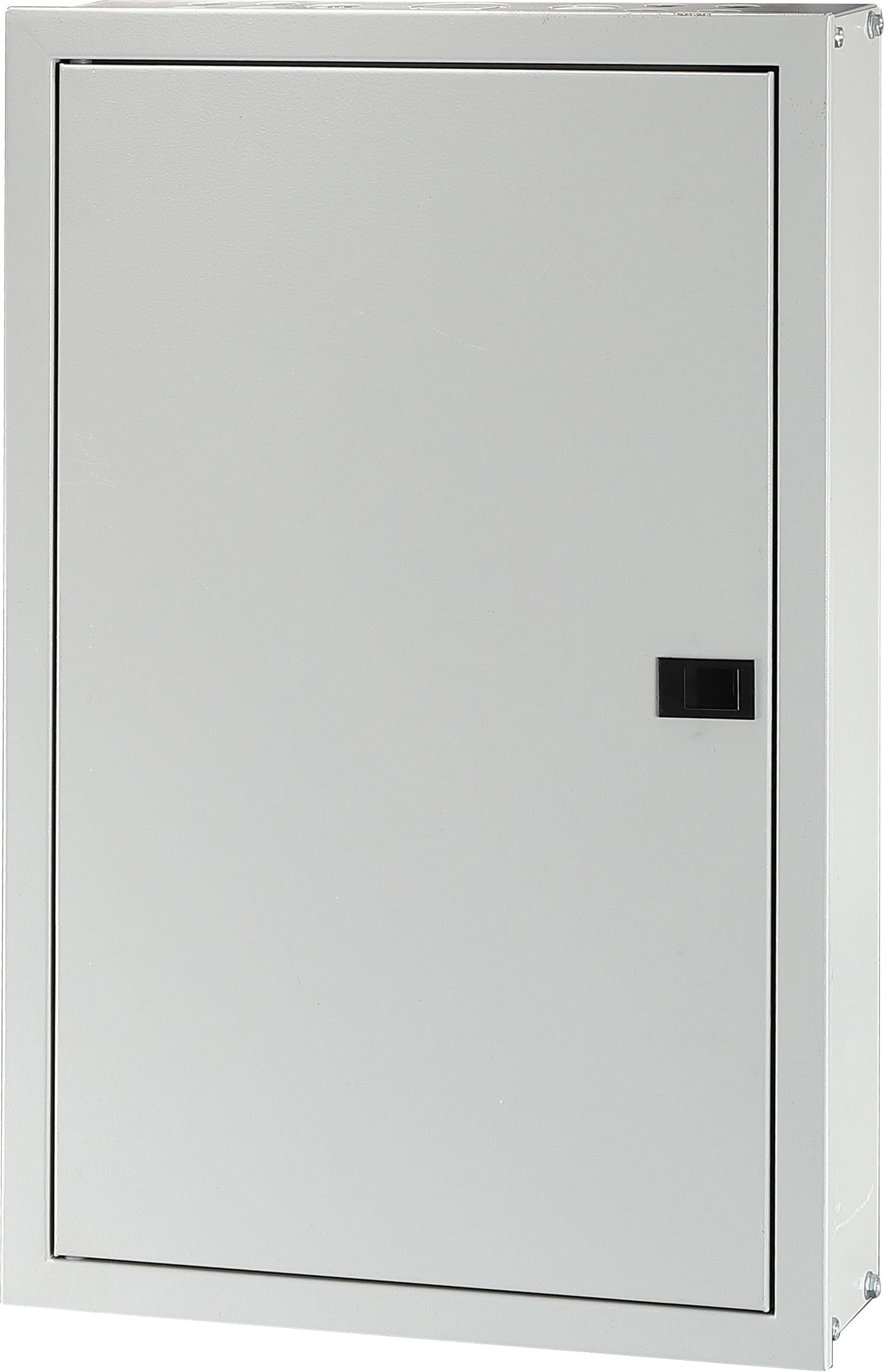
Cover: DB01 distribution box — steel sheet body and enclosure with a copper pan assembly busbar, panel-mounted for indoor boards.
Three Barfuse distribution box models cover most low-voltage building distribution work that uses busbar distribution instead of individual cable connections: DB01 for panel-mounted indoor boards with a high count of MCB branch circuits, DB02 for boards fed by an MCCB with heavier MCCB outgoing circuits, and DB13 for wet, dusty or impact-exposed locations that require an IP65 and IK10 steel enclosure.
The decision between them follows three project inputs: where the box is installed, how many outgoing circuits the branch schedule contains, and which breaker type and rating those circuits use. This application guide maps each model to the building contexts it fits, shows which pan assembly busbars sit behind each enclosure, and lists the specification points that have to be confirmed before a quotation is issued.
Problem Definition: The Three Mismatches Behind Most Distribution Box Application Errors
Most distribution box problems found on site are configuration problems rather than product defects. Three mismatches account for the majority of them.
- Environment mismatch. A standard indoor board installed in a wash-down area, a below-grade plant room or an external equipment yard will not hold up against water ingress or mechanical impact, no matter how well the breakers inside it are rated. The enclosure rating, not the breaker rating, decides whether the installation survives.
- Ways mismatch. The outgoing circuit count drives the number of ways required on the pan assembly busbar. DB01 covers 2W to 32W and DB02 covers 2W to 16W. When the branch schedule grows past the selected range, the result is doubled-up terminations or an unplanned second board.
- Device mismatch. An MCB branch schedule and an MCCB branch schedule require different pan assembly busbars, different terminal widths and different pole spacing. BP3, for example, is built for MCCB pole distances of 25 mm, 30 mm, 35 mm or 45 mm, while BP5 is intended for double-pole MCCBs with a 25 mm pole distance and 50 mm width.
Each mismatch maps to a specification decision that can be settled before the box is ordered, which is why the models in this guide are described by project context rather than by catalogue position.
Industry Background: Busbar Distribution in Commercial and Industrial Buildings
Busbar-based distribution has become the standard wiring method in most commercial and industrial low-voltage boards. In a conventional board, every outgoing breaker is wired back to the incoming device with separate cable. A pan assembly busbar replaces that wiring with a fixed copper conductor, formed and perforated to the breaker pitch, that the outgoing devices connect onto directly. The practical effects are geometric: fixed terminal positions, fewer loose terminations, and a board that can be inspected, extended and documented more predictably.
Market data reflects how widely the approach is now used. Precedence Research values the global busbar market at USD 19.83 billion in 2025, with copper busbars holding 62.8% of that market by material in the same year. The same source forecasts aluminium busbars to grow at a 6.9% CAGR between 2026 and 2035, which indicates that conductor material is becoming a more active decision in large infrastructure projects rather than a default.
Standards activity points in the same direction. IEC 61439-6:2025, the busbar trunking systems part of the IEC 61439 family for low-voltage switchgear and controlgear assemblies, took effect on 1 December 2025. Assembly-level requirements are being actively maintained, which makes project-level documentation review the practical approach for specifiers.
Barfuse (YUEQING BARFUSE ELECTRIC CO.,LTD) is a manufacturer of low-voltage fuse switch disconnectors, busbar systems and high- and low-voltage distribution wiring management products, including MCB pan assemblies, MCCB pan assemblies and metal distribution boxes. The company is based in Yueqing, Zhejiang Province, China, was established in 2014, and operates from a 10,000 m² factory with approximately 45 employees, a 7-engineer R&D team and an annual production capacity of about 250,000 pieces. Around 90% of output is exported, and the company serves markets in the Middle East, Russia, Latin America, Central Asia, the EU, Africa and Oceania, with sales networks in more than 40 countries and regions. Its products are used in low-voltage distribution systems across petroleum, chemical, metallurgical, power and construction industries.
The Three Models and the Project Contexts They Fit
DB01 — Panel-Mounted Indoor Boards with a High MCB Branch Count
DB01 is a distribution box built around an MCB pan assembly busbar. The box body and enclosure are steel sheet, the conductive part of the pan assembly is copper, and the box is panel-mounted — a configuration that places it inside an existing board, cabinet or dedicated electrical room.
- Incoming: MCCB 250A, MCCB 125A or MCB 63A
- Branch: MCB
- Ways: 2W to 32W
- Painting: textured finish RAL7032 or RAL7035, customizable
The distinguishing number is the ways range. A board configured up to 32 ways carries a large number of comparatively small outgoing circuits from a single enclosure, which is typical of tenant distribution in commercial buildings, floor distribution boards, and lighting and socket circuits grouped in a building services room. Because the outgoing devices are MCBs, the panel stays compact while the circuit count stays high.
DB02 — MCCB-Fed Boards with Heavier Outgoing Circuits
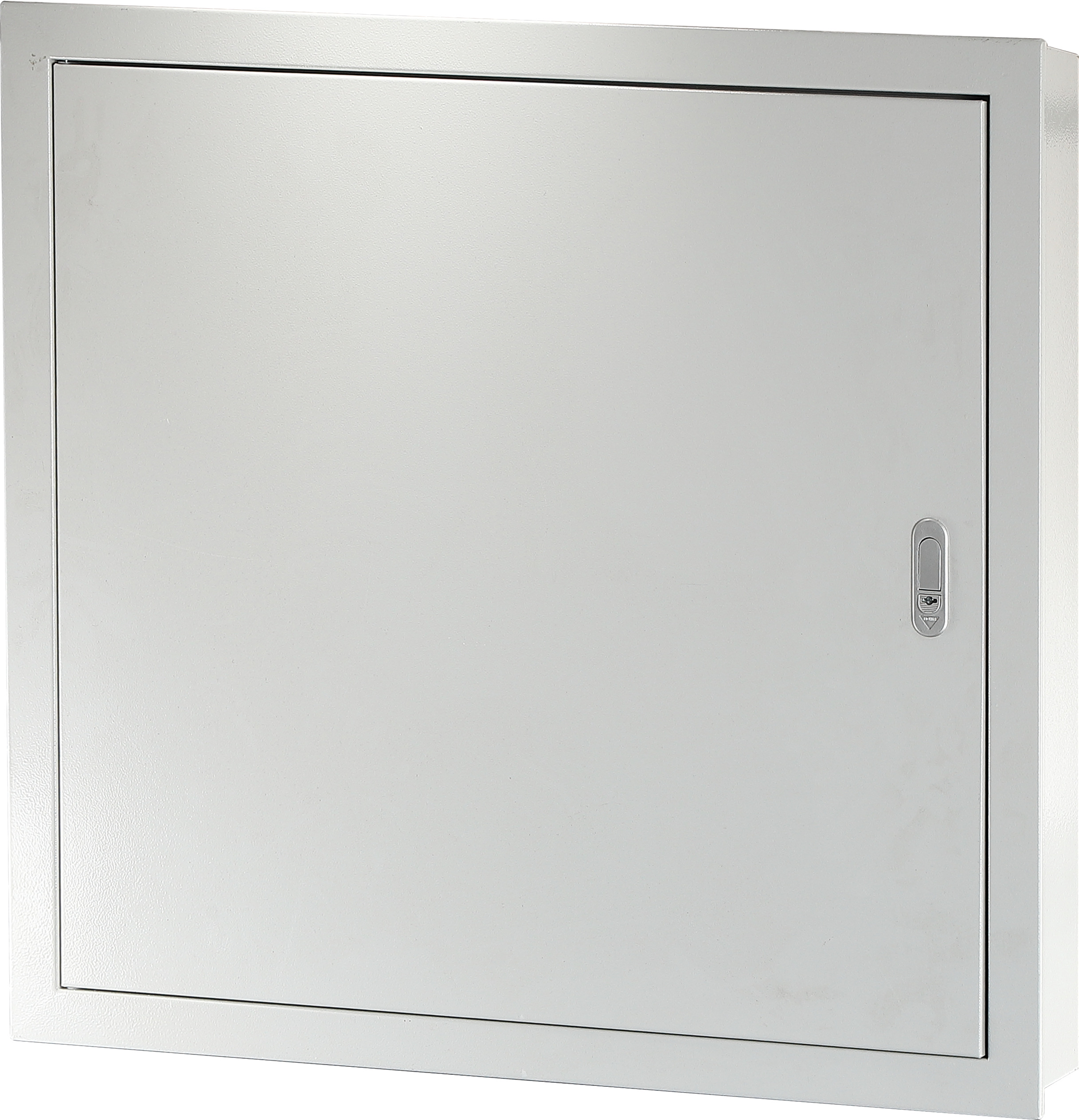
DB02: distribution box with MCCB pan assembly busbar, steel sheet box body and copper busbar, 2–16 ways.
DB02 is a distribution box with an MCCB pan assembly busbar. It uses a steel sheet box body and a copper pan assembly busbar, and the outgoing side is built for molded case breakers rather than miniature breakers.
- Incoming: MCCB 800A, 630A, 400A, 250A or 125A
- Branch: MCCB 400A, 250A or 125A
- Ways: 2W to 16W
- Painting: textured finish RAL7032 or RAL7035, customized specifications available
The design logic is the reverse of DB01. DB02 trades ways for current: fewer outgoing circuits, but each one carries a substantially higher rating. That places it in plant rooms, industrial sub-distribution, machine feeder groups and commercial main or sub-main boards where the outgoing devices are 125A, 250A or 400A molded case breakers and the incoming device may be rated up to 800A.
DB13 — Wet, Dusty and Impact-Exposed Locations
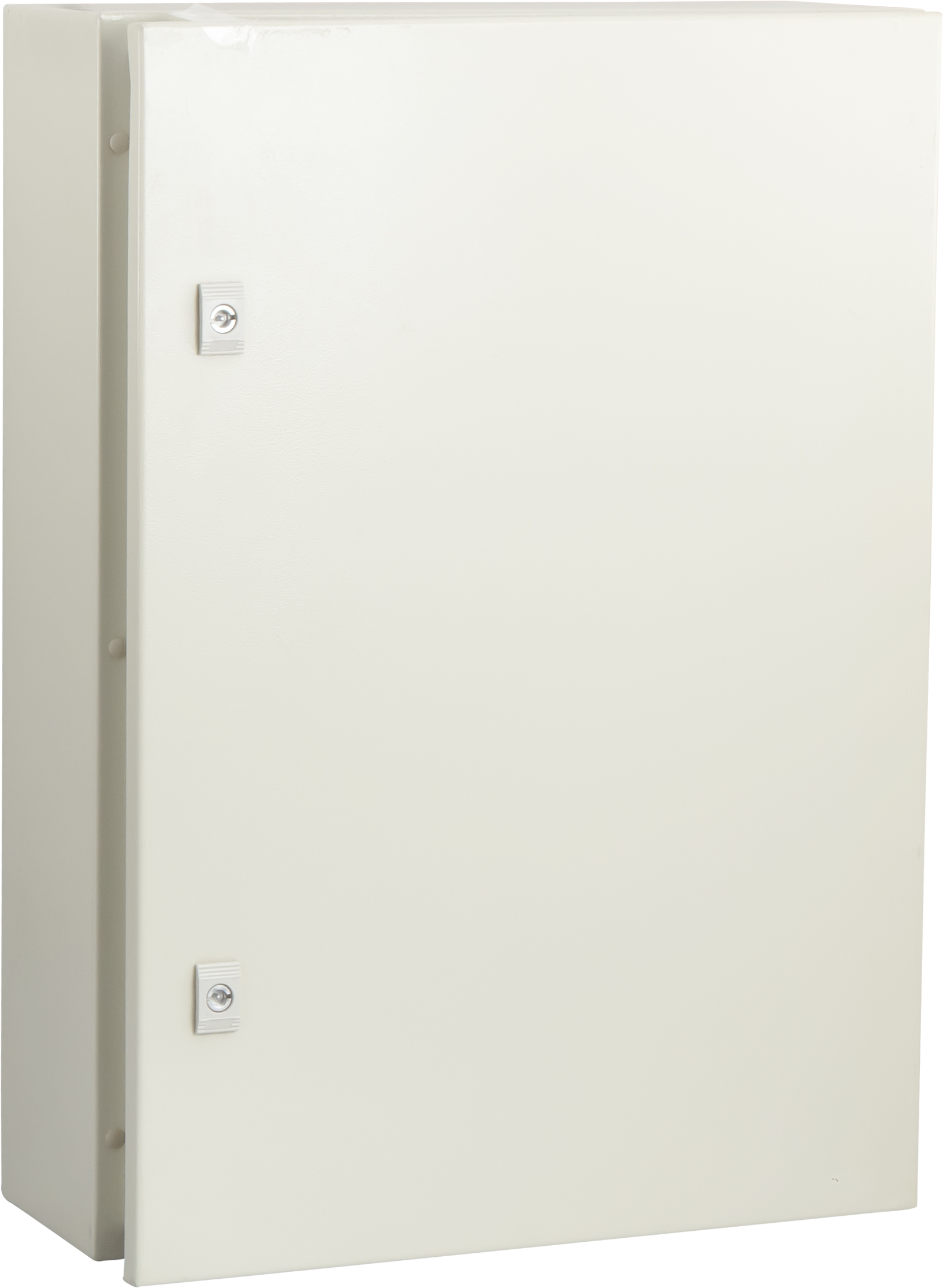
DB13: waterproof low-voltage distribution box in steel sheet, rated IP65 and IK10, with a 2.0 mm mounting plate.
DB13 is a waterproof low-voltage distribution box made from steel sheet. The enclosure is 1.2 mm to 1.5 mm steel sheet, the door is also 1.2 mm to 1.5 mm, and the mounting plate is 2.0 mm. It is rated IP65 for protection and IK10 for impact resistance, and it is intended for low-voltage distribution applications in industrial and commercial building electrical management.
Those two ratings define the application. IP65 addresses dust and water jets, which is the reason DB13 is selected for wash-down areas, food and chemical processing environments, below-grade plant rooms and other locations where an indoor board would be exposed. IK10 addresses mechanical impact, which covers service corridors, loading areas and equipment yards where an enclosure may be struck. The 2.0 mm mounting plate is the structural element that carries the breakers and any busbar hardware inside the enclosure, and it is specified separately from the 1.2 mm to 1.5 mm enclosure and door sheet.
What Sits Inside: Pan Assembly Busbars Behind Each Enclosure
The distribution box is the enclosure; the pan assembly busbar is the distribution. The box model is chosen by environment and ways count, while the busbar inside it is chosen by breaker type, breaker rating, pole distance and terminal geometry. Matching the two correctly is the step most often deferred until after the box has been ordered.
| Busbar model | Category | Ratings | Ways | Terminal and spacing data | Notes |
|---|---|---|---|---|---|
| BP1 | MCB 3P pan assembly | 125A, 160A, 250A | 6W–72W | Connection size 2.0 × 5 mm; outline size 2.0 × 20 mm | DEKRA test certificate |
| BP2 | Modular MCB 2P pan assembly | 125A / 250A; 220/240/120V; incoming MCCB or MCB | — | Incoming terminal 3 × 15 mm; outgoing terminal 2 × 5 mm | Outgoing double-pole MCB or RCBO; PC case material for insulation |
| BP4 | MCB 1P comb busbar for distribution boards | 125A (T2 mm), 160A (T2.5 mm), 250A (T3 mm) | 4W–72W | Incoming terminal width 20 mm; outgoing terminal 5 × 11 mm | Copper and PC parts |
| BP6 | MCB 3P chassis busbar | 250A | — | Incoming terminal 21 × 22 mm; outgoing terminal 6.5 × 12 mm | Complies with IEC 61439 and AS/NZS standards; mounting plate customizable to the outgoing MCB |
| BP5 | MCCB 2P pan assembly busbar | Incoming 125A (4 mm), 250A (6 mm), 400A (10 mm); outgoing 63A (2 mm), 125A (3 mm) | 2W–40W | Incoming terminal width 25 mm; outgoing terminal width 15 mm | Simultaneous live and neutral disconnection; for branch DP MCCB with 25 mm pole distance and 50 mm width |
| BP3 | MCCB 3P pan assembly | Incoming 250A, 400A, 630A, 800A; outgoing 125A, 250A, 400A | 2W, 4W, 6W, 8W, 10W, 12W, 14W | Compatible with MCCB pole distances of 25 mm, 30 mm, 35 mm and 45 mm | OEM accepted; size customized to the customer's MCCB |
The pairing rule that follows from this table is straightforward. Boards with MCB outgoing circuits — the DB01 pattern — use the MCB family: BP1 for three-pole MCB banks, BP2 for modular two-pole or RCBO arrangements, BP4 for single-pole comb distribution, and BP6 where a chassis-mounted three-pole layout with IEC 61439 and AS/NZS compliance is required. Boards with MCCB outgoing circuits — the DB02 pattern — use BP3 for three-pole MCCB banks and BP5 where double-pole MCCBs need live and neutral disconnected together.
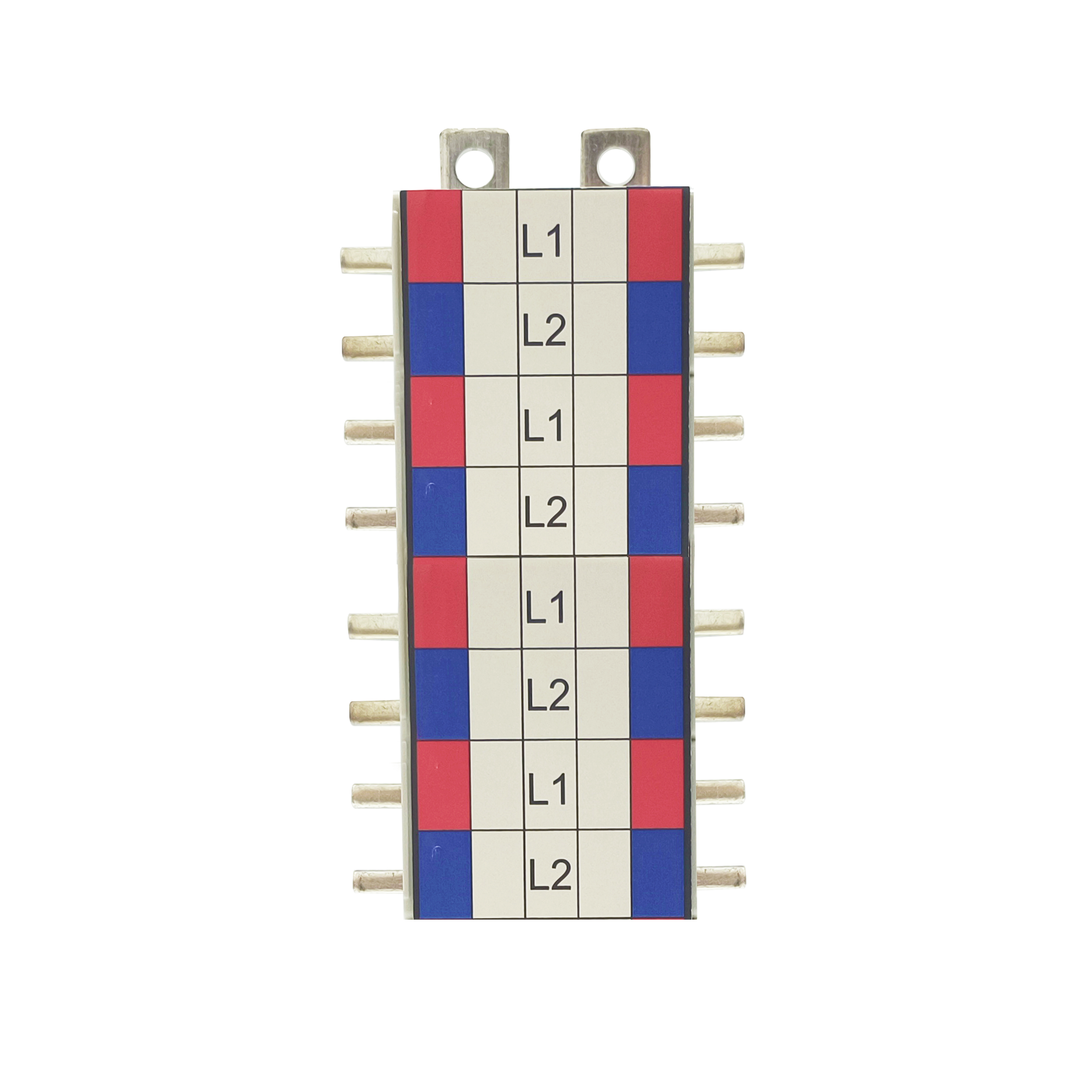
BP2 modular MCB 2P pan assembly busbar: incoming terminal 3 × 15 mm, outgoing terminal 2 × 5 mm, supporting double-pole MCB or RCBO outgoing circuits.
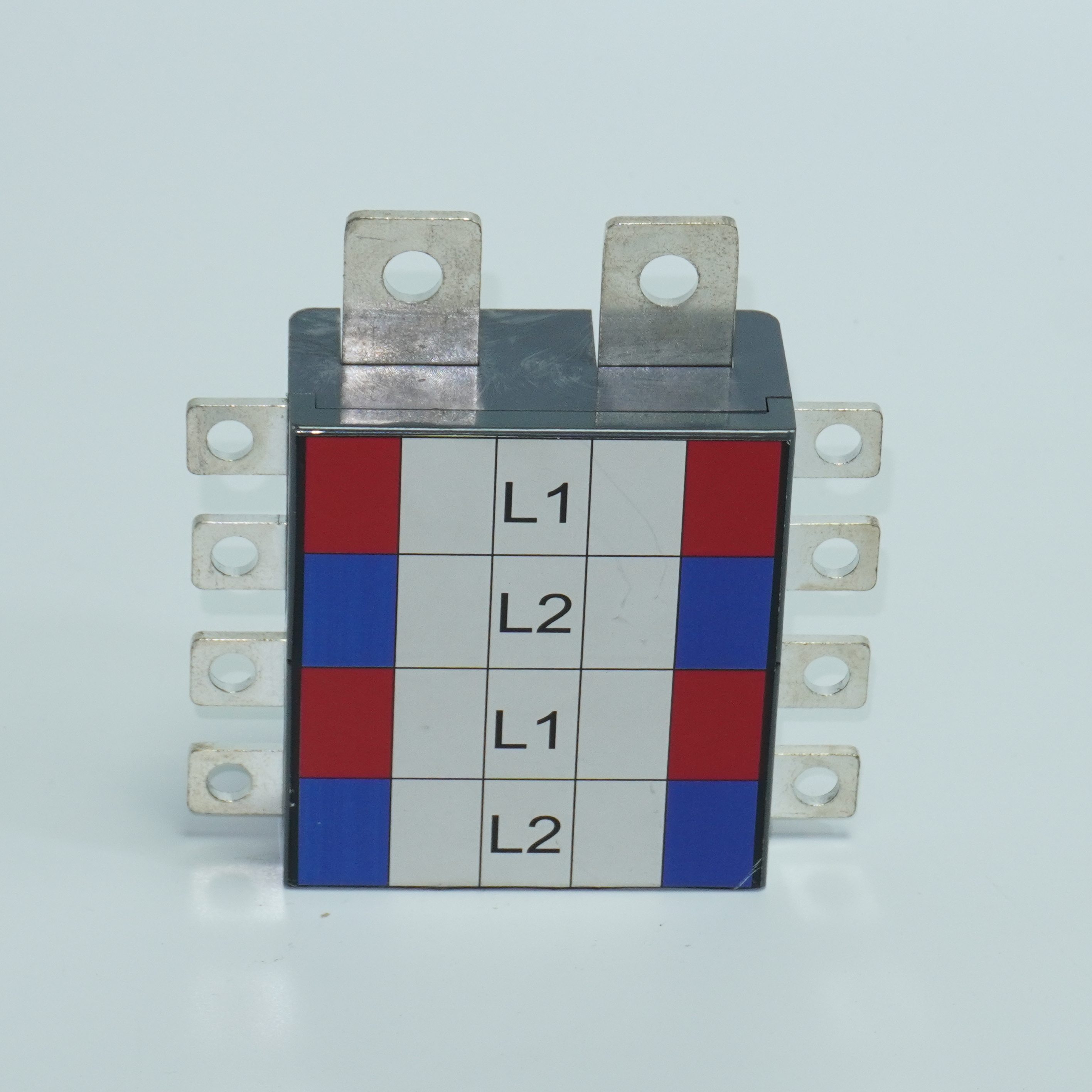
BP5 MCCB 2P pan assembly busbar: 25 mm incoming and 15 mm outgoing terminal widths, with simultaneous live and neutral disconnection.
Step-by-Step: Specifying a Busbar Distribution Box for a Project
The sequence below follows the order in which project information normally becomes available, from the room layout to the breaker schedule to the commercial request.
- Classify the installation location. If the box sits inside a dry, protected electrical room or an existing panel, DB01 or DB02 applies. If the location is exposed to water jets, dust or mechanical impact, DB13 is the enclosure to specify, since it carries IP65 and IK10 ratings and a 2.0 mm mounting plate.
- Count the outgoing circuits on the branch schedule. DB01 accepts 2W to 32W; DB02 accepts 2W to 16W. If the count runs beyond the range of the chosen model, split the load across two boards rather than forcing the configuration.
- Select the incoming device against the total connected load. DB01 supports an incoming MCB of 63A or an MCCB of 125A or 250A. DB02 supports incoming MCCBs of 125A, 250A, 400A, 630A or 800A.
- Match the outgoing device type to the branch. MCB branches in a DB01 board; MCCB branches of 125A, 250A or 400A in a DB02 board.
- Match the pan assembly busbar to breaker geometry. Confirm pole distance and terminal width before ordering. BP3 accepts MCCB pole distances of 25 mm, 30 mm, 35 mm or 45 mm. BP5 is built for double-pole MCCBs with a 25 mm pole distance and 50 mm width, with a 25 mm incoming and 15 mm outgoing terminal width. For MCB banks, BP4 uses a 20 mm incoming terminal width and a 5 × 11 mm outgoing terminal, while BP6 uses a 21 × 22 mm incoming and 6.5 × 12 mm outgoing terminal.
- Confirm enclosure construction and finish. DB01 and DB02 use steel sheet bodies with copper pan assembly busbars and are painted in a textured finish of RAL7032 or RAL7035, with customized specifications available. DB13 uses 1.2 mm to 1.5 mm steel sheet for the enclosure and door and a 2.0 mm mounting plate.
- Verify documentation and validate a sample. Product-level documentation includes a DEKRA test certificate for BP1 and IEC 61439 and AS/NZS compliance for BP6. At company level, Barfuse holds ISO9001 certification together with testing accreditations from KEMA (DEKRA) in the Netherlands and VDE in Germany, plus CB certification and SAA certification in Australia. A physical sample check remains the practical way to confirm terminal alignment against the actual breaker brand, pole distance and panel layout.
Use Cases: Matching Each Box to a Building Context
Indoor commercial boards and tenant distribution — DB01
A commercial building with many small final circuits — lighting, sockets, small HVAC loads — needs a high circuit count in a compact panel. With a ways range of 2W to 32W, MCB branch protection and an incoming device of 63A MCB or 125A/250A MCCB, DB01 fits floor distribution boards, tenant boards and services-room panels. The panel-mounted steel sheet enclosure suits installation inside an existing cabinet or dedicated room.
Industrial plant rooms and heavy commercial sub-distribution — DB02
Where the outgoing circuits feed machines, pumps, large HVAC plant or sub-panels, the branch devices are molded case breakers. DB02 combines MCCB incoming options up to 800A with MCCB branch ratings of 400A, 250A or 125A across 2W to 16W, and a copper pan assembly busbar that carries the heavier current. The overlap between DB01 and DB02 sits in the 2W to 16W band: the deciding factor there is the breaker type on the outgoing circuits, not the enclosure.
Wash-down, dusty and impact-exposed areas — DB13
Food processing, chemical handling, below-grade plant rooms, service corridors and equipment yards place a distribution box in conditions an indoor board was never designed for. DB13 addresses those conditions with an IP65 rating for dust and water jets, an IK10 rating for mechanical impact, and a 2.0 mm mounting plate that carries the internal hardware. Combined with a suitable pan assembly busbar, it allows a low-voltage distribution point to be placed close to the load rather than routed back to a protected room.
Selection rule of thumb: choose the enclosure by environment first, then the ways range by circuit count, then the pan assembly busbar by breaker type, pole distance and terminal width. Reversing that order is what produces the mismatches described at the start of this guide.
Comparison: DB01, DB02 and DB13
The two tables below separate distribution configuration from enclosure and environmental protection, because those are the two decisions that drive model selection.
Table 1 — Distribution configuration
| Item | DB01 | DB02 |
|---|---|---|
| Product category | Distribution box with MCB pan assembly busbar | Distribution box with MCCB pan assembly busbar |
| Incoming device | MCCB 250A, MCCB 125A or MCB 63A | MCCB 800A, 630A, 400A, 250A or 125A |
| Branch device | MCB | MCCB 400A, 250A or 125A |
| Ways | 2W–32W | 2W–16W |
| Construction | Steel sheet box body; copper pan assembly busbar | Steel sheet box body; copper pan assembly busbar |
| Finish | Textured finish RAL7032 or RAL7035, customizable | Textured finish RAL7032 or RAL7035, customized specifications available |
| Typical fit | High circuit count, modest current per circuit | Lower circuit count, higher current per circuit |
Table 2 — Enclosure and environmental protection
| Item | DB01 | DB02 | DB13 |
|---|---|---|---|
| Material | Steel sheet body and enclosure; copper busbar | Steel sheet body; copper busbar | Steel sheet |
| Enclosure / door thickness | Not stated separately | Not stated separately | 1.2 mm–1.5 mm enclosure; 1.2 mm–1.5 mm door |
| Mounting plate thickness | — | — | 2.0 mm |
| Ingress protection | — | — | IP65 |
| Impact resistance | — | — | IK10 |
| Mounting | Panel-mounted | Panel-mounted indoor board configuration | Low-voltage distribution box format |
| Intended application | Industrial application and commercial building electric management; low-voltage distribution systems, supporting power distribution and circuit protection with circuit breakers as supporting equipment | ||
FAQ
What standards and certificates apply to these busbar distribution boxes?
Product-level documentation applies per item, not per brand. BP1 carries a DEKRA test certificate, and BP6 complies with IEC 61439 and AS/NZS standards. At company level, YUEQING BARFUSE ELECTRIC CO.,LTD holds ISO9001 certification together with testing accreditations from KEMA (DEKRA) and VDE, plus CB certification and SAA certification in Australia. For DB13, the enclosure itself is rated IP65 for protection and IK10 for impact resistance. Specifiers should treat enclosure ratings and standard compliance as separate items to be confirmed on the specific model and configuration, and should note that assembly-level requirements remain under active revision — IEC 61439-6:2025 for busbar trunking systems took effect on 1 December 2025.
Can DB01, DB02 or DB13 be customized to a specific breaker brand or layout?
Yes, within the published customization scope. Barfuse provides OEM and ODM production services, including customization of color, logo, material, new design, surface treatment, mold development and packing. At component level, BP3 is accepted for OEM work and can be sized according to the customer's MCCB, with compatibility across pole distances of 25 mm, 30 mm, 35 mm and 45 mm. BP6 allows the mounting plate to be customized according to the outgoing MCB. For the enclosures, DB01 and DB02 are painted in a textured finish of RAL7032 or RAL7035 with customized specifications available. The customization limit to respect is physical: ways count, breaker type, pole distance and terminal width must match the selected pan assembly busbar.
Which configuration factors drive the cost of a busbar distribution box?
Cost follows configuration rather than a published list price, and the main drivers are visible in the specifications. They include the number of ways (DB01 supports 2W–32W and DB02 supports 2W–16W), the incoming and outgoing breaker ratings and types, the conductor thickness and terminal width of the busbar, the enclosure and mounting plate thickness, and the painting or customization requirement. Conductor thickness scales with current on the busbar side: BP5 uses 4 mm at 125A, 6 mm at 250A and 10 mm at 400A on the incoming side, and 2 mm at 63A and 3 mm at 125A on the outgoing side, while BP4 uses T2 mm at 125A, T2.5 mm at 160A and T3 mm at 250A. Material choice also affects the commercial picture at market level: Precedence Research reports copper busbars at 62.8% of the busbar market by material in 2025, with aluminium forecast to grow at a 6.9% CAGR from 2026 to 2035. A quotation should be prepared from the actual ways count, breaker schedule and finish requirement.
How can a buyer validate a distribution box before placing an order?
The practical validation is a sample check against the real breaker schedule. Confirm that the pan assembly busbar accepts the intended breaker brand at the correct pole distance — 25 mm, 30 mm, 35 mm or 45 mm for BP3, or a 25 mm pole distance with 50 mm width for the double-pole MCCBs used with BP5. Confirm the terminal widths match the incoming and outgoing devices (BP5 uses 25 mm incoming and 15 mm outgoing; BP4 uses a 20 mm incoming terminal width and a 5 × 11 mm outgoing terminal). Confirm the ways count against the branch schedule, and confirm the enclosure specification, including the DB13 enclosure, door and 2.0 mm mounting plate. Sample and quotation requests can be sent to sales04@barfuses.com or raised by phone on +86 577 61666659, with mobile, WeChat and WhatsApp on +86 18815184322.
What information should be prepared for a quotation, and how is production scheduled?
Prepare the model (DB01, DB02 or DB13), the required ways count, the incoming device type and rating, the outgoing device type and rating, the breaker brand with its pole distance, the required terminal widths, the painting or finish requirement, the quantity, and any OEM or ODM customization scope. Scheduling is then determined by the configuration itself: a standard painted board and a customized assembly built around a specific MCCB brand follow different production paths, and the current production lead time is confirmed at the quotation stage rather than assumed from a catalogue. The full product range, including pan assembly busbars and distribution boxes, is documented in the Barfuse catalogue.
Conclusion
Applying busbar distribution boxes to industrial and commercial buildings comes down to matching three things in the right order. The environment decides the enclosure: DB13 where IP65 and IK10 protection is required, DB01 or DB02 where the board sits indoors. The branch schedule decides the ways range: up to 32W with MCB branch protection in DB01, or up to 16W with MCCB branch protection in DB02. The breaker schedule decides the pan assembly busbar, with BP1, BP2, BP4 and BP6 covering MCB banks and BP3 and BP5 covering MCCB banks at their published ratings, terminal widths and pole distances.
Handled in that sequence, the specification is settled before ordering, the terminal geometry is verified against the actual breaker, and the board performs in the location it was chosen for.
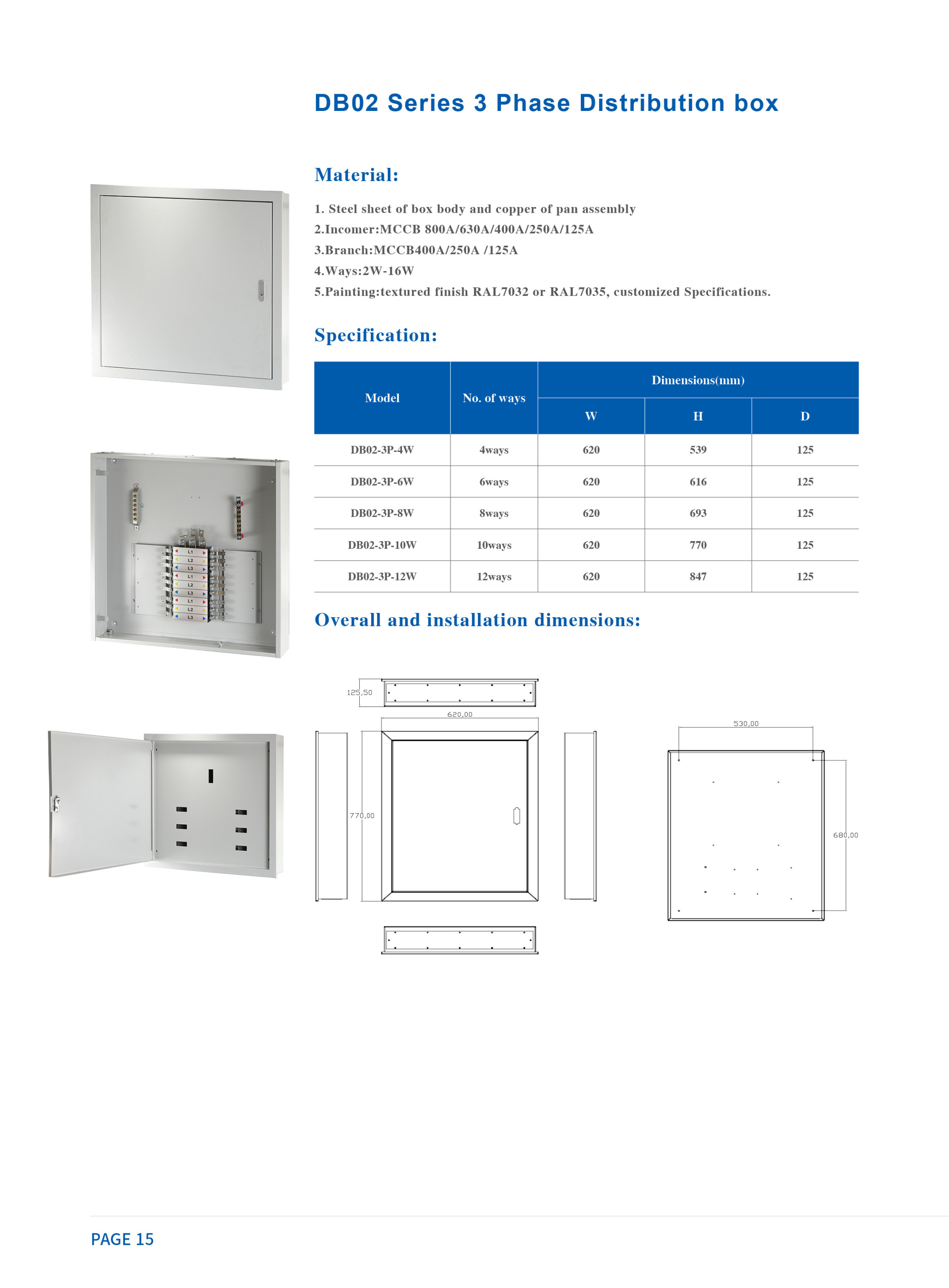
Catalogue sheet: distribution box range with pan assembly busbars.
Next step for your project
Send the branch schedule, the breaker brand and pole distance, and the installation environment. Barfuse can confirm which of DB01, DB02 or DB13 fits the location and which pan assembly busbar matches the breakers inside it.
Product catalogue (PDF): Download the Barfuse catalogue
Email: sales04@barfuses.com | Phone: +86 577 61666659 | Mobile / WeChat / WhatsApp: +86 18815184322
Website: www.barfuses.com
Have Questions or Need More Details?
Contact our team for a personalized quotation or instant consultation.
Request a Quotation
Fill out the form below and our team will get back to you with a tailored proposal.
WhatsApp Direct Chat
Prefer to chat in real-time? Message us on WhatsApp for instant assistance & quick answers.
- Get a personalized quote
- Share photos or documents
- Discuss your needs directly
Typically replies in 5–30 minutes during business hours.