
BH-400 DIN Rail Fuse Base vs NT/NH Fuse Base: Selection Guide for LV Distribution Projects
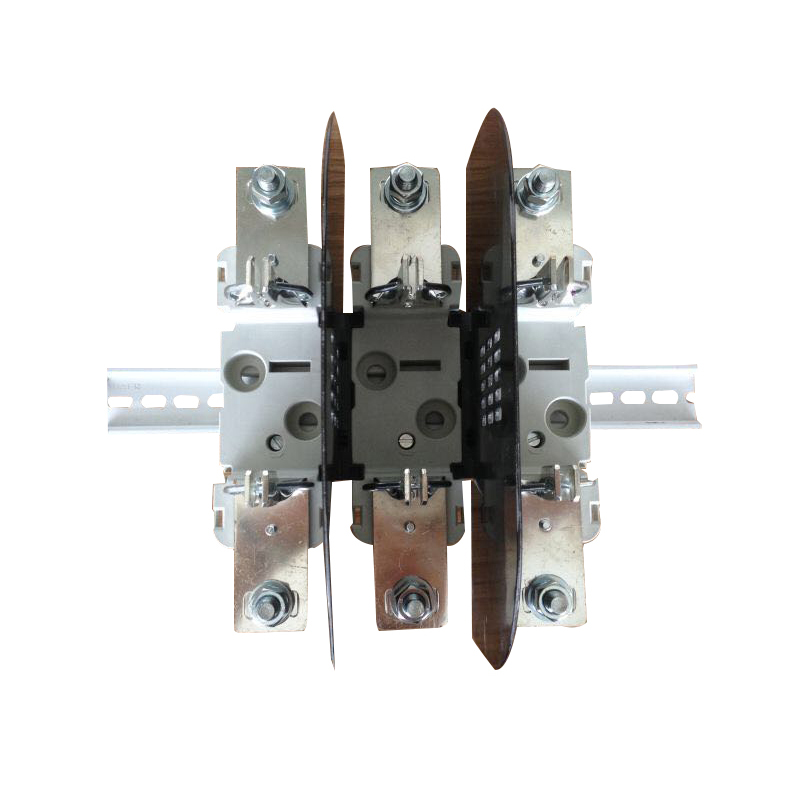
Cover: BH-400 DIN rail type fuse base rated 690 V / 400 A with tin-plated copper contacts.
Short answer: A BH-400 DIN rail type fuse base is rated 690 V and 400 A, with rated neutral links providing a breaking capacity of 120 kA, and it is specified against IEC 60269-1 and 2 and VDE 0636-1 and 2. An NT/NH fuse base in models NT00, NT1, NT2 and NT3 is suitable for AC 50 Hz circuits with rated voltage up to 1140 V and rated current up to 630 A, takes NT NH fuse links rated up to 1250 A, and its fuse links carry a breaking capacity up to 120 kA. Choose the BH-400 when the feeder is a 400 A, 690 V DIN rail position inside an industrial or commercial building panel. Choose the NT/NH base when the system voltage, the base current, or the panel standard goes beyond that.
This guide compares the two fuse base platforms side by side at parameter level: the BH-400 DIN rail type fuse base, and the NT/NH fuse base family covering NT00, NT1, NT2 and NT3 together with the NT NH fuse links that sit inside them. It is written for panel builders, OEM electrical equipment manufacturers, importers and procurement engineers who are in the research and evaluation stage of a project and need verifiable numbers rather than general claims.
Everything below is limited to parameters published by the manufacturer, BARFUSE Electric Co., Ltd. of Wenzhou, China, and to third-party references on the fuse market and low-voltage fuse standards.
Problem Definition: What Actually Goes Wrong When a Fuse Base Is Specified by Habit
Fuse base selection fails in predictable ways. The first is voltage: a base sized for a 690 V feeder is carried into a project running at a higher system voltage, and the part number is never re-checked against the new single-line diagram. The second is current: a 400 A base is used where the continuous load needs a larger frame, or a 630 A base is specified for a 400 A feeder and the panel becomes deeper, heavier and more expensive for no functional gain. The third is fault level: the breaking capacity of the fuse links or neutral links is never compared with the prospective short-circuit current at the point of installation.
Behind those three failures sits a quieter one: two different fuse base platforms are treated as interchangeable because both are called fuse bases. They are not. The BH-400 DIN rail type fuse base and the NT/NH fuse base in NT00, NT1, NT2 and NT3 differ in rated voltage, rated current, mounting interface and the fuse element they accept, and each of those differences changes where the part belongs in a panel.
Decision rule: if the feeder is a 400 A position at 690 V that must sit on a DIN rail, the BH-400 is the matched part. If the system voltage rises above 690 V, if the base current requirement rises above 400 A, or if the panel is built around NH fuse links as a standard, the NT/NH family is the matched part.
Industry Background: Standards, Market Scope and Where Fuse Bases Sit
Fuse protection is not a static category. Fortune Business Insights projects the global electric fuse market to reach USD 5.84 billion in 2025, growing at a CAGR of 7.05% towards 2034. That headline number deserves one caveat: published 2025 valuations for the same category range from roughly USD 4.0 billion to USD 5.84 billion depending on whether fuse bases and switch disconnectors are aggregated with fuse links or treated as separate mechanical switchgear. For a panel builder, the useful signal is direction, not the decimal point.
The direction points to higher voltage and higher current. The 800 V DC circuit breaker and protection market for data centers is estimated at USD 265 million in 2026 with a 29.9% CAGR, and global exports under HS Code 853610, electrical fuses for under 1000 V, are tracked by UN Comtrade with major volume shifts toward EV-related high-voltage components. Low-voltage distribution is being pushed from both ends: DC-side applications are moving up in voltage class while AC-side industrial and commercial boards continue to carry large fault currents.
Standards follow the same path. IEC 60269-1:2024 updated the general requirements for low-voltage fuses, covering AC systems up to 1000 V and DC systems up to 1500 V, effective from 9 August 2024. In the same equipment family, vertical fuse switch disconnectors are optimized for 185 mm and 100 mm busbar spacing systems in LV networks, which is why busbar spacing now belongs in the base selection conversation rather than in the panel layout stage.
BARFUSE Electric Co., Ltd., based in Wenzhou, China, supplies the product families discussed here. The company was founded in 2014 and operates a 10,000 m² factory with 45 employees and a 7-engineer R&D team. It reports an annual output of 250,000 PCS and a 90% export ratio, and states that it works under an ISO 9001 quality system with testing accreditations from KEMA (DEKRA) in the Netherlands and VDE in Germany, plus CB certification and SAA certification in Australia.
Detailed Solution: BH-400 DIN Rail Fuse Base vs NT/NH Fuse Base
BH-400 DIN rail type fuse base
A DIN rail type fuse base is a fixed holder that accepts a fuse element, secures it mechanically and connects it to the busbar or cable termination on a standardized DIN rail position. The BH-400 is the 400 A model of the BH fuse base family, supplied for industrial application and commercial building electric management.
- Rated voltage: 690 V
- Rated current: 400 A
- Breaking capacity: rated neutral links with a breaking capacity of 120 kA
- Standards and approvals: IEC 60269-1 and 2; VDE 0636-1 and 2
- Contact material: tin-plated copper
- Intended application: industrial application and commercial building electric management
The published design intent covers safety isolation with double protection, heat resistance and anti-aging for a long lifespan, a comprehensive electric shock protection design, easy replacement operation, and high compatibility. In panel terms those features translate into four requirements: an isolation point that can be verified visually, a base that keeps its geometry inside a warm enclosure, finger-safe handling during fuse replacement, and a fuse element that can be sourced from more than one supplier. The base requires supporting equipment such as fuses to perform its protection function.
For buyers, 690 V and 400 A on a DIN rail footprint is a compact feeder position. The 120 kA neutral link breaking capacity is the number to hold against the prospective short-circuit current at the intake of a larger commercial building or an industrial distribution board, where fault levels rise quickly as transformer size increases.
NT/NH fuse base: NT00, NT1, NT2, NT3
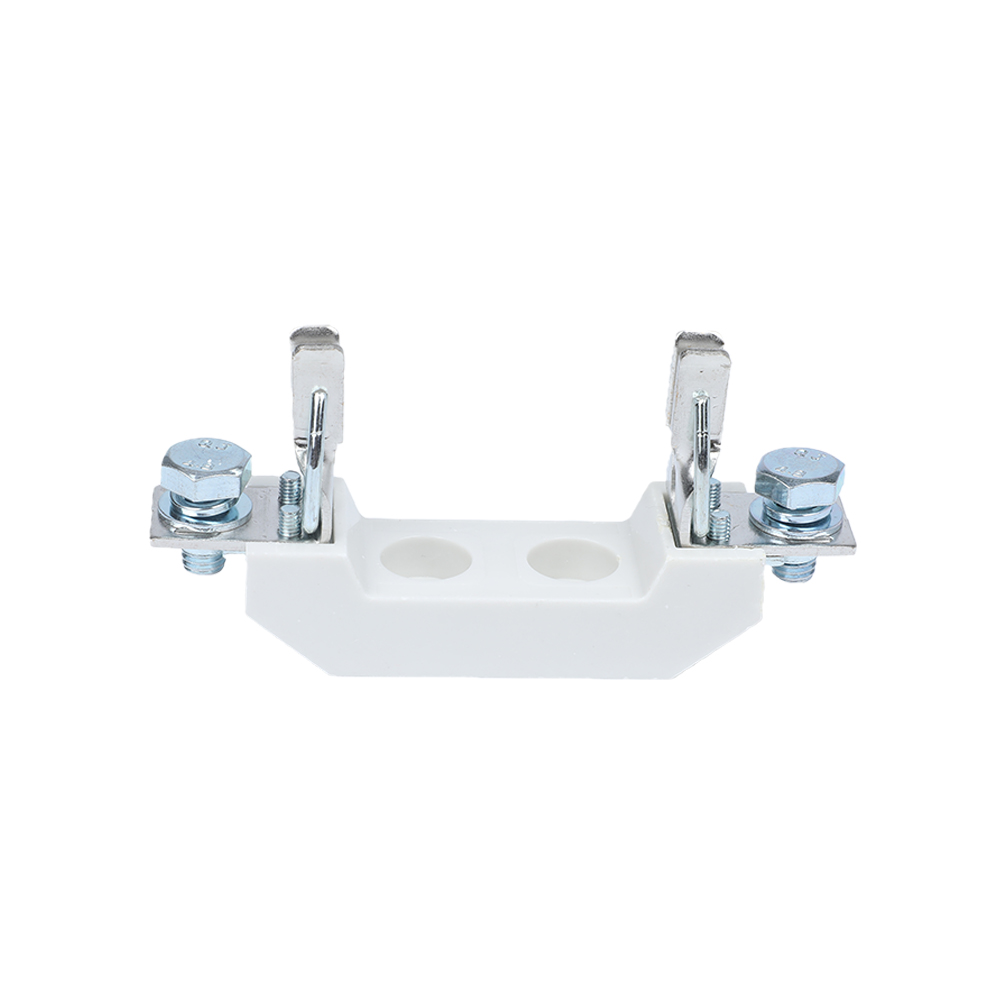
NT/NH fuse base: ceramic body with tin-plated copper contacts, suitable for AC 50 Hz circuits up to 1140 V and up to 630 A.
An NT/NH fuse base is a holder designed around the NH fuse link system, also written NT in several markets. The base provides the contact jaws, the insulation body and the terminal connection, while the fuse link provides the protection function. The BARFUSE range covers the four standard sizes NT00, NT1, NT2 and NT3.
- Circuit: AC 50 Hz
- Rated voltage: up to 1140 V
- Rated current (base): up to 630 A
- Breaking capacity of the fuse links: up to 120 kA
- Fuse link standard: IEC 269
- Body and contact material: ceramic and tin-plated copper
- Intended application: industrial application and commercial building electric management
The design intent for this family is a high protection rating, insulation material with good flame retardant properties, high breaking capacity at 120 kA, strong stability, and compatibility with various fuse elements. The size steps from NT00 to NT3 are what allow one panel standard to cover several feeder ratings without changing the mounting concept or the fuse puller used during maintenance.
NT NH fuse link: the element that sets the breaking capacity
The fuse link is where the actual protection performance is defined, and it is worth separating from the base in any specification. The NT NH fuse link in models NT00, NT1, NT2 and NT3 is suitable for AC 50 Hz circuits with rated voltage up to 1140 V and rated current up to 1250 A. The breaking capacity of the fuse links is up to 120 kA, and the fuse links conform to IEC 269. The body and conductive path use ceramic and silver-plated copper.
Published performance features include extreme breaking capacity with quick and decisive action, anti-aging behaviour from pure silver, a wide specification range for adaptability, an intuitive status display that shortens maintenance time, and low energy consumption with low heat generation. For a maintenance engineer, the status display and the low heat generation matter more than they appear on a datasheet: both reduce the time needed to identify a blown fuse in a live panel row.
Where the BTR stripe fuse rail fits in the same panel
Fuse bases are the fixed protection layer. In many panels they sit downstream of a switching layer built from stripe fuse rails and fuse switch disconnectors. The BARFUSE BTR1 to BTR6 range covers 250 A, 400 A and 630 A frames at Ue 415, 500 and 690 V, with Ui 1000 V, Uimp 10 kV and IP30 protection. The BTR6 uses 100 mm and 185 mm busbar spacing at 160 A, AC 690 V, to IEC/EN 60269, and the BTR4 and BTR5 products are covered by VDE certification. A single panel can therefore use a stripe fuse switch disconnector for incoming or outgoing disconnection and a fuse base for each fixed protection position.
Step-by-Step Breakdown: A Seven-Step Selection Sequence
- Fix the system voltage and frequency. A 690 V requirement on AC 50 Hz points to the BH-400. A requirement up to 1140 V points to the NT/NH base and its matching fuse link. Confirm the value from the single-line diagram, not from the previous project.
- Fix the continuous current. 400 A maps to the BH-400. A base requirement above 400 A and up to 630 A maps to NT/NH. Check the derating that applies inside the enclosure before choosing the frame.
- Compare breaking capacity with the prospective fault current. The BH-400 uses rated neutral links with a 120 kA breaking capacity. For NT/NH, the manufacturer states the breaking capacity of the fuse links to be up to 120 kA, and the same 120 kA is quoted in the base specification. If the calculated fault level at the installation point is higher than the selected device, the selection has to be revisited.
- Confirm the fuse element and its rating. NT NH fuse links in NT00, NT1, NT2 and NT3 are rated up to 1250 A at up to 1140 V, with a breaking capacity up to 120 kA, conforming to IEC 269. The base is only as useful as the link that fits it.
- Check the mounting interface and the panel standard. The BH-400 is a DIN rail type base, which suits retrofit and modular layouts. The NT/NH range is defined by the NH link sizes rather than a rail interface in the available manufacturer data, so confirm the base and panel design before committing the layout.
- Confirm the standard and certification trail. BH-400 is specified with IEC 60269-1 and 2 and VDE 0636-1 and 2. NT/NH fuse links are stated to conform to IEC 269. IEC 60269-1:2024 covers AC systems up to 1000 V and DC systems up to 1500 V, so for any application at or above the top of that band, request the certificate for the exact voltage class before releasing the panel for production.
- Validate with a sample, then lock the lead time. The manufacturer lists an MOQ of 5 pieces, a lead time of 30–45 days and a monthly capacity of 5,000 pieces, with 100% testing and remote technical support. Validate the fit, terminal geometry and marking on a sample before the frame is frozen in the drawing set.
Comparison Table: BH-400 vs NT/NH Fuse Base Parameters
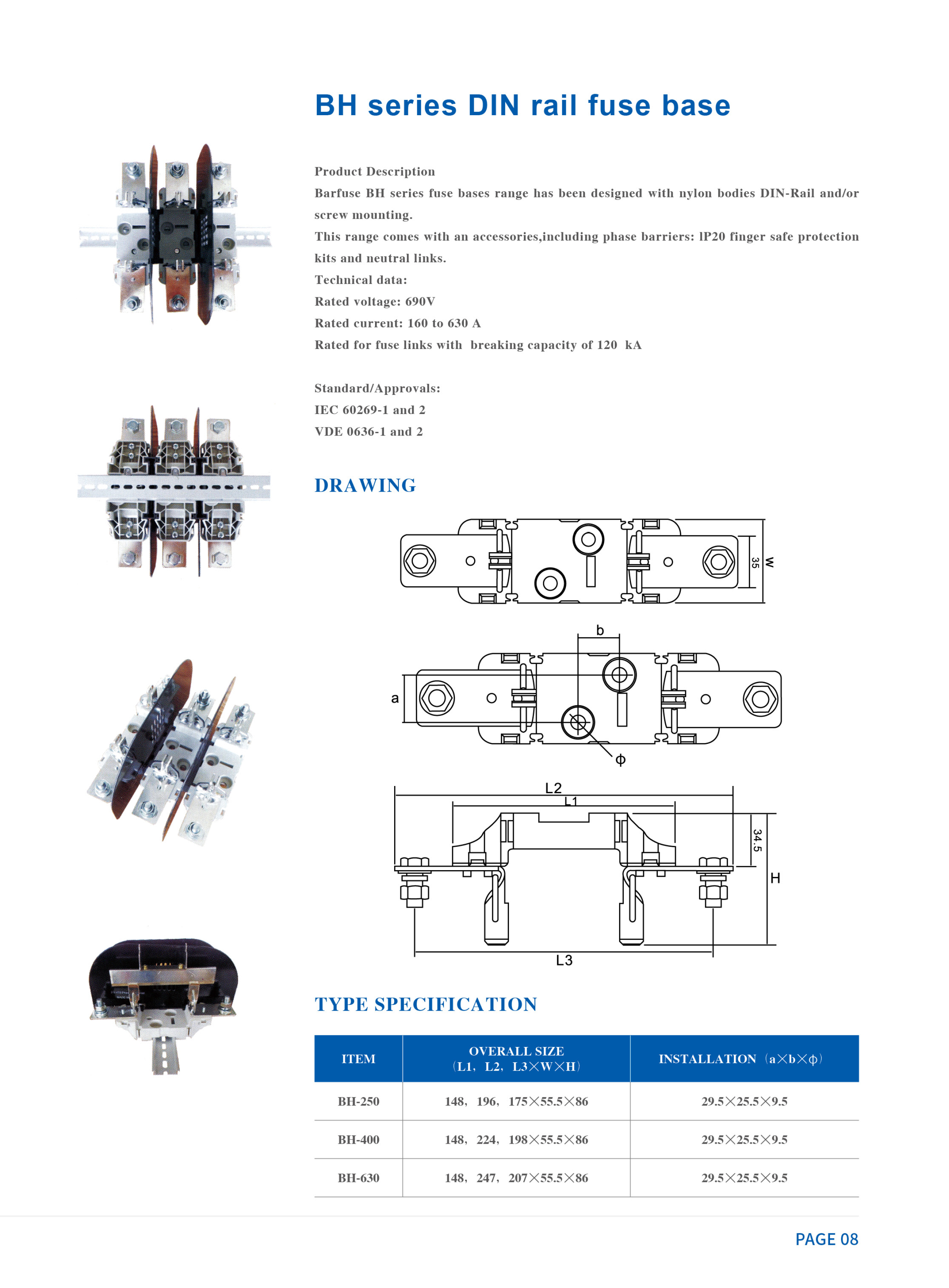
Parameter reference for the BH-400 DIN rail fuse base.
| Parameter | BH-400 DIN rail fuse base | NT/NH fuse base (NT00, NT1, NT2, NT3) |
|---|---|---|
| Product type | Fuse base, DIN rail type | NT/NH fuse base |
| Model designation | BH-400 | NT00, NT1, NT2, NT3 |
| Rated voltage | 690 V | Up to 1140 V (AC 50 Hz) |
| Rated current, base | 400 A | Up to 630 A |
| Matching fuse link rating | Not stated in the available manufacturer data | NT NH fuse link rated up to 1250 A |
| Breaking capacity | 120 kA (rated neutral links) | Up to 120 kA (fuse links) |
| Material | Tin-plated copper contacts | Ceramic and tin-plated copper (base); ceramic and silver-plated copper (link) |
| Standards referenced | IEC 60269-1 and 2; VDE 0636-1 and 2 | IEC 269 (fuse links) |
| Intended industry | Industrial application and commercial building electric management | Industrial application and commercial building electric management |
| Mounting interface | DIN rail | Not specified in the available manufacturer data |
| Typical fit | 400 A, 690 V DIN rail feeder positions | Systems up to 1140 V or up to 630 A where NH fuse links are the panel standard |
The table shows the practical split: the BH-400 wins on mounting flexibility and panel density at 400 A, while the NT/NH family wins on voltage headroom, current headroom and fuse link range. Neither is a general-purpose replacement for the other.
Use Cases: Matching the Base to the Project
Case 1: 400 A DIN rail feeder in an industrial or commercial board. The BH-400 is the matched part when the feeder is a 400 A position at 690 V and the layout is built on DIN rail. The base also requires supporting equipment such as fuses, so the fuse element must be specified together with the base, not after it.
Case 2: Panel standard built around NH fuse links. Where the panel drawing set is already written around NT00, NT1, NT2 or NT3 links, the NT/NH base keeps the design consistent. The base is rated for AC 50 Hz circuits up to 1140 V and up to 630 A, and the matching NT NH fuse link reaches 1250 A, so a single base concept can cover several feeder ratings.
Case 3: High fault level at the intake. Both platforms publish 120 kA as the breaking capacity figure for their fuse links or neutral links. Where the calculated fault level approaches that value, the device must be verified against the actual installation conditions rather than against the catalogue headline alone.
Case 4: Field evidence from cold and hot climates. A wholesaler in Russia used the products for distribution of electric power, with 7,000 units supplied, a project duration of 5 years and a documented highlight of stable operation at low temperatures. In a second project, an OEM electrical equipment manufacturer in Saudi Arabia supplied 300,000 pcs for overload and short-circuit protection in low-voltage feeder pillars and distribution boxes over 12 years, with continuous stable operation in high temperature and outdoor salt spray conditions, high temperature resistance up to 55 °C, and no safety failure or end-user complaint reported. A third project, involving a Saudi manufacturer and 600,000 pcs for feeder pillar applications over 3–5 years, recorded high quality results with low temperature rise. These cases show the same base platforms performing on both sides of the temperature range.

Feeder pillar application: fuse protection for electric power distribution in outdoor enclosures.
FAQ
Which standards cover the BH-400 DIN rail fuse base and the NT/NH fuse links?
The BH-400 DIN rail type fuse base is specified with IEC 60269-1 and 2 and with VDE 0636-1 and 2. The NT/NH fuse base models NT00, NT1, NT2 and NT3 state that the fuse links conform to IEC 269. IEC 60269-1:2024, the general requirements for low-voltage fuses, covers AC systems up to 1000 V and DC systems up to 1500 V, so buyers should confirm that the certificate for their exact voltage class is available before the panel is released for production.
How do I decide between a BH-400 DIN rail fuse base and an NT/NH fuse base?
Decide on three numbers: rated voltage, rated current and breaking capacity. The BH-400 is rated 690 V and 400 A. The NT/NH base in NT00, NT1, NT2 and NT3 is suitable for AC 50 Hz circuits up to 1140 V and up to 630 A, and the matching NT NH fuse link is rated up to 1250 A. If the feeder stays at or below 690 V and 400 A on a DIN rail, the BH-400 is the matched part. Above that, use the NT/NH family. Both are intended for industrial application and commercial building electric management, so the voltage and current figures, not the industry label, drive the decision.
What breaking capacity do the BH-400 base and the NT/NH fuses provide?
The BH-400 DIN rail fuse base uses rated neutral links with a breaking capacity of 120 kA. For the NT/NH family, the manufacturer states that the breaking capacity of the fuse links is up to 120 kA, and the same 120 kA value is quoted in the NT/NH fuse base specification. That figure still has to be checked against the prospective short-circuit current calculated at the actual installation point inside the panel.
How should I select a fuse rail manufacturer for industrial control panels?
Check four things: product scope, certification, quality control and export record. BARFUSE Electric Co., Ltd. is a manufacturer based in Wenzhou, China, founded in 2014, operating a 10,000 m² factory with 45 employees, an annual output of 250,000 PCS and a 7-engineer R&D team. The company states ISO 9001 implementation with testing accreditations from KEMA (DEKRA) in the Netherlands and VDE in Germany, plus CB certification and SAA certification in Australia, and reports sales networks in more than 40 countries across the Middle East, Russia, Latin America, Central Asia, the EU, Africa and Oceania.
What are the MOQ, sample and lead time terms for BH-400 and NT/NH fuse bases?
The manufacturer lists an MOQ of 5 pieces, a lead time of 30–45 days and a monthly capacity of 5,000 pieces, with 100% testing and remote technical support after delivery. OEM and ODM orders are supported, covering customization of color, logo, material, new design, surface treatment, mold development and packing. A sample request is the practical next step before the panel drawing set is frozen: send the feeder rating, the required fuse link size and the mounting arrangement, and confirm the sample against your own assembly. Samples, quotations and the full catalogue can be requested through sales04@barfuses.com or WhatsApp +86 18815184322.
Conclusion: Lock the Three Numbers, Then Order the Base
The BH-400 DIN rail type fuse base and the NT/NH fuse base in NT00, NT1, NT2 and NT3 are not alternatives in the sense of better or worse. They cover different operating bands. The BH-400 covers 690 V and 400 A on a DIN rail footprint, with rated neutral links at a 120 kA breaking capacity and compliance stated against IEC 60269-1 and 2 and VDE 0636-1 and 2. The NT/NH base covers AC 50 Hz circuits up to 1140 V and up to 630 A, with NT NH fuse links rated up to 1250 A, a breaking capacity up to 120 kA and fuse links conforming to IEC 269.
Sort the project by voltage, then by continuous current, then by fault level. That order resolves most base selection questions before the panel layout is drawn, and it prevents the two failure modes that cost the most: an under-rated device at a high fault position and an oversized device that adds depth, weight and cost to every feeder row.
Next step: BARFUSE Electric Co., Ltd. supplies fuse bases, fuse links, fuse rails and fuse switch disconnectors for low-voltage distribution projects worldwide.
Download the full catalogue: BARFUSE Product Catalogue (PDF)
Websites: www.barfuse.com and www.barfuses.com | Blog: blog.barfuse.com
Add: No.88, Weishijiu Road, Economic Development Zone, Yueqing, Zhejiang Province, China (PC: 325600)
Tel: 0086 577 61666659 | Fax: 0086 577 61666650 | Email: sales04@barfuses.com
Mobile / WeChat / WhatsApp: +86 18815184322 — Start a WhatsApp inquiry

Production line: BARFUSE manufactures fuse bases, fuse rails and fuse switch disconnectors in Wenzhou, China.
Have Questions or Need More Details?
Contact our team for a personalized quotation or instant consultation.
Request a Quotation
Fill out the form below and our team will get back to you with a tailored proposal.
WhatsApp Direct Chat
Prefer to chat in real-time? Message us on WhatsApp for instant assistance & quick answers.
- Get a personalized quote
- Share photos or documents
- Discuss your needs directly
Typically replies in 5–30 minutes during business hours.