
Commercial Building LV Distribution: NT/NH Fuse Bases and BH-400 DIN Rail Bases
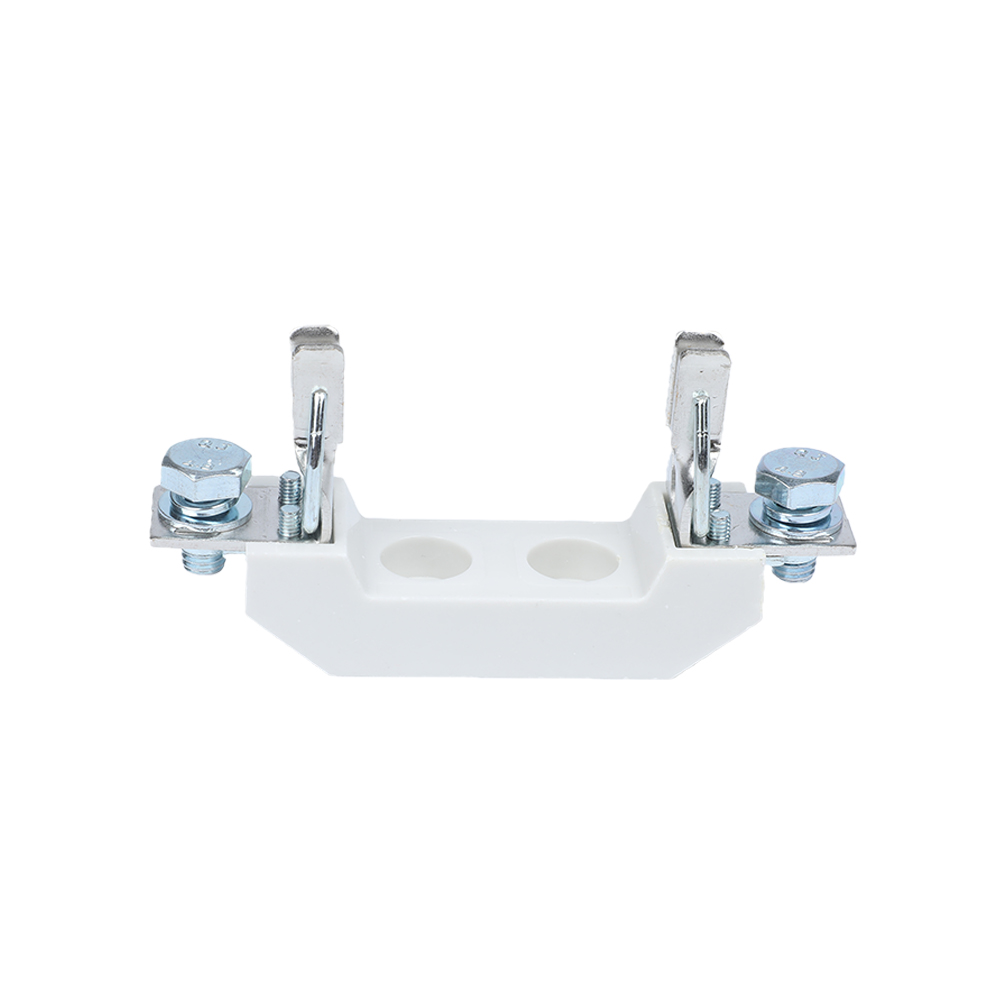
NT/NH fuse bases, models NT00 to NT3, rated up to 1140 V and 630 A.
Short answer: a commercial building LV distribution board usually needs two fuse base formats rather than one. The NT/NH fuse base (models NT00, NT1, NT2 and NT3, AC 50 Hz, rated voltage up to 1140 V and rated current up to 630 A) carries the larger incoming and sub-main circuits, while the BH-400 DIN rail type fuse base (690 V, 400 A, neutral links with 120 kA breaking capacity) fits the modular outgoing ways where DIN rail geometry is already fixed. Both families work with fuse links rated to 120 kA, and both are documented against IEC and VDE references.
The rest of this guide covers the panel-level decisions: how to split a building load across the two formats, how mounting format and DIN rail availability drive the choice, and how to plan a layout that can still be serviced after the building is occupied.
Problem Definition: Why One Fuse Base Format Rarely Fits a Building
A commercial LV distribution design is not a single circuit. It is a stack of different circuits inside one building: an incoming section, sub-main ways feeding risers and plant rooms, and a large number of small outgoing ways for lighting, socket, tenant and control circuits. Each group has a different current band, a different space budget and a different service expectation. Applying one fuse base format to all three usually produces a board that is either oversized in the small ways or awkward in the large ones.
Four practical frictions appear repeatedly:
- Current spread. A riser sub-main may sit in the hundreds of amps, while a lighting way may sit far below that. The base must be rated for the circuit it protects, so the range has to cover both ends.
- Space geometry. Tenant compartments and floor boards are often built around DIN rail, while main sections are built around fixed mounting and cable termination space.
- Service access. Fuse replacement happens while the building is occupied. Access to the base, clearance for a fuse puller or fuse handle, and clear labelling matter as much as the rating.
- Documentation. A base that is correct electrically but undocumented against the specified standard creates a handover problem.
The selection problem, then, is not which base is better. It is which base belongs to which part of the board, and whether the two can be specified from one supplier so that fuse links, spare parts and documentation stay consistent across floors.
Industry Background: Standards and Market Context
Fuse-based protection remains common in commercial LV distribution because it combines a high breaking capacity with a simple, visible disconnection point. The governing standard family is IEC 60269. The 2024 edition, IEC 60269-1:2024, was published in August 2024 and sets general requirements for low-voltage fuses covering AC systems up to 1000 V and DC systems up to 1500 V. Product-level documentation in this segment usually cites the IEC 60269 parts alongside the German VDE 0636 parts.
Demand behind that standard is steady. Fortune Business Insights values the global electric fuse market at USD 5.84 billion in 2025 and projects a CAGR of 7.05% towards 2034. Building electrical management is one of the application areas counted inside that figure, alongside industrial distribution, which is why the same fuse base families appear in both industrial panels and commercial building boards.
BARFUSE Electric Co., Ltd. is a manufacturer of low voltage fuse switch disconnectors, busbar systems and high and low voltage distribution wiring management products, based in Wenzhou, Zhejiang Province, China. Its product data covers both formats discussed here: the NT/NH fuse base and the BH-400 DIN rail type fuse base.
Detailed Solution: The Two Base Families and Where Each Belongs
NT/NH fuse base — NT00, NT1, NT2, NT3
The NT/NH fuse base is designed for industrial applications and commercial building electric management. It is suitable for circuits at AC 50 Hz with rated voltage up to 1140 V and rated current up to 630 A. The matched fuse links have a breaking capacity up to 120 kA and are listed as conforming to IEC 269. The base body is made of ceramic with tin-plated copper contacts, and the range is listed as compatible with a range of fuse elements.
In a building board, this is the format that absorbs the larger ways. Model sizes NT00 through NT3 let a designer step the base up as the circuit current rises, instead of forcing every way into one footprint. NT00 is the size also written NH00 in NH terminology, which matters when a specification mixes NT and NH naming for the same physical base.
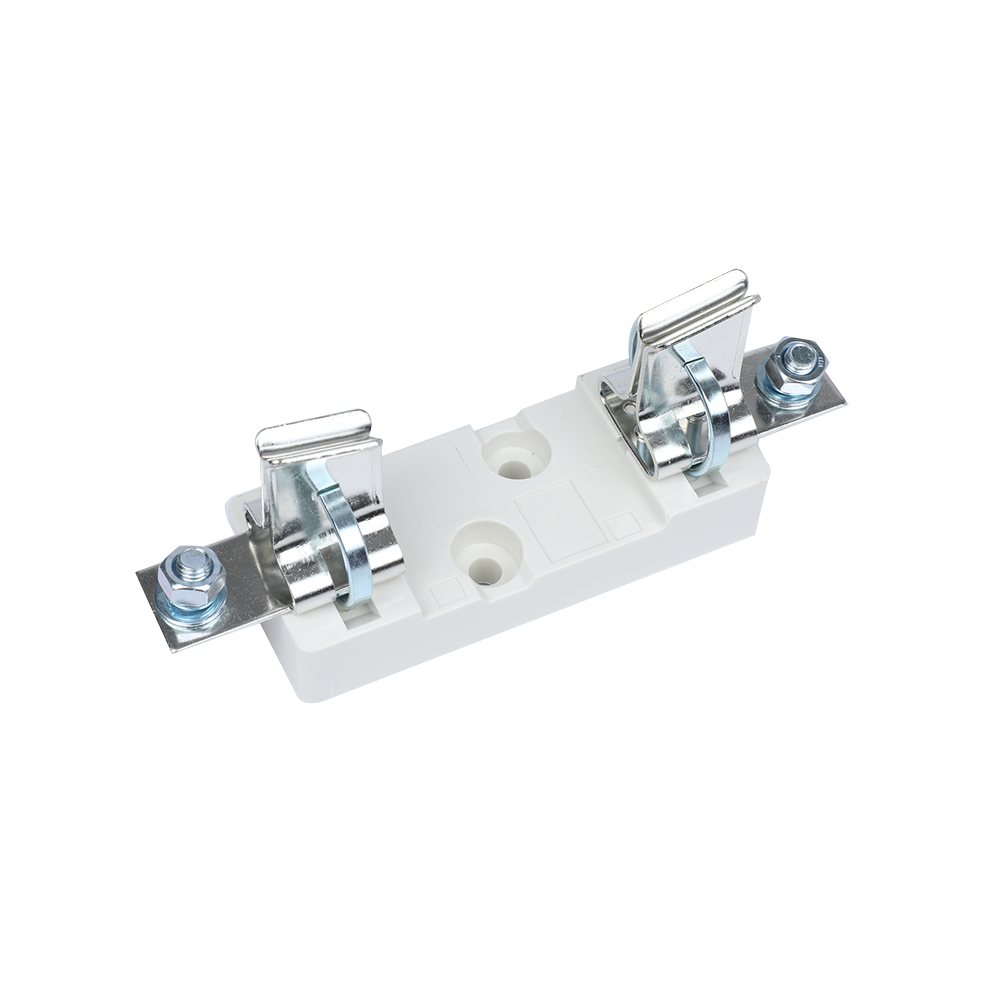
NT/NH fuse base range, models NT00 to NT3, ceramic body with tin-plated copper contacts.
BH-400 DIN rail type fuse base
The BH-400 is a DIN rail type fuse base rated 690 V and 400 A. Its rated neutral links have a breaking capacity of 120 kA, and the contact material is tin-plated copper. The product data lists compliance with IEC 60269-1 and 2 and with VDE 0636-1 and 2. It is intended for industrial and commercial electrical distribution systems and is suitable for switchgear and control panels.
The distinguishing feature is the mounting format. The BH-400 is specified as a DIN rail type base, so it fits boards that are already laid out around DIN rail: tenant distribution boards, floor boards in a retail podium, and the smaller modular panels that are assembled and wired on the bench. The product data also describes a safety isolation arrangement, a heat resistant and anti-aging housing, an electric shock protection design, and a replacement procedure intended to be carried out without dismantling the way.
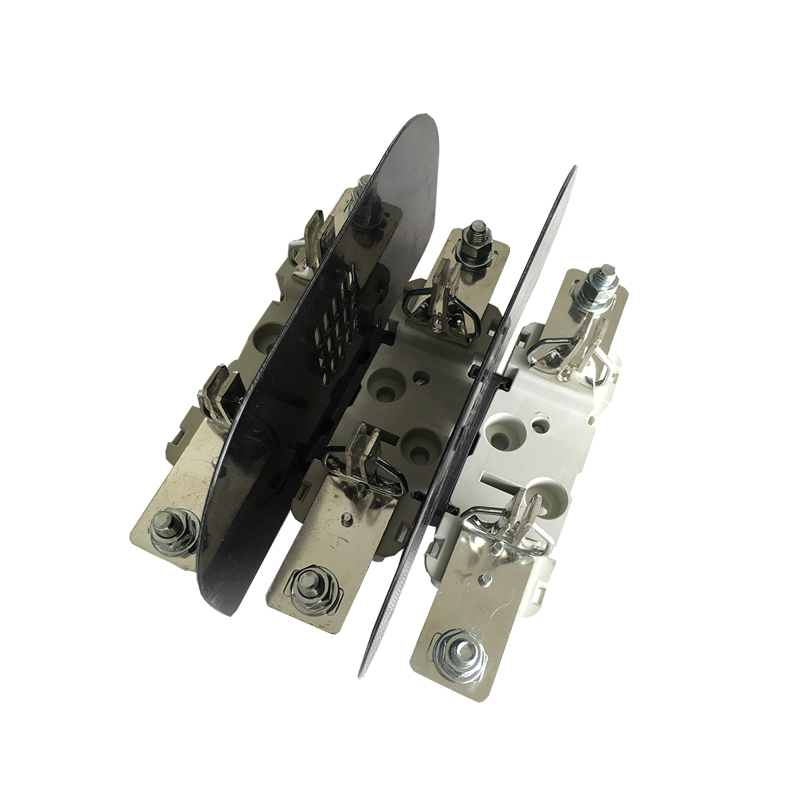
BH-400 DIN rail type fuse base: 690 V, 400 A, tin-plated copper contacts, IEC 60269-1 and 2, VDE 0636-1 and 2.
The fuse link that ties the two together
The base is only half of the protection. The NT/NH fuse link is available in models NT00, NT1, NT2 and NT3, suitable for AC 50 Hz circuits with rated voltage up to 1140 V and rated current up to 1250 A, with breaking capacity up to 120 kA, conforming to IEC 269 and made of ceramic and silver-plated copper. The range is listed with a visible status display, which shortens fault finding when a link has operated.
One practical point follows from reading the two data sets together: the base range is rated to 630 A while the link range extends to 1250 A. In a panel, the base rating is the ceiling for the way, so a link chosen for a circuit above the base rating requires a different base size, not just a different link.
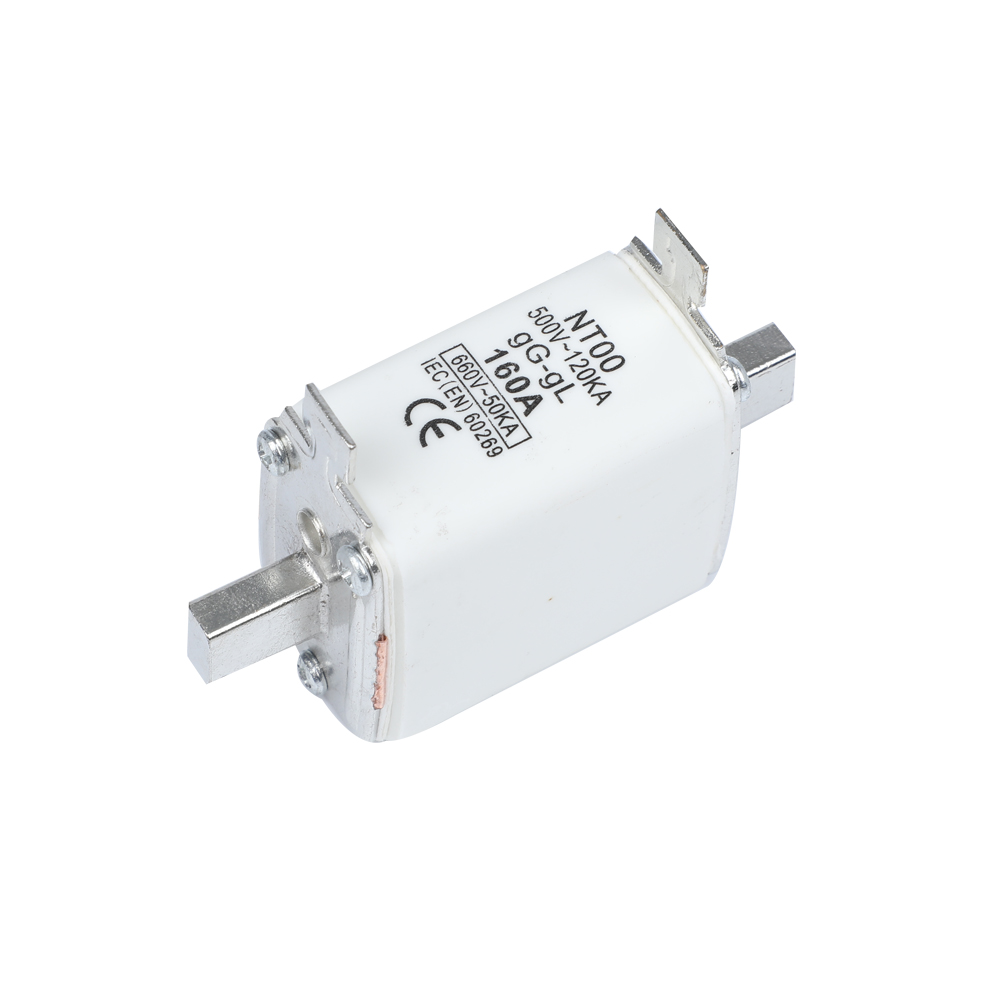
NT00 fuse link; the NT/NH link range runs to 1250 A with breaking capacity up to 120 kA.
Step-by-Step: Adapting the Bases to a Real Panel Layout
- Fix the circuit list and the steady current of each way. Separate incoming, sub-main and outgoing ways before choosing hardware. The current value of each way, not the board total, decides the base model. Group ways into the bands the range actually covers rather than inventing intermediate sizes.
- Assign a base model per band. Small outgoing ways go to NT00; mid-size sub-mains step up through NT1 and NT2; the heaviest ways use NT3, which sits inside the 630 A base ceiling. Where a single 400 A way is required and the board is DIN rail based, the BH-400 covers that rating at 690 V.
- Choose the mounting format before drawing the enclosure. Use the BH-400 DIN rail base where the board is built on DIN rail and the way does not exceed 400 A at 690 V. Use the NT/NH base where the current or voltage exceeds the DIN rail format and where fixed mounting with dedicated cable termination space is available. Where the board is built on a 100 mm or 185 mm busbar system, a vertical fuse switch disconnector is the third option: the stripe type fuse switch disconnector (also written strip type) combines the base and the disconnection function in one busbar-mounted unit, and vertical fuse switch disconnectors are optimised for 185 mm and 100 mm busbar spacing. The BTR6, for example, is listed at 160 A, AC 690 V, with 100 mm or 185 mm busbar distance and IEC/EN 60269.
- Verify voltage and breaking capacity against the system, not against the catalogue headline. Both families work with links breaking at 120 kA, which covers most commercial building fault levels, but the verification has to be done against the calculated prospective fault current at that point. Voltage needs the same discipline: the BH-400 is rated 690 V, inside the AC 1000 V scope of IEC 60269-1:2024, while the NT/NH base is rated up to 1140 V AC. A design that uses the full 1140 V rating sits above the AC scope of the 2024 edition of Part 1 and should confirm the applicable standard reference for that voltage with the manufacturer.
- Plan the service path while the layout is still movable. Leave clearance for a fuse puller or fuse handle in front of every base, keep spare links of each size in the board, and label each way with its model and link rating. A DIN rail base that can be reached and re-fused in minutes is worth more over a building lifetime than a marginally denser layout.
- Collect the documentation per model before handover. Standards are stated per product, not per brand. The BH-400 data lists IEC 60269-1 and 2 and VDE 0636-1 and 2; the NT/NH base and link data lists IEC 269. Confirm that the certificate and the declaration supplied cover the exact model and rating ordered, not only the family name.
Use Cases: Four Typical Building Layouts
1. Office riser sub-main board
A mid-rise office riser board feeds floor distribution boards. The ways are few but heavy, so the NT/NH base in the larger sizes carries the sub-mains, with the fuse link selected inside the 630 A base ceiling. The design priority is termination space and a clear disconnection point per riser, not density.
2. Tenant distribution board in a retail podium
Tenant boards are modular, repetitive and built on DIN rail. The BH-400 DIN rail type fuse base fits that geometry at 400 A and 690 V, and its replacement procedure is designed for occupied buildings where a tenant way has to be restored quickly. Because the same base repeats across tenants, spare-part consistency becomes the main operational benefit.
3. Plant room feeder panel for chillers and pumps
Plant rooms combine high current with continuous duty and elevated ambient temperature. NT/NH bases in the upper sizes handle the feeder ways, and the ceramic body with tin-plated copper contacts suits a panel that runs continuously. Service access matters here too: maintenance is usually scheduled during a shutdown window, so the fuse puller clearance and the spare link set should be planned in advance.
4. Retrofit of an existing floor board
In a retrofit, the enclosure and the rail are already fixed, which usually points to a DIN rail base rather than a fixed base. The limiting factors are the rail rating and the cable termination space behind it, not the fuse base itself. When the existing board is busbar based instead, a vertical fuse switch disconnector on the existing 100 mm busbar spacing avoids rebuilding the interior.
NT/NH Fuse Base vs BH-400 DIN Rail Fuse Base
| Comparison point | NT/NH fuse base | BH-400 DIN rail fuse base |
|---|---|---|
| Model range | NT00, NT1, NT2, NT3 | BH-400 |
| Rated voltage | Up to 1140 V, AC 50 Hz | 690 V |
| Rated current | Up to 630 A (base) | 400 A |
| Breaking capacity | Fuse links up to 120 kA | Neutral links 120 kA |
| Material | Ceramic body, tin-plated copper contacts | Tin-plated copper contacts |
| Mounting format | Fuse base for panel and board use; no DIN rail designation in the product data, so confirm the mounting configuration for the exact model | DIN rail type fuse base |
| Standards listed | IEC 269 for the fuse links | IEC 60269-1 and 2; VDE 0636-1 and 2 |
| Stated application | Industrial application and commercial building electric management | Industrial and commercial electrical distribution; switchgear and control panels |
All values above are taken from the published product data for each model. Where a value is not stated for a product, the table says so rather than assuming it.
Read as a selection rule, the table gives a simple split: the BH-400 is a single-rating DIN rail device for modular boards up to 400 A at 690 V, and the NT/NH family is a stepped range that covers the heavier ways up to 630 A and the higher voltages up to 1140 V. A building that needs both does not need two philosophies of protection, only two mounting formats.
FAQ
Which standards apply to NT/NH fuse bases and the BH-400 DIN rail fuse base?
The BH-400 product data lists IEC 60269-1 and 2 and VDE 0636-1 and 2. The NT/NH fuse base and the NT/NH fuse link are listed as conforming to IEC 269, the earlier designation of the IEC 60269 low-voltage fuse series. IEC 60269-1:2024, published in August 2024, is written for AC systems up to 1000 V and DC systems up to 1500 V, so an NT/NH application that uses the full 1140 V AC rating should confirm the applicable standard reference for that voltage with the manufacturer before approval.
What current and voltage range can I cover with these two base formats?
The NT/NH base covers models NT00, NT1, NT2 and NT3, with rated voltage up to 1140 V and rated current up to 630 A, and its fuse links are rated to 1250 A with breaking capacity up to 120 kA. The BH-400 covers one rating point: 690 V, 400 A, with neutral links rated at 120 kA breaking capacity. Together they let a designer cover a small outgoing way, a 400 A DIN rail feeder and a heavy sub-main from the same supplier, while keeping fuse link practice consistent across the building.
How should a buyer shortlist Chinese fuse manufacturers for these products?
Five checks separate a documented manufacturer from a catalogue reseller. First, whether the published range actually covers the sizes needed, meaning NT00 through NT3 and a 400 A DIN rail base. Second, whether standards are stated per model rather than per brand. Third, whether third-party testing is documented: BARFUSE states testing accreditations from KEMA (DEKRA) in the Netherlands and VDE in Germany, plus CB certification and SAA certification in Australia. Fourth, whether material data is published, such as a ceramic body with tin-plated copper contacts for the NT/NH base and tin-plated copper contacts for the BH-400. Fifth, whether production capability is disclosed: BARFUSE operates a 10,000 square metre facility with approximately 45 staff, a 7-engineer R&D team and an annual production capacity of 250,000 pieces, with export business accounting for 90% of total sales across more than 40 countries and regions.
What drives the cost of an NT/NH or BH-400 base order?
Cost follows the model mix rather than a single headline figure. The variables that matter are the base model and its current rating, the number of ways per board, the total quantity across a project, the contact material specified, and the documentation package required for handover. Fuse links are a separate line and should be quoted per rating, because a project that mixes NT00 with NT2 and NT3 sizes carries three link lines, not one. Quotations are therefore issued against a specific model, rating, quantity and destination rather than against a general price list.
Can I get a sample before committing to a panel build?
Yes. Send the model, rating and quantity to sales04@barfuses.com or contact the team on +86 18815184322, and confirm fit on a short sample run before releasing the full panel order. Delivery timing is confirmed at quotation stage for the exact models ordered, since it depends on the size mix rather than on the family name. The full product catalogue is available for download at the BARFUSE catalogue PDF.
Conclusion
Commercial building LV distribution works best when the fuse base is chosen per way rather than per project. The NT/NH fuse base carries the incoming and sub-main circuits with models NT00 to NT3, up to 1140 V and 630 A, ceramic construction and tin-plated copper contacts. The BH-400 DIN rail type fuse base carries the modular ways at 690 V and 400 A, with neutral links breaking at 120 kA and documentation against IEC 60269-1 and 2 and VDE 0636-1 and 2. Fuse links rated to 120 kA serve both.
The layout decisions that follow are ordinary engineering: split the load, assign the band, choose the mounting format, verify voltage and fault level, then plan service access and documentation before the enclosure is closed. A board built that way is still serviceable years later, which is the point of fuse-based protection in an occupied building.
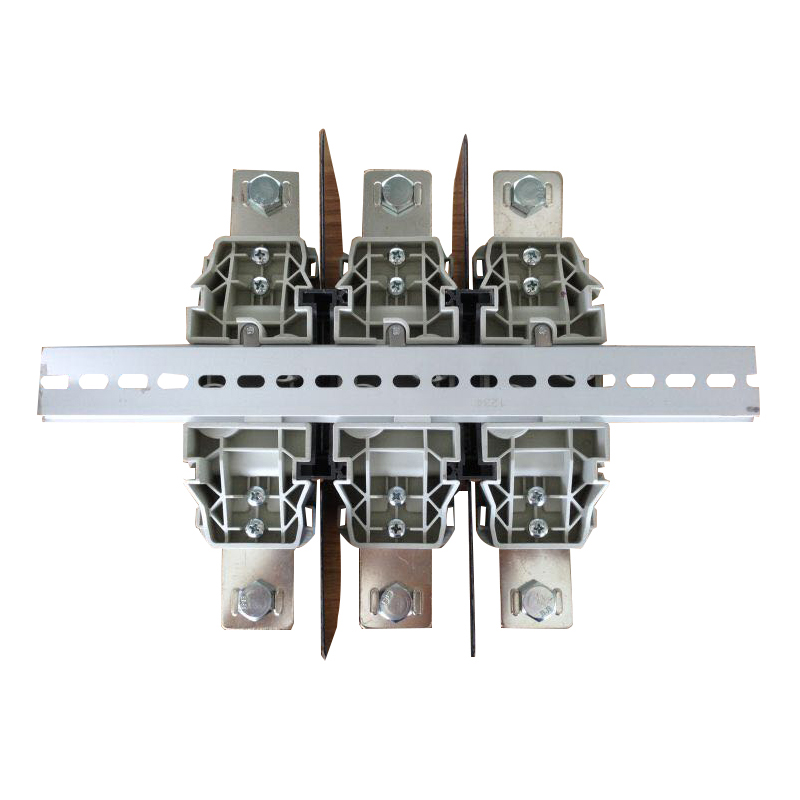
BH-400 DIN rail type fuse base, 690 V, 400 A.
Specifying NT/NH or BH-400 bases for a building project?
Request a sample, a model-level quotation, or the full catalogue from BARFUSE Electric Co., Ltd. — No.88, Weishijiu Road, Economic Development Zone, Yueqing, Zhejiang Province, China. Email sales04@barfuses.com, telephone 0086 577 61666659, or mobile and WhatsApp +86 18815184322.
Manufacturer background: established 2014, 10,000 square metre facility, approximately 45 staff, 7 engineers, 250,000 pieces annual production capacity, export share 90% of total sales.

Production line at BARFUSE Electric, Yueqing, Zhejiang Province, China.
Scope note: this guide covers AC low-voltage fuse bases for commercial building distribution. DC and photovoltaic protection devices, including 800 V DC fuses and PV fuse holders, follow separate DC rating and standard requirements and are outside the scope of this article.
Have Questions or Need More Details?
Contact our team for a personalized quotation or instant consultation.
Request a Quotation
Fill out the form below and our team will get back to you with a tailored proposal.
WhatsApp Direct Chat
Prefer to chat in real-time? Message us on WhatsApp for instant assistance & quick answers.
- Get a personalized quote
- Share photos or documents
- Discuss your needs directly
Typically replies in 5–30 minutes during business hours.