IEC 61439 and AS/NZS Compliance for Pan Assembly Busbars: What Buyers Must Verify
COMPLIANCE VERIFICATION GUIDE
A low-voltage pan assembly busbar is only "compliant" when the exact model on your purchase order can be traced to a valid standard reference and to a manufacturing system that keeps production consistent. That traceability — not a standards logo printed on a catalogue cover — is what an IEC 61439 or AS/NZS review is designed to test.
Barfuse (YUEQING BARFUSE ELECTRIC CO., LTD) is a Wenzhou-based manufacturer of low-voltage fuse switch disconnectors, busbar systems, and high and low voltage distribution wiring management products, including MCB pan assemblies and MCCB pan assemblies. Its documented compliance position includes a DEKRA type test certificate assessed against IEC 61439-2:2011 and EN 61439-2:2011, and an ISO 9001:2015 quality management certificate covering busbar systems and distribution boxes.
Problem Definition: Why a Pan Assembly Busbar Compliance Claim Needs Verification
Compliance in low-voltage assemblies is evidence-based. The evidence normally consists of three parts: a type test certificate produced against a defined standard, a manufacturing quality system that holds production to the tested construction, and a construction description that matches what is actually shipped to site.
The friction point is scope. A supplier can hold a genuine, accredited certificate and that certificate may still not cover the model you are buying. This is not a loophole; it is how type testing works. Each tested configuration is a separate evidence line, and buyers who assume line-wide coverage create their own commercial risk.
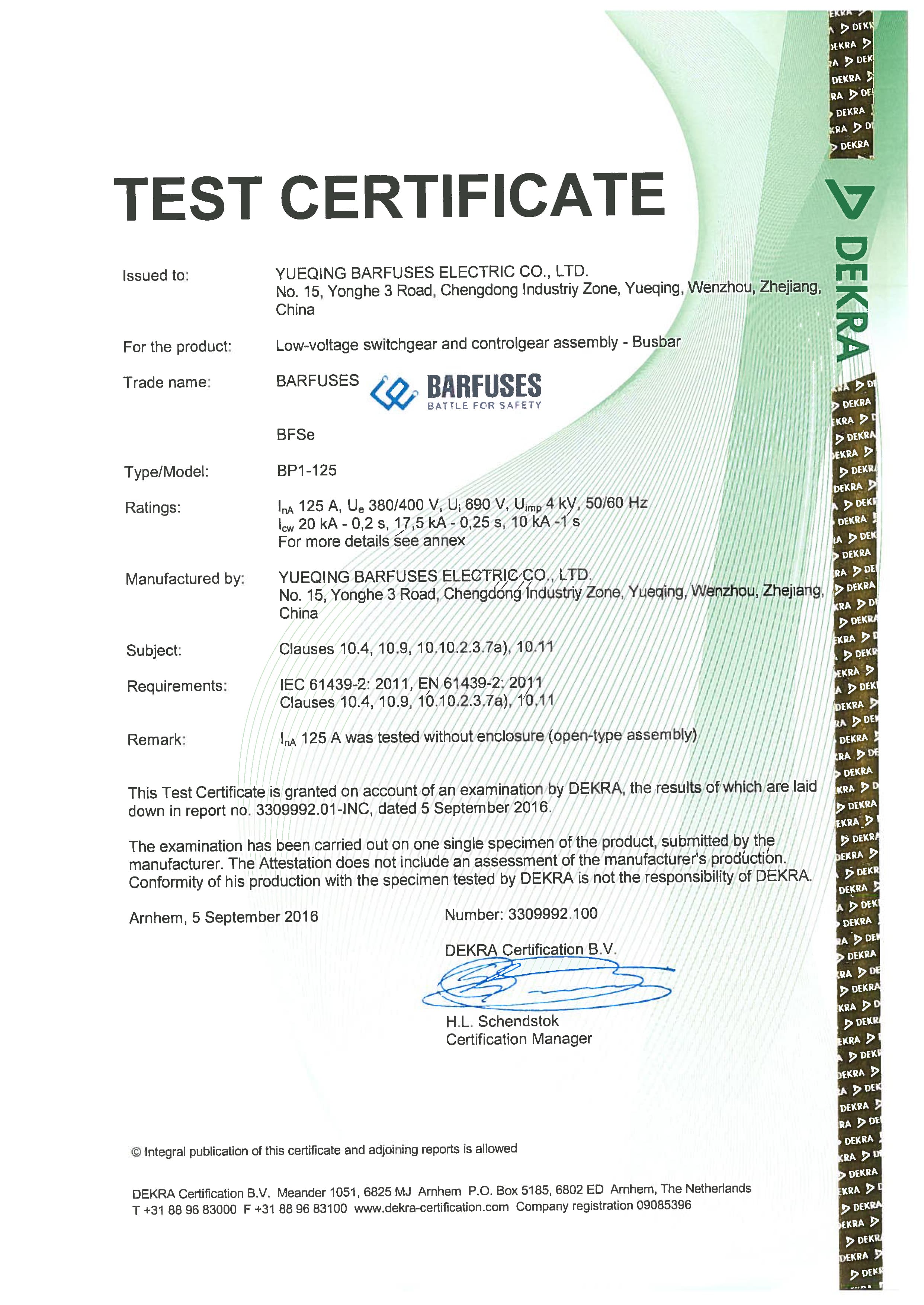
The Barfuse IEC 61439 position illustrates the point precisely. The company holds a DEKRA Test Certificate (Number: 3309992.100; Number: 3309992.101) issued by DEKRA Certification B.V., a Type Test Certificate whose stated scope reads: Low-voltage switchgear and controlgear assembly – Busbar, Model BP1-125, BP1-250 (Brand: BARFUSES, Series: BFSe, open-type assembly without enclosure), assessed to IEC 61439-2:2011 and EN 61439-2:2011.
Read that scope carefully and three verification duties appear immediately:
- Model duty. The certificate names BP1-125 and BP1-250. If your bill of materials lists a BP6 chassis busbar, a BP3 MCCB pan assembly, a BP5 DP pan assembly, a BP2 or a BP4 unit, then this particular document is not, on its face, the type test evidence for that line item. Ask what evidence route applies to that model.
- Series and configuration duty. The certificate is tied to the BFSe series and to a construction described as an open-type assembly without enclosure. Enclosing the assembly, changing pole spacing, or re-terminating the busbar changes the assembly context in which the tested busbar sits.
- Currency duty. The certificate was issued on 2016-09-05 and is stated as valid to 2099-09-05. Even with a long validity window, a buyer should confirm that the standard edition referenced still matches the edition required by the project specification and the destination market.
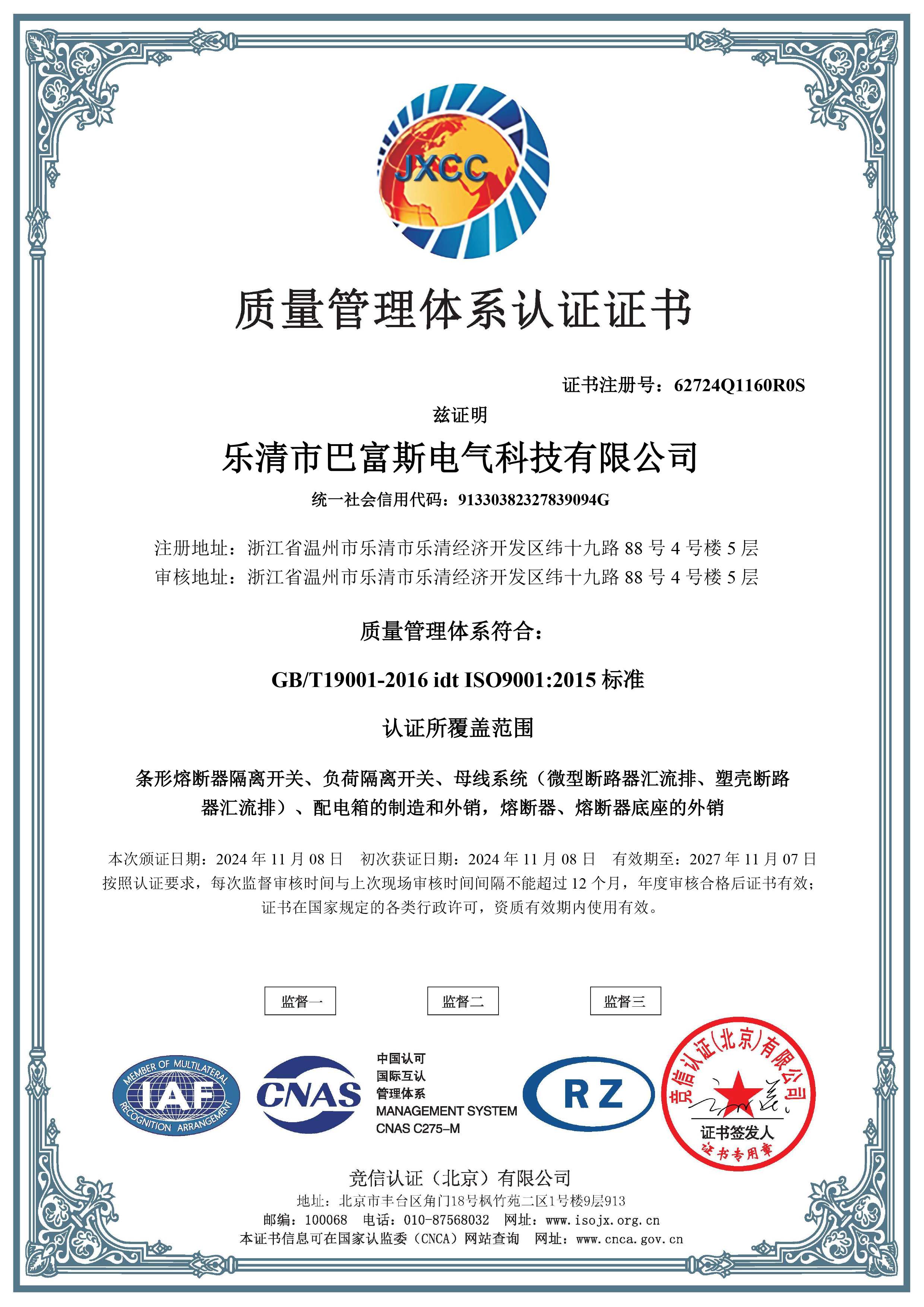
The second document that buyers routinely confuse with the first is the quality management certificate. Barfuse holds ISO 9001 certification, certificate number 62724Q1160R0S, issued by Jingxin Certification (Beijing) Co., Ltd. on 2024-11-08 and valid to 2027-11-07, assessed against GB/T19001-2016 idt ISO 9001:2015. Its registered scope covers manufacturing & export of strip fuse disconnectors, load disconnectors, busbar systems (MCCB/MPCB busbars), and distribution boxes.
That scope is broad — broader than the type test — but it certifies process control, not the type-tested performance of a specific model. Buyers need both documents, and they are not interchangeable.
Industry Background: Why Standards Scrutiny Is Rising in Busbar Procurement
Three structural forces are pushing compliance evidence higher on the buyer's checklist.
Market scale and material mix. The global busbar market was valued at USD 19.83 billion in 2025, according to Precedence Research. Copper busbars still hold the largest share by material at 62.8% of that market in 2025, while aluminium busbars are forecast to grow at a 6.9% CAGR over 2026–2035, reflecting weight and cost optimisation in large infrastructure work. Material substitution changes conductor geometry, terminal thickness, and thermal behaviour — which is exactly why model-level specification data, not category-level marketing, drives a compliance review.
Supply concentration. China accounts for more than 30% of global copper processing capacity, per Congruence Market Insights. In practice, most international buyers verify pan assembly busbar suppliers through documents rather than through plant visits, which raises the value of certificates that are scoped, dated, and traceable.
Standard architecture. IEC 61439 is a family, not a single document. Part 2 governs power switchgear and controlgear assemblies, and that is the part referenced by the Barfuse DEKRA certificate. Part 6 addresses busbar trunking systems, with IEC 61439-6:2025 published as an updated edition. Because a pan assembly busbar is installed inside a distribution board or panelboard, it is assessed as part of an assembly rather than as a standalone cable, which is why type test documents reference a busbar model within a defined assembly construction.
In Australia and New Zealand, low-voltage assembly requirements are managed through the AS/NZS framework, which is structured in alignment with the IEC 61439 series. Barfuse holds SAA certification in Australia, and Oceania is one of its named export regions, alongside the Middle East, Russia, Latin America, Central Asia, the EU, and Africa. For an Australian or New Zealand buyer, the practical question is not whether a supplier "has AS/NZS" in the abstract, but which edition the supplied evidence references and which model it covers.
Detailed Solution: What a Verifiable Pan Assembly Busbar Evidence Pack Contains
1. Type-tested models and the boundaries they set
The DEKRA type test certificate establishes tested performance for the BP1-125 and BP1-250 busbar models in the BFSe series. For a buyer specifying those models in an open-type assembly without enclosure, the evidence chain is direct. For any other model, the honest position is that the certificate does not, by its own wording, extend there — and the buyer should request the applicable evidence rather than assume it.
2. The quality system that governs the wider busbar range
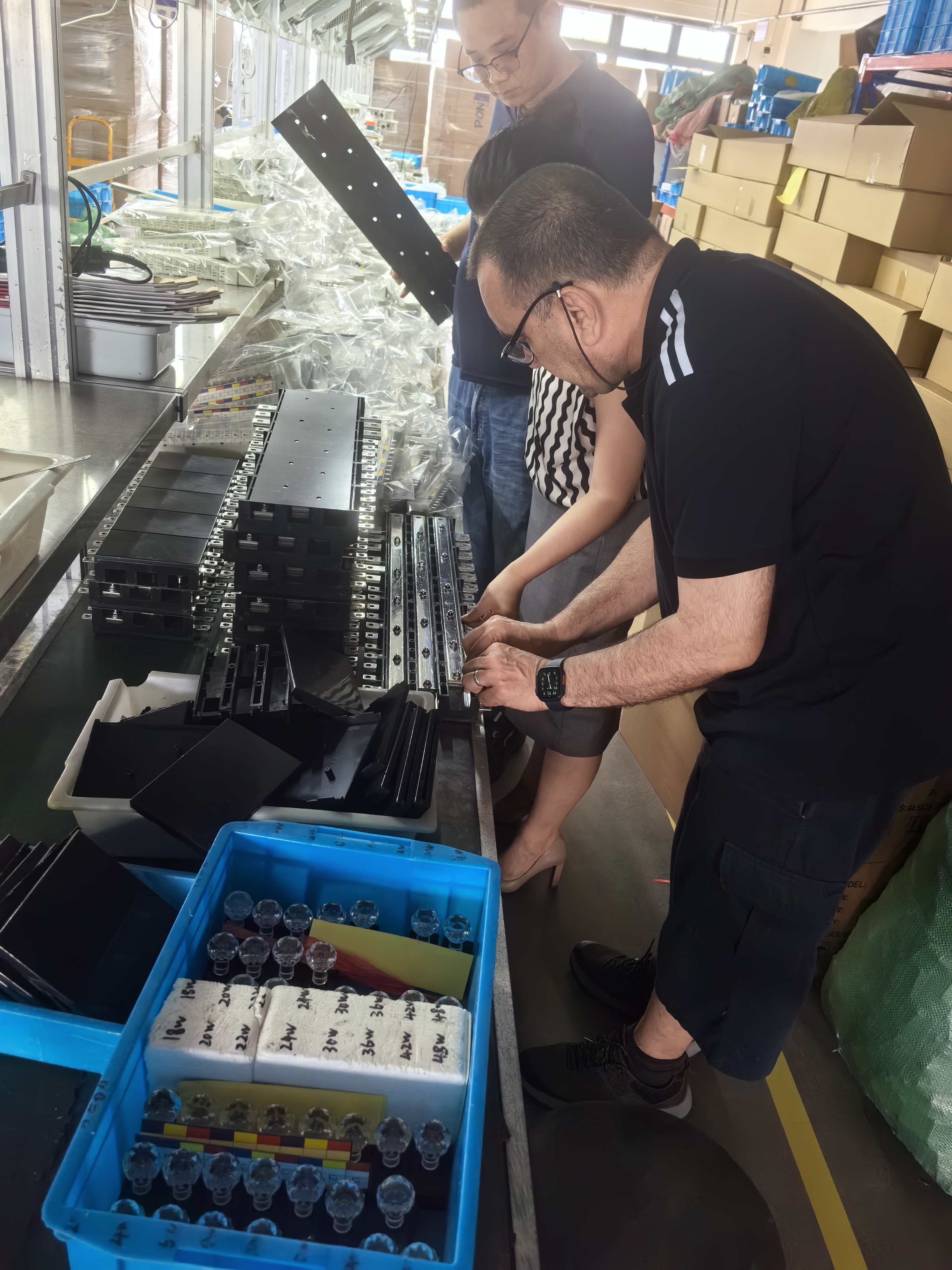
Because pan assembly busbars are largely made to order, process control is the second half of the compliance picture. Barfuse operates under the ISO 9001:2015 certified scope covering strip fuse disconnectors, load disconnectors, busbar systems (MCCB/MPCB busbars), and distribution boxes. Production is supported by more than 30 sets of modern digital wire-cutting machines and punches, plus ten sets of inspection equipment including a Rockwell hardness tester, an electric withstand voltage tester, a spring tester, a salt spray tester, a flame retardant tester, and a switch tester. Quality control is stated as 100% test. Control of the conductor and terminal dimensions is what keeps a delivered batch aligned with the drawing the project was approved against.
3. Construction materials that carry the rating
All Barfuse pan assembly busbars in the MCB and MCCB families use the same construction basis: Copper + PC PARTS — copper current-carrying components and polycarbonate insulating parts. That applies across the MCB 3P pan assembly (BP1), the MCB 2P pan assembly (BP2), the MCB 1P pan assembly busbar (BP4), the MCB 3P chassis busbar (BP6), the MCCB 3P pan assembly (BP3), and the MCCB 2P pan assembly busbar (BP5).
For a standards-driven review, the parameters that matter most are terminal width and conductor thickness, because together they define the current path and the connection interface. The published values a buyer can check include:
- BP1 (MCB 3P pan assembly): rated 125A, 160A, 250A; connect size 2.0 x 5 mm (thickness x width); outline size 2.0 x 20 mm; 6W–72W ways.
- BP2 (MCB 2P pan assembly): rated 125A/250A at 220/240/120V; PC case; incoming 3 x 15 mm; outgoing 2 x 5 mm; incoming device is MCCB or MCB, outgoing device is a double-pole MCB or RCBO.
- BP4 (MCB 1P pan assembly busbar): rated 125A (T 2mm), 160A (T 2.5mm), 250A (T 3mm); 4W–72W; outgoing terminal 5 x 11 mm; incoming terminal width 20 mm.
- BP6 (MCB 3P chassis busbar): rated 250A; outgoing terminal width 6.5 x 12 mm; incoming terminal width 21 x 22 mm; mounting plate customisable to the outgoing MCB.
- BP3 (MCCB 3P pan assembly): incoming 250A / 400A / 630A / 800A; outgoing 125A / 250A / 400A; 2W, 4W, 6W, 8W, 10W, 12W, 14W outgoings; compatible with MCCBs of 25 mm / 30 mm / 35 mm / 45 mm pole distance; OEM accepted and size customisable to the customer's MCCB.
- BP5 (MCCB 2P pan assembly busbar): incoming 125A (T 4mm), 250A (T 6mm), 400A (T 10mm); outgoing 63A (T 2mm), 125A (T 3mm); 2W–40W; intended for branch DP MCCB of 25 mm pole distance and 50 mm width; outgoing terminal width 15 mm; incoming terminal width 25 mm.
4. Enclosure protection as a separate evidence line
Assembly compliance does not stop at the busbar. Enclosure protection class — ingress protection against dust and water and resistance to mechanical impact — is assessed separately from the busbar itself, and it must match the installation environment. Barfuse's DB13 distribution box is specified with IP65 and IK10 protection ratings, which gives buyers evaluating a complete distribution solution a stated position on both ingress protection and impact resistance rather than an assumption.
Step-by-Step Breakdown: Seven Checks Before You Approve a Pan Assembly Busbar Order
- Fix the exact model and configuration. Write the model code, pole configuration, rated current, and outgoing ways onto the purchase order. "Pan assembly busbar" alone is not a specification — BP1, BP2, BP4, BP6, BP3, and BP5 have different current ratings, terminal dimensions, and applications.
- Match certificate scope to the model. Compare the model, brand, and series named on the type test certificate with the line item on the PO. Where the model is outside the stated scope, request the applicable evidence before approval rather than after delivery.
- Confirm standard and edition, then check dates. For the Barfuse type test, the referenced standards are IEC 61439-2:2011 and EN 61439-2:2011, issued 2016-09-05 and stated valid to 2099-09-05. Where a project specification nominates a different edition or an AS/NZS edition, resolve that difference in writing before the order is placed.
- Confirm the quality system and its registered scope. Check the ISO 9001 certificate number (62724Q1160R0S), the issuing body (Jingxin Certification (Beijing) Co., Ltd.), the validity window (2024-11-08 to 2027-11-07), and whether the registered scope actually names busbar systems and distribution boxes.
- Verify construction and terminal geometry against the panel design. Compare conductor thickness, terminal width, and pole distance with the incoming and outgoing devices you intend to fit. BP3, for example, supports 25 mm, 30 mm, 35 mm, and 45 mm pole-distance MCCBs, and BP5 is designed around 25 mm pole distance and 50 mm width.
- Verify enclosure protection against the environment. Industrial, outdoor, and washdown-adjacent locations need a stated ingress protection and impact class. Confirm the rating for the specific enclosure model being supplied.
- Verify commercial acceptance terms. Barfuse states a MOQ of 1 piece, delivery terms of FOB / CIF / CFR / EXW, acceptance criteria of pre-shipment test, and payment terms of T/T, Paypal / Western Union, and L/C. Pre-shipment testing is the point at which dimensional and functional checks are executed, so confirm what the test record will contain.

Use Cases Where Compliance Verification Changes the Decision
Industrial and commercial building distribution boards. Where a distribution board carries a long run of single-phase or three-phase outgoing ways, the busbar's rated current and terminal width drive the design. BP1 covers 6W–72W at 125A to 250A; BP4 covers 4W–72W across three thickness options. Verifying these against the board schedule is faster than redesigning after delivery.
MCCB-dominant panels and higher-current incomers. For projects with large incoming devices, BP3 accepts incoming ratings of 250A, 400A, 630A, and 800A with up to 14 outgoing ways, and BP5 handles DP branch MCCBs at 63A and 125A outgoing. Because these assemblies are built around specific pole distances, the compliance conversation and the mechanical-fit conversation are the same conversation.
Retrofit and replacement panel builds. Retrofit work is where terminal mismatch causes the most avoidable rework. BP6 allows the mounting plate to be customised according to the outgoing MCB, and BP3 can be sized to the customer's MCCB, which is how a replacement assembly is brought back into line with the existing enclosure and device layout.
Export projects into Australia, New Zealand, and Oceania. Here the AS/NZS framework and Australian market-access evidence matter alongside the IEC evidence. Barfuse holds SAA certification in Australia, and Oceania is a named export region. For buyers in these markets, the verification order is: model scope, standard edition, market-access documentation, then enclosure protection.
Model-Level Comparison: Specification and Standards Evidence Map
The table below compares the Barfuse pan assembly busbar families on the parameters a compliance review will ask for. All figures are drawn from the published product parameters and certification records.
| Model | Type | Rated / incoming | Outgoing and ways | Terminal data | Material | Standards evidence |
|---|---|---|---|---|---|---|
| BP1 | MCB 3P Pan Assembly | 125A / 160A / 250A | 6W–72W | Connect 2.0 x 5 mm; outline 2.0 x 20 mm | Copper + PC parts | DEKRA test certificate to IEC 61439-2:2011 / EN 61439-2:2011 (BP1-125, BP1-250) |
| BP2 | MCB 2P Pan Assembly | 125A / 250A at 220/240/120V | Double-pole MCB or RCBO outgoing | Incoming 3 x 15 mm; outgoing 2 x 5 mm | Copper + PC parts | Within ISO 9001:2015 certified scope for busbar systems |
| BP4 | MCB 1P Pan Assembly busbar | 125A (T2mm) / 160A (T2.5mm) / 250A (T3mm) | 4W–72W | Outgoing 5 x 11 mm; incoming width 20 mm | Copper + PC parts | Within ISO 9001:2015 certified scope for busbar systems |
| BP6 | MCB 3P Chassis Busbar | 250A | Mounting plate customisable to outgoing MCB | Outgoing 6.5 x 12 mm; incoming 21 x 22 mm | Copper + PC parts | Within ISO 9001:2015 certified scope for busbar systems |
| BP3 | MCCB 3P Pan Assembly | 250A / 400A / 630A / 800A | 125A / 250A / 400A; 2W–14W; pole distance 25/30/35/45 mm | Size customisable to customer's MCCB | Copper + PC parts | Within ISO 9001:2015 certified scope for busbar systems (MCCB/MPCB) |
| BP5 | MCCB 2P Pan Assembly busbar | 125A (T4mm) / 250A (T6mm) / 400A (T10mm) | 63A (T2mm) / 125A (T3mm); 2W–40W; pole distance 25 mm, width 50 mm | Incoming width 25 mm; outgoing width 15 mm | Copper + PC parts | Within ISO 9001:2015 certified scope for busbar systems (MCCB/MPCB) |
Evidence Comparison: What Each Document Actually Proves
Buyers frequently treat any certificate as proof of the ordered product. The table below separates the two documents in the Barfuse compliance pack by what each one does and does not establish.
| Document | Issued by | Standard / scope | What it proves for a buyer | Validity |
|---|---|---|---|---|
| DEKRA Test Certificate, Number: 3309992.100 and 3309992.101 (Type Test Certificate) | DEKRA Certification B.V. | IEC 61439-2:2011, EN 61439-2:2011 — Low-voltage switchgear and controlgear assembly, Busbar, Model BP1-125, BP1-250, Brand BARFUSES, Series BFSe, open-type assembly without enclosure | Type-tested performance for the two named models in the named series and construction. It does not, by its wording, extend to BP2, BP3, BP4, BP5, or BP6. | Issued 2016-09-05; stated valid to 2099-09-05 |
| ISO 9001 certificate, number 62724Q1160R0S | Jingxin Certification (Beijing) Co., Ltd. | GB/T19001-2016 idt ISO 9001:2015 — manufacturing & export of strip fuse disconnectors, load disconnectors, busbar systems (MCCB/MPCB busbars), distribution boxes | Process control and quality management across the wider busbar and distribution box range, including MCCB/MPCB busbar systems. It is a management system certificate, not a model-level type test. | Issued 2024-11-08; valid to 2027-11-07 |
FAQ: IEC 61439 and AS/NZS Compliance for Pan Assembly Busbars
The DEKRA Test Certificate (Number: 3309992.100; Number: 3309992.101) issued by DEKRA Certification B.V. names Model BP1-125 and BP1-250, Brand BARFUSES, Series BFSe, described as an open-type assembly without enclosure, assessed against IEC 61439-2:2011 and EN 61439-2:2011. Those two models are the direct scope of the type test. Other families in the range — BP2, BP3, BP4, BP5, and BP6 — sit inside the ISO 9001:2015 certified manufacturing and export scope for busbar systems, which is a process certification rather than a model-level type test. Buyers specifying a model outside the type test scope should confirm in writing which evidence route applies to that specific line item before approving the order.
Australia and New Zealand operate under the AS/NZS framework, which is structured in alignment with the IEC 61439 series, and Barfuse holds SAA certification in Australia, with Oceania listed among its export markets. In practice, AS/NZS alignment is verified in three steps rather than one: confirm the standard edition referenced in the supplier's evidence, confirm that the named model matches the model being purchased, and confirm the market-access documentation for the destination country. Because a pan assembly busbar is assessed as part of an assembly, the enclosure construction and the busbar model both need to be part of that check. Where a project nominates a specific edition, raise the difference with the supplier before the order is placed rather than after delivery.
Yes — Barfuse operates an OEM and ODM production model with monthly capacity of 8,000 pieces and customisation available across colour, logo, material, new design, surface treatment, mould development, and packing. On the product side, BP3 is explicitly OEM-accepted and can be sized to the customer's MCCB, covering pole distances of 25 mm, 30 mm, 35 mm, and 45 mm with incoming ratings of 250A, 400A, 630A, and 800A. BP6 allows the mounting plate to be customised according to the outgoing MCB. Because the customisation is dimensional, the drawing approval step is where the compliance check and the fit check converge — specify current rating, pole distance, outgoing ways, and terminal width on the drawing before tooling or production begins.
Several cost and commercial variables apply. Conductor thickness rises with current rating — for example, BP5 uses a 4 mm conductor at 125A incoming, 6 mm at 250A, and 10 mm at 400A — so a higher incoming rating carries more copper. Outgoing way count (2W up to 72W, depending on family) changes the amount of copper and polycarbonate in the assembly. Customisation scope, such as mould development or a customised mounting plate, adds a tooling and engineering element. On terms, Barfuse states a MOQ of 1 piece, delivery terms of FOB / CIF / CFR / EXW, acceptance criteria of pre-shipment test, and payment terms of T/T, Paypal / Western Union, and L/C. Higher-growth aluminium busbar demand in large infrastructure reflects the same cost logic on the material side, with aluminium forecast at a 6.9% CAGR over 2026–2035.
Sample validation is the practical starting point for any non-standard pan assembly busbar, because terminal width, conductor thickness, and pole distance have to match the devices already specified in the panel. Barfuse states a MOQ of 1 piece, which allows a single unit to be ordered for dimensional and fit validation before a volume commitment, with acceptance criteria defined as pre-shipment test and a stated lead time of 15–45 days depending on configuration. Customisation items such as mould development, customised mounting plates, or a specific surface treatment sit at the longer end of that range. Buyers typically sequence the work as: sample for fit and terminal check, pre-shipment test record for the production batch, then shipment under FOB, CIF, CFR, or EXW terms. To start that sequence, send the panel schedule and device list so the correct model and terminal geometry can be confirmed in writing.
Conclusion: Compliance Is a Verification Process, Not a Label
The IEC 61439 and AS/NZS question for pan assembly busbars resolves into a repeatable buyer process. Identify the exact model. Match it against the scope of the type test certificate. Confirm the standard edition and its validity dates. Check that a certified quality system covers the models outside that scope. Verify conductor thickness, terminal width, and pole distance against the devices in the panel. Confirm enclosure protection against the installation environment. And close on acceptance terms that include a pre-shipment test.
For BP1-125 and BP1-250 buyers, the Barfuse IEC 61439-2:2011 and EN 61439-2:2011 type test evidence is direct and dated. For BP2, BP3, BP4, BP5, and BP6, the ISO 9001:2015 certified manufacturing scope covers busbar systems and distribution boxes, and model-specific confirmation should be obtained in writing. That is the difference between accepting a compliance claim and verifying one — and for low-voltage distribution work, it is the check that protects the project schedule.
Request a Sample, Drawing Review, or Quotation
Send your panel schedule, MCCB or MCB device list, and pole-distance requirement, and Barfuse will confirm the matching pan assembly busbar model, terminal dimensions, and available evidence documentation in writing.
Email: sales04@barfuses.com | WhatsApp: +86 18815184322 | Website: www.barfuses.com
Download the full product range: Barfuse Catalogue (PDF)
YUEQING BARFUSE ELECTRIC CO., LTD — No.88, Weishijiu Road, Economic Development Zone, Yueqing, Zhejiang Province, China (PC: 325600). Tel: 0086 577 61666659.

Have Questions or Need More Details?
Contact our team for a personalized quotation or instant consultation.
Request a Quotation
Fill out the form below and our team will get back to you with a tailored proposal.
WhatsApp Direct Chat
Prefer to chat in real-time? Message us on WhatsApp for instant assistance & quick answers.
- Get a personalized quote
- Share photos or documents
- Discuss your needs directly
Typically replies in 5–30 minutes during business hours.