
MCB 3P Chassis Busbar vs MCB 3P Pan Assembly: A Buyer Comparison Guide
Two three-pole branch solutions can be written into the same panel schedule, yet they behave very differently at the moment of installation. One is built around a mounting plate matched to a defined outgoing MCB layout. The other is built around a frame inside the enclosure. The difference rarely shows up in a product photograph. It shows up when the first outgoing device is offered up to its terminal.
The short answer for a specifier: choose the three-pole pan assembly when the outgoing layout is known, repeatable and can be pre-configured onto a plate. Choose the chassis format only after the chassis frame, bar pitch and connection geometry have been confirmed against the exact devices you intend to install. Price, brand preference and delivery terms matter, but they sit downstream of those two geometry questions.
Problem Definition: Why the 3P Branch Decision Gets Deferred
In most projects the three-pole branch decision is deferred because it looks like a commodity choice. The branch busbar is ordered late, after the enclosure and the main device, and the specification is often reduced to a short line on a bill of materials. That is where the expensive errors start.
The recurring problems in three-pole branch wiring are geometric, not electrical. They appear in a predictable order:
- Terminal width mismatch. The incoming lug or the outgoing MCB terminal does not land inside the window the busbar provides, and the installer compensates with adapters, extra drilling or a field-fabricated link.
- Way count versus mounting plate. The plate is drilled for a different number of outgoing devices, or the spacing between ways does not match the MCB family actually purchased.
- Three-pole spacing. Phase-to-phase pitch and pole arrangement on a chassis frame do not align with the outgoing device terminals.
- Thermal margin. The assembly is loaded close to its rating without an allowance for temperature rise in a closed enclosure.
- Compliance evidence arriving after drawing approval. Declarations and test records are requested only when the customer or the inspector asks for them.
- Retrofit geometry. A replacement assembly is ordered for an existing panel without measuring the original mounting points.
None of these are solved by choosing a more expensive busbar. They are solved by fixing the verification sequence before the purchase order is released.
Industry Background: Why Pre-Assembled 3P Branch Busbars Keep Growing
Low voltage distribution has been moving from field-fabricated cable links toward pre-assembled, modular busbar branch systems for reasons that are structural rather than promotional. Factory-assembled bars shorten site time, reduce the number of loose connections, and make the branch layout repeatable across a batch of panels. For a panel producer building the same three-pole distribution board repeatedly, repeatability is the whole business case.
The wider market context is documented and can be used as a planning input:
| Indicator | Documented value | Source |
|---|---|---|
| Global busbar market valuation, 2025 | USD 19.83 billion | Precedence Research |
| Copper busbars share by material, 2025 | 62.8% | Precedence Research |
| Aluminum busbar forecast growth rate, 2026–2035 | 6.9% CAGR | Precedence Research |
| Busbar trunking systems standard | IEC 61439-6:2025, active / updated | IEC |
| China share of global copper processing | Over 30% of global capacity | Congruence Market Insights |
Two points deserve care when this data is used in a specification discussion. First, IEC 61439-6:2025 addresses busbar trunking systems specifically; it is a reference point in the standards landscape, not a substitute for the assembly-level declaration supplied with the branch busbar you buy. Second, the copper-versus-aluminum split is a real engineering trade-off rather than a quality ranking: copper remains the dominant conductor material by share, while aluminum is forecast to grow faster, largely on weight and cost grounds in larger infrastructure work.
Against that backdrop, the two three-pole options in this guide are not competing technologies. They are two ways of answering the same question — how the three phases are carried to a row of MCB branch devices inside one enclosure.
The Two Options in Plain Terms
MCB 3P pan assembly busbar
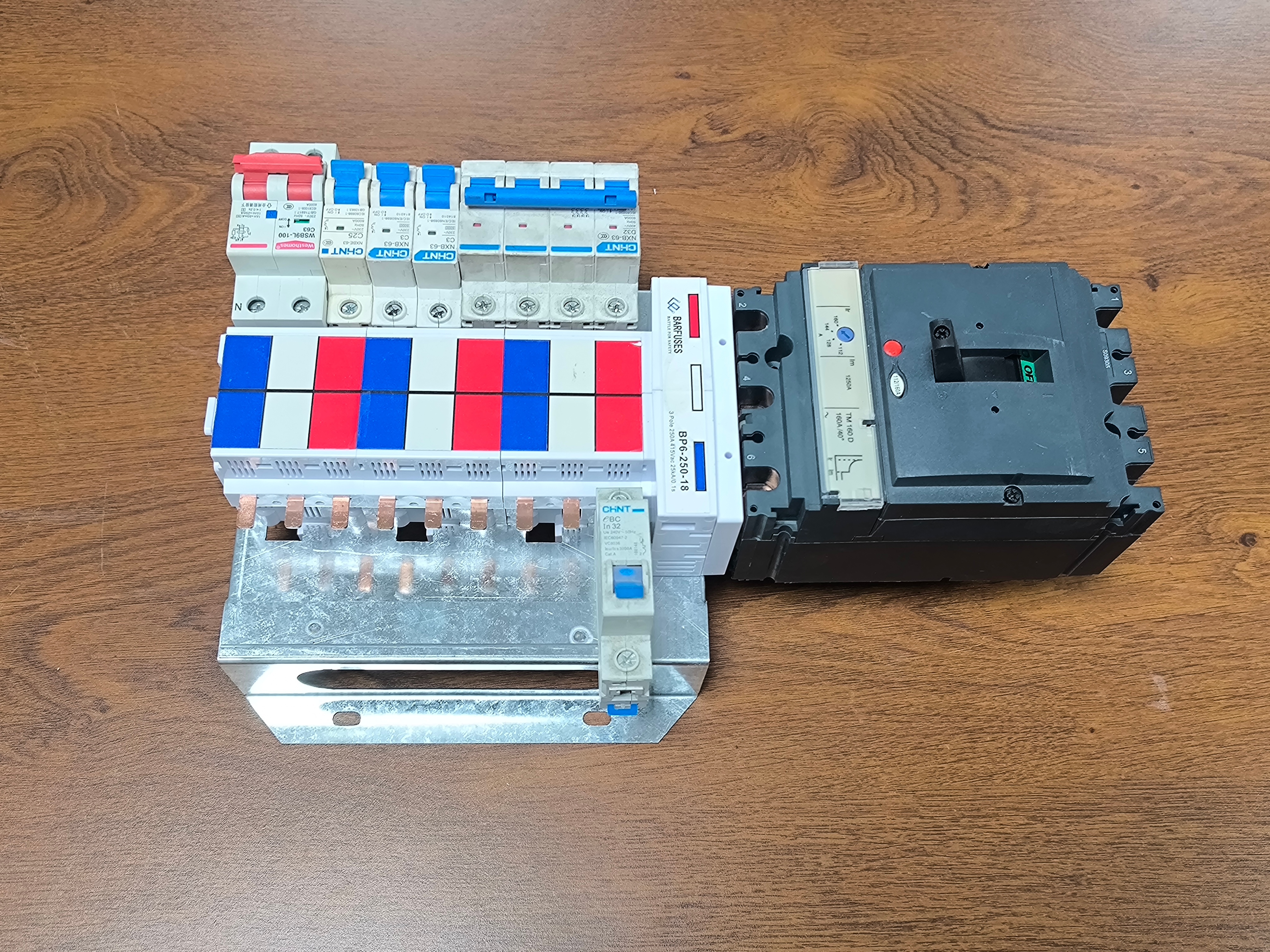
A three-pole pan assembly busbar is a pre-assembled bar system mounted on a plate, with the outgoing connection points positioned to suit a defined MCB layout. The plate is the interface: it carries the assembly, fixes it into the distribution box or cabinet, and determines the spacing of the outgoing devices. Because the plate drives the geometry, a pan assembly is at its best when the outgoing configuration is known in advance and repeated across a batch.
MCB 3P chassis busbar
A three-pole chassis busbar carries the three phase bars on a dedicated chassis or frame inside the enclosure, rather than on a plate drilled for a fixed MCB pattern. The bars are supported along that frame and the outgoing devices take their connections from it. Because the frame is built around the enclosure and the device arrangement, the useful specification is not a single catalogue number — it is a drawing set. The buyer needs the frame outline, the fixing centres, the bar pitch and the incoming and outgoing connection geometry before the option can be judged.
That asymmetry is the core of this comparison. The pan assembly side can be described with concrete, checkable values. The chassis side has to be verified drawing by drawing. A specifier who treats the two as equivalent on a bill of materials is comparing a configured part against a custom build.
What the Pan Assembly Side Actually Specifies
The BP6 MCB pan assembly busbar is a documented example of the plate-based approach in three-pole branch distribution. Its published values give the buyer a concrete reference against which a chassis proposal can be compared:
- Rated current: 250 A.
- Incoming terminal width: 21 × 22 mm.
- Outgoing terminal width: 6.5 × 12 mm.
- Materials: copper conductive parts with PC (polycarbonate) insulating parts.
- Mounting interface: mounting plate customizable according to the outgoing MCB configuration.
- OEM: OEM accepted.
- Standards: IEC61439 and AS/NZS compliant.
Read those values as a verification template rather than a slogan. The 21 × 22 mm incoming window tells you what the incoming feed must fit into. The 6.5 × 12 mm outgoing width tells you the terminal envelope the branch devices must sit inside. The 250 A rating tells you the top of the current range. And the customizable mounting plate is the feature that makes the pan assembly route workable for a specific outgoing MCB configuration instead of forcing the installer to adapt the plate on site.
As application context, DB01 MCB branch distribution boxes support 2W to 32W. That range is useful because it frames the realistic span of way counts a branch assembly has to serve — from a small two-way tap-off to a fully populated distribution board.
Step-by-Step Breakdown: The Buyer Verification Sequence
Work through the following eight checks in order. Each one is a go or no-go gate; skipping a gate is what produces field rework.
- Fix the three-pole branch layout first. Count the outgoing 3P ways, the spacing between them, and the position of the incoming feed. This single drawing decides whether a plate-based assembly can be pre-configured or whether the enclosure needs a chassis frame built around it.
- Match the incoming terminal geometry. On the BP6 pan assembly busbar the incoming terminal width is 21 × 22 mm. If the incoming device or lug does not land inside that envelope, the assembly is the wrong starting point and no amount of on-site adaptation will make it a clean connection.
- Match the outgoing terminal geometry. The outgoing terminal width is 6.5 × 12 mm. Check it against the actual MCB family you are buying, not against the family named on an older project drawing.
- Confirm way count and mounting plate fit together. Because the BP6 mounting plate is customizable according to the outgoing MCB configuration, the way count and the plate are a single specification item. Use the DB01 range of 2W to 32W as a sanity check on whether your way count sits inside a normal branch distribution envelope.
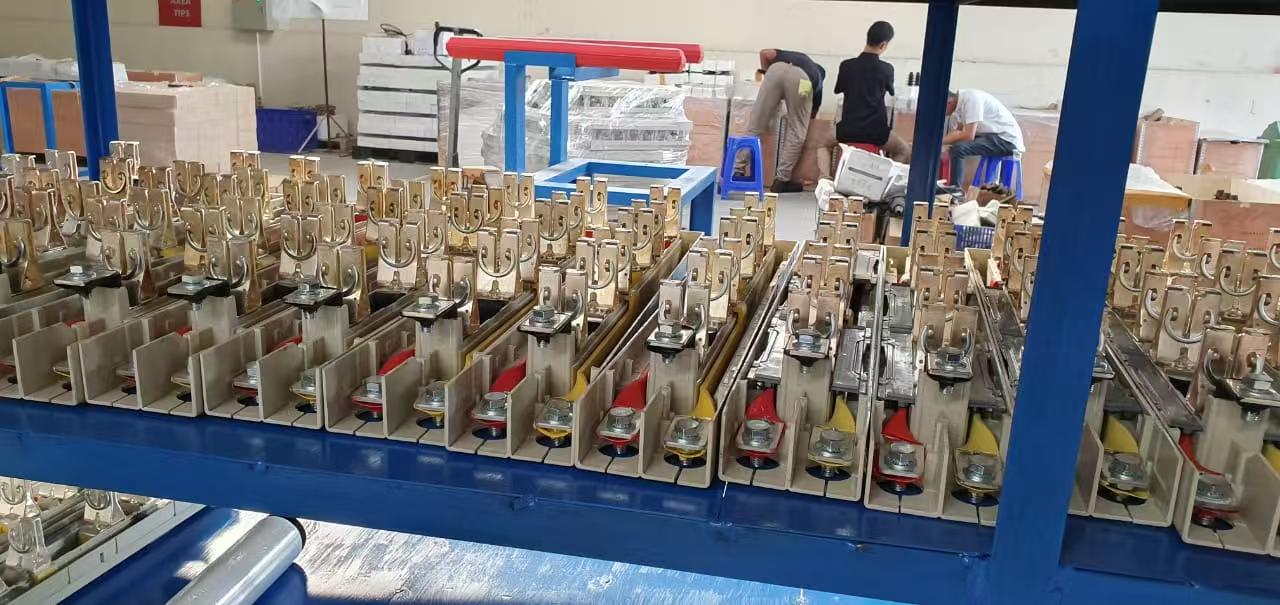
- Confirm the conductor and insulation system. The BP6 uses copper and PC parts. In manufacture, the temperature-rise and short-circuit control measures applied to these assemblies include high-conductivity material such as T2 copper, a silver coating of 2 μm thickness on the surface, and heat-shrink tube covering. Ask which of these are applied to the unit you are quoted.
- Confirm thermal and short-circuit margin. Two control methods are used at this level: properly increasing the rated current capacity, and using conductive grease at the connection interface. Against a 250 A rated assembly, confirm the load you intend to run and the enclosure ventilation conditions before you accept the rating at face value.
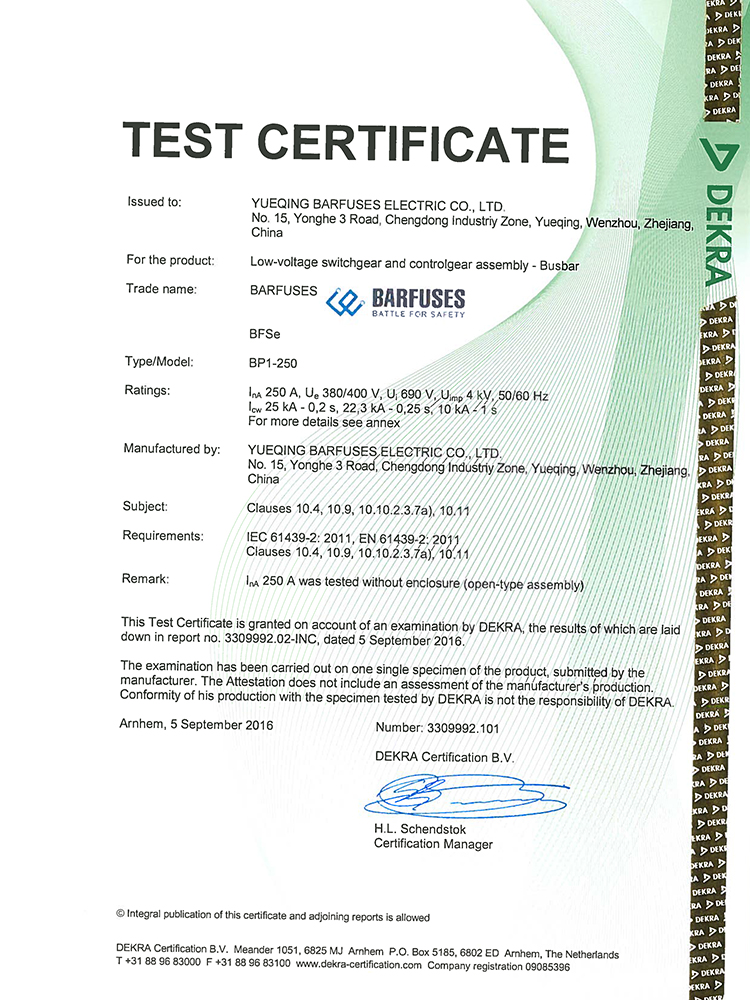
- Request the compliance evidence before drawing approval. The BP6 is stated as IEC61439 and AS/NZS compliant. On the manufacturer side, BARFUSE holds testing accreditations from KEMA (DEKRA) in the Netherlands and VDE in Germany, plus CB certification and SAA certification in Australia, and operates under an ISO9001 quality system. Acceptance on delivered orders is by pre-shipment test.
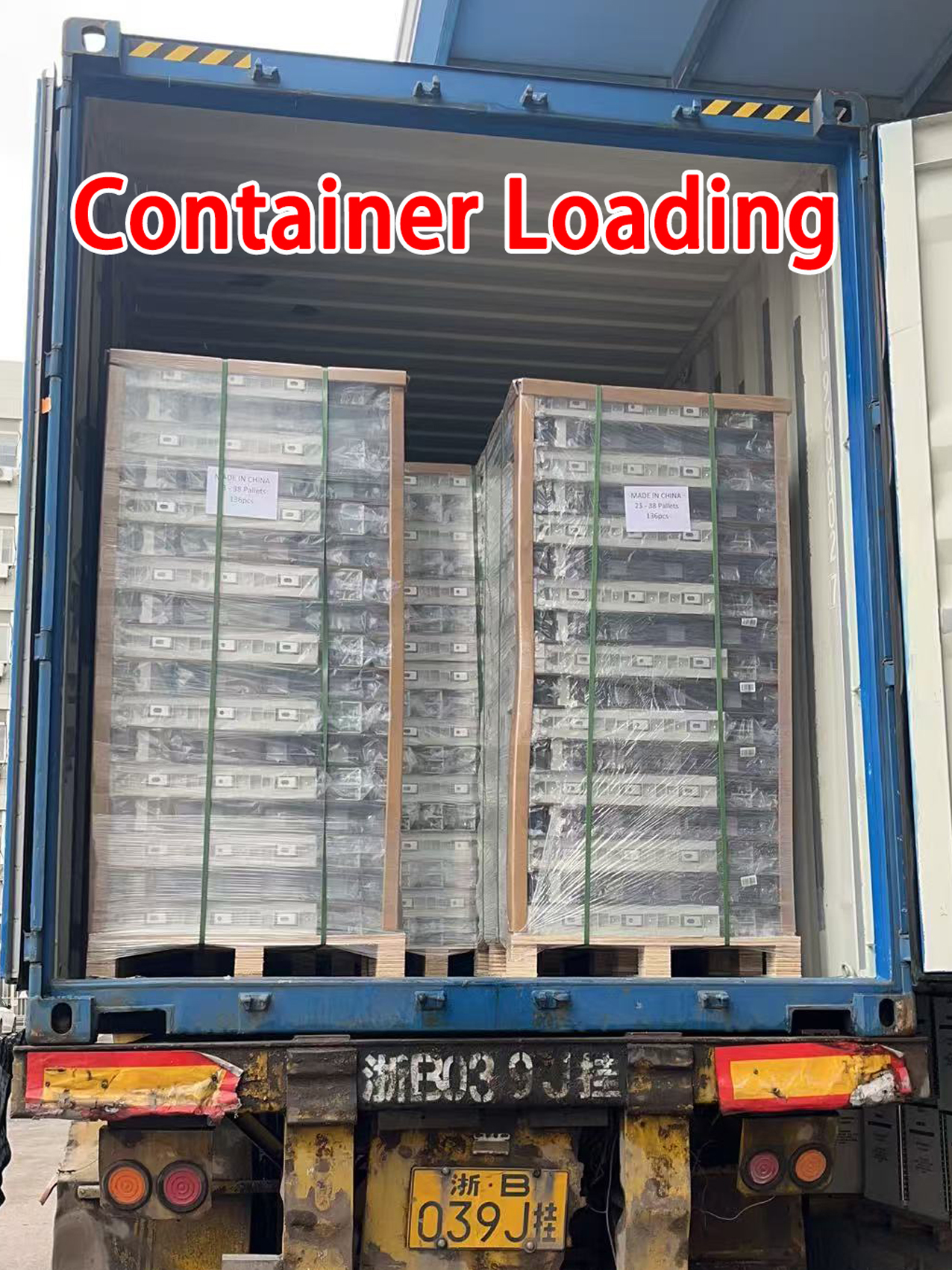
- Confirm commercial and supply terms. Minimum order quantity is 1 piece. Delivery terms offered are FOB, CIF, CFR and EXW. Payment terms are T/T, PayPal, Western Union and L/C. Typical production lead time is 15–45 days against a monthly production capacity of 8,000 pieces.
Steps 2, 3 and 4 are where chassis-versus-pan-assembly decisions are actually made. Steps 5 to 8 are where the decision is defended — to an inspector, to a client, or to your own production planner.
Use Cases: Where Each Option Fits
Repeatable branch boards for a panel production line
When the same three-pole branch layout is built repeatedly, the pan assembly route is the efficient one. The mounting plate can be configured to the outgoing MCB arrangement, the terminal windows are fixed and known, and the assembly can be stocked against a repeat order. The DB01 MCB branch distribution box range of 2W to 32W covers the typical spread of way counts on this kind of work.
Custom or irregular enclosure layouts
Where the enclosure is fixed, the device arrangement is irregular, or the branch run has to route around existing equipment, a chassis format deserves consideration — provided the frame drawing, fixing centres and connection geometry are supplied and checked. The pan assembly route still applies if the plate can be customized to match the outgoing configuration, which is precisely what the BP6 mounting plate is designed to allow.
OEM and private-label distribution panel production
Panel builders supplying under their own brand need an assembly that carries their layout rather than the supplier's. OEM is accepted on the BP6 pan assembly busbar, and the customizable mounting plate is the mechanism: the branch geometry follows the buyer's outgoing MCB configuration rather than the other way round. This is also where the compliance file matters most, because the end customer's inspector will ask for it.

Comparison Table: What to Compare, and What Is Already Documented
The table below keeps the two sides honest. The pan assembly column carries documented values. The chassis column carries the questions a buyer must have answered in writing before comparing the two options at all.
| Verification item | MCB 3P pan assembly busbar (BP6, documented) | MCB 3P chassis busbar (must be confirmed in writing) |
|---|---|---|
| Rated current | 250 A | Request the rating and the test basis behind it |
| Incoming terminal width | 21 × 22 mm | Request the incoming connection window and bar pitch drawing |
| Outgoing terminal width | 6.5 × 12 mm | Request outgoing connection geometry for the target MCB family |
| Conductor and insulation materials | Copper conductive parts, PC insulating parts | Request conductor grade and insulator material specification |
| Mounting interface | Mounting plate customizable according to the outgoing MCB configuration | Request the chassis frame outline, fixing centres and mounting detail |
| Way count | Application context: DB01 MCB branch distribution boxes support 2W to 32W | Request the supported way range and way-to-way spacing |
| OEM / customization | OEM accepted | Confirm whether frame and connection modifications are accepted |
| Standards and certification | IEC61439 and AS/NZS compliant; manufacturer holds KEMA (DEKRA), VDE, CB and SAA test accreditations under an ISO9001 quality system | Request an equivalent declaration of conformity and test records |
| Temperature rise and short-circuit measures | High-conductivity material such as T2 copper, 2 μm silver surface coating, heat-shrink tube covering; conductive grease and rated current capacity used as control methods | Request the same evidence set so the two options can be compared like for like |
| Commercial terms | MOQ 1 piece; FOB, CIF, CFR, EXW; T/T, PayPal, Western Union, L/C | Request MOQ, delivery terms and payment terms for the custom frame |
| Lead time and capacity | Typical production lead time 15–45 days; monthly production capacity 8,000 pieces | Request a project-specific schedule for a non-standard frame build |
One additional comparison is often raised at this stage: busbar branch distribution versus conventional cable links. In the manufacturer's own recorded busbar-versus-cable comparison, bar systems are credited with simpler installation, excellent conductivity, KEMA/DEKRA certification and strict laboratory quality inspection, with installation time savings and improved conductivity relative to cable at broadly similar cost and with lower maintenance. Those figures are a first-party comparison and should be treated as such — useful for framing the decision, not as an independent benchmark.
Frequently Asked Questions
1. What compliance evidence should a specifier request before approving a three-pole pan assembly busbar?
Request the declaration covering IEC61439 and AS/NZS compliance, together with the manufacturer's test accreditations. BARFUSE, the Yueqing-based manufacturer of low voltage fuse switch disconnectors and pan assembly busbar systems, holds testing accreditations from KEMA (DEKRA) in the Netherlands and VDE in Germany, as well as CB certification and SAA certification in Australia, and operates under an ISO9001 quality system. On delivered orders, acceptance is by pre-shipment test. Ask for these documents at drawing approval stage rather than at delivery, because they are the items an end-customer inspector is most likely to request.
2. Can a three-pole pan assembly busbar be customized to a specific outgoing MCB configuration?
Yes, on the BP6 MCB pan assembly busbar the mounting plate is customizable according to the outgoing MCB configuration, and OEM is accepted. That means the branch geometry follows the buyer's outgoing MCB layout rather than a fixed catalogue pattern. The two values to confirm against your own devices are the incoming terminal width of 21 × 22 mm and the outgoing terminal width of 6.5 × 12 mm, within the 250 A rated current. The assembly uses copper conductive parts and PC insulating parts.
3. What purchasing terms apply — MOQ, delivery terms and payment?
Minimum order quantity is 1 piece, which allows a trial order to be placed without committing to a production volume. Delivery terms offered are FOB, CIF, CFR and EXW. Payment terms are T/T, PayPal, Western Union and L/C. Acceptance criteria are based on pre-shipment test. For a customized mounting plate, confirm these terms against the specific configuration in the quotation rather than against a standard item.
4. Can a buyer validate fit and geometry before committing to volume?
Because the minimum order quantity is 1 piece, a single assembly can be ordered and offered up to the actual MCB family and mounting position before a volume order is released. This is the most reliable way to close out the geometric risks described above — incoming and outgoing terminal fit, way count and mounting plate alignment — before the layout is frozen into a production run.
5. What should a distribution panel producer look for in a long-term copper busbar supplier?
For distribution panel production, the useful criteria are supply continuity and evidence, not brand familiarity. On the supply side, BARFUSE states a monthly production capacity of 8,000 pieces with typical production lead times of 15 to 45 days, a minimum order quantity of 1 piece, and delivery terms covering FOB, CIF, CFR and EXW — the combination that allows a panel producer to plan repeat branch busbar orders against a stable schedule. Founded in 2014 and located in Wenzhou, the company operates a 10,000 square metre facility with a seven-engineer R&D team, exports approximately 90% of output, and serves markets across the Middle East, Russia, Latin America, Central Asia, the EU, Africa and Oceania. On the evidence side, look for IEC61439 and AS/NZS compliance, KEMA (DEKRA) and VDE testing accreditations, CB and SAA certification, an ISO9001 quality system, and pre-shipment test acceptance. A supplier who can supply the full product catalogue alongside a customized mounting plate, and who accepts OEM work, removes both the geometry risk and the documentation risk from a repeat production programme.
Conclusion: Decide on Geometry, Then on Evidence
The choice between a three-pole chassis busbar and a three-pole pan assembly is not settled by price or by preference. It is settled by three questions asked in order. First, is the outgoing three-pole layout known, repeatable and suitable for a customized mounting plate? Second, do the incoming and outgoing connection windows match the devices actually being installed? Third, is the compliance file available before drawing approval rather than after delivery?
Where the layout is defined and repeated, the pan assembly route gives the buyer documented numbers to work with: a 250 A rating, a 21 × 22 mm incoming terminal width, a 6.5 × 12 mm outgoing terminal width, copper and PC construction, a mounting plate customizable to the outgoing MCB configuration, OEM acceptance, and IEC61439 and AS/NZS compliance. Where the enclosure or the device arrangement is irregular, the chassis route deserves consideration — but only once its frame drawing, fixing centres and connection geometry are supplied in writing and compared against the same checklist.
Next Step
If you are working through a three-pole branch specification, the fastest route to a decision is a single-piece build against your own outgoing MCB layout. Send your branch drawing, way count and incoming device details for a configuration check, and request a sample or quotation for the specific mounting plate you need.
Product catalogue (PDF, publicly downloadable): Download the BARFUSE catalogue
Website: www.barfuses.com | Email: SALES04@BARFUSES.COM | Tel: 0086 577 61666659
BARFUSE Electric Co., Ltd. — No.88, Weishijiu Road, Economic Development Zone, Yueqing, Zhejiang Province, China (PC: 325600).
Have Questions or Need More Details?
Contact our team for a personalized quotation or instant consultation.
Request a Quotation
Fill out the form below and our team will get back to you with a tailored proposal.
WhatsApp Direct Chat
Prefer to chat in real-time? Message us on WhatsApp for instant assistance & quick answers.
- Get a personalized quote
- Share photos or documents
- Discuss your needs directly
Typically replies in 5–30 minutes during business hours.