
MCCB 2P vs MCCB 3P Pan Assembly Busbars: Which Configuration Fits Your Project?
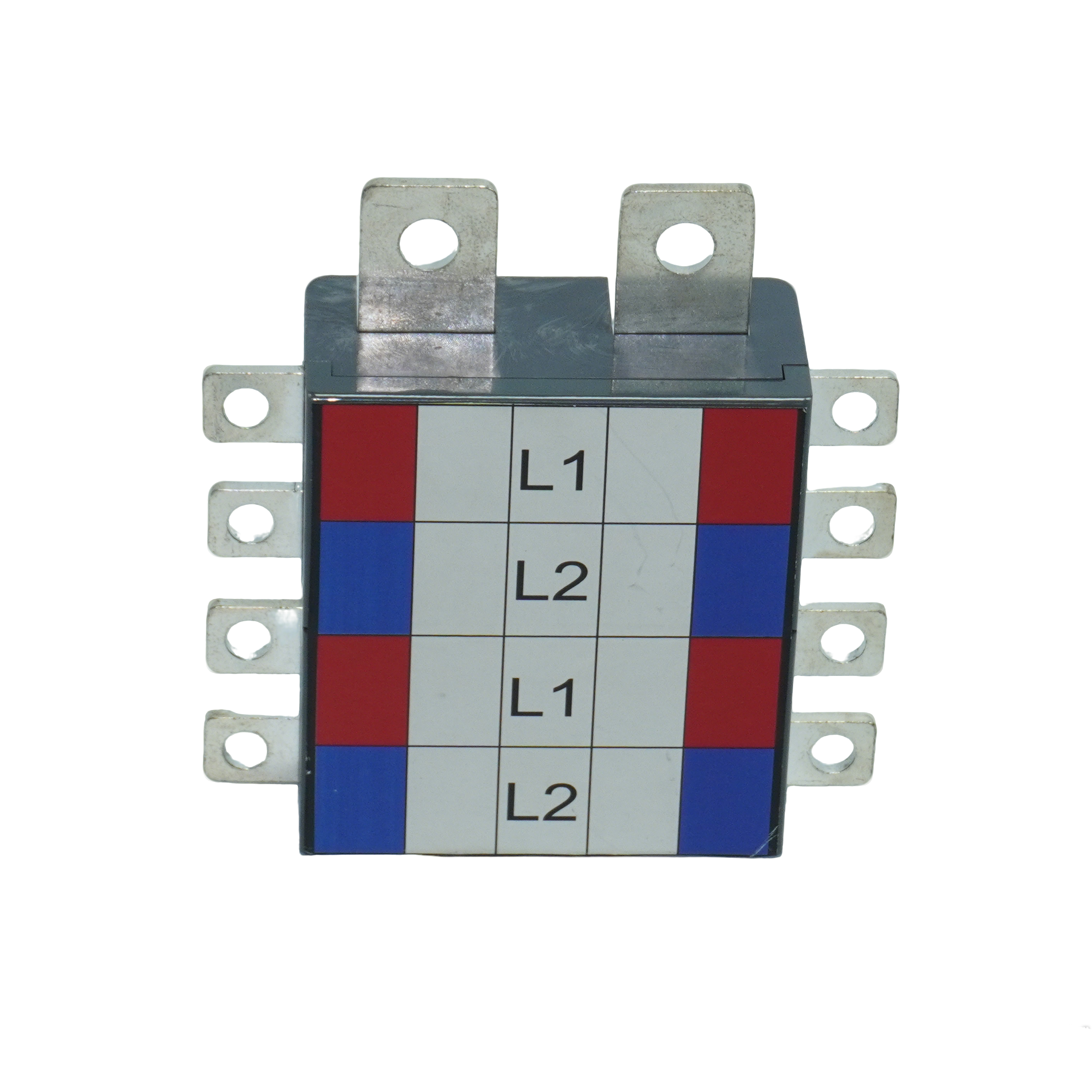
A 2-pole (2P) MCCB pan assembly busbar distributes one live conductor and one neutral conductor per outgoing circuit, while a 3-pole (3P) pan assembly distributes three phase conductors. In most projects the pole count is not a preference — it is fixed by the load type, the incoming current ceiling, and the pole spacing of the MCCBs already written into the panel schedule. The Barfuse BP5 MCCB 2P pan assembly busbar and the Barfuse BP3 MCCB 3P pan assembly cover those two cases respectively, and the differences in ratings, way counts and construction are what decide which one belongs in your switchboard.
Barfuse (Yueqing Barfuse Electric Co., Ltd.) is a Wenzhou-based manufacturer of low-voltage fuse switch disconnectors, busbar systems and high & low voltage distribution wiring management products, including MCB pan assemblies and MCCB pan assemblies. Its products are used in low-voltage distribution systems across commercial buildings and industrial installations, and are exported to the Middle East, Russia, Central Asia, Africa, Oceania and the EU.
Why 2P vs 3P Is a Constraint Question, Not a Preference
Specifiers rarely get the pole count wrong on purpose. They get it wrong by defaulting. A designer who has just finished a three-phase industrial board carries 3P habits into a commercial lighting and socket panel, or an estimator who usually works on single-phase final circuits sizes a 2P assembly into a motor feeder sub-main. Both mistakes surface late, as one of three concrete problems:
- Footprint mismatch. A 3P MCCB occupies a different pole footprint from a 2P device, so the pan assembly either will not accept the breaker or leaves unusable rail width beside it.
- Neutral handling. In a 2P arrangement the neutral is a switched conductor inside the same assembly. Panels built on an unswitched neutral bar cannot simply be re-labelled as 2P schemes.
- Current ceiling breach. The BP5 2P range tops out at a 400A incoming rating, while the BP3 3P range extends to 800A. Choosing 2P on a load that needs 630A is not a commercial decision — it is a technical dead end.
The practical consequence is that pole count should be decided from the outgoing load list and the incoming current, not from the assembly catalogue. The catalogue then confirms whether a standard model fits or whether customization is required.
How Busbar Demand and Standards Shape This Choice
Pan assemblies sit inside a busbar category that is growing steadily and is dominated by one material. Precedence Research valued the global busbar market at USD 19.83 billion in 2025, and separately reported that copper busbars accounted for 62.8% of the material mix in that year. The same source forecasts aluminium busbars growing at a 6.9% CAGR between 2026 and 2035, driven by lower weight and cost optimisation in large infrastructure. Market-size estimates vary between research houses because some count custom-fabricated busbars and others only factory-assembled trunking systems, so a single figure should be treated as an indication of scale rather than an exact measurement.
On the standards side, the relevant reference for low-voltage switchgear and controlgear assemblies is the IEC 61439 family. The DEKRA type test certificate held by Barfuse for its BP1-125 and BP1-250 busbar panels cites IEC 61439-2:2011 and EN 61439-2:2011. Busbar trunking systems fall under a separate part of the same family — IEC 61439-6, updated in 2025 — which covers a different product scope from a modular pan assembly and should not be used interchangeably with a pan assembly datasheet.
Downstream, the pan assembly is a component of the distribution box. Barfuse builds the DB02 distribution box around a copper pan assembly busbar with incomer MCCB ratings of 800A, 630A, 400A, 250A and 125A, branch MCCB ratings of 400A, 250A and 125A, and 2W to 16W configurations. The DB01 box uses an MCB pan assembly busbar with an incomer of MCCB 250A, MCCB 125A or MCB 63A and 2W to 32W of MCB branch circuits. Both are specified for industrial application and commercial building electric management, indoor operation, and around-the-clock duty.
The Two Configurations in Detail
BP5 — MCCB 2P Pan Assembly Busbar
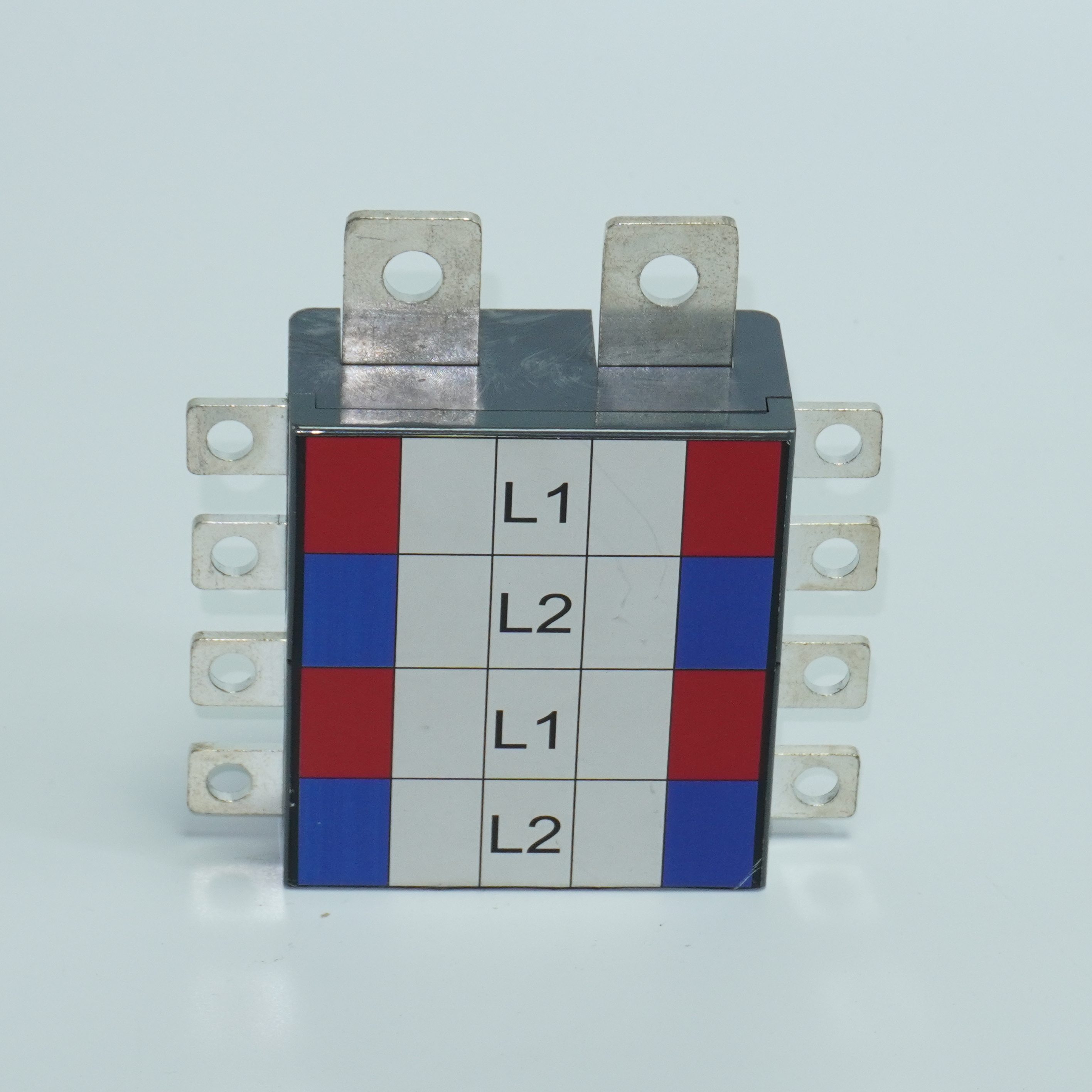
The BP5 is a two-pole pan assembly busbar built from copper conductive parts and polycarbonate insulating parts. Its rated range is defined by conductor thickness: incoming ratings of 125A at T 4mm, 250A at T 6mm and 400A at T 10mm, with outgoing ratings of 63A at T 2mm and 125A at T 3mm. Terminal widths are published as 25mm on the incoming side and 15mm on the outgoing side, and the assembly supports 2W through 40W — the widest way count in the MCCB pan assembly range.
The defining functional characteristic is simultaneous live and neutral disconnection. Both poles open together, which means the neutral is switched as part of the same operation rather than being routed to a separate bar. For panels where isolation must remove both conductors from a single-phase circuit, this removes an entire wiring step and the associated risk of a neutral that stays connected after the live pole has been opened. Barfuse lists the related mechanical benefits as simple wiring, fast installation, precise tooth pitch for reliable contact, and a neater interior layout.
The BP5 is designed for branch DP MCCBs with a pole distance of 25mm and a width of 50mm.
BP3 — MCCB 3P Pan Assembly
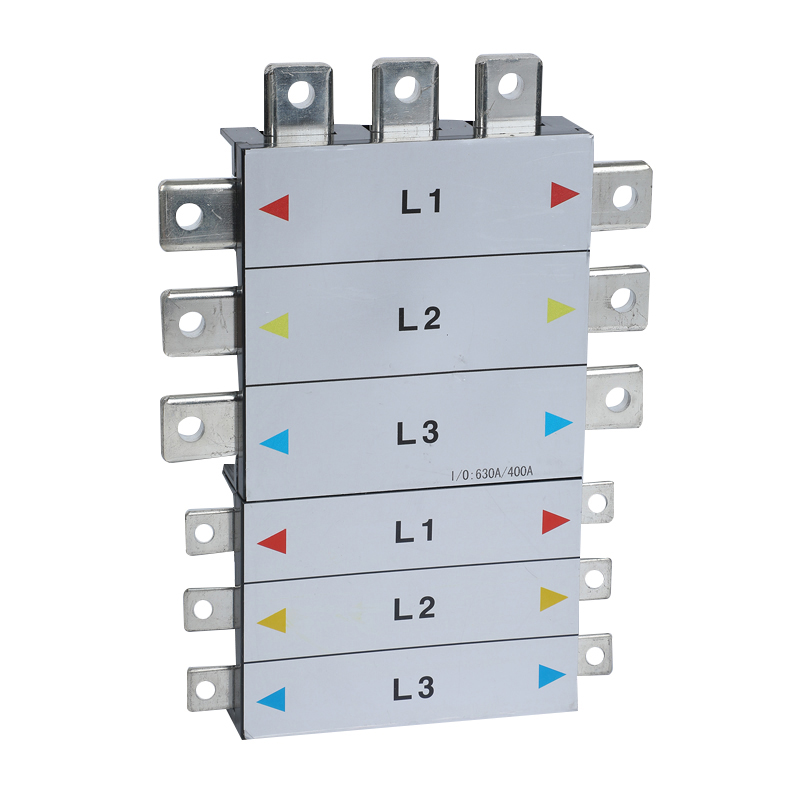
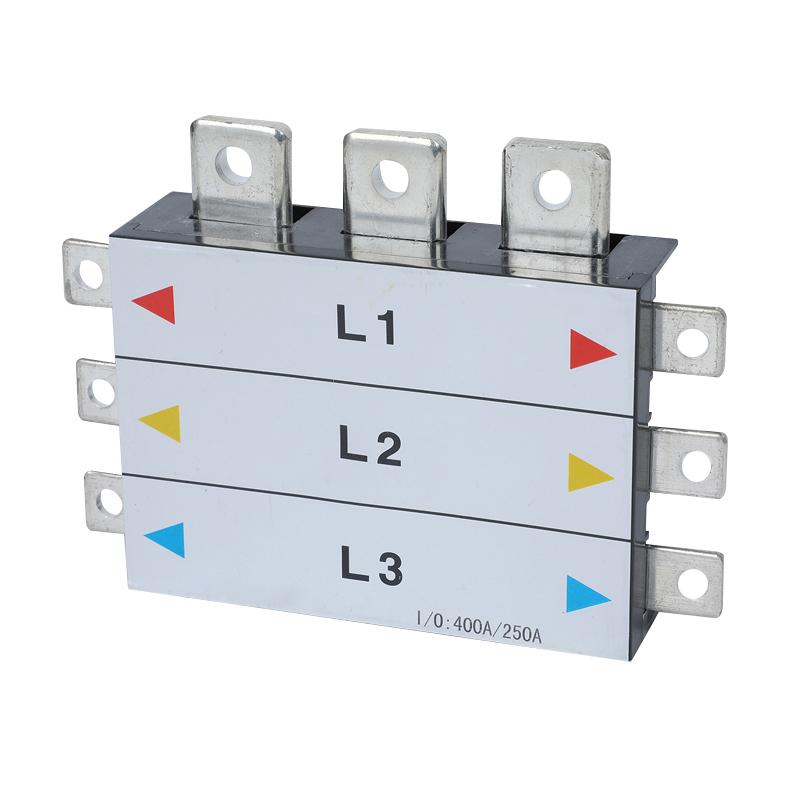
The BP3 is a three-pole MCCB pan assembly, also constructed from copper and PC parts, aimed at three-phase distribution and higher current levels. Its incoming ratings are 250A, 400A, 630A and 800A, with outgoing ratings of 125A, 250A and 400A. Outgoing quantities are offered in 2W, 4W, 6W, 8W, 10W, 12W and 14W.
Where the BP5 is constrained to one pole geometry, the BP3 is deliberately flexible on that axis: it can be used with MCCBs from different brands that have pole distances of 25mm, 30mm, 35mm or 45mm. OEM production is accepted, and the size and mounting plate can be customized to match the customer's MCCB. Barfuse describes the design intent as standardized phase spacing to eliminate short circuits between phases, strong heat dissipation for high-current duty, faster installation, and a clean interior.
A Five-Step Selection Sequence
The following sequence resolves the 2P versus 3P question in the order that avoids rework. Each step narrows the field until only one of the two models, or a customized variant, remains.
- Classify the outgoing loads. If the panel serves single-phase final circuits — lighting, socket outlets, small single-phase equipment — the neutral is a working conductor that must be distributed and, in many isolation schemes, switched. That points to the 2P BP5. If the panel feeds three-phase motors, three-phase sub-mains or balanced three-phase distribution, the three phase conductors must be distributed and the 3P BP3 is the correct architecture.
- Check the incoming current ceiling. Add the total connected load and apply diversity. If the resulting incomer exceeds 400A, the BP5 range is exhausted at 400A (T 10mm) and the BP3, which reaches 800A, becomes the only standard option. Between 250A and 400A both ranges overlap, and the decision returns to pole count.
- Count the ways. The BP5 covers 2W to 40W. The BP3 covers 2W, 4W, 6W, 8W, 10W, 12W and 14W. A dense single-phase board with more than fourteen outgoing circuits fits the BP5's way range more naturally, while a three-phase board with fourteen ways or fewer sits inside the BP3 range.
- Match the pole geometry. For the BP5, confirm that the branch DP MCCB has a 25mm pole distance and 50mm width. For the BP3, confirm the pole distance falls within 25mm, 30mm, 35mm or 45mm. If the selected breaker falls outside these values, treat the assembly as a customization request rather than a standard order.
- Confirm documentation and customization. Decide whether the project needs a standard catalogue item or an OEM variant with a customized size and mounting plate. ISO 9001:2015 coverage applies at manufacturing level, and any model-specific declaration should be requested by exact model number.
Where Each Configuration Fits
Both models are specified for the same industry environment — industrial application and commercial building electric management — so the application split is driven by circuit type rather than by sector.
Commercial building electric management
Commercial boards are dominated by single-phase final circuits. Distribution boards for lighting, socket outlets and single-phase mechanical services typically need a moderate incomer with a high number of outgoing ways. The BP5 addresses this directly: incoming ratings up to 400A, up to 40 outgoing ways, terminal widths of 25mm incoming and 15mm outgoing, and simultaneous live and neutral disconnection that keeps isolation logic simple. Paired with the DB01 distribution box, which accepts an MCCB 250A, MCCB 125A or MCB 63A incomer and up to 32W of MCB branch circuits, this covers the standard commercial final distribution pattern.
Industrial distribution and three-phase sub-mains
Industrial panels carry three-phase loads and higher fault energy. The BP3 is built for that role: incoming ratings of 250A, 400A, 630A and 800A, outgoing ratings of 125A, 250A and 400A, and standardized phase spacing. The DB02 distribution box, configured with a copper pan assembly busbar, an incomer of 800A, 630A, 400A, 250A or 125A, branch MCCBs of 400A, 250A and 125A, and 2W to 16W, shows how the 3P architecture translates into a finished enclosure for industrial application. Optional textured finishes of RAL7032 or RAL7035 are available, and whether or not the customer's MCCB is supported across multiple brands with 25mm, 30mm, 35mm and 45mm pole distances comes down to using the right pan assembly.
A useful edge case is a mixed board. A three-phase incomer with predominantly single-phase outgoing circuits is common in commercial buildings. In that case, the incoming and bus arrangement follows the 3P architecture while the final circuits are single-phase — and the neutral distribution method becomes a design decision that must be resolved before the pan assembly is ordered, not after.
BP5 vs BP3: Side-by-Side Comparison
| Comparison criterion | BP5 MCCB 2P Pan Assembly Busbar | BP3 MCCB 3P Pan Assembly |
|---|---|---|
| Pole configuration | 2P — live and neutral per circuit | 3P — three phase conductors per circuit |
| Construction material | Copper + PC parts | Copper + PC parts |
| Incoming ratings | 125A (T 4mm), 250A (T 6mm), 400A (T 10mm) | 250A, 400A, 630A, 800A |
| Outgoing ratings | 63A (T 2mm), 125A (T 3mm) | 125A, 250A, 400A |
| Outgoing ways | 2W–40W | 2W, 4W, 6W, 8W, 10W, 12W, 14W |
| Terminal widths | Incoming 25mm; outgoing 15mm | Not stated in the published datasheet — confirm with manufacturer |
| MCCB pole-distance compatibility | Branch DP MCCB with pole distance 25mm and width 50mm | 25mm, 30mm, 35mm and 45mm, across different MCCB brands |
| Neutral handling | Simultaneous live and neutral disconnection | Three-phase pole arrangement — neutral strategy defined by the panel design |
| Customization | Standard catalogue configuration | OEM accepted; size and mounting plate customizable to the customer's MCCB |
| Quality system coverage | Manufacturing covered by ISO 9001:2015 quality management system certification, certificate number 62724Q1160R0S, issued by Jingxin Certification (Beijing) Co., Ltd. under GB/T19001-2016 idt ISO 9001:2015 | |
| Intended environment | Industrial application and commercial building electric management | Industrial application and commercial building electric management |
Note: the DEKRA type test certificate held by Barfuse applies specifically to the BP1-125 and BP1-250 busbar panels (certificate numbers 3309992.100 and 3309992.101, issued by DEKRA Certification B.V., citing IEC 61439-2:2011 and EN 61439-2:2011). It should not be read as covering the BP5 or the BP3.

Frequently Asked Questions
Are the copper busbars used in Barfuse panel assemblies CE compliant?
CE and RoHS conformity is stated for the Barfuse BP1 MCB 3P Pan Assembly, which also holds a DEKRA test certificate. That DEKRA type test certificate is issued by DEKRA Certification B.V. and covers the BP1-125 and BP1-250 busbar panels under certificate numbers 3309992.100 and 3309992.101, citing IEC 61439-2:2011 and EN 61439-2:2011. Manufacturing of the BP5 MCCB 2P pan assembly busbar and the BP3 MCCB 3P pan assembly is covered by an ISO 9001:2015 quality management system certificate, number 62724Q1160R0S, issued by Jingxin Certification (Beijing) Co., Ltd. under GB/T19001-2016 idt ISO 9001:2015. Because certificate scope differs by model, a buyer should request the declaration that names the exact model being purchased rather than relying on a general compliance statement.
Will the BP5 or BP3 accept an MCCB from a different brand?
Compatibility is defined by pole geometry and current, not by brand. The BP5 is designed for branch DP MCCBs with a pole distance of 25mm and a width of 50mm. The BP3 accepts MCCBs with pole distances of 25mm, 30mm, 35mm or 45mm, OEM production is accepted, and its size and mounting plate can be customized to match the customer's MCCB.
Is a 2P configuration cheaper than a 3P configuration?
Barfuse does not publish price lists for pan assemblies, so quoted cost depends on the ordered configuration rather than on a list price. The structural cost drivers are the incoming rating, the number of ways, and any customization. A 2P arrangement carries two conductors per outgoing circuit rather than three, while the BP5 covers a wider way range (2W–40W) than the BP3 (2W to 14W) but a lower incoming ceiling (400A against 800A). Size the configuration from the load schedule first, and treat the pole count as a consequence of that decision rather than the starting point.
Can I validate a pan assembly with a sample before committing to a volume order?
Barfuse lists a minimum order quantity of 1 piece, so a single unit can be ordered for evaluation before a volume commitment. Production runs at a monthly capacity of 8,000 pieces with 100% testing, and customization options include color, logo, material, new design, surface treatment, mould development and packing.
What lead time and after-sales support should I plan for?
Lead time is quoted at 15 to 45 days, and after-sales support is provided as remote technical support. Because the BP3 is available as an OEM item with a customized mounting plate, and the BP5 is supplied as a standard configuration, the lead time within that band depends on whether the order is a catalogue item or a custom variant. Sharing your MCCB brand, pole distance and load schedule with the manufacturer at enquiry stage is the fastest way to get an accurate quotation and delivery date.
Next Step: Confirm Your Pole Count and Request a Quotation
If your load schedule is dominated by single-phase final circuits with a switched neutral, the BP5 MCCB 2P pan assembly busbar is the match. If you are feeding three-phase loads above 400A, or need MCCBs with pole distances of 30mm, 35mm or 45mm, the BP3 MCCB 3P pan assembly is the correct architecture.
Download the full Barfuse product catalogue with ratings, terminal dimensions and model numbers: Barfuse Catalogue (PDF). To request a sample, a quotation, or an OEM configuration against your own MCCB, contact the sales team at sales04@barfuses.com or visit www.barfuses.com.
Conclusion
The 2P versus 3P decision comes down to one question asked in the right order: what does each outgoing circuit need to carry? If it is a live conductor and a neutral, the BP5 MCCB 2P pan assembly busbar delivers that with simultaneous live and neutral disconnection, incoming ratings from 125A to 400A, terminal widths of 25mm and 15mm, and up to 40 outgoing ways. If it is three phase conductors, the BP3 MCCB 3P pan assembly delivers standardized phase spacing, incoming ratings from 250A to 800A, 2W to 14W configurations, OEM customization, and compatibility with MCCBs of 25mm, 30mm, 35mm and 45mm pole distances.
Both are built from copper and PC parts, both are intended for industrial application and commercial building electric management, and both are manufactured under an ISO 9001:2015 quality management system. Verify the pole geometry of the MCCB you have already specified, check the incoming current against the 400A and 800A ceilings, and confirm any model-specific certification scope before the order is placed. Those three checks prevent almost every pan assembly mismatch that appears at commissioning stage.
Have Questions or Need More Details?
Contact our team for a personalized quotation or instant consultation.
Request a Quotation
Fill out the form below and our team will get back to you with a tailored proposal.
WhatsApp Direct Chat
Prefer to chat in real-time? Message us on WhatsApp for instant assistance & quick answers.
- Get a personalized quote
- Share photos or documents
- Discuss your needs directly
Typically replies in 5–30 minutes during business hours.