
NT/NH Fuse Base vs BH-400 DIN Rail Fuse Base: A 400 A Comparison Guide for Industrial Panels
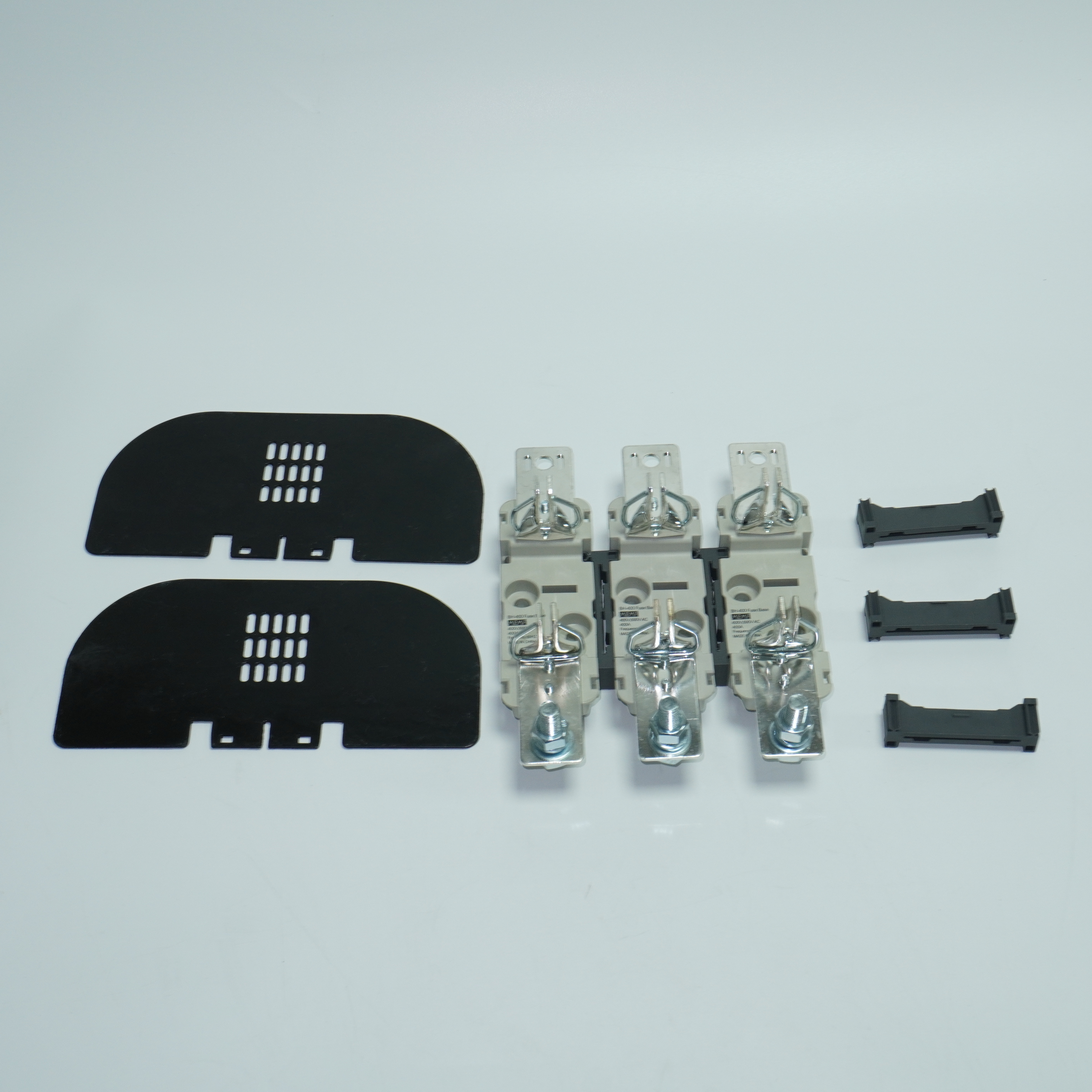
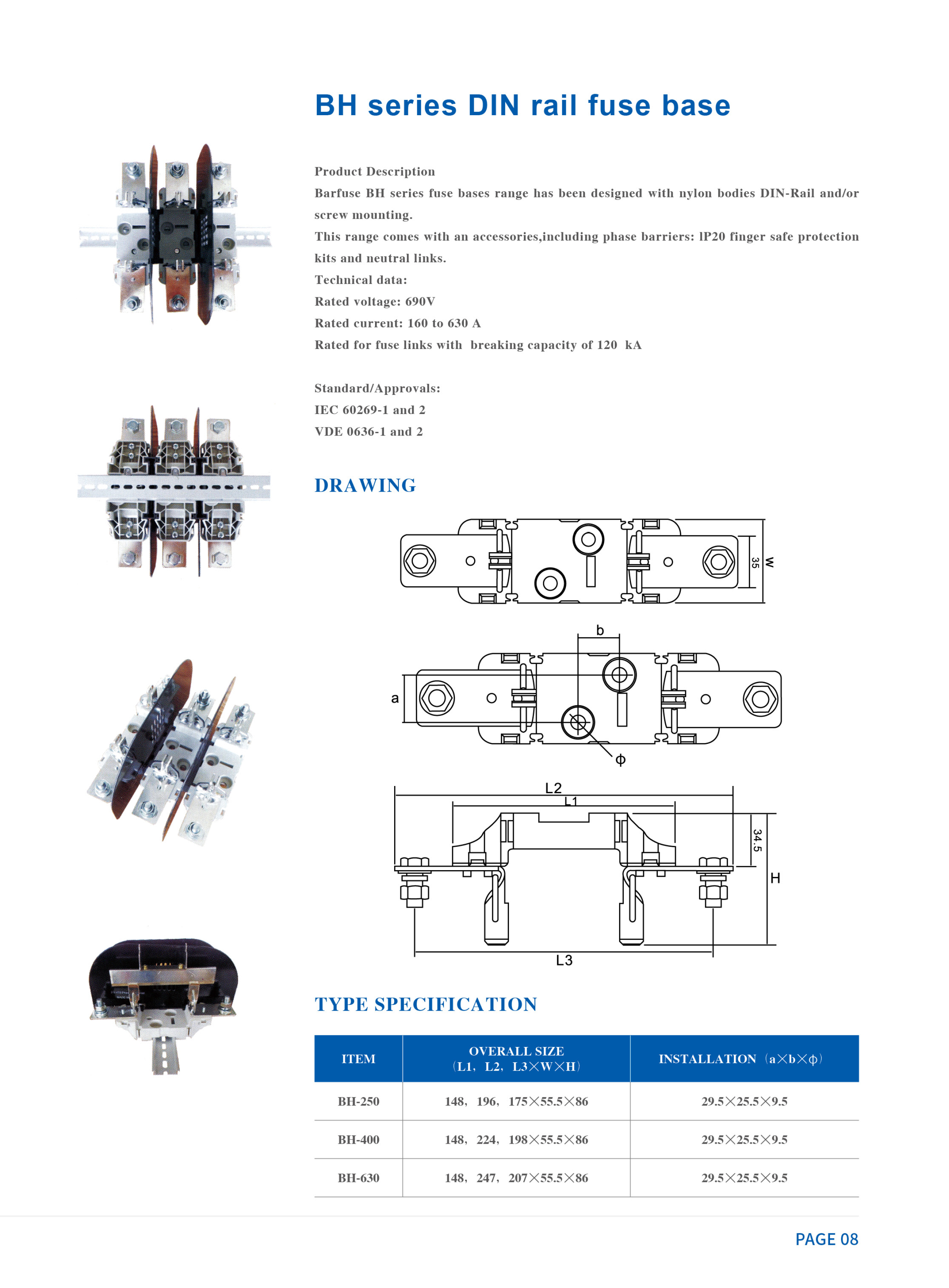
BH-400 DIN rail type fuse base — rated 690 V and 400 A, with rated neutral links having a breaking capacity of 120 kA.
Choosing between an NT/NH fuse base and a BH-400 DIN rail fuse base is not a question of which product is superior. It is a question of which base matches the voltage ceiling, the current rating and the mounting platform of one specific low-voltage distribution panel.
The two families overlap exactly where most procurement confusion begins: at 400 A. A 400 A feeder in a 690 V system can be served by either product, yet the NT/NH base family also reaches 1140 V and 630 A, while the BH-400 stops at 690 V and carries the VDE 0636-1 and 2 documentation that EU-facing specifications often call for. This guide compares the two using published specifications only, and closes with a buyer checklist that turns the comparison into a purchase decision.
Short answer
- NT/NH fuse base (NT00, NT1, NT2, NT3): suitable for AC 50 Hz circuits, rated voltage up to 1140 V, rated current up to 630 A, fuse link breaking capacity up to 120 kA, fuse links conforming to IEC 269, ceramic and tin-plated copper construction.
- BH-400 DIN rail fuse base: rated voltage 690 V, rated current 400 A, rated neutral links with a breaking capacity of 120 kA, tin-plated copper contact material, compliant with IEC 60269-1 and 2 and VDE 0636-1 and 2.
- Shared ground: both products are intended for industrial applications and commercial building electric management.
Problem Definition: The 400 A Question Is Really Three Questions
Panel builders rarely struggle to find a 400 A fuse base. They struggle to justify the one they chose when the specification is reviewed. The difficulty comes from the fact that NT/NH bases and the BH-400 are documented along different axes.
The NT/NH family is described primarily by its electrical reach: AC 50 Hz circuits, rated voltage up to 1140 V, rated current up to 630 A, and fuse links with a breaking capacity of up to 120 kA that conform to the standards of IEC 269. The BH-400 is described primarily by its installation format and its compliance set: a DIN rail type fuse base designed for industrial and commercial electrical distribution systems, suitable for DIN rail mounting in switchgear and control panels, rated 690 V and 400 A, with rated neutral links having a breaking capacity of 120 kA, and compliance with IEC 60269-1 and 2 plus VDE 0636-1 and 2.
That documentation mismatch produces three separate decisions:
- Voltage ceiling. Does the system operate above 690 V? If it does, the BH-400 is outside its rating band and the NT/NH family is the only one of the two that still applies, up to 1140 V.
- Mounting platform. Is the protective device mounted on DIN rail inside switchgear and control panels, or fixed into a busbar-based distribution assembly? DIN rail mounting is the BH-400's stated application; the NT/NH base is a fixed base for LV distribution assemblies.
- Standard jurisdiction. Does the project specification cite IEC 269, or IEC 60269-1 and 2 together with VDE 0636-1 and 2? The two families are documented against different standard sets, which affects approval paperwork rather than performance.
Answer those three and most 400 A comparisons resolve in a single step.
Industry Background: Standards and Where a Fuse Base Sits in LV Distribution
A fuse base is the mechanical and electrical interface between a fuse link and the distribution assembly around it. It defines the contact geometry, the mounting footprint and the electrical envelope the link operates inside. That is why base selection is a standards question as much as a hardware question.
IEC 60269-1:2024, published on 9 August 2024 by the International Electrotechnical Commission, updated the general requirements for low-voltage fuses and covers AC up to 1000 V and DC up to 1500 V. Older datasheets in circulation still reference IEC 269, the numbering used for the NT/NH fuse link documentation in this comparison. Buyers reviewing a mixed specification should therefore confirm which edition and numbering the project actually requires, rather than treating the two references as interchangeable.
Market context points in the same direction. Fortune Business Insights projects the global electric fuse market at USD 5.84 billion in 2025, growing at a CAGR of 7.05% towards 2034. One commercial research estimate places the 800 V DC protection segment for data centres at USD 265 million in 2026 with a 29.9% CAGR. Published 2025 valuations differ across publishers — a comparison of reported figures shows a range from roughly USD 4.0 billion to USD 5.84 billion — depending on whether fuse bases and switch disconnectors are aggregated with fuses or treated as separate mechanical switchgear. Trade data follows a similar pattern: exports under HS Code 853610, which covers electrical fuses below 1000 V, are tracked through UNdata/WITS with volume shifts toward EV-related high-voltage components.
The useful takeaway for a panel buyer is not the headline growth figure. It is that fuse bases are increasingly specified against application-specific constraints — voltage class, AC or DC duty, mounting format and compliance set — rather than purchased as generic accessories.
Detailed Comparison: The NT/NH Fuse Base Family
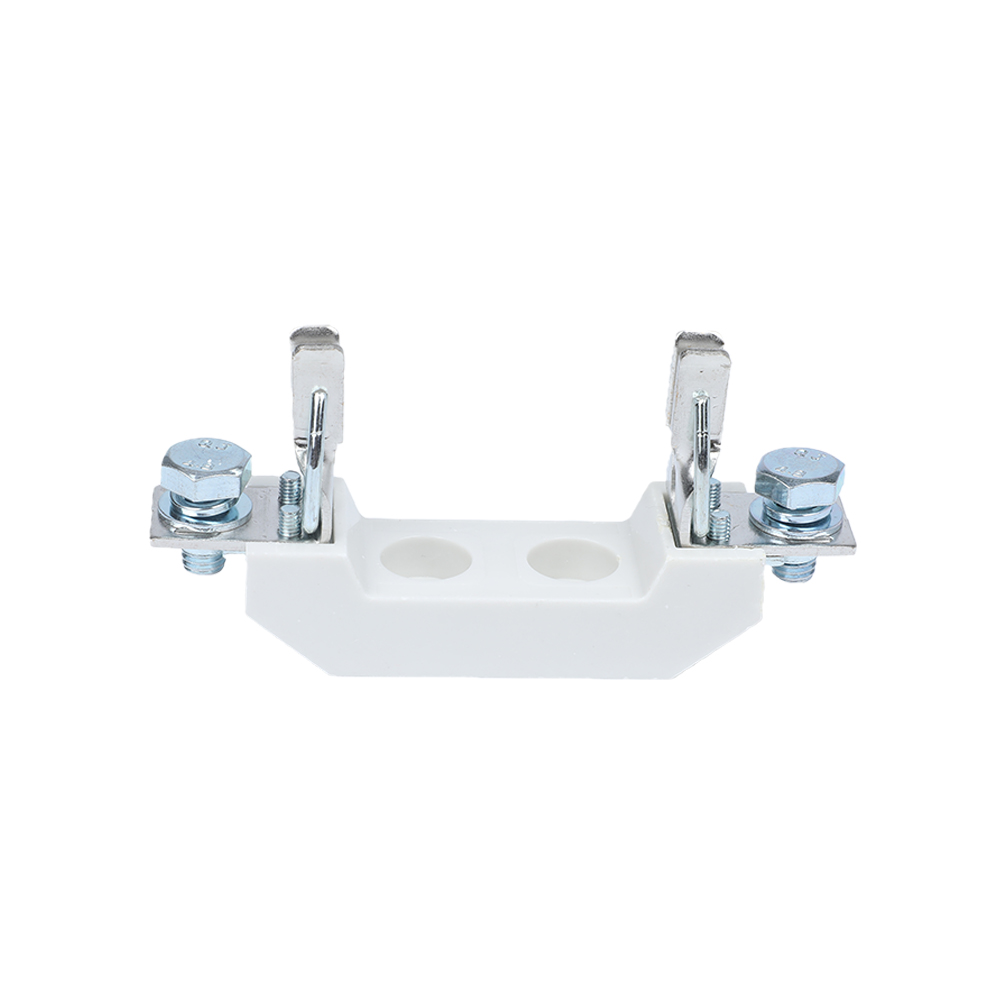
NT/NH fuse base family — suitable for AC 50 Hz circuits, rated voltage up to 1140 V, rated current up to 630 A.
The NT/NH fuse base is offered in four model designations: NT00, NT1, NT2 and NT3. Across the family it is suitable for the circuit of AC 50 Hz, rated voltage up to 1140 V, rated current up to 630 A. The fuse links used with the base have a breaking capacity of up to 120 kA and conform to the standards of IEC 269.
Construction is ceramic and tin-plated copper. Ceramic forms the insulating body, which underpins the family's stated flame-retardant insulation properties, high protection rating and stability. Tin-plated copper is used at the current-carrying contacts, where plating supports a consistent contact surface under repeated thermal cycling. Stated design points include a high protection rating, insulation material with good flame-retardant properties, high breaking capacity of 120 kA, strong stability, and compatibility with various fuse elements.
The family is intended for industrial applications and commercial building electric management, and is widely applied in low voltage distribution systems in the petroleum, chemical, metallurgical, power and construction industries.
The NT NH fuse link that pairs with the base
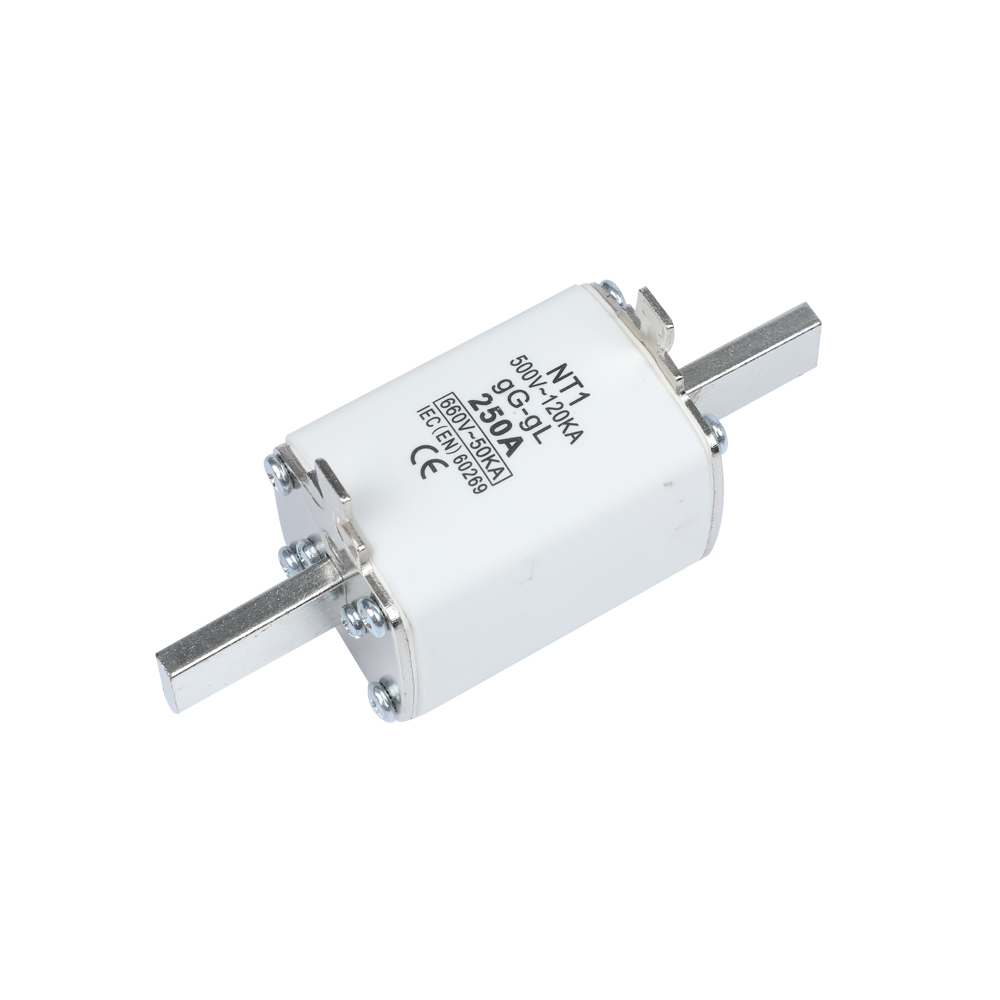
NT NH fuse link, model NT1 — part of the NT00, NT1, NT2 and NT3 link range.
The matching NT NH fuse link is available as NT00, NT1, NT2 and NT3. It is suitable for low-voltage circuits up to 1140 V at AC 50 Hz, with a rated current up to 1250 A and a breaking capacity of up to 120 kA. It is made of ceramic and silver-plated copper and conforms to the standards of IEC 269. Stated characteristics include extreme breaking capacity with quick, decisive action, anti-aging performance from pure silver contacts, a wide specification range, an intuitive status display for faster maintenance, and low energy consumption with low heat generation.
One sizing note matters when the base and the link are read together: the NT/NH base family is rated to 630 A while the link range extends to 1250 A. The base rating therefore sets the practical ceiling for the assembly, and the fuse link must be selected inside that ceiling.
Detailed Comparison: The BH-400 DIN Rail Fuse Base
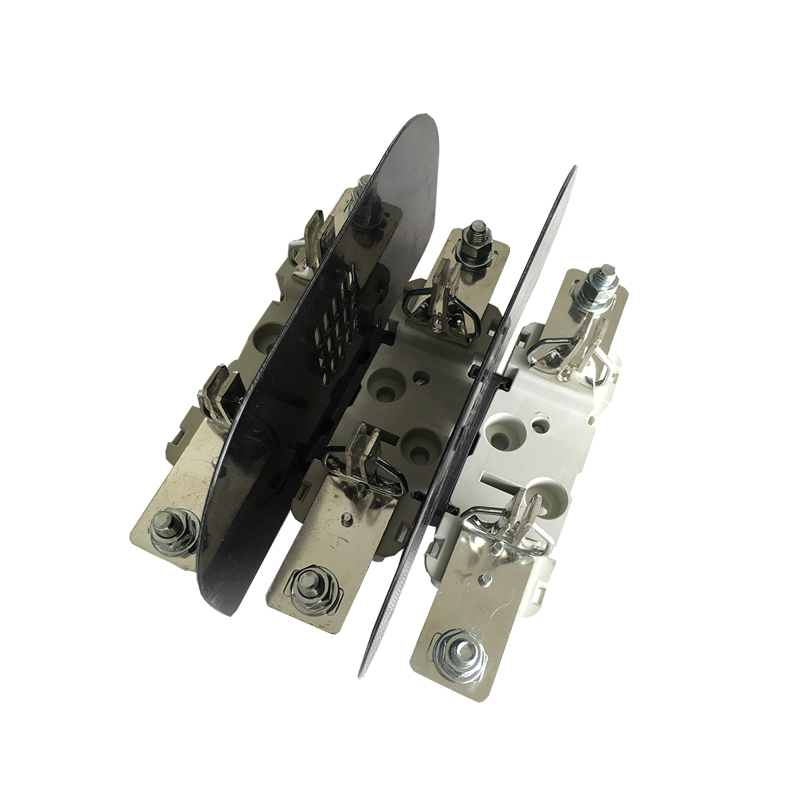
BH-400 DIN rail fuse base — designed for industrial and commercial electrical distribution systems.
The BH-400 is a DIN rail type fuse base with a rated voltage of 690 V and a rated current of 400 A. Its rated neutral links have a breaking capacity of 120 kA, and the contact material is tin-plated copper. It is designed for use in industrial and commercial electrical distribution systems and is suitable for DIN rail mounting in switchgear and control panels. Its stated application is industrial applications and commercial building electric management.
On compliance, the BH-400 is listed against both IEC 60269-1 and 2 and VDE 0636-1 and 2. That dual listing is the product's most distinctive commercial feature for EU-facing specifications, because it allows a panel builder to reference a VDE standard directly instead of arguing equivalence with an IEC-only document.
Stated design points for the BH-400 are safety isolation with double protection; heat resistance and anti-aging behaviour supporting a long lifespan; a comprehensive electric shock protection design; easy replacement operation; and high compatibility with a versatile fit. The maintenance-facing points matter in commercial building electric management, where panels are frequently serviced by facility teams rather than by the original panel builder, and where a straightforward replacement procedure reduces downtime during fuse changes.
Mounting style: the clearest dividing line
Mounting is where the two products stop being interchangeable. The BH-400 is specified for DIN rail mounting inside switchgear and control panels, which suits compact distribution boards and retrofit work where the rail is already present. The NT/NH base is a fixed base positioned within an LV distribution assembly, and its electrical envelope — up to 1140 V and 630 A — suits higher-voltage or higher-current industrial feeders. Choosing a DIN rail base for a 1140 V feeder, or a fixed base in a retrofit enclosure built around DIN rail, are the two most common mismatches.
If the Panel Uses a Fuse Switch Disconnector Instead of a Bare Base
Not every LV panel mounts a fuse on a bare base. Many specifications call for a fuse switch disconnector, which combines the fuse carrier with a disconnecting function. In that case the comparison shifts from base geometry to busbar spacing and switching performance.
The BTR stripe fuse switch disconnector range from BARFUSE Electric Co., Ltd. covers this segment. BTR1, BTR2, BTR3, BTR4 and BTR5 are rated with Ue of 415 V, 500 V or 690 V, Ith of 250 A, 400 A or 630 A, a frequency of 50/60 Hz, a rated insulation voltage (Ui) of 1000 V, a rated impulse withstand voltage (Uimp) of 10 kV and a degree of protection of IP30. BTR5 and BTR2 use an enclosed structure with SMC material for comprehensive safety protection, a hook-type installation for convenient busbar mounting, and a modular design supporting 100 mm and 158 mm busbar systems, with a limiting short-circuit current of 50–100 kA. BTR6 is rated at 160 A and AC 690 V with busbar distances of 100 mm or 185 mm and compliance with IEC/EN 60269. BTR4 additionally states 1.3 IB, 50–100 kA instantaneous breaking capacity and 12 kV impulse voltage.
For buyers comparing a base against a disconnector, the practical rule is simple: if the panel requires an isolation function at the fuse position, a disconnector such as the BTR range replaces the base entirely, and the comparison becomes a busbar-spacing decision rather than a base-selection decision.
Step-by-Step Buyer Checklist: Choosing the Right Base
The following sequence resolves the NT/NH versus BH-400 decision in a predictable order. Each step uses published specifications rather than assumptions.
- Confirm the voltage ceiling of the system, not just the nominal voltage. The BH-400 is rated 690 V; the NT/NH base family is suitable for AC 50 Hz circuits up to 1140 V. If the highest voltage the base can ever see exceeds 690 V, the BH-400 is eliminated at this step.
- Confirm the continuous current. The BH-400 is rated 400 A and the NT/NH base family up to 630 A. Where the load is close to 400 A, verify the duty cycle and ambient before assuming a 400 A device has margin.
- Confirm the short-circuit withstand the specification demands. Both families document 120 kA — for the NT/NH base the figure belongs to the fuse link, and for the BH-400 it belongs to the rated neutral links.
- Confirm the mounting platform. DIN rail in switchgear and control panels points to the BH-400. A fixed position inside a busbar-based LV distribution assembly points to the NT/NH family.
- Confirm which standard the project cites. If the specification names VDE 0636-1 and 2, the BH-400 holds that listing alongside IEC 60269-1 and 2. If it names IEC 269 for the fuse link, the NT/NH family is the documented match.
- Confirm fuse link compatibility and rating. NT/NH links are available as NT00, NT1, NT2 and NT3 with rated current up to 1250 A and breaking capacity up to 120 kA. Because the base family is rated to 630 A, select the link inside that figure.
- Confirm the environment and service model. Heat resistance and anti-aging behaviour are stated for the BH-400, and flame-retardant insulation plus stability for the NT/NH base. Panels maintained by facility teams should also weigh the BH-400's easy replacement operation.
- Validate with a sample before the full panel fit-out. Checking a base against the actual voltage ceiling, current rating, DIN rail or fixed mounting arrangement and fuse link fit is faster and cheaper than correcting an installed batch.
Use Cases: Where Each Base Earns Its Place
Both bases are intended for industrial applications and commercial building electric management, and the field record is concentrated in low voltage distribution systems in petroleum, chemical, metallurgical, power and construction industries. Deployment is common across Indonesia, Kuwait, Nigeria, Oman, Russia, Syria, Peru, Mexico, Saudi Arabia, Thailand, Vietnam, Venezuela, Pakistan, the Philippines, Malaysia, Mongolia, Romania, Australia, Argentina, Bangladesh, Ivory Coast, Chile, the Dominican Republic, Algeria, Ecuador, Egypt, Trinidad and Tobago, Turkey, South Africa, Kenya and Hungary.
Documented project experience illustrates the difference in duty. A wholesaler in Russia has distributed 7,000 units over five years for power distribution, with stable operation reported in low-temperature conditions. An OEM electrical equipment manufacturer in Saudi Arabia has taken 300,000 pcs over twelve years for overload and short-circuit protection in low voltage feeder pillars and distribution boxes, reporting continuous stable operation in high temperature and salt-spray environments, with no safety failures and no end-user complaints. A further Saudi manufacturer has used 600,000 pcs in feeder pillar applications over three to five years, with low temperature rise noted as the key outcome.
Read against the two products, these cases split along the intended lines. Feeder pillar and distribution box programmes — outdoor, high ambient, salt spray — depend on stable contacts and flame-retardant insulation, which is where the NT/NH ceramic base and its silver-plated ceramic links are deployed. Commercial building distribution and switchgear panel work, where DIN rail is the standard fixing method and where maintenance access matters, is the natural fit for the BH-400.
NT/NH Fuse Base vs BH-400: Comparison Table
| Comparison dimension | NT/NH fuse base (NT00, NT1, NT2, NT3) | BH-400 DIN rail fuse base |
|---|---|---|
| Rated voltage | Up to 1140 V, AC 50 Hz circuits | 690 V |
| Rated current | Up to 630 A | 400 A |
| Breaking capacity | Fuse links up to 120 kA | Rated neutral links with breaking capacity of 120 kA |
| Mounting style | Fixed base inside LV distribution assemblies | DIN rail mounting in switchgear and control panels |
| Standard compliance | Fuse links conform to IEC 269 | IEC 60269-1 and 2; VDE 0636-1 and 2 |
| Contact material | Tin-plated copper (base), ceramic and tin-plated copper | Tin-plated copper |
| Fuse link pairing | NT NH fuse link, models NT00, NT1, NT2, NT3, up to 1250 A, ceramic and silver-plated copper | Neutral links as rated for the base |
| Intended application | Industrial application and commercial building electric management | Industrial application and commercial building electric management |
| Stated design strengths | High protection rating, flame-retardant insulation, 120 kA breaking capacity, strong stability, compatibility with various fuse elements | Safety isolation with double protection, heat resistance and anti-aging, electric shock protection design, easy replacement, high compatibility |
The table shows why the two products are not ranked against each other. They share the 120 kA figure and the same application statement, and they separate on voltage ceiling, current rating, mounting format and standard set.
Frequently Asked Questions
What standards do the NT/NH fuse base and the BH-400 DIN rail fuse base comply with?
The NT/NH fuse base is documented with fuse links that conform to the standards of IEC 269. The BH-400 DIN rail fuse base complies with IEC 60269-1 and 2 and with VDE 0636-1 and 2. For a project that names a VDE standard in its specification, the BH-400 holds that listing directly, while the NT/NH family is documented against IEC 269.
What is the breaking capacity of each fuse base?
The fuse links used with the NT/NH fuse base have a breaking capacity of up to 120 kA. The BH-400 DIN rail fuse base has rated neutral links with a breaking capacity of 120 kA. The figure is 120 kA in both cases, but it is documented differently: for the NT/NH family it belongs to the fuse link, while for the BH-400 it belongs to the rated neutral links.
What are the minimum order quantity and commercial terms?
BARFUSE Electric Co., Ltd. states a minimum order quantity of 5 pieces and a monthly capacity of 5,000 pieces, with both OEM and ODM production. Customization covers colour, logo, material, new design, surface treatment, mould development and packing, and quality control includes 100% test.
Can we validate a fuse base with a sample before panel fit-out?
Yes. Sampling follows the same minimum order quantity of 5 pieces, which allows a base to be checked against the panel's voltage ceiling, current rating, mounting arrangement and fuse link fit before a full order is released.
What is the lead time, and how do we start?
Standard lead time is 30–45 days, and remote technical support is provided after delivery. To move forward, download the BARFUSE catalogue or send an enquiry with your panel voltage, current rating and mounting arrangement to receive a quote.
Manufacturing, Certification and Supply Context

Production line at BARFUSE Electric Co., Ltd., Wenzhou, Zhejiang Province, China.
BARFUSE Electric Co., Ltd. (YUEQING BARFUSE ELECTRIC CO.,LTD) is a manufacturer based in Wenzhou, Zhejiang Province, China, producing low voltage fuse switch disconnectors, busbar systems and high and low voltage distribution wiring management products such as MCB pan assemblies and MCCB pan assemblies. The company was founded in 2014, operates a 10,000 ㎡ facility with 45 employees and a 7-engineer R&D team, and reports an annual output of 250,000 PCS with roughly 90% of production exported to the Middle East, Russia, Latin America, Central Asia, the EU, Africa and Oceania.
On quality documentation, BARFUSE holds ISO 9001 certification with certificate number 62724Q1160R0S, covering the production and export of strip fuse disconnectors, load break switch disconnectors and busbar systems, valid until 7 November 2027. The BTR3 stripe fuse switch disconnector holds VDE certification with certificate number NO.40047494 issued by the VDE Testing and Certification Institute for the EU market. The BTR2 stripe fuse rail is certified to IEC 60947-3:2008+A1:2012 in conjunction with IEC 60947-1:2007+A1:2010 under certification number V160016, issued by the Low-voltage Apparatus Laboratory (Wenzhou) of Zhejiang Academy of Science and Technology for Inspection and Quarantine for the global market. The company also reports KEMA (DEKRA) and VDE testing accreditations, CB certification and SAA certification in Australia. Production uses more than 30 digital wire-cutting machines and punches together with inspection equipment including a Rockwell hardness tester, electric withstand voltage tester, spring tester, salt spray tester, flame retardant tester and switch tester.
Next step: confirm the base against your panel
Review the full fuse base, fuse link and fuse switch disconnector range in the BARFUSE catalogue, then send your panel voltage, current rating and mounting arrangement for a quote or a sample request.
Download the BARFUSE product catalogue (PDF)
Website: www.barfuse.com and www.barfuses.com | Blog: blog.barfuse.com
Enquiries: sales04@barfuses.com | Tel: 0086 577 61666659 | No.88, Weishijiu Road, Economic Development Zone, Yueqing, Zhejiang Province, China (PC: 325600)
Conclusion
The NT/NH fuse base and the BH-400 DIN rail fuse base are not competing at 400 A — they are covering different parts of the same LV panel landscape. The NT/NH family, in NT00, NT1, NT2 and NT3 sizes, exists for AC 50 Hz circuits up to 1140 V and 630 A with fuse links rated to 120 kA under IEC 269. The BH-400 exists for DIN rail mounting in switchgear and control panels at 690 V and 400 A, with rated neutral links at 120 kA and compliance with IEC 60269-1 and 2 plus VDE 0636-1 and 2.
The decision rule is therefore short. Choose the NT/NH base when the voltage ceiling or current rating exceeds the BH-400's 690 V and 400 A envelope, or when the panel is built around a fixed, busbar-based distribution assembly. Choose the BH-400 when the panel uses DIN rail, when the load sits at or below 400 A, and when the specification names VDE 0636-1 and 2 alongside IEC 60269-1 and 2. If the panel needs isolation at the fuse position rather than a bare base, the comparison shifts to a fuse switch disconnector such as the BTR range, where busbar spacing becomes the deciding specification.
Whichever family applies, validate the choice against the actual system voltage, continuous current, short-circuit requirement, mounting platform and standard set — and confirm it with a sample before the full panel order is released.
Have Questions or Need More Details?
Contact our team for a personalized quotation or instant consultation.
Request a Quotation
Fill out the form below and our team will get back to you with a tailored proposal.
WhatsApp Direct Chat
Prefer to chat in real-time? Message us on WhatsApp for instant assistance & quick answers.
- Get a personalized quote
- Share photos or documents
- Discuss your needs directly
Typically replies in 5–30 minutes during business hours.