
Retrofitting a Distribution Box? Solving Pan Assembly Busbar Terminal Mismatches
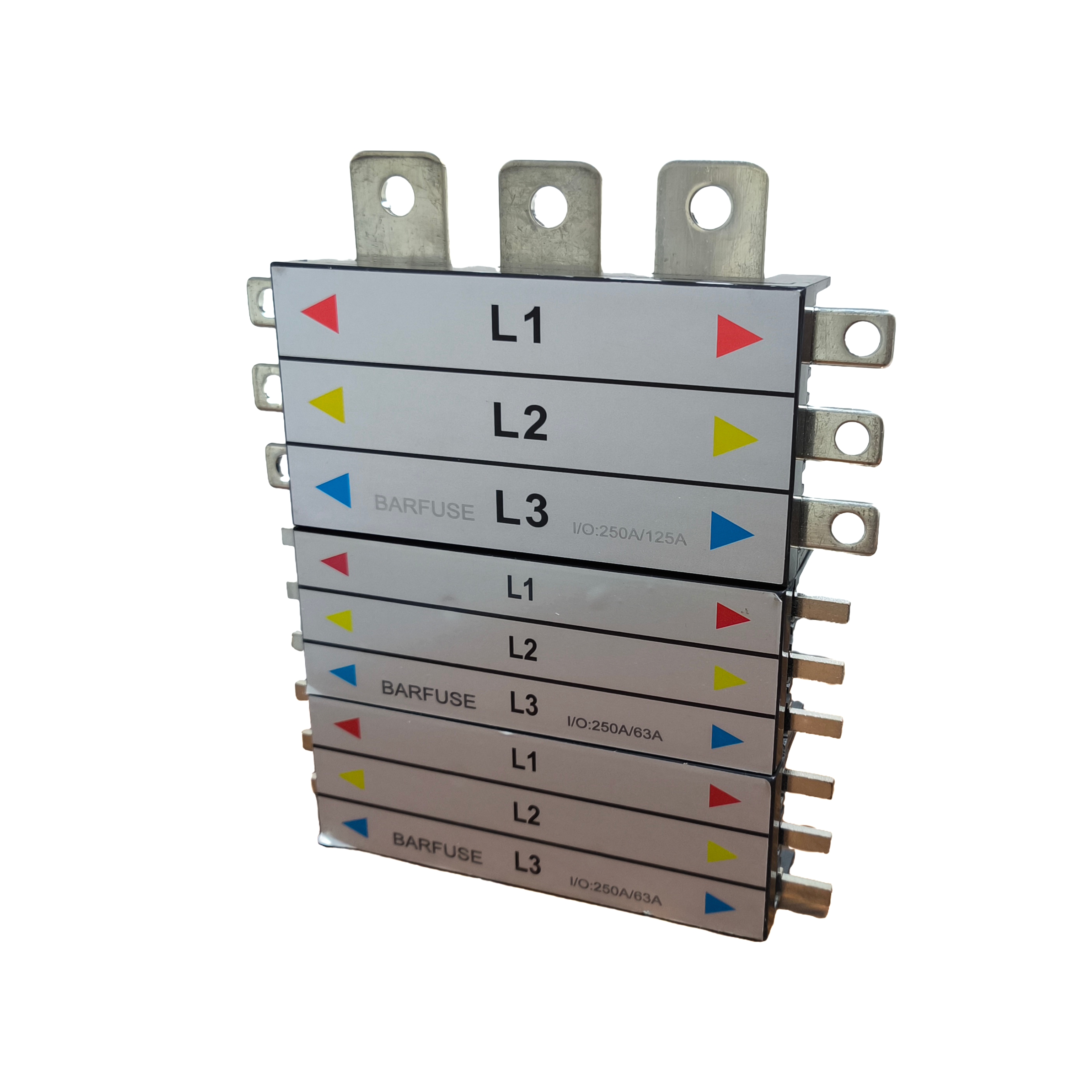
A pan assembly busbar fails a retrofit when three things do not line up: the pole distance of the breaker already installed in the box, the terminal footprint on the incoming and outgoing sides, and the split between incoming and outgoing current ratings. In the Barfuse MCB and MCCB pan assembly range, those three variables explain almost every case where a replacement busbar will not seat in an existing distribution box. Each of them can be confirmed with a caliper, the breaker datasheet and the existing mounting plate — before an order is placed.
This article is written for the engineer, panel builder or buyer who is replacing a pan assembly busbar inside an existing enclosure rather than specifying a complete new assembly. It sets out the five mismatch types that cause retrofit failures, the values that matter across the Barfuse range, a six-step diagnostic sequence, and the customization route when no standard item will fit.
Fast diagnostic. Confirm the breaker pole distance first (the Barfuse BP3 MCCB series covers 25 mm, 30 mm, 35 mm and 45 mm). Then check incoming and outgoing ratings separately (BP3: 250–800 A incoming, 125–400 A outgoing). Then measure terminal width and thickness on both sides (BP6: 6.5 × 12 mm outgoing, 21 × 22 mm incoming). If all three line up, the mismatch is almost always in the mounting plate, the enclosure or the neutral and earth path.
The Problem: Five Mismatches That Stop a Replacement Busbar From Fitting
A retrofit keeps the enclosure, the breakers and the outgoing cables, and changes only the busbar and its supports. That makes the busbar the single component expected to adapt to everything else. In low-voltage distribution work, the mismatch surfaces in five recurring places.
1. Pole distance mismatch
On MCCB-based assemblies, the pole distance of the breaker fixes the pitch of the outgoing stabs. A bar drilled or punched for one pitch cannot be re-pitched on site, so the breaker model governs busbar selection. The Barfuse BP3 MCCB 3P Pan Assembly is built for MCCBs with pole distances of 25 mm, 30 mm, 35 mm and 45 mm — four of the common pitch families — and its size can be customized to the customer's MCCB. If the installed breaker falls outside that set, the plate and bar geometry must be produced to the actual measurement rather than selected from a catalogue.
2. Terminal geometry mismatch
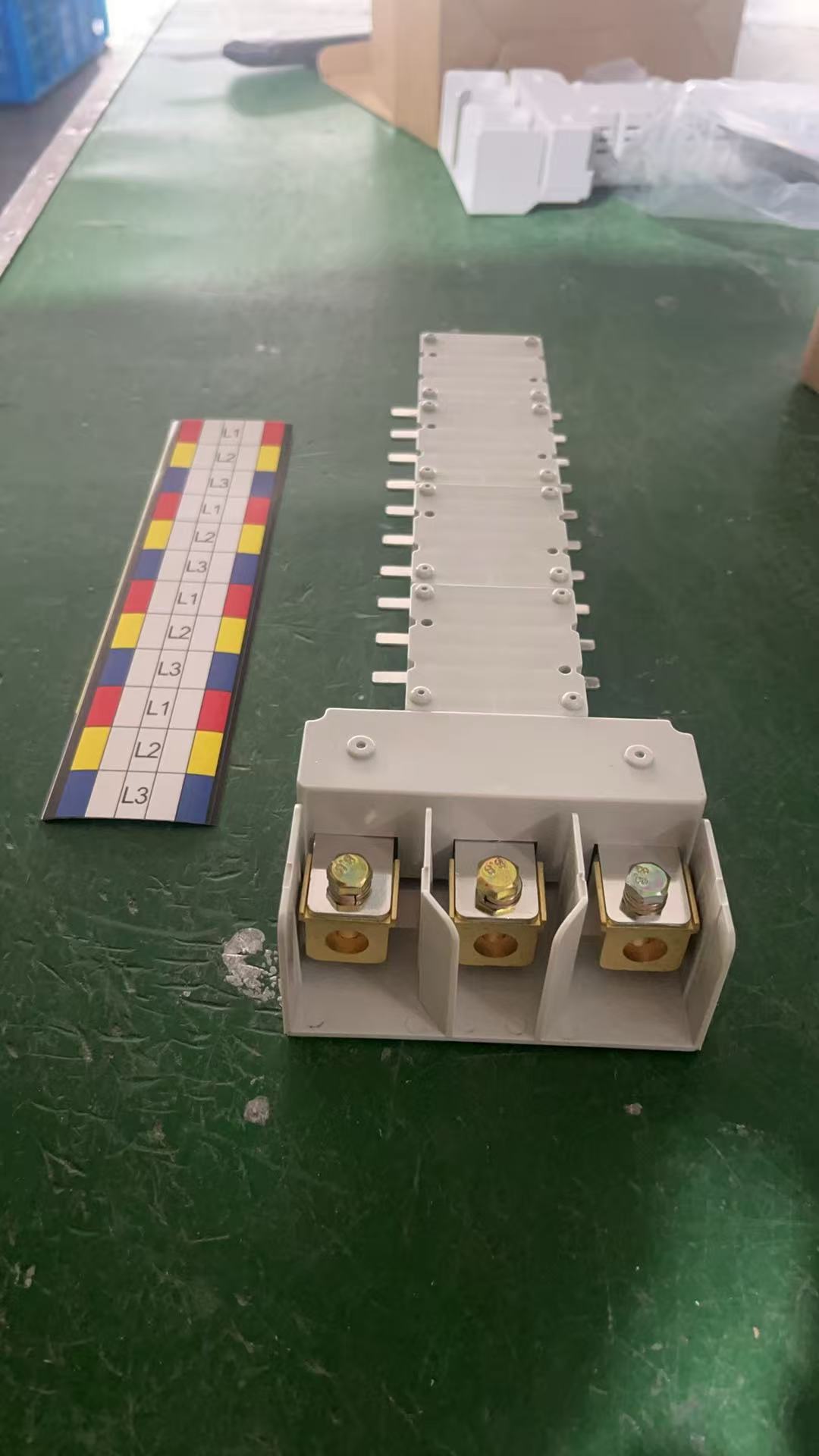
Every pan assembly has two terminal systems, and they rarely share dimensions: the incoming (main or feed pillar) terminal and the outgoing (branch) terminal. In the Barfuse range the difference is explicit and measurable — BP6 uses a 6.5 × 12 mm outgoing terminal and a 21 × 22 mm incoming terminal; BP2 uses 2 × 5 mm outgoing and 3 × 15 mm incoming; BP4 uses a 5 × 11 mm outgoing terminal and a 20 mm incoming terminal width; BP5 uses a 15 mm outgoing terminal width and a 25 mm incoming terminal width; BP1 has a connect size of 2.0 × 5 mm with an outline size of 2.0 × 20 mm. A busbar that matches on width but not on thickness reduces contact area, and a bar that matches on thickness but not on width will not enter the terminal at all.
3. Current rating mismatch between incoming and outgoing
The rating of a pan assembly is not one number, it is two. BP3 accepts incoming currents of 250 A, 400 A, 630 A and 800 A while its outgoing circuits are rated 125 A, 250 A and 400 A. BP5 takes 125 A (T 4 mm), 250 A (T 6 mm) or 400 A (T 10 mm) on the incoming side and offers 63 A (T 2 mm) or 125 A (T 3 mm) on the outgoing side. A purchase request that says only "250 A" therefore describes at least two different products, and a bar sized on the incoming figure alone will be over-dimensioned at the branch terminals.
4. Pole, way and live/neutral arrangement mismatch
Pole format determines which plate family applies: SP work generally points to BP4 (MCB 1P Pan Assembly busbar), DP work to BP2 (MCB 2P Pan Assembly) or BP5 (MCCB 2P Pan Assembly busbar), and TP work to BP1, BP6 or BP3. Way counts are equally model-specific: BP1 covers 6W–72W, BP4 covers 4W–72W, BP3 covers 2W, 4W, 6W, 8W, 10W, 12W and 14W, and BP5 covers 2W–40W. BP5 is the double-pole design, matched to branch DP MCCBs with a pole distance of 25 mm and a width of 50 mm, where the live and neutral poles are switched together; retrofitting a single-pole installation with a double-pole plate changes both the enclosure depth requirement and the cable routing.
5. Mounting plate, neutral and earth path mismatch
Two plates can share identical ratings and still not interchange, because the mounting plate, not the bar, positions the breaker. The Barfuse BP6 MCB 3P CHASSIS BUSBAR is supplied with a mounting plate that can be customized according to the outgoing MCB. Retrofit bills of materials also normally include a neutral terminal busbar and an earth terminal busbar alongside the phase busbar; replacing only the phase bar frequently moves the mismatch onto the neutral bar, where the same width, thickness and pitch rules apply.
Industry Background: Why Retrofit Fit Problems Are Now Routine
Busbars are a large and still expanding product category, which keeps dimensional variants in circulation and makes "one standard size" an unrealistic expectation in retrofit work. Precedence Research puts the global busbar market at USD 19.83 billion in 2025, with a forecast of USD 29.96 billion by 2035. Other published 2025 estimates diverge — Stratview Research reports USD 15.72 billion while IMARC reports USD 20.3 billion — a gap that is generally attributed to methodology, specifically whether locally custom-fabricated busbars are counted alongside factory-assembled systems. For a buyer, the practical reading is that custom-fabricated bars are a material part of the market, not an exception.
Material choice is also shifting. Copper busbars held 62.8% of the market share in 2025, while aluminum busbars are forecast to grow at a 6.9% CAGR over 2026–2035, a trend driven partly by roughly 40% lower weight and by cost optimization in large infrastructure projects. Laminated busbars, used in high-density applications, are forecast at an 8.9% CAGR. On the supply side, China accounts for more than 30% of global copper processing capacity and produces more than 11 million metric tons of refined copper annually, according to Congruence Market Insights.
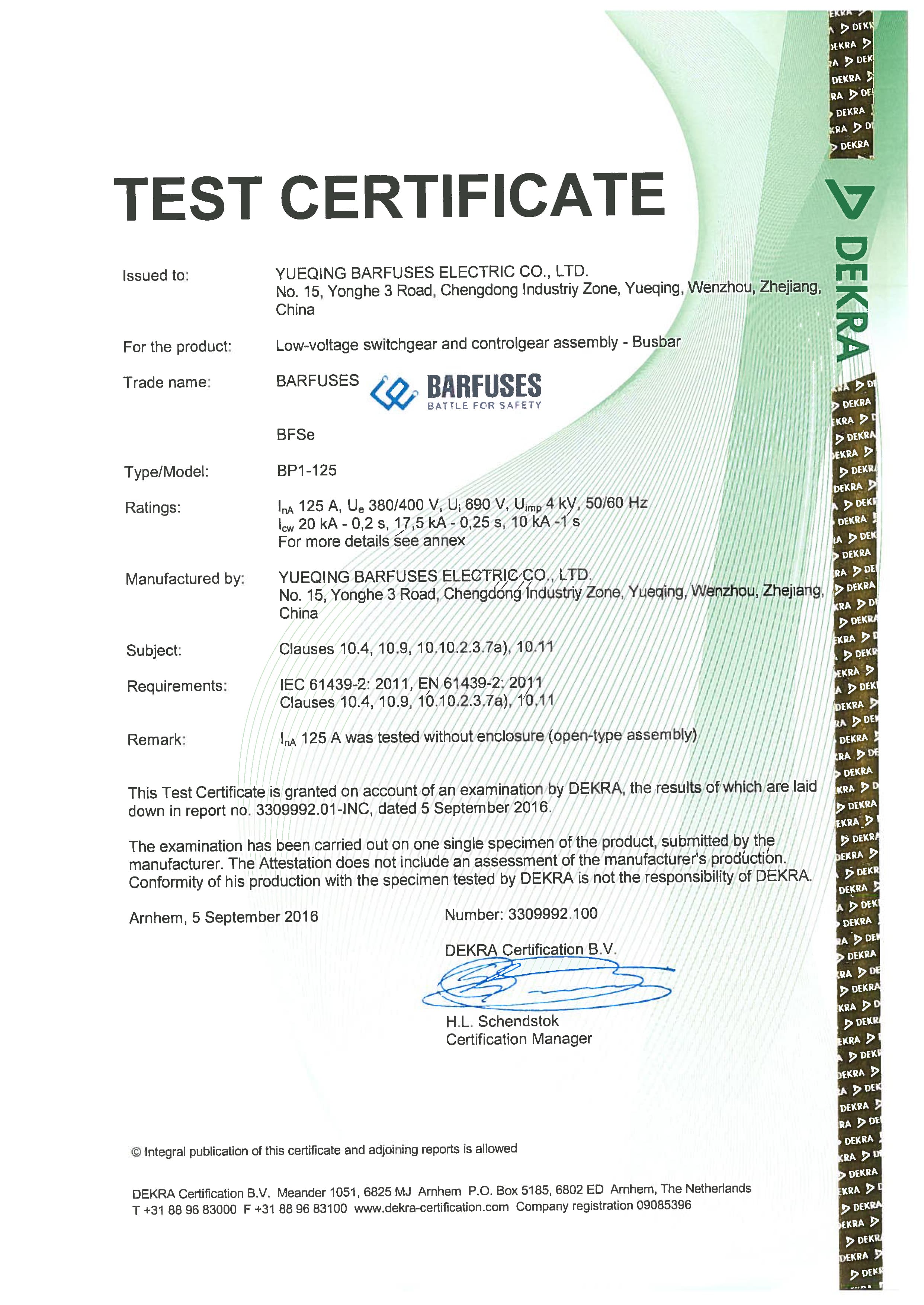
Standards work is another moving part. IEC 61439-6:2025, the part of the IEC 61439 series covering busbar trunking systems, carries an effective date of 2025-12-01. It is worth separating that from IEC 61439-2, which covers low-voltage switchgear and controlgear assemblies — the standard that applies to open-type pan assembly busbars. Barfuse's BP1-125 and BP1-250 pan assemblies are covered by DEKRA type test certificates issued against IEC 61439-2:2011 and EN 61439-2:2011. Trade classification adds a further wrinkle: there is no single dedicated HS code for pan assembly busbars, so import statistics are normally aggregated under codes such as 8537 or 8544, and HS-code-level data should not be treated as a precise measure of this component category.
BARFUSE Electric (Yueqing Barfuse Electric Co.,Ltd) is a low-voltage electrical manufacturer based in Yueqing, Zhejiang Province, China, founded in 2014, operating a 10,000 m² factory with 45 employees, 7 R&D engineers and an annual output of 250,000 PCS. Its main products are low-voltage fuse switch disconnectors, busbar systems and high and low voltage distribution wiring management products, including MCB pan assemblies, MCCB pan assemblies and metal distribution boxes in all sizes. Roughly 90% of output is exported, with sales networks covering more than 40 countries and regions across the Middle East, Russia, Latin America, Central Asia, the EU, Africa and Oceania.
Detailed Solution: Matching Each Mismatch to the Right Pan Assembly
Because each mismatch has a different root cause, the fix is a mapping exercise rather than a single product recommendation. The following pairings reflect the actual Barfuse specification data for the MCB and MCCB pan assembly series.
Pole distance mismatch → BP3 MCCB 3P Pan Assembly
BP3 is the series built around breaker compatibility rather than a fixed footprint. It is designed for use with different brand MCCBs whose pole distance is 25 mm, 30 mm, 35 mm or 45 mm, accepts OEM production, and its size can be customized according to the customer's MCCB. Incoming ratings run from 250 A to 800 A and outgoing ratings from 125 A to 400 A, with outgoing quantities of 2W, 4W, 6W, 8W, 10W, 12W or 14W. For a retrofit, the practical sequence is to measure the existing breaker pitch, confirm the incoming and outgoing currents separately, then specify the way count — not to order the nearest catalogue item and re-drill on site.
Live/neutral disconnection → BP5 MCCB 2P Pan Assembly busbar
BP5 is the double-pole MCCB pan assembly, intended for branch DP MCCBs with a pole distance of 25 mm and a width of 50 mm, where the live and neutral poles operate together. Its incoming ratings are 125 A (T 4 mm), 250 A (T 6 mm) and 400 A (T 10 mm); its outgoing ratings are 63 A (T 2 mm) and 125 A (T 3 mm). Outgoing terminal width is 15 mm and incoming terminal width is 25 mm, and the series spans 2W–40W. In retrofit terms, the incoming conductor thicknesses matter as much as the amperage: a 400 A incoming connection uses a 10 mm bar, which will not enter a terminal block sized for 4 mm.
Mounting plate and chassis mismatch → BP6 MCB 3P Chassis Busbar
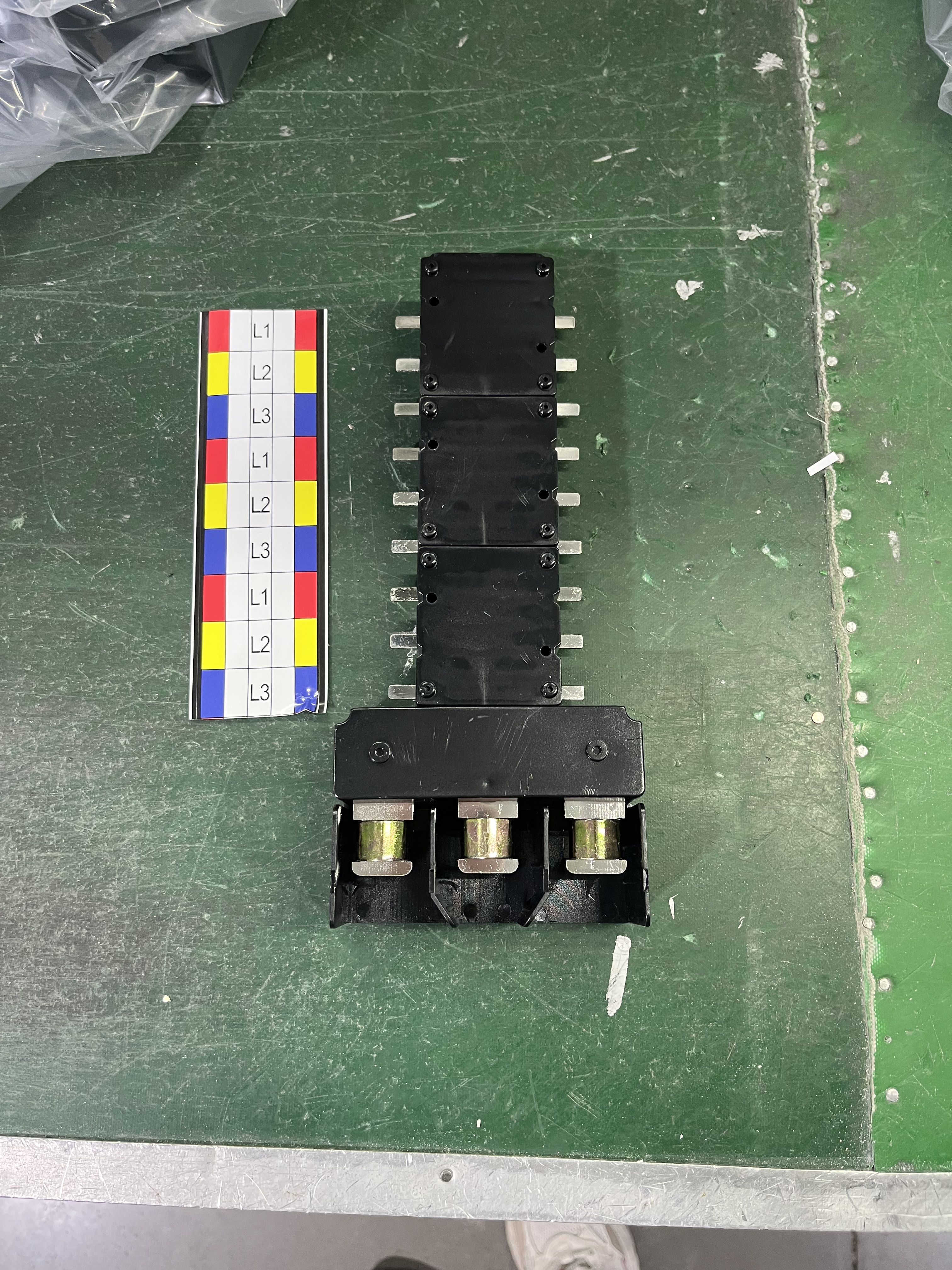
BP6 is rated 250 A and is defined by two features that matter in retrofit work: a mounting plate that can be customized according to the outgoing MCB, and clearly separated terminal dimensions of 6.5 × 12 mm outgoing and 21 × 22 mm incoming. When a chassis busbar is being replaced but the MCB mix stays unchanged, the mounting plate is usually the only component that has to be re-engineered, which keeps the retrofit local instead of touching the whole enclosure.
MCB terminal and module mismatch → BP1, BP2 and BP4
For MCB-based installations, three series cover the common formats. BP1 (MCB 3P Pan Assembly) is rated 125 A, 160 A and 250 A, uses a connect size of 2.0 × 5 mm and an outline size of 2.0 × 20 mm, and spans 6W–72W. BP2 (MCB 2P Pan Assembly) is rated 125 A / 250 A at 220 / 240 / 120 V, accepts an MCCB or MCB as the main switch, uses double-pole MCB or RCBO devices as branch switches, and has a 2 × 5 mm outgoing terminal against a 3 × 15 mm incoming terminal. BP4 (MCB 1P Pan Assembly busbar) is rated 125 A (T 2 mm), 160 A (T 2.5 mm) and 250 A (T 3 mm), spans 4W–72W, and uses a 5 × 11 mm outgoing terminal with a 20 mm incoming terminal width. All three are copper conductor assemblies with PC parts.
Enclosure-level mismatch → DB01 and DB02 distribution boxes and custom sizes
When the existing box cannot accept the required way count — a common outcome when a 12-way or 40-way replacement is specified into a smaller enclosure — the retrofit has to move up one level and replace the enclosure as well. Barfuse manufactures metal distribution boxes in all sizes, including the DB01 and DB02 enclosure families, with way counts configured to the pan assembly selected for the project. At that point the constraint shifts from terminal fit to enclosure depth, cable entry and the clearance needed around the incoming terminal.
Custom and OEM capability behind the retrofit
Customization is the mechanism that resolves the residual cases. Barfuse operates in OEM and ODM production modes and offers customization of color, logo, material, new design, surface treatment, mold development and packing. Monthly capacity is 8,000 pieces, lead time runs 15–45 days, the minimum order quantity is 1 piece, and every unit is 100% tested. After-sales support is provided remotely, which is relevant in retrofit work where the fit can only be judged once the bar is in the box.
Step-by-Step Breakdown: A Six-Step Fit Check Before You Order
The sequence below is ordered deliberately: each step eliminates a category of mismatch, and the cheapest checks come first. Skipping ahead to rating selection is the most common cause of a wrong first order.
Step 1 — Identify the breaker and measure pole distance
Record the breaker brand, model and pole distance. For MCCB-based assemblies, compare the measured pitch against the 25 mm, 30 mm, 35 mm and 45 mm values that define BP3 compatibility. For MCB-based assemblies, record the pole format (1P, 2P/DP or 3P/TP) and the module width instead.
Step 2 — Split the ratings: incoming versus outgoing
Write the incoming and outgoing current values as two separate figures. Use the BP3 split (250–800 A incoming, 125–400 A outgoing) or the BP5 split (125–400 A incoming, 63–125 A outgoing) as a sanity check on how far apart the two sides normally are. If your required incoming and outgoing figures differ by a wide margin, that is normal — not a reason to order a single oversized bar.
Step 3 — Measure terminal width and thickness on both sides
Measure the incoming and outgoing terminals independently and record width and thickness. Compare with the values published for each series: BP1 connect 2.0 × 5 mm, BP2 outgoing 2 × 5 mm against incoming 3 × 15 mm, BP4 outgoing 5 × 11 mm against incoming 20 mm, BP5 outgoing 15 mm against incoming 25 mm, and BP6 outgoing 6.5 × 12 mm against incoming 21 × 22 mm. Thickness determines contact area; width determines whether the bar enters at all.
Step 4 — Confirm pole count, way count and live/neutral behaviour
Confirm the number of outgoing ways required and match it to the series range: 6W–72W for BP1, 4W–72W for BP4, 2W–14W for BP3 and 2W–40W for BP5. Where the outgoing devices are double-pole and must switch live and neutral together, the BP5 double-pole layout with its 25 mm pole distance and 50 mm width applies.
Step 5 — Check the mounting plate, enclosure depth and way count
Measure the existing mounting plate fixing centres, confirm that the required way count fits the enclosure, and check clearance around the incoming terminal. If the enclosure itself is the limit, the Barfuse metal distribution box range — including the DB01 and DB02 families — is the level at which the problem has to be solved. For chassis-style replacements, a customized mounting plate matched to the outgoing MCB, as offered on BP6, is usually the smaller intervention.
Step 6 — Confirm the compliance evidence for the destination market
Match the certificate scope to the model being supplied, not to the supplier in general. The DEKRA type test covering Barfuse BP1-125 and BP1-250 was issued against IEC 61439-2:2011 and EN 61439-2:2011 for open-type assemblies without enclosure. ISO 9001 certification 62724Q1160R0S, issued by Jingxin Certification (Beijing) Co.,Ltd. and valid to 2027-11-07, covers the manufacture and export of busbar systems (MCCB/MPCB busbars) and distribution boxes. Barfuse also reports testing accreditations from KEMA (DEKRA) in the Netherlands and VDE in Germany, plus CB certification and SAA certification in Australia — a relevant checkpoint for Australian and New Zealand projects.
Use Cases
Commercial building distribution board refurbishment
Where an older commercial board is being re-fitted with MCB branch devices, the fit question is usually module width and way count rather than pole pitch. BP1 (6W–72W), BP2 (double-pole MCB or RCBO branches with a 3 × 15 mm incoming terminal) and BP4 (4W–72W with a 5 × 11 mm outgoing terminal) cover the common single, double and triple pole formats in this category.
Industrial MCCB panel capacity upgrade
Where an industrial panel is being extended or its main device replaced, the constraint is the MCCB pole distance combined with a high incoming rating. BP3 addresses this case directly through its 25 / 30 / 35 / 45 mm pole distance coverage, 250–800 A incoming and 125–400 A outgoing ratings, and up to 14W configurations — with size customization to the customer's MCCB where the installed device falls outside the standard pattern.
Chassis busbar replacement without changing the breaker
When the outgoing MCBs stay in service and only the chassis busbar is replaced, BP6 is the targeted option: 250 A rated, 6.5 × 12 mm outgoing and 21 × 22 mm incoming terminals, and a mounting plate that can be customized according to the outgoing MCB. This keeps the retrofit to a single component and avoids re-terminating branch cabling.
Sub-main and distribution board work where the enclosure is the limit
Sub-main distribution board (SMDB) retrofits and projects converting to a pre-assembled busbar pan assembly frequently outgrow the original enclosure before they outgrow the busbar. In those cases the specification moves to the metal distribution box level, with the DB01 and DB02 families configured to the selected pan assembly way count.
Weight and material considerations
Barfuse's listed MCB and MCCB pan assemblies use copper conductors with PC parts. Where a project is comparing copper against aluminum on weight or cost grounds — aluminum busbars are forecast to grow at 6.9% CAGR over 2026–2035, partly on the basis of roughly 40% lower weight — material is one of the customization options Barfuse offers, so the choice should be raised at specification stage rather than assumed from the standard listing.
Comparison Table: Barfuse Pan Assembly Busbars for Retrofit Work
| Model and type | Breaker format | Incoming rating | Outgoing rating | Terminal geometry (out / in) | Outgoing ways | Retrofit note |
|---|---|---|---|---|---|---|
| BP1 — MCB 3P Pan Assembly | MCB, 3-pole | 125 A, 160 A, 250 A | — | Connect 2.0 × 5 mm / outline 2.0 × 20 mm | 6W–72W | DEKRA type-tested to IEC 61439-2:2011 and EN 61439-2:2011 |
| BP2 — MCB 2P Pan Assembly | Incoming MCCB or MCB; branch double-pole MCB or RCBO | 125 A / 250 A at 220 / 240 / 120 V | — | 2 × 5 mm / 3 × 15 mm | — | Used where live and neutral branch devices are double-pole |
| BP3 — MCCB 3P Pan Assembly | MCCB, 3-pole, pole distance 25 / 30 / 35 / 45 mm | 250 A, 400 A, 630 A, 800 A | 125 A, 250 A, 400 A | Size customized to customer's MCCB | 2W, 4W, 6W, 8W, 10W, 12W, 14W | OEM accepted; size customizable to the customer's MCCB |
| BP4 — MCB 1P Pan Assembly busbar | MCB, single pole | 125 A (T 2 mm), 160 A (T 2.5 mm), 250 A (T 3 mm) | — | 5 × 11 mm / 20 mm width | 4W–72W | Incoming terminal width is the limiting dimension |
| BP5 — MCCB 2P Pan Assembly busbar | Branch DP MCCB, pole distance 25 mm, width 50 mm | 125 A (T 4 mm), 250 A (T 6 mm), 400 A (T 10 mm) | 63 A (T 2 mm), 125 A (T 3 mm) | 15 mm width / 25 mm width | 2W–40W | Double-pole design where live and neutral are switched together |
| BP6 — MCB 3P CHASSIS BUSBAR | MCB, 3-pole | 250 A rated | — | 6.5 × 12 mm / 21 × 22 mm | — | Mounting plate customizable according to the outgoing MCB |
All values above are drawn from Barfuse product specification data for the BP1, BP2, BP3, BP4, BP5 and BP6 series. Where a field is not stated for a given model, it is left blank rather than estimated.
Frequently Asked Questions
What certification covers Barfuse pan assembly busbars used in retrofit work?
Barfuse's BP1-125 and BP1-250 MCB pan assemblies are covered by DEKRA type test certificates 3309992.100 and 3309992.101, issued by DEKRA Certification B.V. against IEC 61439-2:2011 and EN 61439-2:2011 for low-voltage switchgear and controlgear assemblies — busbar, open-type assembly without enclosure, brand BARFUSES, series BFSe. The company also holds ISO 9001 certification 62724Q1160R0S, issued by Jingxin Certification (Beijing) Co.,Ltd. and valid to 2027-11-07, covering manufacturing and export of busbar systems (MCCB/MPCB busbars) and distribution boxes. Barfuse additionally reports testing accreditations from KEMA (DEKRA) in the Netherlands and VDE in Germany, plus CB certification and SAA certification in Australia. Because the DEKRA type test above applies specifically to BP1-125 and BP1-250, buyers should confirm that the certificate scope matches the exact model being retrofitted.
Can an OEM pan assembly busbar be made to match my existing MCCB layout?
Yes, within the documented customization scope. The BP3 MCCB 3P Pan Assembly is stated as accepting OEM production and its size can be customized according to the customer's MCCB; it is designed for MCCBs with pole distances of 25 mm, 30 mm, 35 mm or 45 mm, with incoming ratings of 250 A, 400 A, 630 A and 800 A, outgoing ratings of 125 A, 250 A and 400 A, and 2W to 14W configurations. For chassis-style assemblies, the BP6 mounting plate can be customized according to the outgoing MCB. Barfuse operates in OEM and ODM production modes and lists customization of color, logo, material, new design, surface treatment, mold development and packing, with a minimum order quantity of 1 piece.
What is the minimum order quantity and how is payment handled?
The minimum order quantity is 1 piece, which allows a single retrofit set or a trial unit to be ordered before a larger batch. Delivery terms offered are FOB, CIF, CFR and EXW; payment methods are T/T, Paypal, Western Union and L/C; and pre-shipment test acceptance is available. Monthly production capacity is 8,000 pieces, so a retrofit order and a follow-on project order can be placed on the same specification without changing supplier.
How can I verify terminal fit before committing to a full retrofit order?
Send the measured values rather than a model name: breaker pole distance, incoming and outgoing current ratings, and the width and thickness of the incoming and outgoing terminals. Against those figures the relevant series can be confirmed — for example, a 6.5 × 12 mm outgoing and 21 × 22 mm incoming terminal points to BP6, while a 15 mm outgoing and 25 mm incoming terminal width points to BP5. Because the minimum order quantity is 1 piece and every unit is 100% tested, a single-unit order can be used to validate fit in the actual enclosure before a full batch is released; remote technical support is provided after delivery.
What is the lead time for a customized pan assembly busbar?
Documented lead time is 15–45 days, depending on the degree of customization and the order volume, against a monthly capacity of 8,000 pieces. Customization can cover color, logo, material, new design, surface treatment, mold development and packing, and OEM and ODM production modes are both supported. To move a retrofit requirement into a quotation, the useful inputs are the breaker make and model, measured pole distance, incoming and outgoing ratings, terminal width and thickness on both sides, required outgoing way count, and the destination market so that the applicable compliance documentation can be confirmed at the same time.
Conclusion: Retrofit Fit Is a Measurement Problem, Not a Sourcing Problem
Pan assembly busbar mismatches in retrofit work are almost never caused by an unreliable supplier. They are caused by specifying from a rating alone when the fit is decided by pole distance, terminal width and thickness, the incoming/outgoing rating split, and the mounting plate. A 25 mm breaker pitch cannot accept a 45 mm bar, a 6.5 × 12 mm outgoing terminal cannot take a bar sized for 5 × 11 mm, and a 250 A figure without an incoming/outgoing split does not identify a product.
The countermeasure is procedural: measure the breaker pitch and both terminal systems, split the ratings, confirm the way count and the live/neutral behaviour, check the mounting plate and enclosure, then verify the certificate scope for the destination market. Where the standard series cannot satisfy the measurement, the Barfuse range offers a defined route through BP3 size customization to the customer's MCCB, BP6's customizable mounting plate, and OEM/ODM customization of material, surface treatment, mold development and packing — with a 1-piece minimum order quantity that makes single-unit validation realistic.

Send the measurements, get a matched busbar
If a replacement pan assembly busbar will not fit an existing box, send the breaker model, pole distance, incoming and outgoing ratings and the terminal dimensions on both sides. Barfuse will confirm the matching series — BP1, BP2, BP3, BP4, BP5 or BP6 — or quote a customized unit under OEM/ODM.
Email: SALES04@BARFUSES.COM | WhatsApp: +86 18815184322 | Web: www.barfuses.com
Download the full product catalogue: Barfuse Catalogue (PDF)
Company address: No.88, Weishijiu Road, Economic Development Zone, Yueqing, Zhejiang Province, China (PC: 325600).
Have Questions or Need More Details?
Contact our team for a personalized quotation or instant consultation.
Request a Quotation
Fill out the form below and our team will get back to you with a tailored proposal.
WhatsApp Direct Chat
Prefer to chat in real-time? Message us on WhatsApp for instant assistance & quick answers.
- Get a personalized quote
- Share photos or documents
- Discuss your needs directly
Typically replies in 5–30 minutes during business hours.