
Top Pan Assembly Busbar Models for Industrial and Commercial Distribution: BP3, BP5, and BP6 Picks
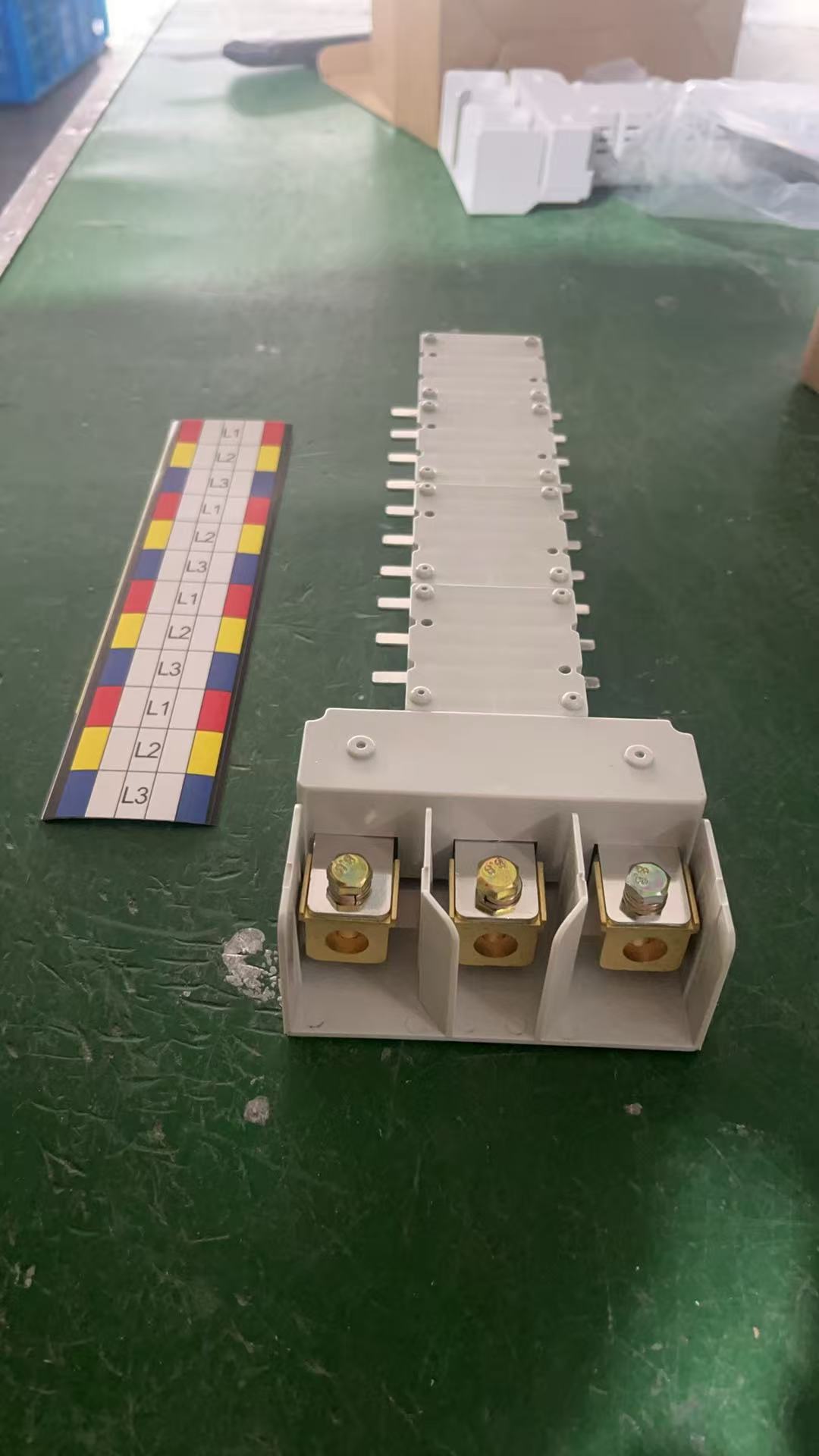
For low-voltage industrial and commercial distribution boards, three BARFUSE pan assembly busbar models cover most branch-distribution layouts — and each of them is the strongest pick for a different configuration rather than for the category as a whole.
The BP3 MCCB 3P pan assembly is the pick for three-phase incoming and heavy branch frames, rated 250 A, 400 A, 630 A and 800 A incoming and 125 A, 250 A and 400 A outgoing, with 2W to 14W of outgoing ways. The BP5 MCCB 2P pan assembly busbar is the pick for double-pole MCCB branch circuits, with incoming ratings of 125 A, 250 A and 400 A and a way range from 2W to 40W. The BP6 MCB 3P chassis busbar is the pick for MCB-based outgoing distribution: rated 250 A, with a 21 × 22 mm incoming terminal width, a 6.5 × 12 mm outgoing terminal width and a mounting plate that can be customized to the outgoing MCB.
This ranking is written for buyers who already know they need a pre-assembled busbar pan assembly and are now comparing concrete models. Every comparison below uses published model data only — incoming and outgoing ratings, way counts, pole distances, terminal widths, conductor thicknesses and customization terms — because those are the values that decide whether a busbar actually fits a board.
Why Pan Assembly Busbar Choice Is a Fit Problem, Not a Rating Problem
A pan assembly busbar is a pre-assembled, modular current-carrying system that sits inside a distribution box and brings one incoming supply onto a set of outgoing MCCB or MCB devices. Because it is modular and pre-assembled, the specification decision is mechanical as much as it is electrical. Two assemblies with similar current ratings can be completely incompatible with the same board.
Four variables decide which model applies:
- Incoming current and pole arrangement — a 3P MCCB frame and a double-pole MCCB frame are different mechanical families, not two sizes of one part.
- Outgoing device type and way count — MCCB outgoing circuits and MCB outgoing circuits use different terminal geometry and different per-way ratings.
- Mechanical interface — pole distance, device width, incoming terminal width and outgoing terminal width.
- Mounting plate and enclosure geometry — chassis-mounted assemblies depend on a plate that matches the outgoing device layout.
A buyer who compares models on rated current alone usually finds the mismatch later, at installation: the outgoing device does not land on the bar, the pole distance does not align, or the plate does not fit the enclosure. That is why the three models below are ranked by scenario instead of by a single overall score.
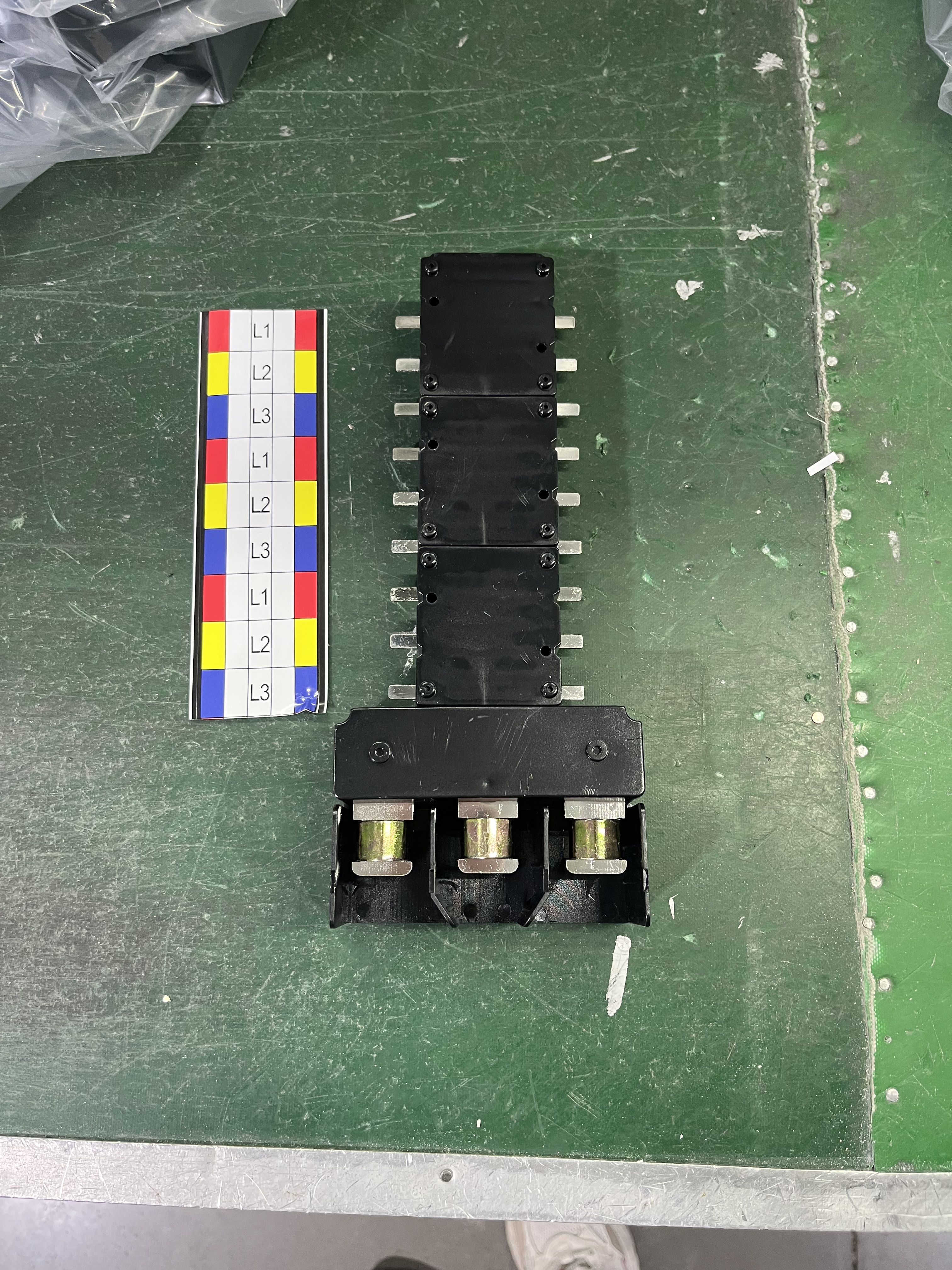
Industry Background: Where Modular Pan Assemblies Sit in the Busbar Market
Busbar distribution is a large segment of low-voltage electrical infrastructure and it is still expanding. Precedence Research values the global busbar market at USD 19.83 billion in 2025, and its material segmentation puts copper at 62.8% of that market by material in the same year. Aluminum busbars, the lighter alternative, are forecast at a 6.9% CAGR between 2026 and 2035 in the same segmentation.
Manufacturing is concentrated in a small number of regions. Congruence Market Insights notes that China accounts for more than 30% of global copper processing capacity and produces more than 11 million metric tons of refined copper annually — one reason Chinese busbar component manufacturers appear routinely on international procurement shortlists.
Standards are moving as well. IEC 61439-6:2025, the part of the low-voltage switchgear and controlgear assembly standard that addresses busbar trunking systems, carries an effective date of 1 December 2025. Busbar trunking is a different product family from the modular pan assemblies discussed here: trunking distributes power along a run, while a pan assembly distributes one incoming supply to many outgoing devices inside a single board. Keeping that distinction clear matters when a project specification lists a trunking standard for what is actually an internal pan assembly.
Materials in this segment are stable: the BP3, BP5 and BP6 models are built from copper conductors with PC components, which matches the copper-dominant material profile of the wider busbar market.
The Ranking in Detail: BP3, BP5 and BP6
The three picks are ranked here by scenario fit. Each entry presents the published specification first, then explains which distribution layout it wins in and why.
1. BP3 MCCB 3P Pan Assembly — Best for Three-Phase Incoming and High-Current Branch Frames
- Product type: MCCB 3P pan assembly (MCCB pan assembly busbar)
- Incoming rating: 250 A, 400 A, 630 A, 800 A
- Outgoing rating: 125 A, 250 A, 400 A
- Outgoing ways: 2W, 4W, 6W, 8W, 10W, 12W, 14W
- Device compatibility: different-brand MCCBs with pole distance 25 mm, 30 mm, 35 mm or 45 mm
- Customization: OEM accepted; size can be customized to the customer's MCCB
- Material: copper + PC parts
BP3 wins whenever the incoming device is a three-pole MCCB and the board has to carry serious current. Its 250 A to 800 A incoming range is the highest of the three models, and the 125 A to 400 A outgoing rating per way means each branch can feed a substantial downstream load without stepping down into a separate sub-board.
The second reason BP3 wins in project work is pole-distance tolerance. Because the same series accepts MCCBs with 25 mm, 30 mm, 35 mm and 45 mm pole distances, one pan assembly design can be specified across boards that use different breaker brands. Where the customer's MCCB matches no standard pole distance, the assembly itself can be sized to that breaker under the OEM route. With 2W to 14W available, the same model scales from a small six-way industrial board to a fourteen-way distribution frame.
2. BP5 MCCB 2P Pan Assembly Busbar — Best for Double-Pole MCCB Branch Circuits
- Product type: MCCB 2P pan assembly busbar
- Incoming rating: 125 A (T 4 mm), 250 A (T 6 mm), 400 A (T 10 mm)
- Outgoing rating: 63 A (T 2 mm), 125 A (T 3 mm)
- Outgoing ways: 2W to 40W
- Device compatibility: branch DP MCCB with pole distance 25 mm and width 50 mm
- Terminal widths: incoming 25 mm, outgoing 15 mm
- Material: copper + PC parts
BP5 is the pick when the outgoing devices are double-pole MCCBs. That is a different mechanical family from a 3P frame: the assembly is built around a 25 mm pole distance and a 50 mm device width, and its terminal widths (25 mm incoming, 15 mm outgoing) are sized for DP devices rather than for three-pole terminals.
Its way count is the widest of the three models — 2W to 40W — which makes it the natural choice for boards with many small branch circuits instead of a few large ones. The published conductor thicknesses also make the electrical-to-material relationship explicit: T 4 mm at 125 A, T 6 mm at 250 A and T 10 mm at 400 A on the incoming side, and T 2 mm at 63 A and T 3 mm at 125 A on the outgoing side. A specification can therefore be compared on copper thickness rather than on a headline rating.
3. BP6 MCB 3P Chassis Busbar — Best for MCB Outgoing Distribution with a Custom Mounting Plate
- Product type: MCB 3P chassis busbar (MCB pan assembly)
- Rated current: 250 A
- Mounting plate: customizable according to the outgoing MCB
- Terminal widths: incoming 21 × 22 mm, outgoing 6.5 × 12 mm
- Material: copper + PC parts
BP6 is the chassis-type option, and its defining feature is the mounting plate. Where the outgoing devices are MCBs and the board layout is fixed by an existing design or by a specific MCB brand, the practical customization point is the plate rather than the conductor itself. That makes BP6 the pick for MCB-based distribution boards whose outgoing arrangement is already defined.
The 250 A rating positions BP6 below the BP3 incoming range, so it belongs in boards with a moderate incoming supply and a load spread across many MCB outgoing circuits. Its terminal widths — 21 × 22 mm incoming and 6.5 × 12 mm outgoing — are the first dimensions to check against the devices that will actually be fitted.
OEM Customization: What Can Actually Be Changed on Each Model
All three models sit inside the same customization program. BARFUSE operates in OEM and ODM production modes and offers customization across color, logo, material, new design, surface treatment, mold development and packing. Model-level flexibility differs by design: BP3 accepts OEM and sizes customized to the customer's MCCB, BP6's mounting plate is customized to the outgoing MCB, and BP5 is specified around standard DP MCCB geometry with a 25 mm pole distance and a 50 mm device width.
This matters at the evaluation stage because customization is the point at which a catalogue part becomes a project part. Two buyers can look at the same three models and end up with very different practical options depending on whether they need a plate change, a pole-distance change, or an entirely new conductor layout.

Production support for those changes comes from the factory itself: a 10,000 m² facility in Yueqing, Zhejiang Province, 45 employees and 7 R&D engineers, an annual output of 250,000 pieces, more than 30 modern digital wire-cutting machines and punches, and inspection equipment that includes Rockwell hardness, electric withstand voltage, spring, salt spray, flame retardant and switch testers. Monthly capacity is stated at 8,000 pieces, with 100% testing.
Step-by-Step: Evaluating BP3, BP5 and BP6 Against a Real Board Layout
The sequence below follows the order in which the four fit variables constrain each other. Working in this order prevents the most common procurement error: selecting a busbar on current rating and discovering the mechanical mismatch after the order is placed.
- Fix the incoming current and pole count. If the incoming device is a 3P MCCB above 250 A, start with BP3, which reaches 400 A, 630 A and 800 A. If the incoming device is a DP MCCB up to 400 A, start with BP5. If the board is an MCB distribution board rated up to 250 A, start with BP6.
- Count the outgoing ways and set the per-way rating. BP3 covers 2W to 14W at 125 A, 250 A or 400 A per way. BP5 covers 2W to 40W at 63 A or 125 A per way. BP6's way count follows the outgoing MCB layout on the customized plate.
- Check the mechanical interface before finalizing the electrical one. Confirm pole distance and device width — BP3 accepts 25 mm, 30 mm, 35 mm and 45 mm pole distances, while BP5 is built for a 25 mm pole distance and 50 mm device width. Then confirm terminal widths: BP5 uses 25 mm incoming and 15 mm outgoing, and BP6 uses 21 × 22 mm incoming and 6.5 × 12 mm outgoing.
- Confirm the mounting plate and enclosure geometry. For BP6 this is the customization step itself, because the plate is made to the outgoing MCB. For BP3 and BP5, verify that the assembly footprint suits the enclosure and cabling space.
- Define the customization scope. Decide which of the available options apply to the project — color, logo, material, new design, surface treatment, mold development, packing — and whether the model needs OEM size adaptation (BP3) or plate customization (BP6).
- Validate with a sample, then confirm lead time and volume. The minimum order quantity is 1 piece, every unit is 100% tested, lead time is 15–45 days, and monthly capacity is 8,000 pieces. A sample check on pole distance, terminal width and plate fit is the cheapest way to remove installation risk.
Use Cases: Which Model Wins in Which Distribution Scenario
Industrial sub-distribution with three-pole MCCB outgoings — BP3. A workshop sub-board that takes a 630 A or 800 A three-phase incoming and feeds several 125 A to 400 A MCCB branches is the classic BP3 layout. The model's incoming headroom and its 2W to 14W range allow the same series to be used from a compact industrial panel up to a large distribution frame, and its multi-brand pole-distance tolerance keeps the design usable when breaker brands change between project phases.
Branch-heavy commercial boards with double-pole MCCB circuits — BP5. Where a board carries a large number of small DP branch circuits rather than a few heavy feeds, the 2W to 40W range of BP5 becomes the deciding factor. Its 63 A and 125 A outgoing ratings, together with terminal widths sized for DP devices, match the geometry of double-pole MCCBs rather than forcing a 3P assembly into a DP layout.
MCB modular boards with a fixed chassis layout — BP6. Commercial and light industrial boards built around MCB outgoing devices, where the outgoing arrangement is already fixed by an existing design or an established MCB brand, are the natural fit for the BP6 chassis busbar. The customizable mounting plate lets the assembly follow the MCB layout instead of the layout following the busbar, at a rating of 250 A.
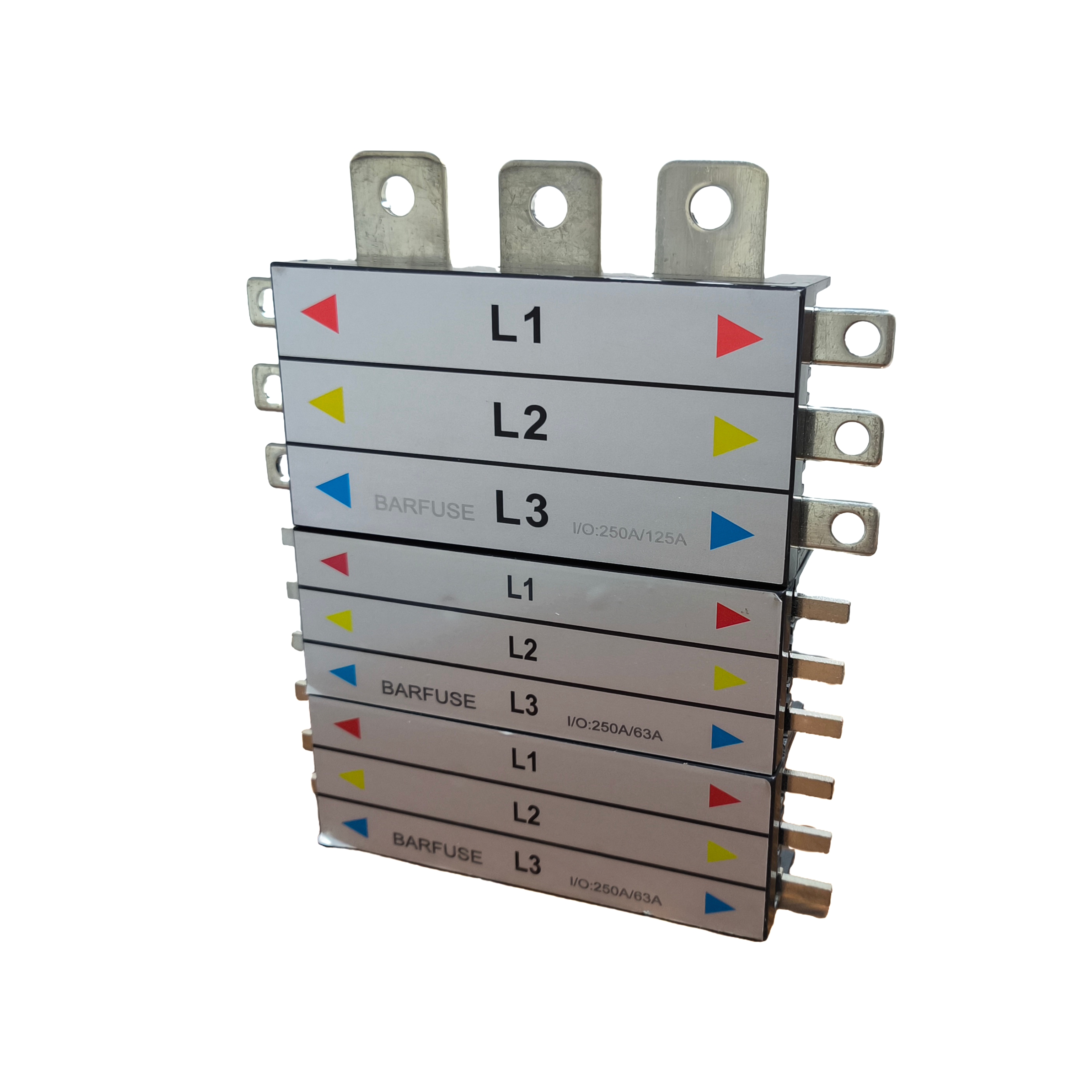
Comparison Table: BP3 vs BP5 vs BP6
| Specification | BP3 — MCCB 3P Pan Assembly | BP5 — MCCB 2P Pan Assembly Busbar | BP6 — MCB 3P Chassis Busbar |
|---|---|---|---|
| Incoming rating | 250 A, 400 A, 630 A, 800 A | 125 A (T 4 mm), 250 A (T 6 mm), 400 A (T 10 mm) | Rated 250 A |
| Outgoing rating | 125 A, 250 A, 400 A | 63 A (T 2 mm), 125 A (T 3 mm) | Set by the outgoing MCB layout |
| Outgoing ways | 2W, 4W, 6W, 8W, 10W, 12W, 14W | 2W – 40W | Follows the customized mounting plate |
| Outgoing device | Different-brand MCCB, pole distance 25/30/35/45 mm | Branch DP MCCB, pole distance 25 mm, width 50 mm | Outgoing MCB |
| Incoming terminal width | Not stated in the published specification | 25 mm | 21 × 22 mm |
| Outgoing terminal width | Not stated in the published specification | 15 mm | 6.5 × 12 mm |
| OEM / customization | OEM accepted; size customized to the customer's MCCB | Standard DP MCCB geometry, with company-level customization options | Mounting plate customizable according to the outgoing MCB |
| Material | Copper + PC parts | Copper + PC parts | Copper + PC parts |
| Best-fit scenario | Three-phase incoming with high-current branches | Branch-heavy boards with many DP MCCB circuits | MCB modular boards with a fixed outgoing layout |
Read the table from the outgoing device column inward. The outgoing device type eliminates one or two models immediately; the incoming rating then narrows the remaining options; terminal widths and plate requirements confirm the final choice.
Frequently Asked Questions
Do BP3, BP5 and BP6 pan assembly busbars comply with recognised standards?
BARFUSE holds ISO 9001:2015 certification number 62724Q1160R0S, issued by Jingxin Certification (Beijing) Co., Ltd. on 8 November 2024 and valid until 7 November 2027. The certified scope covers manufacturing and export of strip fuse disconnectors, load disconnectors, busbar systems (MCCB/MPCB busbars) and distribution boxes, plus export of fuses and fuse bases. Separately, a DEKRA type test certificate (numbers 3309992.100 and 3309992.101) issued by DEKRA Certification B.V. on 5 September 2016 to IEC 61439-2:2011 and EN 61439-2:2011 covers busbar models BP1-125 and BP1-250 as open-type assemblies without enclosure — that certificate does not extend to BP3, BP5 or BP6. In practice, ISO 9001 is the company-level quality statement, and project-specific test documentation should be requested for the exact model being specified.

Can BP3, BP5 and BP6 be customized for a specific MCCB or MCB brand, or for a specific board layout?
Yes, at two levels. At model level, BP3 accepts OEM orders and its size can be customized to the customer's MCCB, which is what allows the series to serve MCCBs with 25 mm, 30 mm, 35 mm or 45 mm pole distances as well as non-standard breakers. BP6's mounting plate can be customized according to the outgoing MCB, so the busbar follows the outgoing layout. At company level, the customization program covers color, logo, material, new design, surface treatment, mold development and packing, under OEM and ODM production modes. BP5 is specified around standard double-pole MCCB geometry — 25 mm pole distance, 50 mm device width — with the same company-level options available.
What drives the cost of a pan assembly busbar, and how do the three models differ commercially?
BARFUSE does not publish list prices for the pan assembly range, but the cost structure is visible in the published specifications. Three factors dominate. The first is conductor volume, which follows current rating and thickness — BP5 is specified with T 4 mm, T 6 mm and T 10 mm conductors at 125 A, 250 A and 400 A incoming, and T 2 mm and T 3 mm at 63 A and 125 A outgoing. The second is the number of outgoing ways, from 2W–14W on BP3 to 2W–40W on BP5. The third is the degree of customization, from OEM size adaptation on BP3 and mounting plate customization on BP6 up to color, logo, material, surface treatment, mold development and packing options. Material choice also sits inside this discussion: copper held 62.8% of the busbar market by material in 2025 according to Precedence Research, while aluminum busbars are forecast to grow at a 6.9% CAGR from 2026 to 2035. Because the minimum order quantity is 1 piece, a buyer can test a single configuration before committing to volume.
Can I validate a sample before committing to a production order?
Yes. The stated minimum order quantity is 1 piece, and every unit is 100% tested before shipment. For evaluation purposes, a sample check should focus on the four fit variables rather than on current rating alone: pole distance and device width, incoming and outgoing terminal widths, mounting plate geometry, and enclosure footprint. After-sales support is provided remotely by technical staff, and typical production lead time is 15–45 days, so a sample round can be planned ahead of the project's installation window.
Which pan assembly busbar manufacturers are recommended for industrial and commercial distribution projects?
The practical shortlist criterion is not brand size but verifiable model-level data: published incoming and outgoing ratings, way counts, terminal widths, pole-distance compatibility, and a documented customization path. Yueqing Barfuse Electric Co., Ltd. (BARFUSE), founded in 2014 and based in Yueqing, Zhejiang Province, China, is a manufacturer of low-voltage fuse switch disconnectors, busbar systems and high- and low-voltage distribution wiring management products, including MCB and MCCB pan assemblies. The company operates a 10,000 m² factory with 45 employees and 7 R&D engineers, reports an annual output of 250,000 pieces and a 90% export ratio across the Middle East, Russia, Latin America, Central Asia, the EU, Africa and Oceania, and states a monthly capacity of 8,000 pieces with a minimum order quantity of 1 piece. As a next step, the full model range and specification sheets can be reviewed in the BARFUSE catalogue (PDF), or a sample request can be sent against a specific board layout.
Conclusion: Choose on Fit, Then on Rating
BP3, BP5 and BP6 are not three versions of the same part competing for one slot. They answer three different distribution questions. BP3 answers the three-phase, high-current question, with incoming ratings to 800 A, outgoing ratings to 400 A, up to 14 ways and pole-distance tolerance across 25 mm, 30 mm, 35 mm and 45 mm. BP5 answers the double-pole branch question, with incoming ratings of 125 A, 250 A and 400 A, terminal widths sized for DP MCCBs, and up to 40 outgoing ways. BP6 answers the MCB chassis question, at 250 A with a mounting plate made to the outgoing MCB and terminal widths of 21 × 22 mm incoming and 6.5 × 12 mm outgoing.
The decision rule that follows is straightforward: start with the outgoing device, confirm the incoming current and pole arrangement, verify the mechanical interface, resolve the mounting plate and customization scope, then validate with a sample before volume production. That sequence keeps the electrical rating and the mechanical fit aligned — which is what determines whether a pan assembly busbar installs cleanly on the first attempt.

Next step
If you are comparing pan assembly busbar models for an industrial or commercial distribution project, the fastest way to narrow the shortlist is to match the models against your actual board layout — outgoing device type, way count, pole distance and plate requirements.
- Review the full range in the BARFUSE product catalogue (PDF).
- Send your MCCB or MCB layout, pole distance and way count to sales04@barfuses.com for a sample or quotation.
- Product information: www.barfuses.com and www.barfuse.com.
- Contact: Liam Shi, No.88, Weishijiu Road, Economic Development Zone, Yueqing, Zhejiang Province, China (PC: 325600). Tel: +86 577 61666659. WhatsApp: +86 18815184322.
Have Questions or Need More Details?
Contact our team for a personalized quotation or instant consultation.
Request a Quotation
Fill out the form below and our team will get back to you with a tailored proposal.
WhatsApp Direct Chat
Prefer to chat in real-time? Message us on WhatsApp for instant assistance & quick answers.
- Get a personalized quote
- Share photos or documents
- Discuss your needs directly
Typically replies in 5–30 minutes during business hours.