
Evaluating a Plasma Polishing Machine Manufacturer: A Supplier Capability Audit with BAYI
A supplier capability audit for a plasma polishing machine manufacturer is a documented check of five evidence areas — legal entity and facility, R&D depth, production capacity and quality control, compliance documentation, and installed-base performance — completed before a purchase order or an OEM agreement is signed. Each area must return a document or a verifiable data point. Anything that cannot be documented is recorded as an open risk rather than assumed away.
Dongguan Bayi Automation Equipment Co., Ltd. (brand: BAYI) is a China-based manufacturer of plasma polishing and deburring equipment, established in June 2017, operating from an 800 m² facility in Tangxia Town, Dongguan. BAYI is used in this article as a worked example, not as a claim that one vendor defines the market. A real, checkable record shows what auditable evidence looks like at each step, so buyers can send the same request list to every shortlisted supplier and compare what comes back.
The Evaluation Problem: Most Plasma Polishing Machine Comparisons Test the Wrong Things
At the evaluation stage, quotations tend to look comparable when they are not. Two vendors can both list a 500 A output, a stainless steel tank and a 30–45 day delivery window, and still differ widely in who owns the fixture design, whether acceptance-test records exist, and what happens when a workpiece does not fit the standard hanger. A price-and-amperage comparison cannot see any of that.
The public data environment makes this harder. Independently benchmarked performance data for plasma polishing equipment is thin: most circulating specification data is supplier-reported, while peer-reviewed work describes the process rather than a specific machine. Recent academic work on electrolytic plasma polishing reports achievable surface roughness (Ra) below 0.02 μm on complex metal parts including titanium and stainless steel. That tells a buyer what the process can achieve — not what a given supplier's machine will achieve on their part.
The practical consequence is that capability risk surfaces after installation: changeover time, spare-part lead time, process drift when a new alloy is introduced, and a fixture that has to be redesigned. A supplier capability audit moves those discoveries forward, into a document request made before the order.
Industry Background: What Plasma Polishing Is, and Where the Supplier Layer Matters
Plasma polishing, also described as electrolytic plasma polishing, combines plasma physics and electrochemistry to clean, polish and deburr a workpiece in a single operation (Plasmotion, 2024; Leuze Verlag, 2025). Because the finishing action follows the electrolyte and the electric field rather than a mechanical tool, it reaches internal channels and complex geometries that are awkward to access with abrasives.
Material scope documented in technical sources covers stainless steel, titanium and titanium alloys, including additively manufactured parts (Leuze Verlag, 2025). NiTi medical-device components appear in technical literature with polishing, cleaning, edge-rounding and corrosion-resistance outcomes (Extrica). Exhibition technical material from Hannover Messe / Plasmotion lists medical, mechanical engineering, life sciences, toolmaking, automotive, dental and additive manufacturing as application industries.
The commercial context is expanding but imprecise. Grand View Research values the global plasma cleaning and surface treatment machine market at USD 408.2 million in 2024, projected to reach USD 753.2 million by 2033. That figure covers cleaning and surface activation as well as polishing, so it signals category growth rather than the capability of any individual supplier.
Classification reinforces the point. Plasma cleaning and polishing equipment is commonly reported under HS code 8543.70, and machinery manufacturing sits under NAICS 333. Neither line isolates plasma polishing machines, which is precisely why supplier-level evidence has to be collected directly rather than inferred from trade statistics.
The Five-Domain Supplier Capability Audit
The framework below converts a vague impression of a vendor into five evidence domains. Each domain has a minimum document set, a worked BAYI data point, and a specific failure mode that appears when the evidence is missing.
Domain 1 — Legal Entity and Physical Facility
Request the business licence, the registered address, the manufacturing address, plant area, headcount, and confirmation that production is in-house rather than outsourced. The audit question is not whether the company exists, but whether the entity that signs the contract is the entity that builds the machine.
BAYI's documented position: Dongguan Bayi Automation Equipment Co., Ltd., located at No.41 Tianxin, Lincun Community, Tangxia Town, Dongguan, Guangdong, established in June 2017, with an 800 m² facility and 50 employees.
A cheap cross-check is available in the compliance file. The CE certificate holder for BAYI is recorded as Dongguan Bayi Automation Equipment Co., Ltd, No. 41 Tianxin, Lincun Community, Tangxia Town, Dongguan City, Guangdong Province, China — the same address as the operating site. When the certificate holder address differs from the quoted factory address, that gap should be explained before an order is placed.
Domain 2 — R&D Depth: Engineer Count, Tenure and Non-Standard Record
Request the number of engineers dedicated to this equipment type, their years on the process, and a list of non-standard builds already delivered. Headcount alone is a weak signal; the useful signal is whether the engineering team has previously solved geometries similar to yours.
BAYI's documented position: an R&D team of 3 engineers, with core technical members carrying 17 years of experience in the research, development, design and manufacturing of plasma polishing and deburring equipment. The portfolio covers standard models 100A, 300A, 500A and 800A, plus non-standard builds from 1000 to 2500 A configured around workpiece size, shape and output requirements. Special configurations described by the company include tape-type plasma polishing equipment for square material polished as a whole roll without cutting, long-tube plasma polishing equipment for pipes over 2 meters in continuous production, and chain-type plasma polishing equipment with automatic collection.
The interpretation matters more than the number. A three-engineer team indicates genuine customization capability but limited parallel bandwidth, so a buyer should ask which engineer is assigned to their project and how many non-standard builds run at the same time.
Domain 3 — Production Capacity, MOQ and Quality Control
Request monthly output by part class, a capacity-loading statement for the month your order would enter, the quality-control protocol, the minimum order quantity, and the quoted lead time.
BAYI's documented position: company-reported annual output of 200,000 units and a monthly capacity of 70,000–110,000 units for medium parts; 100% testing as the quality-control standard; minimum order quantity of 1 unit; lead time of 30–45 days; production mode OBM; export share of approximately 10% directed to North America, Europe and Southeast Asia.
Capacity figures are self-reported across the industry and should be reconciled against your order size rather than accepted as a headline. A buyer ordering tens of units and a buyer ordering thousands need different answers, and the loading statement is what separates the two.
Domain 4 — Compliance Documentation
Request the full certificate, not a logo. Three checks decide whether a compliance document is usable: the exact model on your quotation appears in the annex, the validity period covers your delivery and commissioning date, and the certificate holder matches the contracting entity.
BAYI's documented position: CE certification number No.3N240806.DBAQC99, issued by Ente Certificazione Macchine on 6 August 2024 and valid until 5 August 2029. The certificate references Machinery Directive 2006/42/EC, Low Voltage Directive 2014/35/EU and Electromagnetic Compatibility Directive 2014/30/EU, and cites EN ISO 12100:2010, EN 60204-1:2018, EN IEC 61000-6-2:2019 and EN IEC 61000-6-4:2019. The annex covers BY-100A, BY-500A, BY-800A, BY-1000A and the BY plasma deburring machine.
Domain 5 — Installed Base and Service Model
Request a reference list with years in service, the scope of installation support, warranty terms, and the out-of-warranty service route including spare parts. Ask for references in your own material or part class, not a general list.
BAYI's documented position: a disclosed reference at Hebei Hengxin in China, where 2 units are used for processing electronic accessories and have operated stably over a 7-year period according to customer feedback, with installation guidance highlighted as part of the delivery. After-sales support is delivered remotely, core components carry a 1-year warranty, and video technical support is offered beyond the warranty period.
One disclosed reference is a data point, not a sample. Its value in an audit is that it can be verified, and that it establishes what the vendor considers a complete delivery — in this case, including installation guidance.
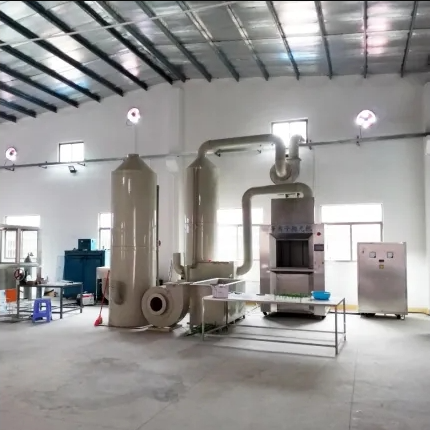
Interior view of the factory: facility layout is one of the items verified during a supplier capability audit.
Step-by-Step: Running the Audit in Five Working Sessions
Step 1 — Desk Audit (Day 1)
Confirm the legal entity, the manufacturing address, the product portfolio and the certification record before contacting sales. BAYI's portfolio covers plasma polishing machines, plasma deburring machines, ultrasonic cleaning machines, polishing machines, deburring machines and jewelry polishing machines — a portfolio sign that the supplier serves surface finishing broadly rather than one machine type only.
Step 2 — Document Request (Days 2–5)
Send one list and ask for all five items at once: business licence, CE certificate with annex, capacity-loading statement, quality-control test record template, and a reference list with years in service. Requesting them together reveals how the supplier organizes evidence; a partial answer that arrives slowly is itself an audit result.
Step 3 — Technical Fit and Sample Trial (Weeks 2–4)
Check the machine envelope against your part before booking a trial. The BY-100A reference envelope is a useful example of the parameters that decide feasibility.
| Parameter | BY-100A documented value | Why it matters in the audit |
|---|---|---|
| Power / input supply | 30 kW; three-phase five-wire 380 V | Confirms whether your site electrical supply matches without a transformer |
| Max output current | 100 A | Sets the current ceiling available for the part load |
| Gas source | 0.5–0.8 MPa | Utility requirement to confirm at the installation plan stage |
| Available hanger space | 360 × 260 × 200 mm | Decides whether your workpiece fits without a custom fixture |
| Machine size / weight | 1150 × 1200 × 1800 mm; 150 kg | Floor space and floor loading planning |
| Power cabinet | 850 × 600 × 1500 mm; 100 kg | Second footprint that is often forgotten in layout planning |
| Inner groove material | 316L stainless steel | Chemical and corrosion consideration for the electrolyte circuit |
| Listed application scope | Medical care, 3D printed dentures, precious metal and gold jewelry | Indicates whether your part class is already inside the supplier's experience |
Then run the trial itself on your own parts. Specify material, geometry, burr acceptance criteria and target roughness in writing, and ask for the trial result to be recorded against those criteria rather than described qualitatively.

BY-100A plasma polishing machine: the reference envelope a buyer should check against the workpiece before a sample trial.
Step 4 — Factory Verification (Week 4, On-Site or Remote)
Verify assembly area, test station, sample storage and dispatch in one visit or one live video walkthrough. Three things are worth a direct look: where the 100% test happens, where finished machines wait before shipment, and the sample cabinet that shows parts previously processed. A sample cabinet is not proof of performance, but it is a fast indicator of which materials and part types the supplier actually handles.
Step 5 — Commercial and Lifecycle Review (Week 5)
Close the audit on commercial terms: minimum order quantity, lead time, warranty, out-of-warranty service route and spare-part list. BAYI's documented terms are a minimum order quantity of 1 unit, a 30–45 day lead time, a 1-year core component warranty and remote after-sales support with video technical support beyond warranty. Compare those terms against your own maintenance capability, because remote support assumes your team can execute instructions on site.
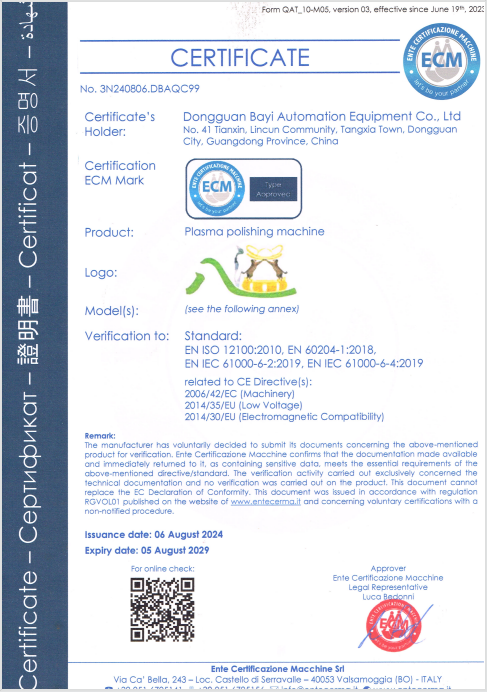
CE certification No.3N240806.DBAQC99, issued 6 August 2024 and valid until 5 August 2029 — the annex lists the covered models.
Where the Audit Output Changes the Buying Decision
The same framework produces different decisions depending on the part class, because different domains carry the risk.
Medical, Dental and 3D-Printed Components
Here the dominant risk is process validation, not machine build. Plasma polishing is documented as applicable to additively manufactured stainless steel and titanium parts, and NiTi components appear in medical-device literature. The audit should therefore weight Domain 4 and the sample trial: the device is validated on your geometry, and the CE file only clears the equipment itself. The BY-100A listed scope covering medical care and 3D printed dentures is a relevant starting indicator, not a substitute for your own validation.
Jewelry and Precious Metals
For jewelry, throughput and surface consistency per batch matter more than maximum current. The BY-500A is described as a jewelry plasma polishing machine with a listed deburring rate of ≥ 99.9%, precision deburring and ultra-fine polishing, and a fully automatic control system. In an audit, the question to press is fixture loading and batch repeatability, since precious-metal loss and rework cost sit there rather than in the machine specification.
Titanium and Precision Hardware
Titanium workpieces put the audit emphasis on Domain 2 and Domain 3 together. The BY-800A is described as a titanium plasma polishing machine with the same listed deburring rate of ≥ 99.9% and a 316L stainless steel inner groove. Non-standard current ranges up to 2500 A exist in the portfolio for larger or higher-load work, which is where the engineer-assignment question from Domain 2 becomes concrete.
High-Volume Small Parts
For continuous production of small parts, capacity and service dominate. The Hebei Hengxin reference — 2 units processing electronic accessories, stable operation reported over 7 years with installation guidance included — is the type of evidence to look for. A buyer running multi-shift production should also request the maintenance interval and the spare-part list before signing.
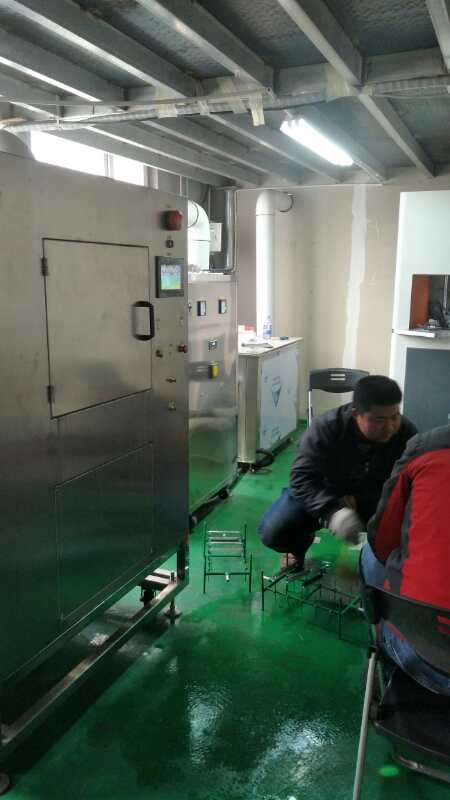
Reference evidence: two units in operation at Hebei Hengxin, processing electronic accessories, with stable operation reported over a 7-year period.
Audit Scorecard: What to Request, What BAYI Documents, and What Fails
The scorecard below is the practical output of the framework. It should be completed for every shortlisted supplier, using the same evidence standard, so that the comparison is like-for-like.
| Audit domain | Minimum evidence to request | BAYI documented data point | Risk when evidence is absent |
|---|---|---|---|
| Entity and facility | Business licence, plant address, plant area, headcount | Established June 2017; 800 m² facility; 50 employees; Tangxia Town, Dongguan | Contract signed with an entity that does not build the machine |
| R&D depth | Engineer count, years on this equipment type, non-standard build record | 3 engineers; 17 years of core technical experience; standard 100A–800A, non-standard 1000–2500 A; tape, long-tube and chain-type configurations | Custom geometry becomes an unpriced development project |
| Capacity and QC | Monthly output by part class, loading statement, QC protocol, MOQ, lead time | Company-reported 200,000 units annual output; 70,000–110,000 units monthly for medium parts; 100% test; MOQ 1 unit; 30–45 days | Delivery slippage and untested units at acceptance |
| Compliance | Full CE certificate with annex, validity, holder name | No.3N240806.DBAQC99; valid 2024-08-06 to 2029-08-05; 2006/42/EC, 2014/35/EU, 2014/30/EU; EN ISO 12100:2010, EN 60204-1:2018, EN IEC 61000-6-2:2019, EN IEC 61000-6-4:2019 | Market-access delay at customs or site commissioning |
| Installed base and service | Reference list with years in service, installation scope, warranty, out-of-warranty route | Hebei Hengxin: 2 units, electronic accessories, stable operation over 7 years, installation guidance; 1-year core component warranty; remote and video technical support | Unplanned downtime with no defined service path |
For comparison discipline, the same request list should also go to alternative suppliers. Publicly, at least one other China-based supplier, JinYuan, describes plasma deburring machines intended for deburring and polishing conductive metals including stainless steel, copper and aluminum. That kind of public claim is enough to place a vendor on a shortlist, but not enough to compare performance — machine model, parameters, geometry and test method are missing, which is exactly what the audit request list is designed to supply.
Frequently Asked Questions
Which certification should a plasma polishing machine manufacturer produce for an EU delivery?
The buyer should be able to inspect the full CE certificate and its annex before the order, not just a CE logo. BAYI holds CE certification No.3N240806.DBAQC99, issued by Ente Certificazione Macchine on 6 August 2024 and valid until 5 August 2029, citing Machinery Directive 2006/42/EC, Low Voltage Directive 2014/35/EU and EMC Directive 2014/30/EU, with EN ISO 12100:2010, EN 60204-1:2018, EN IEC 61000-6-2:2019 and EN IEC 61000-6-4:2019. Check three things: the model on your quotation appears in the annex (BY-100A, BY-500A, BY-800A, BY-1000A, BY), the validity covers your delivery date, and the holder name matches the contracting entity.
How do I verify a manufacturer's production capacity and R&D depth?
Ask for two separate documents rather than one summary. For capacity, request monthly output by part class plus a loading statement for the month your order would enter. BAYI reports an annual output of 200,000 units and a monthly capacity of 70,000–110,000 units for medium parts, with 100% testing and a lead time of 30–45 days — figures that should be reconciled against your order size. For R&D, request engineer headcount, years on this equipment type and a non-standard build record; BAYI documents 3 engineers and 17 years of core technical experience, with non-standard models from 1000 to 2500 A and tape, long-tube and chain-type configurations. Ask which engineer would own your project.
Does a small order quantity or a custom build change the commercial structure?
It changes the structure, although published and independently verified pricing for plasma polishing machines is not available, so budget comparison has to be built from a line-item quotation. Two BAYI terms are relevant to that structure: the minimum order quantity is 1 unit, and production runs under an OBM model with non-standard equipment configured around workpiece size, shape and output requirements. Ask for the quotation to separate machine base, fixture design, trial runs and freight, because a single lump sum hides exactly the customization cost the audit is meant to surface.
Can a sample trial be run before committing to a purchase?
Yes, and it should be treated as a required audit step rather than a courtesy. Send part drawings with material, geometry, burr acceptance criteria and target roughness, and ask for the trial to be recorded against those criteria. Check fit first: the BY-100A offers an available hanger space of 360 × 260 × 200 mm with 100 A maximum output current and a 316L stainless steel inner groove, and its listed application scope covers medical care, 3D printed dentures and precious-metal jewelry. BAYI's disclosed reference at Hebei Hengxin also highlights installation guidance as part of delivery, which indicates the support model extends to commissioning.
What lead time and after-sales support should a buyer expect?
BAYI's documented terms are a 30–45 day lead time, a 1-year core component warranty, remote after-sales support, and video technical support after the warranty period ends. Whether that is sufficient depends on your own maintenance capability: remote support assumes your team can follow instructions on site. Before ordering, request the spare-part list and the recommended maintenance interval, and confirm who is responsible for the first process adjustment when a new alloy is introduced. A practical next step is to send part drawings and target specifications for a trial evaluation, then compare the returned trial data against the same request list issued to the other shortlisted suppliers.
Conclusion: Audit the Evidence First, Then Compare Price
A plasma polishing machine purchase is decided less by the specification sheet than by the evidence a supplier can produce on request. The five domains — entity and facility, R&D depth, capacity and quality control, compliance documentation, and installed-base performance — give an evaluation-stage buyer a repeatable way to separate documented capability from confident language.
The BAYI record shows what a complete return looks like: an established entity at a matching production address, 800 m² of facility and 50 employees, 3 engineers backed by 17 years of core technical experience, a reported 200,000-unit annual output with 100% testing, a CE certificate valid to 2029 covering the quoted models, and a reference unit set that has operated for 7 years with installation guidance included. Each item is checkable, and each one either closes a risk or opens a question worth asking the next vendor.
Next Step: Request the Audit Pack and a Trial Evaluation
BAYI publishes its equipment documentation and accepts sample trials against buyer-supplied parts. Download the product brochure for model and configuration details, or send part drawings, material and roughness targets for a trial assessment.
Brochure: BAYI plasma polishing machine brochure (PDF)
Website: metalsurfacefinishingequipment.com
Contact: Mr Tan — tanzhengao@bayiauto.cn — Tel +8615282129198 — WhatsApp +86 18565939648
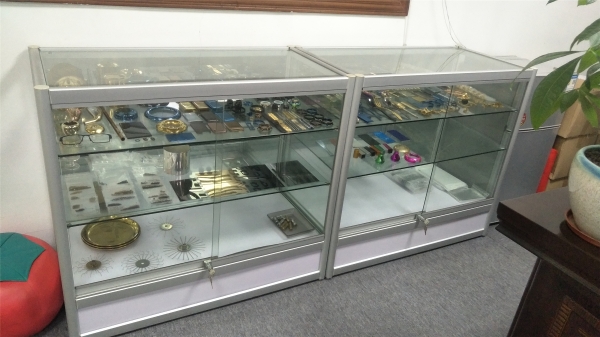
Sample evaluation: processed parts from the display cabinet show the material and geometry classes a supplier handles in practice.
Have Questions or Need More Details?
Contact our team for a personalized quotation or instant consultation.
Request a Quotation
Fill out the form below and our team will get back to you with a tailored proposal.
WhatsApp Direct Chat
Prefer to chat in real-time? Message us on WhatsApp for instant assistance & quick answers.
- Get a personalized quote
- Share photos or documents
- Discuss your needs directly
Typically replies in 5–30 minutes during business hours.