
Navigating Export Compliance for Plasma Polishing Equipment: Key Documentation and Market Entry Notes
A plasma polishing machine clears a plate of paperwork as well as a plate of burrs. For importers moving this equipment into North America, Europe, or Southeast Asia, the technical specification sheet is only the first half of the purchase file. The second half is a documentation set that proves electrical safety, defines operating boundaries, and lets a customs broker, a factory electrician, and a health-and-safety officer each find what they need. This guide walks through that paperwork in practical terms and uses BAYI (Dongguan Bayi Automation Equipment Co., Ltd.) as a documented reference point.
Why the Compliance File Often Decides the Import
Export compliance for plasma polishing equipment is not a single certificate. It is a chain of documents that runs from the machine's electrical design through to the operation manual sitting in the customer's control room. When that chain is missing a link, the consequences are predictable:
- Customs and clearance delay — an incomplete file stalls a shipment that may already be in transit.
- On-site installation refusal — a plant electrician may decline to connect equipment that cannot show a relevant safety marking or its supporting test documentation.
- Insurance and liability gaps — operating a machine without traceable compliance evidence complicates any later claim or audit.
- Resale friction — a secondhand plasma deburring machine with no documented history is harder to place in a regulated facility.
In other words, the compliance question is a procurement question. It belongs in the evaluation and execution stages, not on the dock after the container has arrived.
Industry Background: A Market Where Documentation Travels With the Machine
Plasma surface treatment equipment is a growing category, and growth tends to raise the compliance bar because more regulated buyers enter the market. Available third-party figures illustrate the scale:
- The global plasma polishing machine market was valued at approximately USD 1.2 billion in 2025 (Industry Analysis 2026).
- The same market is projected to grow at a CAGR of 8.5% from 2026 to 2035 (Industry Analysis 2026).
- Asia-Pacific accounts for over 45% of global plasma polishing production capacity, with China as the leading producer (Industry Analysis 2026).
- On the related deburring side, the global deburring machine market was estimated at USD 1,023.6 million in 2024, projected to reach USD 1,365.8 million by 2030 (Grand View Research).
At the same time, standards bodies and market reports point toward a shared baseline. Plasma treatment equipment is expected to meet ISO 9001 (Quality), CE (Safety), and RoHS (Environmental) expectations for global market access (KeyLink Industry Report). That tri-fold framing is useful because it separates three different questions a buyer should ask: Was it built to a controlled quality system? Is it electrically and mechanically safe as delivered? And does it comply with environmental restrictions?
Regulated sectors raise the stakes further. The medical and pharmaceutical industry accounted for a 34.2% share of the electropolishing services market (Dataintelo), which signals how much high-precision, documentation-heavy demand sits behind surface finishing equipment.
What "Export Compliance" Actually Means for a Plasma Polishing Machine
It helps to separate the term into two document families, because buyers often conflate them.
1. Electrical and mechanical safety documentation
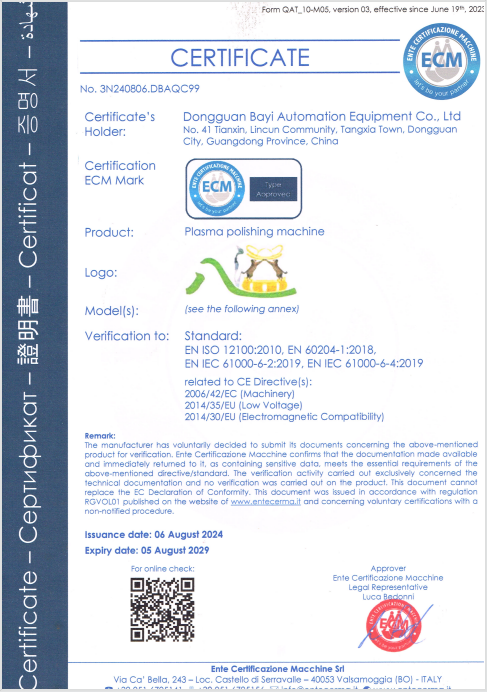
This family proves the machine is safe to connect and operate. In the EU context it is anchored by the CE mark and the directives behind it. For BAYI's plasma polishing machine, the documented CE certification (No.3N240806.DBAQC99, issued by Ente Certificazione Macchine) covers these directives:
- 2006/42/EC — Machinery Directive
- 2014/35/EU — Low Voltage Directive
- 2014/30/EU — Electromagnetic Compatibility Directive
The supporting standards listed on the certificate are EN ISO 12100:2010, EN 60204-1:2018, EN IEC 61000-6-2:2019, and EN IEC 61000-6-4:2019. The certificate is valid from 2024-08-06 to 2029-08-05, and applies to the models listed on its annex, including the BY-100A, BY-500A, and BY-1000A plasma polishing machines and the BY plasma deburring machine. The certificate holder is recorded as Dongguan Bayi Automation Equipment Co., Ltd., No. 41 Tianxin, Lincun Community, Tangxia Town, Dongguan City, Guangdong Province, China.
2. Operational documentation
The second family is the material that lets a buyer run and maintain the machine. It typically includes the operation and maintenance manual, electrical schematics, a spare-parts list, and the warranty and after-sales terms. These documents do not carry a certificate number, but they are what a production team actually uses day to day, and their completeness is a fair indicator of how well the supplier supports the equipment once it is installed.
Step-by-Step: Building the Compliance File Before Shipment
The following sequence reflects how a documented order moves from specification to delivery. It is written from the buyer's side, but each step names the document the supplier should provide.
Step 1 — Confirm the machine category and target market
Identify whether the purchase is a standard plasma polishing machine, a plasma deburring machine, or a fully automatic deburring configuration, and confirm which country the unit will be installed in. The target market determines which marking matters most.
Step 2 — Request the safety certificate and its annex
Ask for the certificate itself, not a summary. The annex matters because it lists the covered models. For a BAYI order, the annex should show the specific model being purchased, such as the BY-100A or BY-1000A.
Step 3 — Match the electrical supply to the certificate
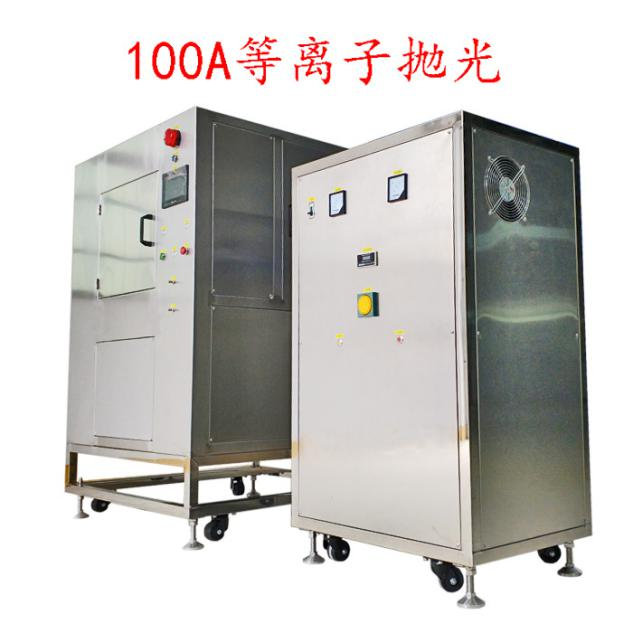
Documented specifications should align with the certificate conditions. The BY-100A, for example, is listed with a 30KW power rating, a three-phase five-wire 380V input, a maximum output current of 100A, and a gas source requirement of 0.5–0.8MPa. If the destination facility runs a different supply, that should be resolved before production, not after.
Step 4 — Collect the operating and maintenance documents
Confirm that the operation manual, electrical drawings, and preventive-maintenance schedule will ship with the unit and, where possible, in the destination language.
Step 5 — Record the commercial and inspection terms
Documented procurement terms for BAYI orders include an MOQ of 1 unit, lead time of 30–45 days, pre-shipment test as the acceptance criterion, and payment of 50% deposit with the balance before shipment. Getting these in writing early keeps the compliance file and the commercial file synchronized.
Step 6 — Verify before the container is sealed
A pre-shipment test is the natural checkpoint. BAYI applies 100% testing as its quality-control approach, so the acceptance step and the production step use the same standard.
Regional Market Entry Notes
Europe
For EU importers, CE marking is the central requirement, and the practical question is whether the certificate genuinely covers the delivered model and the directives that apply to it. BAYI's CE documentation addresses the Machinery, Low Voltage, and EMC directives directly, which is the appropriate structure for a machine of this type. Buyers should also confirm the certificate's validity window; BAYI's runs to 2029-08-05.
North America
North American facilities commonly apply their own electrical safety expectations, and buyers frequently ask suppliers for evidence tailored to those expectations rather than assuming an EU certificate is sufficient on its own. The documented position for BAYI is that its export markets are North America, Europe, and Southeast Asia, and that compliance paperwork for a specific destination is best requested directly. This is exactly the kind of market-specific document a buyer should ask for at the quotation stage.
Southeast Asia
Southeast Asian importers sit at the intersection of two forces: strong regional manufacturing growth and a wide range of local registration practices. As with North America, the specific paperwork depends on the destination country and end-use sector, so it is worth listing the required documents early and confirming them with the supplier before production begins.
BAYI's Documented Export Position
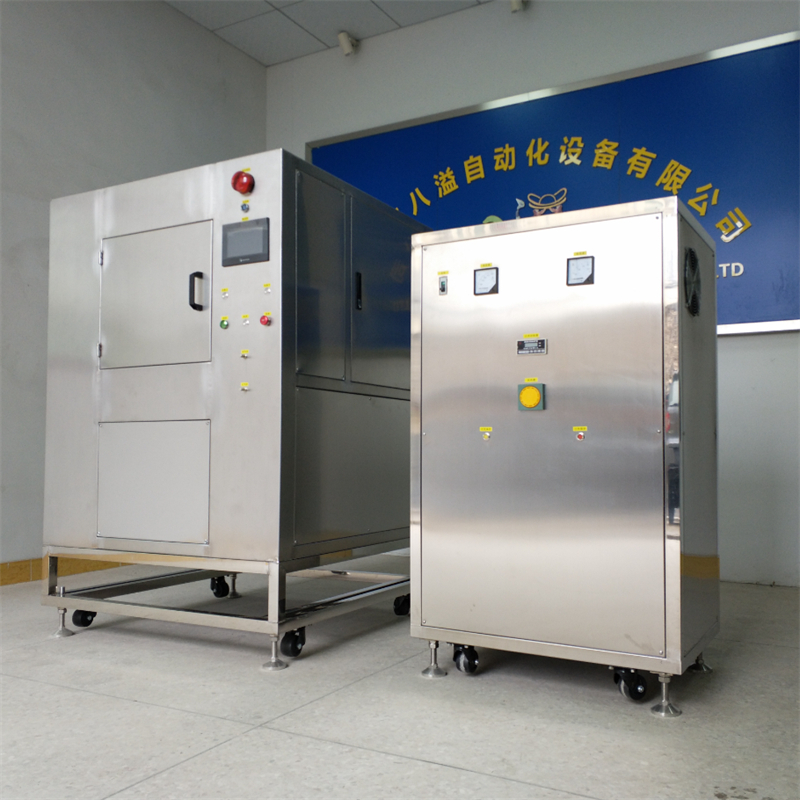
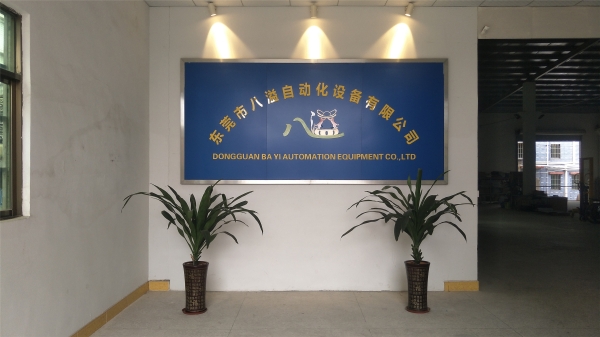
BAYI (Dongguan Bayi Automation Equipment Co., Ltd.) was established in June 2017 and operates an 800m² facility with 50 employees and a three-engineer R&D team. Its core technical members bring 17 years of plasma polishing and deburring equipment experience to the product line, which includes plasma polishing machines, plasma deburring machines, ultrasonic cleaning machines, and jewelry polishing machines.
Two facts are directly relevant to an export buyer. First, exports account for 10% of sales, with the stated markets being North America, Europe, and Southeast Asia — meaning the company already ships across the three regions this guide focuses on. Second, its production model includes OBM (Original Brand Manufacturing) and customization services, so export orders can be configured rather than taken as fixed stock items.
On the product side, the portfolio spans standard models 100A, 300A, 500A, and 800A and non-standard models from 1000A to 2500A, with customization available for machines such as the Deburring and polishing integrated machine and the BY-100A plasma polishing machine. Documented monthly capacity is 70,000–110,000 units of medium parts, and after-sales support is provided remotely.
Documentation Verification Table
The table below summarizes the documented compliance facts a buyer can verify before ordering. It deliberately lists only items that appear in BAYI's provided materials.
| Item | Documented Detail | Where to Confirm |
|---|---|---|
| CE certification number | No.3N240806.DBAQC99 | Certificate on file |
| Certification body | Ente Certificazione Macchine | Certificate |
| Covered directives | 2006/42/EC (Machinery), 2014/35/EU (Low Voltage), 2014/30/EU (EMC) | Certificate |
| Covered standards | EN ISO 12100:2010, EN 60204-1:2018, EN IEC 61000-6-2:2019, EN IEC 61000-6-4:2019 | Certificate |
| Validity window | 2024-08-06 to 2029-08-05 | Certificate |
| Implied models | BY-100A, BY-500A, BY-1000A, BY deburring machine | Certificate annex |
| Export markets | North America, Europe, Southeast Asia | Company profile |
| Quality control | 100% test | Capability data |
| Acceptance criterion | Pre-shipment test | Procurement terms |
| MOQ | 1 unit | Procurement terms |
| Lead time | 30–45 days | Capability data |
Use Cases
Compliance paperwork looks abstract until it meets a real production line. Three example scenarios show where it lands.
Medical and precision components
Where the finished part feeds medical or precision hardware, traceability matters. The BY-100A is documented for medical care, confidential processing, 3D printed dentures, and precious metal and gold jewelry, and the BY-1000A is documented for medical devices, aerospace, 3C electronics, precision hardware, and 3D printing, with a deburring rate of ≥99.9%. A buyer in these sectors should treat the certificate file as part of the process qualification.
Electronics accessory processing
The Hebei Hengxin case is a documented reference: two units installed in China for the processing of electronic accessories, delivering stable operation over a seven-year period, with installation guidance highlighted as a key support element. Longevity like that is partly a documentation story — a machine that has been correctly installed, maintained, and inspected is easier to keep running.
First-time importer
A buyer importing plasma polishing equipment for the first time can use the same checklist a large factory would use, simply scaled: certificate, manual, specifications, inspection record, and commercial terms. The order is still MOQ 1, so the documentation discipline does not require large volume to justify.
Frequently Asked Questions
For a BAYI plasma polishing machine, the core document is the CE certificate (No.3N240806.DBAQC99, issued by Ente Certificazione Macchine), which lists the covered directives (2006/42/EC, 2014/35/EU, 2014/30/EU) and the supporting standards, and applies to models listed on its annex. Alongside the certificate, a buyer should request the operation and maintenance manual, electrical schematics, and the warranty terms. Because the destination country shapes the exact paperwork, BAYI's stated export markets of North America, Europe, and Southeast Asia mean destination-specific documentation is best requested directly from the sales team.
Yes. BAYI offers OBM (Original Brand Manufacturing) production services and customization, including for the Deburring and polishing integrated machine and the BY-100A plasma polishing machine. The product range covers standard models 100A, 300A, 500A, and 800A, and non-standard models from 1000A to 2500A, so an export order can be configured around part size, shape, and output.
Documented procurement terms list an MOQ of 1 unit, delivery terms by negotiation, pre-shipment testing as the acceptance criterion, and payment structured as a 50% deposit with the balance due before shipment. Because the MOQ is a single unit, compliance-led purchasing is practical for smaller importers and first-time buyers as well as large facilities.
Yes. The acceptance criterion is a pre-shipment test, and BAYI's quality-control approach is documented as 100% testing. Testing also appears as a supporting document type — mechanical test reports are listed as provided for models including the BY-1000A, BY-500A, and BY-800A. This lets the buyer confirm performance characteristics before the unit leaves the factory rather than after it arrives.
Documented lead time for BAYI equipment is 30–45 days, with monthly capacity of 70,000–110,000 units of medium parts. Once a machine ships, after-sales support continues remotely. To begin, buyers can request the documentation set or a quotation through the contact channels below, or download the product catalog for the full model range.
Conclusion: Compliance as a Purchasing Habit
Export compliance is not a hurdle a buyer clears once; it is a habit built into how the order is placed. The practical takeaway is a short sequence: confirm the target market, request the safety certificate and its annex, match the electrical specification to the certificate, gather the operating and maintenance documents, and inspect before sealing the container.
BAYI's documented position gives buyers a concrete starting point — a CE certificate covering Machinery, Low Voltage, and EMC directives, valid to 2029, evidence of export activity across North America, Europe, and Southeast Asia, and structured procurement terms with an MOQ of 1 unit. Where market-specific paperwork is required, the correct step is to ask for it directly before production, not after departure.
Request the Compliance File or a Quotation
Ask for the CE certificate annex, the operating manual, and destination-specific documentation before placing your order, or request a sample and quotation for a BAYI plasma polishing machine.
Email: tanzhengao@bayiauto.cn
Tel: +8615282129198 | WhatsApp: +86 18565939648
Website: metalsurfacefinishingequipment.com
Catalog: Download the BAYI product brochure
Have Questions or Need More Details?
Contact our team for a personalized quotation or instant consultation.
Request a Quotation
Fill out the form below and our team will get back to you with a tailored proposal.
WhatsApp Direct Chat
Prefer to chat in real-time? Message us on WhatsApp for instant assistance & quick answers.
- Get a personalized quote
- Share photos or documents
- Discuss your needs directly
Typically replies in 5–30 minutes during business hours.