
Top Plasma Polishing Machine Models for High-Volume Manufacturing: A 2026 Ranking
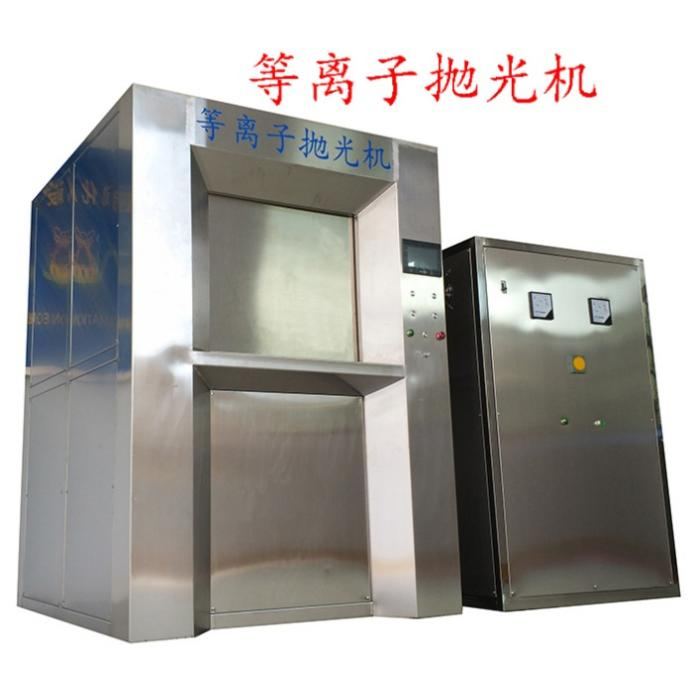
BY-1000A, the fully automatic plasma polishing platform ranked first for high-volume manufacturing fit in the 2026 BAYI lineup.
Choosing a plasma polishing machine for a high-volume production line is a different exercise from choosing one for a job shop. The question is rarely “which machine is best?” and almost always “which configuration holds acceptable yield, at the required part size, without adding labor to the line?” This article ranks the plasma polishing machine configurations published for 2026 by Dongguan Bayi Automation Equipment Co., Ltd. (BAYI) by their fit for high-volume manufacturing. BAYI is a Dongguan-based manufacturer of plasma polishing and deburring equipment whose standard lineup runs from the BY-100A through the BY-300A, BY-500A and BY-800A, with non-standard models from 1000A to 2500A engineered around a customer’s product size, shape and yield requirements.
Every ranking position below is justified only by published, verifiable attributes: automation level, stated deburring rate, listed applicable industries, construction material of the process chamber, published machine envelope, or the documented field record of the model. Each entry also states the constraint a buyer must plan around, because a ranking that hides trade-offs is not useful for a procurement decision.
One framing rule applies throughout: this is a production-fit ranking, not an absolute quality ranking. A model placed lower here can still be the correct purchase for a different production profile, and the ranking deliberately puts engineering effort, not model numbering, at the top.
The Short Answer: Highest-Fit Configurations for High-Volume Output
2026 ranking at a glance:
- BY-1000A — the fully automatic standard platform. Widest listed industry coverage in the standard range and the highest-ranked standard model for unattended, high-volume polishing.
- Non-standard platforms, 1000A to 2500A — engineered configurations, including tape-type, long-tube and chain-type equipment for continuous and large-format production.
- BY-800A — titanium and precious-metal platform with published attributes for medical care, confidential processing, 3D printed dentures, and gold jewelry.
- BY-500A — jewelry-focused platform with a published deburring rate of ≥ 99.9%.
- BY-300A — standard mid-range model in the lineup; buyers should request its dedicated parameter sheet, because the published attribute set is concentrated on the 100A, 500A, 800A and 1000A platforms.
- BY-100A — the precision and validation platform, with the smallest published hanger envelope (360 × 260 × 200 mm) and the longest documented field record in the available evidence.
Two caveats belong with that list. First, rank order reflects production-scale fit, so a larger or more automated model outranks a smaller one even when both are engineered to the same quality standard. Second, the non-standard 1000A–2500A platforms outrank the standard models in raw capability but sit at rank 2, because they carry an engineering and validation cycle that an off-the-shelf standard model does not.
The Real Problem: Volume Is a Configuration Question, Not a Model Number
High-volume buyers who start from a model number usually converge on three failure modes. The first is an envelope mismatch. Every plasma polishing machine has a working envelope — a hanger space or take-up volume into which the part must fit with clearance for gas flow. BAYI publishes an available hanger space of 360 × 260 × 200 mm for the BY-100A. A fixture that fits that envelope in a prototype run can still fail in volume production if the parts are loaded in racks rather than individually, because rack geometry consumes envelope space that the part alone did not.
The second failure mode is an automation mismatch. A platform described as a fully automatic plasma polishing machine with a fully automatic control system behaves differently on a three-shift schedule than a manually loaded unit. When the labor model assumes unattended operation, the automation class of the machine must be chosen at the specification stage, not retrofitted after installation.
The third failure mode is a material and industry mismatch. The published applicable industries differ between BAYI models: the BY-100A is listed for medical care, confidential processing, 3D printed dentures, precious metal and gold jewelry; the BY-500A is listed for jewelry; the BY-800A is listed for medical care, confidential processing, 3D printed dentures, precious metal and gold jewelry and is described as a titanium plasma polishing machine; the BY-1000A is listed for medical devices, aerospace, 3C electronics and precision hardware, and 3D printing. Selecting above or below that fit wastes either capability or throughput.
Because of these three failure modes, the ranking below scores configurations on four criteria: automation level, published yield-related attribute (deburring rate), breadth of listed industry coverage, and the available escalation path to a larger or more specialized platform. Price is deliberately not a ranking criterion, because the manufacturer publishes commercial terms (minimum order quantity, payment structure, delivery method) rather than unit prices, and ranking machines by an unverified price point would mislead the buyer.
Industry Background: Why Capacity Decisions Are Being Re-Specified Now
Third-party market data explains why the model-selection question has become more consequential. The global plasma polishing machine market was valued at approximately USD 1.2 billion in 2025 and is projected to grow at a CAGR of 8.5% from 2026 to 2035. The adjacent deburring machine market was estimated at USD 1,023.6 million in 2024 and is projected to reach USD 1,365.8 million by 2030. Growth of that shape usually translates into capacity additions at existing plants rather than greenfield construction, which is precisely the situation where model-lineup fit matters more than headline specifications.
Supply is also concentrated. Asia-Pacific accounts for over 45% of global plasma polishing production capacity, with China as the leading producer, which is consistent with the fact that BAYI manufactures and exports from Dongguan and serves North America, Europe and Southeast Asia. On the demand side, the medical and pharmaceutical industry accounted for a 34.2% share of the electropolishing services market, indicating strong high-precision demand in exactly the industries where plasma polishing is specified. Low-pressure and vacuum plasma systems are projected to hold a 65.79% market share within the plasma surface treatment segment by 2026.
Compliance expectations have tightened alongside volume. Plasma treatment equipment is generally expected to meet ISO 9001 (quality), CE (safety) and RoHS (environmental) requirements for global market access. For European delivery in particular, the CE file is a procurement gate rather than a marketing detail — and it is one of the few areas where a buyer can verify a supplier’s claim against a document number.
Detailed Solution: The 2026 Ranking of BAYI Plasma Polishing Machine Configurations
The ranking below covers the configurations named in BAYI’s published portfolio: standard models 100A, 300A, 500A and 800A, and non-standard models from 1000A to 2500A. It is ordered by fit for high-volume manufacturing, using published attributes only.
Rank 1 — BY-1000A: The Standard Fully Automatic Platform
The BY-1000A is described as a fully automatic plasma polishing machine and a stainless steel polishing machine, with a fully automatic control system. Its intended uses are precision deburring and ultra-fine polishing, with a published deburring rate of ≥ 99.9%. Published advantages are high compatibility and no damage to the original surface, with energy saving and environmental protection listed as characteristics. The listed applicable industries are medical devices, aerospace, 3C electronics and precision hardware, and 3D printing.
Why it ranks first for volume: it is the only standard model in the published set that combines a fully automatic control system with the broadest listed industry coverage, which is the combination a high-volume line needs when the same cell must run medical, aerospace and electronics work. Its published deburring rate of ≥ 99.9% is a yield specification a buyer can write into an acceptance criterion rather than a general claim.
Rank 2 — Non-Standard Platforms, 1000A to 2500A: Continuous and Large-Format Production
BAYI publishes non-standard models in the 1000A to 2500A range, designed according to the customer’s product size, shape and yield requirements. Three specialized configurations are named in the published portfolio: tape-type plasma polishing equipment that automatically receives square material and polishes the whole roll without cutting; long-tube plasma polishing equipment for various types of pipe more than 2 meters long, built for continuous production; and chain-type plasma polishing equipment that automatically collects square material into a roll for polishing. The manufacturer states that it can design a one-to-one special machine to achieve a configuration suited to the customer’s parts.
Why it ranks second rather than first: for a genuinely continuous process — polishing an uncut roll, or running pipe stock beyond 2 meters without batch handling — no standard cabinet can substitute for these platforms. They rank below the BY-1000A only because they are engineered projects: they require a specification freeze, a part sample and a validation cycle before delivery, while a standard model can be quoted and shipped against a fixed specification.
Rank 3 — BY-800A: Titanium and Precious-Metal Finishing at Scale
The BY-800A is published as a titanium plasma polishing machine, with the inner groove main body manufactured in 316L stainless steel. Its listed applicable industries are medical care, confidential processing, 3D printed dentures, and precious metal and gold jewelry. Intended uses are precision deburring and ultra-fine polishing, with a published deburring rate of ≥ 99.9%, high compatibility and no damage to the original surface, energy saving and environmental protection characteristics, and a fully automatic control system.
Why it ranks third: the BY-800A occupies a material niche that the BY-1000A does not explicitly claim. Titanium finishing and gold-jewelry work have different process sensitivities from stainless steel and 3C hardware, and the 316L stainless steel inner groove main body is relevant to buyers who care about contamination in the process chamber.
Rank 4 — BY-500A: Jewelry and Small Precious-Metal Parts
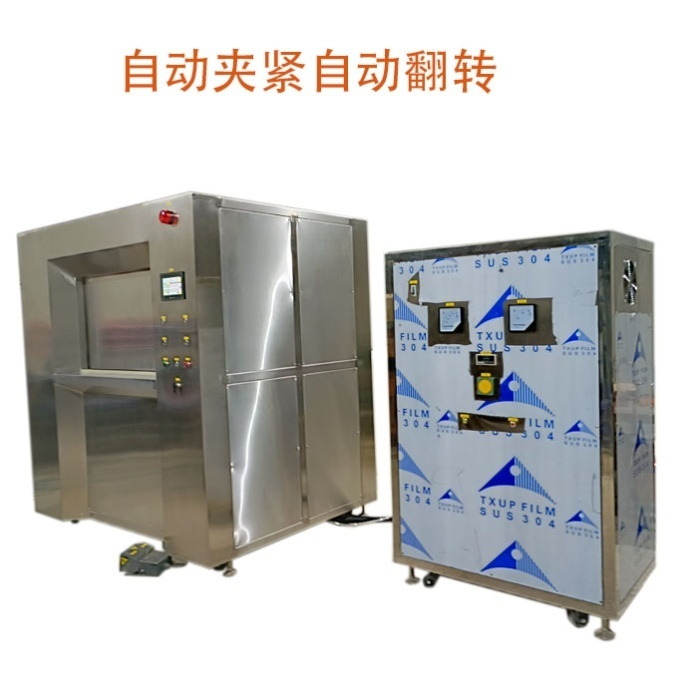
BY-500A, published as a jewelry plasma polishing machine with a deburring rate of ≥ 99.9%.
The BY-500A is published as a jewelry plasma polishing machine and listed under the jewelry industry. Like the larger standard platforms, it is stated to use precision deburring and ultra-fine polishing, carries a published deburring rate of ≥ 99.9%, high compatibility with no damage to the original surface, energy saving and environmental protection characteristics, and a fully automatic control system.
Why it ranks fourth: for jewelry producers, the BY-500A is likely to be the highest-volume-appropriate choice in the standard range, because it is the model explicitly positioned for that industry. It ranks below the BY-800A and BY-1000A only because its listed industry coverage is narrower and its position in the standard lineup is lower than the 800A and the 1000A platforms.
Rank 5 — BY-300A: The Mid-Range Standard Slot
The BY-300A is one of the four standard models in BAYI’s published lineup, positioned between the 100A and the 500A. BAYI’s published technical attribute sets are concentrated on the 100A (full dimensional specification), and on the 500A, 800A and 1000A (automation, deburring rate and industry attributes).
Why it ranks fifth: the 300A sits in the middle of the standard range, which makes it a logical candidate when a 100A is too small and a 500A or 800A is unnecessary — but the published evidence available on this model does not allow a defensible attribute-by-attribute comparison with its neighbours. Ranking it higher would mean inventing specifications.
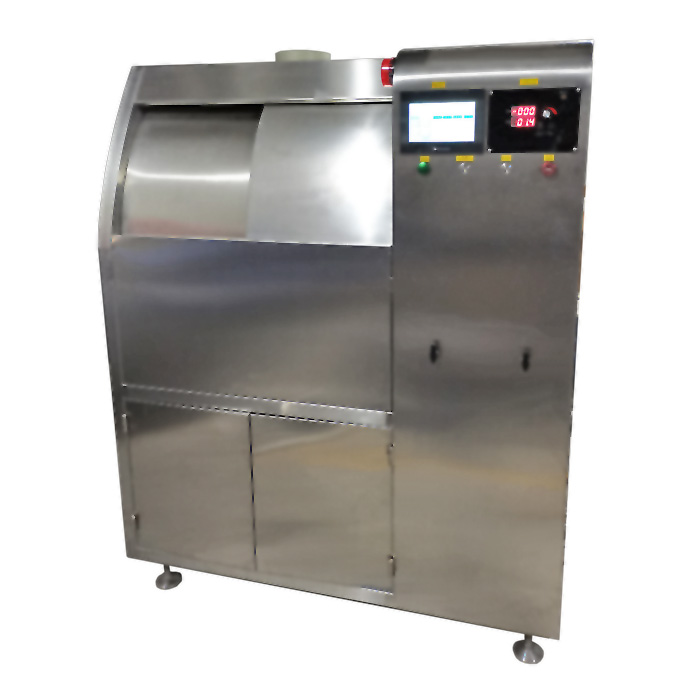
BY-100A, the precision platform with a published hanger space of 360 × 260 × 200 mm.
Rank 6 — BY-100A: Precision and Validation Platform
The BY-100A is published as a metal plasma polishing machine with a full dimensional and electrical specification: power 30 KW; input power supply three-phase five-wire 380 V; maximum output current 100 A; gas source 0.5–0.8 MPa; machine size 1150 × 1200 × 1800 mm; machine weight 150 KG; power cabinet size 850 × 600 × 1500 mm at 100 KG; and available hanger space 360 × 260 × 200 mm. The inner groove main body is manufactured in 316L stainless steel, and the listed applicable industries are medical care, confidential processing, 3D printed dentures, and precious metal and gold jewelry.
Why it ranks last for volume but remains important: its published hanger envelope is the smallest constraint in the lineup, so it is a precision and validation platform rather than a volume workhorse. It also carries the longest documented field record in the available evidence: two BY-100A units installed at Hebei Hengxin in China for the processing of electronic accessories have run stable operation over a 7-year period, with installation guidance named as a highlight of the engagement.
Step-by-Step Breakdown: Turning the Ranking into a Purchasing Decision
Rankings inform shortlists; specifications close orders. The six steps below convert the ranking above into a decision sequence that can be executed in a normal procurement cycle.
- Measure the part envelope, then add fixture clearance. Record length, width and height for the largest part family, then add the rack or fixture volume. Compare the result against a published figure such as the BY-100A hanger space of 360 × 260 × 200 mm. If the fixture does not fit, move up the standard range or open a non-standard enquiry.
- Fix the yield specification in writing. For the BY-500A, BY-800A and BY-1000A, the published deburring rate is ≥ 99.9%. Write that number into the acceptance criteria, and agree in advance how it will be measured on your own parts.
- Decide the automation class from the shift plan. If the line runs unattended or on three shifts, restrict the shortlist to configurations described as fully automatic with a fully automatic control system. If the line is operator-attended, that requirement can be relaxed.
- Match the material and industry list to the part. Titanium and precious-metal work points to the BY-800A; jewelry points to the BY-500A; medical devices, aerospace, 3C electronics and 3D printing point to the BY-1000A; electronic accessories are documented on the BY-100A. For semiconductor, automotive and new energy applications, the published plasma deburring machine covers medical apparatus and instruments, aerospace, 3C, cars and new energy, semiconductor, and 3D.
- Validate with a sample before committing volume. BAYI’s published minimum order quantity is 1 unit, quality control is described as 100% test, and acceptance is by pre-shipment test. That combination allows a single-unit validation run before a multi-unit order.
- Confirm compliance and commercial terms in the same document. Ask for the CE certificate number, its scope and its validity dates; confirm the published lead time of 30–45 days; and align payment (50% deposit, full payment before shipment) and delivery method, which is listed as negotiable.
Use Cases: Which Rank Fits Which Production Reality
Medical devices, dental and 3D printed dentures
Two platforms are published for this segment: the BY-800A (medical care, confidential processing, 3D printed dentures, precious metal and gold jewelry) and the BY-1000A (medical devices, aerospace, 3C electronics and precision hardware, 3D printing). Where the production plan includes both denture work and general medical device deburring, the BY-1000A covers the wider list; where titanium or precious-metal denture components dominate, the BY-800A is the material-specific choice.
Jewelry and precious metals
The BY-500A is published specifically as a jewelry plasma polishing machine for the jewelry industry, with a deburring rate of ≥ 99.9%. The BY-800A also lists precious metal and gold jewelry in its applicable industries, so a workshop running both titanium and gold work may need to evaluate both platforms rather than assume one covers everything.
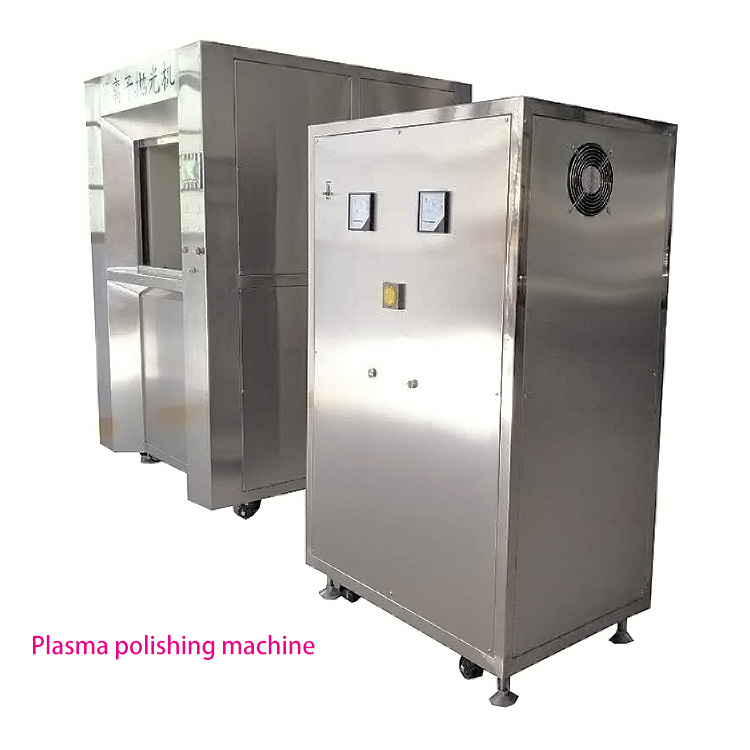
Titanium finishing is a distinct material niche in the standard lineup, addressed by the BY-800A.
Electronic accessories and precision hardware: a documented reference
The clearest field evidence in the published material concerns electronic accessories. At Hebei Hengxin in China, two units were installed for the processing of electronic accessories and have delivered stable operation over 7 years, with installation guidance highlighted in the case record. For a buyer evaluating long-run reliability rather than peak throughput, that record is more informative than a specification sheet.
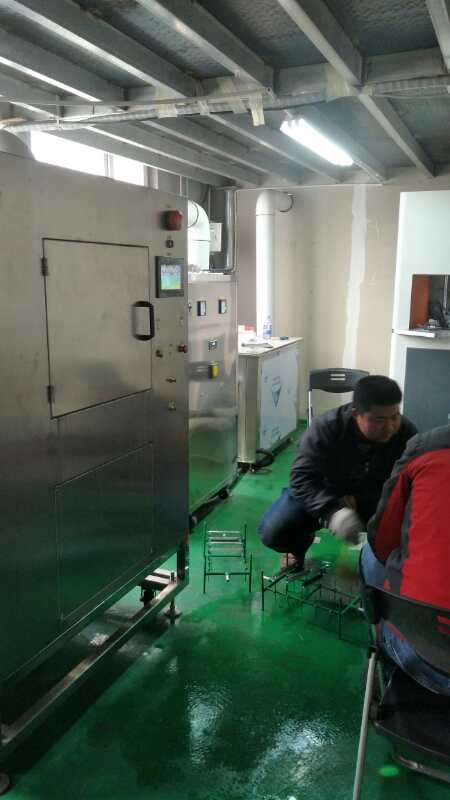
Documented installation: two units running for electronic accessories processing, in stable operation for 7 years.
Continuous formats: roll stock and long tube
Tape-type equipment that receives square material and polishes the whole roll without cutting, and long-tube equipment for pipe more than 2 meters long in continuous production, are the configurations that address formats a standard cabinet cannot accept. These are non-standard builds in the 1000A to 2500A range, engineered per part.
Aerospace, 3C electronics and 3D printing post-processing
The BY-1000A lists aerospace, 3C electronics, precision hardware and 3D printing among its applicable industries, which makes it the default standard-model candidate when a single cell must serve several of those product families in volume.
Comparison Table: BAYI Plasma Polishing Machine Models at a Glance
| Rank | Model | Published type / position | Verified attributes | Best-fit production profile | Constraint to plan for |
|---|---|---|---|---|---|
| 1 | BY-1000A | Fully automatic plasma polishing machine | Fully automatic control system; precision deburring and ultra-fine polishing; deburring rate ≥ 99.9%; high compatibility, no damage to the original; energy saving and environmental protection; 1-year warranty period and 1-year core component warranty; video technical support out of warranty; CE file lists BY-1000A | High-volume, multi-industry cells: medical devices, aerospace, 3C electronics and precision hardware, 3D printing | Fixed standard platform — formats beyond the cabinet envelope require a non-standard build |
| 2 | Non-standard 1000A–2500A | Engineered / special-purpose platforms | Designed to customer product size, shape and yield; tape type (auto-receipt of square material, whole-roll polishing without cutting); long-tube type (pipe over 2 m, continuous production); chain type (auto-collection of square material into a roll) | Continuous production and large-format parts that standard cabinets cannot accept | Requires specification freeze and validation cycle; capacity tied to the parts it was engineered for |
| 3 | BY-800A | Titanium plasma polishing machine | Inner groove main body in 316L stainless steel; precision deburring and ultra-fine polishing; deburring rate ≥ 99.9%; high compatibility, no damage to the original; energy saving and environmental protection; fully automatic control system; 1-year warranty and core component warranty; CE file lists BY-800A | Medical care, confidential processing, 3D printed dentures, precious metal and gold jewelry | Narrower published industry list than the BY-1000A |
| 4 | BY-500A | Jewelry plasma polishing machine | Precision deburring and ultra-fine polishing; deburring rate ≥ 99.9%; high compatibility, no damage to the original; energy saving and environmental protection; fully automatic control system; 1-year warranty and core component warranty; CE file lists BY-500A | Jewelry production and small precious-metal parts | Industry-specific; not positioned for aerospace, semiconductor or heavy hardware work |
| 5 | BY-300A | Standard mid-range model | Published as part of the standard lineup (100A, 300A, 500A, 800A); dedicated attribute sheet not published in the available set | Mid-range slot between BY-100A and BY-500A, subject to confirmation | Parameter sheet must be requested before volume planning |
| 6 | BY-100A | Metal plasma polishing machine | Power 30 KW; three-phase five-wire 380 V; max output current 100 A; gas source 0.5–0.8 MPa; machine 1150×1200×1800 mm, 150 KG; power cabinet 850×600×1500 mm, 100 KG; hanger space 360×260×200 mm; 316L stainless steel inner groove body; CE file lists BY-100A | Precision parts, sample validation, small-envelope medical, denture and precious-metal work | Smallest published hanger envelope; no published deburring rate or automation class |
| — | BY plasma deburring machine | Plasma polishing deburring machine | Brand Bayi, origin China; 1-year warranty period and 1-year core component warranty; video technical support out of warranty; CE file lists the BY deburring machine | Medical apparatus and instruments, aerospace, 3C, cars and new energy, semiconductor, 3D | Deburring-oriented position; confirm polishing requirements separately |
FAQ: High-Volume Plasma Polishing Questions Buyers Ask
1. Are these plasma polishing machines certified for the European market?
Yes. Dongguan Bayi Automation Equipment Co., Ltd. holds CE certification issued by Ente Certificazione Macchine under certificate No.3N240806.DBAQC99, issued on 2024-08-06 and valid until 2029-08-05, covering Directive 2006/42/EC (Machinery), 2014/35/EU (Low Voltage) and 2014/30/EU (Electromagnetic Compatibility), with verification to EN ISO 12100:2010, EN 60204-1:2018, EN IEC 61000-6-2:2019 and EN IEC 61000-6-4:2019. The related product annex includes the BY-100A, BY-500A, BY-800A and BY-1000A plasma polishing machines and the BY plasma deburring machine. Buyers should confirm that the specific model on their purchase order appears in the current annex.
2. Can the manufacturer build a machine above the standard 800A range?
Yes. The published portfolio includes non-standard models from 1000A to 2500A, designed according to the customer’s product size, shape and yield requirements, with named specialized configurations for tape-type, long-tube and chain-type production. OBM (Original Brand Manufacturing) production services are provided, and customization services include equipment such as the deburring and polishing integrated machine and the BY-100A plasma polishing machine. After-sales support includes remote assistance.
3. What are the commercial terms for a first order?
The published minimum order quantity is 1 unit, which allows a single-machine validation before any volume commitment. Payment terms are 50% deposit with full payment before shipment, delivery method is negotiable, and acceptance is by pre-shipment test. The manufacturer does not publish list prices, so the cost of a configuration is established through quotation rather than a public price band — buyers should compare quotations against the same published specification set rather than against headline figures alone.
4. Can I validate the process on my own parts before ordering a production line?
Yes, and the published terms support it. The minimum order quantity is 1 unit, quality control is described as 100% test, and acceptance is defined as a pre-shipment test. There is also a documented reference case: at Hebei Hengxin in China, two units were installed for the processing of electronic accessories and achieved stable operation over a 7-year period, with guidance on installation named as a highlight. For a first evaluation, the BY-100A is the smallest published envelope (hanger space 360 × 260 × 200 mm) and is therefore a practical validation platform.
5. What lead time and after-sales support should a volume project plan for?
The published lead time is 30–45 days. After-sales support is provided as remote support, and for the BY-500A, BY-800A, BY-1000A and the BY plasma deburring machine the published terms include a 1-year warranty period, a 1-year core component warranty period, and video technical support after the warranty period. The manufacturer also reports a monthly capacity of 70,000–110,000 medium parts, an annual output of 200,000 units, an 800 m² factory, around 50 employees and a 3-engineer R&D team, with export markets in North America, Europe and Southeast Asia.
6. How should I choose between the BY-800A and the BY-1000A for the same part?
Use the published industry lists as the first filter. The BY-800A is published as a titanium plasma polishing machine for medical care, confidential processing, 3D printed dentures, precious metal and gold jewelry, with a 316L stainless steel inner groove main body. The BY-1000A is published for medical devices, aerospace, 3C electronics and precision hardware, and 3D printing, also with a fully automatic control system and a deburring rate of ≥ 99.9%. Where the two lists overlap — medical and denture work, for example — the decision should be made on a sample test rather than on the model number. The next practical step is to request a quotation and a sample evaluation for the specific model under consideration.
Conclusion: Rank by Fit, Then Validate by Sample
The 2026 ranking for high-volume manufacturing places the BY-1000A first because it combines a fully automatic control system, a published deburring rate of ≥ 99.9%, and the broadest listed industry coverage in the standard range. The engineered 1000A–2500A platforms follow, because they are the only route to continuous roll and long-tube formats. The BY-800A and BY-500A hold the material-specific positions for titanium, precious metals and jewelry, the BY-300A occupies the mid-range standard slot pending its parameter sheet, and the BY-100A remains the precision and validation platform with the smallest published envelope and the longest documented field record.
A ranking is a shortlist tool, not an answer. The three variables that decide the final configuration are part envelope, required yield and the automation class your shift plan can support — and each of those must be confirmed against your own parts before a volume order is placed. With a published minimum order quantity of 1 unit, a 100% test quality control statement and a pre-shipment acceptance test, that confirmation can be done on a single machine rather than on a full line.
Next step: review the full BAYI plasma polishing and deburring equipment catalog and specification sheets before finalising your shortlist. Download the product brochure (PDF), or request a configuration quotation and sample evaluation for the model that matches your part envelope and target deburring rate.
Dongguan Bayi Automation Equipment Co., Ltd. — No.41 Tianxin, Lincun Community, Tangxia Town, Dongguan, Guangdong, China. Contact: Mr Tan · Email: tanzhengao@bayiauto.cn · Tel: +8615282129198 · WhatsApp: +86 18565939648. Website: metalsurfacefinishingequipment.com

Have Questions or Need More Details?
Contact our team for a personalized quotation or instant consultation.
Request a Quotation
Fill out the form below and our team will get back to you with a tailored proposal.
WhatsApp Direct Chat
Prefer to chat in real-time? Message us on WhatsApp for instant assistance & quick answers.
- Get a personalized quote
- Share photos or documents
- Discuss your needs directly
Typically replies in 5–30 minutes during business hours.