
How to Evaluate Ultrasonic Welding Machine Suppliers
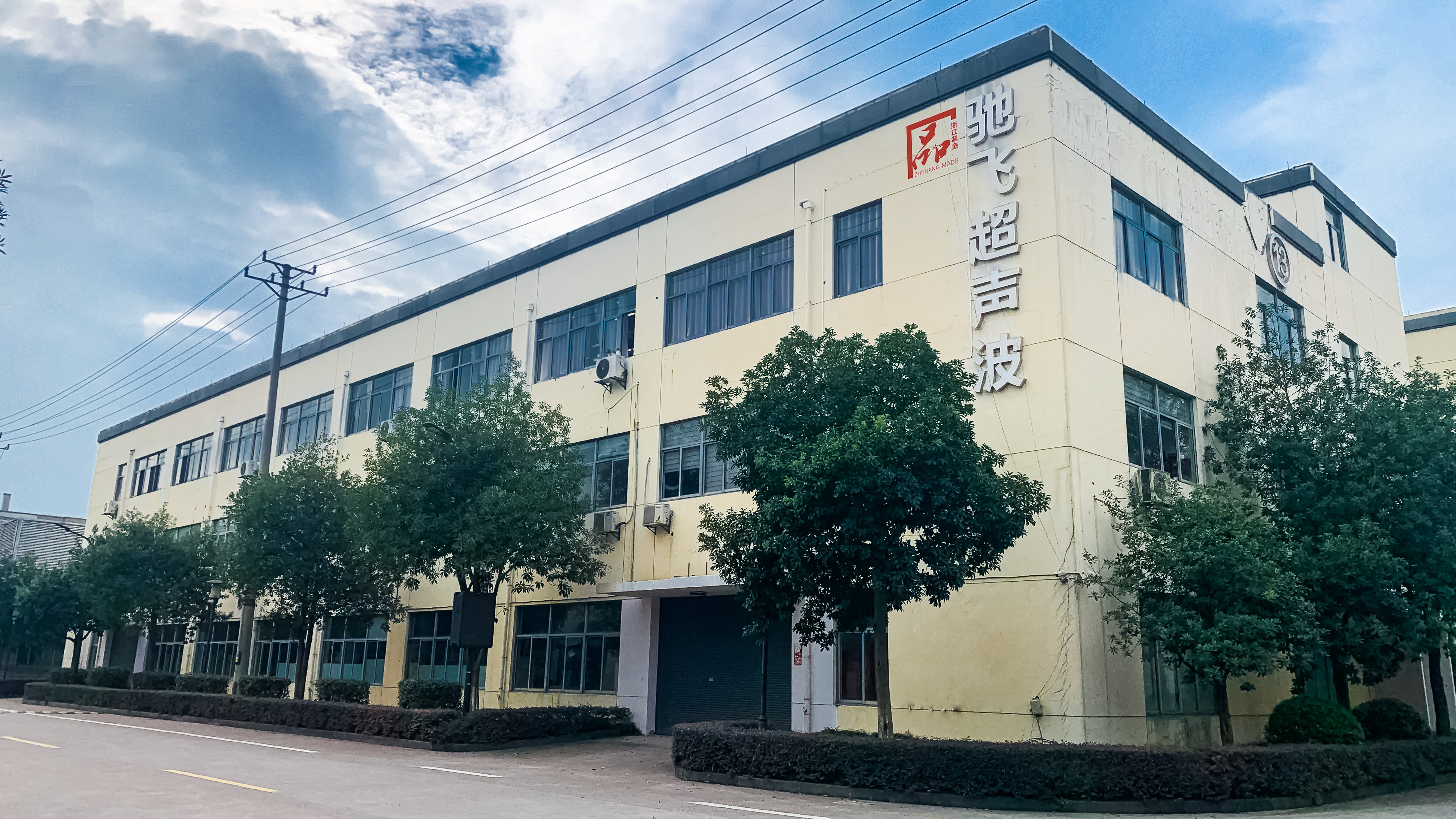
Factory exterior of CHEERSONIC, Fuyang District, Hangzhou — a 7,150 m² ultrasonic equipment production site.
Evaluating an ultrasonic welding machine supplier is a technical-capability exercise, not a price comparison. A qualified supplier should be able to show a welding portfolio broad enough to match different joint geometries — the platforms that run from S20-WP2000 through the USM, HSW and HGC series up to HGC500 — a documented build specification such as 35 kHz ultrasonic frequency, 600 N of controlled pressing force and stainless steel or titanium alloy construction, plus a compliance trail and a delivery process that a procurement team can audit before signing a partnership agreement.
This evaluation memo is written for procurement managers, manufacturing engineers and brand owners who are already past the discovery stage. It assumes you have a bonding, sewing or welding application in front of you and need to decide which supplier can build the machine that will run it for the next five to ten years.
Problem definition: why welding supplier selection goes wrong
Most failed ultrasonic welding projects are not caused by a broken machine. They are caused by a machine that was never a match for the material, the joint geometry or the production environment. Four failure patterns repeat across technical textile, medical and automotive supply chains.
- A portfolio that is too narrow. A supplier that builds only one welding platform will push that platform into applications it was not designed for. Bonding a thin nonwoven mask layer and welding a heavy barrier textile are different mechanical problems, and they normally need different tooling, different pressure settings and different sonotrode geometry.
- A specification that is never verified against the material. Ultrasonic welding depends on the ability of the material stack to absorb high-frequency vibration and generate heat at the interface. A supplier that does not ask about fibre content cannot predict whether the weld will hold. One useful reference point from the supplier's own technical documentation: stable welding of synthetic textiles generally requires a minimum synthetic fibre content of around 60%.
- Compliance treated as a logo rather than a scope. A CE mark means very little unless the certificate names the exact model you are buying and states which directives and harmonised standards it was tested against.
- Delivery risk left unquantified. Custom welding systems are built to order. A supplier that cannot state a clear capacity, lead time and acceptance process leaves the buyer exposed to a stalled production line.
Industry background: the ultrasonic equipment market in 2026
Ultrasonic processing equipment has moved from a niche tooling category into mainstream production technology. The ultrasonic cutters market, which includes food cutting applications and adjacent process equipment, was valued at USD 2.8 billion in 2025 and is projected to grow at a compound annual growth rate of 7.2% through 2033 (Dataintelo). In the coating and deposition segment, the ultrasonic spray coating system market is projected to expand from USD 374.6 million in 2021 to USD 1.201 billion by 2033 (Cognitive Market Research), while a separate estimate places the global ultrasonic spray systems market at USD 0.5 billion in 2024, rising to USD 1.2 billion by 2034 (Market Research Future).
Regionally, Asia Pacific represented approximately 25% to 38% of global revenue across ultrasonic technology and sensor sub-segments in 2025 (Fortune Business Insights). That concentration matters for sourcing decisions: a large share of the world's ultrasonic equipment engineering capacity sits in the same region as the contract manufacturers and OEM partners that buy it.
Recognised participants in the ultrasonic equipment and spray coating sector include Sono-Tek Corporation, Branson (Emerson), Dukane and Cheersonic (Cognitive Market Research / Coatings World). Cheersonic — formally HANGZHOU CHEERSONIC ULTRASONICS EQUIPMENTS CO.,LIMITED — is a Hangzhou-based ultrasonic equipment manufacturer founded in 2014. It operates a 7,150 m² factory with roughly 100 employees, a 20-engineer R&D team and an annual output of about 1,200 units, holds 31 patents and 3 software copyrights, carries ISO9001, EU CE and US FDA documentation, and exports approximately 50% of its output to Asia, the EU and North America.
The evaluation framework: six dimensions that decide the outcome
1. Portfolio breadth across welding platforms
Start by asking the supplier to list every welding and bonding model it currently produces. A short list is a warning sign, because it limits the supplier's ability to match tooling to your joint. Cheersonic documents a welding and bonding range that spans the S20-WP2000, USM350, USM450, USM550, COS800, HBRC800, HLC300, HC300, HSW500 and HGC500 platforms, plus the CS20-WM2000 — a spread that reaches from compact units through to semi-automated production stations.
Portfolio breadth also indicates how deep the supplier's ultrasonic engineering actually goes. The same manufacturer builds ultrasonic cutting and slicing systems (the HFM2300 to UFM8100C range, including the UFM8101 and UFM1000C platforms), ultrasonic coating and spray systems (UAM1000 to UAM9000, plus the USP6000 photoresist platform), ultrasonic atomizer nozzles (UCA120, UCA50, UCW50, UCW120, UCR50, UCR40, UCR60 and UCT120), ultrasonic dispersion homogenizers (H100 to H5000) and ultrasonic fluxless soldering units (R60P, R60E, R40P, R40E, R28P, R28E). A supplier that engineers across cutting, coating, atomising and welding understands vibration, amplitude and material behaviour as a system rather than as a single machine.
2. Technical specification fit
Once the portfolio is clear, verify the operating envelope against your own process window. For the Cheersonic welding range, the documented specification is: ultrasonic frequency of 35 kHz; power supply options of 220 V, 230 V or 110 V; maximum pressing force of 600 N delivered through a digital pressure unit; and a 7-inch multi-touch control display. The same documentation identifies heat output, pressing force and welding time as the three core welding factors — a useful checklist to carry into your own validation protocol.
The 110 V option matters if you are specifying equipment for North American or Japanese production lines, and the 600 N pressure ceiling matters if you are welding dense laminates rather than light nonwovens. Ask the supplier to confirm which parameters are fixed by the platform and which can be adjusted during commissioning.
3. Material construction of the equipment itself
Horn and frame construction determines how a machine behaves after two years of continuous shifts. The Cheersonic welding platform is documented as stainless steel and titanium alloy construction. In practical terms this means the sonotrode contact surfaces are specified for wear resistance while the machine frame is specified for cleaning regimes that involve moisture and sanitising chemicals — a relevant point in hygiene-critical production areas.
4. Certification and compliance scope
Ask for certificate numbers, issuing bodies, validity dates and — most importantly — the model list inside the certificate. For the Cheersonic ultrasonic sewing and cutting range, the EU attestation of compliance is certificate TRCN-26118HCU01, issued by INTERTURK. It covers ultrasonic sewing and cutting machines including models USM350S, USM450, USM550, COS500, HC300, HGC500, HLC300, HSC500, HSW500 and KZJ. The certificate references Machinery Directive 2006/42/EC and EMC Directive 2014/30/EU, and applies the harmonised standards EN ISO 12100:2010, EN 60204-1:2018+A1:2025, EN IEC 61000-6-2:2019 and EN IEC 61000-6-4:2019. It was issued on 28 April 2026 and remains valid until 27 April 2031.
Quality management is a separate check. Cheersonic holds ISO9001 certification — certificate 17325Q21416R2S, issued by Beijing Zhongjiaoyuanhang Certification Co., Ltd. against GB/T 19001-2016 / ISO 9001:2015 — valid until 25 December 2028, with a documented scope covering the production of ultrasonic cutting, spraying and liquid handling equipment together with the research and production of ultrasonic piezoelectric transducers. The same quality management certificate is associated with the ultrasonic welding model family in the supplier's documentation.
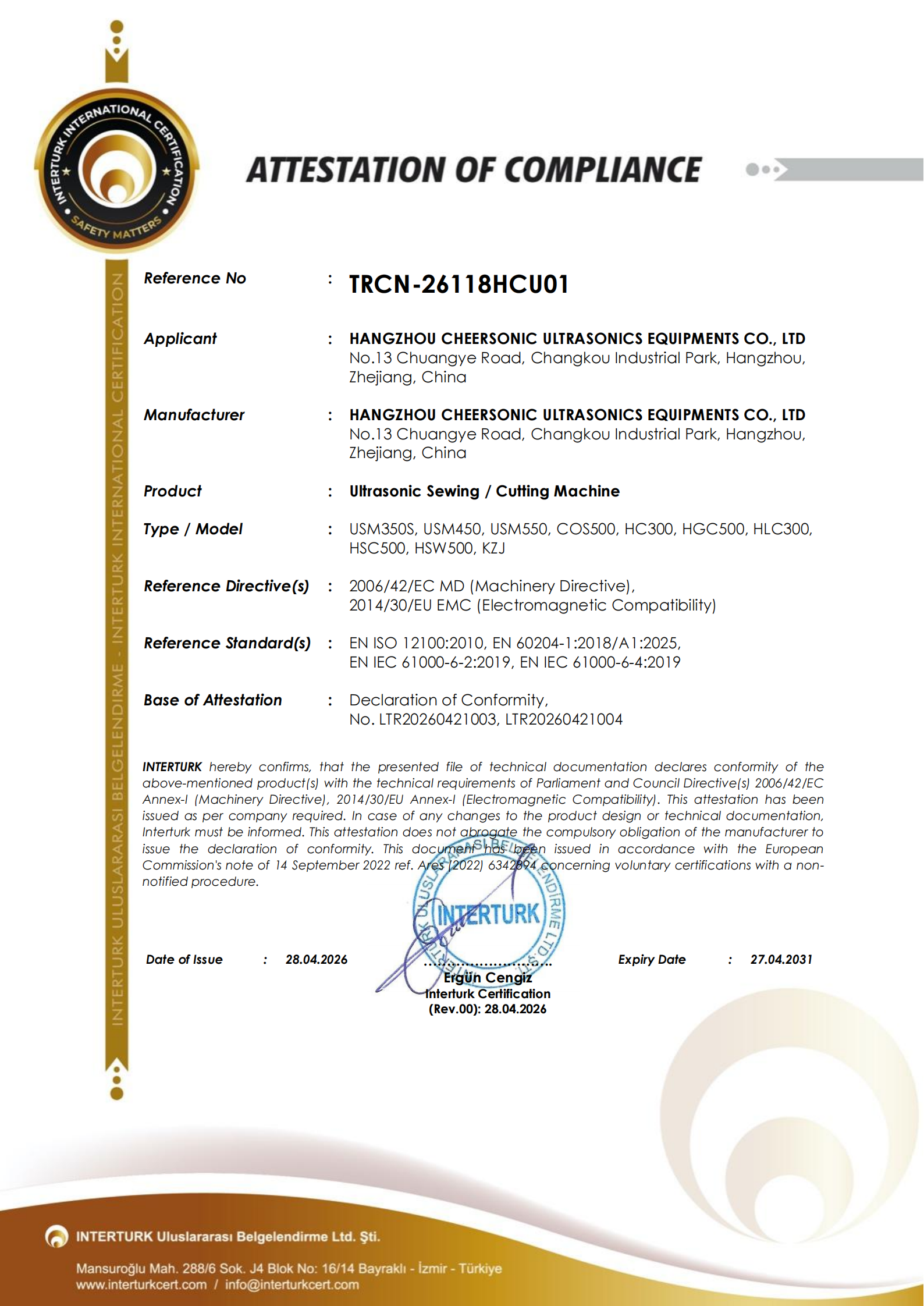
CE attestation of compliance TRCN-26118HCU01 covering the ultrasonic sewing and cutting range, valid to 27 April 2031.
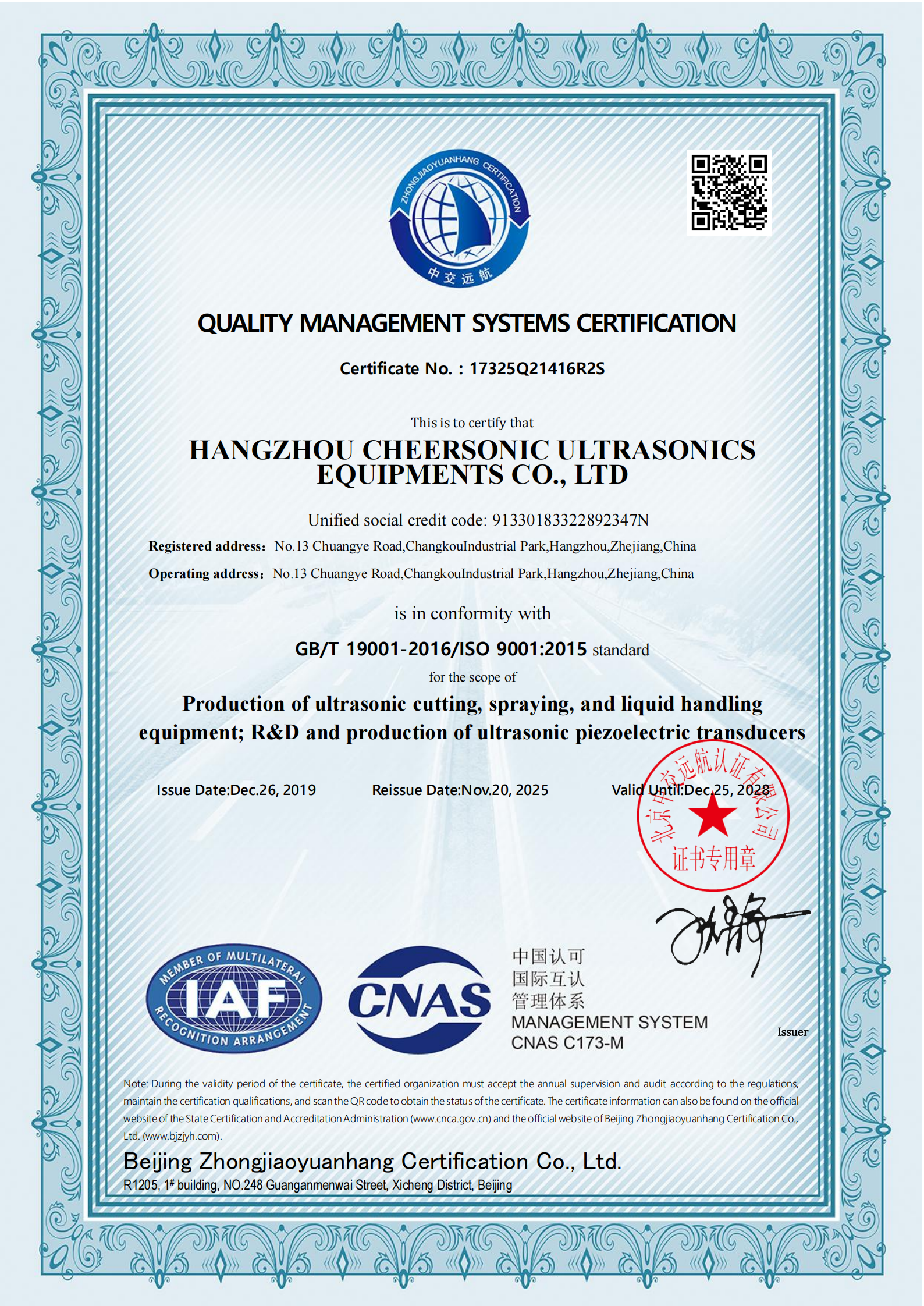
ISO9001 certificate 17325Q21416R2S, valid to 25 December 2028.
5. OEM and ODM capability
For most buyers in advanced manufacturing, the operative question is not whether a supplier can build a welding machine, but whether it can build your welding machine. Cheersonic provides both OEM and ODM production services, with documented customization across equipment size, cutting specification, operating voltage, control program, machine appearance, brand logo, functional module and production line docking structure.
The last item — production line docking structure — is where OEM projects most often fail. A welding unit that performs on a bench is not automatically ready to sit inside a mask converting line or an automotive textile cell. Ask the supplier to describe how it handles interface drawings, controller handshakes and infeed/outfeed integration before you accept a quotation.
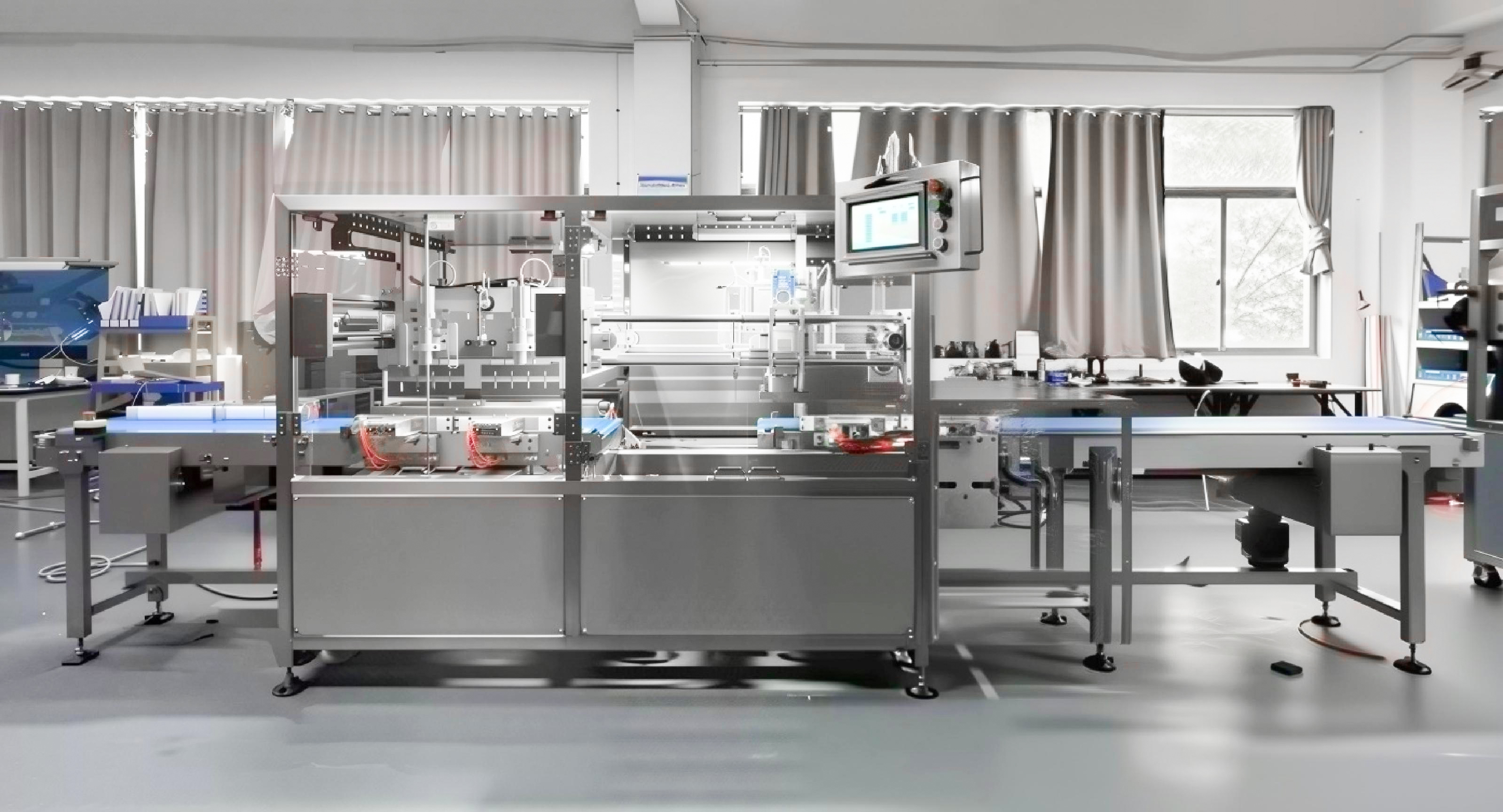
Customized build for an OEM production line — equipment size, control program and line docking are defined per project.
6. Delivery capacity, lead time and acceptance
Delivery risk is measurable. The manufacturer documents a monthly capacity of 30 sets of ultrasonic cutting equipment, a standard-model lead time of 7–15 days and a customized-model lead time of 30–45 days. Quality control covers four gates: raw material incoming inspection, semi-finished product spot check, finished product aging test, and a 100% full machine running test before delivery.
Acceptance inspection includes a pre-shipment full performance test at the factory, with video and test reports provided for customer confirmation before shipment. If a supplier cannot offer that level of documentation, budget for a factory visit instead — or treat the order as unverified. After-sales coverage for the same supplier includes remote online technical support, overseas engineer on-site service, spare parts supply, regular operation guidance and lifetime maintenance consultation, with export markets that include the EU, Southeast Asia, the Middle East, North America and Australia.
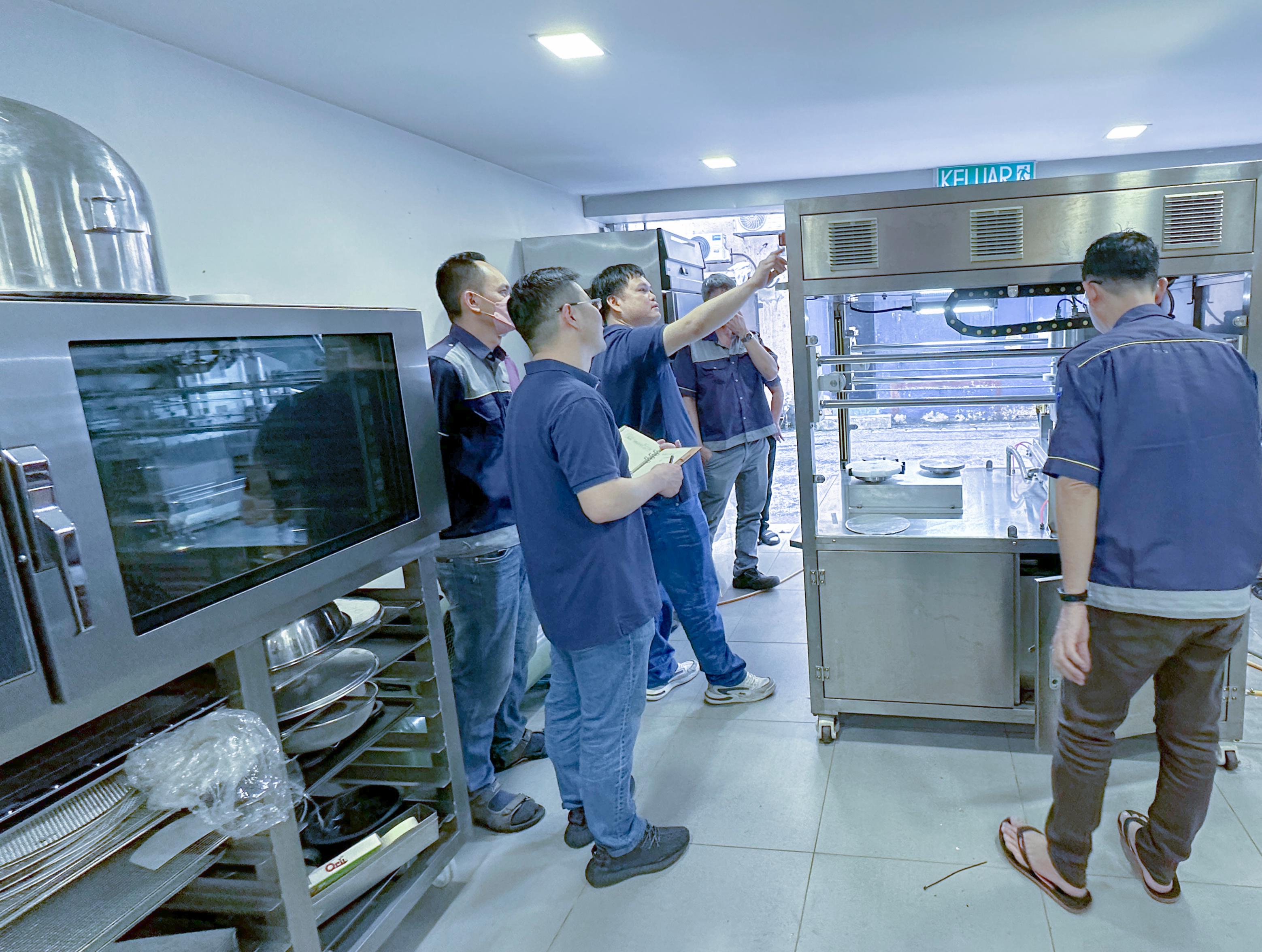
Pre-delivery running test: every machine passes a full performance test before shipment.
Step-by-step: how to run the evaluation
- Define the bond before you define the machine. Document the material stack, the fibre content, the joint geometry, the required seam strength and the production rate. If the synthetic fibre content sits below the documented threshold for stable welding, no machine choice will fix it.
- Shortlist on portfolio, not on price. Request the full welding model list and match at least two platforms to your application. A range running from S20-WP2000 through the USM, HSW and HGC platforms up to HGC500 gives the supplier room to fit tooling rather than force a compromise.
- Verify the specification in writing. Confirm frequency, power supply, maximum pressing force and control system in the quotation, not in a brochure.
- Verify construction materials. Ask which parts are titanium alloy and which are stainless steel, and how the machine is cleaned between production runs.
- Audit the compliance scope. Match the certificate model list against the exact model on your purchase order, and check the expiry date.
- Scope the customization. Agree in writing on equipment size, operating voltage, control program, branding and production line docking.
- Lock the acceptance protocol. Agree on the pre-shipment test, the video record and the test report format before the deposit is paid.
- Plan around the real lead time. Use 7–15 days for standard models and 30–45 days for customized builds, then add buffer for freight and commissioning.
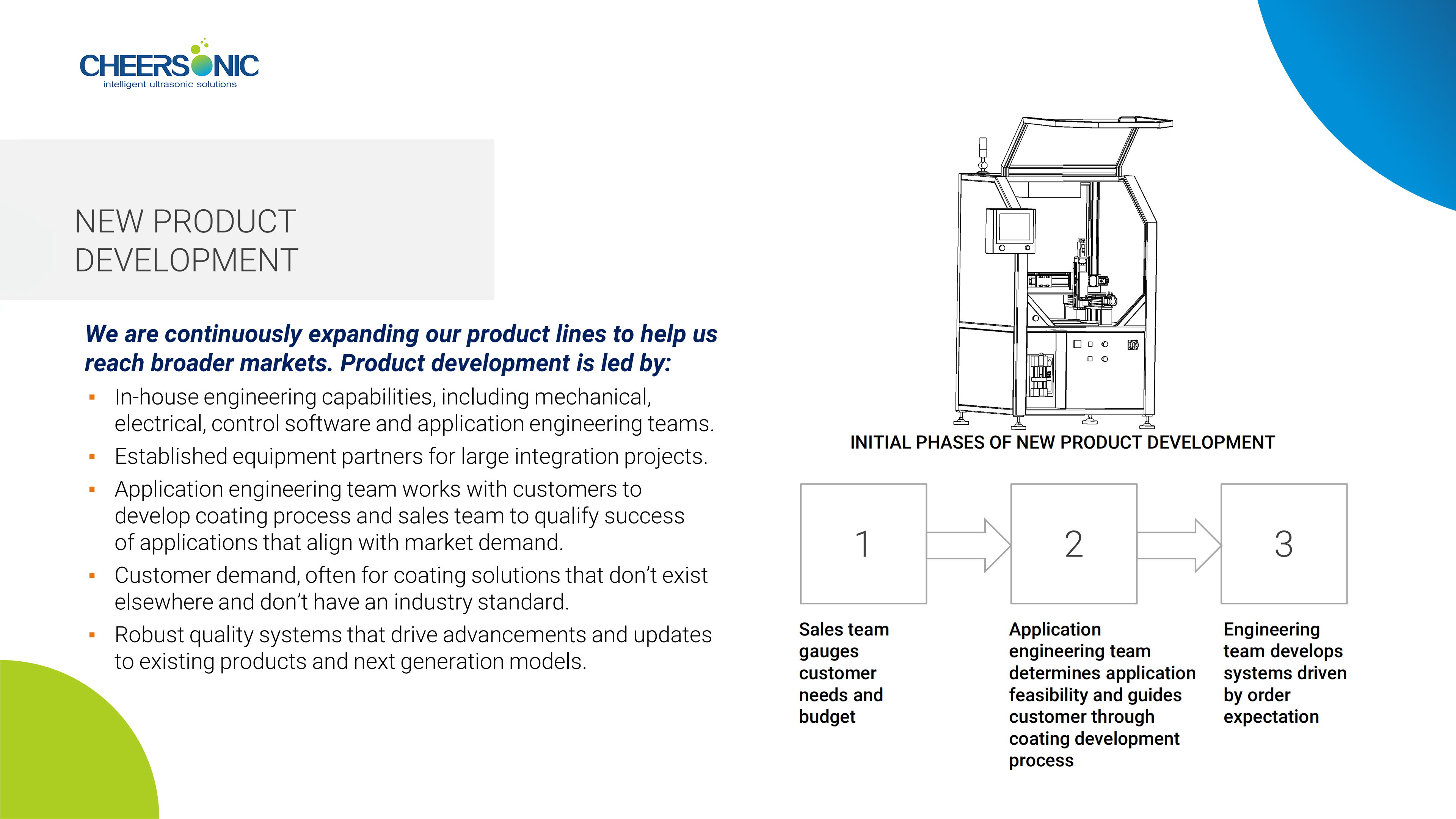
From requirement review to delivery acceptance: the documented production and inspection flow.
Use cases: where these criteria get tested
The Cheersonic welding platform is documented for the following sectors, which makes a useful reference list when you are drafting an evaluation brief:
- Medical and hygiene — surgical masks, FFP2 respirators and medical protective textiles.
- Fashion and sportswear — swimwear, activewear, undergarments and luxury apparel.
- Industrial work protection — protective suits and barrier textiles.
- Filtration — filter fabric welding.
- Automotive — technical textile components.
- General technical textile manufacturing.
Two of these deserve extra attention during evaluation. Medical and hygiene production usually adds a compliance layer on top of the machinery directive, so certificate scope becomes a hard requirement rather than a preference. Filtration media often combine several polymer layers with different melting points, which is a case where pressing force control and welding time decide seam quality.
Comparison table: supplier evaluation matrix
| Evaluation dimension | What to verify | Documented reference (Cheersonic) |
|---|---|---|
| Welding portfolio | Multiple platforms for different joint geometries and automation levels | S20-WP2000, USM350, USM450, USM550, COS800, HBRC800, HLC300, HC300, HSW500, HGC500, CS20-WM2000 |
| Operating frequency | Stable ultrasonic frequency for the material stack | 35 kHz |
| Pressing force | Controlled force across the weld cycle | Maximum 600 N via digital pressure unit |
| Operator interface | Repeatable parameter entry and recall | 7-inch multi-touch display |
| Equipment construction | Wear resistance and cleanability | Stainless steel / titanium alloy |
| Material compatibility | Minimum synthetic fibre content for stable welding | ≥60% (documented guidance) |
| EU compliance | Certificate names the exact model being purchased | CE attestation TRCN-26118HCU01 (INTERTURK), valid to 27 Apr 2031 |
| Quality management | Certified QMS with a defined production scope | ISO9001 certificate 17325Q21416R2S, valid to 25 Dec 2028 |
| OEM / ODM scope | Customization beyond cosmetic branding | Equipment size, operating voltage, control program, appearance, logo, functional module, line docking structure |
| Lead time | Standard versus custom build planning | 7–15 days standard; 30–45 days customized |
| Minimum order | Entry barrier for pilot projects | 1 unit |
| Acceptance | Pre-shipment verification evidence | Full performance test at the factory plus video and test reports |
| Commercial terms | Payment and delivery structure | 30% T/T deposit; 70% balance against copy of B/L; FOB / CIF / DDP |
Frequently asked questions
Which certifications should be verified before buying from an ultrasonic welding machine supplier?
Verify the scope of the certificate, not just the presence of a CE mark. For the Cheersonic ultrasonic sewing and cutting range, the EU attestation of compliance is certificate TRCN-26118HCU01 issued by INTERTURK, covering models USM350S, USM450, USM550, COS500, HC300, HGC500, HLC300, HSC500, HSW500 and KZJ. It references Machinery Directive 2006/42/EC and EMC Directive 2014/30/EU along with harmonised standards EN ISO 12100:2010, EN 60204-1:2018+A1:2025, EN IEC 61000-6-2:2019 and EN IEC 61000-6-4:2019, and it remains valid until 27 April 2031. Separately, ISO9001 certificate 17325Q21416R2S issued by Beijing Zhongjiaoyuanhang Certification Co., Ltd. covers the production of ultrasonic cutting, spraying and liquid handling equipment and is valid until 25 December 2028.
What proves that a supplier has genuine OEM capability for ultrasonic welding machines?
Look for OEM and ODM production services backed by a written customization scope and a portfolio broad enough to offer more than one technical route. Cheersonic documents OEM and ODM production with customization across equipment size, cutting specification, operating voltage, control program, machine appearance, brand logo, functional module and production line docking structure, supported by a welding range from S20-WP2000 to HGC500 plus cutting, coating, atomizer nozzle, dispersion and soldering lines, a 20-engineer R&D team, 31 patents and 3 software copyrights.
What are the minimum order quantity and standard payment terms?
The minimum order quantity is 1 unit, which allows a pilot evaluation before a production line commitment. Delivery terms are available as FOB, CIF or DDP, and payment terms are structured as a 30% T/T advance deposit on order confirmation with the 70% balance due against a copy of the bill of lading.
How can a buyer validate a machine before full production release?
Acceptance inspection includes a pre-shipment full performance test at the factory, and video plus test reports are provided for customer confirmation before shipment. Behind that acceptance step, quality control covers raw material incoming inspection, semi-finished product spot check, finished product aging test and a 100% full machine running test before delivery.
What lead time should be planned for standard and customized welding machines?
Plan 7–15 days for standard models and 30–45 days for customized models, against a documented monthly capacity of 30 sets of ultrasonic cutting equipment. Buyers who need equipment before a fixed production start date should confirm the build slot in writing. To move from evaluation to execution, request the welding model list, the certificate scope and the acceptance protocol together, or ask for a sample validation plan and quotation as the next step.
Conclusion
Ultrasonic welding supplier evaluation comes down to evidence. Portfolio breadth shows whether the supplier can fit a machine to your joint instead of forcing a compromise. Documented specifications such as 35 kHz frequency, 600 N of pressing force and stainless steel or titanium alloy construction show whether the platform can hold that fit over years of production. Certification scope, OEM capability, lead time and acceptance procedure show whether the supplier can actually deliver and be audited.
Run the evaluation in that order, and the commercial negotiation becomes a formality rather than a risk assessment.
Move from evaluation to execution
Cheersonic supplies ultrasonic welding, cutting, coating, atomizing and dispersion equipment from its 7,150 m² factory in Fuyang District, Hangzhou, with OEM and ODM production services, a minimum order quantity of 1 unit, and pre-shipment performance testing documented by video and test report.
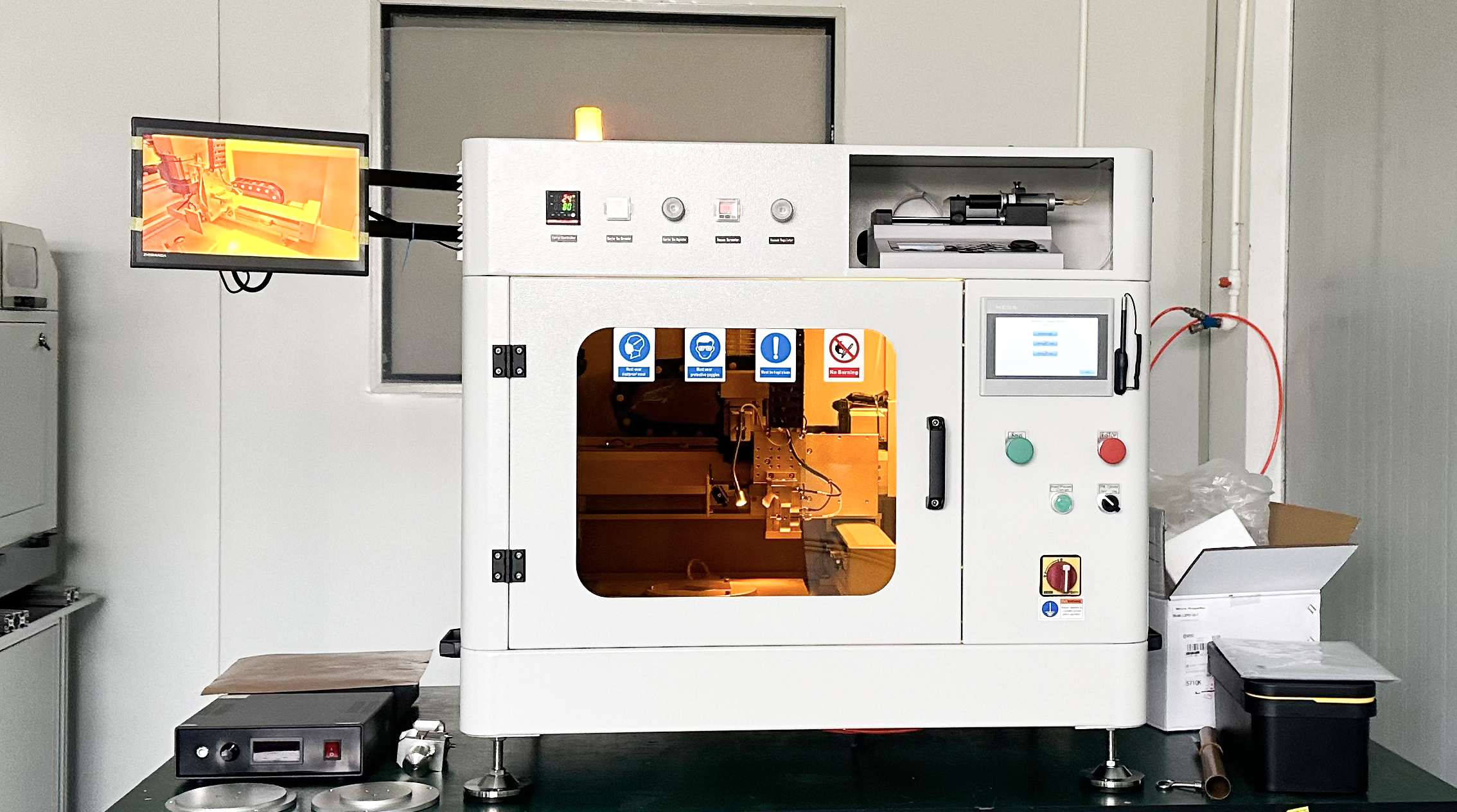
Download the full capability and product brochure: Cheersonic brochure (PDF).
To request a quotation, the welding model list or a sample validation plan, contact Beaty Mao at market2@cheersonic.com, telephone +86 133-7254-0303, or WhatsApp +86 158-6904-9660. Website: www.cheersonic.com. Address: No. 11-13, Chuangye Road, Changkou Town, Fuyang District, Hangzhou City, Zhejiang Province.