
Ultrasonic Fluxless Soldering: How 20–60 kHz Cavitation Works
Most people meet ultrasound inside an ultrasonic machine that slices cake or cleans a machined part. Fluxless soldering looks like a completely different technology, but it runs on the same physics at a different interface: vibration at 20–60 kHz is delivered into molten solder rather than into a blade, a nozzle or a cleaning bath.
Ultrasonic fluxless soldering joins metals without chemical flux by using high-frequency vibration to create cavitation in the molten solder. The collapsing cavities disrupt and disperse the oxide film on the base metal, so the solder wets the surface directly instead of waiting for a chemical agent to clean it. In the soldering range supplied by Cheersonic, that happens across 20–60 kHz, at process temperatures of 115–450 °C, on aluminum, ceramic, glass, graphite and dissimilar metal combinations, with no pre-plating and no post-bond cleaning step.
This guide explains the mechanism from first principles, maps the working envelope and the six model designations, and ends with the production situations where the approach earns its place over conventional flux soldering.
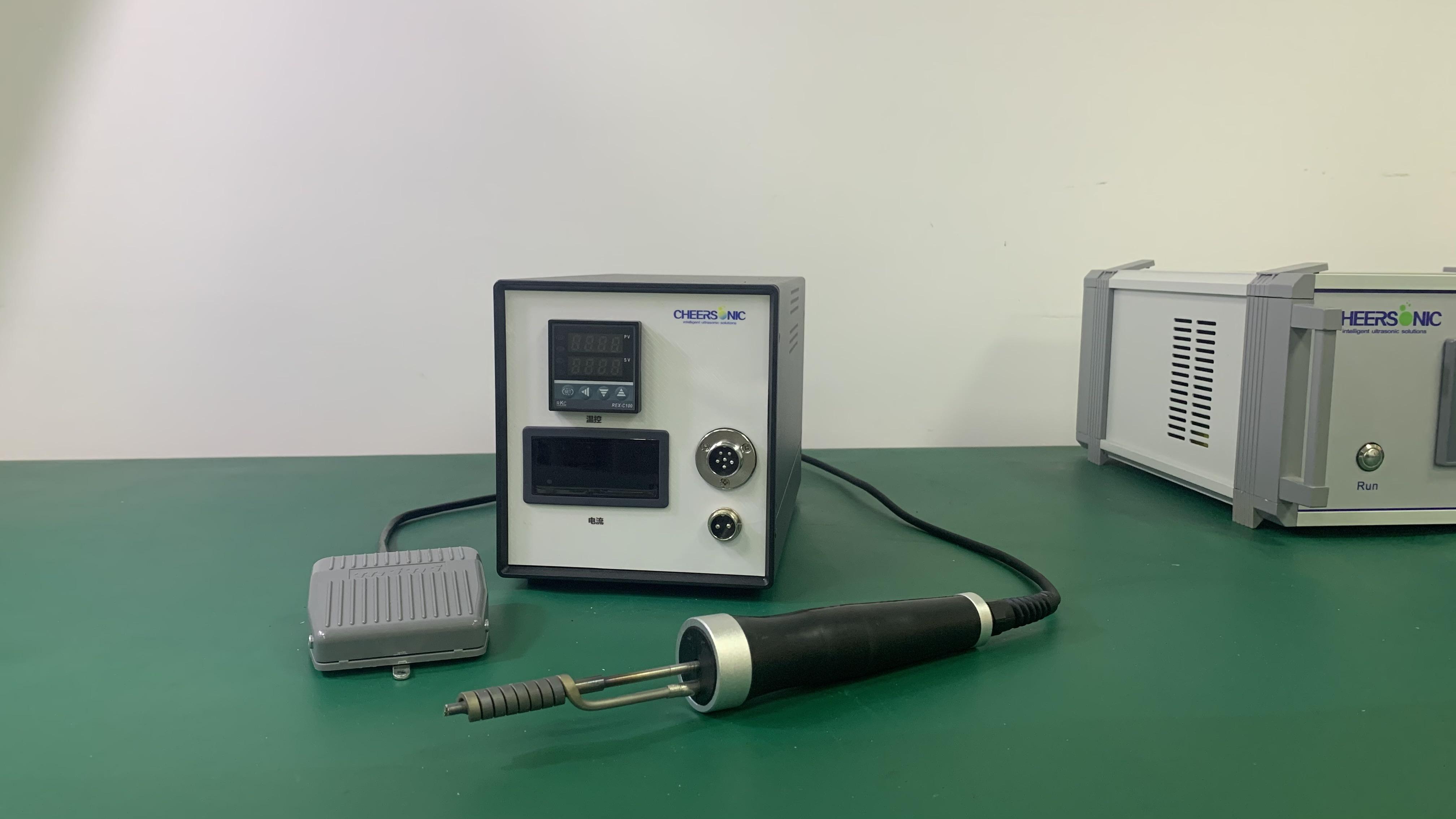
Why soldering normally needs flux — and what that requirement costs
Flux exists because most metals are already oxidized long before a soldering iron touches them. Its job is twofold: chemically reduce the oxide during heating, and shield the freshly exposed metal from re-oxidizing while the solder wets and solidifies. On tin-plated copper boards, that chemistry is mature, predictable and hard to argue with.
The cost appears after the joint is made. Flux residue has to be removed wherever contamination matters — sealed modules, evacuated assemblies, medical devices and semiconductor hardware. Residue can sit under components and around joint fillets where inspection is difficult, and the cleaning step itself adds handling, chemistry control and a new route for variability. There is also a material problem that no amount of process discipline fixes: aluminum forms a stable oxide that conventional flux chemistries struggle to displace, ceramics and glass wet poorly with standard alloys, and dissimilar pairs such as copper-to-aluminum or ceramic-to-metal combine a wetting problem with a thermal-expansion problem in the same joint.
Fluxless ultrasonic soldering attacks the oxide directly at the interface rather than in the chemistry. That single change is what shifts aluminum, ceramic, glass, graphite and mixed-metal joints from difficult to routine.
Where fluxless soldering sits in the ultrasonic landscape
Buyers usually arrive at ultrasonic equipment through one of three families: cutting and slicing, spray coating and atomization, and joining. The joining family is the smallest and least familiar, even though it is produced by the same kind of manufacturer and often by the same supplier.
One distinction is worth making early because it inverts the objective. Ultrasonic spray fluxing uses an ultrasonic nozzle to atomize flux into a fine, controlled deposit — here ultrasound helps apply flux. Ultrasonic fluxless soldering uses ultrasound to remove flux from the process entirely. It is the same physics family at a different frequency band and with the opposite goal, which is why a coating or cutting background does not transfer directly.
Cheersonic (Hangzhou Cheersonic Ultrasonics Equipments Co., Limited) is an ultrasonic equipment manufacturer founded in 2014 in Fuyang District, Hangzhou, whose product lines cover ultrasonic cutting, ultrasonic spray coating and ultrasonic soldering systems; its soldering range is documented on the Cheersonic official website. The company holds 31 patents and 3 software copyrights, and has obtained certifications including ISO 9001, EU CE and US FDA.
How cavitation removes the need for flux
Cavitation is the whole mechanism, and it happens in the solder rather than at the tool.
A piezoelectric transducer converts an electrical drive signal into mechanical vibration. The horn, tip or solder-pot wall then transmits that vibration into the molten alloy at 20–60 kHz, so the pressure inside the liquid oscillates at the same rate. Where local pressure falls far enough, the solder cavitates: microscopic cavities form, grow, and then collapse.
Collapse near a substrate is not gentle. It concentrates energy at the metal-to-solder interface, fracturing and dispersing the oxide layer and continuously exposing fresh base metal to fresh alloy. Wetting then proceeds as a metallurgical bond rather than as a physical coating, which is exactly what the Cheersonic soldering specification means when it lists oxide layer removal via ultrasonic cavitation alongside fluxless metallurgical bonding of dissimilar materials.
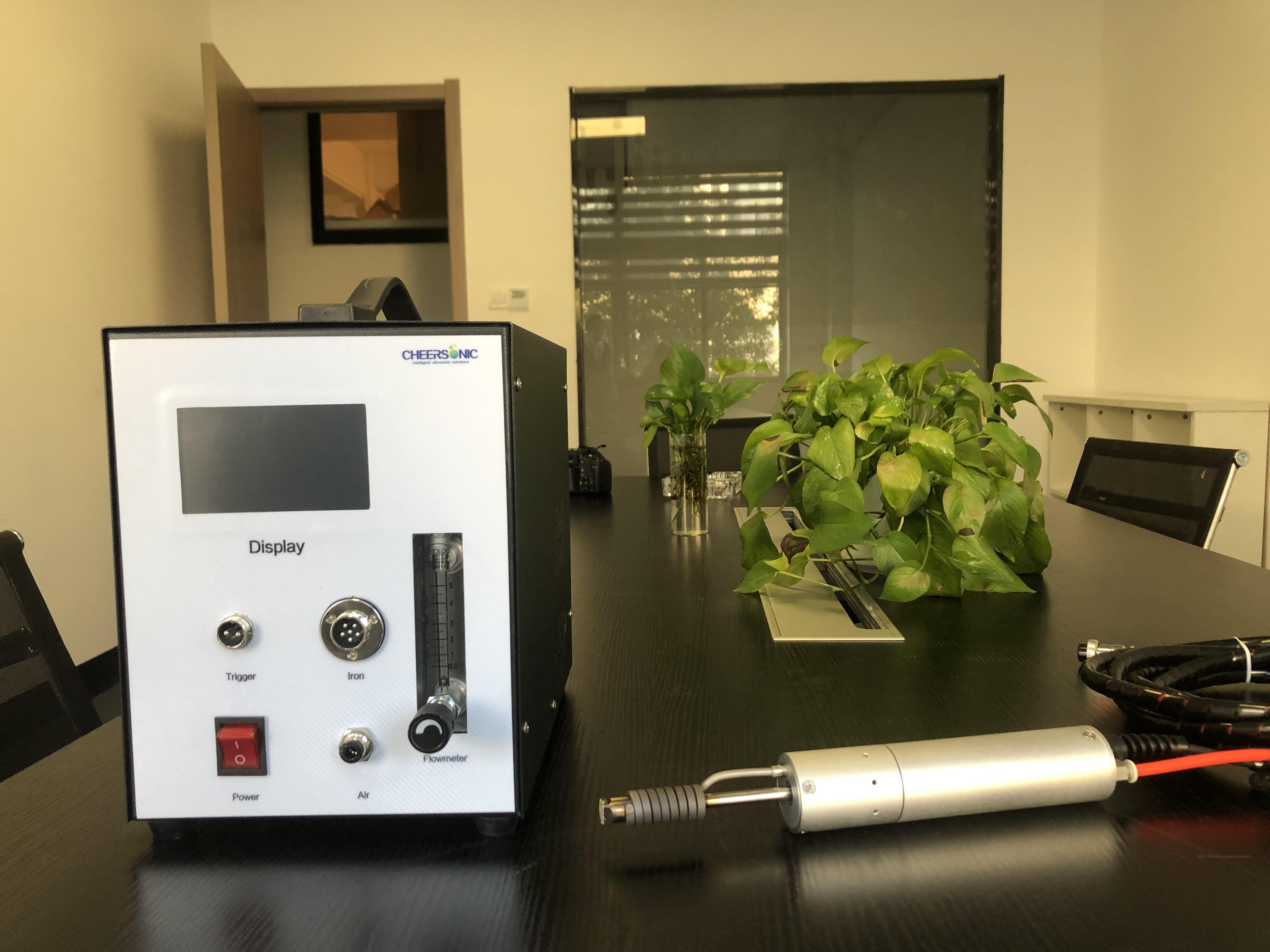
Three production consequences follow directly:
- No chemical oxide removal. Because the oxide is dealt with mechanically at the interface, the process is described as flux-free and lead-free.
- No residue, therefore no cleaning. The specification lists ultra-low joint contamination and a post-bond cleaning-free process. In vacuum, plasma or cleanroom equipment this matters more than speed: there is no flux to outgas or to leave ionic residue behind.
- No pre-plating step. Bonding works directly on aluminum, ceramics, glass, graphite and dissimilar metals, which removes a plating or pretreatment stage from the routing.
The boundary condition is physical rather than commercial: the vibration must reach the joint with enough energy to cavitate the alloy in contact with the surface, and the parts must tolerate the process temperature. Both are configuration questions rather than universal limits, which is why frequency and temperature are matched per application.
The working envelope: 20–60 kHz, 115–450 °C and six model designations
The envelope is best read as four decisions: frequency, temperature, material pair and equipment form.
Ultrasonic frequency is specified at 20–60 kHz. In the Cheersonic soldering range the six designations pair a P and an E variant at each of three frequency steps: R60P and R60E, R40P and R40E, R28P and R28E. Treat the designation as the identifier for a configuration; power rating and tool construction are specific to the model, so confirm them on the datasheet for the exact designation you intend to specify rather than assuming one figure covers all six.
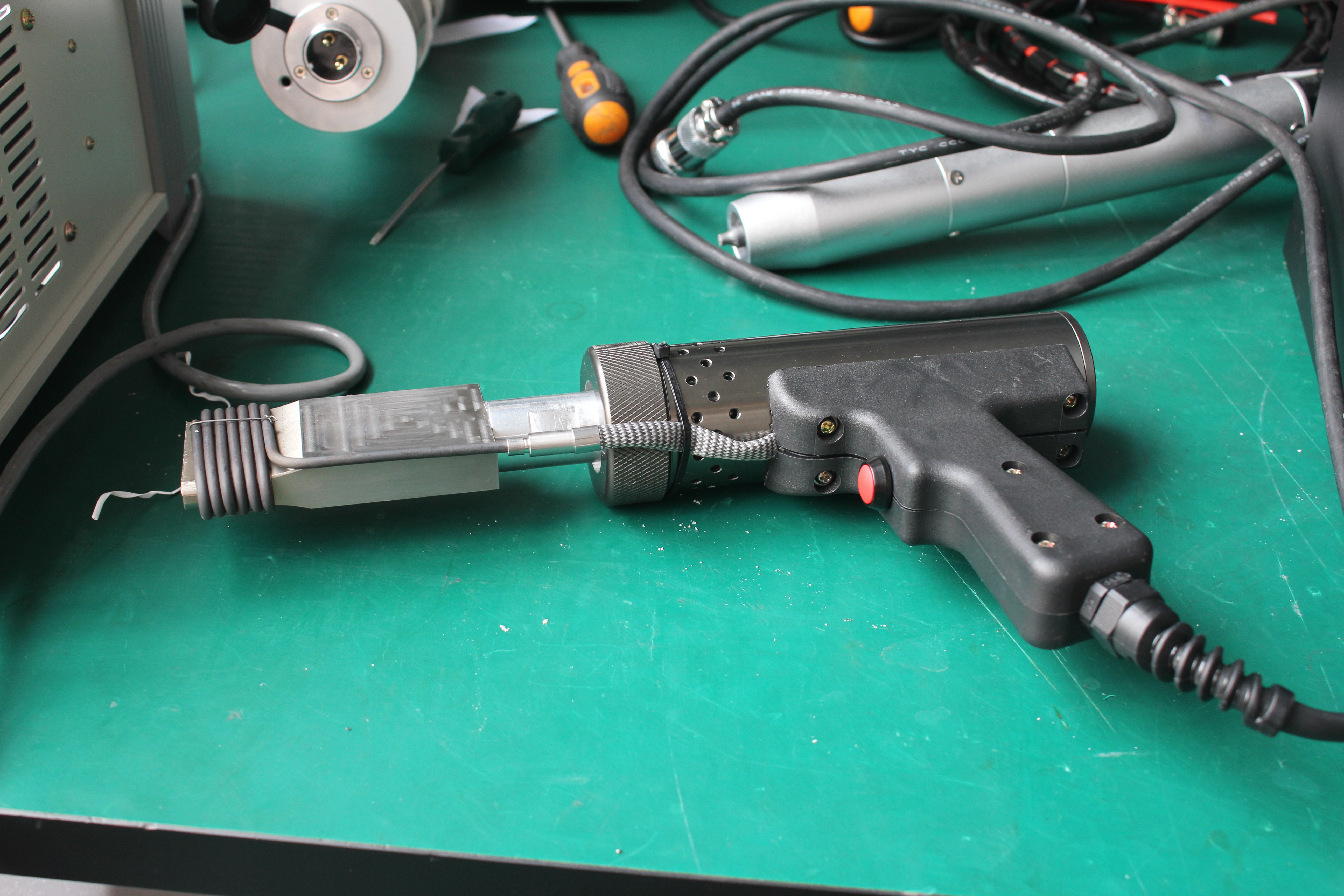
| Parameter | Supported range or option | What it changes at the joint |
|---|---|---|
| Ultrasonic frequency | 20–60 kHz, expressed through three designations (60, 40, 28), each in a P and an E variant | Sets the cavitation behaviour in the molten alloy and the hardware the process is built into |
| Process temperature | 115–450 °C | Allows heat-sensitive parts to be joined at the low end while higher-melting combinations stay possible |
| Base materials | Aluminum, ceramic, glass, graphite, copper, silicon, hard alloys and dissimilar combinations | Determines whether a flux chemistry would have been needed at all |
| Atmosphere | Vacuum, inert gas or atmospheric | Vacuum-tight and hermetic seals are produced in a controlled atmosphere |
| Flux and residue | Flux-free, lead-free, no pre-plating pretreatment, cleaning-free after bonding | Removes flux application, pre-plating and post-bond cleaning from the route |
| Joint requirements | Hermetic sealing, vacuum-tight sealing, low porosity, low thermal stress on sensitive parts | Defines the acceptance test the process has to pass, not just the bond itself |
| Equipment forms | Ultrasonic soldering iron system, ultrasonic solder pot, piezoelectric generator, heating cartridge, active solder wire/foil/pellet, auxiliary heating plates, automated fixture handling, process control console | Handheld repair work, batch pots and automated lines need different hardware for the same process |
| Operating modes | Manual handheld, automated continuous, batch soldering in a pot, 24/7 production, periodic prototype trial, lease-based on-site self-test | The same principle covers one-off prototypes and continuous output |
Step by step: designing a fluxless soldering process
- Define the constraint, not the machine. Record the material pair, the temperature ceiling of the parts, the cleanliness class and whether the joint must be hermetic. These four answers eliminate most of the envelope before any quotation is requested.
- Choose the equipment form. A handheld iron suits localised joints and repairs, a solder pot suits batch work, and an automated configuration suits continuous production and 24/7 duty.
- Choose the filler. Active solder wire, foil or pellet is the alloy that wets without flux; the process is specified as lead-free.
- Remove the flux-dependent steps. No flux application, no pre-plating and no post-bond cleaning. Handling discipline still matters, because a contaminated surface is a contaminated surface whatever the mechanism.
- Set frequency and temperature inside the envelope. Frequency in the 20–60 kHz band, temperature within 115–450 °C, both matched to the parts rather than to a default.
- Let cavitation work at the interface. The vibration does the oxide removal in process; the operator does not need a chemical to do it.
- Verify against the metric your application penalises. Porosity, hermeticity, shear strength or thermal resistance — whichever failure mode actually stops your line.
- Freeze and record the parameters. A repeatable recipe is what turns a successful trial joint into a production process.
Production situations that call for the fluxless route
Across documented applications the pattern is consistent: the approach is chosen when the material pair, the cleanliness class or the temperature ceiling rules out a flux route. Three clusters dominate.
Semiconductor and vacuum equipment
A US semiconductor equipment manufacturer has run ultrasonic soldering for four years with two systems, using active solder to join heterogeneous materials in sputtering equipment, MEMS sensors and thermal management components. The applications include sputtering target backplate bonding, optical mirror encapsulation and gas flow controller sealing. Reported results include extremely low interface porosity, no delamination during long continuous runs, shear strength above 5000 psi, resistance to high and low temperature cycling, and no residual flux to contaminate the plasma chamber. The joints remain reworkable, and no pre-plated metal layer is required.
Photovoltaics and energy storage
A US photovoltaic module manufacturer has used 15 units for eight years to weld busbars in silicon cells, bond concentrated-photovoltaic ceramic substrates to heat sinks, connect coated glass to metal conductors without solder, and join aluminum concentrator plates and copper-aluminum electrode columns for storage batteries. Reported outcomes include very low joint porosity with strong heat dissipation, low-temperature bonding that avoided thermal deformation of aluminum components, contact resistance reported lower than the previous welding method, and no delamination or fracture at the energy-storage terminals over long service.
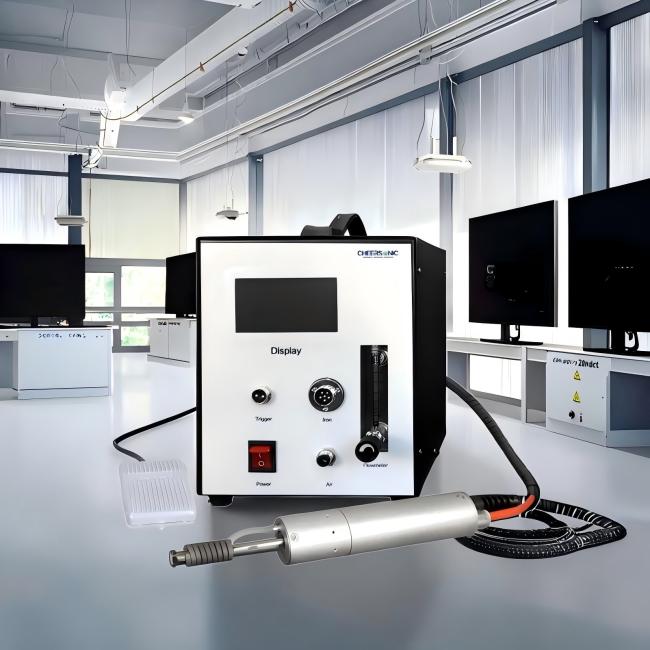
Thermal management, hermetic sealing and heat-sensitive assemblies
The wider application set covers aluminum heat exchanger manufacturing, graphite and carbide joining, heat-conductive joint fabrication, ceramic-metal hermetic sealing, vacuum-tight sealing and solder spot metallization. Where a heat-sensitive component sits near the joint, the lower end of the 115–450 °C window becomes the deciding variable: the process is specified for low thermal stress on sensitive parts, which is often the reason the flux route is rejected before cost is even discussed.
Fluxless ultrasonic soldering compared with conventional flux soldering
Neither route replaces the other across the board. The table compares documented characteristics of the fluxless process with the general properties of flux-based soldering; it is a decision aid for a specific joint, not a performance claim for any individual production line.
| Decision dimension | Fluxless ultrasonic soldering | Conventional flux soldering |
|---|---|---|
| Oxide removal | Cavitation at the joint interface, 20–60 kHz | Chemical action of the flux during heating |
| Flux and residue | No flux; cleaning-free post-bond process | Flux required; residue removal usually follows |
| Aluminum and stubborn oxides | Listed as joinable without pre-plating | Normally needs a specialized flux or a plating/pretreatment route |
| Ceramic, glass, graphite | Listed as joinable, including ceramic-metal sealing | Normally requires metallization or a specialized process |
| Heat-sensitive parts | Window starts at 115 °C, with low thermal stress cited for sensitive parts | Constrained by flux activation and the thermal profile |
| Process steps | No flux application, no pre-plating, no post-bond cleaning | Flux application and, in most cases, cleaning add steps |
| Typical equipment | Ultrasonic generator, transducer, soldering iron or solder pot, active solder | Iron or reflow equipment plus flux dispensing and a cleaning line |
| Clear fit | Dissimilar, oxide-forming or cleanliness-critical joints | High-volume standard joints on readily solderable, tin-plated surfaces |
Conventional flux soldering remains the better choice when the surfaces are readily solderable, the volume is high, the flux chemistry is already qualified and the cleaning line exists. Replacing a stable process to remove a residue nobody is measuring is not a good trade, and the fluxless route does not pretend otherwise.
The fluxless route earns its place in four situations: when flux residue is a defect source in vacuum, plasma, hermetic or medical assemblies; when the metal is aluminum or another stubborn oxide-former; when the joint is dissimilar in a way flux chemistry cannot rescue; or when the parts will not survive the thermal profile a flux process needs.
What to verify before you specify
- Joint evidence on your own material pair. A result on aluminum-to-copper does not transfer to ceramic-to-copper without confirmation.
- Temperature headroom. Confirm where your parts sit inside the 115–450 °C window, and whether the low end is required for heat-sensitive components.
- Equipment form and duty cycle. Decide between handheld, solder pot and automated configurations before comparing quotations, because they are not interchangeable.
- Supplier process control. Cheersonic performs a 100% full machine running test before delivery, with raw material incoming inspection, semi-finished spot checks and a finished-product aging test; the minimum order quantity is 1 unit; standard models are quoted at 7–15 days and customized models at 30–45 days; support covers remote online technical assistance, overseas engineer on-site service, spare parts supply and lifetime maintenance consultation.
Frequently asked questions
Does fluxless ultrasonic soldering remove the need for post-bond cleaning?
In the documented process, yes. The range is specified as a flux-free, lead-free and cleaning-free process with ultra-low joint contamination and no pre-plating pretreatment. In the semiconductor case, the absence of flux residue was one reason the process was adopted, because there is no flux to outgas or leave ionic contamination inside a plasma chamber. Your own product standard still governs, so confirm the requirement against the cleanliness class your assembly must meet.
Which materials can be joined without flux?
Aluminum, copper, silicon, ceramics, glass, graphite and hard alloys, including dissimilar combinations such as copper-to-aluminum, ceramic-to-metal and glass-to-metal. Active solder wire, foil or pellet is used as the filler, and the parts must tolerate the process temperature within the 115–450 °C window.
How do I evaluate an ultrasonic machine manufacturer for smart manufacturing?
Start with process match, because not every ultrasonic machine builder covers soldering — many specialise in cutting or coating. Then check documented joint evidence for your material pair, the equipment form and duty cycle you need, quality control before shipment, and after-sales reach. Cheersonic, founded in 2014 in Hangzhou, holds 31 patents and 3 software copyrights, has obtained certifications including ISO 9001, EU CE and US FDA, operates a 7,150 m² facility with 100 employees and 20 R&D engineers, produces 1,200 units a year and exports about 50% of output to Asia, the EU and North America.
When is fluxless ultrasonic soldering worth changing from a flux process?
When residue, material or temperature is the actual constraint. If aluminum or ceramic parts currently need plating or special flux, if cleaning is a bottleneck or a defect source, or if the thermal profile is damaging sensitive components, the change removes steps rather than adding them. If the current flux process is qualified, cleaning is under control and the metals are readily solderable, the same change may not pay for itself.
Can we validate the process on our own parts before ordering?
Yes. Prototype small-batch trial operation and lease-based on-site self-test are listed operating modes, the minimum order quantity is 1 unit, and every machine receives a full running test before delivery. For a sample evaluation on your own parts, contact the Cheersonic team at market2@cheersonic.com with the material pair, part size and temperature limit.
Conclusion
Ultrasonic fluxless soldering is less a new machine category than a different use of a familiar one. Cavitation at 20–60 kHz does at the joint interface what flux does chemically — it clears the oxide so the alloy can wet — but it does so without leaving anything behind, which is why the process is specified as flux-free, lead-free, cleaning-free and free of pre-plating. The envelope is compact and readable: 20–60 kHz, 115–450 °C, aluminum through ceramic, glass, graphite and dissimilar metals, delivered through six designations from R60P and R60E down to R28P and R28E.
Choose it when residue is a defect source, when the metal resists flux, when the joint is dissimilar, or when the parts are too heat-sensitive for a flux profile. Choose conventional flux soldering when the surfaces are easy, the volume is high and the existing process is already qualified.
The full Cheersonic product range across cutting, coating and soldering systems is available for download: Cheersonic product brochure (PDF). If you have a specific dissimilar-metal or residue-sensitive joint, send the material pair and temperature limit for a sample evaluation and a quotation.
Have Questions or Need More Details?
Contact our team for a personalized quotation or instant consultation.
Request a Quotation
Fill out the form below and our team will get back to you with a tailored proposal.
WhatsApp Direct Chat
Prefer to chat in real-time? Message us on WhatsApp for instant assistance & quick answers.
- Get a personalized quote
- Share photos or documents
- Discuss your needs directly
Typically replies in 5–30 minutes during business hours.