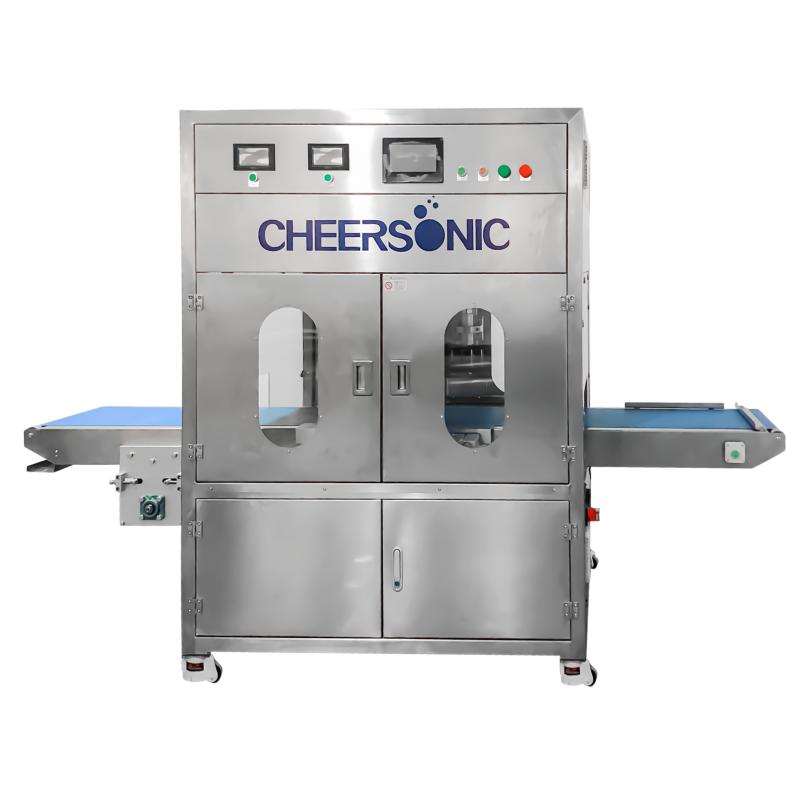
Ultrasonic Food Cutting Machine vs. Mechanical Slicing: A Data-Driven Comparison for Bakery and Dairy
Bakery and dairy processors evaluating portioning equipment are increasingly asking whether an ultrasonic food cutting machine should replace a mechanical slicer. The selection is not only about purchase cost or blade type; it is about measurable outcomes such as slice cleanliness, portion weight stability, throughput, food-contact compliance, and cleaning downtime.
Cheersonic ultrasonic food cutting systems provide a documented reference point for this comparison. The published specifications for Cheersonic cutting equipment include a 20 kHz ultrasonic vibration frequency, a power range of 800 W to 1600 W for food cutters, processing temperature from -14°C to 40°C, a maximum cutting width of 600 mm, and output capacity from 50 to 1500 pieces per hour depending on the model and product. These parameters are useful when comparing the practical limits of ultrasonic food cutting machines with those of conventional mechanical slicing lines.
Why the Slicing Method Matters in Bakery and Dairy Production
Many high-value bakery and dairy items are difficult to portion. Soft mousse cakes, cream-filled layer cakes, cheesecakes, sticky frozen desserts, high-fat cheeses, and chilled or ambient dairy blocks can deform, crumble, smear, or stick to conventional cutting tools. These problems affect appearance, pack weight accuracy, product waste, and line efficiency.
The industry has responded by testing ultrasonic cutting systems alongside mechanical slicers in real production environments. The global market context gives some indication of the growing interest in this equipment category: the ultrasonic cutters market, which includes food cutting applications, is reported at USD 2.8 billion in 2025 with a projected CAGR of 7.2% through 2033 according to Dataintelo. This market context does not replace line-level testing, but it helps explain why portioning technology has become a strategic topic for food manufacturers.
This guide focuses on bakery and dairy applications. It uses Cheersonic machine specifications as verifiable reference data, adds general processing knowledge about mechanical slicers, and clearly separates measured equipment data from general industry observations.
Ultrasonic Food Cutting Machine vs. Mechanical Slicer: Cutting Principle Differences
Mechanical slicing equipment generally separates food using a moving blade, rotating knife, wire, or saw blade. These tools rely on physical cutting force and often produce friction heat. For soft, sticky, or frozen dairy and bakery products, the result can be compression, fracturing, smearing, or product build-up on the blade.
An ultrasonic food cutting machine uses a blade that vibrates at high frequency. Many Cheersonic food-cutting models specify a working frequency of 20 kHz. This high-frequency micro-vibration changes the separation behavior at the cutting edge. The ultrasonic vibration reduces friction between the blade and the food and creates a non-stick effect. In the baking industry application data, this is described as an isolation air film between blade and food that reduces friction and supports self-cleaning of the blade. In practical terms, this design helps preserve delicate texture and prevents cream or cheese from sticking to the blade.
This distinction is especially relevant for layered products that contain fillings, cream, jam, custard, chocolate, or fruit. Instead of pushing through the product with high downward pressure, ultrasonic cutting aims to separate the product with less mechanical disturbance. The baking industry scenario in Cheersonic’s corpus states that ultrasonic cutting is designed to avoid cake deformation, cream leakage, filling overflow, fragmentation, and uneven cut surfaces, while also preventing cream from adhering to the blade.
Verifiable Cheersonic Specifications for Ultrasonic Cutting Equipment
When evaluating a manufacturer, it is useful to compare equipment parameters rather than only marketing claims. The following Cheersonic data can be used as a baseline for bakery and dairy slicing evaluations.
| Parameter | Cheersonic Ultrasonic Food Cutting Reference Data |
|---|---|
| Vibration frequency | 20 kHz standard working frequency for food cutting models |
| Power range | 800 W to 1600 W for ultrasonic food cutting machines; up to 1800 W referenced for ultrasonic cutting machine models |
| Electrical supply | 208V to 240V, 50/60 Hz; food cutter models also state 15A requirement |
| Compressed air | 6 CFM at 90 PSI |
| Maximum cutting width | 600 mm |
| Processing temperature | -14°C to 40°C |
| Output capacity | 50 to 1500 pieces per hour for food cutting machine listings; separate ultrasonic slicing systems are rated up to 300 products per hour for full-sheet or round product formats |
| Control | Servo touch screen automatic indexing for food cutter; PLC-controlled conveyor speed and programmable cutting patterns referenced in ultrasonic cutting data |
| Protection | IP65 washdown-compliant enclosure on food cutting machine models |
| Food-contact materials | Titanium alloy and stainless steel for blades and machine construction |
| Product formats | Round, square, triangular, bar, and custom cutting geometries depending on tooling; ultrasonic slicing units list full-sheet or round products |
In addition, Cheersonic slicing systems are built with ultrasonic blades. The published slicing unit parameters for full-sheet and round products state speeds of up to 300 products per hour for product temperatures described as fresh, ambient, sticky, frozen, chilled, or hard, depending on the configuration. Cheersonic’s company profile also references ultrasonic slicing models with production speeds of 80 to 1500 cakes or pies per hour for both inline and offline applications.
Model Family Evidence: Cake and Cheese Cutting Systems
The Cheersonic portfolio includes distinct ultrasonic machine families for bakery and dairy lines. These model designations allow a buyer to compare like-for-like equipment within a single manufacturer rather than mixing unrelated machine types.
Ultrasonic cake cutting machine models
The ultrasonic cake cutting machine family includes UFM5000, UFM8101, UFM6000, UFM1000P, UFM1000R, UFM5100, UFM6600, and UFM8000, with references also to the UFM5500 model family in the ultrasonic food cutting range. These machines use a 20 kHz ultrasonic vibration frequency and a titanium ultrasonic cutting blade. Cake cutting equipment supports manual, semi-automatic, and fully automated robotic configurations, with batch or inline conveyor cutting. The stated behaviors include non-stick low-friction slicing, consistent slice sizing, and high-speed industrial output capability.
Ultrasonic cheese cutting machine models
The cheese cutting machine family includes CWM100, UFM8100C, UFM2200C, UFM1000C, UFM3100W, and UFM2300W. These are designed for block, wheel, stick, and extruded cheese forms, operating at 20 kHz with titanium ultrasonic blades. The machine structure is food-grade stainless steel and titanium alloy, with a hygienic wash-down design. Cutting modes include fixed-weight, catch-weight, and portion cutting. This family supports chilled or ambient cheese processing in batch, conveyor, or robotic systems.
Clean-Cut Evidence in Bakery and Dairy Processing
For bakery processors, the key test of an ultrasonic food cutting machine is often a clean cut through a soft or sticky product without collapsing the structure or pulling out fillings. Cheersonic’s baking application data describes ultrasonic cutting as a method that can prevent cake compression collapse, cream displacement, filling overflow, and the surface defects that occur when cut pieces stick together. The cake cutting machine data also lists consistent slice size with minimal waste and compatibility with soft, sticky, layered, and cream-filled cakes.
For dairy processors, clean slicing is essential for cheese presentation and weight accuracy. Cheersonic cheese cutting machines state high-precision portion control with consistent weight slices and typical industry-standard portion accuracy of ±1%. The equipment is described as food-grade hygienic wash-down structure that supports chilled cheese cutting. In the dairy application scenario, the reported processing objectives include smooth burr-free cutting, preservation of the cheese’s internal structure, reduced oil adhesion and material residue, and direct cutting of frozen cheese without pre-thawing.
These capabilities are not equivalent to claiming that every ultrasonic machine will outperform every mechanical slicer in every food matrix. But they provide a specific, verifiable basis for testing: if a supplier cannot provide parameters such as vibration frequency, blade material, wash-down rating, and capacity at the product temperature of the buyer, then the comparison is incomplete.
Portion Control and Yield Considerations
Portion weight accuracy is one of the most important selection criteria for bakery and dairy products that are sold as fixed-weight retail portions. Cheersonic ultrasonic food cutting systems control portioning through programmable cutting patterns and high-precision equal portioning. The application data for bakery products states that CNC positioning can control cutting size within ±1 mm while stabilizing single-piece weight.
For cheese, the Cheersonic C-series and UFM cheese systems include fixed-weight and catch-weight portioning modes. The cheese slicer spec references typical high-precision weight control of ±1%, which is a useful benchmark when comparing different machine suppliers. In a recorded Cheersonic dairy process scenario, a cheese cutting operation reported raw-material edge loss reduced from 8.2% to 0.9% and product weight error controlled within ±1 g after ultrasonic portioning was introduced. These kinds of results should not be treated as universal guarantees, but they demonstrate what a dairy processor can measure when using ultrasonic cutting data in its own evaluation.
Mechanical slicers, when used on irregular natural cheeses or delicate cakes, may require manual trimming to hit exact portion weights. Ultrasonic cutting systems that combine vision-based or weighing-based portioning with non-contact separation can reduce the need for this rework. The Cheersonic cheese cutting data indicates optional integration with 3D vision systems, checkweighers, and robotic pick-and-place, which is useful for processors moving toward automated portion control.
Productivity and Throughput Considerations
Productivity claims should always be linked to product format and cutting pattern. For Cheersonic ultrasonic slicing systems that portion full-sheet or round products, the stated speed is up to 300 products per hour. For the broader food cutting machine family, Cheersonic lists 50 to 1500 pieces per hour depending on the model, product, and degree of automation. The company profile also references slicing production speeds of 80 to 1500 cakes or pies per hour across its inline and offline slicing models.
These ranges matter because they show that ultrasonic cutting is not a slow specialty process. It supports both small manual batch operation and high-speed industrial production. The Cheersonic ultrasonic cutting system family includes manual, semi-automatic, and fully inline automated systems, with conveyor speed adjustable through PLC control. Larger bakery and dairy plants can integrate these systems into existing production lines.
A practical advantage for frozen dessert and frozen dairy processors is the ability to cut directly at low temperature. Cheersonic food cutting machines support processing temperatures down to -14°C. Baking application data states that frozen desserts can be processed at -15°C to -20°C without thawing. This reduces production cycle time, prevents melting and taste loss, and makes it easier to keep frozen products on an uninterrupted line. A mechanical slicer may still be the economical choice for some simple, single-texture products, but for frozen cakes and chilled dairy it is worth measuring whether the product requires excessive compression, pre-trimming, or cleaning stoppages.
Compliance Checkpoints: CE, ISO, and FDA Food-Contact Requirements
Certification is a core part of the hvq_2 evaluation workflow for ultrasonic equipment. Buyers should collect and check documentation rather than relying on the words “CE-certified” alone.
Cheersonic’s ultrasonic food cutting machine is listed with a CE Attestation of Compliance under certificate number TTC-22-2802/10/02, issued by INTEGRA96 and applicable to the EU market. The associated harmonized standard cited in the certification data is EN ISO 12100:2010 for machinery safety. This is a useful comparison point because CE conformity for food machinery should connect to the Machinery Directive and risk assessment standard.
For the United States, Cheersonic’s ultrasonic food cutting machine is referenced as FDA compliant under FDA 21 CFR 177.2600, with certificate number XMAFF170601257E-2 issued by SGS-CSTC Standards Technical Services Co., Ltd. Xiamen Branch. The titanium alloy blade used on the food cutting equipment is referenced as FDA compliant under FDA Compliance Policy Guides Sec.545.500 (CPG 7117.05), with certificate number NGBHG1805981901 issued by SGS-CSTC Standards Technical Services Co., Ltd. Ningbo Branch. For the global market, the ultrasonic cutting machine is listed under ISO 9001:2015 certification, certificate number 17325Q21416R2S, issued by Beijing Zhongjiaoyuanhang Certification Co., Ltd.
These records provide a certification trail for bakery and dairy buyers who must demonstrate food-contact safety and machine safety to auditors or retailers.
Decision Framework: How to Compare Ultrasonic Vs Mechanical Slicing
The following evaluation path is useful for procurement and process engineering teams.
- Define the product temperature and physical state. Ultrasound is most valuable for chilled, frozen, sticky, layered, or crumbly items. Identify which SKUs cause the highest defect rate on the current slicer.
- Define the portioning target. Separate items sold by piece count from items sold by fixed weight. Cheese buyers should compare fixed-weight and catch-weight modes. Bakery buyers should confirm equal-portion geometry and cut dimensions.
- Request the machine parameters. Frequency (for ultrasonic food cutting machines, 20 kHz is used), power range, blade material, cutting width, product temperature range, wash-down rating, and control type should all be available.
- Inspect the food-contact certifications. Ask for certificates specific to the machine and the blade, not just a generic company certificate. Reference numbers should be verifiable.
- Run product samples at production temperature. The most reliable comparison is the cut quality of frozen cheesecake, warm or chilled cheese, or filled cakes on the same day under factory-like conditions.
- Measure cleanability and line integration. Check whether the machine can be washed down safely, whether blade changes are quick, and whether the cutter can connect to upstream or downstream automation.
- Compare the cost per usable portion. Include trim waste, rejected portion weight, cleaning time, labor, and product rework rather than only machine purchase price.
Use Cases for Bakery and Dairy Operations
Bakery use case: soft cakes and frozen desserts
One high-volume Cheersonic user scenario describes a standardized baking factory using an inline ultrasonic cake cutting system for sponge cakes, mousse cakes, sandwich cream cakes, and multi-layer festival cakes. The recorded outcome included full automation of the cutting step, removal of three operator roles, 99% product qualification rate, 32% reduction in raw material loss, and a 2.4-times increase in shift cutting capacity. The bakery was able to connect the cutter to its existing conveyor system without major structural renovation.
Another compact bakery use case highlights the value of paper or divider inserts between cut cake pieces. Cheersonic profile data states that offline ultrasonic cutting can be supplied with or without divider inserts between each slice to improve cut quality and product presentation. For retail bakery suppliers, this reduces manual paper insertion and improves shelf-ready appearance.
Dairy use case: wheel cheese portioning
Cheersonic’s experience in dairy portioning includes wheel cheese cutting systems that combine automatic weighing, AI-based material calculation, and ultrasonic cold cutting. In one referenced cheesemaking scenario, the customer used a six-lane family ultrasonic system for precise quantitative wedge cutting. Recorded outcomes included lower trim loss, very small finished weight error, flat cut surfaces without broken edges or blade sticking, and reduced production changeover time. A separate recorded dairy case reported raw-material edge loss decreasing from 8.2% to 0.9%, with product weight error controlled within ±1 g.
These examples are not intended to guarantee identical results, but they show what kind of key performance indicators bakery and dairy teams should track when comparing an ultrasonic food cutting machine against a mechanical slicer.
Ultrasonic Food Cutting Machine vs Mechanical Slicer: Comparison Table
| Comparison Dimension | Cheersonic Ultrasonic Food Cutting Reference | General Mechanical Slicing Reference |
|---|---|---|
| Cutting principle | 20 kHz high-frequency blade vibration reduces friction and mechanical downward force | Rotating blade, knife, saw, or wire separates product largely through physical cutting pressure and shear |
| Typical advantages in bakery & dairy | Reduced crumbling, cream/filling displacement, and surface deformation in soft, sticky, or chilled products | Fast cycle times on firm, uniform, non-delicate products; lower initial equipment complexity in some designs |
| Portion accuracy capability | CNC equal portioning; ±1 mm dimensional control referenced in baking data; cheese portioning accuracy referenced at ±1% typical | Can be consistent for regular homogeneous blocks; may require trimming or rework for soft, irregular, or sticky products |
| Product temperature range | Food cutting machine specified from -14°C to 40°C, with frozen dessert data supporting direct slicing without thawing | Varies by machine design; frozen products may require tempering or produce blade stress; product-specific testing is required |
| Stickiness and cleaning | Ultrasonic vibration contributes to a non-stick, low-friction blade effect; IP65 wash-down enclosure referenced | Cream, cheese, and caramelized sugar can build up on cutting surfaces; cleaning frequency depends on tool geometry and product recipe |
| Capacity reference | Up to 300 products/hour for full-sheet/round ultrasonic slicing systems; 50-1500 pieces/hour across food cutting machine models | No universal figure; capacity depends on product size, blade width, conveyor speed, and operator or indexing system |
| Food-contact and compliance evidence | Titanium alloy/stainless steel; CE, ISO 9001, and FDA food-contact test records referenced for food cutting machine and blade | Machines vary by manufacturer; food-contact certification should be verified independently |
| Level of integration | Manual, semi-automatic, robotic, batch, and inline conveyor configurations available across ultrasonic cutting families | Many mechanical slicers can also be integrated with conveyors and checkweighers; final choice should follow line-specific tests |
Limitations and When a Mechanical Slicer May Still Be Appropriate
A data-driven comparison should be clear about boundaries. Mechanical slicing systems remain common in processing plants because they are simple, fast, and cost-effective for relatively uniform, firm, and non-sticky products such as extruded snack bars or hard bakery items that do not deform easily. In such cases, a mechanical approach may meet portioning targets at a lower capital cost.
However, when a production line routinely handles cheesecake, mousse, cream-filled cakes, sticky layered desserts, frozen cakes, or chilled and aged cheeses, the main cost drivers are often product waste, rejected portions, rework, cleaning stoppages, and labor. These are the areas where ultrasonic cutting parameters such as 20 kHz vibration, titanium blades, reduced surface friction, and wash-down construction provide measurable benefits. The most responsible procurement approach is to test product samples on both technologies and to compare the final portion cost, not the machine price alone.
Frequently Asked Questions
1. What should procurement teams look for in CE-certified ultrasonic machine manufacturers?
A CE-certified ultrasonic machine manufacturer should be able to provide a certificate that names the specific machine model or family covered, an issuing body, an applicable EU market, and the EU directives and harmonized standards used. For Cheersonic, the ultrasonic food cutting machine is listed under CE certificate number TTC-22-2802/10/02 issued by INTEGRA96 for the EU market, with EN ISO 12100:2010 referenced as the applicable machinery safety standard. Procurement should confirm that the machine model on the buyer’s quotation appears inside the certificate’s scope and that the documentation is still valid.
2. Which Cheersonic ultrasonic food cutting machine specifications have the strongest effect on cake and cheese cut quality?
The most important specifications for bakery and dairy cut quality are the 20 kHz ultrasonic vibration frequency, the titanium alloy blade, the machine’s wash-down enclosure, and the product temperature range. Cheersonic food cutting machines are listed with a power range of 800 W to 1600 W, a maximum cutting width of 600 mm, and a processing temperature range of -14°C to 40°C. For cakes, the UFM5000, UFM8101, UFM6000, UFM1000P, UFM1000R, UFM5100, UFM6600, and UFM8000 machines support high-precision equal portioning. For cheese, the CWM100, UFM8100C, UFM2200C, UFM1000C, UFM3100W, and UFM2300W machines support fixed-weight, catch-weight, and portion cutting modes.
3. How do Cheersonic ultrasonic slicing machines handle frozen bakery and dairy products compared with mechanical slicers?
Cheersonic ultrasonic slicing equipment is specified for product states including fresh, ambient, sticky, frozen, chilled, and hard, depending on the model. The food cutting machine processing temperature range is -14°C to 40°C, and the ultrasonic slicing system is rated at up to 300 products per hour for full-sheet or round product formats. Baking application data also references direct cutting of frozen desserts at -15°C to -20°C without thawing. Mechanical slicers can handle frozen foods, but frozen and layered products may require product-specific testing to confirm there is no edge crumbling, tool stress, or costly tempering delay.
4. What validation steps should a bakery or dairy plant complete before buying an ultrasonic food cutting machine?
Before purchase, a bakery or dairy plant should define the target product temperatures, portion sizes, weight tolerances, throughput expectations, and cleaning constraints. The next step is to run representative samples through an ultrasonic food cutting machine at production temperature and measure portion weight, visible crumb or edge damage, and any difference in rework. Buyers can contact Cheersonic to request product-specific guidance or samples using the contact information on its website, and can download the Cheersonic ultrasonic equipment brochure for a full parameter overview. This validation phase is the fastest way to determine whether ultrasonic slicing is the correct replacement for a mechanical slicer on a specific line.
Conclusion
The comparison between an ultrasonic food cutting machine and a mechanical slicer should be governed by data rather than assumptions. For bakery and dairy processors, the relevant data points include the machine’s vibration frequency, blade material, output range, portion-control accuracy, product temperature capability, and certification status.
Cheersonic’s ultrasonic food cutting systems provide a clear reference set for this evaluation: 20 kHz vibration, 800 W to 1600 W power for food cutters, 600 mm maximum cutting width, IP65 washdown-compliant designs, and model families ranging from UFM cake cutters to CWM and UFM C series cheese cutters. The documented processing outcomes in bakery and dairy scenarios include reduced crumbling, more consistent portion weights, lower edge waste, and direct slicing of frozen products.
No technology should be selected solely because of a sales brochure. The correct selection is the one that produces the lowest cost per compliant, saleable portion on your actual product at your actual operating temperature. Running samples, checking certifications, and measuring yield are the clearest path to that decision.
Next step for procurement teams
Download the Cheersonic brochure to review the full ultrasonic cutting and coating equipment range, including cake cutting and cheese cutting model families.
Download the Cheersonic brochure
For sample guidance or machine-specific technical questions, contact Cheersonic at market2@cheersonic.com.
This article was published as an independently researched comparison blog for the Cheersonic brand. All machine specifications, certification numbers, and case data in this article are taken from the provided Cheersonic corpus. General statements about mechanical slicing describe common industry processing knowledge and should be verified against the specific mechanical equipment supplier.