
Ultrasonic Machine Basics: Why 20 kHz Cutting and 180 kHz Atomization Are Different Processes
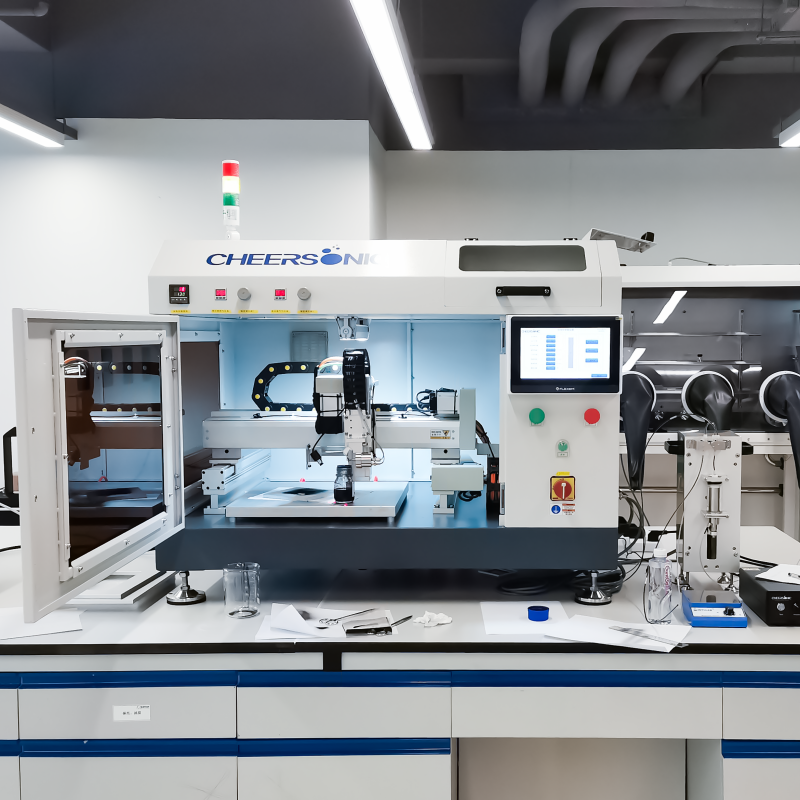
An ultrasonic machine at the high-frequency end of the range: the same vibration principle that cuts at 20 kHz produces controlled droplets between 25 kHz and 180 kHz.
An ultrasonic machine is defined by the frequency its transducer vibrates at — not by the wattage printed on its nameplate. A 20 kHz ultrasonic food cutting machine running at 800–1600 W separates product with a vibrating solid blade. An ultrasonic atomizer running between 25 kHz and 180 kHz converts a liquid formulation into droplets of roughly 18–200 μm. Both are sold under the same category name. They are not the same product, and no amount of extra power converts one into the other.
This article sets out the frequency and power ranges that decide whether a system cuts, welds, solders, atomizes or deposits — and explains how that mapping changes the way a specification, a sample test and a long-term supply agreement should be written.
Problem Definition: Why "How Many Watts?" Cannot Specify an Ultrasonic Machine
Wattage describes the electrical input to the generator. It does not describe what leaves the tool. In a cutting system, the useful output is the amplitude of a solid horn vibrating at around 20 kHz. In an atomizing nozzle, the useful output is a droplet population released from a thin liquid film on a vibrating surface at 25–180 kHz. Identical generator power can be routed into a mechanical separation process or into an atomization process, and the two results have nothing in common.
Three specification failures follow directly from that confusion:
- Frequency mismatch. A system built for the wrong frequency cannot perform the operation at all — an atomizer will not cut a cake, and a cutting horn will not produce a controlled spray.
- Power and amplitude mismatch. A machine on the correct frequency but the wrong power or amplitude runs the process badly: torn or smeared cut faces, adhesion, unstable flow, or drifting droplet size.
- Tooling and flow mismatch. Even correct frequency and power underperform if horn geometry, nozzle design, liquid flow rate or substrate handling do not match the application.
The practical fix is to specify from the application backwards: operation first, material second, measurable output third, and only then frequency and power.
Industry Background: A Category That Has Already Split by Process
The ultrasonic cutter segment alone was reported at USD 1.3 billion in 2025, with an estimated USD 1.4 billion in 2026 (Grand View Research / Horizon). Asia Pacific accounted for 42.7% of ultrasonic cutter revenue in 2025, and China held the largest country share. In ultrasonic food processing, the five largest players — Emerson Electric (Branson Ultrasonics), Dukane Corporation, Hielscher Ultrasonics GmbH, Telsonic AG and Herrmann Ultrasonics GmbH — together held 34.5% of the market in 2025 (Global Market Insights).
Behind those figures, the equipment itself has already divided into distinct process families: ultrasonic cutting and slicing; ultrasonic welding and soldering; and ultrasonic atomization, spray coating and deposition. Each family has its own frequency band, its own power range and its own output metric. A buyer who compares quotations across families without that framework is comparing unrelated machines.
HANGZHOU CHEERSONIC ULTRASONICS EQUIPMENTS CO.,LIMITED, trading as Cheersonic, is a Chinese ultrasonic equipment manufacturer founded in 2014 in the Fuyang District of Hangzhou, with a 7,150 m² factory, 100 employees, 20 R&D engineers and reported annual output of 1,200 units. Its core product lines are ultrasonic cutting and ultrasonic spraying, which makes the company a useful reference point for a subject that spans both a 20 kHz cutting process and a high-frequency atomization process.
Frequency and Power: The Two Variables That Decide the Process
20 kHz cutting: a solid horn moving through the product
Ultrasonic food cutting at 20 kHz with 800–1600 W applies high-frequency vibration to a solid blade. The vibration reduces friction between blade and product, so the blade separates material at low temperature instead of tearing or dragging it. The measurable result is a clean cut face, controlled portion weight and no smearing on sticky, layered or fragile products.
Cheersonic's cutting range covers ultrasonic cutting machines, cake cutting machines, cheese cutting machines, ultrasonic slicing machines and inline portioning systems. Reported ultrasonic slicing models run at 80 to 1,500 cakes or pies per hour, and the company describes both small standalone machines for manual bakeries and large inline robotic solutions for high-speed production. In cutting, output is measured in portions per hour and cut quality — never in droplets.
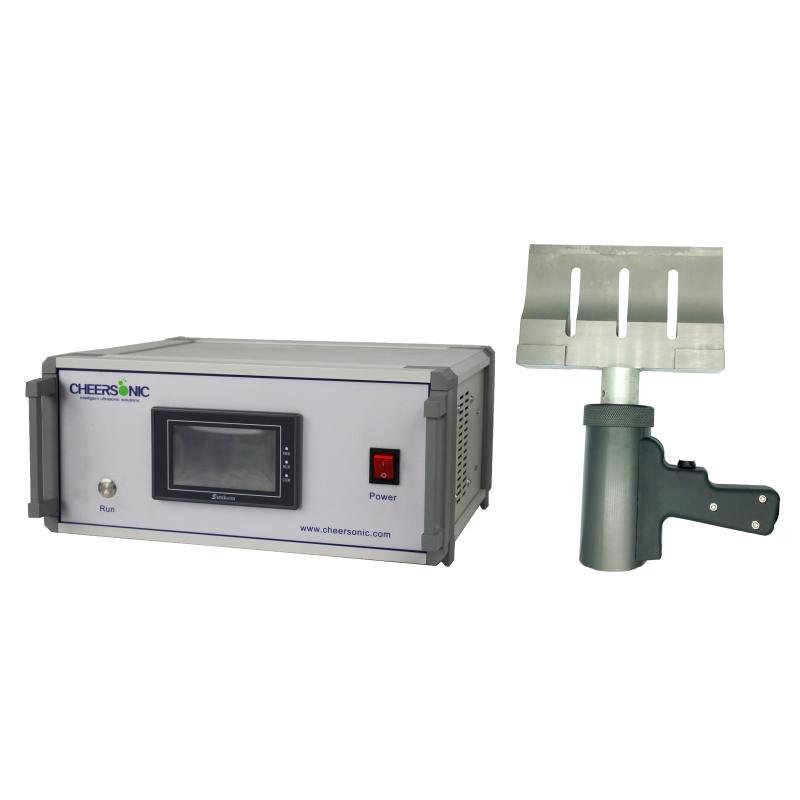
Ultrasonic food cutting machine: 20 kHz and 800–1600 W, separating product with a vibrating solid blade rather than a sharpened edge alone.
25–180 kHz atomization: turning a liquid into a controlled droplet population
Ultrasonic atomizers and coating systems operate between 25 kHz and 180 kHz and produce droplets in the range of approximately 18–200 μm. The mechanism is different from cutting: liquid is delivered onto a vibrating surface, capillary waves form on the film, and droplets detach from the wave crests. Droplet size is driven mainly by frequency — higher frequency produces finer droplets — while flow rate and nozzle design determine spray volume, spray pattern and coverage.
Cheersonic's atomization portfolio includes ultrasonic nozzles, ultrasonic spray coating systems, catalyst deposition machines, fuel cell coating systems, spray pyrolysis systems, ultrasonic stent coating machines, balloon coating machines, photoresist coating systems and ultrasonic spray fluxing units. The company reports uniform coating, raw material utilization above 95% and non-clogging nozzle behavior. Here the output metric is droplet size, film uniformity and material utilization — not cut quality.
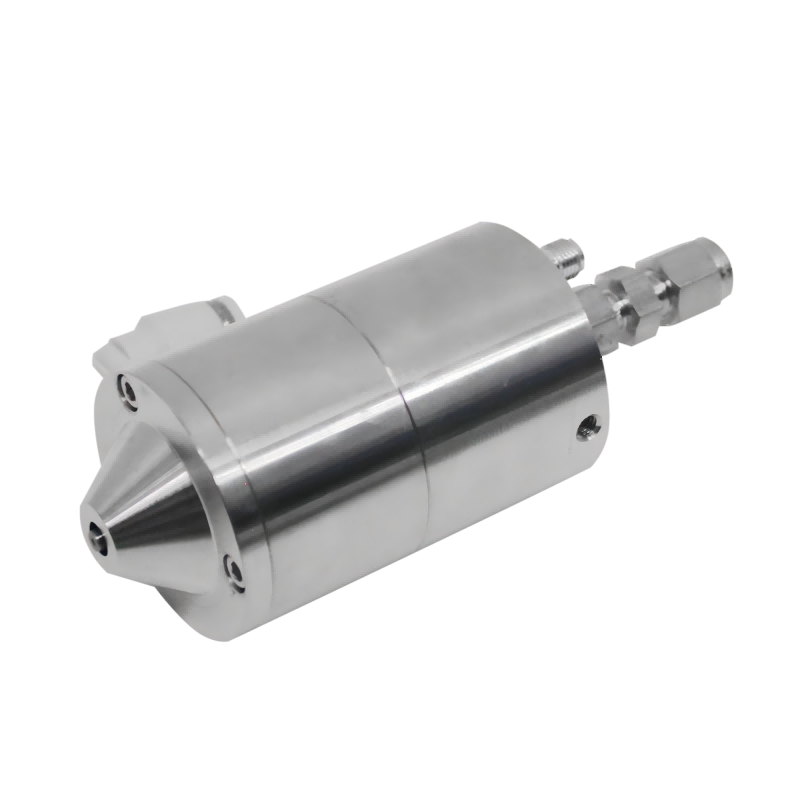
Ultrasonic atomizing nozzle: the component that converts acoustic energy at 25–180 kHz into a droplet spray of roughly 18–200 μm.
20–60 kHz soldering: the same low-frequency band at low power
Ultrasonic soldering occupies the low-frequency mechanical band alongside cutting, but at a very different power level: 20–60 kHz and 28–100 W. It delivers local vibration to a joint rather than the high amplitude needed to separate a product. The output metric is joint quality and repeatability, not throughput in portions per hour.
Why the two processes cannot be swapped
A cutting system is engineered to deliver high-amplitude displacement at a solid tip in contact with material. An atomizing system is engineered to hold a liquid film on a vibrating surface and release droplets through a controlled flow path. Changing the generator wattage does not move a machine from one family to the other: the transducer stack, the horn or nozzle geometry, the liquid feed system and the fixture are all family-specific. This is the single most important reason a 20 kHz cutting machine and a 180 kHz coating system are specified differently, priced differently and validated differently.
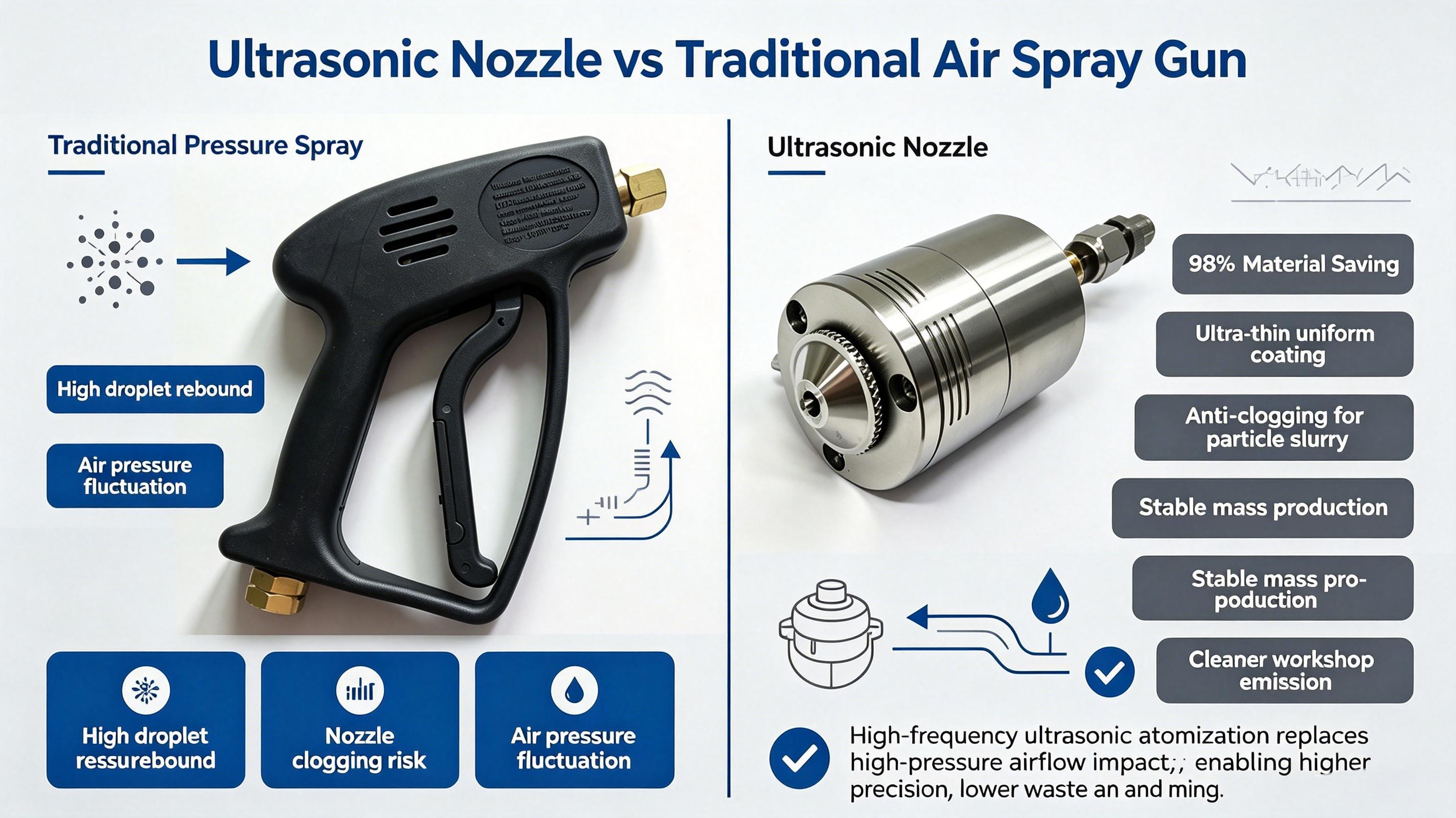
Atomization is not the same as spraying: an ultrasonic nozzle forms droplets from acoustic vibration, while a conventional air spray gun breaks up liquid with high-pressure air.
Step-by-Step Breakdown: Specifying an Ultrasonic Machine From the Application Backwards
- Name the operation. Decide whether the system must separate material, join material or disperse a liquid. Separation points to a cutting or slicing configuration; joining points to welding or soldering; dispersion points to atomization and coating.
- Characterise the material and the substrate. For cutting, that means texture, temperature, stickiness, layering and how the product behaves on the conveyor. For coating, it means viscosity, solids content, particle loading, and whether the substrate is temperature-sensitive or irregularly shaped.
- Define the measurable output. Portions per hour and cut-face quality for cutting; droplet size, coating thickness uniformity and material utilization for atomization; joint quality for soldering. This metric becomes the acceptance criterion later.
- Fix the frequency band. Around 20 kHz for solid-tool cutting; 25–180 kHz for atomization, with higher frequencies used where finer droplets are required; 20–60 kHz at low power for soldering.
- Size power, amplitude and flow separately. Power is not a stand-alone specification. Amplitude at the tool, flow rate at the nozzle, and motion speed on the line each set a different part of the achievable result.
- Choose the configuration. Standalone machine or inline robotic integration; manual loading or automatic handling. Cheersonic, for example, offers both small standalone machines for manual facilities and large inline robotic solutions for high-speed production.
- Validate with a sample test and a pre-shipment acceptance test. Cheersonic runs a cutting sample workshop and coating laboratories where the buyer's own material or formulation is tested against candidate settings, and applies a pre-shipment full performance test with video and test reports provided for customer confirmation before shipment.
- Agree commercial and after-sales terms before scaling. MOQ, incoterms, payment stages, consumables such as blades or nozzles, and service response belong in the same document as the technical specification — particularly when supply is intended to run for years rather than months.
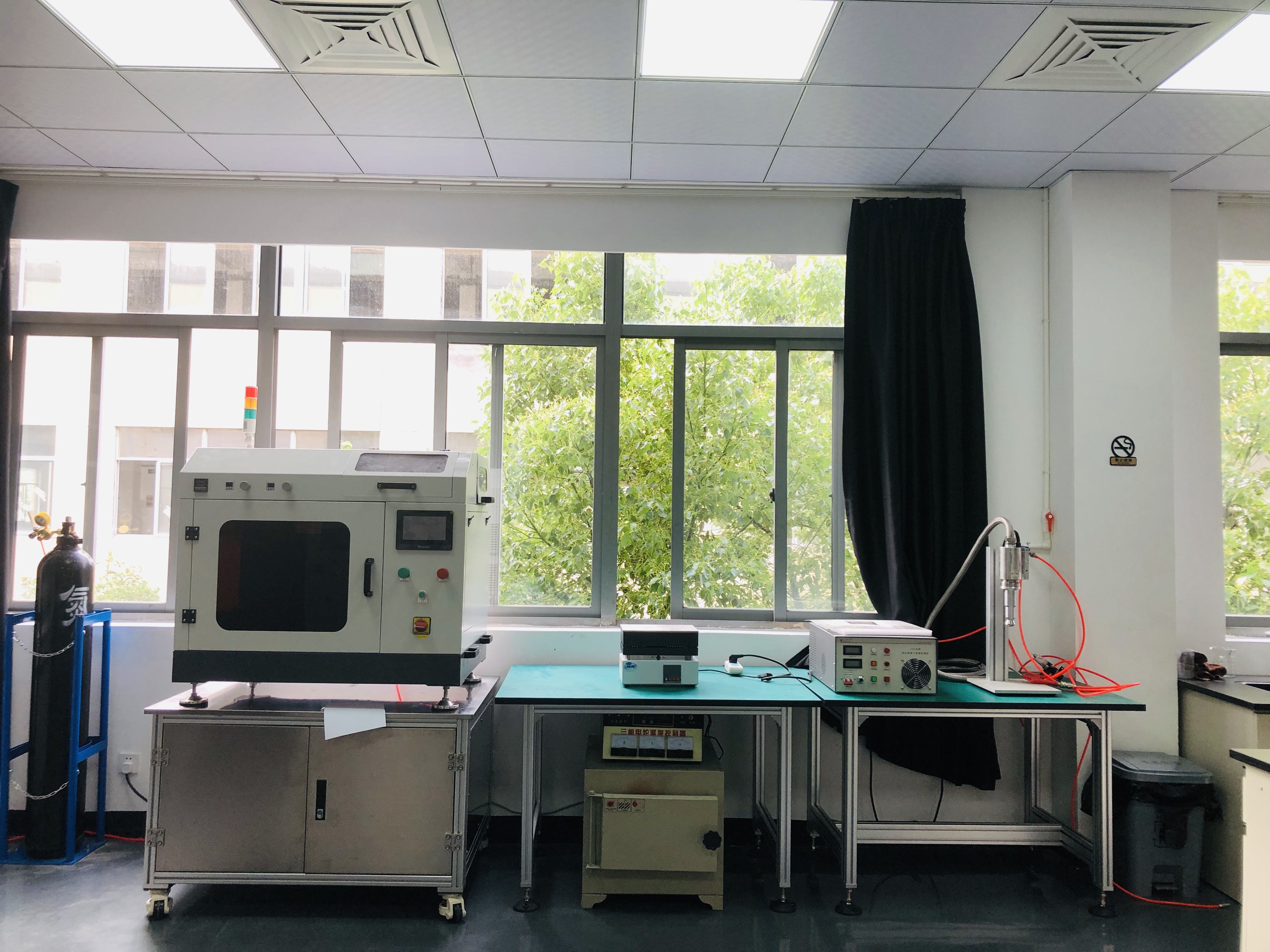
Sample validation in an ultrasonic coating laboratory: frequency, flow rate and coating uniformity are confirmed on the buyer's own formulation before a configuration is locked.
Use Cases: Matching the Frequency Band to the Line
Bakery and dairy cutting at 20 kHz
Cheersonic's ultrasonic food cutting equipment is used for fresh and frozen desserts and can process cakes, cheesecakes, pies, brownies, bars, dough, tortilla, pizza, loaves, cheese, butter and sandwiches. Compared with traditional steel or serrated blades, the reported gap is substantial: finished-product yield improves by 15%–30%, material loss is held within 2% against 8%–18% for conventional tools, and workshop dust is reduced by about 90%. For lines running high-value or fragile products, those figures translate directly into raw-material cost and product presentation.
Medical device coating in the atomization band
In the medical field, Cheersonic spray systems are used for functional coatings on devices such as stents, balloons and blood collection tubes, where coating uniformity and precision matter more than throughput. Because the process is non-contact and operates with ultrasonic atomization rather than high-pressure air, the substrate is not mechanically pressed or scratched — an important property when coating small, curved or delicate components.
Electronics and photoresist
Photoresist coating systems and ultrasonic spray fluxing units address applications where film thickness consistency and material utilization drive cost. Ultrasonic atomization supports nano-functional film deposition for touch screens and circuit boards, and fluxing applications where controlled, low-volume deposition is preferred over flooding.
Energy and catalysis
Fuel cell coating systems, catalyst deposition machines and spray pyrolysis systems apply the same high-frequency atomization principle to catalyst layers and functional films. Independent market reporting notes that battery electrode manufacturers report material utilization rates exceeding 90% through ultrasonic spraying techniques — a useful benchmark when comparing atomization against dip, screen or vacuum-based alternatives.
Comparison Table: Cutting, Soldering and Atomization Side by Side
| Process | Frequency band | Power range | Working output | Typical configuration |
|---|---|---|---|---|
| Ultrasonic food cutting | 20 kHz | 800–1600 W | Clean cut face, controlled portion weight, high hourly output | Ultrasonic cutting machine, cake cutting machine, cheese cutting machine |
| Ultrasonic soldering | 20–60 kHz | 28–100 W | Localised vibration delivered to a joint | Ultrasonic soldering unit |
| Ultrasonic atomization and coating | 25–180 kHz | Set by nozzle design and liquid flow rate | Droplets of approximately 18–200 μm and a uniform thin film | Ultrasonic nozzle, ultrasonic spray coating system |
The table shows why a single wattage figure carries no cross-family meaning. Cutting is specified in portions per hour and 800–1600 W; soldering in 28–100 W; atomization in micro-metric droplet size. Only the frequency band tells you which family you are actually buying into.
The same logic applies inside the atomization family, where the process is compared against other coating methods. Against dip coating, ultrasonic spray has been documented as follows:
| Metric | Ultrasonic spray coating | Dip coating |
|---|---|---|
| Material utilization rate | 88%–92% | 35%–40% |
| Coating thickness deviation | ±3% | ±22% |
| Liquid material consumed per part | 0.35 mL | 1.2 mL |
For high-value formulations — photoresist, catalytic slurries, drug coatings and precious-metal pastes — these differences decide whether a coating line is commercially viable. They also explain why atomization equipment is specified around droplet size and film uniformity rather than around maximum power.
Operating Boundaries and Safety Constraints
Frequency and power also define how a machine must be operated. All ultrasonic equipment carries mechanical-injury risk from moving or rotating parts, electric-shock risk where high-voltage circuits, damaged power cords, poor grounding or water ingress are present, and noise and vibration exposure during long shifts. Applying material beyond the machine's capacity, or setting parameters incorrectly, creates overload and damage risk.
- Engineering controls: install on stable, firm ground with adequate working space; use grounded power cords; fit an emergency stop button that cuts power immediately; provide overload protection.
- Management controls: check equipment integrity and power connections before each run; set power, amplitude and speed according to material characteristics; monitor the run continuously; train operators on the equipment principle and procedure.
- Personal protection: wear protective goggles and safety gloves, and use noise protection for long operating periods.
- Maintenance: clean surface residue after each use, check transmission component tension, lubricate and replace worn parts, and store the machine in a dry, clean environment when idle for long periods.
These constraints are part of the specification, not an afterthought. A cutting line that runs all shift and a coating system running continuous inline production both depend on parameters being matched to the material — and on the operator knowing where the boundary sits.
Frequently Asked Questions
What compliance evidence should a long-term ultrasonic machine supply partner in China provide?
Cheersonic states that it holds ISO9001, EU CE and US FDA certifications alongside 31 patents and 3 software copyrights. Because these categories are not equivalent — ISO9001 addresses quality management, while CE and FDA relate to different market and regulatory scopes — buyers should request the original certificates, certificate numbers, the issuing body and the exact product models covered before treating any claim as confirmed. For food-contact cutting equipment and for medical-device coating systems the applicable scope differs, so the documentation review should be tied to the specific machine being purchased.
Can one supplier deliver both a 20 kHz cutting system and a 180 kHz atomization system?
Cheersonic's two core product lines are ultrasonic cutting and ultrasonic spraying. Its portfolio covers cake cutting machines, cheese cutting machines, ultrasonic slicing machines, ultrasonic nozzles, ultrasonic spray coating systems, catalyst deposition machines, fuel cell coating systems, spray pyrolysis systems, stent coating machines, balloon coating machines, photoresist coating systems and spray fluxing units. The company operates a 7,150 m² factory with 20 R&D engineers and 100 employees, and reports annual production of 1,200 units. Buyers should still confirm that the specific frequency, power and tooling they require fall inside the supplier's proven configuration range.
What delivery and payment terms are typically used for ultrasonic machine orders from China?
Cheersonic confirms orders with a minimum order quantity of 1 unit and arranges delivery under FOB, CIF or DDP incoterms. Payment terms are a 30% T/T advance deposit upon order confirmation with the 70% balance by T/T before delivery, or alternatively the 70% balance by T/T against a copy of the Bill of Lading. Because freight, duties and installation scope differ between incoterms, the delivered cost of two apparently identical quotations can differ substantially — which is why the incoterm belongs in the comparison, not only the machine price.
How can a buyer validate a configuration before committing to production?
Validation happens in two stages. First, a sample test: Cheersonic maintains a cutting sample workshop and coating laboratories where the buyer's own material or formulation is run against candidate frequency, power and tooling settings. Second, pre-shipment acceptance: a full performance test is carried out at the factory, and video and test reports are provided for customer confirmation before the machine ships. That second stage is what converts a sample result into a contractual acceptance criterion.
What does building a long-term ultrasonic machine supply partnership in China involve?
Cheersonic, founded in 2014 in Hangzhou, exports about 50% of its output to Asia, the EU and North America, which means production and documentation already run against multiple market requirements. A durable partnership usually rests on four elements: a locked configuration baseline so repeat orders match the validated sample; a consumables and spare-parts arrangement covering blades or nozzles; agreed certificate scope for each destination market; and a delivery model — FOB, CIF or DDP — that matches the buyer's own logistics capability. Buyers can request the full product catalogue through the contact details below and discuss a configuration before committing to a frequency and power baseline.
Conclusion: Frequency First, Power Second, Partnership Third
A 20 kHz cutting system and a 180 kHz atomization system are both ultrasonic machines, and neither can be specified by wattage alone. Frequency determines the process family: separation at 20 kHz, atomization between 25 kHz and 180 kHz, low-power joining at 20–60 kHz. Power, amplitude, tooling and flow then determine how well that process performs on a given material. Once those variables are locked, the remaining decisions are commercial — sample validation, acceptance testing, consumables and supply continuity.
For smart-manufacturing buyers, the practical takeaway is simple: write the specification around the operation and the material, use the frequency band to select the equipment family, and use the sample test to confirm the exact configuration before the purchase order is raised.

Cheersonic's manufacturing site in Hangzhou: 7,150 m² of production space supporting ultrasonic cutting and atomization systems for export markets.
Next Step: Specify Your Frequency Band With a Manufacturer
Cheersonic (Hangzhou Cheersonic Ultrasonics Equipments Co., Limited) manufactures ultrasonic cutting, slicing, atomization and coating systems for the baking, dairy, medical, electronics and energy sectors. Full specifications, model families and configuration options are listed in the company brochure.
Download the Cheersonic ultrasonic machine brochure (PDF)
Contact: Beaty Mao | Email: market2@cheersonic.com | Tel: +86 133-7254-0303 | WhatsApp: +86 158-6904-9660
Address: No. 11-13, Chuangye Road, Changkou Town, Fuyang District, Hangzhou City, Zhejiang Province
Send your operation, material and required output — cutting, slicing or coating — and the appropriate frequency and power configuration can be reviewed against your sample.
Have Questions or Need More Details?
Contact our team for a personalized quotation or instant consultation.
Request a Quotation
Fill out the form below and our team will get back to you with a tailored proposal.
WhatsApp Direct Chat
Prefer to chat in real-time? Message us on WhatsApp for instant assistance & quick answers.
- Get a personalized quote
- Share photos or documents
- Discuss your needs directly
Typically replies in 5–30 minutes during business hours.