
Ultrasonic Machine Compliance Guide: Regional Standards for Cutting, Coating and Atomization
An ultrasonic machine compliance review succeeds or fails on one question: can the buyer trace a specific model — with its electrical rating, materials, ingress protection and operating frequency — to a document that names that model? Category-level certification claims are the most common reason a cutting or coating system stalls inside a purchasing audit.
This guide maps the regional and industry requirements that smart manufacturing buyers apply to ultrasonic cutting, ultrasonic coating and ultrasonic atomization systems, and shows how to verify electrical and protection data, food-contact materials and frequency-based application limits before a purchase order is released. Cheersonic (HANGZHOU CHEERSONIC ULTRASONICS EQUIPMENTS CO.,LIMITED), an ultrasonic equipment manufacturer founded in 2014 in Fuyang District, Hangzhou, is used throughout as the working example, with certificate numbers, model scopes and project data taken from its documentation.
Problem Definition: Why a Generic “CE Certified” Claim Fails Review
A compliance file is checked line by line, not in aggregate. In practice, ultrasonic equipment documentation breaks down at six predictable points — and each one is fixable with a document request rather than a negotiation.
- Model scope mismatch. A certificate issued for one model family is presented as if it covered the whole catalogue. An auditor reads the model list, not the cover page.
- Directive and standard confusion. 2006/42/EC, 2014/35/EU and 2014/30/EU are directives; EN ISO 12100:2010, EN 60204-1:2018 and EN IEC 61000-6-2:2019 are the standards used to demonstrate conformity with them. A file that lists only one of the two layers is incomplete.
- Electrical rating not matched to the destination grid. Buyers working to North American or dual-standard plants typically ask for 208–240 V, 50/60 Hz, 15 A, and need to know whether the machine is built to that rating or adapted after arrival.
- Ingress protection claimed without scope. “IP65” means nothing until it says which enclosure, which cleaning practice and which product zone it applies to.
- Missing material-level evidence for food contact. On a food cutting machine the blade and the conveyor belt are the contact surfaces, and they need their own reports — not the machine’s CE file.
- Frequency used as a marketing number. Cutting typically sits around 20 kHz while coating and atomization run from roughly 25–180 kHz; a specification that ignores the application band cannot be validated.
Industry Background: What Regulated Buyers Now Expect from an Ultrasonic Machine Supplier
Ultrasonic equipment has shifted from a single-purpose tool to a documented process asset in four sectors: medical device coating (coronary stents, PTCA balloons, blood collection tubes), semiconductor and microelectronics lithography, fuel cell and electrolyzer catalyst deposition, and food packaging and portioning. In each case the machine is audited alongside the product it makes, so the supplier’s quality system, material records and model-level certificates become part of the buyer’s own regulatory file.
Cheersonic’s operating profile reflects that expectation. The company operates a 7,150 m² facility with 100 employees, including a 20-engineer R&D team, reports 31 patents and 3 software copyrights, and produces about 1,200 units annually. Around 50% of output is exported, with Asia, the EU and North America listed as main markets. Its quality system is certified to GB/T 19001-2016 / ISO 9001:2015 under certificate 17325Q21416R2S, issued by Beijing Zhongjiaoyuanhang Certification Co., Ltd. and valid to 25 December 2028, with a scope covering production of ultrasonic cutting, spraying and liquid handling equipment plus research and production of ultrasonic piezoelectric transducers.
Detailed Solution: Four Verification Layers of a Compliant Ultrasonic Machine
1. Electrical Rating and Ingress Protection
Electrical review starts at the nameplate. A 208–240 V, 50/60 Hz, 15 A configuration is a common reference point for export projects, and the first question is whether the quoted machine is built to that rating or converted afterwards. Operating voltage is a formal customization item in Cheersonic’s build process, alongside equipment size, cutting specification, control program, machine appearance, brand logo, functional module and production-line docking structure — which means the rating is fixed at order stage rather than corrected at commissioning.
Ingress protection should always be tied to a real process. In a Polish frozen and semi-frozen fish project, five cutting units were specified with IP65 waterproof and corrosion-resistant construction, plus vibration self-cleaning and anti-sticking behaviour for mackerel and herring processing, against an EU food safety compliance requirement. That is the level of specificity an audit expects: protection class, cleaning regime and product type in one sentence.
2. Material and Washdown Construction
Stainless steel, titanium and polymer components are chosen for different compliance reasons, and mixing them up is a common review error. A dairy wheel-cheese weighing and cutting system supplied to an Irish processor is built on a food-grade 304 stainless steel body that is detachable for cleaning, matching dairy hygiene practice in a compact workshop.
Where the cutting edge is the food-contact surface, the material record becomes the controlling document. Cheersonic holds an SGS-CSTC test report for a titanium alloy blade (report NGBHG1805981901, issued 23 November 2018, assessed against FDA Compliance Policy Guides Sec. 545.500, CPG 7117.05) and a separate report for TPU conveyor belting (XMAFF170601257E-2, issued 30 June 2017, against FDA 21 CFR 177.2600).
For bakery and dairy reviews the practical sequence is: list every food-contact part, match each part to a material report, then confirm cleanability — detachable guards, non-absorbent surfaces and a documented washdown routine. Titanium alloy blades also earn their place where acidic fillings or abrasive inclusions shorten conventional blade life on cake and cheese cutting machines.
3. Frequency-Based Application Checks
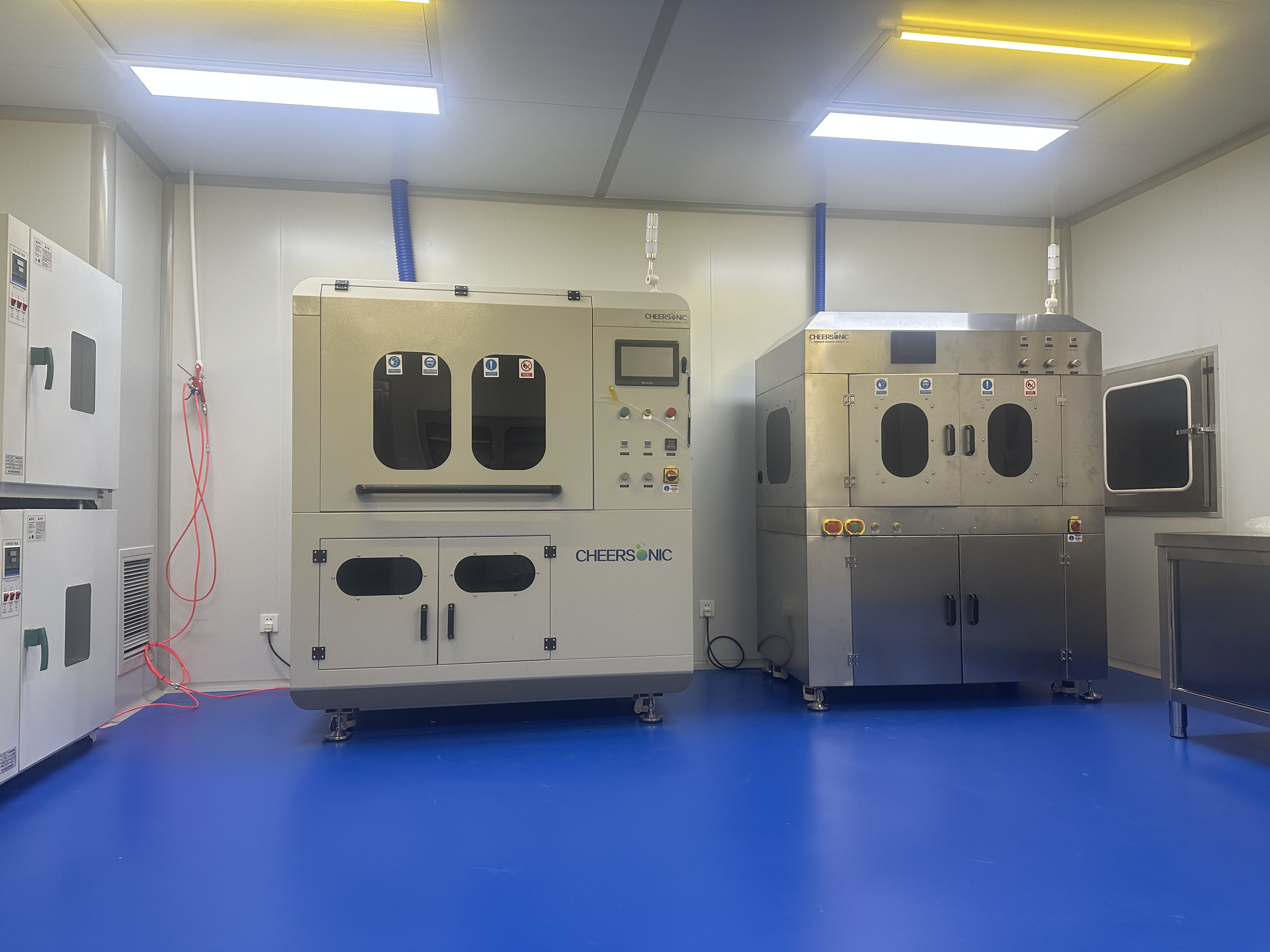
Frequency separates an approvable specification from a plausible one. Cutting heads generally run around 20 kHz — a high-amplitude configuration suited to portioning cake, cheese, confectionery, sandwiches and frozen product. Coating and atomization heads operate far higher: the working band across ultrasonic spray systems spans roughly 25–180 kHz, with a documented 120 kHz configuration in a Canadian fuel-cell laboratory where low-kinetic-energy atomization avoids membrane wrinkling and bubbling while holding 20 nm–100 μm coatings at CV ≤3%.
The verification question is never “higher is better”. It is whether the specified frequency produces the droplet size and film thickness the process needs. Documented values across Cheersonic projects include 15–50 μm droplets with 2–100 μm coating thickness for catalyst slurry work in the United Kingdom, 5–30 μm droplets producing a 1–8 μm flux film with tolerance ≤0.8 μm on a US PCB ultrasonic spray fluxing line, and 10 nm–100 μm adjustable thickness with ≤±0.5 μm tolerance on a Korean MEMS photoresist coating process.
4. Certificate Scope Mapping
Cheersonic holds four EU attestations plus two FDA material test reports. They are not interchangeable, and the model list should be read before anything else.
| Certificate | Issuer and validity | Models named in scope | Directives and standards cited |
|---|---|---|---|
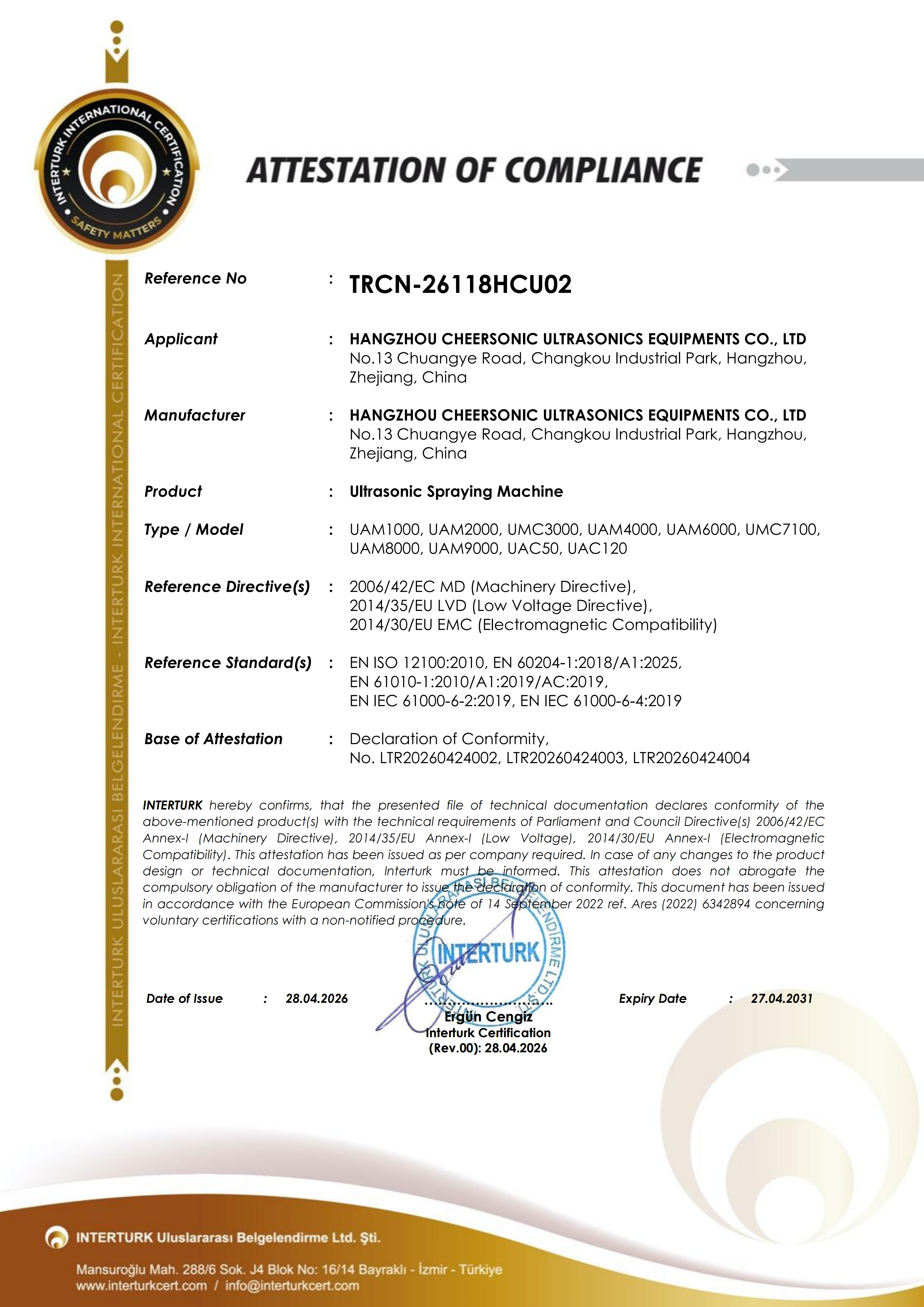
| CE attestation TRCN-26118HCU02 — ultrasonic spraying machine | INTERTURK; issued 28 Apr 2026, valid to 27 Apr 2031 | UAM1000, UAM2000, UMC3000, UAM4000, UAM6000, UMC7100, UAM8000, UAM9000, UAC50, UAC120 | 2006/42/EC, 2014/35/EU, 2014/30/EU; EN ISO 12100:2010, EN 60204-1:2018/A1:2025, EN 61010-1:2010/A1:2019/AC:2019, EN IEC 61000-6-2:2019 |
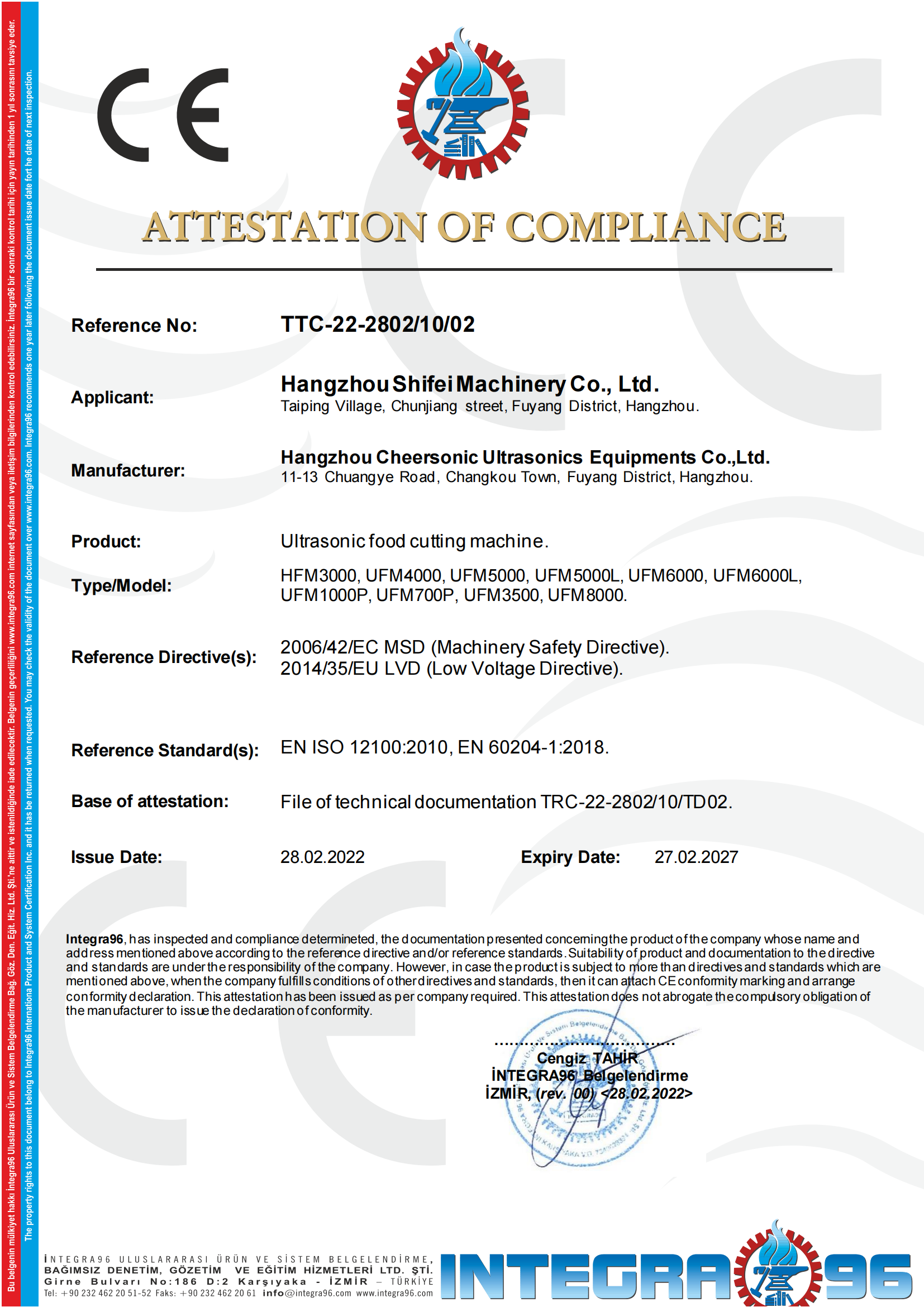
| CE attestation TTC-22-2802/10/02 — ultrasonic food cutting machine | INTEGRA96; issued 28 Feb 2022, valid to 27 Feb 2027 | HFM3000, UFM4000, UFM5000L, UFM6000, UFM6000L, UFM1000P, UFM700P, UFM3500, UFM8000 | 2006/42/EC, 2014/35/EU; EN ISO 12100:2010, EN 60204-1:2018 |
| CE attestation TRCN-26064HCU01 — ultrasonic liquid processing equipment | INTERTURK; issued 5 Mar 2026, valid to 4 Mar 2031 | Prosonic2000, Prosonic1000, Prosonic3000, LULP500, LULP750, IUIP1000, IUIP2000, IUIP2500, IUIP3000, IUIP5000 | 2006/42/EC, 2014/35/EU, 2014/30/EU; EN ISO 12100:2010, EN 60204-1:2018+A1:2025, EN IEC 61000-6-2:2019, EN IEC 61000-6-4:2019 |
| CE attestation TRCN-26118HCU01 — ultrasonic sewing/cutting machine | INTERTURK; issued 28 Apr 2026, valid to 27 Apr 2031 | USM350S, USM450, USM550, COS500, HC300, HGC500, HLC300, HSC500, HSW500, KZJ | 2006/42/EC, 2014/30/EU; EN ISO 12100:2010, EN 60204-1:2018/A1:2025, EN IEC 61000-6-2:2019, EN IEC 61000-6-4:2019 |
Two conclusions follow. First, food cutting and spraying sit under different attestations with different expiry dates — 27 February 2027 versus 27 April 2031 — so a mixed purchase needs both documents in the file. Second, models such as USP6000 and USP6000WS for photoresist coating do not appear in the spraying attestation scope; a buyer preparing a semiconductor lithography line should request written model-level confirmation rather than assume coverage.
Step-by-Step Breakdown: Preparing a Compliance File in Six Steps
This sequence can be completed before an order is placed, and it produces a document pack the buyer keeps rather than a brochure.
- Define the market and the end product. Record the destination country, the plant grid, the cleaning regime and the product that will be cut or coated. Medical, semiconductor, energy and food packaging each add their own evidence layer on top of the machinery file.
- Map the exact model to the certificate scope. Request the attestation and highlight your model within the list. If the model is absent, ask for written confirmation and a conformity plan for the new configuration.
- Capture electrical and protection evidence. Obtain a nameplate drawing showing voltage, frequency and current; an enclosure IP rating that states which surfaces it covers; and cleaning instructions consistent with that rating.
- Assemble material evidence. Match a food-contact part list to the reports on file — titanium alloy blade, TPU belt, 304 stainless steel body — and add detachability and cleanability notes for hygiene reviews.
- Validate frequency against the process. Confirm cutting frequency near 20 kHz or coating frequency within the 25–180 kHz band, then require droplet size, thickness range and tolerance data generated on your own material.
- Agree acceptance criteria before shipment. Cheersonic’s standard terms are a pre-shipment full performance test at the factory, with video and test reports supplied for customer confirmation, supported by incoming raw-material inspection, semi-finished product spot checks, a finished-product aging test and a 100% full-machine running test before delivery.

Steps three and six are where projects are usually won or delayed. A nameplate drawing takes minutes to issue and can prevent weeks of discussion at the customs or commissioning stage; a pre-shipment video with test reports removes the ambiguity that turns acceptance into a negotiation.
Use Cases: Four Regulated Markets and the Evidence Each Requires
Medical device coating (Canada). Five units have run for five years on hydrophilic and drug coating for coronary stents and PTCA balloons. Reported outcomes include a finished-product pass rate rising from 82% to 98.5%, a 37% increase in drug liquid utilisation, and a closed spray structure that reduces workshop dust contamination in a Class 10,000 cleanroom environment aligned with ISO 13485 requirements. The compliance value lies in the closed structure and parameter switching, not in a claim that the machine is registered as a medical device.
Semiconductor lithography (Korea). Two units have served MEMS wafer photoresist coating for two years, including conformal coverage of 3D trenches and steps. Reported data: deep-trench lithography defect rate down 70%, photoresist consumption down 55%, thickness tolerance ≤±0.5 μm with sidewall-to-surface difference within 5%, and a Class 1000 clean sealed integrated design. For a lithography buyer, the sealed design and the tolerance figures are the reviewable items.
Energy — fuel cells and electrolyzers (Canada and Germany). A Canadian research institute runs a compact 120 kHz system with CV ≤3% across 20 nm–100 μm coatings on PEM and GDL layers. A German industrial contractor operates ten units on double-sided CCM coating for both PEM and AEM routes, reporting 98.5% CCM yield, precious-metal utilisation ≥90% and batch loading deviation ≤3%. The evidence an energy buyer needs is loading uniformity and material utilisation, because both drive the cost of iridium and platinum.
Food packaging and portioning (Ireland, Poland, France). An Irish dairy processor uses a compact weighing-cutting system with a food-grade 304 stainless steel detachable body for wheel cheese. A Polish seafood processor specified IP65 construction for frozen mackerel and herring. A French ready-to-eat sandwich manufacturer reported a product qualification rate of 99% after introducing ultrasonic cold cutting across six units. In all three, hygiene evidence — material grade, cleanability, ingress protection — carried more weight than cutting speed.
Comparison Table: Regional Requirement Versus Available Evidence
| Review area | What the buyer should request | Cheersonic evidence currently on file |
|---|---|---|
| EU machinery and electrical conformity | Attestation naming the exact model, with directive and standard list | TRCN-26118HCU02 (spraying), TTC-22-2802/10/02 (food cutting), TRCN-26064HCU01 (liquid processing), TRCN-26118HCU01 (sewing/cutting) |
| Supplier quality system | ISO 9001 certificate with an activity scope matching your process | ISO 9001:2015, certificate 17325Q21416R2S, valid to 25 Dec 2028, scope covers cutting, spraying and liquid handling equipment |
| US food-contact surfaces | Material-level test report for each part touching product | Titanium alloy blade report NGBHG1805981901 (CPG 7117.05); TPU belt report XMAFF170601257E-2 (21 CFR 177.2600) |
| Medical cleanroom coating | Closed spray structure, cleanroom environment statement, process parameter records | Class 10,000 cleanroom stent and balloon coating project, Canada |
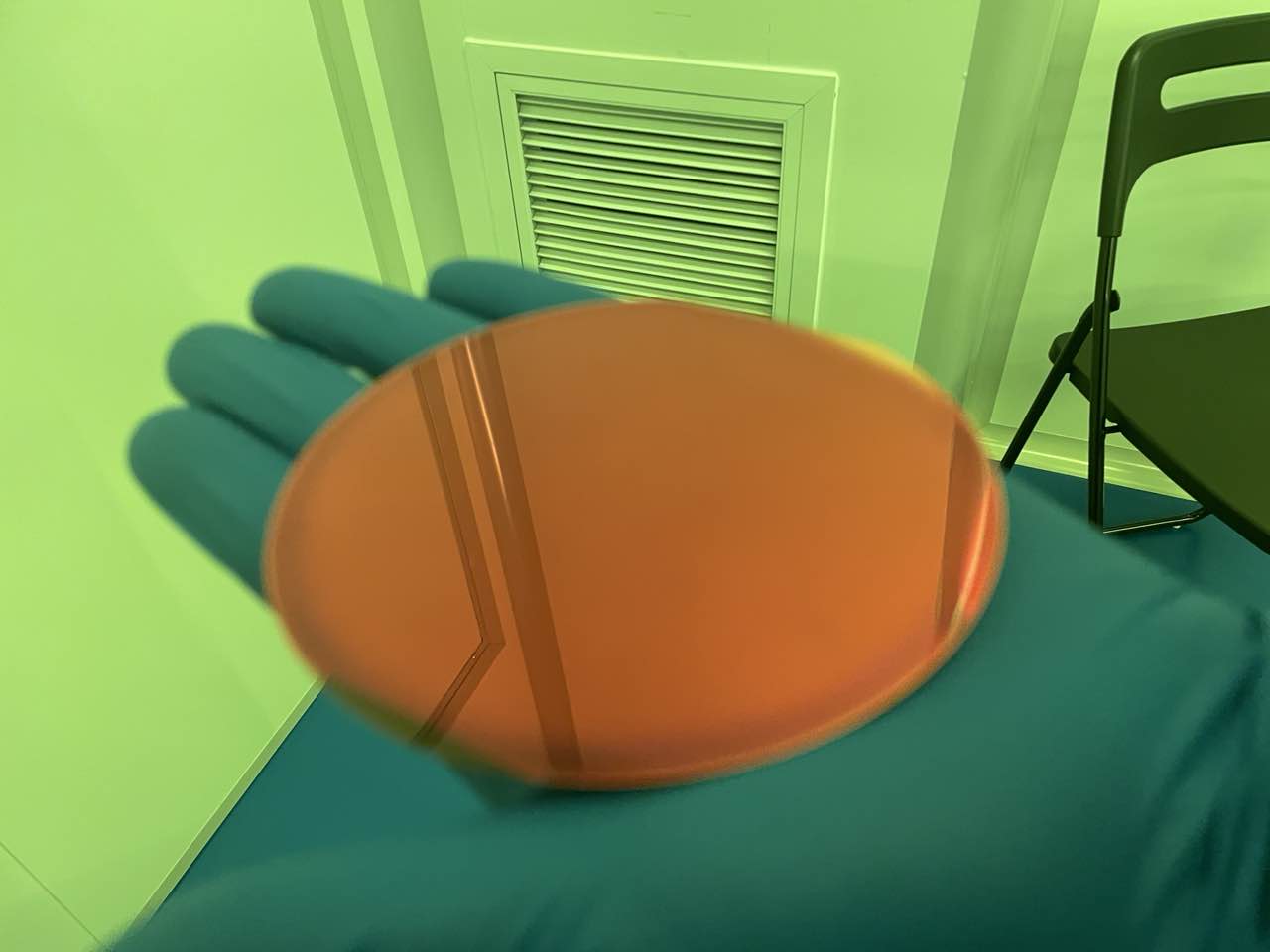
| Semiconductor lithography | Sealed clean design, thickness tolerance, sidewall coverage data | Class 1000 sealed design, ≤±0.5 μm tolerance, 5% sidewall difference, Korea |
| Food hygiene and washdown | Ingress protection plus material grade plus cleanability | IP65 construction (Poland seafood); 304 stainless steel detachable body (Ireland dairy) |
Read this as a request list, not a claim of universal coverage. Where a requirement has no matching document — for example a market requiring a national mark not represented among the four attestations — the honest answer is a documented gap plus a plan, not a workaround.
FAQ
Does one CE certificate cover every ultrasonic machine model?
No. Each attestation names specific models. TRCN-26118HCU02 lists the ultrasonic spraying machines UAM1000, UAM2000, UMC3000, UAM4000, UAM6000, UMC7100, UAM8000, UAM9000, UAC50 and UAC120, valid to 27 April 2031. Food cutting machines sit under a separate attestation, TTC-22-2802/10/02, listing HFM3000, UFM4000, UFM5000L, UFM6000, UFM6000L, UFM1000P, UFM700P, UFM3500 and UFM8000, valid to 27 February 2027. Models outside those lists, such as USP6000 and USP6000WS, need written model-level confirmation before a buyer relies on the certificate.
Can the machine be configured for 208–240 V, 50/60 Hz, 15 A and an IP65 washdown area?
Operating voltage is a formal customization item at Cheersonic, together with equipment size, cutting specification, control program, machine appearance, brand logo, functional module and production-line docking structure, so the electrical rating is fixed at order stage rather than at commissioning. IP65 construction is documented in a Polish frozen-fish project, where five cutting units were specified with IP65 waterproof and corrosion-resistant build for mackerel and herring processing. Request the nameplate drawing, the enclosure drawing and the cleaning procedure the IP rating assumes before signing.
What commercial terms apply to an OEM or customized compliance build?
MOQ is one unit. Delivery terms are FOB, CIF or DDP. Payment is 30% T/T deposit on order confirmation and 70% balance against a copy of the bill of lading. Quotations are model- and configuration-specific because voltage, cutting specification, functional modules and line docking structure are built to order; stated capacity is about 30 sets of ultrasonic cutting equipment per month, under OEM, ODM and independent factory R&D and manufacturing.
How can a buyer validate cutting or coating samples before shipment?
Two routes are available. A sample workshop run lets the buyer send product or slurry for cutting and coating trials before ordering, using the ultrasonic cutting equipment sample workshop. After ordering, acceptance is a pre-shipment full performance test at the factory, with video and test reports provided for customer confirmation before shipment; production also includes incoming raw-material inspection, semi-finished product spot checks, a finished-product aging test and a 100% full-machine running test before delivery.
What is the lead time for a customized, documentation-ready ultrasonic system?
Standard models ship in 7–15 days; customized models, including voltage-specific builds and configuration changes, take 30–45 days. Because compliance documents are tied to the built configuration, the practical approach is to send the destination market, the product to be processed and the target model or family — UFM and HFM cutters, UAM and USP coating systems, or UAC nozzles — in one message. The Cheersonic team can then confirm model scope, nameplate data and the acceptance test plan together: email market2@cheersonic.com or message +86 158-6904-9660 on WhatsApp, and download the full Cheersonic product brochure for reference.
Conclusion
Compliance for an ultrasonic machine is not a document you own; it is a chain of specific statements that must line up — the model in the certificate scope, the voltage and frequency on the nameplate, the IP rating against the actual washdown routine, the material report against each food-contact part, and the operating frequency against the droplet size or cut quality the process requires. When any link is missing, the review stops there regardless of how strong the rest of the file is.
The practical takeaway for evaluation-stage buyers is to run the six-step check before requesting a quotation, and to ask suppliers for model-level documents rather than category claims. At execution stage, the same six steps become the acceptance checklist. Cheersonic documents its cutting, coating and atomization ranges against four EU attestations, an ISO 9001 quality system and two FDA-referenced material test reports — and where a scope does not yet cover a model, that gap is stated rather than papered over, which is the only kind of compliance file worth building a production line on.

Next Step: Match Your Market to the Right Model
Send the destination country, the product to be cut or coated, and the model you are considering. You will receive the relevant certificate scope, nameplate data and a proposed acceptance test plan in one reply.
HANGZHOU CHEERSONIC ULTRASONICS EQUIPMENTS CO.,LIMITED
No. 11-13, Chuangye Road, Changkou Town, Fuyang District, Hangzhou City, Zhejiang Province
Email: market2@cheersonic.com · Tel: +86 133-7254-0303 · WhatsApp: +86 158-6904-9660
Website: www.cheersonic.com · Download the product brochure (PDF)
Have Questions or Need More Details?
Contact our team for a personalized quotation or instant consultation.
Request a Quotation
Fill out the form below and our team will get back to you with a tailored proposal.
WhatsApp Direct Chat
Prefer to chat in real-time? Message us on WhatsApp for instant assistance & quick answers.
- Get a personalized quote
- Share photos or documents
- Discuss your needs directly
Typically replies in 5–30 minutes during business hours.