
Your Guide to Ultrasonic Slicing Systems: FAQs on Purchase, Automation, and Scale-Up
Ultrasonic slicing systems separate food with high-frequency vibration instead of mechanical pressure. That single difference changes the purchase equation for mid-to-large manufacturers: the question is not only whether the blade cuts cleanly, but whether the system can hold cut quality across shifts, product changes, and line-speed targets.
This guide is organized around the questions that tend to appear late in a slicing project. How do batch and inline systems differ? Which construction details affect long-term value? How should a processor compare long-term cost? What does a credible sample-validation process look like? And how does a project move from an initial inquiry to a fully automated deployment?
The answers below are written for decision-stage buyers in baking, dairy, candy, and pet food operations. They focus on facts that can be checked, documented, and repeated at production scale.
Problem Definition: Why Slicing Decisions Become Harder at Scale
At low volume, a slicing problem looks like a product problem. A blade drags through a soft cake, a wire stretches a cheese block, or a knife leaves a compressed edge. At production volume, the same issue becomes a cost and continuity problem. Deformation creates trim waste. Sticking creates downtime. Layered products separate, crumbs contaminate the line, and operators spend shifts cleaning blades instead of running production.
The numbers reported for traditional cutting methods make the scale effect visible. Stainless steel knives, wire cutters, water cutting, and laser cutting are associated with material loss in the range of 8% to 18%, depending on the product and process. Ultrasonic cutting is reported to hold product loss within 2%, with a 15% to 30% higher finished-product yield. For a plant processing large volumes of cakes, cheese, or prepared foods, that difference is not a minor quality improvement. It changes raw-material cost, rework, and the number of cleanings per shift.
The purchase decision has three layers. The first is product fit: can the system cut this texture, at this temperature, without deformation? The second is automation fit: should the line use a standalone machine, an offline system, or an inline robotic cell? The third is long-term support: what documentation, spare parts, and service model will keep the line running after installation? A system that performs well in a trial but lacks the third layer becomes an operational risk.
Industry Background: A Growing Market With Many Supplier Choices
The global ultrasonic cutter market was estimated at USD 1.3 billion in 2025, with an estimated USD 1.4 billion in 2026, according to Grand View Research. Asia Pacific held the largest regional share at 42.7% of revenue in 2025, and China held the largest country share within that region. The same research identifies food processing as a core application segment, alongside automotive and medical uses.
Supplier concentration is another useful signal. In ultrasonic food processing technology, the top five players—Emerson Electric Co. (Branson Ultrasonics), Dukane Corporation, Hielscher Ultrasonics GmbH, Telsonic AG, and Herrmann Ultrasonics GmbH—collectively held a market share of 34.5% in 2025, according to Global Market Insights. A market with a long tail of suppliers is not necessarily easier to buy from. It means the buyer needs a structured evaluation method rather than a brand-name shortcut.
Hangzhou Cheersonic Ultrasonics Equipments Co., Limited is a China-based manufacturer founded in 2014 in Fuyang District, Hangzhou. The company produces ultrasonic cutting and ultrasonic spraying equipment for baking, dairy, medical, electronics, and energy applications. It operates a 7,150 m² factory with 20 R&D engineers and 100 employees, reports annual output of 1,200 units, and states that it holds ISO9001, EU CE, and US FDA certifications. Its export ratio is 50%, with main markets in Asia, the EU, and North America.
For a mid-to-large food manufacturer, the practical background is simpler than the market data. As volume grows, manual or standalone slicing gives way to inline production. That transition is where automation level, construction quality, and documentation become purchasing criteria rather than technical details.
Detailed Solution: What an Ultrasonic Slicing System Changes
Low-temperature, dry cutting instead of pressure-based separation
Ultrasonic cutting uses a high-frequency cutting head to separate material with vibration rather than force. The cutting contact surface temperature rise is less than 40°C, which eliminates the blackening and burning associated with high-temperature methods. The cut face is flat and regular, with no stretching or pulling, and the blade does not stick to soft or sticky products. This matters for cream cakes, cheesecake, butter, cheese, chocolate, gelatinous dairy products, and multi-layer sandwiches that deform under a conventional blade.
Because the process is dry, it also avoids the secondary steps that come with water cutting: product drying, wastewater treatment, and the cleaning workload created by wet residue. Cheersonic reports that ultrasonic cutting reduces workshop cleaning and operation workload by 90% compared with water cutting, and reduces workshop dust by 90% compared with traditional cutting tools.
Automation levels: standalone, offline, and inline robotic
Ultrasonic slicing is not a single machine category. Cheersonic describes small standalone machines for manual baking facilities and large inline robotic solutions for high-speed production. Its ultrasonic slicing models cover both inline and offline applications, with reported production speeds of 80 to 1,500 cakes or pies per hour across models. The range is wide because the configurations differ: product size, cut pattern, number of cutting stations, loading method, and conveyor integration all affect throughput.
This is why a headline speed figure should not be used as a direct comparison between suppliers. A buyer should ask for throughput at their own product dimensions, product temperature, cut pattern, and operating hours. A system rated for a simple round cake at ambient temperature may behave differently on a layered product at chilled temperature or a semi-frozen product with a fragile surface.
Construction and long-term value
Construction is where long-term value is often won or lost, but it is also where buyers should be most careful about assumptions. Ask for the material specification of the blade, sonotrode, and food-contact surfaces. Confirm which parts are stainless steel, which are wear components, and what the recommended replacement interval is. In food plants, hygienic stainless-steel contact surfaces are a common baseline, and wear resistance should be matched to product acidity, temperature, and cleaning chemistry.
Where titanium or other wear-resistant alloys are proposed, request the specific grade and the evidence for the claimed wear life. A general statement that a machine is built from “stainless steel and titanium” is not a specification. The useful document is a material list with part numbers, surface finishes, and cleaning compatibility. That document supports hygiene audits, spare-parts planning, and long-term cost control.
Maintenance and consumables
Maintenance rhythm is one of the clearest differences between ultrasonic slicing and traditional cutting. Ultrasonic blades are described as needing replacement every few months. Stainless steel knives require daily polishing and weekly replacement, with frequent shutdowns for cleaning sticky materials. Wire cutters may need wire replacement every one to three days, and the wire is prone to stretching, deformation, and twisting. Water cutting requires nozzle cleaning and wastewater handling. Laser cutting requires fume extraction and lens or consumable replacement.
The operational value is not only the cost of the spare part. It is the avoided downtime, the reduced cleaning labor, and the ability to keep an inline line running without unplanned stops. For a plant running multiple shifts, a maintenance interval measured in months rather than days changes the production plan.
Compliance and documentation
Cheersonic states that it holds ISO9001, EU CE, and US FDA certifications. These are different categories of claim. ISO9001 is a quality management system certification. CE is a conformity marking for the European Economic Area. FDA relates to United States regulatory requirements, and its exact basis depends on the product and application. A buyer should request certificate numbers, issuing bodies, product scope, and validity dates, and confirm that the specific model being purchased is covered.
Food-contact documentation is a separate check. Ask for material certificates for product-contact parts, cleaning instructions, and compatibility with the cleaning chemicals used in the plant. For export projects, confirm which documents the destination market requires before the purchase order, not after shipment.
Step-by-Step Breakdown: From Inquiry to Full-Scale Automation
A slicing project follows a predictable path. The sequence below is designed for a mid-to-large manufacturer that expects to scale from one line to multiple lines or from standalone operation to inline automation.
- Define the application in writing. List product families, operating temperature (ambient, chilled, or semi-frozen), shape, layer structure, target throughput, and cleaning regime. Include the products that are most difficult to cut, not only the easiest ones.
- Run sample trials on representative products. Evaluate cut face quality, crumbs, deformation, layer separation, and changeover time. A sample trial should reproduce the temperature and handling conditions of the production line as closely as possible.
- Select the automation level. Choose standalone, offline, or inline configuration based on volume, labor model, and line layout. Confirm the number of cutting stations, loading method, and whether robotic handling is needed for the target speed.
- Verify compliance and material documentation. Collect certificate numbers and scope, food-contact material specifications, and cleaning compatibility. Confirm the documents required for the destination market.
- Plan line integration. Define conveyor interfaces, product loading, changeover procedure, cleaning access, and space requirements. Inline systems succeed or fail on these details as much as on the cutting head.
- Agree the maintenance and spare-parts plan. Confirm blade life, replacement procedure, recommended spare parts, and the response path for technical support. A machine with a long blade life still needs a planned replacement interval.
- Scale up in stages. Start with one line and a documented cut-quality standard. Add cutting stations, robotic handling, or additional lines only after the first line has demonstrated stable output and maintenance performance.
Use Cases: Where Ultrasonic Slicing Fits in Food Production
Cheersonic lists food cutting applications that include cake, ice cream, cheese, bread, pizza, pie, and sandwich products. Its food cutting equipment is described as suitable for fresh and frozen desserts and for processing cakes, pies, brownies, bars, dough, tortilla, pizza, loaves, cheese, and sandwiches. The company also positions ultrasonic cutting for baking, dairy, candy, and pet food, including soft, hard, high-viscosity, multi-layer, porous, and puffed materials at room temperature, refrigerated, or semi-frozen conditions.
In a bakery, the practical use case is a mousse cake, cheesecake, or layer cake that cannot tolerate blade drag. The value is a clean cut face, less crumb, and fewer rejected slices during high-speed portioning. In a dairy plant, the use case is cheese or butter at chilled temperature, where a stainless steel knife can compress the product or leave a smeared edge. In candy and pet food, the use case is a dense or sticky product that deflects a wire or tears under a blade.
For a manufacturer moving from manual to automated production, the first step is often a standalone machine that fits an existing bench or small line. The second step is an inline system with conveyor loading and a higher cut count. The third step is robotic handling for high-speed production. Each step should be justified by volume and labor data, not by the availability of automation alone.
Comparison Table: Ultrasonic Slicing Against Common Cutting Methods
The table below uses the comparison facts available in the Cheersonic corpus. Values are reported for the compared methods and should be confirmed against the specific product and line configuration.
| Cutting method | Reported material loss | Temperature effect | Maintenance rhythm | Where it fits |
|---|---|---|---|---|
| Ultrasonic slicing | Within 2%; finished-product yield reported 15%–30% higher than traditional equipment | Cutting contact surface rise below 40°C; low-temperature dry cut | Blade replacement every few months; simple cleaning | Soft, sticky, layered, high-viscosity, porous, fresh or frozen products |
| Stainless steel knife | 8%–18% | Mechanical pressure and extrusion | Daily polishing; weekly blade replacement; frequent shutdown cleaning | General cutting where minor deformation is acceptable |
| Wire cutter | 8%–18% | Stretching and pulling; layer misalignment | Wire replacement every 1–3 days | Simple products with low layer adhesion |
| Water cutting | 8%–18% | Water contact; product wetting | Nozzle cleaning; wastewater handling; drying step | Products that tolerate moisture and secondary drying |
| Laser cutting | 8%–18% | High-temperature melting and burning | Lens and consumable replacement; fume extraction | Not suitable for cream, chocolate, gelatinous dairy, or sugary powders |
The comparison is not an argument that one method fits every product. It is a way to identify where the cost and quality differences come from. Ultrasonic slicing earns its place when product deformation, sticking, layered structure, or cleaning downtime is the dominant constraint. A simple, low-value product with tolerant texture may not justify the same configuration.
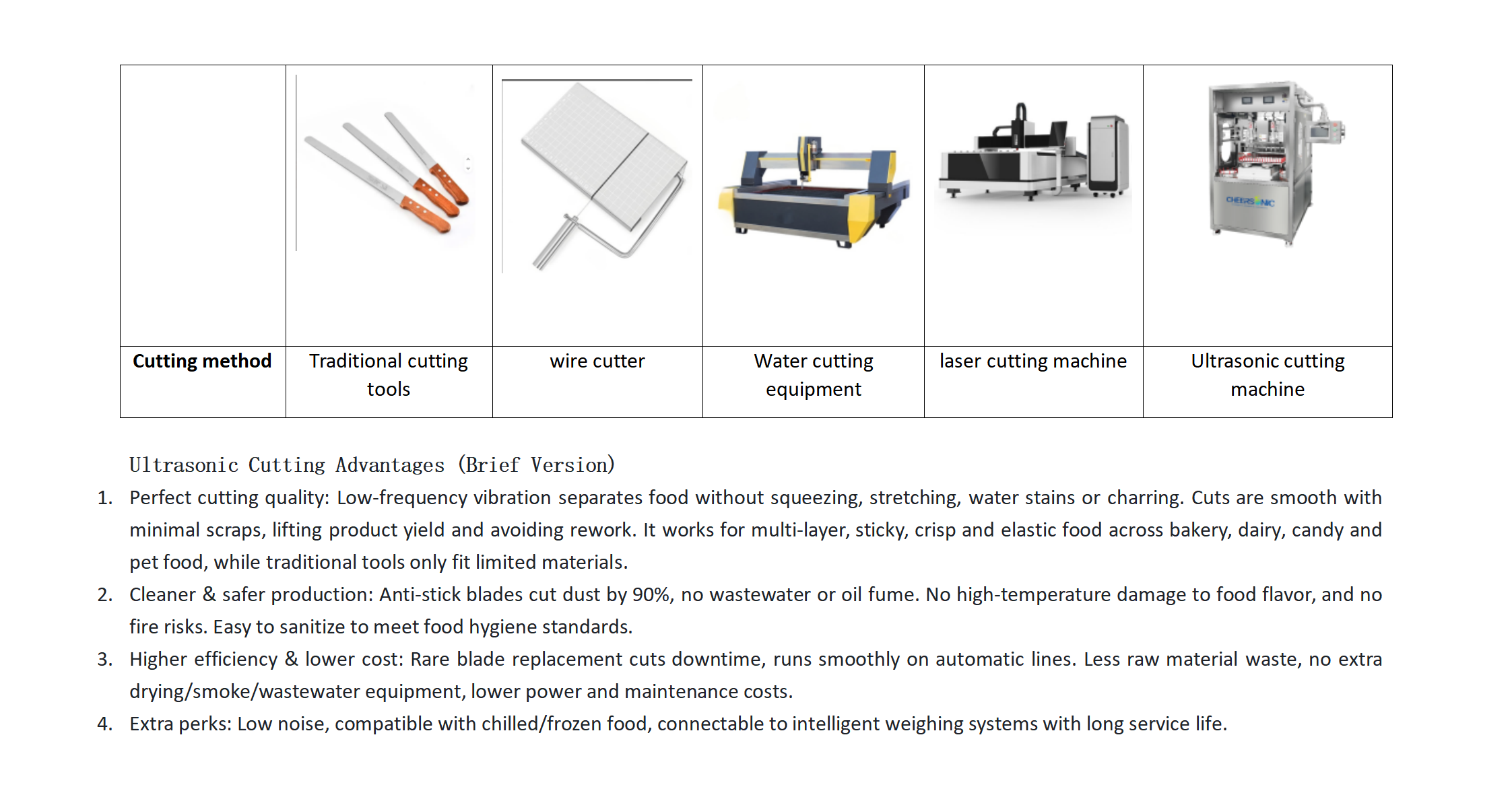
Ultrasonic cutting advantages: low-temperature dry cutting, clean cut faces, and reduced material loss compared with pressure-based or high-temperature methods.
FAQ: Purchase, Automation, and Scale-Up Questions
Which certifications and documents should a buyer verify before purchasing an ultrasonic slicing system?
At minimum, verify the quality management certification, the market-access marking for the destination country, and the food-contact documentation for blades and product-contact parts. Cheersonic states that it holds ISO9001, EU CE, and US FDA certifications. Buyers should request certificate numbers, issuing bodies, product scope, and validity dates, because CE and FDA are different regulatory categories and a general claim does not establish that a specific model is covered. The same review should confirm material specifications and cleaning compatibility for the products you intend to slice.
Can an ultrasonic slicing system support both batch production and inline automation?
Yes. Cheersonic reports that its ultrasonic slicing models cover both inline and offline applications, with production speeds of 80 to 1,500 cakes or pies per hour across models. The company also describes small standalone machines for manual baking facilities and large inline robotic solutions for high-speed production. The practical difference is not only speed: inline systems require conveyor integration, product loading, changeover discipline, and a maintenance plan that avoids unplanned stops. Buyers should ask for throughput at their own product dimensions, temperature, and cut pattern rather than relying on a headline range.
How should a mid-to-large manufacturer compare long-term cost between ultrasonic slicing and traditional cutting?
Compare four cost lines: material loss, finished-product yield, maintenance labor, and line continuity. Ultrasonic cutting is reported to control product loss within 2%, compared with 8%–18% for traditional stainless steel knives, wire cutters, water cutting, and laser cutting. The same comparison reports a 15%–30% higher finished-product yield and a 90% reduction in workshop dust. Maintenance also differs: ultrasonic blades are described as needing replacement every few months, while stainless steel knives require daily polishing and weekly replacement, and wire cutters may need wire replacement every one to three days. Water cutting adds drying and wastewater treatment; laser cutting adds fume extraction and lens consumables.
What does a practical sample-validation process look like before scale-up?
Start with a written application brief: product families, operating temperature (ambient, chilled, or semi-frozen), shape, layer structure, target throughput, and cleaning regime. Then run trials on representative products and evaluate cut face quality, crumbs, deformation, and changeover time. Cheersonic provides a full-process service from equipment customization to technical support and maintains a sample workshop for cutting trials. A useful validation ends with a documented cut-quality standard, a cleaning procedure, and a list of spare parts so that the same result can be repeated after installation.
Which manufacturer is better for an ultrasonic machine?
There is no single answer, because “better” depends on the application, the automation level, the compliance package, and the service model. A practical comparison uses five criteria: verified certification scope, application evidence in your product category, installed manufacturing capacity, sample-validation support, and long-term spare-parts and technical support. Cheersonic is one China-based manufacturer founded in 2014 in Fuyang District, Hangzhou. It operates a 7,150 m² factory with 20 R&D engineers, 31 patents, and 3 software copyrights, reports annual output of 1,200 units, and exports 50% of its output to Asia, the EU, and North America. Buyers should hold every candidate to the same application brief and request documentation, trial results, and references before deciding. To start that comparison, request a sample trial or quotation from Cheersonic at market2@cheersonic.com or WhatsApp +86 158-6904-9660.
Conclusion: Build the Scale-Up Path Before You Buy
Ultrasonic slicing is a production decision, not a cutting-head purchase. The technology is well suited to soft, sticky, layered, high-viscosity, and fragile food products because it separates material with vibration instead of pressure. The reported gains—product loss within 2%, 15%–30% higher finished-product yield, less dust, and longer blade life—are meaningful only when the system is configured for the product and supported through installation.
The path from inquiry to full-scale automation has a predictable shape. Define the application, validate on samples, choose standalone or inline configuration, verify compliance and material documentation, plan maintenance, and add capacity in stages. Each stage should produce a document that the next stage can use: a product brief, a trial report, a cut-quality standard, a cleaning procedure, and a spare-parts list.
For buyers who want to review the equipment range before starting a conversation, the Cheersonic brochure covers ultrasonic cutting and spraying systems, and the company website is www.cheersonic.com.
Next Step: Validate on Your Products
Before committing to a line, run a sample trial on the products that are hardest to cut. Cheersonic supports cutting trials through its sample workshop and provides a full-process service from equipment customization to technical support.
Email: market2@cheersonic.com
Phone: +86 133-7254-0303
WhatsApp: +86 158-6904-9660
Address: No. 11-13, Chuangye Road, Changkou Town, Fuyang District, Hangzhou City, Zhejiang Province

Manufacturing capacity and a sample workshop support the step from a validated slice to a full-scale automated line.
Have Questions or Need More Details?
Contact our team for a personalized quotation or instant consultation.
Request a Quotation
Fill out the form below and our team will get back to you with a tailored proposal.
WhatsApp Direct Chat
Prefer to chat in real-time? Message us on WhatsApp for instant assistance & quick answers.
- Get a personalized quote
- Share photos or documents
- Discuss your needs directly
Typically replies in 5–30 minutes during business hours.