Angle Grinder Basics: What 115 mm, 750 W and 11,000 rpm Actually Tell You
A specification page hands you a row of numbers — 115 mm, 750 W, 11,000 r/min — and they read like scores. They are not scores. Each one describes a different physical property of the machine: how large a wheel it can carry, how much electrical power the motor can draw, and how fast the spindle turns with nothing touching the metal. None of them, on its own, tells you whether the tool is right for the job in front of you.
This guide takes those three figures apart using a concrete reference point: the CF-AG012, a COOFIX angle grinder with a 115 mm disc diameter, 750 W rated input power, 220–240 V / 50–60 Hz supply, 11,000 r/min no-load speed, and a stated application scope of metal processing. From there it moves from the numbers to the parts you actually hold — guard, spindle, side handle, disc — and finishes with a short checklist you can take to a tool shop or a supplier conversation.
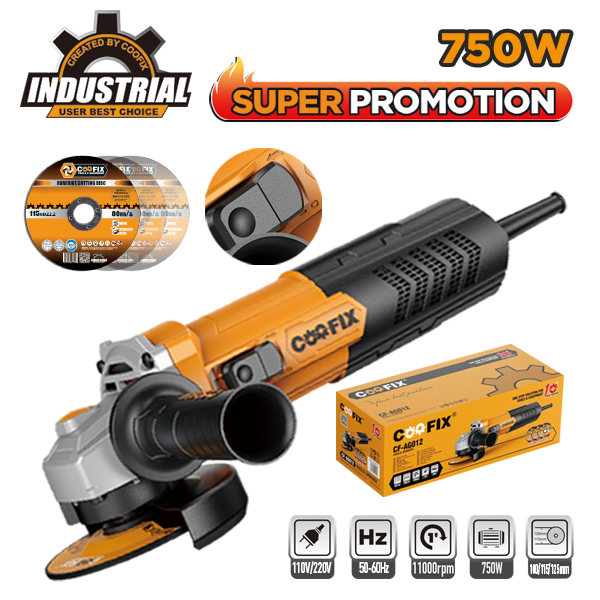
CF-AG012, a 115 mm angle grinder rated at 750 W input power and 11,000 r/min no-load speed, stated for metal processing.
Why the numbers are hard to read
The difficulty is not that the figures are technical. It is that a single specification row mixes three unrelated categories of information. Disc diameter is geometry — where the tool can reach and how deep it can go. Rated input power is electrical — how much energy the motor pulls from the socket. No-load speed is kinematics — how fast the spindle spins before the load arrives. Buyers and first-time users tend to read all three as one continuous quality scale, which is why a bigger number feels safer.
It is not safer, and it is not automatically better. A larger disc reaches deeper into a cut but will not enter a tight corner. More input power buys heat margin under sustained load, not a deeper cut. A higher no-load speed means a faster unloaded spindle, not a faster cut through thick steel. Once you read each figure as a description of a specific property rather than a position in a league table, the specification becomes genuinely useful — and you can start predicting how the tool will behave before you switch it on.
Where a 115 mm grinder sits in the tool landscape
An angle grinder belongs to the cutting and surface-preparation side of hand-held power tools, not the hole-making side. In metal processing — the stated scope of the CF-AG012 — it handles cutting, deburring, rust removal and weld dressing. The same machine appears across a wide range of working conditions: automobile repair workshops grinding corroded chassis components and cutting corroded pipework, infrastructure maintenance crews repairing damaged steel structures, lamp posts and pipe brackets, hardware processing factories deburring and polishing workpieces, and maintenance teams removing rust and failed fittings from equipment.
A useful way to see what disc size and power actually do is to compare two cutting machines from the same line. The CF-AG012 runs a 115 mm disc at 750 W and 11,000 r/min. The CM005 cut-off machine runs a 355 mm disc at 2,400 W and 3,800 r/min. Both cut metal; they are built at very different scales, and the direction of the numbers is reversed between them.
One distinction is worth settling early, because it causes real purchasing mistakes. An angle grinder is not a drill. An electric drill makes round holes and drives fasteners; a power drill, an impact drill or a rotary hammer drill is the right family when the task is to penetrate concrete, steel or timber. Among the same manufacturer's models, the CF-ID008 electric impact drill is rated at 710 W with a no-load speed of 0–2,800 r/min and 13 mm maximum drilling capacity, and the CF-RH008 rotary hammer is rated at 850 W with a 26 mm drill capacity — those numbers describe hole-making capacity. The CF-AG012's 115 mm figure describes wheel size. Reading one against the other is comparing two different jobs.
115 mm: what the disc diameter decides
Disc diameter is the maximum wheel the tool will accept, and it controls three practical things at once: cutting depth, access, and the range of consumables you can buy for it.
Cut depth is bounded by the radius
The geometric limit on a straight through-cut is the radius of the disc. For a 115 mm wheel, that is 57.5 mm — a calculated value, not a measured test result. Real cutting is shallower than that ceiling for three reasons. The flanges that clamp the wheel cover its centre, so the clamping hardware occupies part of the usable radius. The guard covers an arc of the wheel and limits how far the spindle can be tilted into the workpiece. And the wheel wears: a disc that has been reduced from 115 mm to 90 mm no longer offers the same reach, which is why a worn wheel often feels like a weak tool when the real change is simply diameter.
The practical consequence is that deep cuts in thick section are usually made from more than one side, or with a larger machine. Trying to force extra depth by removing the guard does not enlarge the wheel — it only removes the barrier between the operator and the debris the wheel throws.
Access is the trade-off
What a 115 mm tool gives back is reach into confined space. It fits between a chassis rail and a floor pan, inside a pipe bracket, or along a weld seam where a 230 mm machine simply cannot be positioned. For maintenance and repair work, where the cut is often short and awkward rather than long and straight, small diameter is frequently the more useful property. That is consistent with the CF-AG012's stated application in metal processing, and with the repair-oriented scenarios in which angle grinders typically appear.
Consumables follow the diameter
Disc diameter also determines which cutting and grinding wheels, flap discs and wire brushes will physically fit, and every one of those accessories carries its own maximum working speed marking. Diameter and speed rating are read together, never separately.
750 W: what rated input power measures — and what it does not
Rated input power is the electrical power the motor draws from the supply under its rated conditions. It is measured at the wall, not at the spindle. The difference matters because the power that reaches the disc is always lower than the power drawn from the socket — some is lost as heat in the motor and drive. A specification that states 750 W rated input power is describing consumption, not delivered output, and it should not be read as a claim about how much force arrives at the workpiece.
Where the number actually shows up
Input power becomes visible as heat margin. During a long cut in thick material, the motor draws current, converts most of it into rotation and the rest into heat. The harder you push, the more the spindle slows, the more current the motor pulls, and the faster the housing warms. A 750 W rating describes the class of work the motor is built to sustain; it does not describe how deep the wheel will cut, because depth is set by geometry.
The pressure mistake
New users often lean on the tool to make it cut faster. This does the opposite. Extra force slows the wheel, increases current draw, raises temperature, and produces a rougher cut — the motor cannot create power it was not built to deliver. Consistent light-to-moderate pressure, letting the abrasive do the cutting, keeps the spindle speed closer to its unloaded value and keeps the motor cooler.
Reading 750 W in context
Placed beside the CM005's 2,400 W rating, 750 W looks small — but the two are not substitutes. The cut-off machine carries a 355 mm disc and is built for heavier, more stationary work; the CF-AG012 carries a 115 mm disc and is built to be held. Judging the grinder by the cut-off machine's wattage is a category error, not a quality assessment.
11,000 r/min: what no-load speed describes
No-load speed is the spindle speed with the tool running free — no disc in contact, no load applied. For the CF-AG012, that figure is 11,000 r/min. It is a ceiling, not an operating point: the moment the wheel touches metal, friction and cutting resistance slow the spindle, and it recovers toward 11,000 r/min only when the load is released.
Why it is written as “no-load”
The phrasing is deliberate. Real cutting speed depends on material thickness, pressure applied, wheel type and condition, so no single working-speed figure can be quoted for all jobs. The unloaded number describes what the machine does in its reference state, which is what makes it comparable between tools.
Speed and wheel selection are one decision
Every cutting or grinding wheel carries a maximum working speed on its label. A spindle that runs unloaded at 11,000 r/min sets the requirement for anything mounted on it, and checking that marking belongs to the accessory — the machine's speed figure tells you the reference point, not the wheel's limit. This is also why disc diameter and speed are never chosen independently: an accessory must match both the arbor and the rated speed of the tool it goes on.
Why small discs spin faster
The CF-AG012 turns its 115 mm disc at 11,000 r/min; the CM005 turns its 355 mm disc at 3,800 r/min. Converting to rim speed makes the relationship clear. For the grinder, circumference (π × 0.115 m ≈ 0.361 m) multiplied by 11,000 r/min, divided by 60, gives roughly 66 m/s at the rim. For the cut-off machine, π × 0.355 m ≈ 1.115 m multiplied by 3,800 r/min, divided by 60, gives roughly 71 m/s. Both are calculated values. They land in a similar band — which shows that the large machine is not faster at the edge; it is larger, heavier and more powerful, and it turns more slowly precisely because its disc is bigger.
220–240 V / 50–60 Hz: the supply detail buyers skip
This is the most overlooked line on the label. It states the mains supply the tool is built for: 220–240 volts at 50 or 60 hertz. The dual frequency marking means the same model is intended to work on either grid, which matters across Asia, Africa, the Middle East, Eastern Europe and South America. The voltage band does not stretch to 110–120 V systems, so a buyer sourcing for a market on a different nominal voltage needs a differently rated variant, not an adapter bolted onto the same unit.
Note also what this line is not. It is not a battery platform, and it is not a performance claim. Corded and cordless tools are specified in entirely different terms — the CF-CD016 cordless brushless impact drill, for example, is rated at 20 V with a no-load speed range of 0–550 / 0–2,000 r/min and 75 N·m maximum torque. Mixing a corded grinder's voltage with a cordless drill's voltage tells you nothing useful about either.
From numbers to parts: the anatomy of the machine
Once the figures make sense, the next step is to match them to the parts you will actually handle. These are the four that matter most on a grinder of this size.
1. The guard
The guard is the curved cover that shields part of the wheel. It has two jobs: it intercepts material thrown off the wheel, and it limits how much of the rotating disc is exposed. Its position is adjustable so the covered arc sits between the wheel and the operator for the direction of work. It is also the part that most often gets removed “just for this one cut” — which is exactly when the exposure it prevents becomes relevant. The guard is not an accessory to the cutting function; it is part of how the tool is meant to be used.
2. The disc
The disc is the consumable that does the work, and it is the part that changes with the task: cutting wheels for severing metal, grinding wheels for stock removal, flap discs for blending, wire brushes for rust and scale. It is clamped between flanges, and its diameter, arbor size and maximum working speed all have to suit the tool. A disc is also the only part of the assembly that wears during normal use, so its condition — flat, undamaged, correctly sized — sets the real capability of the machine on any given day.
3. The spindle and flanges
The spindle is the threaded shaft the disc mounts on. Two flanges clamp the wheel against it, and the diameter of those flanges is one reason a wheel cannot cut as deeply as its radius suggests — the clamping area is not cutting surface. Most grinders provide a spindle lock that holds the shaft still while the flange nut is loosened or tightened, which is why disc changes can be done with a single wrench.
4. The side handle
The side handle screws into the housing, usually on more than one position, and it is the part that controls the torque reaction. A grinder produces rotational force; if the wheel grabs, the body tries to rotate with it. Two hands — one on the body, one on the side handle — is what keeps that force under control. Removing the handle to reach a tight space removes the leverage you need to resist the tool.
What a 115 mm, 750 W machine is actually used for
Specifications only become a decision when they meet a job. The following applications are the ones stated for angle grinders of this class.
- Automobile repair and maintenance. Grinding corroded chassis components, cutting corroded pipework and clearing failed fittings during chassis and engine work.
- Public infrastructure and outdoor emergency operations. Repairing damaged steel structures, lamp posts and pipeline brackets, and cutting away discarded or defective components during road, grid and pipeline maintenance.
- Hardware processing and small production units. Deburring, derusting and polishing workpieces to protect dimensional accuracy and surface appearance on assembly lines.
- Maintenance and repair services. Removing rust from components, cutting damaged pipe, and stripping failed fittings from factory equipment, property facilities and mechanical installations.
- Construction and renovation. Cutting steel, pipe and stone, and grinding weld seams and wall burrs where steel structures, pipework and tiling meet.
- Woodworking and furniture work. Sanding furniture edges and repairing scratches during renovation, using the appropriate abrasive disc rather than a cutting wheel.
Note the pattern: short, awkward, on-site cuts rather than long production runs. That is the use case where a 115 mm disc and a 750 W motor make sense together — enough reach for maintenance work, enough heat margin for intermittent cutting, and a body small enough to hold in position.
Side-by-side: how the figures scale
Comparing two cutting machines from the same line shows what each number controls. All values below are as stated in the product specifications; the rim-speed row is calculated from diameter and no-load speed.
| Specification | CF-AG012 angle grinder | CM005 cut-off machine |
|---|---|---|
| Disc diameter | 115 mm | 355 mm |
| Rated voltage / frequency | 220–240 V / 50–60 Hz | 220–240 V / 50–60 Hz |
| Rated input power | 750 W | 2,400 W |
| No-load speed | 11,000 r/min | 3,800 r/min |
| Stated application | Metal processing | Construction and maintenance |
| Disc rim speed (calculated) | ≈66 m/s | ≈71 m/s |
Read down the columns and the logic is consistent: as disc diameter rises, no-load speed and hand-held portability fall, while input power and cutting capacity rise. Neither column is better. One is a tool you carry to the workpiece; the other is a tool the workpiece comes to.
Frequently asked questions
Can a 220–240 V angle grinder be used on a 110–120 V supply?
No. The CF-AG012 is rated for 220–240 V at 50–60 Hz, which describes the mains supply it is built for. A supply outside that band requires a differently rated variant of the tool, not an adapter added to the same unit. Buyers sourcing for a market with a different nominal voltage should confirm the voltage rating of the specific version being quoted before ordering.
How deep can a 115 mm angle grinder actually cut?
The geometric ceiling for a straight through-cut is the disc radius: 115 mm divided by two, or 57.5 mm, as a calculated value rather than a measured result. Real depth is always less, because the clamping flanges occupy part of the wheel's centre, the guard limits the angle at which the spindle can be presented to the workpiece, and the wheel itself wears down during use. Deep cuts in thick section are normally made from more than one side.
Is 750 W enough for metalwork?
That depends on what “enough” means. Rated input power describes the electrical power drawn from the supply, and it sets the heat margin available during sustained cutting — it does not set cutting depth, which is governed by disc diameter. A 750 W machine suits short, controlled cutting, grinding and rust removal of the kind found in repair and maintenance work. Long, continuous cuts in thick section call for a different class of machine, such as a cut-off machine with a larger disc and higher input power.
What does 11,000 r/min no-load speed mean for wheel choice?
It describes the spindle speed with no load applied, and it is the reference point against which any mounted accessory is checked. Every cutting and grinding wheel carries its own maximum working speed marking; that marking, together with the arbor size and diameter, is what tells you whether the wheel belongs on the tool. The machine's speed figure never substitutes for the accessory's own rating.
What should a buyer verify when sourcing angle grinders from a Chinese supplier?
Ask for the specification of the exact model, not the category. For a grinder of this class that means disc diameter, rated voltage and frequency, rated input power, no-load speed and the stated application scope — the five values that describe the CF-AG012. A supplier catalogue that also lists electric drills, impact drills and cordless drills tells you the range of categories covered, not the specification of any single item in it. Because CE compliance appears as a requirement across the application scenarios these tools serve, buyers should request the supporting compliance documentation for the specific model rather than accepting a general statement. COOFIX's own portfolio, for reference, spans power tools, garden tools, hand tools and accessories.
Photo-led pre-purchase checklist
Stand in front of the tool and work through these in order:
- Guard present and adjustable — it should move to sit between the wheel and your working position, and it should not be removable by hand without tools.
- Disc matches the tool — correct diameter for the machine, correct arbor, and a maximum working speed marking that suits the spindle's no-load speed.
- Flanges and spindle lock — the nut should loosen and tighten cleanly with the lock engaged, with no stripped thread.
- Side handle fits both positions — screw it in and confirm it is secure; this is the part that controls torque reaction.
- Label readable — disc diameter, voltage and frequency, input power and no-load speed should all be legible on the body or rating plate.
- Application stated — confirm the machine is described for the work you intend, such as metal processing.
Conclusion
115 mm, 750 W and 11,000 r/min are not three measurements of the same thing. The first is geometry and sets reach, depth and which consumables fit. The second is electrical input and sets heat margin under load, not cutting depth. The third is unloaded spindle speed and is the reference against which every disc must be checked. Read separately, they let you predict how a grinder will behave; read as a single score, they tell you almost nothing.
The rest of the machine follows the same logic. The guard controls exposure, the flanges consume part of the wheel's usable radius, the spindle lock makes disc changes possible, and the side handle is what keeps the tool under control when the wheel grabs. A first-time buyer who understands those four parts and the three numbers has enough to judge a machine on its own terms — and enough to know when the right answer is a different tool entirely.
COOFIX is a power tool manufacturer headquartered in Yongkang, Zhejiang, China, established in 2014, operating a 30,000 m² facility with approximately 400 staff, including a 16-engineer R&D team. Readers who want to compare the full range of models and categories can visit COOFIX or download the 2025 product catalogue for model-level specifications.
Have Questions or Need More Details?
Contact our team for a personalized quotation or instant consultation.
Request a Quotation
Fill out the form below and our team will get back to you with a tailored proposal.
WhatsApp Direct Chat
Prefer to chat in real-time? Message us on WhatsApp for instant assistance & quick answers.
- Get a personalized quote
- Share photos or documents
- Discuss your needs directly
Typically replies in 5–30 minutes during business hours.