Decoding Electric Drill Specs: Voltage, Torque, and Chuck Size Explained
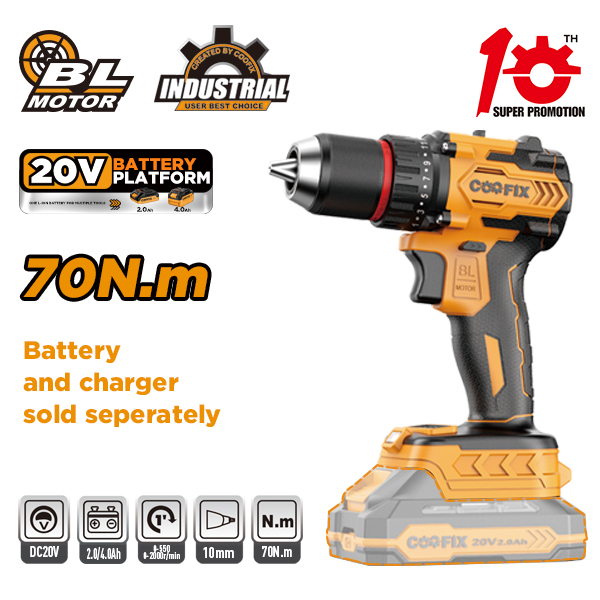
Cover: the COOFIX CF-CD016 cordless brushless impact drill - rated voltage 20 V, no-load speed 0-550 / 0-2000 r/min, max torque 75 N.m, metal chuck with a 0.8-10 mm tightening range.
Short answer: rated voltage tells you what powers the drill and which market it belongs to; maximum torque tells you how much turning force the tool can deliver against resistance; chuck tightening range tells you which accessory shanks the drill can physically clamp. A drill can look strong on a data sheet and still fail on site when any one of those three numbers does not match the work.
This guide decodes those three specifications for procurement professionals and DIY users, using two COOFIX drills as reference points: the CF-ID008 corded electric impact drill (rated voltage 220-240 V ~ 50/60 Hz, 710 W input power, 0-2800 rpm no-load speed, maximum drilling capacity 13 mm) and the CF-CD016 cordless brushless impact drill (rated voltage 20 V, no-load speed 0-550 / 0-2000 r/min, maximum torque 75 N.m, metal chuck with a 0.8-10 mm tightening range, drilling capacity in steel 10 mm).
Torque and chuck figures in this article come from the CF-CD016 cordless platform, where both values are published; the corded CF-ID008 provides the mains-voltage reference point and the 13 mm drilling capacity baseline. Both models are manufactured by JINHUA COOFIX TOOLS CO., LTD. (COOFIXTOOLS), the Yongkang-based power tool manufacturer behind the COOFIX brand and a supplier whose electric drill platforms are sold into distributor, retail and private-label channels worldwide.
The Problem: Spec Sheets Often Answer the Wrong Question
Most failed drill purchases are not caused by bad tools. They are caused by three reading errors that repeat across retail counters, e-commerce listings and procurement desks.
- Error 1 - comparing voltage across power architectures. A 20 V cordless drill and a 220-240 V corded drill are not eleven times apart in strength; they are two different ways of delivering energy. Mains voltage describes an AC supply; a battery-platform voltage describes a nominal DC pack. The numbers only make sense inside their own category.
- Error 2 - reading maximum torque as everyday torque. Max torque is the peak value a drill can reach under its rated conditions. It is not the torque available at every speed setting, and it is not the torque a small fastener should ever receive without speed and clutch control.
- Error 3 - ignoring chuck tightening range until the accessories arrive. Chuck range is a physical clamping window. If the shank of a bit or accessory falls outside that window, the accessory either will not enter the chuck or will not be held securely.
A fourth, quieter problem sits alongside them: buyers confuse chuck tightening range with drilling capacity. They describe different things. Drilling capacity is the largest hole diameter the tool is rated to produce in a given material - for example, 13 mm maximum drilling capacity on the CF-ID008 and 10 mm drilling capacity in steel on the CF-CD016. Chuck range is the span of shank diameters the chuck can clamp. Reading one as the other produces mismatched accessory orders and avoidable returns.
Industry Background: Specification Literacy Has Become a Sourcing Skill
Drill specifications matter more than they did a decade ago because the market has grown and shifted toward battery platforms. The global power drill market was valued at USD 15.2 billion in 2023 and is projected to reach USD 22.9 billion by 2030, according to Strategic Market Research. Cordless drills contributed more than 55% of global power drill market revenue in 2023, driven by lithium-ion battery advances, and Grand View Research notes that lithium-ion batteries account for over 75% of cordless drill units sold worldwide.
Regional weight follows the same pattern. Asia Pacific held a 33.4% revenue share of the smart power tools market in 2024, per Grand View Research, while China concentrated 31.9% of total global exports of tools and cutlery in 2024 and remained the largest exporter, according to the Observatory of Economic Complexity. In other words, a large share of the cordless and corded drills reaching global shelves is specified, sourced and shipped from this region - which is precisely why spec-level accuracy at the buying stage protects margin downstream.
Market sizing should always be read with its scope in mind. Estimates diverge: Spherical Insights values the electric portable drill segment at USD 6.5 billion, while broader power drill definitions reach USD 42.52 billion. Before quoting a market figure in a commercial document, confirm which product scope it includes.
Compliance adds a second layer. Hand-held drills and impact drills must comply with EN 62841-2-1 / IEC 62841-2-1 to carry CE marking and access global markets. Specification reading and certification reading are therefore the same task viewed from two angles: the numbers define the job, the certificate defines the destination market.
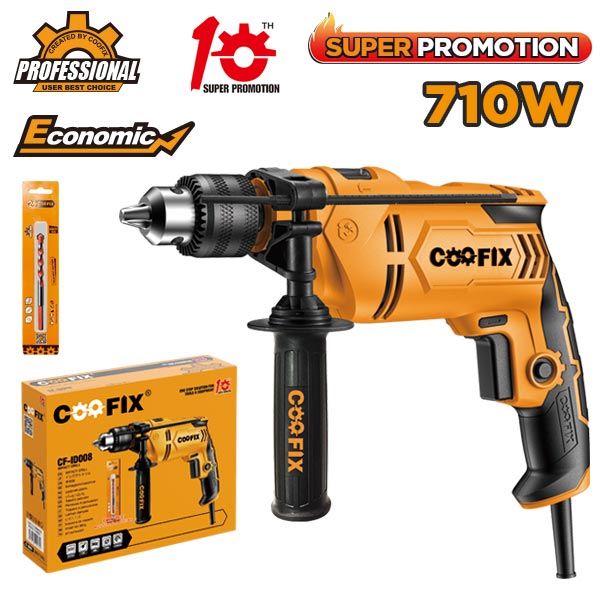
The corded reference point: COOFIX CF-ID008 electric impact drill - 220-240 V ~ 50/60 Hz, 710 W, 0-2800 rpm, maximum drilling capacity 13 mm.
How to Read the Three Core Specifications
Rated Voltage: Power Source and Market Fit
Rated voltage answers one question: what supply is this tool engineered for? The CF-ID008 is rated at 220-240 V ~ 50/60 Hz, which identifies it as a corded mains tool intended for grids in that voltage band. Corded tools of this type run continuously without runtime limits and without battery inventory - a decisive advantage for workshop and site use where an outlet is available.
The CF-CD016 is rated at 20 V, which identifies it as a battery-platform tool. Portability and freedom from cabling are the trade: runtime then depends on the battery, and battery capacity and cell brand become purchasing decisions rather than fixed constants. For distributors, that distinction has an inventory consequence - cordless platforms create battery and charger SKUs that must be planned alongside the tool itself.
A practical rule for buyers: never place a mains voltage and a battery voltage in the same comparison column. Compare corded against corded, and cordless against cordless. Then compare the two categories on the criteria that actually differ - runtime, portability, sustained output and total SKU count.
Maximum Torque: Turning Force Against Resistance
Torque, expressed in newton-metres (N.m), is rotational force. The published maximum torque of the CF-CD016 is 75 N.m. That figure describes the peak turning force the tool can bring to bear, and it is the number that decides whether a drill stalls when the material fights back.
In wood, torque limits how large a bit or hole saw the tool can drive at a controlled speed. A wide-diameter bit removed from the same gear setting as a small pilot bit will demand noticeably more turning force, and a drill whose maximum torque sits below that demand will bind or stall. In steel, the relationship is different: the 10 mm drilling capacity in steel published for the CF-CD016 describes the rated hole size, and steel drilling depends on holding a lower speed, applying steady pressure and letting the bit cut rather than forcing it. Torque gets the drill through the material; speed control decides whether the bit survives.
Two cautions apply when comparing torque across models. First, maximum torque is a peak rating - it is not the torque delivered at every speed step. Second, torque that cannot be modulated is a liability for small screws and delicate assemblies. The COOFIX cordless platform is offered with an adjustable multi-torque design and dual impact and drill modes for multi-scenario use, which lets the operator match output to the fastener instead of applying peak force to every task.
Chuck Tightening Range: Which Accessories Actually Fit
The CF-CD016 uses a metal chuck with a tightening range of 0.8-10 mm. Read that as a window: the chuck can securely clamp accessory shanks with a diameter from 0.8 mm up to 10 mm. Anything smaller than the lower limit cannot be gripped reliably; anything larger than the upper limit does not fit at all.
This is where a specification becomes a purchase order. If a distributor plans to bundle the drill with a full accessory kit, every bit in that kit must fall inside the chuck window. Coofix supports custom accessory combinations for the tool case - drill bits, screwdriver bits and the quantity of chargers - so the accessory list and the chuck range be verified against each other before the packaging design is finalised. A metal chuck, as specified on the CF-CD016, is generally preferred over a plastic chuck where grip consistency and service life matter.
Remember the companion rule: the shank diameter of the accessory - not the hole diameter being drilled - must sit inside the chuck range. A drill rated for a 10 mm hole in steel can be paired with bits whose shanks are within the 0.8-10 mm window, and the two numbers serve different purposes.
No-Load Speed and Drilling Capacity: The Two Supporting Numbers
No-load speed tells you how fast the spindle turns with no load. The CF-ID008 is rated at 0-2800 rpm; the CF-CD016 offers a two-range speed of 0-550 / 0-2000 r/min. Speed range is a control feature, not a power claim: low speed supports screw driving and metal work, higher speed supports fast drilling in wood and lighter materials. A tool with a single wide range is simpler to operate; a tool with two defined ranges gives the operator a clearer decision boundary.
Drilling capacity defines the rated hole size per material - 13 mm maximum on the CF-ID008 and 10 mm in steel on the CF-CD016. Buyers should compare capacity against the largest hole the end user actually needs, then add a margin rather than buying to the exact limit.
A Six-Step Specification Review Process
- Identify the platform. Decide whether the job needs a corded tool such as the CF-ID008 (220-240 V ~ 50/60 Hz, 710 W) or a battery tool such as the CF-CD016 (20 V).
- Verify supply compatibility. For corded models, confirm the destination market grid matches the rated voltage band. For cordless models, confirm the battery platform, capacity and cell brand that the order will carry.
- Convert the job into a torque requirement. Look at the largest bit, hole saw or screw the user will run, in which material, and check it against the published maximum torque - 75 N.m on the CF-CD016.
- Match the accessory kit to the chuck window. List every bit and attachment by shank diameter and confirm each one sits inside the 0.8-10 mm range of the CF-CD016 metal chuck.
- Check speed range against the dominant task. Two-range speed such as 0-550 / 0-2000 r/min supports both driving and drilling; a single 0-2800 rpm range suits straightforward drilling work.
- Confirm compliance and supply capability. Verify the safety standards and certificates that apply to the destination market, then confirm MOQ, lead time and quality-control process before the order is placed.
Where These Specifications Decide the Purchase: Use Cases
Home Decoration and Carpentry
Both the CF-ID008 and the CF-CD016 list home decoration, carpentry and mechanical repair as applicable industries. For this profile the deciding specs are torque control and chuck range: furniture assembly, shelf fixing and mixed pilot-hole work require a tool that can drive small fasteners without over-torquing and hold a spread of small bit shanks. The 0.8 mm lower limit of the CF-CD016 chuck matters here, because fine-diameter bits are common in finish work.
Mechanical Repair
Repair work moves between materials within minutes, which is why maximum torque and speed range carry the decision. A tool with 75 N.m maximum torque and a two-range speed of 0-550 / 0-2000 r/min lets the operator drop to the low range for metal and step up for lighter materials, while the 10 mm steel drilling capacity sets the ceiling on metal hole size.
Retail Distribution and Hardware Wholesale
For buyers supplying hardware stores, the specification question shifts from single-unit performance to range coherence: which voltage platforms, chuck ranges and accessory kits belong in the same retail program. Volume reference points exist in this channel - COOFIX drills have been supplied to offline building material chain supermarkets at volumes where a single category exceeds 100,000 units, and to cross-border e-commerce sellers at volumes where a single category exceeds 50,000 units.
Distributor Private-Label Programmes
Distributors building a private brand need the spec sheet and the customization sheet read together. COOFIX drills are used by overseas hardware brand distributors acting as Coofix brand agents, supported by OEM customized packaging and logo silk printing that allow a private brand to be established quickly. In one distributor programme, the product failure rate was reported as far lower than competing similar products, with a rework rate kept below 1.1% and a customer repeat purchase rate above 80%; in a separate retail and e-commerce case, the rework rate was controlled below 1.5% with a repeat purchase rate above 70%. For a brand owner, those figures convert a specification decision into a shelf-life and warranty decision.
CF-ID008 vs CF-CD016: Verified Specification Comparison
| Specification | COOFIX CF-ID008 | COOFIX CF-CD016 |
|---|---|---|
| Tool type | Electric impact drill (corded) | Cordless brushless impact drill |
| Rated voltage | 220-240 V ~ 50/60 Hz | 20 V |
| Input power | 710 W | Not stated in the available data |
| No-load speed | 0-2800 rpm | 0-550 / 0-2000 r/min |
| Maximum torque | Not stated in the available data | 75 N.m |
| Chuck tightening range | Not stated in the available data | 0.8-10 mm (metal chuck) |
| Drilling capacity | 13 mm maximum | 10 mm in steel |
| Housing material | Copper, plastic | Copper, plastic |
| Applicable industry | Home decoration, carpentry, mechanical repair | Home decoration, carpentry, mechanical repair |
| Power source implication | Requires mains supply in the 220-240 V band; no runtime limit | Battery platform; runtime set by the battery pack |
Two further tables help convert the numbers into ordering decisions. The first maps each specification to the decision it controls; the second summarises the verified commercial parameters that COOFIX applies to OEM and ODM programmes.
| Specification | What it controls | What to verify before ordering |
|---|---|---|
| Rated voltage | Power architecture and market fit | Destination grid band or battery platform and pack specification |
| Maximum torque | Ability to overcome resistance in wood, steel and fasteners | Largest bit, hole saw or screw in the intended application |
| Chuck tightening range | Which accessory shanks can be clamped | Shank diameter of every bit planned for the kit |
| No-load speed | Control across drilling and driving tasks | Whether single-range or two-range speed suits the user |
| Drilling capacity | Maximum rated hole size per material | Largest hole the end user needs, plus margin |
| Certification | Market access eligibility | EN 62841-2-1 for CE marking; EAC documentation for EAEU markets |
| Supply parameter | Standard OEM / customized production | OEM private labeling | ODM appearance and structure customization |
|---|---|---|---|
| Minimum order quantity | 10 units | 100-500 units | 100-500 units |
| Typical lead time | 10 days | 30 days | 60 days |
| Customization scope | Body color, silk screen or laser-engraved logo; voltage options 12 V / 16.8 V / 21 V; battery capacity and cell brand; chuck size, impact gears and rotation speed parameters; accessory combination for the tool case; color box and export carton design | Body color, silk screen or laser-engraved logo on housing; accessory and packaging customization | Housing appearance, additional functions, complete machine personalization and full tool kit design |
| Monthly capacity | 300,000 units | 300,000 units | 300,000 units |

Quality-control stage: finished COOFIX drills are fully inspected for no-load speed, torque and impact performance before shipment.
FAQ: Voltage, Torque, Chuck Range and OEM Supply
Which safety standards and certificates should an electric drill carry for export markets?
For hand-held drills and impact drills, EN 62841-2-1 / IEC 62841-2-1 is the applicable safety standard for CE marking and global market access. For the Eurasian Economic Union, the COOFIX cordless drill CF-CD016 holds EAC certificate No. ЕАЭС KG417/046.CN.02.07167, issued on 7 July 2025 and valid to 6 July 2030, assessed against ТР ТС 010/2011, ТР ТС 020/2011, GOST IEC 60745-1-2011 and GOST IEC 60745-2-2-2011. On the trade side, JINHUA COOFIX TOOLS CO., LTD. holds AEO certificate No. 096099139001, issued by Hangzhou Customs on 23 December 2025 and valid to 22 December 2030. Buyers should request the certificate page that names the exact model being purchased.
Can COOFIX act as an OEM cordless drill manufacturer for distributors and private labels?
Yes. COOFIXTOOLS provides OED, OEM and customized production services, supports OEM private labeling, and offers ODM appearance and structure customization. The listed customization options include body color and silk-screen or laser-engraved logo on the housing; voltage options of 12 V / 16.8 V / 21 V across corded and cordless models; custom battery capacity and cell brand selection; adjustable chuck size, impact gears and rotation speed parameters; custom accessory combinations for the tool case, including drill bits, screwdriver bits and the quantity of chargers; and custom color box and export carton design. Monthly production capacity is 300,000 units, and the manufacturer exports to Asia, Africa, Eastern Europe, the Middle East and South America.
What order size does COOFIX require, and what commercial terms apply?
MOQ is 10-500 units depending on the programme. Standard OEM and customized production starts at 10 units; OEM private labeling and ODM appearance and structure customization start at 100-500 units. Delivery terms are FOB, CIF or OA. Payment terms are T/T, LC or OA. Acceptance criteria is pre-shipment test.
How can a buyer validate drill quality before committing to a bulk order?
COOFIXTOOLS applies a four-stage quality-control process: 100% incoming inspection of raw materials; power-on aging sampling inspection of semi-finished products on the production line; 100% full inspection of finished products for no-load speed, torque and impact performance; and sampling reliability testing. Pre-shipment testing is part of the stated acceptance criteria, which allows a buyer to confirm the specifications described in this article - rated voltage, maximum torque and chuck tightening range - before the shipment leaves the factory. After-sales support includes a one-year warranty for the complete machine, a 12-month warranty for lithium batteries and chargers, bulk supply of spare wearing parts, remote technical guidance, on-site engineer support for bulk orders, and reshipment for goods damaged in logistics.
What lead time and shipping capacity should distributors plan for?
Typical production lead time is 10 days for standard OEM and customized production, 30 days for OEM private labeling, and 60 days for ODM appearance and structure customization, against a monthly capacity of 300,000 units. Shipping capacity supports more than five 40HQ high-cube containers per day, and distributor programmes built around the COOFIX brand agent model start from 2 x 40HQ containers. Distributors planning a private-label launch should align the lead-time tier with their packaging and accessory decisions, since both must be fixed before production is scheduled. For a quotation, sample arrangement or catalogue, contact the export team at sales@coofixtools.com or via WhatsApp at +86 13967460577.
Conclusion: Read the Spec Sheet in the Right Order
Voltage, torque and chuck range are not three independent numbers to be skimmed - they are a sequence. Voltage defines the power architecture and the destination market. Torque defines what the drill can force through wood, steel and fasteners. Chuck tightening range defines which accessories the tool can actually hold. Read in that order, a spec sheet stops being a marketing document and becomes a purchasing tool.
COOFIXTOOLS, founded in 2014 and headquartered in Yongkang, Zhejiang, manufactures power tools across a 30,000 m² facility with 400 employees and an annual output of 2,000,000 units, exporting approximately 90% of production to Asia, Africa, Eastern Europe, the Middle East and South America. Its corded CF-ID008 and cordless CF-CD016 platforms - 220-240 V ~ 50/60 Hz with 13 mm maximum drilling capacity, and 20 V with 75 N.m maximum torque and a 0.8-10 mm metal chuck respectively - illustrate how the same application, home decoration and carpentry and mechanical repair, can be served by two different specification strategies.
The practical next step for a buyer is to fix three answers before sourcing: the material and hole size that sets the torque requirement, the accessory list that must fall inside the chuck window, and the market whose grid, standards and certification the tool must satisfy. With those three answers in hand, comparing models becomes a short, evidence-based exercise instead of a guess.
Next step: specifications, samples and a quotation
Send the job requirement - material, hole size, accessory list and destination market - and the COOFIX export team will confirm the matching model, torque range, chuck window and certification package.
Email: sales@coofixtools.com | WhatsApp: +86 13967460577 | Website: www.coofix-tools.com
Download the full COOFIX 2025 catalogue for the complete power tool range: COOFIX Catalogue 2025 (PDF)

Ready to ship: COOFIX warehousing supports a daily dispatch capacity above five 40HQ high-cube containers.

Proof: EAC certificate No. ЕАЭС KG417/046.CN.02.07167 for the COOFIX cordless drill CF-CD016, valid to 6 July 2030.