Electric Drill vs Rotary Hammer vs Demolition Hammer: Match the Tool to the Task
Electric Drill vs Rotary Hammer vs Demolition Hammer: Which Tool for Your Job?
If your work is mainly wood, drywall, light steel, and small fasteners, an electric drill is enough. If you need to drill regularly into brick or concrete, a rotary hammer is the more efficient choice. For heavy breaking, chipping, and large-scale concrete demolition in construction or mining, a demolition hammer is the tool that matches the task.
This guide compares three COOFIX models that cover different parts of the drilling and breaking spectrum: the CF-ID008 electric impact drill, the CF-RH008 rotary hammer, and the CF-DH021 demolition hammer. Instead of asking which one is “best” overall, buyers should ask which one fits the material hardness, hole size, and project frequency they face.
Home decor and furniture assembly do not demand the same machine as a reinforced concrete wall or a mining site. The decision starts with the substrate you are cutting into and the impact energy required to make the tool productive.
What Each Tool Is Designed to Do
Electric drill / impact drill — general-purpose drilling and screwdriving
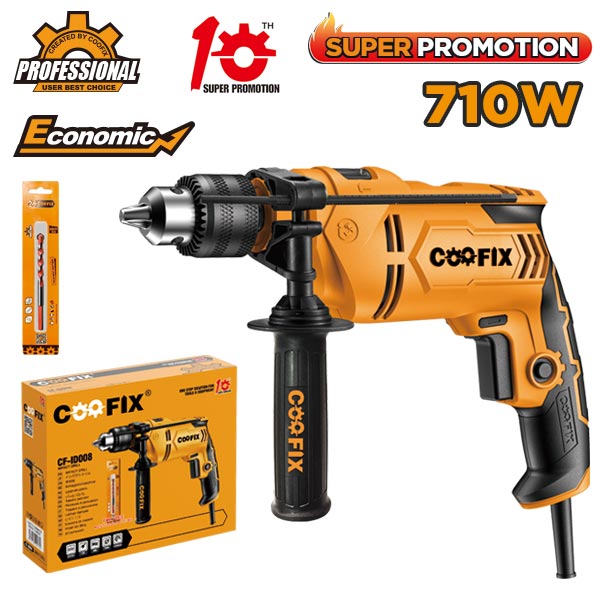
An electric drill is the everyday tool for drilling holes in wood, plastic, drywall, and softer metals, and for driving screws. The COOFIX CF-ID008 is an electric impact drill that also provides a hammer action for lighter masonry work. It operates at 220–240V~50/60Hz with 710W input power, a no-load speed of 0–2800rpm, and a maximum drilling capacity of 13mm. Its compact body and variable speed make it the first tool for assembly tasks, cabinet installation, mechanical repair, and general home maintenance.
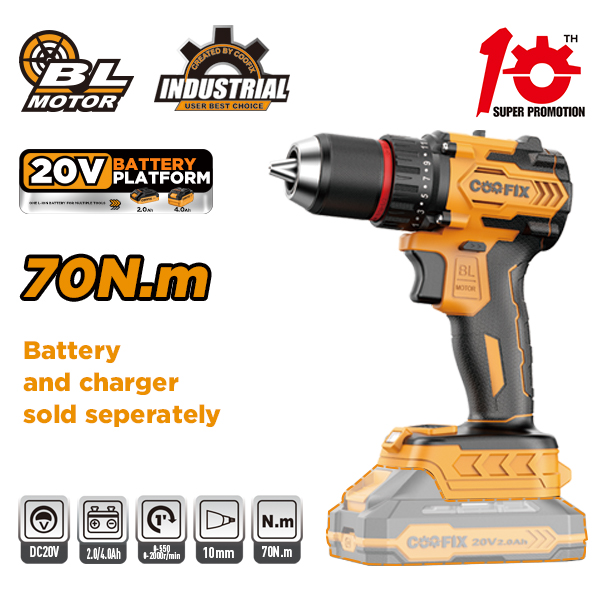
The cordless version, such as the COOFIX CF-CD016, adds portability for users who work in multiple locations or where a power outlet is not easily accessible. It is a 20V brushless impact drill with a metal chuck, max torque of 75N.m, and a drilling capacity of 10mm in steel. Both corded and cordless drills share the same intended industries: home decoration, carpentry, and mechanical repair.
Many buyers call this type of machine simply a “power drill,” a “cordless drill,” or an “impact drill.” The common feature is that it spins a drill bit or screwdriver bit and is designed for holes or fasteners up to roughly 13mm depending on the model and material.
Rotary hammer — reinforced drilling in masonry and concrete
A rotary hammer combines rotation with a powerful pneumatic hammering mechanism. It is the standard tool for drilling anchor holes in brick, block, and concrete on construction sites and for infrastructure maintenance.
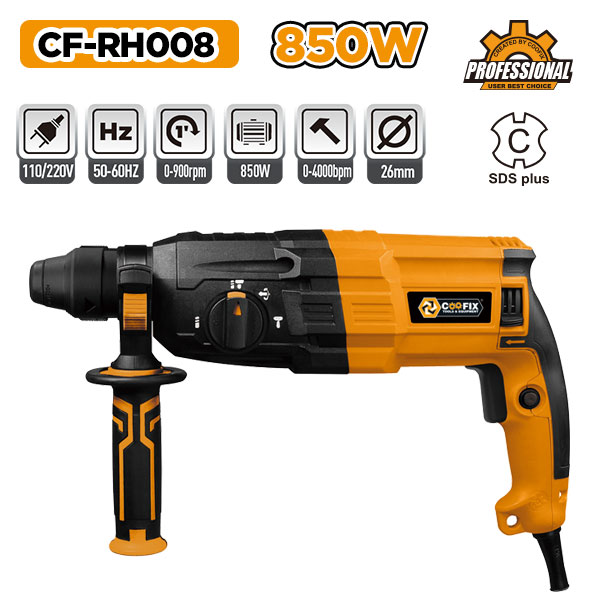
The COOFIX CF-RH008 is a corded rotary hammer with a drill capacity of 26mm, 220–240V/50–60Hz input, 850W rated input power, and a no-load speed of 0–900r/min. Compared with the electric impact drill, the rotary hammer delivers substantially greater impact energy per blow. That is why it appears in the COOFIX application corpus for public infrastructure projects, including fixing road guardrails and power poles, drilling large holes for municipal infrastructure, and construction work on brick and concrete walls.
The rotary hammer is often the next step up when a 13mm impact drill slows down or vibrates excessively in hard masonry. On a continuous renovation site that installs expansion anchors into concrete ceilings or walls, an electric impact drill wears the operator down quickly and produces slower drilling progress.
Demolition hammer — breaking, chipping, and heavy material removal
Demolition hammers are not primarily drilling tools. They are designed to break up concrete, masonry, tiles, and other hard materials using pure impact force. The COOFIX CF-DH021 has a 1500W rated input power, 1550 blows per minute, and an impact energy of 45 joules. It is listed for the construction industry and the mining industry, where heavy breaking and chipping are part of the work.
Unlike a rotary hammer, a demolition hammer is used with chisels or flat points for controlled breaking, channel cutting, and removal work rather than making round holes. If a project involves demolishing a wall, opening a large chase in concrete, or removing heavy tile layers, the demolition hammer is the tool the task requires.
Key Specification Comparison
The table below summarizes the verified specifications that matter most for tool selection.
| Comparison Point | CF-ID008 Electric Impact Drill | CF-RH008 Rotary Hammer | CF-DH021 Demolition Hammer |
|---|---|---|---|
| Primary function | Drilling and screwdriving with light impact option | Rotary hammer drilling in masonry and concrete | Heavy breaking and chipping |
| Rated input power | 710W | 850W | 1500W |
| Rated voltage | 220–240V~50/60Hz | 220–240V/50–60Hz | 220V/50Hz |
| No-load speed | 0–2800rpm | 0–900r/min | Not specified |
| Drilling / impact capacity | Max drilling capacity 13mm | Drill capacity 26mm | Impact energy 45J |
| Blows per minute | Not specified | Not specified | 1550bmp |
| Typical target industries | Home decoration, carpentry, mechanical repair | Construction and maintenance, public infrastructure | Construction industry, mining industry |
The differences in power, speed, and mechanism create a clear boundary. The electric drill operates at high speed with low impact; the rotary hammer operates at low speed with high impact; the demolition hammer removes the rotation function and concentrates all output into blunt impact.
Application Fit: Home Decor, Construction, and Mining
Home decor and woodworking
For online furniture assembly, wall shelf installation, furniture repair, small appliance repair, and daily household maintenance, a drill is the most practical choice. The COOFIX application scenario for Home DIY lists the electric drill CF-ID008 and the cordless drill CF-CD016 as the tools used to assemble furniture and install wall racks, curtains, door locks, and other hardware fittings. In these tasks, users mostly drive screws and drill into wood, plastic, or light masonry. A rotary hammer adds unnecessary weight, and a demolition hammer is completely out of place.
When users move from occasional DIY to full custom cabinet installation or professional woodworking, the cordless drill becomes even more attractive because it is fast for screwdriving and easy to handle on ladders and in tight spaces. The COOFIX woodworking scenario lists the cordless drill and screwdriver as the primary tools for assembling customized cabinets, wooden doors, and wooden floors.
Construction and decoration
On a construction site, the selection depends on the substrate. The COOFIX construction scenario describes the cordless impact drill and cordless electric hammer as the tools used for drilling holes in brick and concrete walls, fixing expansion screws, opening slots for water and electricity pipelines, and installing doors, ceilings, hanging cabinets, and light steel keels.
For small-diameter anchor holes in brick and light concrete, the CF-ID008 can handle the task, especially when workers already own the tool for screwdriving. However, when the job is repeated all day or the concrete is hard, a rotary hammer such as the CF-RH008 creates noticeably faster drilling and reduces physical strain. The CF-RH008 has a maximum drill capacity of 26mm, which makes it suitable for larger bolts and thicker anchors used in steel structures, road guardrails, power poles, and municipal infrastructure.
Demolition, mining, and heavy removal
The CF-DH021 is not a tool for fine drilling. Its listed applicable industries are construction and mining, where the main tasks are breaking and material removal. In the case of old house renovation, concrete beam modification, or mining auxiliary work, the operator needs a high-impact tool such as the CF-DH021 with 45J energy. This class of tool is usually paired with chisels and used to break concrete slabs, remove tiles, cut channels, and break oversized rock sections in mining support work.
For a distributor or procurement manager, this distinction matters. Stocking only electric drills cannot cover construction crews; stocking only demolition hammers cannot cover mechanical repair or furniture installation. The practical product mix should include a drill for fastening and smaller holes, a rotary hammer for concrete anchors, and a demolition hammer for breaking work.
How to Choose: A Simple Decision Path
Use the following questions to make a fast selection.
- Do you mainly drive screws and drill wood, drywall, plastic, or thin steel? Choose an electric drill. The corded CF-ID008 covers most workshop and home tasks; the cordless CF-CD016 adds portability and convenience for assembly and fastening.
- Do you regularly drill into brick, concrete block, or poured concrete for anchors? Choose a rotary hammer such as the CF-RH008. Its 26mm drill capacity and 850W motor are designed for construction and infrastructure work.
- Do you need to break, chip, or demolish concrete, masonry, or rock? Choose a demolition hammer such as the CF-DH021. With 1500W input and 45J impact energy, it is intended for heavy material removal, not for precise holes.
Project Scale and Frequency
Project scale affects the tool decision even when material hardness is identical.
For occasional home use, the electric drill is sufficient because duty cycles are short and total volume is low. For continuous professional renovation or construction crews, the duty cycle is much higher, and a rotary hammer is the appropriate class of tool for concrete. For a full demolition project, an electric impact drill will fail quickly if used for breaking; the demolition hammer is engineered for that force level.
The boundary is not just about power. It is also about how the machine transmits force to the material. A rotary hammer’s pneumatic mechanism delivers efficient impact energy without forcing the user to push hard. A demolition hammer delivers even higher impact energy through a chisel or point. An electric impact drill’s hammer action is a mechanical vibration added to rotation; it helps for small masonry holes but is not a replacement for real hammer mechanisms on larger or harder materials.
Industry Typical Use Cases
Home DIY / household maintenance
The COOFIX corpus describes the home DIY personal sector as follows: products are used to assemble online furniture and install hardware fittings. They operate under household daily maintenance conditions and are designed for furniture assembly and home small renovation environments. This scenario is common globally and requires supporting equipment such as drill bits.
Auto repair and maintenance
Auto repair shops use drills for tasks such as removing or installing brackets, polishing rusted chassis components, drilling holes for modified parts, and cutting corroded pipes. The COOFIX auto maintenance scenario lists the electric drill CF-ID008 and cordless drill CF-CD016, along with an angle grinder, as supporting tools for vehicle repair. The tools operate in both corded and cordless modes and require supporting equipment such as drill bits, grinding wheel discs, and sockets. CE compliance is required for these products.
Public infrastructure and outdoor emergency operations
For road maintenance, municipal engineering, and outdoor construction, the rotary hammer is the core drilling and anchoring tool. The COOFIX infrastructure scenario states that the rotary hammer and diamond core drill are used to fix road guardrails and power poles and drill large holes for municipal infrastructure construction. CE compliance is listed as a special requirement. This explains why infrastructure buyers commonly prefer a rotary hammer instead of a general-purpose electric drill.
Construction project and home decoration
In the core construction scenario, the COOFIX product range covers brick and concrete walls, expansion screw fixing, water and electricity slotting, door installation, ceiling installation, and light steel keel work. Depending on the frequency and concrete hardness, the team selects either the CF-ID008-electric drill or the CF-RH008 rotary hammer. The CF-DH021 is added when wall or floor demolition becomes part of the project scope.
How COOFIX Supports Distributors and Procurement Teams
COOFIX is the power tool brand of Jinhua Coofix Tools Co., Ltd., based in Yongkang, Zhejiang, China. The company operates a 30,000 m² facility with more than 400 employees, an R&D team of 16 engineers, and an annual output of about 2,000,000 units. More than 90% of products are exported to Asia, Africa, Eastern Europe, the Middle East, and South America. Jinhua Coofix Tools is an AEO-certified exporter and produces power tools under both the COOFIX brand and OEM/ODM programs.
For buyers evaluating tool specifications, COOFIX provides three different drilling classes in one supply chain: the general-purpose CF-ID008, the masonry-focused CF-RH008, and the heavy breaking CF-DH021. This range makes the company a practical single source for distributors who need to stock multiple power tool categories without managing dozens of separate suppliers.
OEM capability adds another layer of flexibility. COOFIX supports customization of body color, logo placement, voltage options (12V/16.8V/21V for cordless models), battery capacity, cell brand selection, chuck size, impact gears, rotation speed, and accessory combinations. Lead times range from 10 days for existing production lines to 60 days for full ODM appearance and structure customization, depending on the program. Buyers can also request CE-compliant configurations and custom tool case contents.
The full COOFIX catalog is available for download at coofix catalog 2025.pdf.
Practical Selection Checklist
- Confirm the dominant material: wood/drywall → electric drill; brick/concrete anchors → rotary hammer; concrete breaking/mining → demolition hammer.
- Confirm the working environment: corded workshop or home fix; cordless for quick moving; heavy equipment for stationary demolition work.
- Confirm the hole diameter: 13mm masonry holes are near the practical limit for many impact drills; the CF-RH008 extends masonry drilling capacity to 26mm.
- Confirm the frequency: frequent daily use on concrete justifies a rotary hammer even if a few holes could be drilled with an impact drill.
- For distributors, stock based on market segments: home/DIY stocks skew to drills; construction/maintenance stocks need both rotary hammer and electric drill; mining/demolition channels add demolition hammer.
FAQ
Can a demolition hammer be used as a drill?
A demolition hammer such as the COOFIX CF-DH021 is not designed for drilling. It has 1500W input power and 45J impact energy, but its mechanism is intended for breaking and chipping. To drill round holes, choose an electric drill for smaller holes or a rotary hammer for masonry and concrete holes. Trying to use a demolition hammer as a drill would require the wrong accessory and would not produce a clean rotating cut.
What is the difference between a rotary hammer and an electric impact drill?
An electric impact drill like the CF-ID008 adds a mechanical hammer action to rotation and is designed for general drilling and screwdriving. A rotary hammer like the CF-RH008 uses a dedicated pneumatic hammer mechanism with lower speed but much higher impact force for masonry and concrete. The CF-ID008 has a maximum drilling capacity of 13mm, while the CF-RH008 has a drill capacity of 26mm and a heavier 850W motor. The two tools overlap only at the small masonry hole range; on continuous concrete work, the rotary hammer is the correct class.
Why is the CF-DH021 called a demolition hammer and not a hammer drill?
The CF-DH021 is classified as a demolition hammer because its output is impact energy for breaking, not rotation for drilling. It delivers 45 joules per blow at 1550 blows per minute and 1500W input power. The intended industries are construction and mining. A hammer drill or rotary hammer retains rotation and is used for holes; a demolition hammer uses chisels and points to fracture material. The model name and category in the COOFIX product data set are demolition hammer.
Which COOFIX tool is suitable for construction crews?
COOFIX supplies several construction-grade tools. For concrete drilling and anchoring, the CF-RH008 rotary hammer is the relevant model, with a drill capacity of 26mm and 850W power. For heavy wall, floor, or mining breaking, the CF-DH021 demolition hammer provides 45J impact energy. For fastening and lighter drilling on construction sites, the CF-ID008 electric impact drill or the CF-CD016 cordless brushless drill can cover general work. Construction crews usually need all three classes because no single tool can efficiently drill, fasten, and demolish concrete.
Does COOFIX provide sample or OEM support for power tool orders?
For buyers evaluating a wholesale partnership, COOFIX supports OEM private labeling and ODM customization. Customization options include body color, logo printing or laser engraving, voltage selection, battery capacity and cell brand, chuck size, gears, rotation speed, and accessory kit composition. MOQ and lead time vary by program: lead times range from 10 days for existing production setup to 60 days for full ODM design work. For detailed sample and quotation support, contact sales@coofixtools.com or send an inquiry through the COOFIX website.
Need help selecting the right power tool mix for your market?
COOFIX manufactures electric drills, rotary hammers, demolition hammers, and a broader power tool range with OEM support. Download the COOFIX catalog or contact Kevin Wang at sales@coofixtools.com / WhatsApp +86 13967460577 to request samples, a quote, or a distributor discussion.