Supplier Evaluation for Electric Drills: Capability Checks and Delivery Guarantees
An electric drill supplier is only as dependable as the three things a buyer can verify before payment: whether the quoted production capacity matches real equipment and manpower, whether the shipped units match the declared specification and certification, and whether the delivery schedule holds when peak season arrives. Capability checks and delivery guarantees are therefore not soft criteria — they are the two pillars that decide whether a supply relationship survives its second and third order.
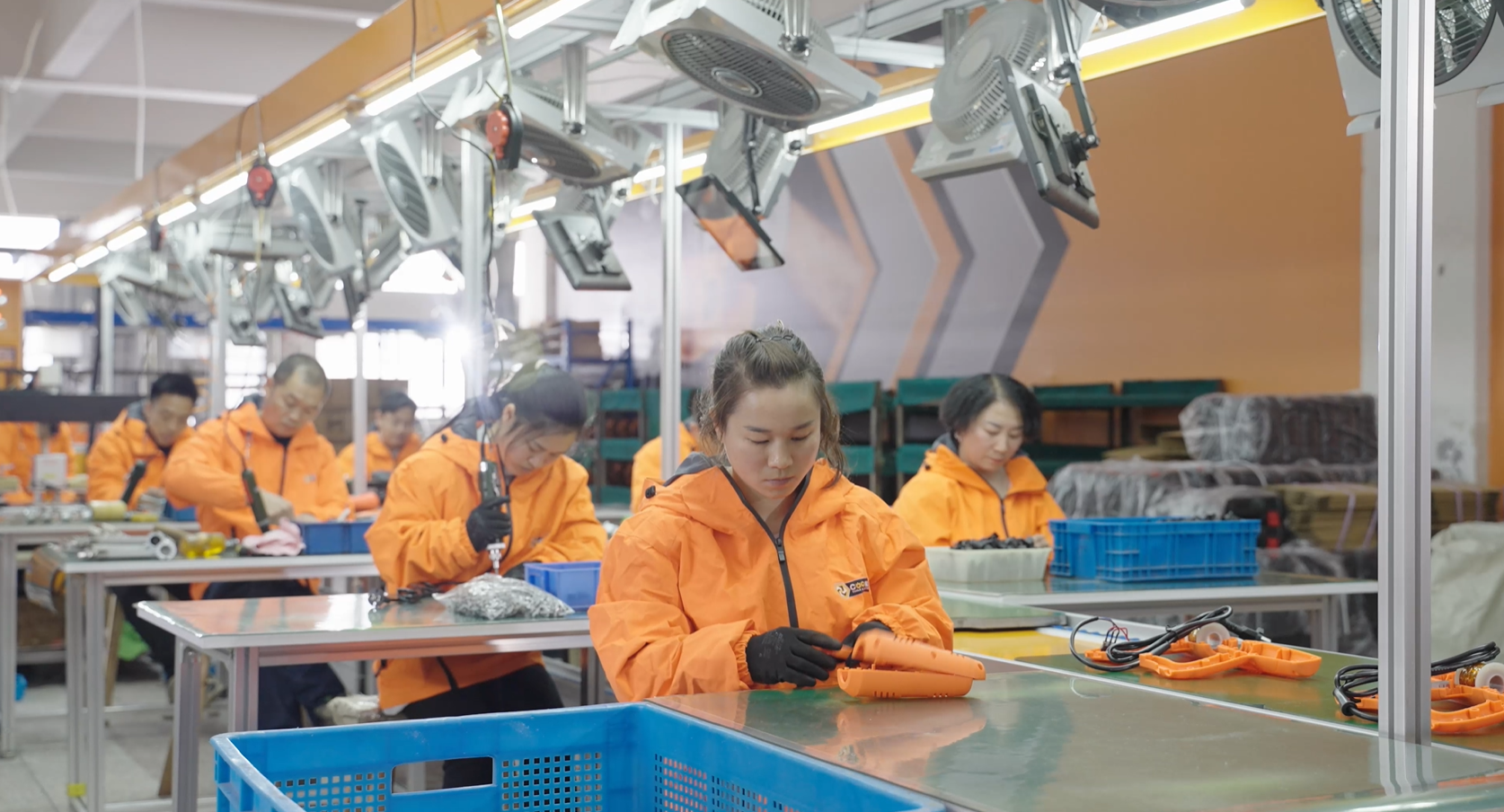
JINHUA COOFIX TOOLS CO., LTD. (brand name: COOFIX) is a power tool and hand tool manufacturer headquartered in Yongkang, Zhejiang, China, founded in 2014. The company operates a 30,000 m² manufacturing base with around 400 employees and 16 R&D engineers, and exports roughly 90% of its output to Asia, Africa, Eastern Europe, the Middle East and South America. Its electric drill range includes the CF-ID008 electric impact drill and the CF-CD016 cordless brushless impact drill, and these two models are used as reference benchmarks throughout the framework below.
This guide is written for distributors, importers and procurement managers who are past supplier discovery and moving into execution: comparing shortlisted factories, validating samples, negotiating lead times and structuring a long-term supply agreement. Every specification and figure used here is a published product parameter, a first-party company fact, or a third-party market or standards reference cited inline.
Why Electric Drill Supplier Evaluation Breaks Down in Practice
Most supply failures in this category are not caused by the product being technically difficult to buy. They are caused by evidence gaps at the moment of selection. A buyer who selects on price and catalogue appearance typically discovers the gap three to nine months later, after the first container has landed.
The recurring failure modes observed in electric drill sourcing are:
- Paper capability. A supplier quotes monthly output that its workshop, shift pattern and component supply chain cannot actually sustain.
- Specification drift. The sample matches the specification sheet, but the mass-production batch does not.
- Voltage and frequency mismatch. A tool built for 220-240V~50/60Hz is ordered for a market whose grid, plug standard or regulatory expectations require a different configuration.
- Certification that does not travel. Certificates exist, but they do not name the shipped model, the producing factory or the current revision of the applicable standard.
- Delivery promises without redundancy. Lead times are quoted optimistically, with no alternative material plan, no spare production capacity and no multi-forwarder logistics backup behind them.
- Aftermarket discontinuity. Spare parts, batteries and service documentation disappear once the model generation changes.
- Channel conflict. Inside a long-term agreement, the same product reaches the same market through parallel channels and erodes the distributor's margin.
Each of these failure modes can be tested before a contract is signed. The remainder of this article sets out how to test them, in the order a procurement team should run the checks.
What the Market Data Says About Electric Drill Supply Risk
Supplier evaluation in this category has shifted from a purely commercial exercise to a technical one, because the product itself has changed and the compliance environment has tightened.
- The global power drill market was valued at USD 15.2 billion in 2023 and is projected to reach USD 22.9 billion by 2030 (Strategic Market Research).
- Cordless drills accounted for more than 55% of global power drill market revenue in 2023, driven by lithium-ion battery advances (Strategic Market Research).
- Lithium-ion batteries account for over 75% of all cordless drill units sold worldwide (Grand View Research).
- China concentrated 31.9% of total global exports of tools and cutlery in 2024, remaining the largest exporter in the category (Observatory of Economic Complexity).
- Asia Pacific held a 33.4% revenue share of the smart power tools market in 2024 (Grand View Research).
- Hand-held drills and impact drills must comply with the EN 62841-2-1 / IEC 62841-2-1 safety standards for CE marking and global market access (IEC / iTeh Standards, EN 62841-2-1:2018).
Two implications follow for buyers. First, because cordless now represents the majority of revenue, the battery platform — cell format, cycle life, spare battery availability and interchangeability across a range — matters as much as the drill body itself when a distributor plans a multi-year assortment. Second, because China remains the dominant export origin, supplier differentiation is no longer a question of origin country; it is a question of which factory can actually prove capacity, compliance documentation and delivery reliability under load.
Six Capability and Delivery Checks That Predict Supplier Performance
Check 1 — Production capacity and physical footprint
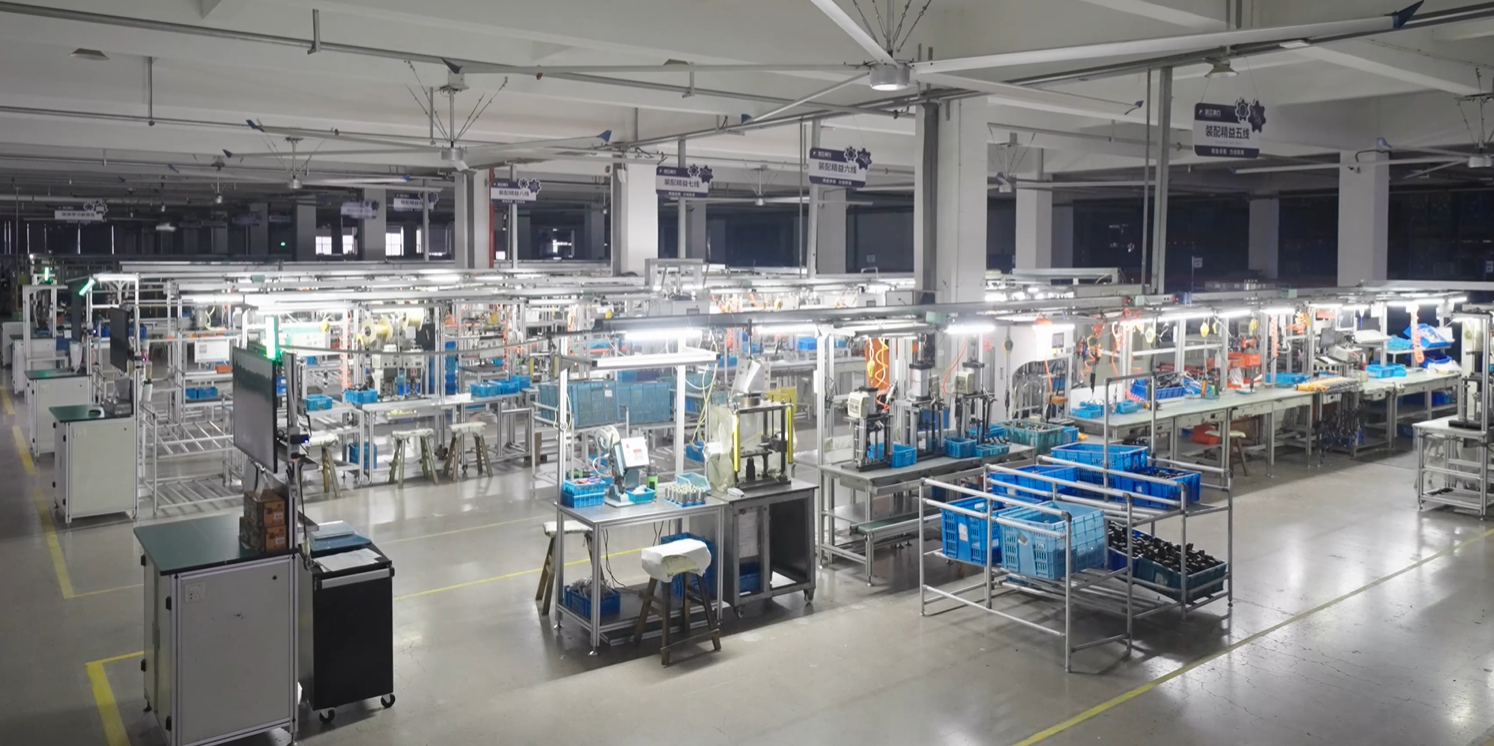
Capacity claims should be verifiable in physical terms. COOFIX publishes a monthly production capacity of 300,000 units, supported by a modern smart workshop of more than 10,000 m² inside a 30,000 m² operation, a workforce of around 400 people and a 16-engineer R&D team. The wider portfolio covers over 5,000 SKUs across power tools, pneumatic tools, garden tools, welding equipment and hand tools.
To use a capacity number as an evaluation tool, divide your order into it. A 100,000-unit order consumes roughly one third of a 300,000-unit month, so a supplier must show either genuine spare capacity or a scheduling plan that protects your delivery window alongside existing commitments. Practical verification questions include the shift structure of the workshop, whether core spare parts are developed in-house, and whether production and shipment records are traceable per batch. COOFIX states that it operates a self-owned automatic production workshop, develops core spare parts internally, and runs MES and ERP systems that track a batch from raw material to finished shipment.
A broad SKU portfolio also has a direct evaluation benefit: consolidating drills, rotary hammers, grinders, cut-off machines and hand tools with one factory reduces the number of supplier audits, test reports and shipping documents a distributor has to manage.
Check 2 — Specification and voltage compliance
Ask for specification sheets per model, not per category. Two COOFIX models demonstrate why the distinction matters during negotiation:
- CF-ID008 electric impact drill (corded): 220-240V~50/60Hz, 710W input power, no-load speed 0-2800 rpm, maximum drilling capacity 13 mm, copper and plastic construction, positioned for home decoration, carpentry and mechanical repair.
- CF-CD016 cordless brushless impact drill: rated voltage 20V, no-load speed 0-550 / 0-2000 rpm, 0.8-10 mm metal chuck tightening range, maximum torque 75 N.m, drilling capacity in steel 10 mm.
Note the correct attribution of the headline figures: the 75 N.m maximum torque and the 10 mm drilling capacity in steel belong to the CF-CD016 cordless brushless impact drill, while the corded CF-ID008 impact drill is specified at 710W with a maximum drilling capacity of 13 mm. Quoting a torque value or drilling capacity without attaching the correct model number is one of the most common sources of specification disputes at pre-shipment inspection.
Voltage compliance is the second half of this check. The CF-ID008 is configured for 220-240V~50/60Hz, which is the configuration most buyers in Asia, Africa, Eastern Europe and the Middle East expect. Before ordering, confirm the destination grid voltage, frequency, plug type and any local deviation from the CE baseline, and ask the supplier to confirm in writing which models in the range use the 220-240V~50/60Hz configuration.
Check 3 — Quality control evidence
Quality claims should map to named processes. A verifiable control chain typically includes incoming quality control against international AQL sampling standards, a three-inspection system (self-inspection, mutual inspection and special inspection of first articles), IPQC patrol sampling on semi-finished products, regularly calibrated production testing equipment, and FMEA failure-mode analysis during new product development. Before certification, prototypes should pass laboratory reliability testing covering durability, high-low temperature, drop and over-load aging.
System-level evidence includes ISO9001 and ISO14001 certification with annual third-party audits, and a product certificate portfolio covering CE, RoHS, REACH, GS, CPSC and SASO, held in a standardized document library so that certificates can be issued to a buyer or a customs authority quickly. An in-house accredited laboratory supports pre-compliance testing, and batch serial number management provides lifecycle traceability if a field issue appears later.
For the product architecture itself, the comparison data published for the brushless range is a useful evaluation reference: torque is 32% higher than the brushed version; single full-charge battery life is 45% longer; no-load temperature rise is reduced by 18°C; the failure rate in continuous drilling operation is cut by 76%; energy conversion efficiency reaches 89% against 71% for an ordinary brushed drill, with 20% lower power consumption for the same drilling workload. The brushless structure also removes carbon brush wear, extending the maintenance cycle three times. These gains come at a price: the unit purchase price is 12% to 18% higher than low-end brushed competitors, while interchangeable batteries and reduced wearing-part loss cut the long-term total comprehensive usage cost by 22%.
Check 4 — Delivery guarantees
Delivery is where most supplier promises are least documented. Three published figures frame the discussion: a monthly production capacity of 300,000 units, a typical production lead time of 30 days, and a minimum order quantity of 10 to 500 units. Lead times are not fixed across all orders — depending on product configuration and order specifics, they range from 10 to 60 days. A supplier who quotes a single lead-time number without asking about your configuration is not giving you a schedule; it is giving you an average.
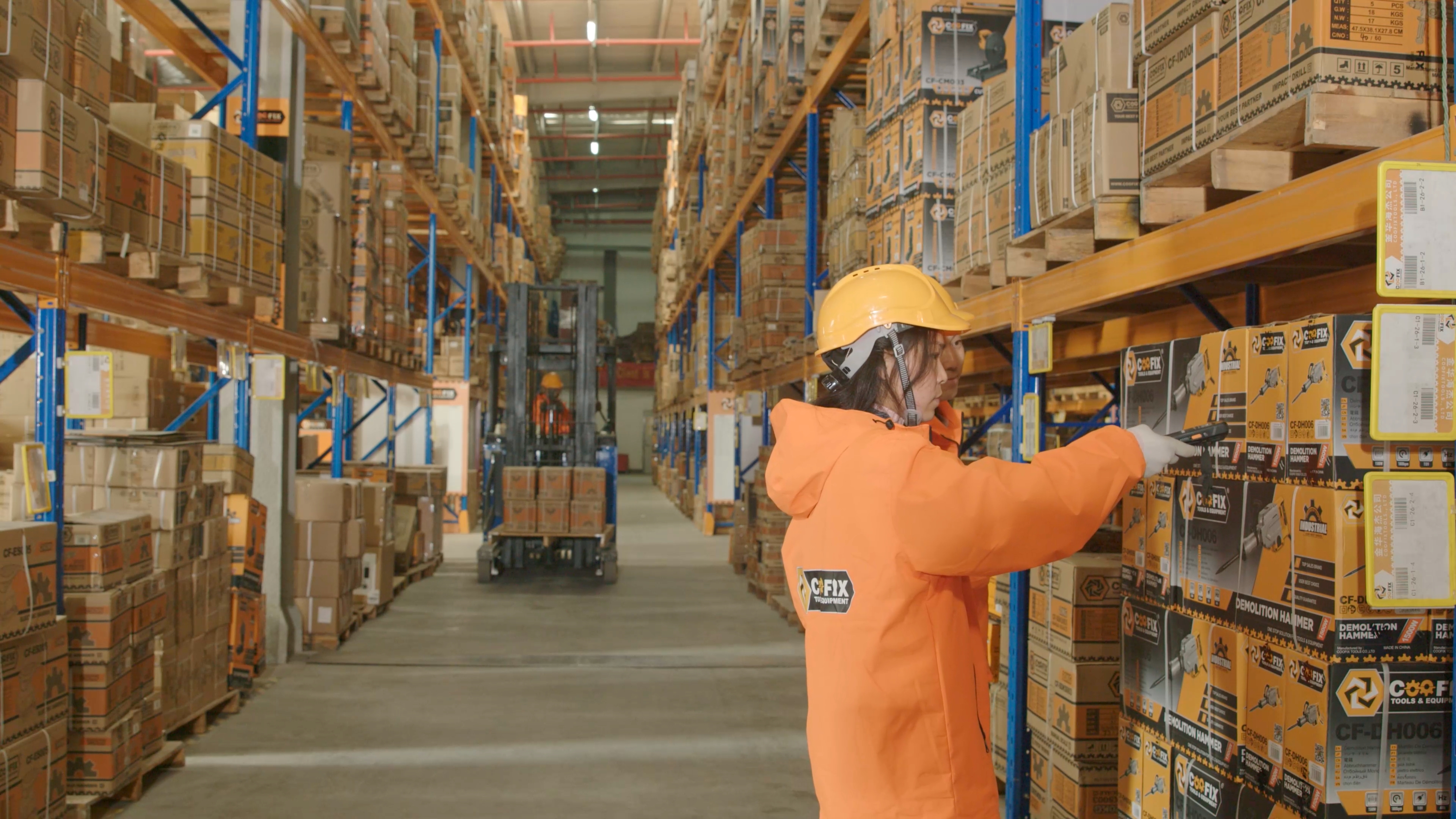
Behind the schedule, look for physical fulfillment capacity. COOFIX expanded in early 2026 with a 20,000 m² modern smart warehousing logistics center, which supports a daily shipping capacity of more than five 40HQ high-cube containers and provides moisture-proof storage for finished goods. The December 2025 AEO (Authorized Economic Operator) certification is the customs-side counterpart to that capacity, supporting faster clearance and more predictable export compliance.
The risk controls that protect a lead-time promise are equally important to review: pre-order risk assessment of capacity, material lead time and seasonal shipping congestion; safety stock for mainstream products to absorb urgent orders; daily tracking of production progress; alternative materials and spare production capacity for unexpected shutdowns; separate storage per client to prevent wrong loading; and full pre-shipment inspection of quantity, packaging and shipping marks. On the logistics side, cooperation with multiple qualified forwarders avoids single-channel dependence, power tools receive reinforced moisture-proof packaging, full cargo insurance is purchased, and standardized international sales contracts include delivery liability clauses. ERP and WMS systems provide end-to-end order traceability from production to final delivery, which shortens dispute resolution when a shipment is delayed or short-shipped.

Check 5 — Commercial terms and order flexibility
Published order terms for COOFIX power tools are a minimum order quantity of 10 to 500 units, delivery under FOB, CIF or OA, payment by T/T, LC or OA, and acceptance by pre-shipment test. For a distributor scaling from a trial order to a container program, the negotiable points are the MOQ ladder between the first and repeat orders, the payment instrument that matches your cash cycle, and the precise definition of acceptance — including who bears remediation cost if the pre-shipment test fails.
Order flexibility also matters on configuration. OEM and ODM customization is supported by three dedicated overseas marketing teams, which means branding, packaging and market-specific configuration requests can be handled as part of the normal order flow rather than as exceptions.
Check 6 — Long-term partnership infrastructure
Long-term supply is an ecosystem question, not a price question. Three capabilities should be assessed before signing a multi-year agreement.
Channel protection. By the end of 2025, the COOFIX trademark had achieved full global registration, and the sales network spans over 100 countries and regions including the USA, European Union, Southeast Asia, South America, Central Asia and the Middle East. Behind the brand position sits a structured IP program: trademark searches and registrations in target export countries to prevent squatting, patents on product appearance, structural design and packaging, copyright registration for packaging and marketing materials, regional coding to prevent cross-channel parallel import, IP liability clauses in OEM contracts, and destructive scrapping of defective products and surplus materials to keep grey-market goods out of the channel. For a distributor, these measures protect territory and margin directly.
Retail merchandising support. COOFIX field teams work on location with distribution partners to organize and optimize in-store product displays — showroom layout, display wall setup, product grouping and visual branding. A well-organized store display helps attract end customers, improves product exposure and drives retail sell-through. In a long-term evaluation, this matters because reorder volume depends on how fast stock leaves the shelf, not only on how cheaply it entered the warehouse.
Market recognition and compliance standing. In 2025 the company was honored as a Zhejiang Export Top Brand and a Jinhua Export Top Brand, and in December 2025 it secured AEO certification. COOFIX Tools was also featured in an official CCTV-13 broadcast as a benchmark enterprise representing hardware brands expanding into global markets.
A Seven-Step Supplier Evaluation Workflow
- Define the technical baseline for your market. Fix the voltage and frequency (for example 220-240V~50/60Hz), the corded-to-cordless mix, the required torque and drilling capacity, and the battery platform you intend to support for several years.
- Request model-level specification sheets. Ask for the parameters of each specific model — not a category brochure. Confirm the model number attached to every headline figure, such as 710W and 13 mm maximum drilling capacity for the CF-ID008, and 75 N.m maximum torque with 10 mm drilling capacity in steel for the CF-CD016.
- Run the capacity arithmetic. Divide your planned annual volume by the quoted monthly capacity and ask for the scheduling plan that covers the remainder. Request batch-level production and shipment traceability rather than summary statements.
- Audit quality and compliance documents. Verify ISO9001 and ISO14001 certificates with current audit dates, the product certificate portfolio (CE, RoHS, REACH, GS, CPSC, SASO), material compliance evidence for RoHS and REACH, and confirmation that EN 62841-2-1 / IEC 62841-2-1 documentation names the shipped model.
- Validate the sample against the sheet. Test rated voltage and frequency, no-load speed, chuck type and tightening range, torque and drilling capacity, then repeat the check on the production batch at pre-shipment test stage.
- Map delivery terms and contingency. Confirm lead time for your specific configuration (10, 30 or 60 days), agree the inspection protocol, and ask which forwarders, packaging reinforcement and cargo insurance cover the route.
- Structure the long-term agreement. Put channel protection, spare-parts continuity, merchandising support, price review and delivery liability into the contract before volume scales.
| Evaluation dimension | Evidence a supplier should be able to produce | Warning signal |
|---|---|---|
| Production capacity | Monthly capacity figure (e.g. 300,000 units), workshop size, staffing, batch traceability via MES/ERP | Capacity quoted without equipment, shift or component-supply detail |
| Specification integrity | Model-level parameters, e.g. 220-240V~50/60Hz / 710W / 13 mm for CF-ID008; 20V / 75 N.m / 10 mm in steel for CF-CD016 | Torque and capacity figures quoted without a model number |
| Quality control | IQC to AQL sampling standard, three-inspection system, IPQC patrol, FMEA, reliability lab testing, ISO9001 with annual audit | Compliance described only in general marketing language |
| Delivery reliability | Lead time range by configuration, safety stock policy, multi-forwarder plan, cargo insurance, ERP/WMS order traceability | A single lead-time number for every configuration and season |
| Commercial terms | MOQ range, delivery method, payment instrument, pre-shipment test as acceptance basis | No written acceptance definition |
| Long-term protection | Trademark registration, regional coding against parallel import, IP liability clauses, merchandising and after-sales support | No channel protection terms in the draft contract |
Use Cases: How the Checks Change by Buyer Type
Hardware distributor building an assortment across corded and cordless
A distributor assembling a retail assortment needs both a corded workhorse for continuous-duty tasks and a cordless platform for mobility. The CF-ID008 at 710W with a 13 mm maximum drilling capacity covers corded drilling, carpentry and mechanical repair, while the CF-CD016 cordless brushless impact drill at 75 N.m covers drilling, impact driving and screwdriving without a cable. The critical evaluation point for this buyer is battery interchangeability across the cordless range and the availability of spare batteries and wearing parts, because both determine repeat purchase behaviour at retail.
Importer launching a private-label cordless program
An importer running an OEM or ODM program must evaluate customization capability alongside product performance. The relevant checks are whether branding, packaging and voltage configuration can be handled through the standard order flow, whether sample and mass-production batches can be matched under the same inspection protocol, and whether IP liability clauses protect both parties if a brand authorization is incomplete. A published MOQ range of 10 to 500 units allows the program to start at pilot scale before committing to container volumes.
Construction-oriented buyer needing a wider powered-tool mix
A contractor-facing buyer typically orders beyond drills. The same supplier base can be assessed for related models under the same quality system — for example a rotary hammer specified at 26 mm drilling capacity, 850W and 220-240V~50/60Hz, or a demolition hammer rated 1500W at 220V/50Hz with 45J energy. Consolidating these items with one qualified factory reduces documentation load, but each model must still be verified on its own specification sheet.
Retailer needing in-store display and sell-through support
For retailers, the deciding factor is often merchandising rather than the tool alone. Field support covering showroom layout, display wall setup, product grouping and visual branding directly affects product exposure and retail sales — which is why merchandising capability should be scored in the supplier evaluation, not treated as an afterthought after the first container arrives.
Electric Drill Model Comparison: CF-ID008 vs CF-CD016
The table below compares the two benchmark models using their published specifications. It is included as a template: a buyer should build the same table for every model under consideration before shortlisting a supplier.
| Parameter | CF-ID008 electric impact drill | CF-CD016 cordless brushless impact drill |
|---|---|---|
| Power source | Corded, 220-240V~50/60Hz | Cordless, rated voltage 20V |
| Input power | 710W | Not applicable (battery powered) |
| No-load speed | 0-2800 rpm | 0-550 / 0-2000 rpm |
| Chuck | Not specified in published parameters | 0.8-10 mm tightening range, metal chuck |
| Maximum torque | Not specified in published parameters | 75 N.m |
| Maximum drilling capacity | 13 mm | 10 mm in steel |
| Construction materials | Copper, plastic | Copper, plastic |
| Typical applications | Home decoration, carpentry, mechanical repair | Home decoration, carpentry, mechanical repair |
Reading the table correctly. The 75 N.m maximum torque and the 10 mm drilling capacity in steel are published for the CF-CD016 cordless brushless impact drill. The CF-ID008 corded impact drill is published at 710W, 0-2800 rpm and 13 mm maximum drilling capacity. Where a parameter is not published for a model, this article states that it is unspecified rather than estimating it, and buyers should apply the same discipline to every supplier quotation they receive.
Frequently Asked Questions
1. What certification and compliance documents should an electric drill supplier provide before shipment?
A hand-held drill or impact drill supplied into a CE market must comply with the EN 62841-2-1 / IEC 62841-2-1 safety standards, so the CE documentation should identify the specific model and the applicable standard. A verifiable supplier should be able to issue a full certification portfolio — CE, RoHS, REACH, GS, CPSC and SASO — from a maintained document library, alongside ISO9001 and ISO14001 system certification with annual third-party audits, AEO customs certification, material-level RoHS and REACH evidence, and batch serial number traceability. Confirm that the certificate names the actual producing factory rather than a trading entity, and that it covers the model you are importing.
2. How can I verify an electric drill supplier's real production capability?
Start with physical arithmetic. A supplier quoting a monthly production capacity of 300,000 units, a modern smart workshop of more than 10,000 m², roughly 400 employees and 16 R&D engineers should be able to reconcile that capacity with your order size and its existing commitments. Then ask for process-level proof: shift structure, whether core spare parts are developed in-house, daily production progress tracking, safety stock policy for mainstream products, and MES/ERP batch traceability from raw material to shipment. A factory that operates its own automatic production workshop and reliability laboratory can generally answer these questions with records rather than descriptions.
3. What MOQ, payment terms and true cost should I expect from an electric drill supplier?
Published order terms for COOFIX power tools are a minimum order quantity of 10 to 500 units, delivery under FOB, CIF or OA, payment by T/T, LC or OA, and acceptance by pre-shipment test. On cost, compare on total usage cost rather than unit price alone: brushless models carry a 12% to 18% higher unit purchase price than low-end brushed competitors, but interchangeable batteries and reduced wearing-part loss cut the long-term total comprehensive usage cost by 22%. If your buyers replace tools frequently, the higher-efficiency, lower-failure platform usually wins on cost of ownership.
4. Can I validate samples before committing to a bulk order?
Yes — and the acceptance method should be written into the order. COOFIX lists pre-shipment test as a standard acceptance basis, meaning the consignment is checked against the agreed specification before it leaves the factory. Samples or pilot batches can be produced to your own brand, packaging and voltage configuration as part of the OEM/ODM service, which is supported by three dedicated overseas marketing teams. During sample validation, check the parameters that are published per model: rated voltage and frequency such as 220-240V~50/60Hz on the CF-ID008, no-load speed, chuck tightening range such as 0.8-10 mm on the CF-CD016, maximum torque of 75 N.m, and drilling capacity — 13 mm on the CF-ID008 and 10 mm in steel on the CF-CD016.
5. What should I expect from a long-term electric drill supply partner in China?
A long-term partner should combine verified capacity, stable lead times and commercial protection. As a benchmark: monthly production capacity of 300,000 units, a typical production lead time of 30 days, lead times ranging from 10 to 60 days depending on product configuration and order specifics, and a minimum order quantity from 10 to 500 units. The manufacturer exports to Asia, Africa, Eastern Europe, the Middle East and South America, supported by a 20,000 m² smart warehousing logistics center with a daily shipping capacity of more than five 40HQ containers and AEO-certified export compliance. The decisive extras for a distributor are channel protection — global trademark registration, regional coding against parallel import and IP liability clauses — plus retail support such as showroom layout, display wall setup and visual branding. You can review the current range in the COOFIX product catalogue, or send your target specification, order volume and destination market to our team for a quotation and sampling arrangement.
Conclusion: Score Capability and Delivery Before You Score Price
Electric drill supplier evaluation is a verification exercise, not a comparison of marketing pages. The checks that carry the most weight are the ones a supplier can prove with records: a monthly capacity that reconciles with your order size, a model-level specification sheet that attaches the right torque and drilling capacity to the right model number, a quality system built on incoming inspection, in-process inspection and traceability, and a delivery promise backed by warehousing, safety stock, multiple forwarders and insurance. For distributors, the long-term layer on top of those checks — channel protection, spare-part continuity and in-store merchandising support — is what converts a first order into a durable supply relationship.
Next Step: Request a Sample or Quotation
JINHUA COOFIX TOOLS CO., LTD. supplies electric drills, cordless drills, impact drills, rotary hammers and a wider power tool and hand tool range to distributors and importers in more than 100 countries and regions. To evaluate capability and delivery for your own market, share your target models, order volume, voltage configuration and destination port — we will return a specification sheet, lead time and sample plan.
Download the 2025 COOFIX product catalogue, or contact our export team directly.
Email: sales@coofixtools.com
Tel / WhatsApp: +86 13967460577
Website: www.coofix-tools.com
Address: 22nd Floor, Jinyun Mansion, China Hardware Headquarters Center, Yongkang, Zhejiang, China
Have Questions or Need More Details?
Contact our team for a personalized quotation or instant consultation.
Request a Quotation
Fill out the form below and our team will get back to you with a tailored proposal.
WhatsApp Direct Chat
Prefer to chat in real-time? Message us on WhatsApp for instant assistance & quick answers.
- Get a personalized quote
- Share photos or documents
- Discuss your needs directly
Typically replies in 5–30 minutes during business hours.