
Choosing the Right Glass Beads for Pool Finishes and Decorative Projects
Choosing the Right Glass Beads for Pool Finishes and Decorative Projects
Selecting decorative glass beads for a pool finish or a decorative surface comes down to four decisions: colour mode, surface finish, particle size and batch consistency. LangFang Dylan Technology Co., Ltd. (Dylan Tech, www.dylantech.com) manufactures decorative glass beads in a 0.5 mm to 20 mm size range with transparent, opaque or mixed colour options and either a smooth or matte surface finish, and supports custom colour and size development. This guide explains how each variable changes the finished surface, and how to specify and buy the material so the delivered batch matches the approved sample.
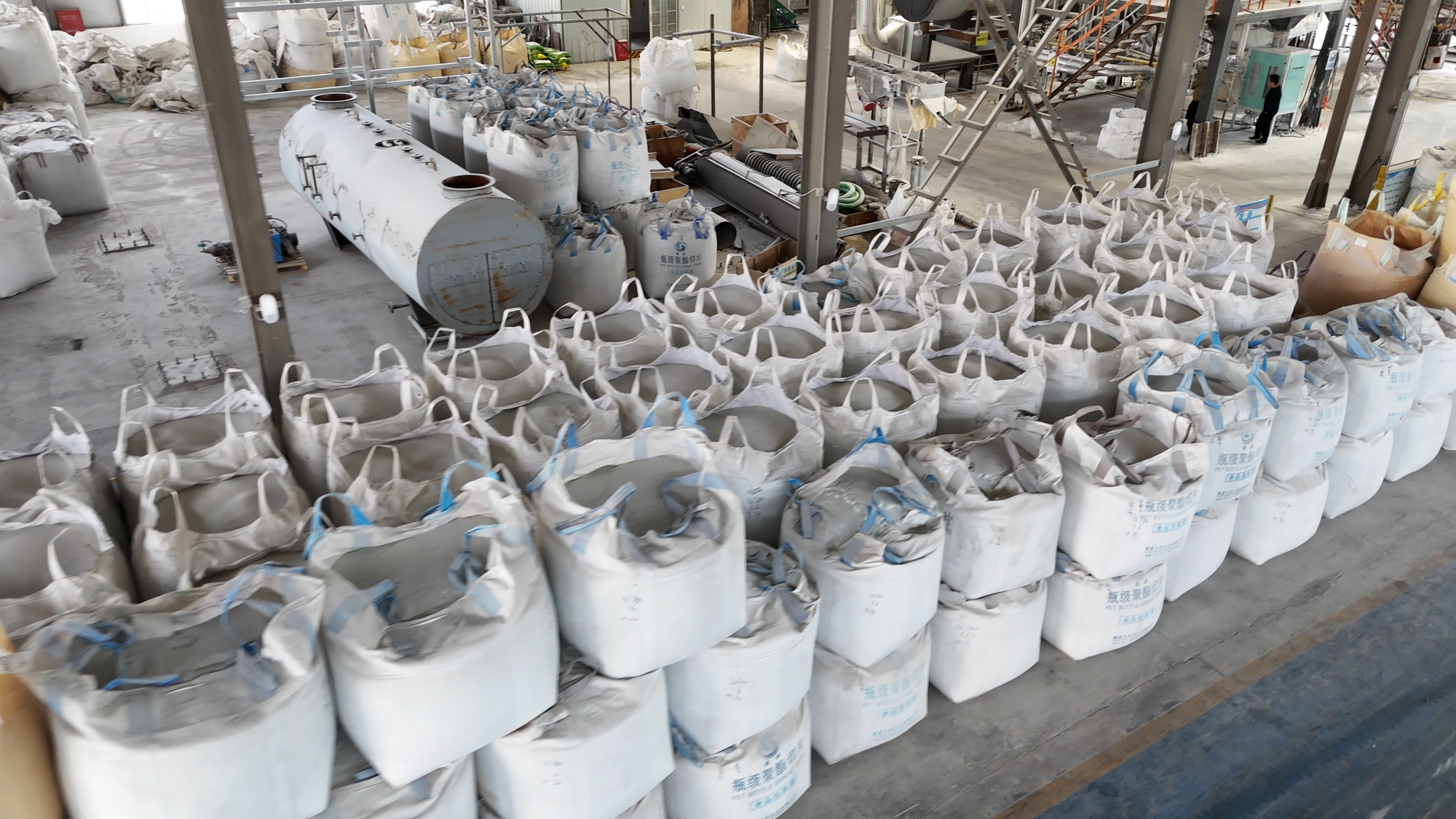
This article is written for the people who actually place the order: contractors finishing pool interiors, distributors stocking decorative aggregate, brand owners building their own product line, and procurement teams comparing quotations that look similar on paper but describe different materials.
Why “Decorative Glass Beads” Is an Incomplete Specification
Most decorative bead problems are specification problems rather than product problems. An order that lists only “glass beads” leaves three appearance variables undefined — colour mode, surface finish and particle size — and each of them changes the look of the finished pool interior or decorative surface. A fourth variable, how consistently the supplier can repeat a batch, decides whether the second delivery matches the first.
Buyers often inherit the wrong language from neighbouring product categories. Road marking beads are written against traffic paint standards and judged on retro-reflectivity; grinding and sandblasting media are written against abrasive behaviour; industrial microspheres are frequently specified by particle size distribution alone. None of those descriptions tells a contractor what a bead looks like once it is set into a pool finish or a decorative surface, which is why decorative selection has to start from appearance rather than from a borrowed standard.
The practical fix is to define four statements before requesting a quotation: colour mode, surface finish, size band, and the acceptable variation between batches. Everything else — certification, capacity, minimum order quantity and lead time — is the commercial wrapper around those four statements.
Where Decorative Glass Beads Sit in the Global Glass Bead Market
China is the dominant export source for glass beads worldwide. According to the Observatory of Economic Complexity (OEC), China accounted for approximately 57.4% of total global glass bead exports in 2024, with an export value of about USD 928 million and the UAE and India among the leading destinations. For decorative buyers this concentration is a practical sourcing fact: most decorative bead supply is produced in and shipped from Chinese manufacturing bases, so supplier evaluation usually means evaluating Chinese production capability.
Inside that market, decorative and swimming pool demand sits alongside three other blocks: road safety (traffic paint beads specified under standards such as AASHTO M247, EN 1423 and BS 6088), industrial surface treatment (grinding and sandblasting media), and general industrial use. The categories should not be mixed up at the specification stage. AASHTO M247 is the standard specification for glass beads used in traffic paints in the United States and classifies beads by type while requiring at least 70% roundness. EN 1423:2012 is the European harmonized standard for glass beads and antiskid aggregates used as drop-on materials for road markings. Both describe road marking behaviour; neither describes decorative appearance. Pool and decorative projects are therefore specified by colour, finish and consistency rather than by retro-reflectivity.
Recycled glass has become a common base material for decorative beads, because it allows colour and finish to be engineered while keeping part of the raw material stream circular. Dylan Tech’s decorative glass beads are produced from recycled glass.
Selecting the Three Visible Variables
Colour mode: transparent, opaque or mixed
Colour mode is the first decision because it sets how the bead layer relates to the surface underneath it. Transparent beads do not hide the substrate: the underlying tone stays visible through the glass, and the bead adds depth, light and a crystalline quality rather than a new colour. Opaque beads carry their own colour and read as that colour regardless of what sits beneath them. Mixed colour is a blend of two or more tones, usually chosen where a single flat colour would look too uniform across a large area. All three options — transparent, opaque and mixed colour — are standard in Dylan Tech’s decorative range, and custom colour is available where a project palette has to be matched precisely.
Surface finish: smooth or matte
Finish controls how light behaves at the bead surface. A smooth finish produces a tighter, brighter highlight, which increases apparent depth and gives a glossier read across the finished surface. A matte finish scatters light instead, producing a softer, diffused appearance with less reflection. The difference is usually clearest in direct light and at glancing angles, which is why finish belongs in the written specification rather than in a visual impression formed during sampling. Both smooth and matte finishes are available as standard.
Particle size: 0.5 mm to 20 mm
The available size range spans 0.5 mm to 20 mm — more than two orders of magnitude. That matters because beads at opposite ends of the range are read quite differently: at the fine end the material registers as texture within the surface, while at the coarse end individual beads are visible as discrete elements with their own highlights. Because the range is continuous, buyers should specify a size band rather than a single maximum or minimum, and confirm the grading with the supplier in writing. Custom sizes are available alongside the standard range.
Manufacturing Capability Behind the Specification
A specification is only as reliable as the plant behind it. LangFang Dylan Technology Co., Ltd. was founded in 2004 and produces glass beads from four modern production bases located in Liaoning, Shanxi, Hebei and Henan provinces, positioned across major Chinese industrial regions. The company operates more than 15 advanced glass bead production lines, with an annual output of 100,000 tons and a monthly capacity of 10,000 tons — capacity that supports both project-scale orders and distributor stocking programmes.
Quality control is built around measurement rather than visual inspection. The company’s laboratory is equipped with a full set of professional testing instruments, including CAMSIZER and X-2600 equipment, used to check particle size, reflectivity, wear resistance and other key indicators through the production process. Testing coverage is 100%. For a decorative buyer, the practical value of that laboratory is narrow and specific: it is the mechanism that keeps particle size grading and appearance consistent from one batch to the next.
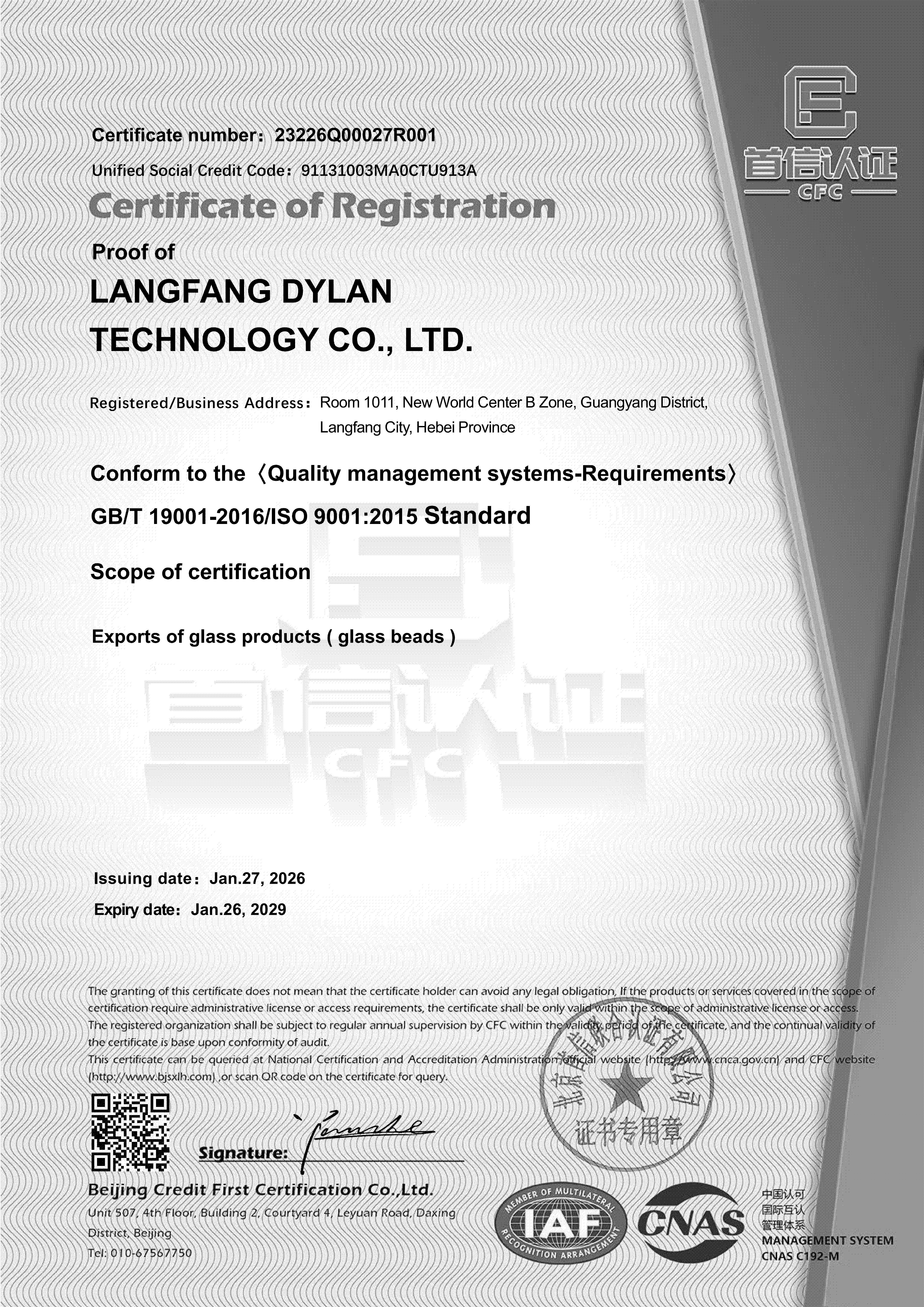
On compliance, Dylan Tech holds ISO 9001 certificate 23226Q00027R001, issued by CFC against the GB/T 19001-2016 / ISO 9001:2015 standard, with a scope covering exports of glass products (glass beads) and validity from 27 June 2026 to 26 June 2029. The company profile additionally lists CE, JIS and KIS certification. Dylan Tech has also been recognised as a provincial-level high-tech enterprise and as a specialised and sophisticated enterprise with distinctive features, and its independently developed waste heat recovery system has been recognised as a scientific and technological achievement by the China Energy Conservation Association.

Commercially, the programme is set up for export buyers. The minimum order quantity is 1 ton. Lead time is 45 to 60 days. Delivery terms are quoted as FOB, CIF, DDP or EXW. Acceptance is based on pre-shipment testing, and after-sales support is provided remotely. OEM production is available, including logo customisation for buyers who sell under their own brand. Around 95% of output is exported, and Dylan Tech products reach customers in more than 50 countries and regions, with main markets in the EU, USA, Southeast Asia and the Middle East.
Long-term partners include road safety companies such as ENNIS, Geveko and Swarco — a track record built on the road marking side of the business, where long-run supply programmes have been maintained for three years or more on individual projects, including a global programme using 198 tons of RI 1.7 beads with three years of stable performance and low wear reported. That record matters to decorative buyers for one reason only: it demonstrates the discipline of holding a specification stable across years of repeat supply, not the road marking performance itself.
Step-by-Step: From Design Intent to Delivered Batch
Six steps take a decorative glass bead project from a design idea to an accepted delivery.
- Write the appearance target in plain language. Describe what the finished surface should look like — for example, a bright pool interior that keeps the base tone visible, or a softer, low-sheen decorative surface. This step prevents colour mode and finish from being decided informally at the ordering stage.
- Convert the description into a four-line specification. Colour mode (transparent, opaque or mixed colour), surface finish (smooth or matte), size band within the 0.5 mm to 20 mm range, and base material (recycled glass, where that matters to the project).
- Confirm the supplier can produce exactly that combination, including the non-standard parts. Ask explicitly whether the required colour and size band are standard items or require custom production. Custom colour and size are available from Dylan Tech, and OEM production with logo customisation is possible.
- Agree a trial quantity and the acceptance test. The 1 ton minimum order quantity functions as a production-scale trial, and the acceptance gate is the pre-shipment test, so batch data is available before the material ships.
- Fix the commercial terms before production starts. Delivery terms (FOB, CIF, DDP or EXW) and the payment structure should be agreed in the same document as the specification, because both feed into the landed cost calculation.
- Plan the repeat order around the lead time. With a 45 to 60 day lead time, the second order should be scheduled before the first delivery is consumed, particularly on projects finished in phases.
Use Cases: Where Decorative Beads Are Specified
Swimming pool finishes are the application that defines this category. Decorative glass beads are used within pool finish systems where the visual result matters most: colour depth, light response, and consistency across a large surface area. Because a pool interior is viewed both from directly above and at oblique angles, colour mode and finish can behave differently across the same surface, which is why specifiers normally lock down both in one specification before ordering.
Decorative surface projects form the second group — applications where glass beads are selected for appearance rather than for any traffic or abrasive function, and where the same four-line specification applies. Buyers in this group are frequently distributors and brand owners building a product line rather than contractors finishing a single site. For them the deciding questions are batch consistency, custom colour development, minimum order quantity and lead time rather than site conditions.
A third, adjacent group is worth noting for companies that buy across categories. The same manufacturer also produces road marking beads (including the BS6088A and BS6088B models, plus grades referenced to AASHTO M247, EN 1423, EN 1424 and AS/NZS specifications) and industrial beads for grinding and sandblasting. Even when both decorative and road marking beads are purchased from one supplier, the specification should still be written separately for each, because the acceptance criteria are not interchangeable.
Selection and Specification Reference
Table 1 — Colour and finish selection matrix
| Option | Status in the decorative range | How it reads in a finished surface | Specify it when |
|---|---|---|---|
| Transparent | Standard | Substrate tone remains visible; the bead adds depth, light and clarity instead of its own colour | The design should stay close to the base colour of the pool or surface |
| Opaque | Standard | The bead reads as its own solid colour rather than the colour beneath it | The palette must be defined and must not shift with the substrate |
| Mixed colour | Standard | A blended multi-tone effect across the bead layer | A flat single colour would look too uniform across a large area |
| Smooth finish | Standard | Tighter, brighter highlight; higher apparent depth and a glossier read | A brighter, more reflective appearance is wanted |
| Matte finish | Standard | Light is scattered rather than sharply reflected; softer, diffused appearance | A low-sheen, understated surface is wanted |
Table 2 — Specification and commercial summary
| Parameter | Value | Note |
|---|---|---|
| Particle size | 0.5 mm – 20 mm | Custom sizes available |
| Colour | Transparent / opaque / mixed colour | Custom colour available |
| Surface finish | Smooth / matte | Both standard |
| Base material | Recycled glass | Decorative glass bead range |
| Application | Decorative / swimming pool | Distinct from road marking and industrial grades |
| MOQ | 1 ton | Usable as a production-scale trial |
| Lead time | 45–60 days | Plan repeat orders around this interval |
| Monthly capacity | 10,000 tons | Annual output 100,000 tons |
| Production base | Four bases; 15+ glass bead production lines | Liaoning, Shanxi, Hebei, Henan |
| Quality control | 100% test | CAMSIZER and X-2600 laboratory instruments |
| Certification | ISO 9001, certificate 23226Q00027R001 | Valid 27 June 2026 to 26 June 2029, issued by CFC |
| Delivery terms | FOB / CIF / DDP / EXW | Quoted per destination |
| Payment terms | Agreed per order | Documented options include TT 30% in advance with 70% against copy B/L, and L/C 90 days after B/L date |
| OEM | Available | Includes logo customisation |
| After-sales | Remote support | — |
Frequently Asked Questions
Which certifications should I check when sourcing decorative glass beads?
The most directly relevant document is the ISO 9001 quality management certificate, because it confirms that the supplier operates a certified quality system rather than testing only on request. Dylan Tech holds ISO 9001 certificate 23226Q00027R001, issued by CFC against the GB/T 19001-2016 / ISO 9001:2015 standard, with a scope covering exports of glass products (glass beads) and validity from 27 June 2026 to 26 June 2029; the company profile additionally lists CE, JIS and KIS certification. It is equally important to recognise which standards do not apply: AASHTO M247 and EN 1423 govern beads used in traffic paints and as drop-on materials for road markings, so they describe road marking performance rather than decorative appearance and should not be used as the primary specification for a pool or decorative project.
Can decorative glass beads be produced in custom colours and sizes?
Yes. Dylan Tech’s decorative glass bead range covers a particle size range of 0.5 mm to 20 mm, with transparent, opaque or mixed colour options and a smooth or matte surface finish, and custom colour and size development is available. Production is supported by four manufacturing bases in Liaoning, Shanxi, Hebei and Henan, more than 15 glass bead production lines and a monthly capacity of 10,000 tons, with annual output of 100,000 tons. OEM production — including logo customisation — is available for buyers who sell decorative beads under their own brand.
What is the minimum order quantity, and how are orders quoted and paid?
The minimum order quantity for Dylan Tech glass beads is 1 ton, which keeps the entry point for a decorative project or a distributor trial relatively low. Delivery terms are quoted as FOB, CIF, DDP or EXW, depending on destination and the Incoterm the buyer prefers. Payment terms are agreed per order; documented structures include TT 30% in advance with 70% against a copy B/L, and L/C 90 days after B/L date. Unit pricing is quoted against the confirmed specification — size band, colour mode, finish and quantity — because those variables determine how the batch is produced.
How can I validate the material before committing to a bulk order?
The practical route is a specification-first trial. Confirm the colour mode, surface finish and size band in writing, then order a small quantity: the 1 ton minimum order quantity is itself a production-scale trial, and the pre-shipment test is the acceptance gate. Dylan Tech tests 100% of output in a laboratory equipped with CAMSIZER and X-2600 instruments for particle size and other key indicators, so batch data is available before goods leave the plant. Buyers who want to discuss a trial quantity or request a quotation can contact the team at dylan@xgbead.com or by WhatsApp on +86 186-3166-3616.
What lead time should be planned for a decorative glass bead order?
Standard lead time is 45 to 60 days. On project work that interval should be built into the finishing schedule from the start, particularly where a custom colour or a non-standard size band has to be produced rather than drawn from stock. A monthly capacity of 10,000 tons and annual output of 100,000 tons across four production bases in China support repeat and large-scale programmes, and about 95% of Dylan Tech output is exported to markets including the EU, USA, Southeast Asia and the Middle East. To start a specification or request the full product catalogue, the corporate brochure can be downloaded here: Corporate Brochure (PDF).
Conclusion
Choosing decorative glass beads for pool finishes and decorative projects is a four-variable decision: colour mode, surface finish, particle size band and batch consistency. Everything else — certification, capacity, minimum order quantity and lead time — is really a question about whether the supplier can hold those four variables across repeat orders.
Dylan Tech’s decorative range covers 0.5 mm to 20 mm in transparent, opaque or mixed colour, with a smooth or matte finish, produced from recycled glass, and backed by custom colour and size development, four production bases, more than 15 production lines and a monthly capacity of 10,000 tons. The written specification is where a project’s appearance is actually decided; supplier capability is what keeps it that way in the following deliveries.

Next step
Send your colour mode, surface finish, size band and target quantity to Dylan Tech, and the team will confirm production feasibility, custom options, lead time and commercial terms.
- Email: dylan@xgbead.com
- Tel / WhatsApp: +86 186-3166-3616
- WhatsApp chat: start a conversation
- Website: www.dylantech.com | Blog: blog.dylantech.com
- Corporate brochure: download the PDF