
From Furnace to Pavement: Glass Bead Manufacturing Capability

From Furnace to Pavement: Glass Bead Manufacturing Capability
Buyers of reflective glass beads for road marking frequently compare standards, particle sizes, and refractive index values, yet the factor that determines whether those specifications are delivered consistently is manufacturing capability. This article explains what glass bead manufacturing capability means in practice, how production capacity, process control, testing equipment, and compliance coverage affect road marking performance, and what procurement teams should verify before executing an order.
LangFang Dylan Technology Co., Ltd. (Dylan Tech) is a Chinese manufacturer of glass beads for the road safety industry, headquartered in Langfang, China, and exporting to the EU, North America, Southeast Asia, the Middle East, and other regions. The company's production system, laboratory equipment, and certification portfolio provide a useful reference for understanding how glass beads are manufactured and qualified for road marking projects.
Why Glass Bead Manufacturing Capability Matters
Road marking glass beads must perform three core functions: return light to the driver, resist wear under traffic, and remain embedded in the marking system. Standards such as AASHTO M247, EN 1423, and BS 6088 define the required particle size distribution, roundness, and quality levels. However, the standard only states what must be delivered; it does not guarantee that a supplier can reproduce those requirements batch after batch, at scale, under project deadlines.
Manufacturing capability determines consistency. A supplier with limited furnace capacity, manual sorting, or weak laboratory control may pass an initial sample but fail to maintain quality during large-volume deliveries. For road marking contractors and traffic safety manufacturers, the evaluation phase must therefore go beyond specification sheets and include an assessment of how the beads are actually produced, tested, and shipped.
Key evaluation insight: When a glass beads supplier claims compliance with AASHTO M247 or EN 1423, buyers should verify three capabilities: the production capacity to fulfill the order volume, the testing equipment to measure roundness and particle size distribution, and the quality system to document batch-level results.
Industry Background: A Market Built on Retroreflective Performance
The road marking glass beads market is substantial and continues to grow. According to Dataintelo, the global road marking glass beads market was valued at approximately USD 1.42 billion in 2025 and is projected to reach USD 2.31 billion by 2034. Asia Pacific accounted for 38.7% of global revenue in 2025, driven largely by highway construction and road safety programs.
China plays a dominant role in glass bead supply. OEC trade data shows that China accounted for approximately 57.4% of total global glass bead exports in 2024, with total export value reaching roughly USD 928 million. The UAE and India are cited as leading destination markets for Chinese glass beads.
On the standards side, AASHTO M247 is the standard specification for glass beads used in traffic paints in the United States, classifying beads into types and requiring at least 70% roundness. In Europe, EN 1423:2012 is the harmonized standard for glass beads and antiskid aggregates used as drop-on materials for road markings. Industry leaders in the sector include Potters Industries LLC, Swarco AG, and 3M Company, according to market analyses from Dataintelo and Mordor Intelligence.
One notable product trend is the use of high refractive index glass beads, particularly RI 1.9 and above, in all-weather road markings to improve visibility during wet night conditions. Lower-index beads, typically RI 1.5 to RI 1.7, remain the common choice for standard road marking applications, balancing retroreflective performance and cost.
Glass Bead Manufacturing Capability in Practice: Dylan Tech
Dylan Tech, established in 2004, operates four production bases in Liaoning, Shanxi, Hebei, and Henan provinces. The company maintains more than 15 professional production lines for glass beads and reports an annual output capacity of 100,000 tons. Factory facilities cover approximately 10,000 m², with around 300 employees including a 20-engineer R&D team. Approximately 95% of production is exported.
For OEM and large-volume programs, Dylan Tech states a monthly production capacity of 10,000 tons and a minimum order quantity of 1 ton. The company offers OEM production services, allowing customers to customize products for their own brand, with customization options including voltage and logo marking. This production model is relevant to buyers who need private-label glass beads or locally distributed brands in the EU and other regulated markets.
Production Equipment and Energy Recovery
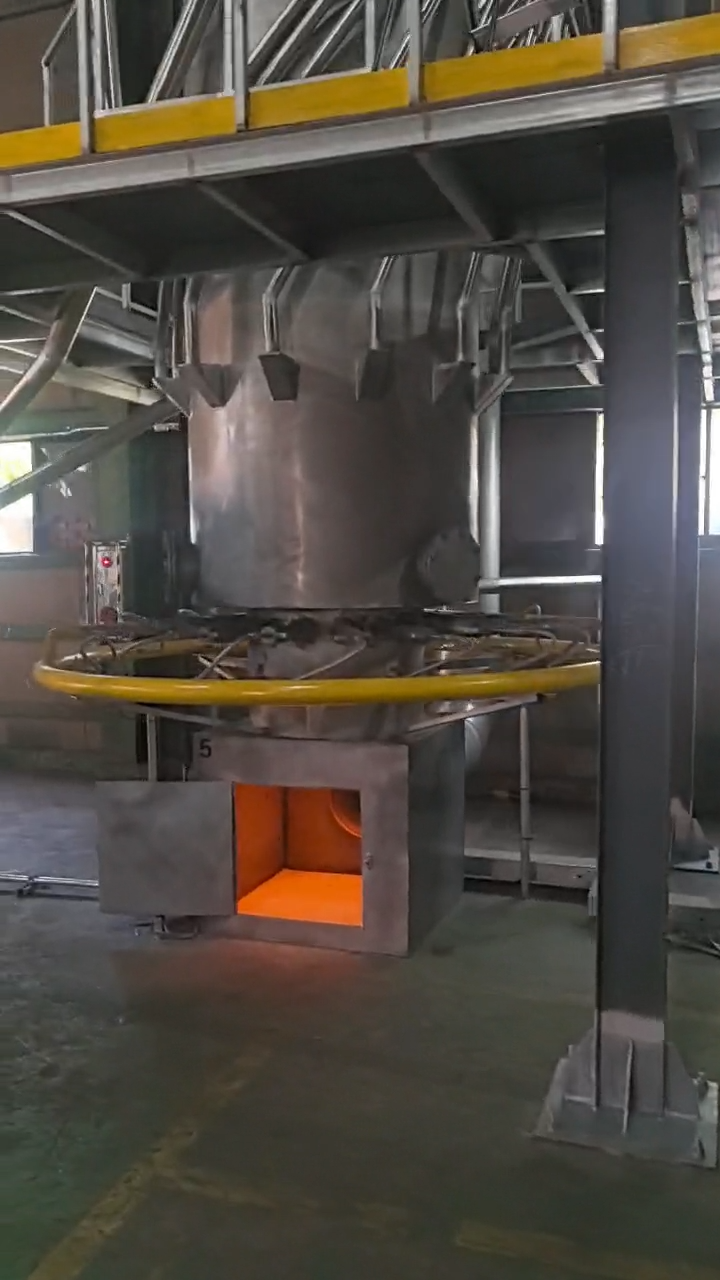
After four years of research and development, Dylan Tech developed its own patented glass bead production equipment. The company also developed a waste heat recovery system for glass bead production, which has been officially recognized as a scientific and technological achievement by the China Energy Conservation Association. For procurement teams, production equipment that improves energy efficiency and process stability can translate into more consistent bead quality and more predictable supply costs over long-term contracts.
Quality Control Laboratory
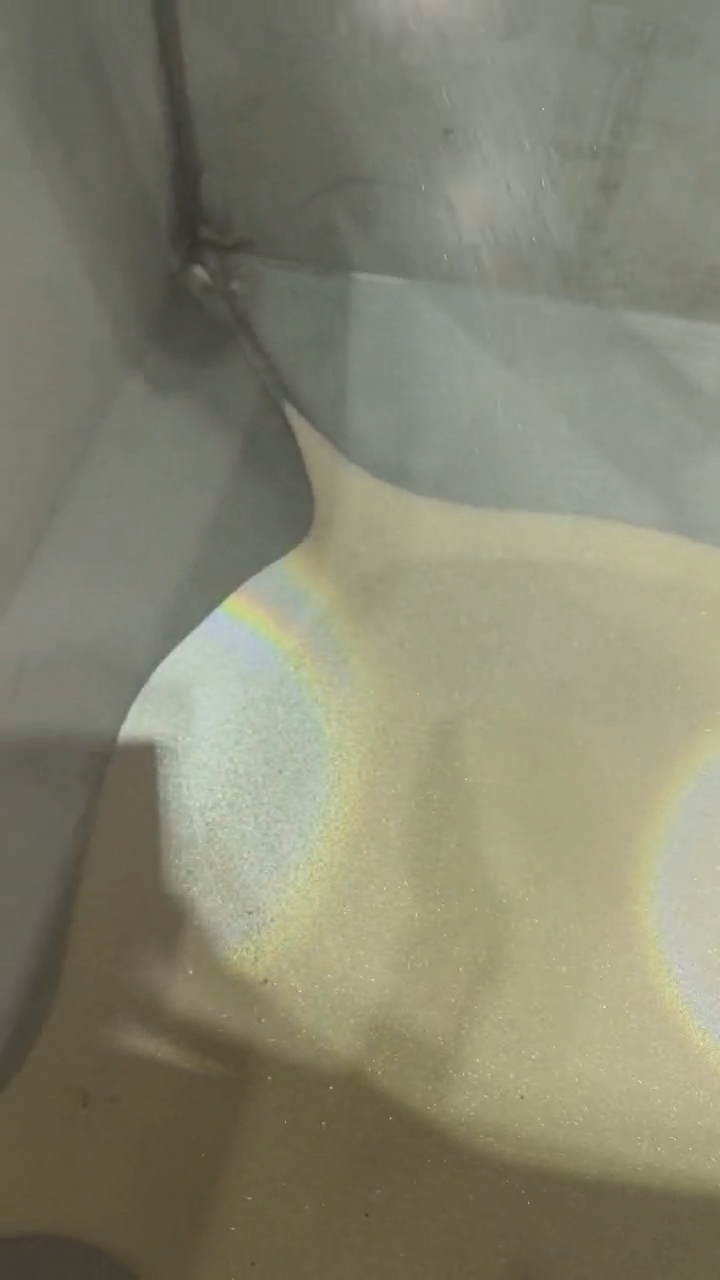
Dylan Tech operates a laboratory equipped with CAMSIZER, X-2600, and other internationally recognized testing instruments. These devices are used to check particle size, reflectivity, wear resistance, and other key indicators during the production process. The company reports that every batch is tested, and pre-shipment testing is offered to customers as part of the acceptance procedure.
Certifications and Market Access
Dylan Tech holds an ISO 9001 quality management system certification under certificate number 23226Q00027R001, issued by CFC for the export of glass products (glass beads), valid until June 26, 2029. The company also reports CE certification, JIS certification, and KIS certification, which support market access to Europe, Japan, and South Korea. In addition, Dylan Tech is recognized in China as a provincial-level high-tech enterprise and a specialized and sophisticated enterprise with distinctive features.
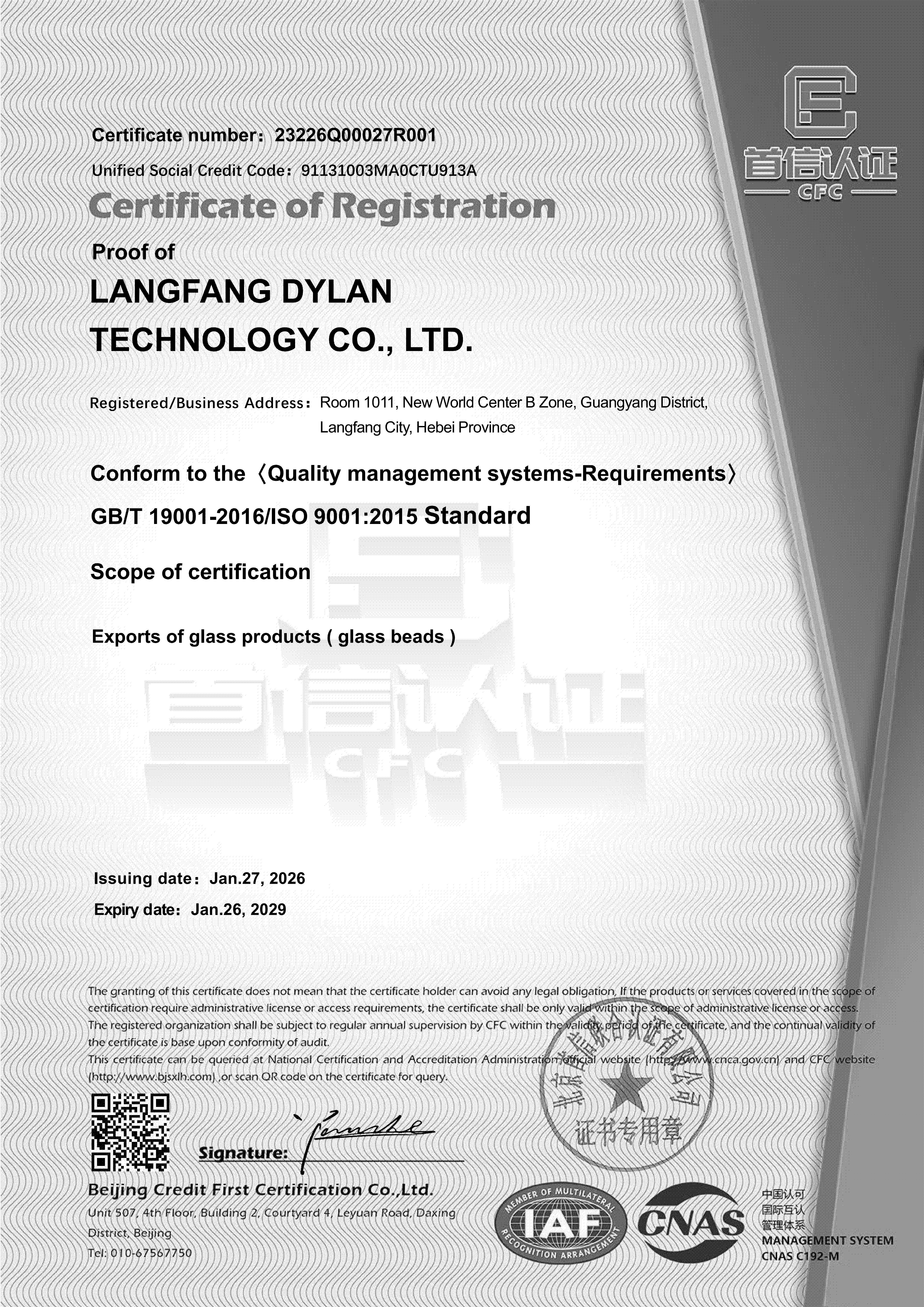
Understanding these capabilities is essential for buyers in the Evaluation and Execution stages. A supplier with certified production lines and documented batch testing can support project planning, regulatory submissions, and long-term supply agreements more reliably than one offering only brochures and samples.
From Specification to Delivery: A Step-by-Step Breakdown
The procurement process for road marking glass beads can be structured into six stages. This workflow helps buyers align their project requirements with the supplier's manufacturing capability.
Step 1: Specification Definition
Define the applicable standard and performance requirements: AASHTO M247, EN 1423, BS 6088, AS/NZS, or a project-specific specification. Determine the required particle size range, refractive index, color, surface finish, and whether beads will be used in drop-on or pre-mixed applications. Dylan Tech's product range covers bead sizes from as fine as 63 μm to as coarse as 20 mm, depending on the product grade.
Step 2: Product Selection and Compliance Check
Select the product grade that matches the standard. Dylan Tech supplies AASHTO M247 Types 1–4, EN 1423 grades in 850–180 μm and 710–125 μm ranges, EN 1424 in 1400–355 μm, BS 6088A and BS 6088B, AS/NZS Types B, C, and D, plus specialty grades such as RI 1.6 and RI 1.7 high-index beads. All standard road marking grades in the applicable products list are manufactured from recycled glass, while RI 1.6 and RI 1.7 grades use glass feedstock.
Step 3: OEM and Customization Confirmation
If the order requires private labeling or customized packaging, confirm OEM production conditions before scheduling. Dylan Tech provides OEM production services, with customization options including logo and voltage marking. The minimum order quantity for OEM programs is 1 ton, and the company's monthly capacity of 10,000 tons supports continuous replenishment for distributors and contractors.
Step 4: Production and Process Control
During production, the supplier should monitor particle size distribution, roundness, reflectivity, and wear resistance. Dylan Tech's laboratory uses CAMSIZER, X-2600, and similar instruments to inspect these indicators throughout the manufacturing process. Buyers should request batch test documentation as part of the quality agreement.
Step 5: Pre-Shipment Testing
Dylan Tech offers pre-shipment testing as the acceptance standard for customer orders. This allows the buyer to verify that the produced lot matches the approved specification before the goods leave the factory. For road marking projects with strict retroreflectivity requirements, this step reduces the risk of receiving off-spec material.
Step 6: Logistics and Delivery Terms
Dylan Tech supports FOB, CIF, DDP, and EXW delivery methods, giving buyers flexibility in managing freight and customs. Payment options include TT and L/C arrangements, such as TT 30% in advance with 70% against copy of B/L, or L/C terms after bill of lading date. Lead time for glass bead orders is approximately 45 to 60 days, depending on volume and customization requirements.
Real-World Use: Glass Beads on Road Marking Projects
Glass beads from Dylan Tech have been applied in multiple global road marking projects. Documented use cases show consistent performance over multi-year service periods.
- High-index beads (product 5399, RI 1.7): A global project supplied 198 tons of high refractive index glass beads to increase the reflective refractive index of road markings. The project was completed within 3 years and achieved 3 years of stable performance, with low wear highlighted as a key result.
- BS 6088A beads (product 5378): A project supplied 108 tons of beads to improve road marking retroreflective performance. The material delivered 3 years of stable performance with low wear, used by a road marking engineering company and traffic safety manufacturer.
- EN 1423 beads (product 5384): A 72-ton application for road marking used beads to increase reflective performance. The result was 3 years of stable performance with low wear characteristics.
- Additional long-term cases: Other documented orders include 56 tons with 3 years of stable performance, 20 tons with 4 years of stable performance and low wear, and a 1-ton verification order where the night visibility effect was reported as remarkable.
These examples indicate that glass bead performance in road marking depends not only on the initial refractive index but also on the bead's ability to maintain reflectivity and resist wear over time. Buyers evaluating supplier capability should therefore ask for long-term application evidence, not just first-year laboratory values.
Glass Beads by Standard: A Specification Map
The table below maps Dylan Tech's glass bead grades to their applicable standards and particle size ranges. All road marking standard grades are made from recycled glass; RI 1.6 and RI 1.7 high-index grades are produced from glass feedstock.
| Product Grade | Applicable Standard / Scope | Particle Size Range | Material |
|---|---|---|---|
| AASHTO M247 Type 1 | AASHTO M247 | 1180–150 μm | Recycled glass |
| AASHTO M247 Type 2 | AASHTO M247 | 1180–180 μm | Recycled glass |
| AASHTO M247 Type 3 | AASHTO M247 | 1700–710 μm | Recycled glass |
| AASHTO M247 Type 4 | AASHTO M247 | 2000–850 μm | Recycled glass |
| EN 1423 (standard) | EN 1423 | 850–180 μm | Recycled glass |
| EN 1423 (fine) | EN 1423 | 710–125 μm | Recycled glass |
| EN 1424 | EN 1424 | 1400–355 μm | Recycled glass |
| BS 6088A | BS 6088 | 1180–425 μm | Recycled glass |
| BS 6088B | BS 6088 | 850–180 μm | Recycled glass |
| AS/NZS Type B | AS/NZS | 850–75 μm | Recycled glass |
| AS/NZS Type C | AS/NZS | 1300–425 μm | Recycled glass |
| AS/NZS Type D | AS/NZS | 1700–710 μm | Recycled glass |
| GLASS BEADS RI 1.6 | High refractive index applications | 1000–180 μm | Glass |
| GLASS BEADS RI 1.7 | High refractive index applications | 1180–180 μm | Glass |
For buyers, the key takeaway is that standard compliance is not a single product characteristic but a combination of particle size distribution, roundness, refractive index, and material quality. When a supplier offers multiple grades under the same standard, the precise particle range must be matched to the marking material system and the project's retroreflectivity target.
FAQ
1. Which standards do Dylan Tech glass beads comply with?
Dylan Tech supplies glass beads in grades designed for AASHTO M247 (Types 1–4), EN 1423 (850–180 μm and 710–125 μm), EN 1424 (1400–355 μm), BS 6088A / BS 6088B, and AS/NZS Types B, C, and D. The company also produces high refractive index grades RI 1.6 and RI 1.7. Road marking standard grades are manufactured from recycled glass. The company's ISO 9001 certification, number 23226Q00027R001, covers the export of glass products (glass beads) and remains valid until June 26, 2029.
2. What customization options are available for glass bead orders?
Dylan Tech provides OEM production services. Customization options include logo and voltage marking, allowing customers to brand products for their own distribution. Product-level customization also covers size range from 0.5 mm to 20 mm, color choices of transparent, opaque, or mixed color, and surface finishes of smooth or matte. The minimum order quantity for OEM production is 1 ton, supported by a monthly production capacity of 10,000 tons.
3. What are the minimum order quantity and payment terms?
The minimum order quantity is 1 ton. Dylan Tech supports FOB, CIF, DDP, and EXW delivery methods. Payment terms include TT and L/C options, with conditions such as TT 100% within 30 days after bill of lading date, L/C 90 days after bill of lading date, TT 30% in advance with 70% against copy of B/L, and other arrangements agreed with the customer. Buyers should confirm the applicable terms with the sales team before placing an order.
4. How is quality verified before shipment?
Dylan Tech applies 100% testing to produced batches and offers pre-shipment testing as the acceptance standard for customer orders. The company's laboratory is equipped with CAMSIZER, X-2600, and other internationally recognized testing instruments, which are used to inspect particle size, reflectivity, wear resistance, and other key indicators throughout the production process. Buyers can request batch-level test documentation as part of their quality agreement.
5. What is the lead time for glass bead orders?
Lead time is approximately 45 to 60 days for standard and OEM orders. This timeframe is supported by four production bases in Liaoning, Shanxi, Hebei, and Henan provinces, more than 15 production lines, and an annual output capacity of 100,000 tons. For project planning, buyers should include the lead time in their schedule and use pre-shipment testing to confirm quality before shipment. The Dylan Tech sales team can be contacted for current production scheduling and quotation details.
Conclusion
Glass bead manufacturing capability is the link between specification compliance and real-world road marking performance. Buyers in the Evaluation and Execution stages should evaluate not only the product grade and refractive index but also the supplier's production capacity, testing equipment, OEM flexibility, and delivery terms.
Dylan Tech's production system offers a practical reference: four production bases, more than 15 glass bead production lines, 100,000 tons of annual output capacity, a laboratory with CAMSIZER and X-2600 instruments, ISO 9001 certification, and documented multi-year use cases across global road marking projects. For road marking contractors, traffic safety manufacturers, and distributors, these are the capabilities that make the difference between a sample that performs and a supply chain that performs.

Next step: If you are evaluating glass beads for a road marking project or building a long-term supply relationship, contact Dylan Tech for current specifications, OEM options, and pre-shipment testing schedules.
Email: dylan@xgbead.com | WhatsApp: +86 186-3166-3616
Website: www.dylantech.com