
Glass Bead Supply FAQ: Custom Specs, Lead Time, Reliability
A long-term glass bead partnership is rarely decided by price alone. It is decided by four constraints: the standard the beads must satisfy, the size and color specification, the minimum order and lead time, and the way each batch is verified. The figures Dylantech publishes for that conversation are a 1-ton minimum order quantity, a 45–60 day lead time, a monthly capacity of 10,000 tons, and custom color and size availability across a 0.5 mm to 20 mm range.

Why buyers ask the same questions before signing
A road marking program usually outlives its first purchase order. The beads specified at tender must still arrive, in the same sieve band and the same color, two or three seasons later. That is why the questions asked during evaluation are rarely about a single delivery — they are about whether the specification can be held over time.
Three failure modes repeat across the category. The first is standard drift: AASHTO M 247-26 is the current US edition, effective 1 July 2026, and it classifies beads from Type 0 to Type 5, so a partner that cannot re-map an existing gradation to a revised one forces a buyer into re-qualification. The second is supply discontinuity: a supplier that resells beads rather than produces them cannot protect volume when demand moves. The third is specification mismatch: a custom color or size agreed during development that cannot be reproduced in serial supply quietly breaks the link between the approved sample and the shipped lot.
The short answers to the partnership question are these:
- Minimum order quantity: 1 ton, per Dylantech capability data.
- Lead time: 45–60 days.
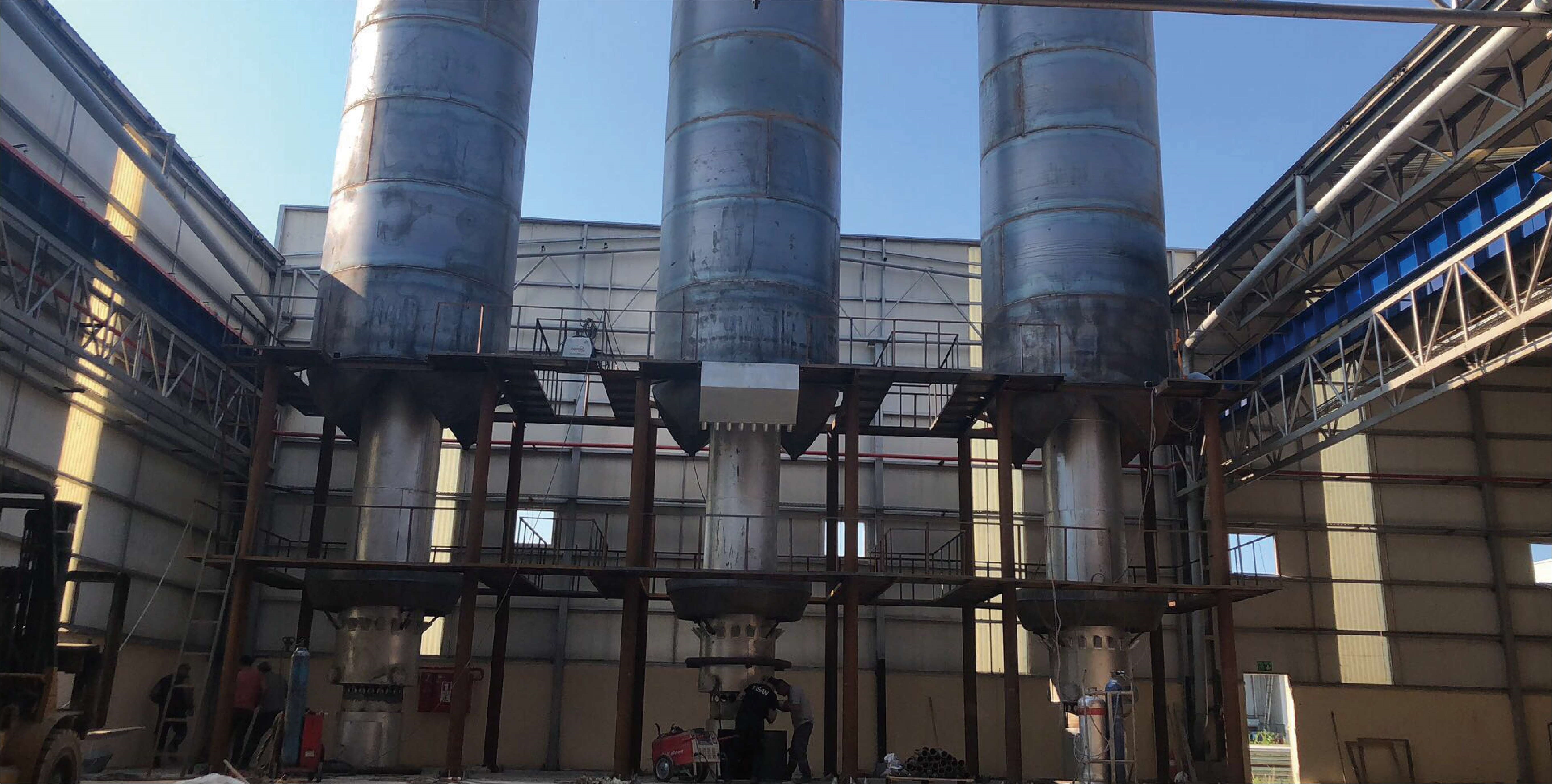
- Capacity behind an order: 10,000 tons per month, with an annual output of 100,000 tons produced across four production bases.
- Quality control: 100% test, supported by an in-house laboratory using CAMSIZER and X-2600 instruments.
- Customization: custom color and size across the glass bead product lines, plus OEM production with voltage and logo customization.
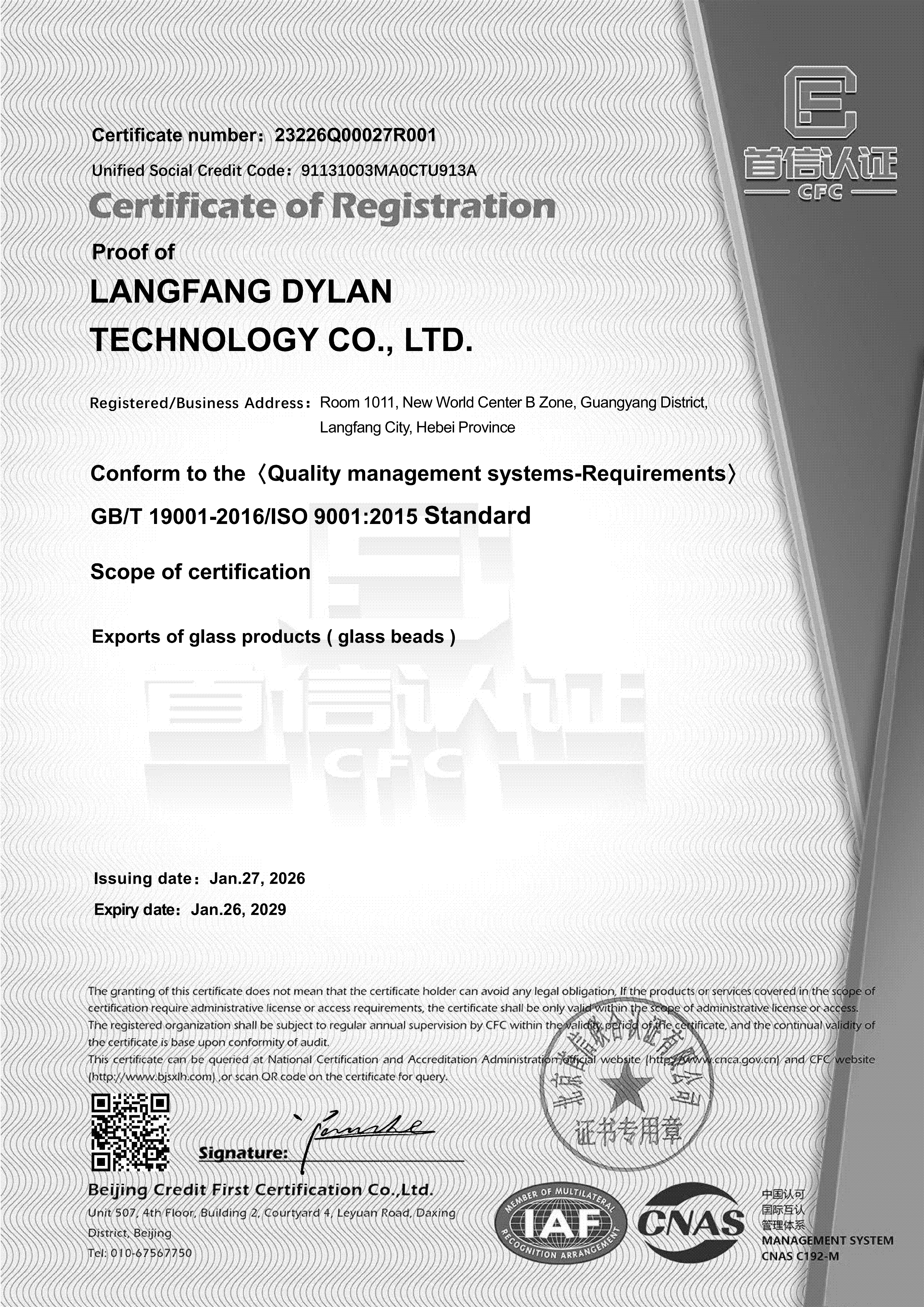
- Quality management: ISO 9001, certificate number 23226Q00027R001, issued by CFC, valid until 26 June 2029.
Industry background: the category is defined by constraints, not claims
Glass beads for road marking sit inside a regulatory framework that differs by market, and the framework is what a long-term agreement actually has to hold. EN 1423 specifies requirements for glass beads, anti-skid aggregates and the mixture of the two when applied as drop-on materials on road markings, as described in the published standard summary. Official Hong Kong road marking guidance maps drop-on beads to BS EN 1423 and premixed beads to BS EN 1424, with the refractive index required to conform to at least Class A (n ≥ 1.5). In the United States, AASHTO M 247-26 is current and introduces Type 0 through Type 5 classifications, and Texas adds its own layer: TxDOT requires beads to conform to DMS-8290, which specifies three gradations tested using Tex-831-B. China maintains GB/T 24722-2020, in force since 1 July 2021.
Commercially, the segment is substantial but concentrated in its standard grade. Cognitive Market Research (2026) values the global road marking glass beads market at USD 1.18 billion in 2025, with 1.5 refractive index standard beads accounting for 54.0% of market value because that grade aligns with conventional road marking specifications. Higher-index products exist alongside it: Potters Industries lists standard 1.5 and high-reflective 1.9 refractive index variants, and SWARCO states it has manufactured reflective glass beads for road markings since 1969, with production facilities in Europe, the United States and Saudi Arabia.
The practical consequence for a buyer in the research and evaluation stage is that supplier comparison starts with documentation and gradation coverage. Price becomes meaningful only after the specification and the verification method are fixed.
What a long-term glass bead partner is expected to hold
LangFang Dylan Technology Co., Ltd. (Dylantech, www.dylantech.com) is a China-based supplier of glass beads for the road safety industry, founded in 2004. Its recorded profile is built around volume, in-house production and testing rather than trading: four modern production bases in Liaoning, Shanxi, Hebei and Henan provinces; more than 15 professional glass bead production lines; an annual output of 100,000 tons; a 10,000 m² factory; 300 employees, including a 20-engineer R&D team; and an export ratio of 95%, serving markets in the EU, the USA, Southeast Asia and the Middle East, with customers in more than 50 countries and regions. The company states that it developed patented glass bead production equipment after four years of research, and that its waste heat recovery system was recognized as a scientific and technological achievement by the China Energy Conservation Association.
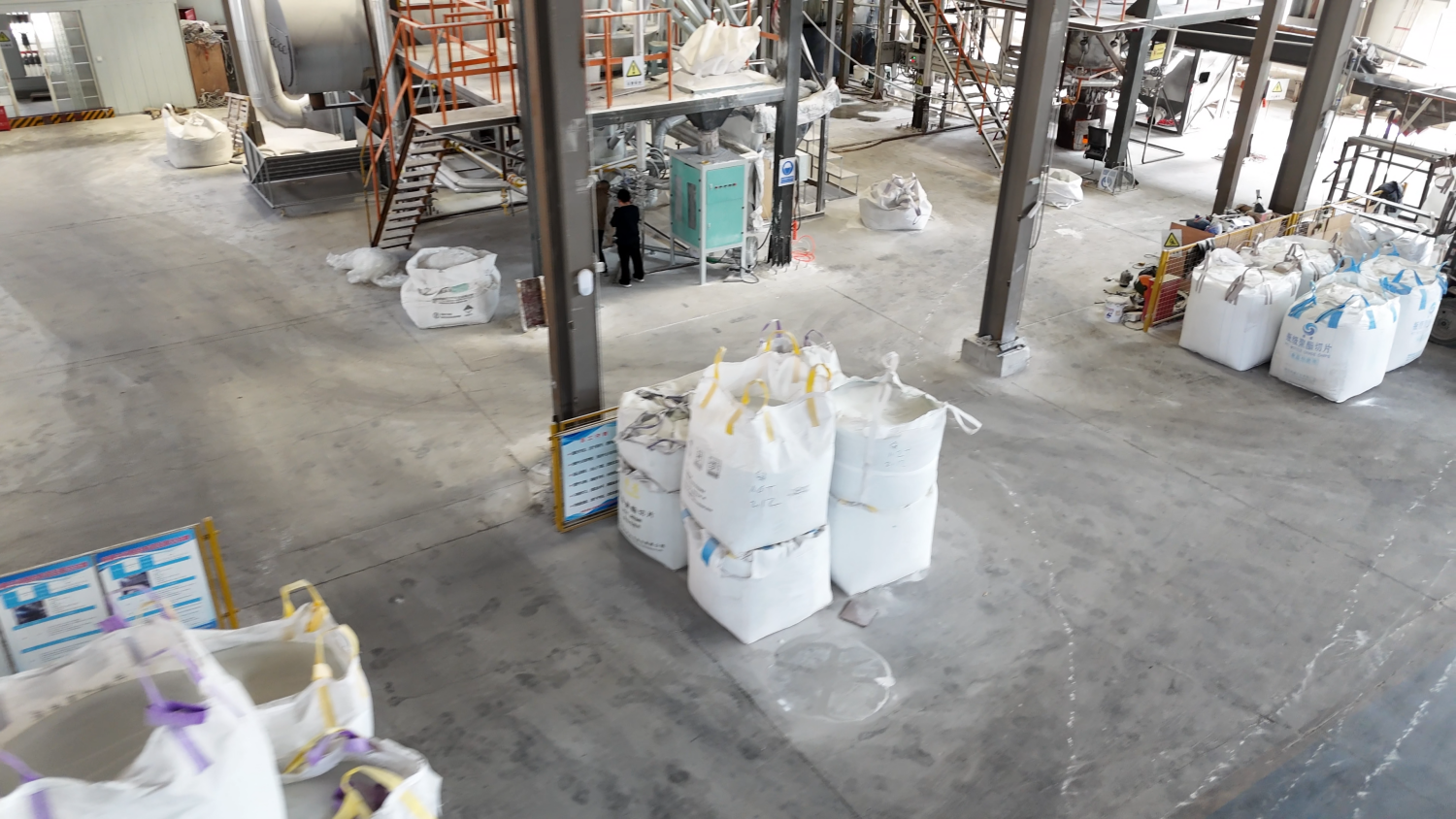
For a partnership, three of those facts matter more than the rest. Multi-base production in four provinces underpins continuity of supply. The in-house laboratory — equipped with CAMSIZER, X-2600 and other instruments — allows particle size, reflectivity and wear resistance to be checked during production rather than only at dispatch. And the certification set — ISO 9001, CE, JIS and KIS — gives an evaluation team documents to file before the first shipment. Dylantech also holds provincial-level high-tech enterprise and specialized and sophisticated enterprise recognition, and lists ENNIS, Geveko and Swarco among its cooperative partners.
Custom colors and custom sizes: what can be written into an agreement
Every Dylantech glass bead range is listed with a 0.5 mm–20 mm size range, a color option of transparent, opaque or mixed color, a surface finish of smooth or matte, and the explicit note that custom color and size are available. That note is the contractual hook for ongoing product development, because it means a buyer is not restricted to a catalog gradation when a project, a climate or a marking formulation requires something different.
What changes between models is the sieve scope, and that is where a specification should be precise. On the road marking side, GLASS BEADS AASHTO M247-TYPE 1 is recorded at 1180–150 µm, TYPE 2 at 1180–180 µm, TYPE 3 at 1700–710 µm and TYPE 4 at 2000–850 µm; EN1423 appears in two scopes, 850–180 µm and 710–125 µm; EN1424 sits at 1400–355 µm; BS6088A covers 1180–425 µm and BS6088B 850–180 µm; AS/NZS TYPE B is 850–75 µm, TYPE C 1300–425 µm and TYPE D 1700–710 µm; OPSS1750 is 850–150 µm and GB05 800–80 µm. Refractive index models are listed separately: GLASS BEADS RI 1.6 at 1000–180 µm and GLASS BEADS RI 1.7 at 1180–180 µm, both made from glass rather than recycled glass. Grinding beads are recorded at 600–1000 µm and 800–1200 µm, while decorative beads cover all sizes and are made from recycled glass.
The base material across most of the range is recycled glass, which is worth stating in the agreement if the buyer's own tender carries a sustainability criterion. Color is the variable most likely to be requested repeatedly: a colored bead approved for a decorative or specialty marking program should be pinned to a reference sample, a sieve band and a finish, so that a reorder three years later is not a new development project.
Step-by-step: from first enquiry to repeat supply
Where a long-term agreement is actually tested
The recorded glass bead projects in Dylantech's case data come from road marking engineering companies and traffic safety manufacturers, all aimed at increasing the reflective refractive index of road performance, and they span very different order sizes: 1 ton, 20 tons, 56 tons, 72 tons, 108 tons and 198 tons. Durations run from 3 to 4 years, the reported result in each case is stability across that period, and the highlights recorded are low wear and, for the smallest order, a night effect described as remarkable.
Read together, those records describe the two ends of a partnership. The 1-ton order is the entry point — a validation quantity that matches the stated minimum order. The 198-ton order, sustained over three years, is the repeat-supply scenario in which gradation consistency and wear behavior determine whether the relationship continues. Between them sit the mid-volume orders of 20, 56, 72 and 108 tons, which are typical of regional marking programs and seasonal tender awards.
- Application fit: road marking and road safety, including thermoplastic and drop-on use defined by the governing standard.
- Longevity signal: 3–4 year project durations with stable results recorded.
- Performance focus: low wear and night visibility, the two outcomes buyers watch after the first season.
Comparison table 1: model families and sieve scopes
| Model family | Standard basis | Recorded sieve scope | Material |
|---|---|---|---|
| GLASS BEADS AASHTO M247-TYPE 1 | AASHTO M 247 Type 1 | 1180–150 µm | Recycled glass |
| GLASS BEADS AASHTO M247-TYPE 2 | AASHTO M 247 Type 2 | 1180–180 µm | Recycled glass |
| GLASS BEADS AASHTO M247-TYPE 3 | AASHTO M 247 Type 3 | 1700–710 µm | Recycled glass |
| GLASS BEADS AASHTO M247-TYPE 4 | AASHTO M 247 Type 4 | 2000–850 µm | Recycled glass |
| GLASS BEADS EN1423 | EN 1423 | 850–180 µm / 710–125 µm | Recycled glass |
| GLASS BEADS EN1424 | EN 1424 | 1400–355 µm | Recycled glass |
| GLASS BEADS BS6088A / BS6088B | BS 6088 | 1180–425 µm / 850–180 µm | Recycled glass |
| AS/NZS TYPE B / C / D | AS/NZS | 850–75 µm / 1300–425 µm / 1700–710 µm | Recycled glass |
| GLASS BEADS TYPE IA / IB / IIA / IIB / IIC | Type classification | 850–75 µm / 300–63 µm / 1000–180 µm / 600–75 µm / 1000–300 µm | Recycled glass |
| GLASS BEADS OPSS1750 / GB05 | OPSS 1750 / GB 05 | 850–150 µm / 800–80 µm | Recycled glass |
| GLASS BEADS RI 1.6 / RI 1.7 | Refractive index model | 1000–180 µm / 1180–180 µm | Glass |
| GRINDING GLASS BEADS | Process media | 600–1000 µm / 800–1200 µm | Glass |
| Decorative / Sandblasting Glass Beads | Decorative and polishing | All sizes within 0.5–20 mm | Recycled glass |
All scopes above are the supplier's recorded product data. A buyer should confirm the model-to-standard mapping against the current edition of the governing standard before the purchase order is issued.
Comparison table 2: partnership parameters to fix in writing
| Parameter | Recorded value | Why it belongs in the agreement |
|---|---|---|
| Minimum order quantity | 1 ton | Sets the size of a validation lot before full commitment |
| Lead time | 45–60 days | Defines the replenishment buffer for tender schedules |
| Monthly capacity | 10,000 tons | Shows headroom for repeat and seasonal demand |
| Annual output | 100,000 tons | Indicates the production base behind the contract |
| Production structure | Four bases, 15+ production lines | Supports continuity if one line or site is interrupted |
| Quality control | 100% test; CAMSIZER and X-2600 laboratory checks | Converts quality claims into named verification points |
| Customization | Custom color and size; OEM with voltage and logo customization | Protects product development work across reorders |
| Quality management | ISO 9001 certificate 23226Q00027R001, valid to 26 June 2029 | Documentation for the buyer's audit file |
| After-sales | Remote support | Defines the channel for technical questions after delivery |
FAQ: long-term glass bead supply partnerships
Which standard should a long-term glass bead order be locked to?
Lock the order to the standard of the market where the marking will be applied, then name the supplier model that matches it. For European drop-on applications the reference is EN 1423, which covers glass beads, anti-skid aggregates and their mixtures applied as drop-on materials; premixed beads are mapped to BS EN 1424 in official Hong Kong road marking guidance, where the refractive index must conform to at least Class A (n ≥ 1.5). In the United States, AASHTO M 247-26 is current and effective from 1 July 2026 with Type 0 to Type 5 classifications, while Texas procurement adds DMS-8290 with three gradations tested by Tex-831-B. China maintains GB/T 24722-2020. Dylantech lists models designated EN1423, EN1424, AASHTO M247-TYPE 1 to TYPE 4, BS6088A, BS6088B, AS/NZS TYPE B, C and D, OPSS1750 and GB05, and holds ISO 9001 certification under certificate 23226Q00027R001.
Can a supplier keep custom colors and sizes consistent across repeat orders?
Consistency depends on whether the supplier produces and tests the beads itself. Dylantech operates four production bases with more than 15 production lines, a monthly capacity of 10,000 tons and an annual output of 100,000 tons, and runs an in-house laboratory with CAMSIZER and X-2600 instruments for particle size, reflectivity and wear resistance checks within a 100% test regime. Custom color and size are available across the product range, with a 0.5 mm–20 mm size range, transparent, opaque or mixed color, and smooth or matte finish. To keep a custom specification stable, write the sieve band, color reference and finish into the agreement and retain an approved reference sample.
How should a multi-year agreement be budgeted when the specification can change?
Budget against specification tiers rather than a single blended figure. Cognitive Market Research (2026) values the global road marking glass beads market at USD 1.18 billion in 2025, with 1.5 refractive index beads holding 54.0% of market value because that grade aligns with conventional specifications — which is why standard-grade volume usually anchors the base case. Higher-index products sit in a different tier: Potters Industries lists standard 1.5 and high-reflective 1.9 refractive index variants, and Dylantech offers RI 1.6 and RI 1.7 models in defined sieve scopes. Keep a separate line for custom color and size development, and use the 1-ton minimum order to cost a validation lot before committing annual volume.
Can a buyer validate with a small quantity before committing to a long-term contract?
Yes, within the stated minimum. The minimum order quantity for Dylantech glass beads is 1 ton, and the recorded case data includes a 1-ton order from a road marking engineering company or traffic safety manufacturer that was aimed at increasing the reflective refractive index of road performance, ran for three years with a stable result, and was noted for its night effect. A validation lot is most useful when it carries the same standard designation, sieve scope and color reference as the intended repeat order, so the trial result is comparable to production supply.
What lead time should be planned for a repeat order?
Plan for 45–60 days per order, and treat that window as the basis of the replenishment calendar rather than as an exception. Dylantech supports that schedule with four production bases in Liaoning, Shanxi, Hebei and Henan provinces, more than 15 production lines and a monthly capacity of 10,000 tons, alongside remote after-sales support. Buyers running seasonal tender programs typically place the first order against this window and then confirm the second order before the first stock is exhausted, which is also the practical way to test whether the partnership holds beyond the initial shipment.
Conclusion: the specification is the partnership
A glass bead supply partnership holds when the standard, the sieve scope, the color reference, the verification method and the lead time are all written down before the first shipment. Everything else — capacity, laboratory equipment, certification and multi-base production — exists to keep those five items unchanged on the second order and the tenth. Dylantech's recorded position for that work is a 1-ton minimum order, a 45–60 day lead time, 10,000 tons of monthly capacity, 100,000 tons of annual output across four production bases, custom color and size availability, and ISO 9001 certification numbered 23226Q00027R001, valid to 26 June 2029.
The next step is a specification conversation: send the standard designation, sieve scope, color requirement and expected annual volume, and the response can be built around an actual gradation rather than a general product description.
Start your specification review
Share your standard, sieve scope and color requirement with the Dylantech team at dylan@xgbead.com, call +86 186-3166-3616, or send a message on WhatsApp. Product and certification details are available on www.dylantech.com, and the full company and product overview can be downloaded from the Dylantech corporate brochure (PDF).
Have Questions or Need More Details?
Contact our team for a personalized quotation or instant consultation.
Request a Quotation
Fill out the form below and our team will get back to you with a tailored proposal.
WhatsApp Direct Chat
Prefer to chat in real-time? Message us on WhatsApp for instant assistance & quick answers.
- Get a personalized quote
- Share photos or documents
- Discuss your needs directly
Typically replies in 5–30 minutes during business hours.