
Glass Beads Explained: How Reflective Road Marking Beads Work from Production to Pavement
Glass Beads Explained: How Reflective Road Marking Beads Work from Production to Pavement
Glass beads are small spherical products made from glass, and in road safety they serve one critical function: they make pavement markings visible at night and in wet conditions. This guide explains what glass beads are, how they are made, which standards govern them, and how buyers can specify the right reflective glass beads for road marking projects.

Dylantech reflective glass beads for road marking and road safety applications.
What Are Glass Beads?
Glass beads are a category of product used in the road marking and road safety industry. They are small, spherical particles made from glass, designed to be applied to pavement markings. When embedded in or dropped onto a marking line, each bead acts as a tiny lens that redirects light from vehicle headlights back toward the driver. This effect is known as retroreflection, and it is the technical basis for reflective road markings.
Glass beads are available in a wide size range, generally from 0.5 mm to 20 mm. In road marking applications, however, the working particle size is much narrower, typically between 75 and 2000 micrometers depending on the standard and the marking system. Color options include transparent, opaque, and mixed color, while surface finish can be smooth or matte. Custom color and size are available upon request.
The terms most often used in procurement are reflective glass beads for road marking, drop-on glass beads, and pre-mixed glass beads. Drop-on beads are applied onto the surface of a wet paint or thermoplastic marking after it is laid. Pre-mixed beads are mixed into the marking material before application, so they remain present as the marking wears. Many projects use a combination of both to maintain retroreflection throughout the service life of the marking.
Why Glass Beads Matter for Road Safety
Road markings only improve safety if drivers can see them in time to react. In dry daytime conditions, paint color alone is usually sufficient. At night, in rain, or on wet roads, colored paint without glass beads reflects very little light. Glass beads create a retroreflective surface that returns a significant portion of headlight light back toward the driver, increasing the distance at which the marking is visible and giving drivers more time to stay in lane.
The importance of this function is reflected in global demand. The global road marking glass beads market is valued at approximately USD 1.42 billion in 2025 and is projected to reach USD 2.31 billion by 2034. Asia Pacific dominates this market with a 38.7% revenue share in 2025, driven by massive highway expansion programs. China is also the world's leading exporter of glass beads, accounting for approximately 57.4% of total global exports in 2024, with total export value reaching approximately USD 928 million and the UAE and India as top destinations. These figures indicate that glass beads are not a niche accessory but a core input in modern road infrastructure.
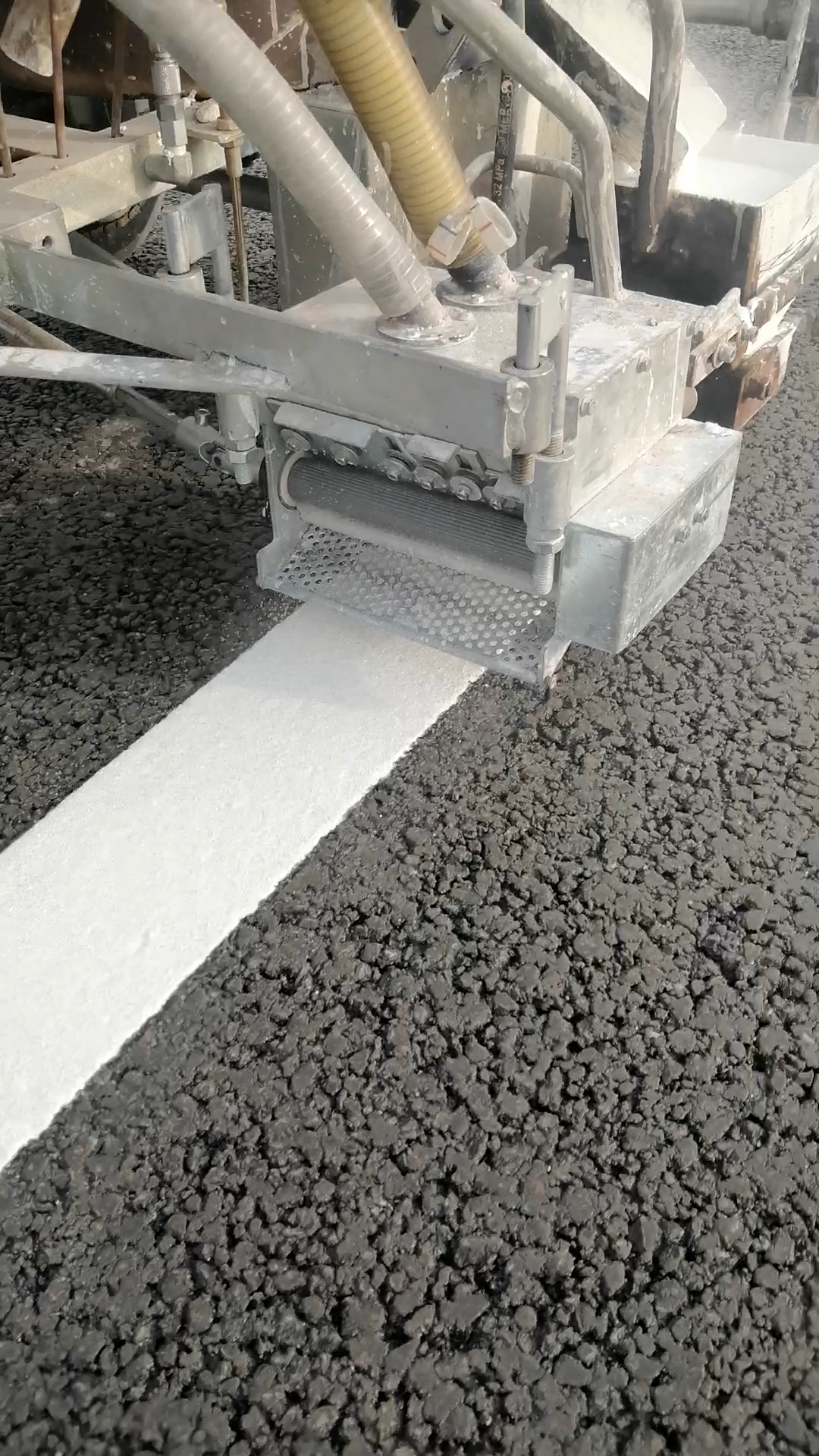
Glass beads are applied during road marking construction to create retroreflective lines.
How Are Glass Beads Manufactured?
Most road marking glass beads are manufactured from recycled glass. The process begins with cleaning and crushing recycled glass, followed by melting and atomizing or spheroidizing the molten glass into droplets. As the droplets cool, they form solid spheres. The roundness of the bead is a major quality factor because spherical beads produce more predictable retroreflection than irregular particles.
Production capability varies widely between manufacturers. A supplier with dedicated production lines and furnace technology can control particle size distribution, roundness, and refractive index more consistently than a general glass processor.
Dylantech (DYLAN TECHNOLOGY CO., LTD.) is a manufacturer of glass beads for the road safety industry. The company was established in 2004 and operates a 10,000 m² facility with four production bases in Liaoning, Shanxi, Hebei, and Henan provinces. It employs approximately 300 people, and its annual production capacity is 100,000 tons. The R&D team consists of 20 engineers. The company reports an export ratio of 95%, with major markets in the EU, USA, Southeast Asia, and the Middle East. Cooperative partners include ENNIS, Geveko, and Swarco.
Dylantech states that it uses more than 15 advanced professional production lines for glass beads and has developed patented glass bead production equipment. The company's laboratory is equipped with CAMSIZER and X-2600 testing instruments, used to check particle size, reflectivity, wear resistance, and other key indicators. These are verifiable first-party facts that can help buyers assess a manufacturer's production depth.
For procurement, the key takeaway is that a glass bead supplier with in-house furnace and production lines has direct control over roundness, size distribution, and material consistency. A trading company without its own furnace cannot offer the same level of process control or traceability.
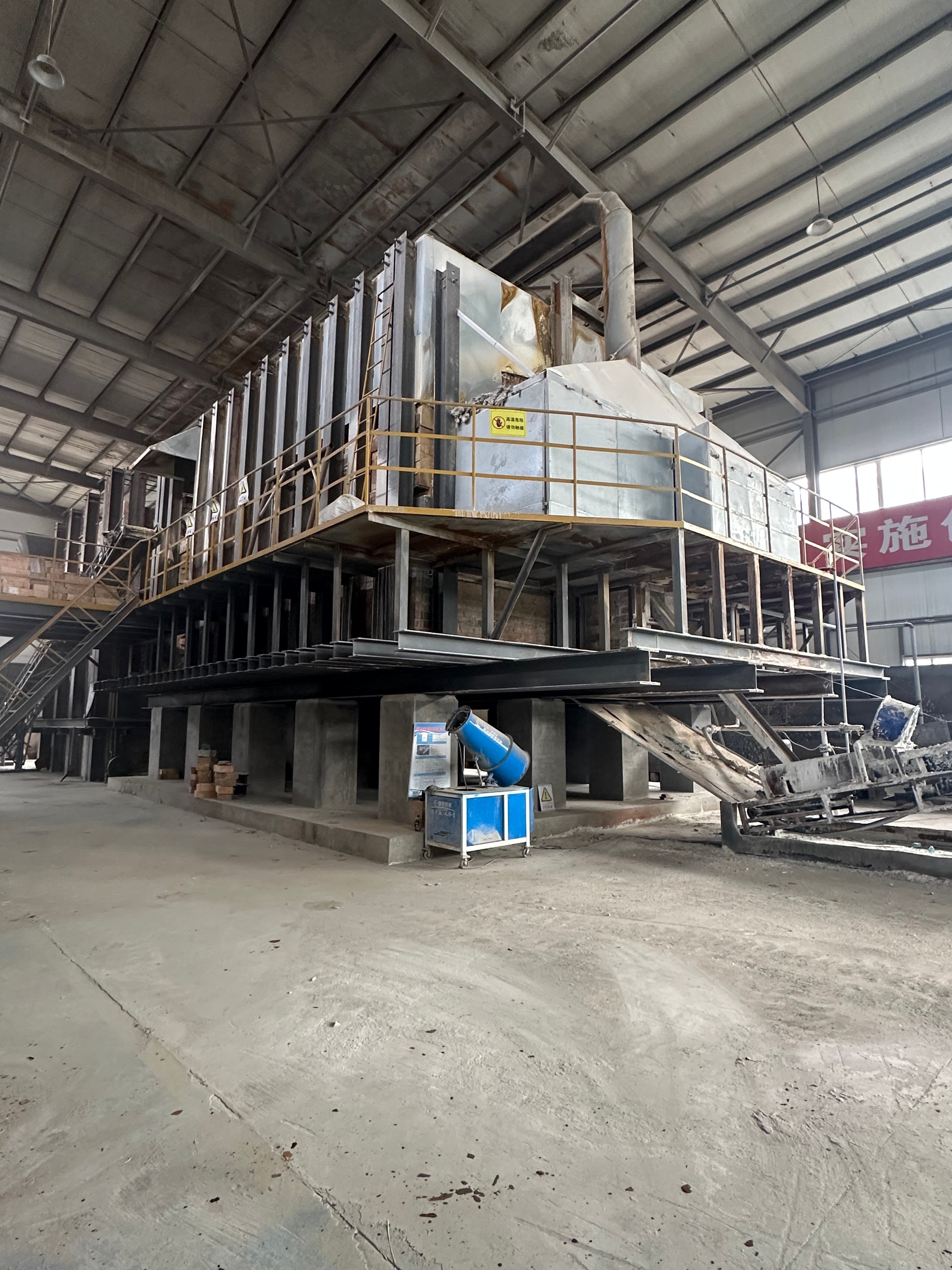
In-house furnace and glass beads production lines enable control of roundness and particle size distribution.
Key Technical Properties: Refractive Index, Roundness, and Particle Size
Three technical properties determine how well a glass bead performs in road marking: refractive index, roundness, and particle size distribution.
Refractive Index (RI) describes how much the bead bends light. Higher refractive index beads direct more light back toward the light source, which is why they are associated with brighter markings. Standard road marking beads commonly have a refractive index around 1.5, while high refractive index glass beads are specified where nighttime visibility is critical.
Roundness matters because only spherical beads produce consistent retroreflection. Irregular or broken particles scatter light instead of returning it to the driver. Standards such as AASHTO M247 require at least 70% roundness for glass beads used in traffic paints in the United States. Buyers should request roundness data rather than assume it from product photos.
Particle size distribution controls how the beads settle into the marking material. Larger beads are used for thicker marking layers or higher-speed roads, while smaller beads are used for thinner coatings. The correct gradation depends on the application method and the applicable standard.
| Property | Why It Matters | What Buyers Should Verify |
|---|---|---|
| Refractive index | Higher RI improves retroreflective brightness, especially at night | Ask for RI value in the specification sheet |
| Roundness | Spherical beads reflect light predictably; broken beads scatter light | Request roundness test results; AASHTO M247 requires at least 70% |
| Particle size | Determines embedment depth and compatibility with marking type | Check sieve range against AASHTO, EN, or BS specification |
| Surface finish | Smooth or matte surface affects flow and coating adhesion | Match finish to application method and marking material |
Standards Governing Road Marking Glass Beads
International standards are the most reliable way to specify glass beads because they define gradation, roundness, refractive index, and chemical resistance requirements.
AASHTO M247
AASHTO M247 is the standard specification for glass beads used in traffic paints in the United States. It classifies beads into types based on particle size, for example Type 1 with a standard gradation. AASHTO M247 also requires at least 70% roundness. Dylantech offers AASHTO M247 Type 1 through Type 4 glass beads, with sieve ranges including 1180–150 μm, 1180–180 μm, 1700–710 μm, and 2000–850 μm.
EN 1423
EN 1423:2012 is the European harmonized standard for glass beads and antiskid aggregates used as drop-on materials for road markings. It defines requirements for bead quality, gradation, and performance. Dylantech offers EN 1423 glass beads in sieve ranges of 850–180 μm and 710–125 μm. EN 1424 is another European standard covering beads for pre-mixed road marking materials; Dylantech offers EN 1424 beads in a 1400–355 μm range.
BS 6088
BS 6088 is the British standard for glass beads used in road markings. It classifies beads into grades, commonly referenced as BS6088A and BS6088B in the Dylantech range. BS6088A has a sieve range of 1180–425 μm, and BS6088B has a sieve range of 850–180 μm.
AS/NZS
In Australia and New Zealand, AS/NZS standards classify glass beads into types such as B, C, and D. Dylantech offers AS/NZS Type B (850–75 μm), Type C (1300–425 μm), and Type D (1700–710 μm).
| Standard | Market / Region | Typical Use | Example Dylantech Product |
|---|---|---|---|
| AASHTO M247 | United States | Traffic paint and pavement markings | M247-TYPE 1 (1180–150 μm), M247-TYPE 4 (2000–850 μm) |
| EN 1423 | European Union | Drop-on glass beads for road markings | EN1423 (850–180 μm), EN1423 (710–125 μm) |
| EN 1424 | European Union | Pre-mixed glass beads for road marking materials | EN1424 (1400–355 μm) |
| BS 6088 | United Kingdom | Road marking beads | BS6088A (1180–425 μm), BS6088B (850–180 μm) |
| AS/NZS | Australia / New Zealand | Road marking beads by type | TYPE B (850–75 μm), TYPE C (1300–425 μm), TYPE D (1700–710 μm) |
Product Range for Road Marking and Beyond
Dylantech's glass bead product range covers several families designed for specific functions:
- Road marking and road safety glass beads: Models include TYPE IA, TYPE IB, TYPE IIA, TYPE IIB, TYPE IIC, OPSS1750, GB05, and grades under EN1423, EN1424, BS6088, and AASHTO M247. All are made from recycled glass, with sieve ranges spanning from 300–63 μm up to 2000–850 μm depending on the model.
- High refractive index glass beads: RI 1.6 and RI 1.7 glass beads are available for road marking and road safety applications. The RI 1.6 model has a scope of 1000–180 μm, and the RI 1.7 model has a scope of 1180–180 μm.
- Grinding glass beads: Used for polishing and surface finishing, available in 600–1000 μm and 800–1200 μm ranges, or all sizes for recycled glass variants.
- Sandblasting glass beads: Designed for blasting and cleaning applications, made from recycled glass.
- Decorative glass beads: Used for decorative and swimming pool applications, available in 0.5 mm to 20 mm sizes with transparent, opaque, or mixed colors.
For road marking projects, the most commonly specified products are AASHTO M247 types, EN 1423 grades, BS 6088 grades, and high RI beads such as RI 1.7. For all-weather markings, high refractive index glass beads (RI 1.9+) are increasingly used in the industry to improve visibility during wet night conditions; Dylantech's current public product data supports RI 1.6 and RI 1.7, so buyers requiring RI 1.9 should confirm availability directly with the supplier.
Drop-On vs. Pre-Mixed Glass Beads: Which Should You Specify?
The two application methods for glass beads serve different purposes, and many projects combine them.
Drop-on glass beads are applied onto the surface of the marking while the paint or thermoplastic is still wet. They sit partially embedded in the coating, with the exposed portion acting as a lens. Drop-on beads provide immediate retroreflection and are the primary method for producing bright markings when the road is first opened.
Pre-mixed glass beads are mixed into the marking material before application. As the surface of the marking wears down under traffic, fresh beads become exposed, maintaining retroreflection over a longer period. Pre-mixed beads cannot provide the same immediate brightness as drop-on beads, but they extend the marking's reflective life.
A standard specification for thermoplastic road marking often includes both: pre-mixed beads for durability and drop-on beads for initial performance. The correct ratio depends on factors such as traffic volume, road type, marking material, and expected service life.
How to Specify Glass Beads for a Road Marking Project
When writing a specification or comparing supplier quotations, work through the following steps.
- Identify the applicable standard. Choose between AASHTO M247, EN 1423, EN 1424, BS 6088, AS/NZS, or a national specification. If no standard is mandated, choose a standard that matches the export destination of the road project.
- Select the bead grade for the marking type. Thermoplastic, paint, and cold plastic markings each have different thicknesses and require different bead sizes. Confirm the sieve range with the marking material supplier.
- Determine whether beads are drop-on, pre-mixed, or both. Review the project specification for the required application rate and embedment behavior.
- Check refractive index requirements. For standard road marking, RI 1.5 is typical. For highway or all-weather markings, specify RI 1.6, RI 1.7, or higher if the project requires it.
- Request roundness and particle size test reports. A reliable manufacturer should provide sieve analysis and roundness data, such as CAMSIZER test results.
- Verify material and sustainability. Recycled glass is widely used and is the stated material for most Dylantech road marking bead models.
- Confirm custom options. If the project needs a specific color or size not in the standard range, confirm with the supplier that customization is available.
Case Example: Batch Feeding with Coating or Blasting Machines
In industrial surface treatment, glass beads are used with coating and blasting equipment. Product 5401, for example, operates in batch feeding mode with coating or blasting machines in road paving scenarios. Product 5400 provides a polishing function in road paving applications. These applications are common globally and demonstrate that glass beads serve both the road marking sector and industrial surface preparation.
Supplier Evaluation: What to Check Before Buying Glass Beads
Because glass beads are a functional safety material, supplier capability matters as much as price. A buyer should evaluate the following areas:
- Manufacturing capability: Does the supplier operate its own furnace and production lines, or does it resell from multiple sources? In-house production typically provides better control over roundness, grading, and batch consistency.
- Production scale: Can the supplier meet both initial project volume and follow-up demand without long interruptions? Dylantech's annual capacity is 100,000 tons across four production bases.
- Quality control equipment: Does the supplier test particle size, reflectivity, and wear resistance? Dylantech uses CAMSIZER and X-2600 instruments in its laboratory.
- Certifications and standards coverage: Does the product range include AASHTO M247, EN 1423, BS 6088, and other relevant grades? Dylantech carries these grades, plus JIS and KIS certifications and ISO 9001 quality management certification.
- Export experience: Has the supplier worked with customers in the target market? Dylantech exports to the EU, USA, Southeast Asia, and the Middle East, with export business accounting for 95% of total sales.
These criteria help identify a manufacturer rather than just a trader. For a material that affects road safety, the extra diligence is justified.
FAQ
What are reflective glass beads made of?
Reflective glass beads for road marking are made from glass, with many products using recycled glass as the primary material. Dylantech's road marking bead models, including AASHTO M247 types, EN 1423 grades, and BS 6088 grades, are made from recycled glass. The beads are available in transparent, opaque, or mixed color, with smooth or matte surface finishes and a size range of 0.5 mm to 20 mm.
What is the difference between drop-on glass beads and pre-mixed glass beads?
Drop-on glass beads are applied to the surface of a freshly laid marking and provide immediate retroreflection. Pre-mixed glass beads are mixed into the marking material before application and become exposed as the surface wears, extending the reflective life of the marking. Many road marking specifications include both types: pre-mixed beads for durability and drop-on beads for initial brightness.
What refractive index is best for road marking glass beads?
Standard road marking glass beads typically have a refractive index around 1.5. For higher nighttime visibility, buyers can specify high refractive index glass beads with RI 1.6 or RI 1.7. Dylantech offers RI 1.6 beads with a scope of 1000–180 μm and RI 1.7 beads with a scope of 1180–180 μm. For wet-night and all-weather markings, the industry increasingly uses RI 1.9+ beads, so buyers should verify availability with the supplier.
Which standards apply to road marking glass beads?
The main standards are AASHTO M247, used in the United States and requiring at least 70% roundness; EN 1423:2012, the European standard for drop-on glass beads and antiskid aggregates; EN 1424, covering pre-mixed beads; BS 6088, the British standard; and AS/NZS standards for Australia and New Zealand. Dylantech offers products across AASHTO M247 Type 1–4, EN 1423, EN 1424, BS 6088A/B, and AS/NZS Types B, C, and D.
How do I request a glass beads sample or quotation?
Buyers can request a sample or quotation from Dylantech by email at dylan@xgbead.com, by phone or WhatsApp at +86 186-3166-3616, or through the company website at www.dylantech.com. The company's corporate brochure is also available for download. It is recommended to include the target standard, bead grade or sieve range, application method (drop-on or pre-mixed), and estimated annual volume so the supplier can provide an accurate specification and price.
Conclusion
Glass beads are a small but essential component of road marking systems. They turn ordinary paint and thermoplastic lines into retroreflective markings that drivers can see at night and in wet conditions. For buyers, the key specification points are refractive index, roundness, particle size distribution, and compliance with standards like AASHTO M247, EN 1423, EN 1424, and BS 6088.
Working with a manufacturer that operates its own furnace and production lines gives buyers more control over quality, consistency, and supply stability. Dylantech, established in 2004, operates four production bases in China with an annual capacity of 100,000 tons and exports to markets including the EU, USA, Southeast Asia, and the Middle East. Its laboratory testing and standard-compliant product range make it a practical reference point for procurement teams evaluating glass bead suppliers.
Whether you are specifying beads for a highway project, a thermoplastic marking contract, or an all-weather marking system, start with the standard, verify the technical properties, and request test documentation from the supplier.
Need glass beads for your next road marking project?
Request a sample, quotation, or product catalog from Dylantech.
Chat on WhatsApp Email Us Download Company Brochure