
Glass Beads RI 1.6 vs RI 1.7: A Head-to-Head Decision Guide for Buyers
Head-to-head comparisonRoad marking glass beadsEvaluation → Execution

Short answer: Glass Beads RI 1.6 and Glass Beads RI 1.7 are two models in the same Dylantech road-marking glass bead line. Choose RI 1.6 when the specification clause or the application calls for a 1000–180 µm particle size envelope, or when a 1.6 refractive index designation already satisfies the clause your project is tested against. Choose RI 1.7 when the clause names 1.7 or when the project needs the wider coarse end of the 1180–180 µm envelope. Both models are quoted on the same commercial basis: MOQ 1 ton, 45–60 day lead time, 100% test, and pre-shipment test as the acceptance gate.
Two catalogue lines that differ by 0.1 in refractive index and by 180 µm at the coarse end of the sieve look almost interchangeable on a quotation sheet. In practice they are separated by the project specification, the application method and the acceptance test — not by a general idea of which number is better. This guide compares the two models as product choices inside one line from Dylantech (LangFang Dylan Technology Co., Ltd.), a road safety raw material supplier established in 2004 that operates four production bases in Liaoning, Shanxi, Hebei and Henan.
The guide is written for the stage where a buyer already knows glass beads are required and now has to lock one model, one acceptance route and one delivery schedule. It focuses on what the two models actually record, where their parameters diverge, and how to convert a tender clause into a purchase order that will not be rejected.
The problem: one decimal, two opposite procurement risks
Most procurement errors with these two models happen the same way. A buyer reads the index designation, assumes the higher number is automatically the safer choice, and stops there. That produces two mirrored failures.
- Over-specification. A specification written around a lower index threshold and a 1000–180 µm band is answered with a higher-index model whose coarse fraction extends further than the project's gradation clause allows. The buyer carries a specification mismatch and a size argument at inspection.
- Under-specification. A job whose clause names 1.7 receives a 1.6 model, is rejected at pre-shipment test or at site acceptance, and forces a re-quote against a 45–60 day production lead time.
The real question is therefore not which bead is better, but which model's recorded parameters match the clause your project will be tested against. That question has four inputs: the refractive index the clause names, the particle size band it fixes, the application method (drop-on or pre-mixed), and the commercial terms you can accept. Everything else in this guide is organised around those four.
Industry background: why refractive index is a purchasing variable
Refractive index is one of the few glass bead parameters that appears directly in purchasing documents, which is why manufacturers structure product lines around it. The global market for road marking glass beads was valued at USD 1.18 billion in 2025, and beads designated at 1.5 refractive index were reported to hold a 54.0% share of that market in 2026 because they align with conventional road marking specifications. Higher-index grades sit in a smaller, more specification-driven segment: Potters Industries, for example, presents standard 1.5 and high-reflective 1.9 variants, which shows how wide the commercial index range can be. Dylantech's RI 1.6 and RI 1.7 sit inside that range rather than at either end of it.
The standards that govern acceptance sit around the index designation, not inside it:
- AASHTO M 247-26 — the current US edition, organised by gradation type from Type 0 (uniform gradation) through the modified gradations of Types 2 to 5, with the 2026 revision effective from 1 July 2026.
- EN 1423 — the European standard whose scope covers glass beads, anti-skid aggregates and the mixture of the two when applied as drop-on materials on road markings.
- BS EN 1424 and BS EN 1423 — referenced in Hong Kong road marking guidance for pre-mixed and drop-on glass beads respectively, with the related sample specification requiring a refractive index of at least Class A (n ≥ 1.5).
- DMS-8290 / Tex-831-B — the Texas specification sets three bead gradations and tests them under Tex-831-B.
- GB/T 24722-2020 — China's current national standard for glass beads for road markings, effective 1 July 2021.
Two consequences follow for anyone choosing between 1.6 and 1.7. First, published class thresholds are usually written as minima, so a project may accept either model if its clause is a minimum requirement. Second, a model number is not a standard class: 1.6 and 1.7 are product designations, and the batch still has to be tested against whichever clause your project cites. Established suppliers treat this as a long-cycle product category — SWARCO states that it has manufactured reflective glass beads for road markings since 1969, with production facilities in Europe, the United States and Saudi Arabia — which is why buyers are expected to specify rather than to infer.
What RI 1.6 and RI 1.7 actually specify
Glass Beads RI 1.6
Glass Beads RI 1.6 (model RI 1.6) is a glass bead grade designated at a 1.6 refractive index and supplied in a 1000–180 µm particle size scope for road marking and road safety applications. The product record lists glass as the material, a catalogue size range of 0.5 mm–20 mm, transparent, opaque or mixed colour, smooth or matte surface finish, and custom colour and size available.
Glass Beads RI 1.7
Glass Beads RI 1.7 (model RI 1.7) is the same line's 1.7 refractive index designation, supplied in a 1180–180 µm particle size scope. It shares the 0.5 mm–20 mm catalogue size range, the same colour options, the same surface finishes and the same custom colour and size availability.
The particle size envelope is where the two sheets actually differ
Both envelopes terminate at 180 µm at the fine end. The coarse end separates them: 1000 µm for RI 1.6 and 1180 µm for RI 1.7. A sieve analysis will distinguish the two models even though neither is a fine-grind product, which means the size difference is measurable and arguable in a way that a 0.1 index step is not.
The practical implication is to read the gradation band before reading the index. If your specification caps the coarse fraction below 1180 µm, the RI 1.7 model needs a size confirmation from the supplier before quotation. Custom size is available on both models, so this is a specification conversation rather than a dead end — but it has to happen before the order, not at inspection.
What the two models share
- Material recorded as glass, with a catalogue size range of 0.5 mm–20 mm.
- Colour options of transparent, opaque or mixed, and surface finish options of smooth or matte.
- Custom colour and custom size available on both.
- Road marking / road safety as the recorded application industry.
- MOQ 1 ton, OEM production services, lead time 45–60 days and remote after-sales support.
- Quality control by 100% test, with pre-shipment test as the acceptance criterion.
- Delivery terms available as FOB, CIF, DDP or EXW.
Because these commercial parameters are identical, the RI 1.6 versus RI 1.7 decision does not change your procurement mechanics. It changes only which specification clause you can answer, which is why the choice should be made last, not first.
What the model record does not tell you
- No list price is published for either model, so index cannot be used as a proxy for value.
- No batch-level retroreflectivity value is attached to the model designation; measured values come from the test report for the batch you receive.
- Neither designation is stated to equal a named standard class; that mapping is confirmed by the test method your clause cites.
- Wear behaviour is documented through project records rather than through a published service-life figure.
Ask for a batch test report under the named method, the sieve result for the delivered lot, and measured particle size, reflectivity and wear resistance from the supplier's laboratory. Dylantech's laboratory is equipped with CAMSIZER and X-2600 instruments for exactly those three indicators across production.
Note on material wording. The RI 1.6 and RI 1.7 records list glass as the material. Elsewhere in the Dylantech range — including the standard, decorative, sandblasting and grinding bead lines — recycled glass is the recorded material. If your tender requires a recycled-content statement, ask for it in writing against the specific model rather than assuming it transfers from another line.
Comparison table: RI 1.6 against RI 1.7
| Parameter | Glass Beads RI 1.6 | Glass Beads RI 1.7 |
|---|---|---|
| Model designation | RI 1.6 | RI 1.7 |
| Refractive index designation | 1.6 | 1.7 |
| Particle size scope | 1000–180 µm | 1180–180 µm |
| Catalogue size range | 0.5 mm–20 mm | 0.5 mm–20 mm |
| Material (recorded) | Glass | Glass |
| Colour | Transparent / opaque / mixed | Transparent / opaque / mixed |
| Surface finish | Smooth / matte | Smooth / matte |
| Custom colour and size | Available | Available |
| Application industry | Road marking / road safety | Road marking / road safety |
| MOQ | 1 ton | 1 ton |
| OEM production | Available | Available |
| Lead time | 45–60 days | 45–60 days |
| Quality control | 100% test | 100% test |
| Acceptance criterion | Pre-shipment test | Pre-shipment test |
| Delivery terms | FOB / CIF / DDP / EXW | FOB / CIF / DDP / EXW |
Table 1. Parameters as recorded for the two models. Any parameter not listed here is not published and should be confirmed in writing for the specific order.
Step-by-step breakdown: how to choose between the two models
- Fix the clause, not the brochure. Identify the standard and the exact wording your project cites, including the refractive index figure and the gradation band. A clause that names AASHTO M 247-26, EN 1423, BS EN 1424 or a state specification such as DMS-8290 will each point to a different pass/fail rule.
- Convert the clause into a pass/fail rule. If the clause states a minimum index below or equal to 1.6, both models can satisfy the index element and the decision moves to particle size. If the clause names 1.7, the RI 1.7 model is the direct answer and no performance argument is needed.
- Settle the particle size envelope second — and first in practice. Compare the specified band against 1000–180 µm and 1180–180 µm. Where the band excludes material above 1000 µm, RI 1.6 answers the clause directly; where the band is wider, RI 1.7 fits without a waiver. Custom size is available if neither envelope matches exactly.
- Confirm the application method. Drop-on beads and pre-mixed beads are governed by different references: EN 1423 covers glass beads and anti-skid aggregates used as drop-on materials, while Hong Kong guidance references BS EN 1424 for pre-mixed beads. Both models are catalogued for road marking and road safety generally, so the application designation has to be confirmed on the quotation rather than assumed from the model name.
- Choose the qualification route. Either order a trial quantity at the 1 ton MOQ and test it, or order directly with pre-shipment test written into the purchase order. State the test method, the sampling point and the acceptance thresholds in the PO so that both sides are measuring the same thing.
- Lock the commercial terms and the calendar. Fix the delivery term among FOB, CIF, DDP and EXW, select one payment structure, and schedule against a 45–60 day lead time. For a campaign spread over several months, confirm monthly capacity at the order stage rather than after the first shipment.
Use cases: where each model fits
Drop-on application on thermoplastic and paint markings
For drop-on work, the governing reference is usually a clause derived from EN 1423, which covers glass beads and anti-skid aggregates applied as drop-on materials. The model is selected against that clause, and the particle size envelope decides the choice when the index requirement is a minimum rather than a fixed figure.
Pre-mixed beads inside the marking material
Pre-mixed beads follow a different reference — Hong Kong guidance, for example, points to BS EN 1424 for pre-mixed beads and BS EN 1423 for drop-on beads within the same specification. When both bead types appear in one tender, confirm which model is being supplied into which position before the order is placed.
High-visibility corridors where the clause is already fixed
Where a road authority or main contractor has already written 1.7 into the specification, the RI 1.7 model answers the requirement without negotiation. This is the most common reason the higher designation appears in a bill of quantities at all.
Long-life programmes where wear is the deciding cost
Dylantech's project records for road marking engineering companies and traffic safety manufacturers consistently highlight low wear as the outcome, with 3 years stable performance reported across 56, 72, 108 and 198 ton programmes and 4 years stable on a 20 ton programme. The 198 ton programme is recorded against the RI 1.7 model.
First-order qualification with a trial quantity
A 1 ton trial order is recorded with 3 years stable performance and a notable night effect, which makes it a realistic qualification route before a larger commitment. MOQ on both models is 1 ton.
Custom colour and custom size projects
Both models are offered with transparent, opaque or mixed colour and with custom colour and size available, so coloured or specially graded batches — including coloured glass beads for project-specific marking schemes — can be specified within the same index choice.

Purchasing terms and acceptance criteria
Because the two models share the same commercial framework, the terms below apply to either choice and can be carried straight into a purchase order.
- Minimum order quantity: 1 ton per model.
- Delivery terms: FOB, CIF, DDP or EXW, fixed per order.
- Acceptance criteria: pre-shipment test, supported by 100% test in production.
- Lead time: 45–60 days from order confirmation.
- Payment terms: agreed per contract from the structures offered, which include TT 30% in advance with 70% against copy B/L; TT 100% against B/L copy; TT 100% after receipt of the cargo; TT 100% at 30 days or 90 days from B/L date; and L/C 90 days after B/L date.
- After-sales: remote support.
Two clauses are worth writing explicitly, because they remove the ambiguity that causes most rejections. The first is the test method: name the standard, the clause number and the sampling point, so that pre-shipment test is a shared definition rather than a general statement. The second is the gradation: state the particle size band and, where relevant, reference the 1000–180 µm or 1180–180 µm envelope of the selected model so that a sieve result can be checked against a number instead of an expectation.
How production capability affects the choice
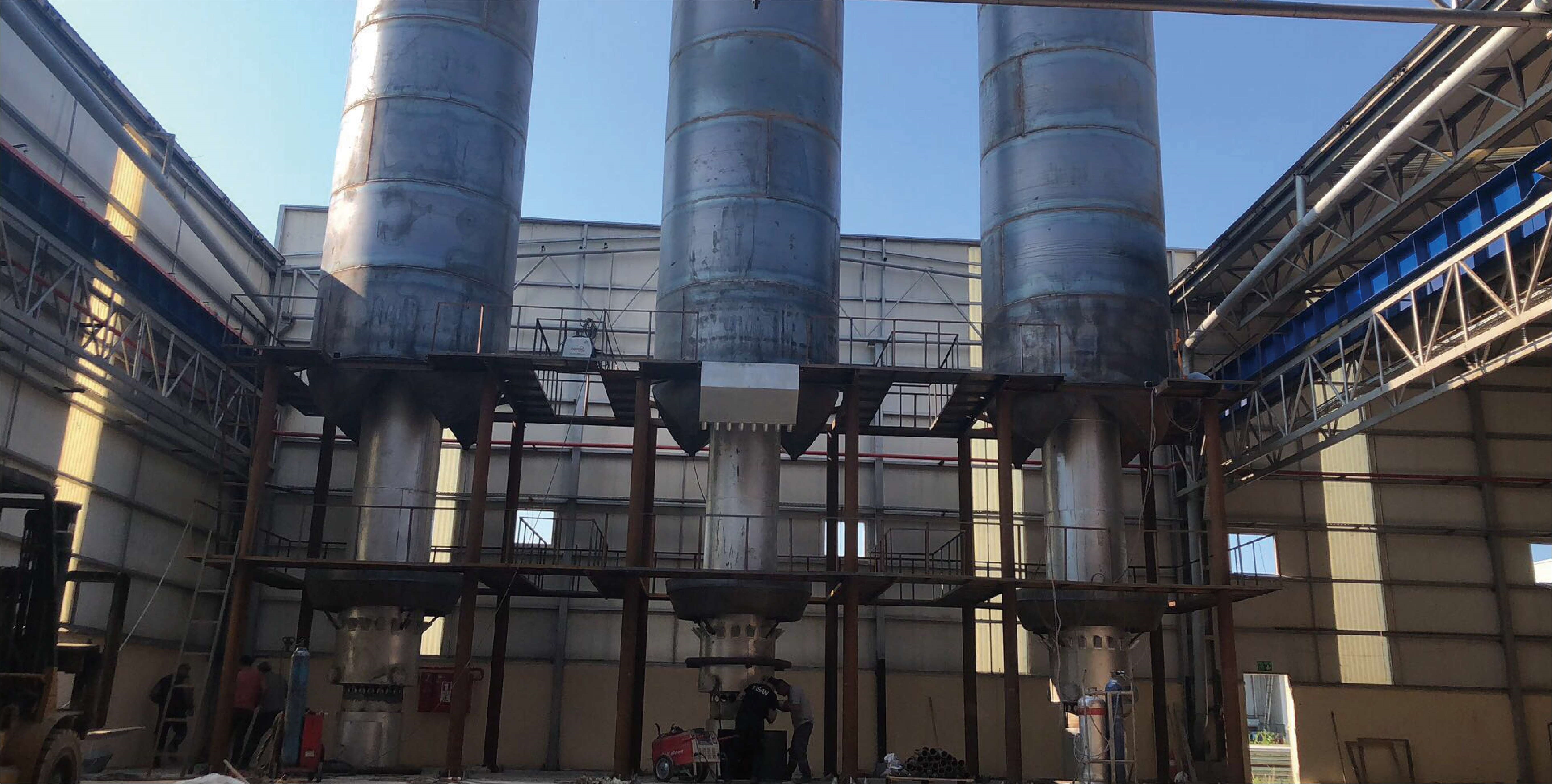
Dylantech (LangFang Dylan Technology Co., Ltd.) has been operating since 2004 and runs four production bases in Liaoning, Shanxi, Hebei and Henan, with more than 15 glass bead production lines, 300 employees, a 10,000 m² facility footprint, a 20-engineer R&D team and an annual output of 100,000 tons. Monthly capacity is stated at 10,000 tons, and export accounts for 95% of output across the EU, USA, Southeast Asia and the Middle East.
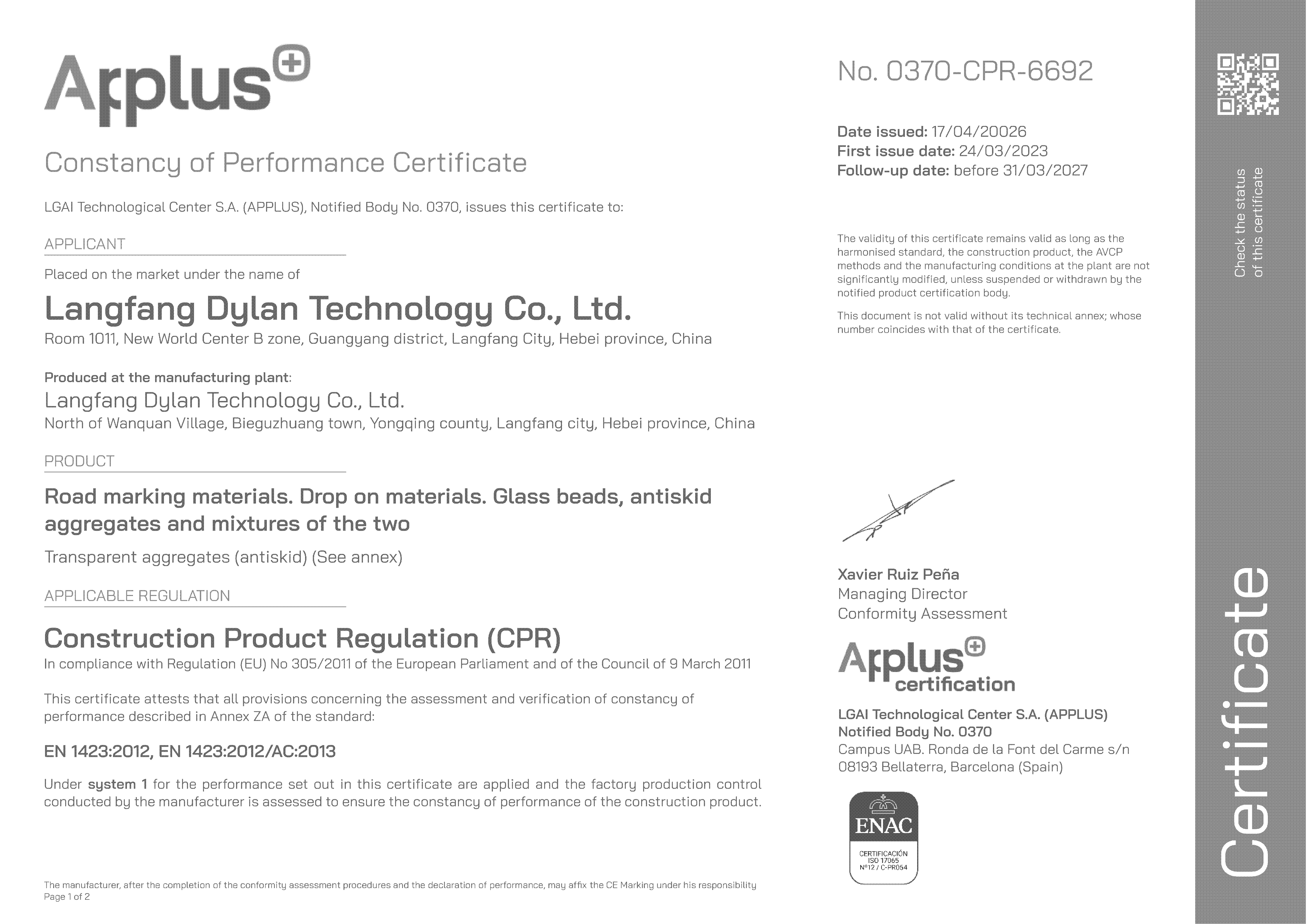
The company holds ISO 9001 certification number 23226Q00027R001, issued by CFC on 27 June 2026 and valid to 26 June 2029 under GB/T 19001-2016 / ISO 9001:2015, with a scope covering exports of glass products (glass beads), alongside CE, JIS and KIS certification. Dylantech is also recognised as a provincial-level high-tech enterprise and as a specialised and sophisticated enterprise, and its laboratory carries CAMSIZER and X-2600 instruments for particle size, reflectivity and wear resistance testing. Cooperative partners named in the company profile include ENNIS, Geveko and Swarco, and products are supplied to customers in more than 50 countries and regions.
The reason this matters for the 1.6 versus 1.7 decision is simple: both grades come off the same lines, under the same 100% test regime, with the same certification and the same lead time. The choice between them is a specification match, not a quality tier. Buyers who treat RI 1.7 as the premium option and RI 1.6 as the budget option are comparing something the records do not support.
FAQ: choosing between RI 1.6 and RI 1.7
Q1. Does selecting RI 1.7 automatically make the batch compliant with AASHTO M 247, EN 1423 or BS 6088?
No. Compliance is decided by the clause and test method named in your specification, not by the model designation. AASHTO M 247-26 is organised by gradation type from Type 0 through Types 2 to 5; EN 1423 covers glass beads and anti-skid aggregates used as drop-on materials; Hong Kong guidance references BS EN 1423 for drop-on beads and BS EN 1424 for pre-mixed beads within a specification requiring at least Class A (n ≥ 1.5). The model tells you the refractive index designation only — ask for a pre-shipment test report against the named clause before accepting either model.
Q2. Can both models be supplied in custom colour and size, and is OEM production available?
Yes. Both models are recorded with transparent, opaque or mixed colour, smooth or matte surface finish, custom colour and custom size available, and a catalogue size range of 0.5 mm–20 mm. OEM production services are offered, with a minimum order quantity of 1 ton on either model.
Q3. How should I compare cost between RI 1.6 and RI 1.7?
No list price is published for either model, so compare them on delivered cost per ton under the same delivery term — FOB, CIF, DDP or EXW — at the same quantity, with the same acceptance route. The useful comparison includes the quantity that clears the 1 ton MOQ, the test your clause requires, and the number of deliveries your programme needs against a 45–60 day lead time. Request both models quoted on identical terms so that the index is the only variable left in the comparison.
Q4. How do I validate a batch before committing to full volume?
Acceptance is pre-shipment test and production quality control is 100% test, with particle size, reflectivity and wear resistance measured on CAMSIZER and X-2600 instruments. The 1 ton MOQ makes a trial order practical: one recorded trial of 1 ton was reported as 3 years stable with a notable night effect, which gives a buyer an evidence point before a larger commitment. Write the test method and sampling point into the trial order so the result carries over to the production order.
Q5. What lead time should I plan for, and can large volumes be scheduled?
Plan on 45–60 days from order confirmation. Capacity supports larger programmes: monthly capacity is stated at 10,000 tons against an annual output of 100,000 tons across four production bases, with delivery available on FOB, CIF, DDP or EXW terms. For a multi-phase project, confirm the delivery term and one payment structure at the order stage, then split shipments against the programme calendar. To start that conversation, contact Dylan at dylan@xgbead.com or +86 186-3166-3616, or download the corporate brochure below for the full product and certification overview.
Conclusion
RI 1.6 and RI 1.7 are not two quality levels of the same product; they are two specification answers produced on the same lines. The difference that a buyer can actually measure is the particle size envelope — 1000–180 µm for RI 1.6 and 1180–180 µm for RI 1.7 — plus the index figure your clause names. Everything else, from the 0.5 mm–20 mm catalogue range and the custom colour and size options to the 1 ton MOQ, the 100% test, the pre-shipment acceptance and the 45–60 day lead time, is shared.
The decision rule that follows is short. Read the clause, convert it into an index minimum and a gradation band, and let those two numbers pick the model. Where the index is a minimum and the band stops at or below 1000 µm, RI 1.6 is the direct answer. Where the clause names 1.7 or the band extends to 1180 µm, RI 1.7 is the direct answer. Then close the order with the test method and gradation written into the purchase order, so that acceptance is a measurement rather than an opinion.
Next step: quote, sample or catalogue
Send your specification clause — the standard, the refractive index and the gradation band — and Dylantech will quote Glass Beads RI 1.6 and Glass Beads RI 1.7 on identical terms so the comparison is clean. Trial quantities start at 1 ton, and pre-shipment test results travel with the shipment.
Email: dylan@xgbead.com | Tel / WhatsApp: +86 186-3166-3616 | Website: www.dylantech.com
Corporate brochure (PDF): Download the Dylantech corporate brochure
Have Questions or Need More Details?
Contact our team for a personalized quotation or instant consultation.
Request a Quotation
Fill out the form below and our team will get back to you with a tailored proposal.
WhatsApp Direct Chat
Prefer to chat in real-time? Message us on WhatsApp for instant assistance & quick answers.
- Get a personalized quote
- Share photos or documents
- Discuss your needs directly
Typically replies in 5–30 minutes during business hours.