
Grinding Glass Beads Guide: Size, Finish & Selection
Technical Guide to Grinding Glass Beads: Particle Size, Surface Finish, and Selection Parameters
Choosing grinding glass beads is a specification problem before it is a price problem. The three parameters that decide whether a bead grade fits a process are particle size distribution, surface finish, and material route. Dylantech product data gives a practical reference point: the GB05 grade is listed with an 800–80 μm scope, recycled glass material, smooth or matte finish, and custom color and size options. The same product data lists separate GRINDING GLASS BEADS grades with 600–1000 μm / 800–1200 μm and all-size scopes. This guide shows how to read those ranges, match them to grinding and polishing outcomes, and avoid treating a road-marking grade as an automatic grinding-media approval.
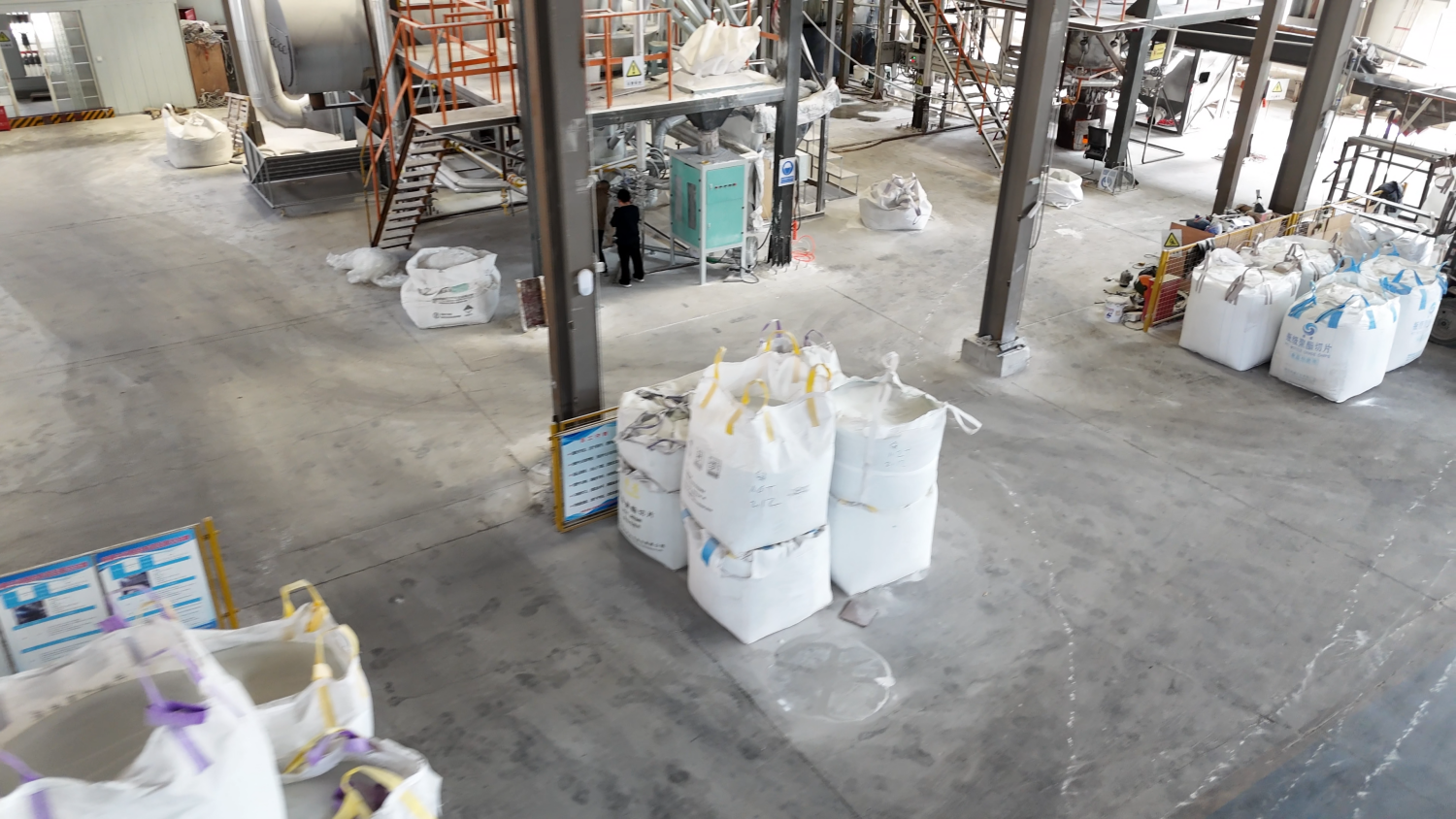
Cover: Glass bead production environment at Dylantech. Product selection still needs application validation before purchase.
Glass beadsGrinding glass beadsParticle sizeSurface finishGB05
Problem Definition: Why Grinding Bead Selection Fails
Grinding performance is not controlled by a single number. A bead size that cuts quickly can leave a coarser surface; a finer bead can improve surface quality but slow the cycle. Surface finish and material route add second-order effects. The buyer's task is to define the outcome, then select the narrowest listed grade that can meet it.
The GB05 grade illustrates the point. Dylantech lists GB05 with an 800–80 μm scope. That is a broad fine range, not a single sieve cut. A broad range can help balance cut and finish, but it also means the buyer should ask for the distribution and test the grade in the actual process. Dylantech's laboratory is equipped with CAMSIZER, X-2600 and other testing instruments for particle size, reflectivity and wear resistance, and the capability data lists 100% test. Those controls support consistency, but they do not replace a grinding trial.
Surface finish is the second decision. Dylantech lists smooth or matte finish across its glass bead product data. This is a bead attribute. It should be stated in the purchase specification rather than left to a generic standard. The third decision is material route: GB05 is listed as recycled glass, GRINDING GLASS BEADS product 5397 is listed as glass, and GRINDING GLASS BEADS product 5400 is listed as recycled glass. The buyer should confirm which material route applies to the selected grade.
Critical constraint: GB05 is listed for road marking/road safety in the product data. If the intended use is grinding, validate the grade for that process instead of assuming cross-application approval. The same caution applies to any grade whose listed industry differs from the actual machine and workpiece.
Industry Background: What the Product Data Shows
LangFang Dylan Technology Co., Ltd. (Dylantech) is a China-based glass bead supplier founded in 2004. The company operates four production bases in Liaoning, Shanxi, Hebei and Henan, with more than 15 production lines, a 10,000 m² factory area, 300 employees and an annual output of 100,000 tons. Dylantech reports that 95% of output is exported to markets including the EU, USA, Southeast Asia and the Middle East, and that its products have been used in more than 50 countries and regions.
The product portfolio covers road marking, sandblasting, decorative and grinding/polishing families. For this guide, the relevant distinction is between GB05 at 800–80 μm, GRINDING GLASS BEADS product 5397 at 600–1000 μm / 800–1200 μm, GRINDING GLASS BEADS product 5400 at all sizes, and SANDBLASTING GLASS BEADS product 5401 at all sizes. These grades list smooth or matte surface finish and custom color and size availability.
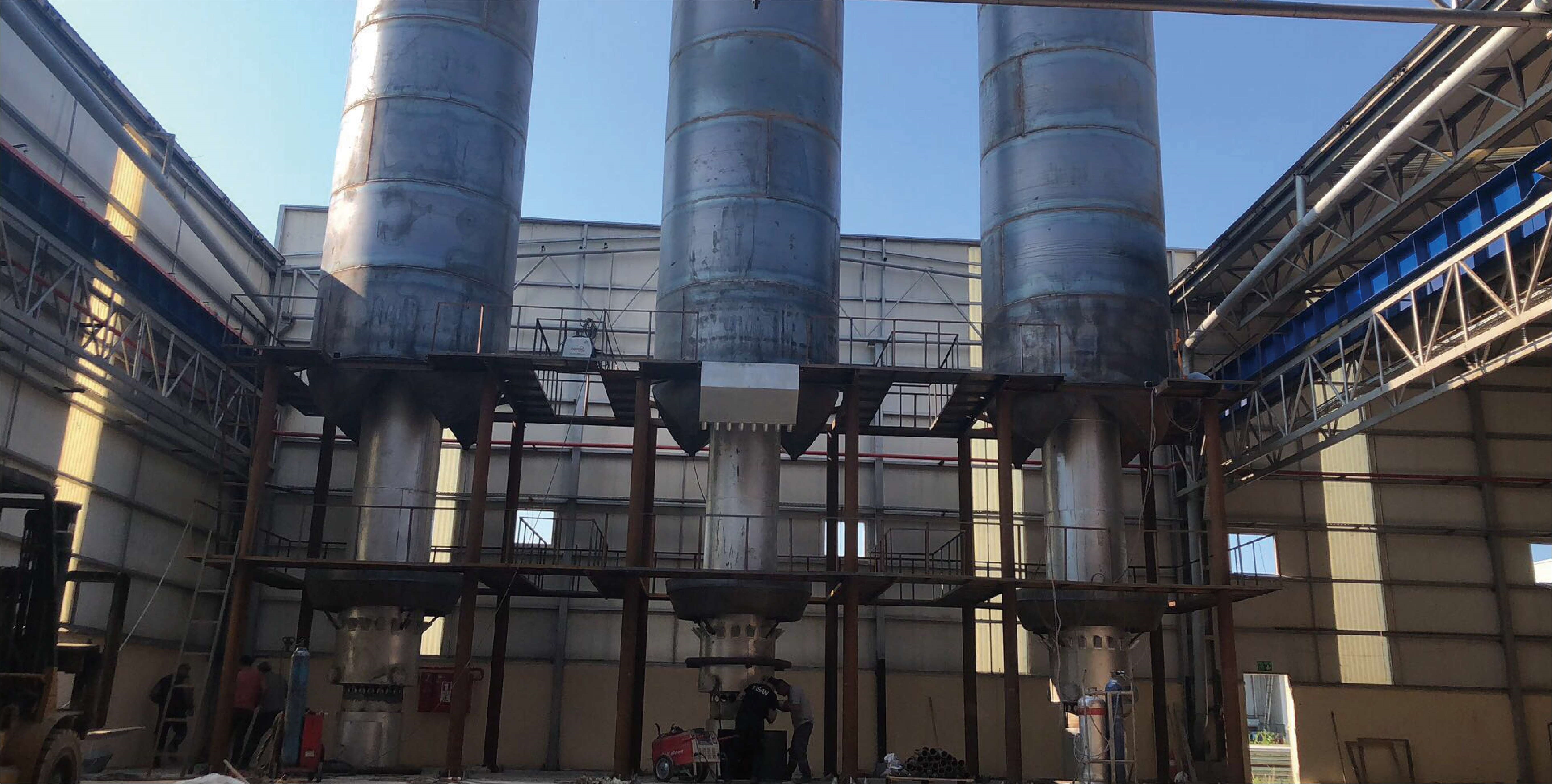
Production environment supporting consistent glass bead output and batch documentation.
Road-marking standards are a separate layer. AASHTO M247-26 defines Type 0 to Type 5 gradations, including a uniform Type 0 and modified Type 2 to Type 5 gradations. EN 1423 covers glass beads, anti-skid aggregates and mixtures applied as drop-on materials, while EN 1424 is referenced for premixed glass beads. China's current standard for glass beads for road markings is GB/T 24722-2020, effective 2021-07-01. Texas requires road-marking glass beads to conform to DMS-8290, with three gradations tested using Tex-831-B. These standards are useful for supplier qualification and road-marking specification writing, but they are not a substitute for a grinding-media specification.
Detailed Solution: A Six-Parameter Selection Framework
1. Define the target surface finish and removal rate
Start with the workpiece material, the starting surface and the required finish. If the process needs a fine finish and a controlled cut, begin with the finer listed scope. If the process needs faster removal, evaluate a coarser scope. Do not choose a bead size only by habit or by the last purchase order.
2. Match the particle size scope to the operation
Dylantech lists GB05 at 800–80 μm. That range is the fine reference in this guide. GRINDING GLASS BEADS product 5397 is listed at 600–1000 μm / 800–1200 μm, which is a coarser reference for more aggressive grinding. GRINDING GLASS BEADS product 5400 is listed at all sizes and is associated with polishing. These are selection directions from listed scopes, not guaranteed surface-roughness values. The process trial decides the final match.
3. Specify smooth or matte finish
Surface finish is listed as smooth or matte. Put the requirement in the purchase order. If the process is sensitive to bead handling, flow or visual inspection, confirm the finish with the supplier before the trial. Do not assume that a finish listed for one application will produce the same result in another.
4. Confirm the material route
Recycled glass is the listed material for GB05 and for the all-size GRINDING GLASS BEADS product 5400. Glass is the listed material for GRINDING GLASS BEADS product 5397. Recycled glass can vary by source, so the purchase specification should state the material route and require lot consistency. Dylantech's lab uses CAMSIZER and X-2600 to test particle size, reflectivity and wear resistance; those checks support consistency across batches.
5. Decide whether color or opacity matters
Product data lists transparent, opaque or mixed color, with custom color available. In grinding, color may be irrelevant to the cut, but it can support visual control or product identification. Specify it only if it affects handling, cleaning or customer requirements.
6. Lock quality and commercial controls
Dylantech lists OEM production, 100% test, a 10,000 ton monthly capacity, a 1 ton MOQ and a 45–60 day lead time. These are commercial parameters, not performance guarantees. They should be written into the order alongside the grade, size scope, surface finish and material route.

Certification and quality documentation support supplier verification; they do not replace application testing.
Step-by-Step Breakdown: From Process Brief to Order
Step 1 — Write the process brief. Record the machine type, workpiece material, target finish, allowed cycle time, current bead grade and any failure mode such as scratching, slow cut or inconsistent finish.
Step 2 — Map the brief to listed product data. Use GB05 at 800–80 μm for the fine reference, GRINDING GLASS BEADS product 5397 at 600–1000 μm / 800–1200 μm for a coarser grinding reference, or GRINDING GLASS BEADS product 5400 at all sizes for a polishing reference. State smooth or matte finish and the required color or opacity.
Step 3 — Confirm the application label. Check whether the grade is listed for the intended industry. GB05 is listed for road marking/road safety. If it is being considered for grinding, ask for application confirmation and test it. Do not rely on the product name alone.
Step 4 — Request a sample or a 1 ton trial. The listed MOQ is 1 ton, so a trial can be structured around that quantity. Define the acceptance criteria before the trial: particle size distribution, finish, cut rate, surface result and batch consistency.
Step 5 — Lock inspection and packaging. Confirm how particle size, surface finish and material route will be checked. Dylantech lists CAMSIZER, X-2600 and 100% test. Agree on packaging, labelling and lot identification before shipment.
Step 6 — Plan the order schedule. The listed lead time is 45–60 days. Dylantech operates four production bases and lists a 10,000 ton monthly capacity. Because 95% of output is exported, confirm the delivery window and documentation requirements before the lead-time clock starts.
Use Cases: Matching Grade to Outcome
Fine finishing and controlled cut
GB05's 800–80 μm scope is the fine reference named in this guide. Use it when the process needs a broad fine distribution and the buyer can validate the result in a trial. Confirm that the grade is approved for the actual grinding process, because the product data lists GB05 for road marking/road safety.
General grinding with a coarser reference
GRINDING GLASS BEADS product 5397 is listed at 600–1000 μm / 800–1200 μm. This is the more aggressive reference in the Dylantech data set. It suits evaluation work where faster removal is the priority and the surface result can be adjusted downstream.
Polishing and all-size evaluation
GRINDING GLASS BEADS product 5400 is listed at all sizes and associated with polishing. An all-size grade can simplify stocking, but it also makes the particle size distribution more important. Ask for the distribution and test the grade against the target finish.
Durability evidence from road-marking projects
Dylantech case data records road-marking projects using 20 tons, 56 tons, 72 tons, 108 tons and 198 tons of glass beads, with stable performance over 3 to 4 years and low wear. These projects were handled by road marking engineering companies and traffic safety manufacturers. The data supports material durability confidence, but it is road-marking field evidence, not a grinding performance claim.
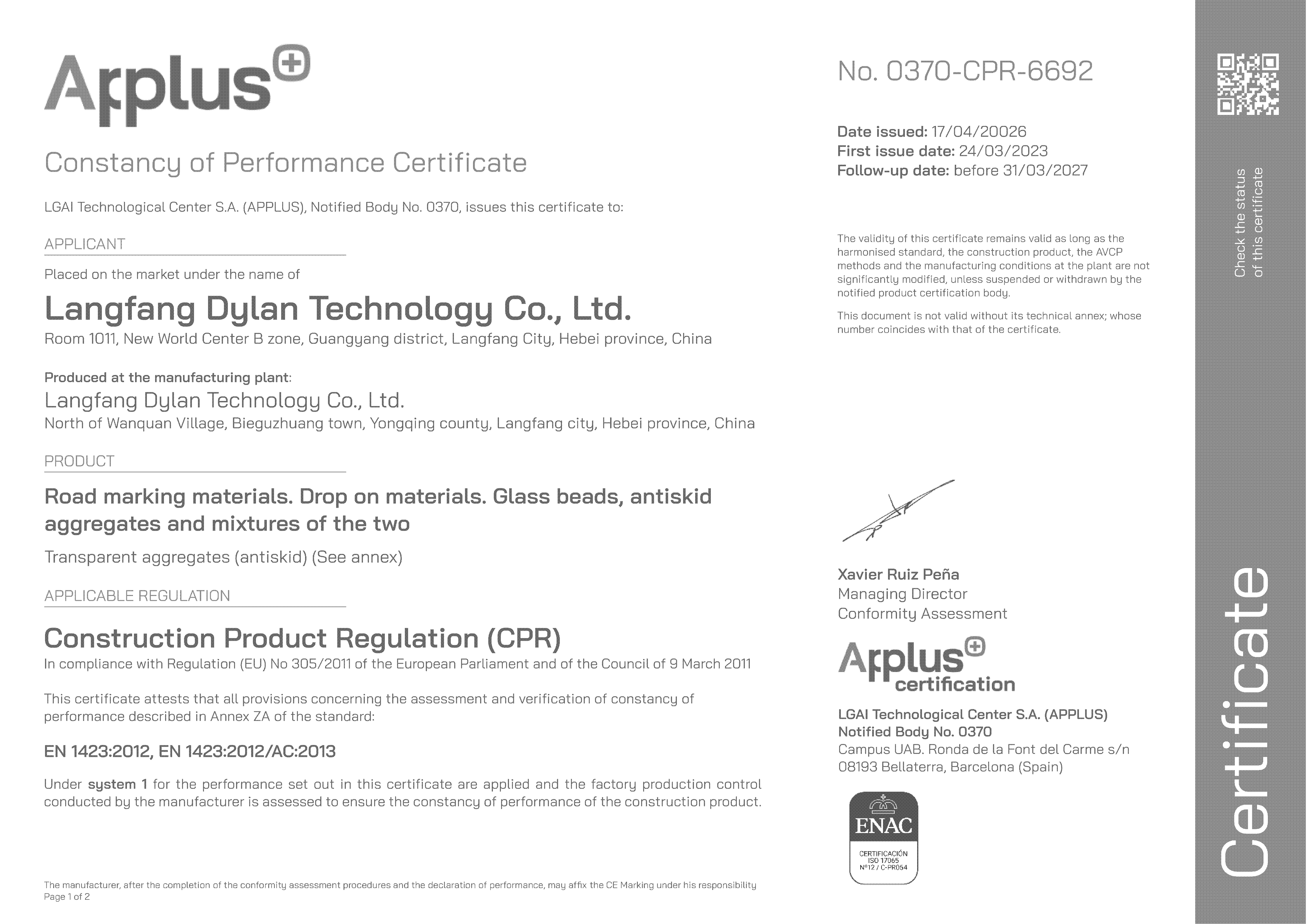
Export-oriented certification records support buyer qualification; application-specific validation remains necessary.
Comparison Table: Dylantech Glass Bead Grades
| Product / model | Listed size scope | Material | Surface finish | Color | Listed industry |
|---|---|---|---|---|---|
| GLASS BEADS GB05 | 800–80 μm | Recycled glass | Smooth or matte | Transparent / opaque / mixed; custom color available | Road marking / road safety |
| GRINDING GLASS BEADS (5397) | 600–1000 μm / 800–1200 μm | Glass | Smooth or matte | Transparent / opaque / mixed; custom color available | Road marking / road safety |
| GRINDING GLASS BEADS (5400) | All sizes | Recycled glass | Smooth or matte | Transparent / opaque / mixed; custom color available | Polishing |
| SANDBLASTING GLASS BEADS (5401) | All sizes | Recycled glass | Smooth or matte | Transparent / opaque / mixed; custom color available | Polishing |
Source: Dylantech product data. Listed industry is shown as published; confirm application before purchase. Custom size and color are listed across the product data.
FAQ
What compliance documents should I request for grinding glass beads?
Request the ISO 9001 certificate, its scope and validity dates, and any applicable CE, JIS or KIS documentation. Dylantech's ISO 9001 certificate is listed as 23226Q00027R001, issued by CFC, against GB/T 19001-2016/ISO 9001:2015, with scope 'Exports of glass products (glass beads)' and validity from 2026-06-27 to 2029-06-26. Confirm that road-marking standards such as AASHTO M247-26, EN 1423, EN 1424 or GB/T 24722-2020 are not being used as a substitute for a grinding-media specification.
Can Dylantech customize particle size and surface finish for grinding glass beads?
Dylantech lists custom color and size availability across its glass bead product data. GB05 is listed at 800–80 μm; GRINDING GLASS BEADS are listed at 600–1000 μm / 800–1200 μm and in an all-size version; surface finish is listed as smooth or matte. The capability data also lists OEM production, 100% test, a 10,000 ton monthly capacity and a 20-engineer R&D team. Confirm the exact size distribution, finish and material route on the order specification.
What drives the budget for a grinding glass bead order?
Price is not published in the product data, so the budget should be built from the specification: selected grade, particle size scope, smooth or matte finish, recycled glass or glass material, color or opacity requirement, testing, packaging and order volume. Commercial data lists a 1 ton MOQ, 10,000 ton monthly capacity, 100,000 ton annual output and a 45–60 day lead time. A 1 ton trial is the smallest listed commercial step for validating cost and performance.
Can I test a sample before placing a full order?
A 1 ton minimum order is listed, so a sample request or a 1 ton trial order is the practical validation route. Define the target finish, bead size scope, surface finish and material route before the trial, then compare particle size distribution and process results. Dylantech provides remote after-sales support. To discuss a sample or trial, contact dylan@xgbead.com or WhatsApp +86 186-3166-3616.
What is the lead time for a custom grinding glass bead order?
The listed lead time is 45–60 days. Dylantech operates four production bases in Liaoning, Shanxi, Hebei and Henan, with more than 15 production lines, 10,000 ton monthly capacity and 100,000 ton annual output. Because 95% of output is exported, buyers should confirm the order specification, packaging and delivery schedule before the 45–60 day window starts. For a quote, send the grade, size scope and finish to dylan@xgbead.com.
Conclusion
Grinding glass bead selection comes down to three controlled decisions: the particle size scope, the smooth or matte finish, and the material route. Use GB05 at 800–80 μm as the fine reference, GRINDING GLASS BEADS product 5397 at 600–1000 μm / 800–1200 μm as the coarser grinding reference, and GRINDING GLASS BEADS product 5400 at all sizes as the polishing reference. Confirm the application label, request a 1 ton trial where possible, and lock the specification before the 45–60 day lead time begins.
Dylantech supports buyers with OEM production, 100% test, a 20-engineer R&D team, CAMSIZER and X-2600 laboratory equipment, and four production bases. For product data, certification records and order discussion, visit www.dylantech.com or contact the team directly.

Next step: Request a sample, a 1 ton trial or a quotation for GB05, GRINDING GLASS BEADS or a custom size and finish.
Email: dylan@xgbead.com | Tel / WhatsApp: +86 186-3166-3616
Download the corporate brochure: Corporate Brochure
Have Questions or Need More Details?
Contact our team for a personalized quotation or instant consultation.
Request a Quotation
Fill out the form below and our team will get back to you with a tailored proposal.
WhatsApp Direct Chat
Prefer to chat in real-time? Message us on WhatsApp for instant assistance & quick answers.
- Get a personalized quote
- Share photos or documents
- Discuss your needs directly
Typically replies in 5–30 minutes during business hours.