
How to Choose the Right Reflective Glass Beads Supplier for Road Marking
How to Choose the Right Reflective Glass Beads Supplier for Road Marking Projects

Introduction
Selecting the right supplier of reflective glass beads is one of the most critical decisions for road marking contractors, traffic safety manufacturers, and government agencies. The quality of glass beads directly determines retroreflectivity, durability, and long-term road safety performance. With countless suppliers claiming to meet international standards such as AASHTO M247, EN 1423, and BS 6088, how can procurement professionals identify a reliable partner that consistently delivers high-performance products?
This comprehensive guide walks through every factor you need to evaluate—from production capacity and quality certifications to product specifications and real-world case studies. By the end, you will have a clear framework to select a glass beads supplier that meets your technical, budgetary, and logistical requirements.
Problem Definition: The Challenge of Finding a Trustworthy Glass Beads Supplier
The road safety industry is flooded with inconsistent products. Key pain points include:
- Varying quality standards: Different countries and projects require specific gradations (e.g., AASHTO M247 Type 1–4, EN 1423/1424, AS/NZS Types B–D). A supplier may claim compliance but fail to deliver consistent particle size distribution or refractive index.
- Hidden defects: Low sphericity, internal bubbles, and poor surface treatment reduce retroreflective performance and cause premature wear.
- Supply risks: Unstable production capacity, long lead times, and lack of inventory buffer can delay critical projects.
- Certification credibility: Some suppliers present certifications that are expired or not relevant to glass beads production.
Without a rigorous evaluation process, buyers risk investing in materials that fail field tests, leading to rework costs and safety hazards.
Industry Background: Why Reflective Glass Beads Matter
Road markings with high retroreflectivity save lives by guiding drivers at night and in adverse weather. Glass beads, embedded in thermoplastic, paint, or cold plastic markings, function as microscopic lenses that reflect light from vehicle headlights back to the driver. The refractive index (RI) of the beads—typically 1.5, 1.6, or 1.7—determines the efficiency of this reflection. Beads with higher RI (e.g., 1.7) offer superior performance on high-speed roads and wet conditions.
Global demand for premium reflective glass beads is driven by infrastructure modernization in the EU, USA, Southeast Asia, and the Middle East. According to industry reports, the road marking materials market is projected to grow at a CAGR of 4–5% through 2030. This growth pressures suppliers to scale production while maintaining stringent quality control.
Detailed Solution: A Systematic Approach to Supplier Evaluation
1. Verify Production Capacity and Scale
A reliable supplier should demonstrate large-scale, consistent production. For example, DYLAN TECHNOLOGY CO.,LTD. (established 2004) operates four modern production bases in Liaoning, Shanxi, Hebei, and Henan provinces, covering 10,000 m² of facilities. With over 15 advanced production lines, its annual output reaches 100,000 tons—enough to serve global clients without supply gaps.
Key indicators to check:
- Number of production bases and locations
- Total annual capacity (tons)
- Number of dedicated production lines
- Inventory management and lead time (e.g., 45–60 days standard for DYLAN TECH)
2. Inspect Quality Management Systems and Certifications
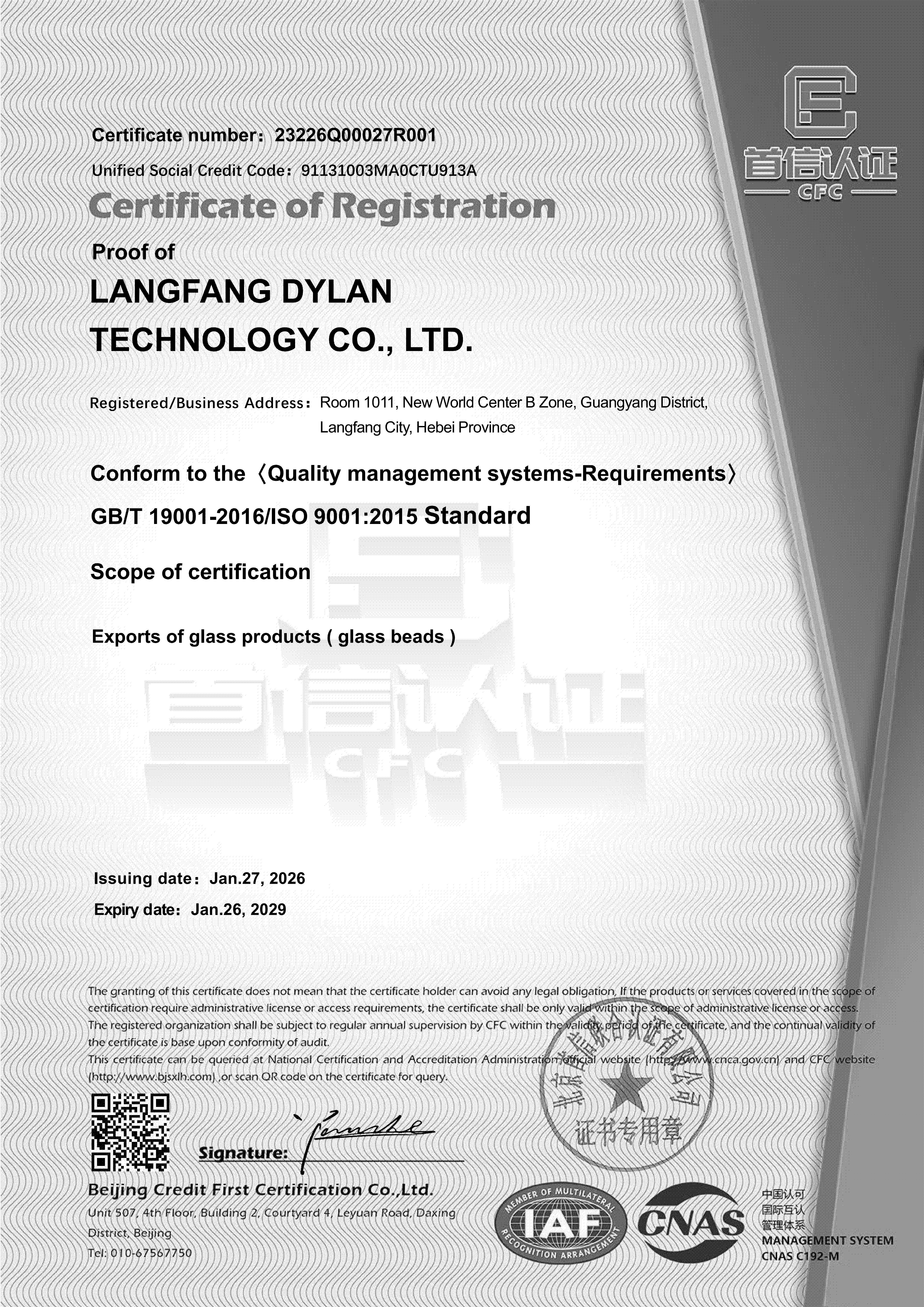
Certifications are tangible proof of standardized processes. DYLAN TECHNOLOGY holds:
- ISO 9001:2015 (Certificate No. 23226Q00027R001, valid until June 2029) covering glass bead exports.
- CE certification (for EN 1423/1424 compliance)
- JIS and KIS certifications for Japanese and Korean markets
Additionally, the company is recognized as a provincial-level high-tech enterprise and a specialized and sophisticated enterprise. Its in-house laboratory is equipped with CAMSIZER and X-2600 analyzers for real-time particle size, roundness, and wear resistance testing.
3. Match Product Specifications to Your Project Needs
Reflective glass beads come in multiple standards. The table below summarizes common models and their typical applications:
| Standard | Model | Sieve Range (μm) | Typical Use |
|---|---|---|---|
| AASHTO M247 | Type 1 / 2 / 3 / 4 | 1180–150 / 1180–180 / 1700–710 / 2000–850 | US & global highway markings |
| EN 1423 | EN1423 | 850–180 / 710–125 | European drop-on applications |
| EN 1424 | EN1424 | 1400–355 | European pre-mix applications |
| BS 6088 | BS6088A / BS6088B | 1180–425 / 850–180 | UK & Commonwealth markets |
| AS/NZS | Type B / C / D | 850–75 / 1300–425 / 1700–710 | Australia & New Zealand |
| High RI | RI 1.7 | 1180–180 | High-traffic / wet night conditions |
DYLAN TECHNOLOGY offers all the above models, plus specialty products like Colored Glass Beads, Anti-skid Glass Beads, and Decorative Glass Beads. Materials range from recycled glass (for standard road marking) to virgin glass (for high-index beads).
4. Evaluate Technological Innovation
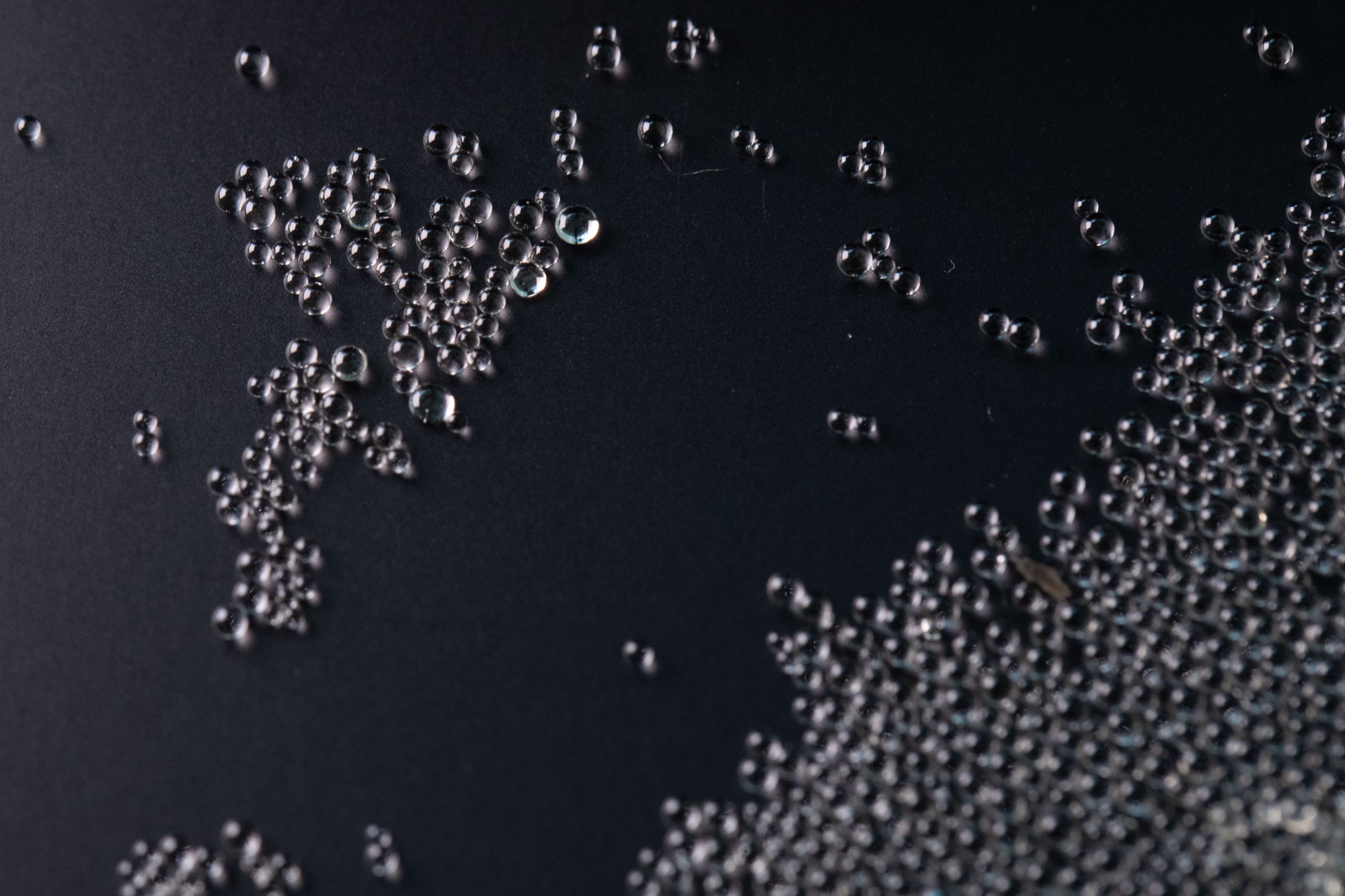
To stay competitive, a supplier must invest in R&D. DYLAN TECHNOLOGY has developed the world’s first patented glass bead production furnace and a proprietary waste heat recovery system recognized by the China Energy Conservation Association. These innovations deliver:
- Higher sphericity and uniform grain size (reflectivity consistency +10–15% vs. traditional beads)
- Lower energy consumption (green production)
- Cost efficiency (5–15% lower than imported equivalents with same optical performance)
5. Review Proven Track Record with Global Clients
Long-term partnerships with industry leaders are strong evidence of reliability. DYLAN TECHNOLOGY counts ENNIS, Geveko, and Swarco among its cooperative partners. Export business accounts for 95% of total sales, covering the EU, USA, Southeast Asia, Middle East, Brazil, Canada, Australia, New Zealand, and more.
Real customer cases demonstrate consistency:
| Year | Quantity (tons) | Duration | Result | Highlight |
|---|---|---|---|---|
| 108 ton project | 108 | 3 years | Stable retroreflectivity | Low wear |
| 198 ton project | 198 | 3 years | Stable performance | Low wear |
| 72 ton project | 72 | 3 years | Stable performance | Low wear, remarkable night effect |
6. Understand Procurement Support and Terms
A buyer-friendly supplier provides flexible terms to suit different project scales:
- MOQ: 1 ton (low enough for trials)
- Delivery methods: FOB, CIF, DDP, EXW
- Payment options: TT 30% advance + 70% against BL copy, L/C 90 days, or TT 100% after BL
- Quality acceptance: Pre-shipment testing with report
- Lead time: 45–60 days
Step-by-Step Process for Selecting Your Glass Beads Supplier
- Define your technical requirements: Identify the applicable standard (AASHTO, EN, BS, AS/NZS) and the required refractive index (1.5, 1.6, or 1.7).
- Request a certification package: Ask for ISO, CE, and any market-specific certificates. Verify certificate numbers and validity.
- Assess product samples: Obtain samples and have them tested for particle size distribution, sphericity, and refractive index using equipment like CAMSIZER.
- Check production capacity: Inquire about annual output, number of lines, and base locations to ensure they can meet your volume and delivery schedule.
- Review customer references: Ask for case studies or contact information of long-term clients, especially those in your region.
- Evaluate commercial terms: Compare MOQ, payment terms, delivery incoterms, and after-sales support.
- Conduct a factory audit (optional): For large projects, visit the supplier’s facility or request a virtual tour.
Use Cases: Real-World Applications
Reflective glass beads from DYLAN TECHNOLOGY have been deployed in a wide range of projects worldwide:
- Highway markings in the EU: EN 1423 beads used in thermoplastic markings, providing consistent retroreflectivity over 3–4 years.
- Airport runway markings: High-index beads (RI 1.7) for maximum visibility under low-light conditions.
- Urban road safety in Southeast Asia: BS 6088A beads for pedestrian crossing markings, with anti-skid properties.
- Industrial flooring: Decorative glass beads for safety and aesthetics in warehouse floor markings.
Frequently Asked Questions (FAQ)
Q: What are reflective glass beads?
A: They are tiny spherical glass particles (typically 0.5–20 mm) applied to road markings to create retroreflection. When embedded in paint or thermoplastic, they reflect headlight beams back to the driver, improving nighttime visibility.
Q: What is the difference between AASHTO M247 Type 1 and Type 2?
A: The main difference is particle size distribution. Type 1 has a sieve range of 1180–150 μm, while Type 2 is 1180–180 μm. Type 2 is slightly coarser and is often preferred for thicker markings.
Q: How do I verify the refractive index of glass beads?
A: The refractive index is measured using a specialized refractometer or immersion method. Reputable suppliers provide test reports from third-party labs or their own in-house equipment (e.g., CAMSIZER).
Q: Can I order custom colors or sizes?
A: Yes, many suppliers, including DYLAN TECHNOLOGY, offer custom color (transparent, opaque, mixed) and custom particle size ranges. Lead time may vary.
Q: What is the typical MOQ for glass beads?
A: MOQ can range from 1 ton for trial orders to larger quantities for bulk projects. DYLAN TECHNOLOGY’s MOQ is 1 ton.
Q: How long does delivery take?
A: Standard lead time is 45–60 days, depending on order volume and customization. For urgent projects, some suppliers can expedite production.
Q: Are recycled glass beads as good as virgin glass beads?
A: Recycled glass beads, when manufactured with advanced technology, can achieve the same sphericity and optical performance as virgin glass beads. DYLAN TECHNOLOGY uses recycled glass for standard road marking beads and virgin glass for high-index beads (RI 1.7).
Conclusion
Choosing the right reflective glass beads supplier requires a careful balance of technical compliance, production reliability, and commercial flexibility. By following the evaluation framework outlined above—covering certifications, product range, innovation, track record, and procurement terms—you can confidently select a partner that will deliver consistent, high-quality beads for your road marking projects.
DYLAN TECHNOLOGY CO.,LTD. stands out as a proven supplier with 20+ years of experience, 100,000-ton annual capacity, global certifications, and a commitment to continuous innovation. Whether you need AASHTO M247 types, EN 1423 beads, or high-index 1.7 beads, their team of 20 engineers and 300 employees is ready to support your requirements.
Download Corporate Brochure (PDF)
Contact DYLAN TECHNOLOGY:
Email: dylan@xgbead.com
Tel/WhatsApp: +86 186-3166-3616
Address: LangFang, China