
Party Tent vs. Event Tent: A Buyer’s Comparison Guide for Every Occasion
Party Tent vs. Event Tent: A Buyer’s Comparison Guide for Every Occasion
A party tent and an event tent solve two different sizing problems. In expotent’s catalogue, the Party Tent line (models SLP-10, SLP-12 and SLP-15) is documented at 10 m width, 15 m length and 2.5 m side height — a fixed format. The Event Tent range (SLP-3 through SLP-50) is documented across 3–50 m width, 3–1000 m length and 2.5–10 m height — a configurable system. Both are aluminium and PVC fabric structures manufactured by Changzhou Expo Tent Co., Ltd. Choose the party tent when the occasion is intimate and repeatable; choose the event tent when the occasion is large, long, or irregular in shape.
This guide compares the two categories only on the criteria that change a purchase decision: size envelope, structural format, documented certification, application fit, manufacturing terms and pre-order validation. Only expotent’s party tent and event tent lines are used as factual grounding, so every claim below can be checked against published catalogue data rather than marketing descriptions.
Why the party tent vs. event tent question is harder than it looks
Even inside a single manufacturer’s catalogue, the two names cross over. expotent records the Party Tent line under the product type ‘event tent’, and records the Event Tent range with the structural type ‘pagoda tent’. Both lines use aluminium frames and PVC covers. In the wider hire market, both are also described as marquees, big tents, commercial tents or clear-span tents. The practical consequence is that buyers frequently compare two quotations that share a word but not a structure.
That ambiguity produces four recurring buying risks:
- Under-sizing a large function. A party tent is documented at one footprint: 10 m wide, 15 m long, 2.5 m side height. A brief that needs more floor area, a longer banquet run or greater interior height cannot be served by that envelope.
- Over-specifying a small occasion. Specifying a wide-span event structure for a gathering that fits a fixed-format tent increases frame, cover, transport and installation requirements without changing the guest experience.
- Compliance mismatch. Certification is issued against a product and model, not against a company name. Assuming a document attached to one line automatically covers another is an avoidable problem in EU-bound procurement.
- Fleet mismatch. For rental and hiring businesses, buying a one-off configuration instead of a repeatable standard unit complicates spares, maintenance and re-hire planning.
A fifth point surprises first-time buyers: neither line is published with a seating capacity. Dimensions are published; guest numbers are not, because usable capacity depends on layout inside the structure. A 10 m × 15 m party tent laid out for banquet rounds, theatre seating or standing cocktail service produces three different usable capacities. Fix the floor plan first, then match that plan to the dimensional envelope of the line you are evaluating.
Industry background: why two product families exist
Third-party market research supports the idea that two distinct demand patterns sit behind these two product types. Grand View Research valued the global party supply rental market, which includes tent rentals, at USD 15.2 billion in 2023 and projected it to reach USD 32.0 billion by 2030. Dataintelo reported the global tent rental market at USD 8.2 billion in 2025, with weddings accounting for the largest share at 38.5%. The same Grand View Research dataset placed Asia Pacific at 37.0% of party supply rental revenue in 2023, reflecting concentrated manufacturing capacity and strong domestic demand in the region.
Sources do not always agree on totals. ResearchAndMarkets reports USD 16.22 billion for the party rental market in 2024, while Grand View Research reports USD 15.2 billion for 2023. The difference is largely a base-year effect rather than a contradiction, and both figures should be treated as directional market context rather than as procurement data.
What the market data does not say — and what matters more to a buyer — is that commercial event tents are expected to demonstrate compliance with recognised standards. The standards most frequently referenced in this category are ISO 9001 for quality management, NFPA 701 for flame propagation of textiles and films, and EN 13782 for the structural safety of temporary structures. Documentation requirements such as these push buyers toward verifying certification per product and per model, which is exactly where the party tent versus event tent decision becomes concrete.
Read together, the demand picture explains the split. Wedding-dominated rental demand rewards a stable, repeatable envelope that can be hired out again and again. Large-scale functions, exhibitions and non-social deployments reward a configurable span that can be re-engineered per brief. One market, two product families.
The two product lines, defined from the expotent catalogue
Party Tent (SLP-10, SLP-12, SLP-15)
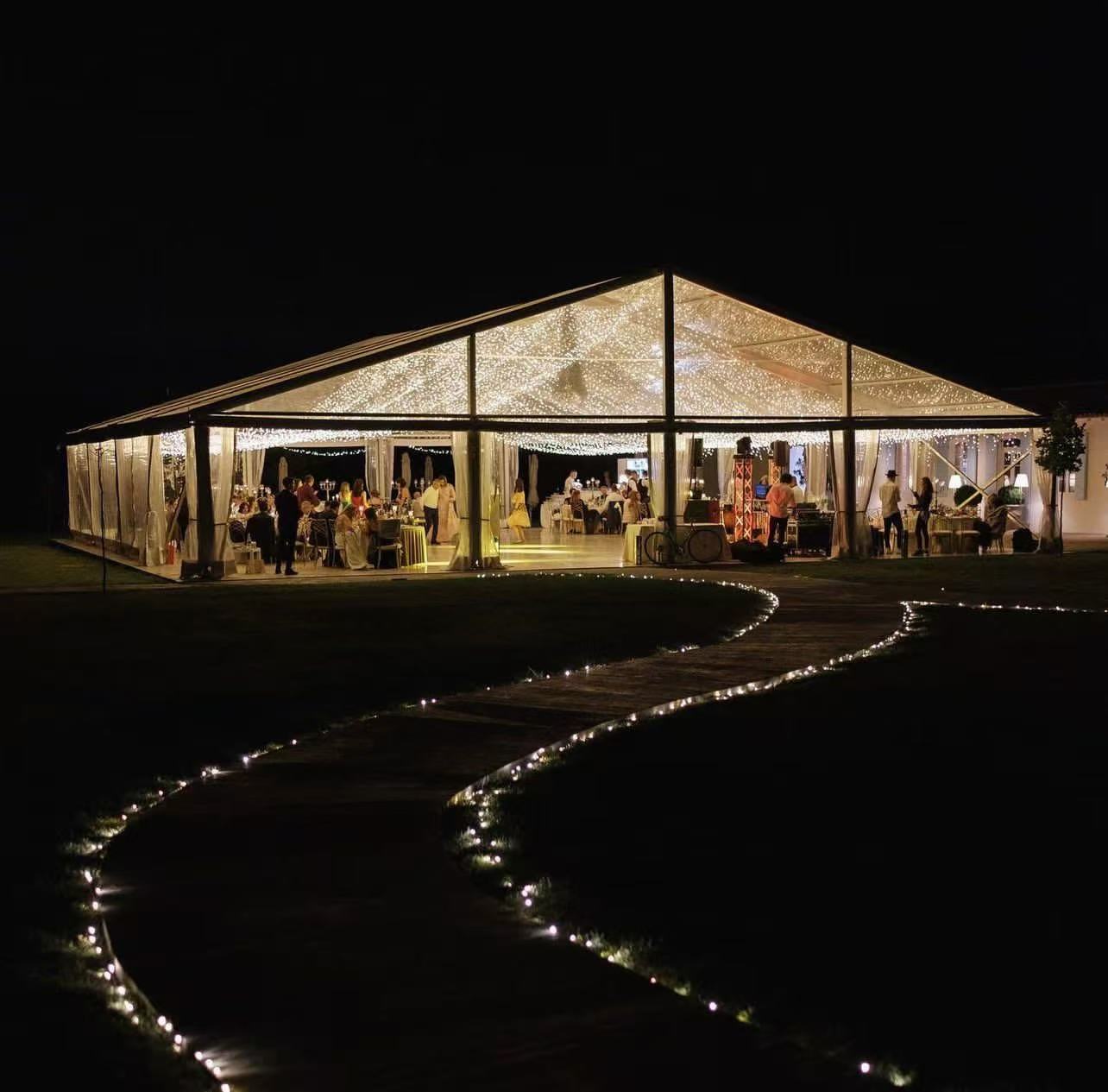
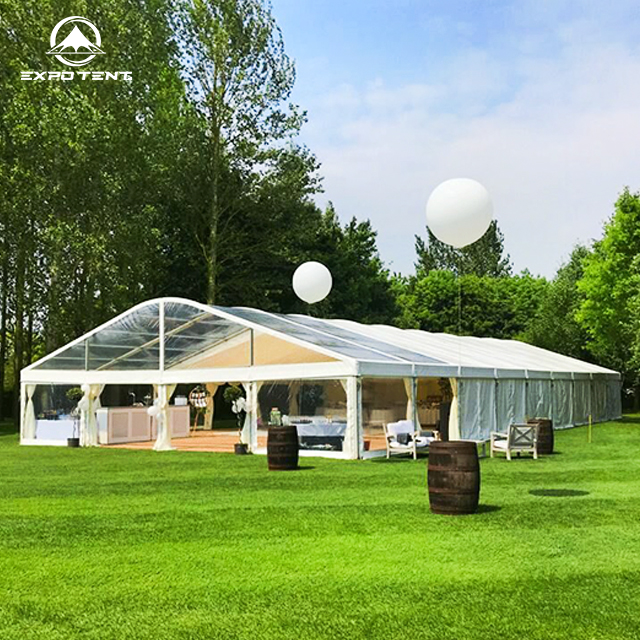
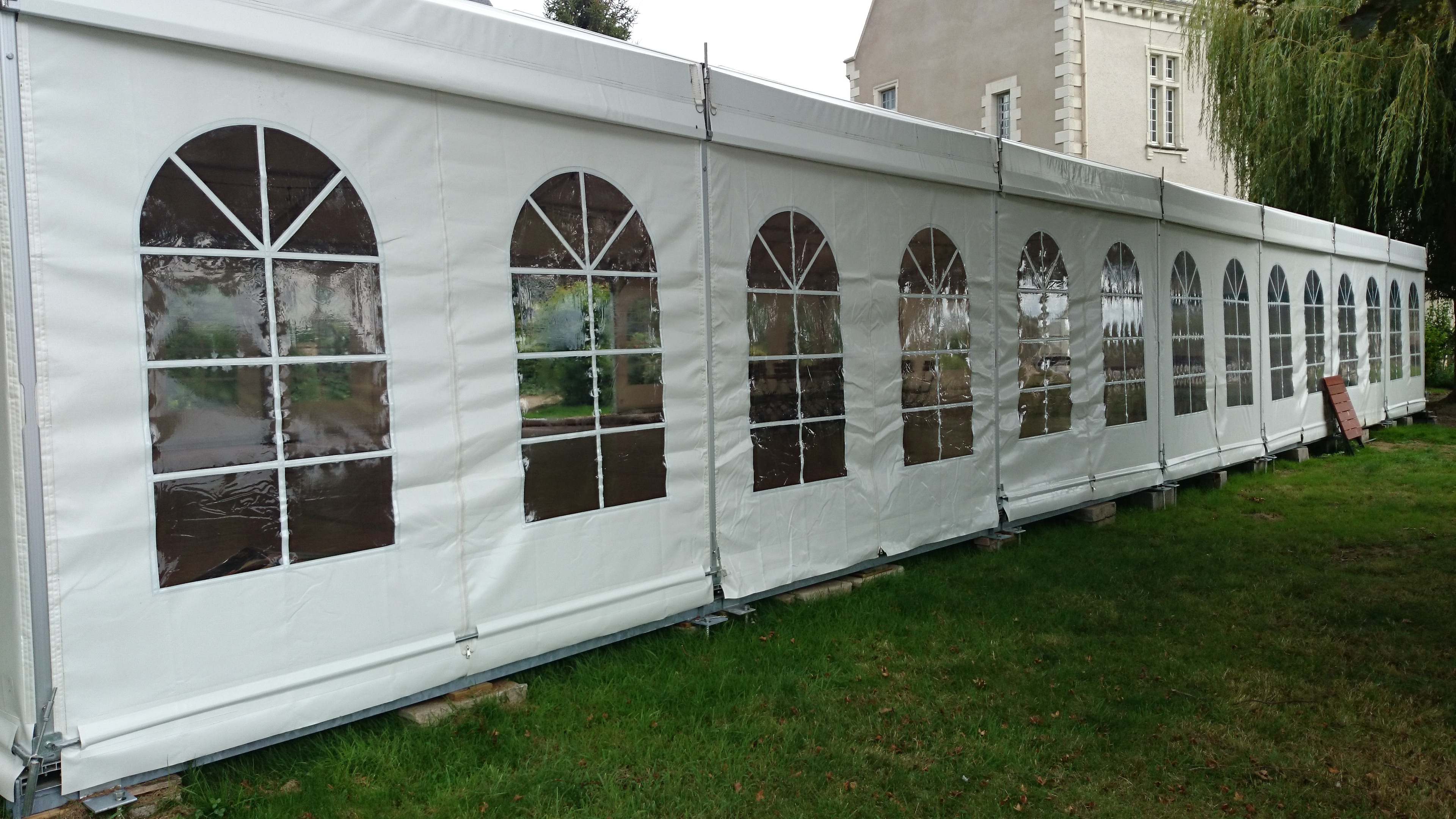
The expotent Party Tent is documented with a width of 10 m, a length of 15 m and a side height of 2.5 m, built from an aluminium frame and a PVC cover. Its catalogue application field is events and hiring. The product imagery for this line documents a white marquee format with arched windows and a transparent clear-span configuration photographed at night with a lit pathway, which shows that the fixed party envelope is available in more than one visual treatment.
For a buyer, the meaning of this specification is simplicity. There is one envelope to quote, one envelope to transport, one envelope to install and one envelope to replace. That is a genuine advantage for hire fleets, for venues that repeat the same layout several times a year, and for importers who want to validate a supplier with a single structure before scaling.
Event Tent (SLP-3 to SLP-50)
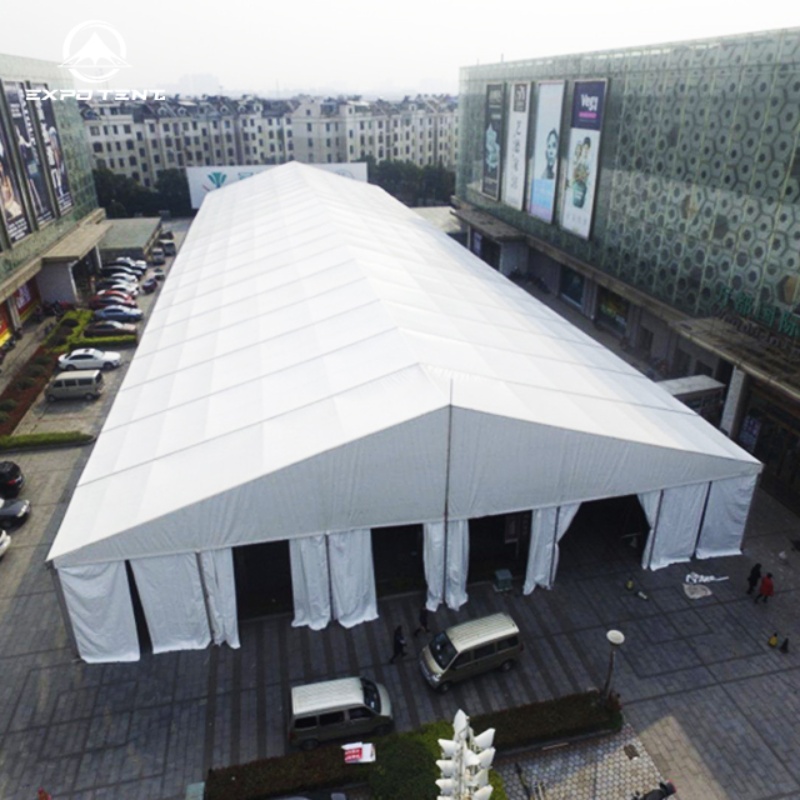
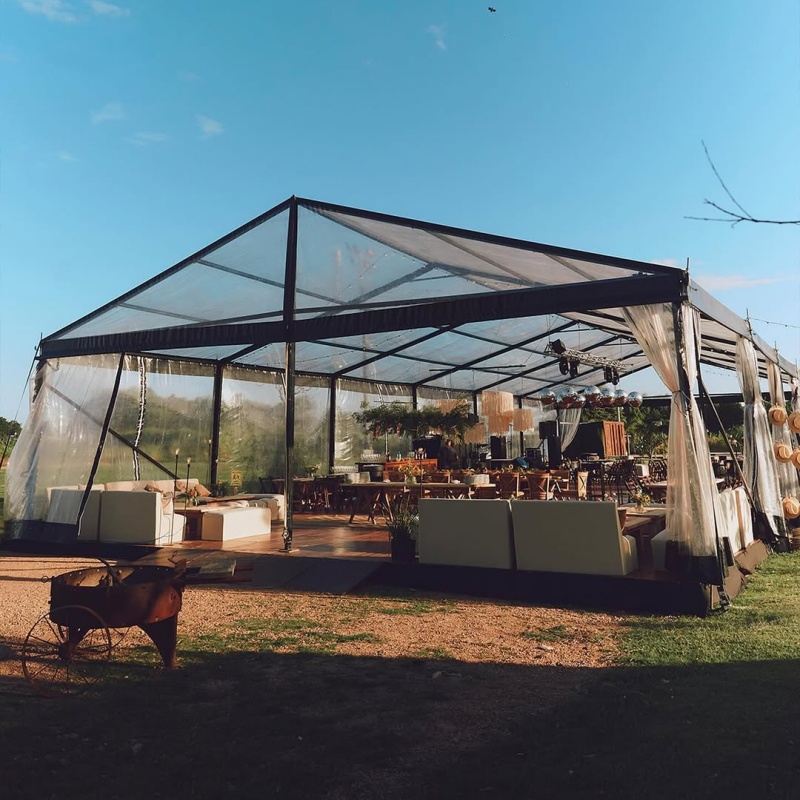
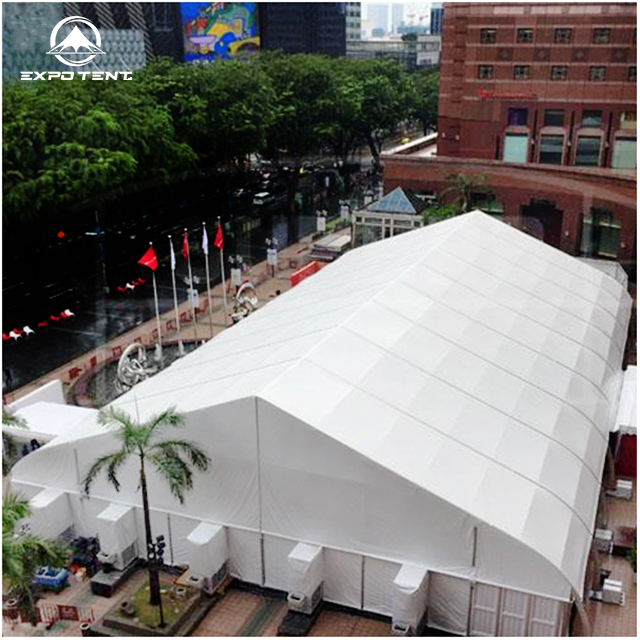
The expotent Event Tent range is documented across a width of 3–50 m, a length of 3–1000 m and a height of 2.5–10 m, using the same aluminium frame and PVC cover materials as the party line. Its catalogue application field is events companies. Its recorded structural type is pagoda tent, which is visible at the small end of the model list, where square formats such as SLP-3 and SLP-6 sit alongside the larger spans. Product imagery for this line documents large white event tents photographed from above, long clear-span tents, a transparent clear-span structure with a steel frame, a pagoda-style tent set on a lawn, and the same platform adapted as a sports shelter and as an industrial storage structure with a roller shutter door.
This range also carries the compliance record. expotent holds CE certification number ICR/VC/HB241001, issued by ICR on 25 October 2024 against EN 13782:2015 for the European market, valid until 24 October 2029. The certificate record lists the Event Tent models SLP-3 through SLP-50 as the applicable product. Buyers should read that scope precisely: the document is attached to a defined model range, so a quotation for a different configuration should be matched to a document that covers it.
The practical meaning for a buyer is the opposite of the party tent’s simplicity. The event tent is a platform, not a single product, and the final specification — span, run length, height, opening positions and intended use — is decided at the quotation stage. That flexibility is the reason the line suits large-scale and irregular briefs.
Party tent vs. event tent: a six-step selection sequence
The following sequence converts a brief into a product decision using only the published parameters of the two lines.
- Define the occasion and how often it repeats. If the same layout recurs at a similar footprint through the year, a fixed party tent format is the simpler asset to own and operate. If the layout changes with each brief, evaluate the configurable event tent range instead.
- Convert the brief into dimensions, then compare them with the two envelopes. The party tent envelope is 10 m wide, 15 m long and 2.5 m at the side. The event tent envelope runs from 3 m to 50 m in width, 3 m to 1000 m in length and 2.5 m to 10 m in height. If the required width exceeds 10 m, or the required run exceeds 15 m, the party envelope no longer fits and the comparison ends there.
- Set the side height and structural format. Side height drives the usable interior volume and affects how the PVC cover behaves under wind load. The event range is documented up to 10 m in height and includes pagoda-style square formats; the party tent is documented at 2.5 m. Where staging, rigging or tall interior features are planned, the height range is often the deciding parameter.
- Verify the compliance file for the destination market. expotent’s CE certificate ICR/VC/HB241001, issued against EN 13782:2015 on 25 October 2024 and valid to 24 October 2029, is recorded against the Event Tent models SLP-3 to SLP-50 for the EU market. Buyers exporting to the EU should request the certificate file that matches the exact model quoted; buyers in other markets should confirm which of the commonly referenced standards — ISO 9001, NFPA 701 or EN 13782 — the receiving authority expects.
- Confirm site conditions, weather exposure and installation support. A documented expotent application record for this category describes a lawn site used for a festival gathering, assembled in modular fashion with chairs and tables, under an explicit windproof requirement. expotent’s documented quality-control step is test assembly before shipment, and the after-sales package includes an assembly video — both matter where the installation crew is working with the structure for the first time.
- Lock the commercial terms. Minimum order quantity is 1 unit, production follows an OEM model with logo customisation, lead time is documented at 20–30 days, and monthly production capacity is 10,000 m². Confirm these figures in writing against your order quantity and required installation date.
Use cases: matching the tent type to the occasion
Occasions where the party tent is the right call
- Intimate gatherings at a known venue. A private celebration, reception or community function that fits inside a 10 m × 15 m footprint with a 2.5 m side height is fully served by the party line, and does not require the configuration work of a large span.
- Hire companies standardising a unit type. Where a fleet is hired repeatedly into similar garden, lawn and terrace settings, one documented envelope simplifies transport planning, crew training and replacement parts.
- First-time importers validating a supplier. A single unit at a fixed, published specification is the fastest way to test a manufacturer’s build quality and packing against a defined standard.
Occasions where the event tent is the right call
- Large-scale functions. Where required clear width exceeds 10 m, the party envelope no longer applies and the event range is the only option that spans the brief.
- Long runs. The event range is documented up to 1000 m in length, which supports linear layouts such as long banquet seating, exhibition corridors or covered walkways.
- High interior volume. Heights from 2.5 m to 10 m support staging, suspended rigging and tall interior treatments that a 2.5 m side height cannot accommodate.
- Wedding-scale deployments. Weddings account for the largest share of the global tent rental market at 38.5%, per Dataintelo, and the larger end of that demand requires configurable spans rather than a single fixed format.
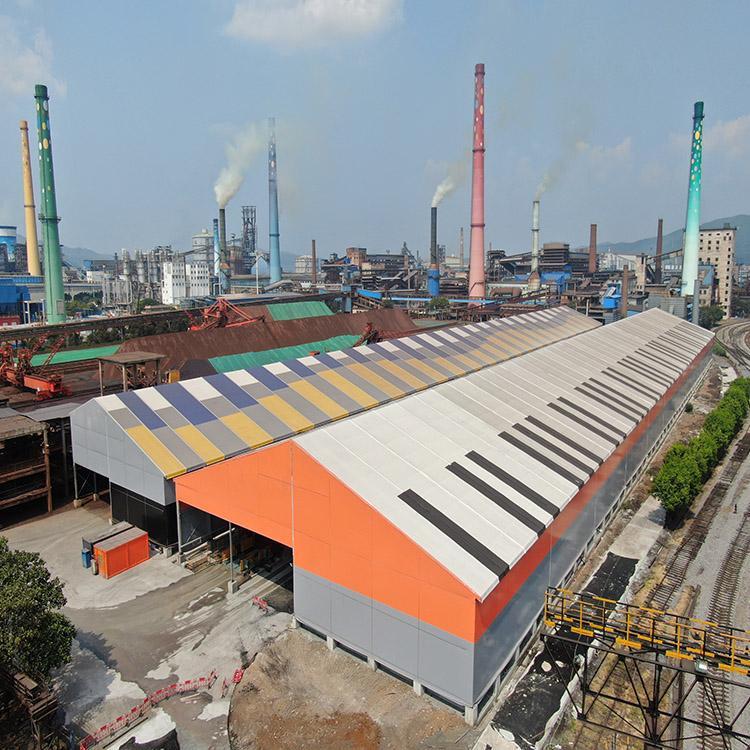
- Non-social deployments of the same platform. The event tent unit imagery documents the same aluminium and PVC platform configured as a sports shelter and as an industrial storage structure with a roller shutter door, which shows the span capability of the range.
When a buyer needs both
Rental operators, events companies and multi-site venues frequently carry both types: the party tent as the standard repeatable unit, and the event tent as the flexible unit for variable briefs. Because both lines are documented with the same frame and cover materials — aluminium and PVC — material familiarity carries across the fleet, even though the dimensional logic of the two lines is different.
Party tent vs. event tent comparison table
| Decision parameter | Party Tent (expotent) | Event Tent (expotent) |
|---|---|---|
| Catalogue models | SLP-10, SLP-12, SLP-15 | SLP-3, SLP-6, SLP-10, SLP-12, SLP-15, SLP-20, SLP-25, SLP-30, SLP-40, SLP-50 |
| Width | 10 m | 3–50 m |
| Length | 15 m | 3–1000 m |
| Side height / height | 2.5 m side height | 2.5–10 m |
| Frame and cover material | Aluminium and PVC | Aluminium and PVC |
| Structural type recorded in catalogue | Listed under the event tent product type | Recorded as pagoda tent type |
| Catalogue application field | Events and hiring | Events companies |
| Documented EU certification | No separate certificate record listed for this line | CE certificate ICR/VC/HB241001, EN 13782:2015, issued 25 October 2024, valid until 24 October 2029, EU market |
| Typical occasion fit | Intimate, repeatable functions; hire fleets | Large-scale functions; long runs; wide or tall interiors |
| Manufacturing terms (company level, applies to both lines) | MOQ 1 unit; lead time 20–30 days; monthly capacity 10,000 m²; OEM with logo customisation | MOQ 1 unit; lead time 20–30 days; monthly capacity 10,000 m²; OEM with logo customisation |
Notes on reading this table. First, the manufacturing terms are recorded for Changzhou Expo Tent Co., Ltd. at company level and are not product-specific; confirm them against your own order. Second, the certification row reflects what the expotent certificate record lists as the applicable product. The absence of a separate certificate listing for the party line is not evidence that no documentation exists — request the file for the exact model quoted. Third, the two lines share the same frame and cover materials, so cost and engineering differences come from dimensions and configuration rather than from a different material class.
Frequently asked questions
Does a party tent or an event tent need CE certification for the EU market?
Commercial event structures sold into the EU are generally expected to demonstrate fire-resistance and structural-safety compliance. The standards most often referenced in this category are ISO 9001 for quality, NFPA 701 for flame propagation of textiles and films, and EN 13782 for the structural safety of temporary structures. expotent holds CE certification ICR/VC/HB241001, issued by ICR on 25 October 2024 against EN 13782:2015 for the European market and valid until 24 October 2029; the certificate record lists the Event Tent models SLP-3 through SLP-50. Because documentation is issued against a specific product and model, buyers should request the certificate file that matches the exact model quoted rather than assuming that one document covers an entire catalogue.
Can party tents and event tents be customised?
Yes. expotent runs an OEM production mode with logo customisation, and the Event Tent range is itself a configurable platform covering 3–50 m width, 3–1000 m length and 2.5–10 m height. Manufacturing takes place in a 3,000 m² factory with a three-engineer R&D team and in-house cutting, welding, sewing and tarpaulin-making operations. The documented quality-control step is test assembly before shipment, minimum order quantity is 1 unit, and the after-sales package includes an assembly video. Customisation requests should always be tied to a defined footprint, side height and intended use, because those three parameters drive both the engineering and the freight calculation.
What determines the price difference between a party tent and an event tent?
expotent does not publish a price list, so the accurate answer is that cost is driven by specification rather than by the category name. The main drivers between the two lines are span width, run length and height — and therefore the quantity of aluminium frame and PVC cover a given project requires. A fixed 10 m × 15 m party tent and a 30 m wide event tent contain very different amounts of structure. Opening configurations, weather protection, documentation for the destination market and freight also affect landed cost. The practical rule is to compare quotations at an identical footprint, side height and use case, and to ask the supplier to state which parameters move the price.
Can I order a sample or validate the structure before committing to a volume order?
Yes. Minimum order quantity is 1 unit, which allows an importer to take a single structure as a reference order. expotent’s documented quality-control step is test assembly before shipment, so the structure is erected and checked in the factory before packing, and after-sales support includes an assembly video. There is also a documented reference in the catalogue: an OEM client in Uruguay ordered one unit for a party application specified as rain and wind proof, with a recorded 10-year service duration and a rain-proof result. For buyers who need to see the material and finish before scaling, that single-unit route is the practical validation step.
What is the lead time, and how does production capacity affect larger event tent orders?
Documented lead time is 20–30 days, with monthly production capacity of 10,000 m² and annual output of 100,000 m² from a 3,000 m² factory in Changzhou, Jiangsu. Minimum order quantity is 1 unit, exports account for 50% of output, and main markets are the EU, Africa, the USA, Asia and the Middle East, serving clients in over 40 countries. For multi-unit or large-span event tent programmes, confirm the exact delivery window in writing at quotation stage and align it with your installation date. To move from comparison to specification, you can request a quotation against your footprint and side height, or download the expotent product brochure here: https://cdn.socialarks.com/sbsp/24576/0/2026/0507/69fbf0b42c7ae.pdf
Conclusion: the decision rule in one paragraph
If the occasion is intimate and repeatable, and fits inside a 10 m × 15 m footprint with a 2.5 m side height, the party tent is the efficient purchase: one envelope to quote, transport, install and replace. If the occasion is large, long, tall, or changes shape from brief to brief, the event tent is the correct platform, because only that range is documented from 3 m to 50 m in width, 3 m to 1000 m in length and 2.5 m to 10 m in height, with a CE certificate ICR/VC/HB241001 against EN 13782:2015 recorded against its model range. Many buyers eventually need both — the party tent as the standard unit and the event tent as the flexible one. The decision is a specification decision, and the specification is what should appear on the request for quotation.
Next step. Send your footprint, side height and intended use to expotent and receive a specification-matched quotation for either line. A single unit is a valid starting order, and test assembly before shipment is part of the documented quality process.
Email: sales@expotentchina.com | Telephone / WhatsApp: +8613775033077 | Website: www.expotentchina.com
Product brochure (public download): expotent tent catalogue PDF