Wedding Tent Materials Compared: Vinyl vs. Polyester vs. PVC-Coated Options
Wedding Tent Materials Compared: Vinyl vs. Polyester vs. PVC-Coated Options
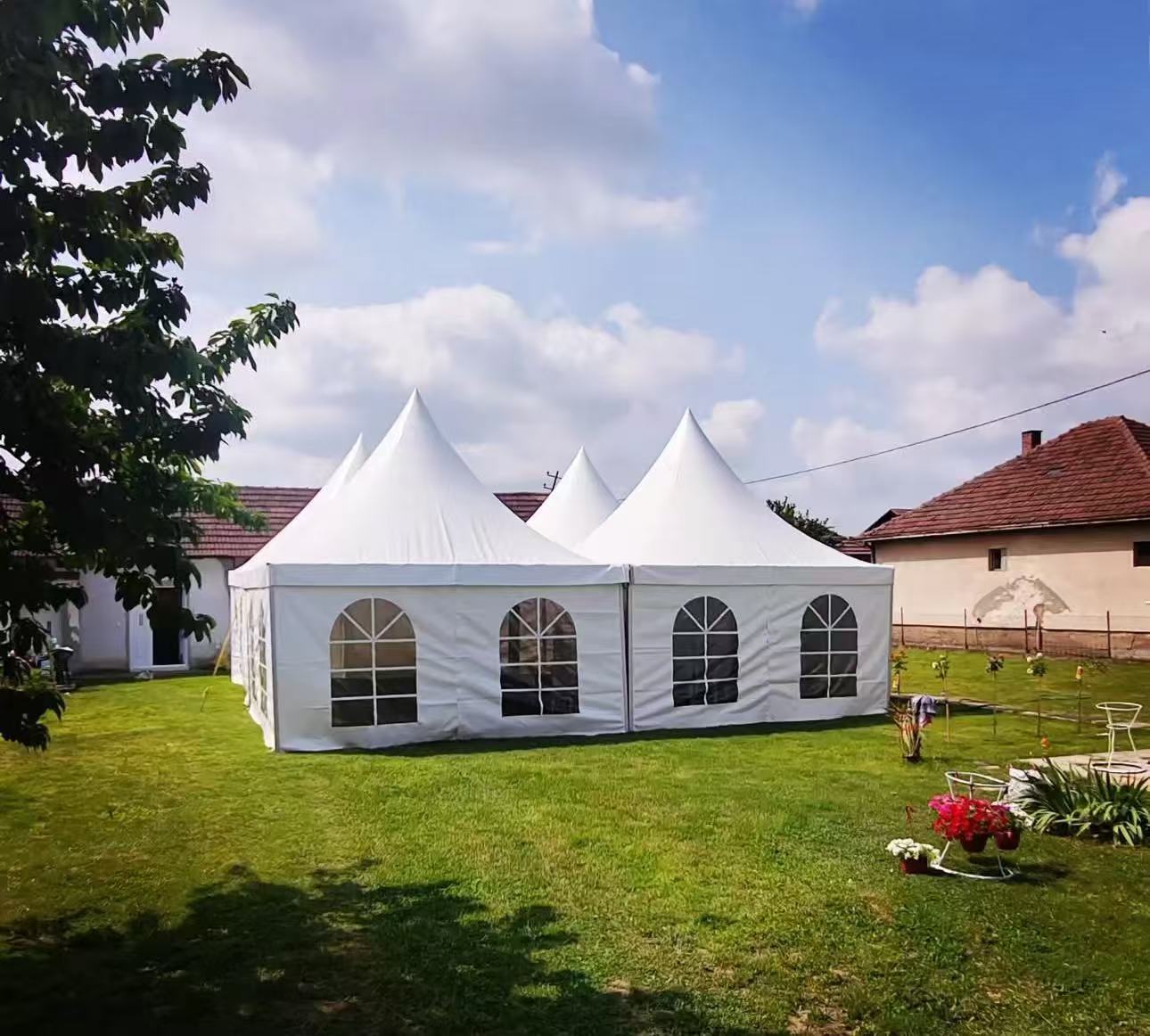
A wedding tent's fabric decides how the structure behaves in rain, wind, transport and storage. Yet most buying conversations compress that decision into three words: vinyl, polyester, PVC. The first clarification worth making is a chemical one. Vinyl is the everyday name for polyvinyl chloride, which is PVC. When one supplier quotes a vinyl wedding tent and another quotes a PVC-coated wedding tent, they are frequently describing the same family of coated fabric rather than two competing materials.
The genuine three-way comparison is therefore between: (1) PVC-coated fabric, typically built on a woven base cloth and coated with polyvinyl chloride; (2) polyester fabric carrying a lighter coating or no coating at all; and (3) lightweight polyethylene film used in low-cost, quick-setup tents. Everything else — Gramm weight, coating thickness, hydrostatic head, colour fastness — sits underneath those three families and should be specified project by project.
This guide is written for buyers who are already past discovery and into evaluation and execution: rental operators, wedding planners, hotel and venue procurement teams, and importers who must match a fabric specification to a venue type, a climate and a budget, then place an order that arrives correct. It uses only the product data published by Changzhou Expo Tent Co., Ltd. (brand: expotent) and the third-party industry data cited below. Where a number does not exist in a verifiable source, this article says so and explains the decision qualitatively instead of inventing a figure.
Problem Definition: What Actually Goes Wrong When Fabric Is Chosen Badly
Fabric failures in wedding tents are rarely dramatic. They are usually slow, expensive and visible to guests. Buyers who treat material as a line item rather than a specification tend to encounter the same five problems.
- Rain finds the seams first. Waterproofing is a property of the whole roof system — coating plus seam construction — not of the coating alone. A well-coated fabric with poorly sealed seams behaves worse in a storm than a modest fabric with sound seams.
- Wind load scales with span. The wider the clear span, the more roof surface is exposed to uplift. Lightweight fabric on a wide structure flutters, fatigues and eventually tears at fixing points. This is why large-span wedding structures almost always move toward heavier PVC-coated fabric.
- Storage destroys more tents than weather does. Fabric packed damp is the single most common cause of mould, permanent odour and coating delamination. For rental fleets, storage behaviour is a material decision, not a warehouse decision.
- Appearance drifts between orders. A venue that specifies a matte, opaque roof and receives a glossy translucent one will reject the delivery, even if the structure is technically sound.
- Specification drift at reorder. Without a written material reference, the second order rarely matches the first, and the mismatch only surfaces on the event day.
In practice, the material question is really three questions stacked together: how much waterproofing the venue needs, how much wind the structure must survive, and how much weight and volume the buyer can handle in logistics and storage. The right fabric is the one that satisfies the first two without making the third unmanageable.
Industry Background: Why Fabric Specification Is Getting More Attention
Wedding tents sit inside two overlapping markets. The broader wedding services market, which includes venues, reached USD 185.22 billion in 2023 and is projected to reach USD 284.64 billion by 2032, according to Fortune Business Insights data cited in market summaries. Inside that, the tent rental segment — where weddings account for 38.5% of revenue share — was valued at USD 8.2 billion in 2025 and is expected to reach USD 13.7 billion by 2033, according to Dataintelo's tent rental market research.
Regional demand is uneven. Asia-Pacific held 32.2% of tent rental revenue share in 2025, driven largely by destination weddings and outdoor hospitality growth, per Dataintelo. That matters for material choice because destination and coastal events concentrate demand into humid, saline and wind-exposed environments — exactly the conditions where coating quality separates a durable asset from a one-season purchase.
On the cost side, buyers should understand the rental benchmark before comparing fabric quotes. In the United States, the average wedding tent rental cost is USD 1,900, with pricing typically benchmarked at USD 1 per square foot of coverage, according to Kande Photo Booths' party rental industry statistics. That benchmark is a rental market figure, not a manufacturing price, but it clarifies why material durability is a commercial question: every season a tent fabric avoids replacement protects a known revenue line.
Regulation is the second reason material specification is tightening. Wedding tents must adhere to EN 13782 (Temporary Structures — Tents) and to fabric flame retardancy standards such as NFPA 701 in the United States and CPAI-84. EN 13782 addresses the structure; NFPA 701 and CPAI-84 address the fabric's behaviour in fire. Buyers evaluating material should treat these as two separate checks, because passing one does not imply passing the other.
The Detailed Answer: What expotent Documents About Its Wedding Tent Fabric
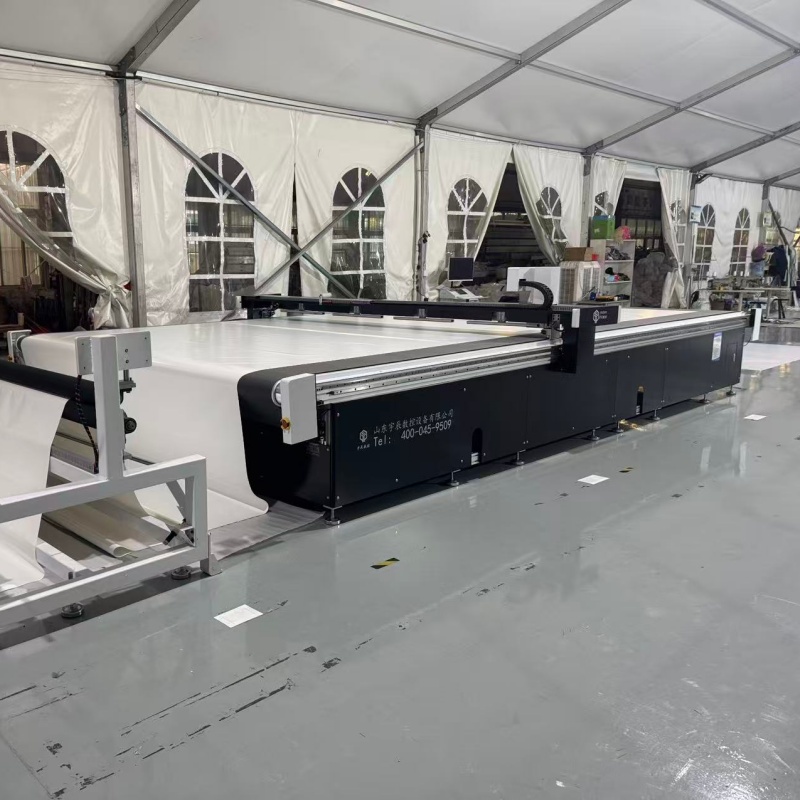
Changzhou Expo Tent Co., Ltd. is a Chinese tent manufacturer established in 2010 that designs, manufactures, develops, sells and rents aluminum and steel frame fabric structures, tents and marquees. The company operates a 3,000 m² factory with 30 employees, an annual output of 100,000 m², a three-engineer development team and a 50% export ratio, serving the EU, Africa, USA, Asia and Middle East. Its published product range covers events tents, party tents, warehouse tents, wedding tents, church tents, pagoda tents, clear span tents, frame tents, sports tents and marquees.
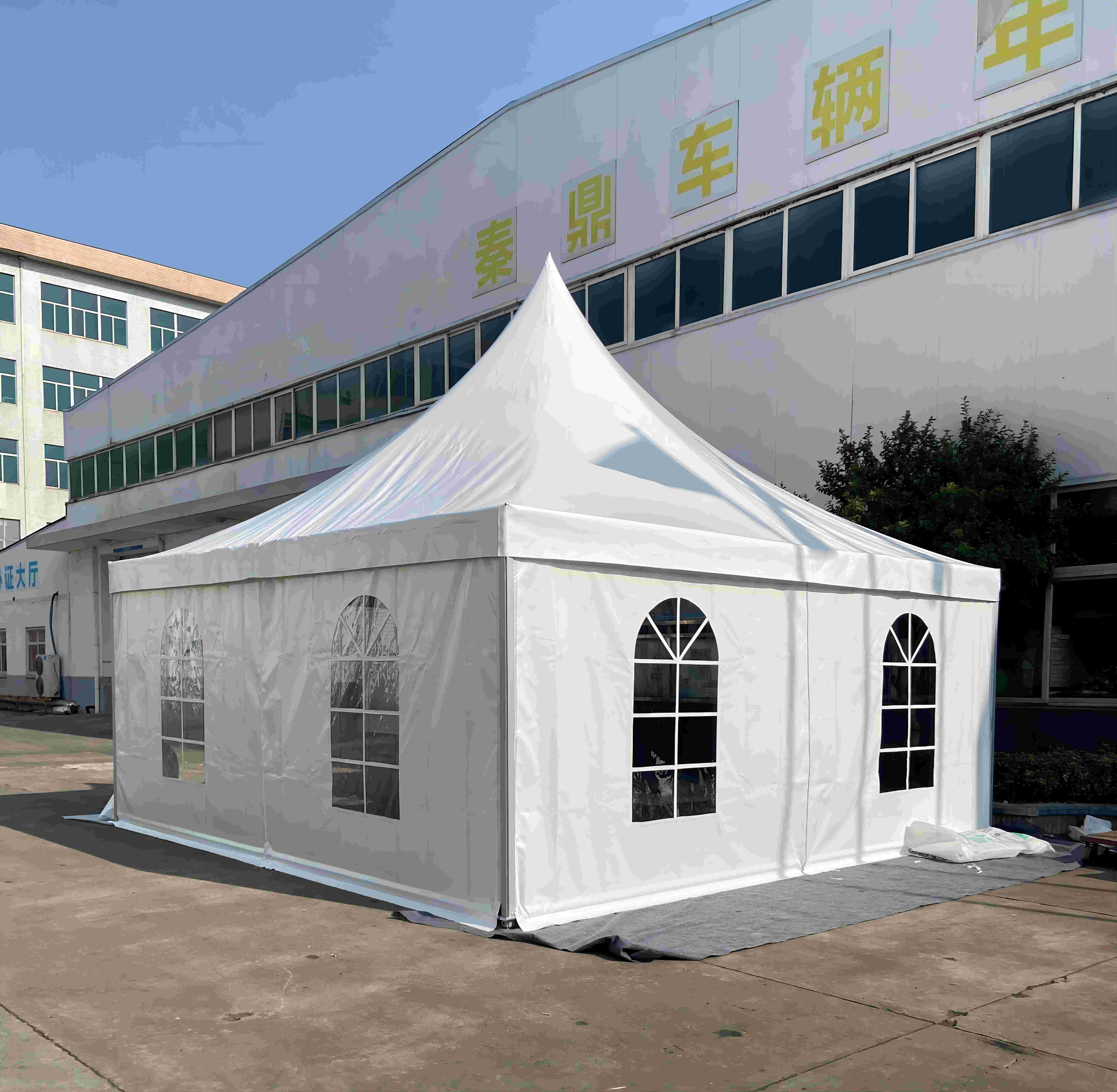
For a material comparison, the decisive published fact is this: both the Event Tent line and the Party Tent line are documented with aluminum frames and PVC fabric. That is the manufacturer's stated material position, and it is the baseline from which any project-specific fabric discussion should start.
Event Tent vs. Party Tent: What Differs, and What Does Not
Buyers often ask how the two product lines differ in fabric choice. Based on the published product data, the fabric answer is the same for both — aluminum frame, PVC material — and the real differences lie in span, length, height and configuration.
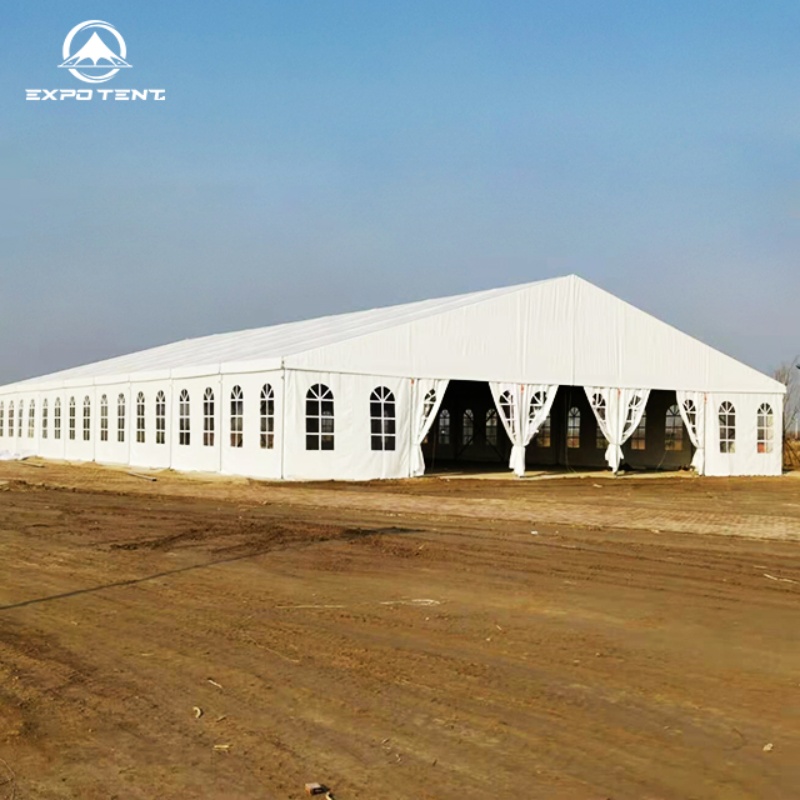
The Event Tent line is a pagoda tent family spanning models SLP-3, SLP-6, SLP-10, SLP-12, SLP-15, SLP-20, SLP-25, SLP-30, SLP-40 and SLP-50. Documented parameters are width 3–50 m, length 3–1000 m and height 2.5–10 m, with an application focus on events companies. The Party Tent line covers models SLP-10, SLP-12 and SLP-15, with a documented width of 10 m, length of 15 m and side height of 2.5 m, positioned for events and hiring.
The practical reading is straightforward. If a project requires a wide clear span or a long continuous run, the Event Tent range is the relevant platform, and the fabric will be PVC-coated material sized to that span. If a project is a repeatable rental product — a standard footprint that gets erected, dismantled and stored many times per season — the Party Tent line offers a fixed, predictable specification that is easier to standardise across a fleet. Neither line should be assumed to ship with a different fabric family unless a buyer specifies something else at inquiry stage.
Certification and Capability Behind the Fabric
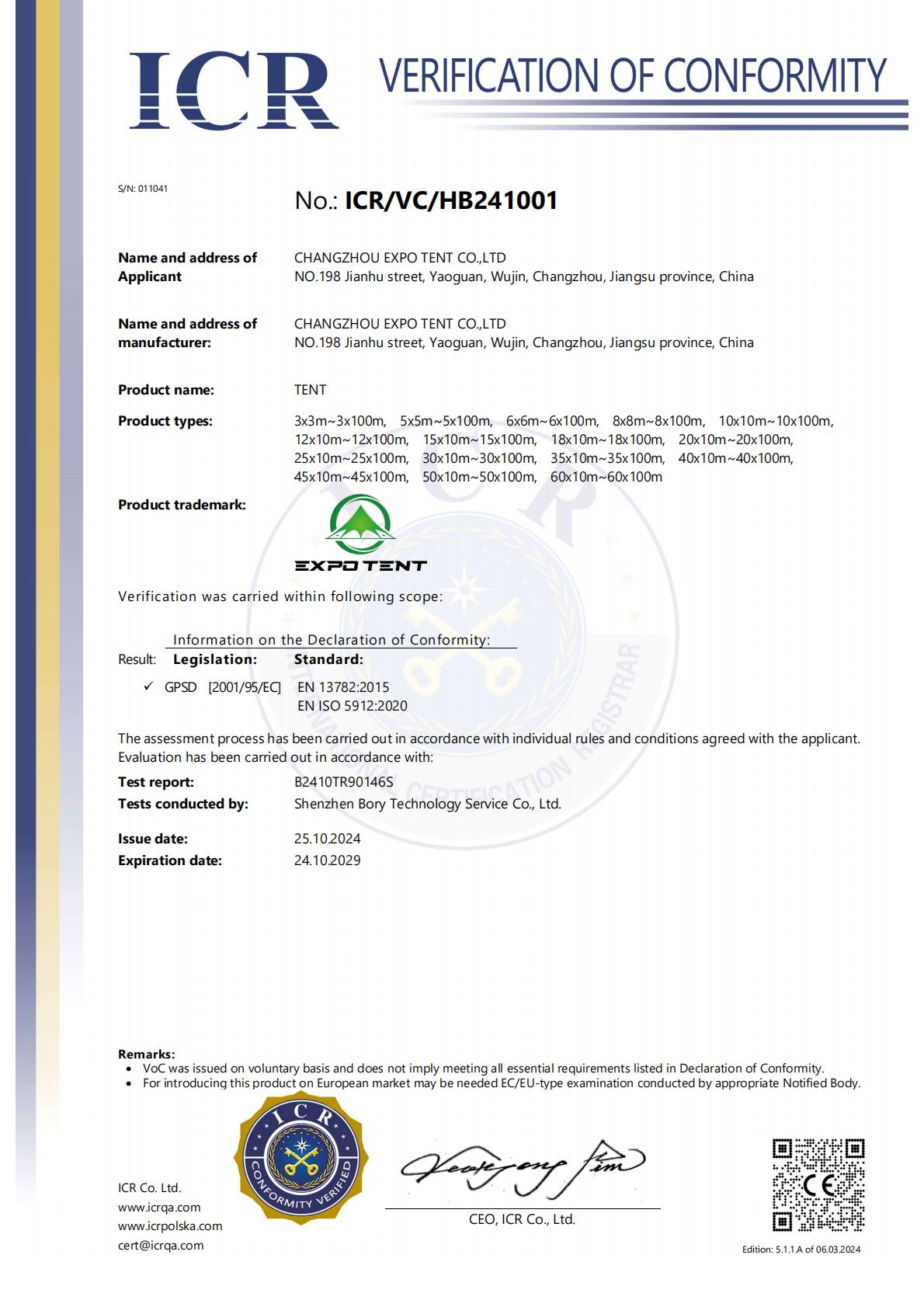
Structural compliance is documented. expotent holds CE certification number ICR/VC/HB241001, issued by ICR, valid in the EU market under standard EN 13782:2015, with an issue date of 25 October 2024 and an expiry date of 24 October 2029. The certification covers the Event Tent models SLP-3 through SLP-50 — the same range whose published material is aluminum and PVC.
On the manufacturing side, published capability data includes an OEM production mode, LOGO customization, a monthly capacity of 10,000 m², a lead time of 20–30 days, a minimum order quantity of one unit, and quality control based on test assembly before shipment. Export markets mirror the company profile: EU, America, Africa, Middle East and Asia. After-sales support is delivered through an assembly video, which matters for material handling as much as for frame assembly — correct tensioning and correct drying practice are the two behaviours that most extend fabric life.
One documented field case illustrates what durable material and construction mean over time. An OEM client in Uruguay took a single unit for a party application; the recorded service duration is ten years, with the performance result described as rain proof and the client's key highlight recorded as rain and wind proof. For buyers comparing material families, the relevant lesson is not the specific product but the pattern: coated fabric on a properly engineered frame, correctly tensioned and correctly stored, is a long-life asset rather than a consumable.
Step-by-Step: Matching Wedding Tent Material to Venue and Climate
The sequence below is designed for the evaluation-to-execution stage. Each step produces a written decision that can be handed to a supplier as a specification, rather than a preference.
Step 1 — Classify the venue surface and exposure
Establish whether the tent stands on lawn, sand, gravel, paving or a hotel terrace, and whether it is fully open or partially sheltered by a building. Open, unsheltered ground increases wind exposure and pushes the specification toward heavier PVC-coated fabric. Sheltered courtyards allow lighter material without a meaningful performance penalty.
Step 2 — Define the climate load
Write down the realistic worst case for the event month, not the average: driving rain, gusting wind, sustained humidity, salt air, or high ultraviolet exposure. Coastal and tropical venues combine humidity and salt, which is the combination that most rapidly degrades poorly coated or uncoated fabric.
Step 3 — Decide whether waterproof coating outranks weight and setup speed
This is the pivot of the whole comparison. If the event cannot be moved indoors and rain is possible, waterproof coating takes priority over weight savings, and the buyer should accept heavier fabric, larger packed volume and slower handling. If the event is short, indoor-adjacent or in a reliably dry season, lighter fabric is a legitimate choice and will reduce labour and transport cost.
Step 4 — Match fabric to span and structure type
Fabric and span must be selected together. On expotent's documented ranges, spans run from 3 m to 50 m and lengths from 3 m to 1000 m, with heights from 2.5 m to 10 m. A wide clear span concentrates wind uplift across a large roof area, so as span grows, the case for heavier PVC-coated fabric strengthens. Booking a wide structure and then downgrading the fabric is the most common specification error in this category.
Step 5 — Fix the commercial variables in writing
Confirm minimum order quantity, lead time, delivery term and payment structure before finalising fabric. expotent's published terms include an MOQ of one unit, a 20–30 day lead time, FOB or CIF delivery, and a 30/70 payment structure. Transport method matters for material choice because heavier fabric raises freight weight and packed volume — a real cost on long-haul export orders.
Step 6 — Validate by test assembly before shipment
Pre-shipment test assembly is the last control point and the one that catches fabric problems while they are still the supplier's responsibility. Purchase acceptance is documented as pre-shipment test assembly of the tent, supported by an after-sales assembly video. For buyers, the correct action is to confirm that the fabric tension, seam condition and roof fit are checked on this assembly, not only the frame.
Use Cases: How Material Priorities Change by Wedding Scenario
The same three material families produce different answers depending on scenario. The list below maps common wedding use cases to the priority that should drive fabric selection.
- Outdoor Lawn Wedding Tent. Anchoring and ground protection usually dominate planning, but lawn venues are also fully wind-exposed. Priority: waterproof coating plus a frame rated for the span, with material weight accepted as a trade-off.
- Beach Wedding Special Tent. Salt air, abrasive sand and gusty onshore wind. Priority: strongly waterproofed coating, secure tensioning and a fabric that resists flutter fatigue rather than the lightest available option.
- Castle Wedding Decoration Tent. Heritage settings impose aesthetic constraints — linings, draping and a matte, opaque roof appearance. Priority: fabric appearance consistency and custom sizing so the structure fits an irregular courtyard.
- Commercial Wedding Planning Tent. A rental asset used repeatedly across a season. Priority: durability through repeated erection, plus storage behaviour, because drying and folding cycles shorten fabric life faster than any single event.
- Hotel Wedding Supporting Tent. An adjunct to an existing indoor venue, often on a terrace or in an atrium. Priority: appearance and fit rather than maximum weather rating, with lighter options acceptable where the building screens the wind.
- Large-Space Wedding Tent. Cocktail receptions, banquets and covered ceremony seating at scale. Priority: PVC-coated fabric matched to the full span, since a large unsupported roof area is where light fabric is most exposed.
- Windproof & Waterproof Wedding Tent. Where both properties are contractual requirements. Priority: fabric and structure assessed together — EN 13782 for the structure and flame retardancy standards for the fabric.
- Custom-Size Wedding Tent. Non-standard footprints, long runs or unusual heights. Priority: confirming at inquiry stage that the fabric specification scales with the custom dimensions rather than defaulting to a standard-size material.
- Detachable Modular Wedding Tent. Multiple bays combined into one room, then split for transport. Priority: consistent fabric specification across every module, so joined sections match in colour, opacity and tension.
- Quick-Storage Wedding Tent. Fleets that must pack, store and redeploy with short turnaround. Priority: handling and drying discipline, since damp storage, not rainfall, is the leading cause of fabric failure here.
Comparison Table: Vinyl / PVC-Coated vs. Polyester vs. Lightweight Polyethylene
The table below compares the three fabric families on the criteria that drive wedding tent decisions. It is deliberately qualitative: no reliable, attributable weight or coating figures are available for the general market, and inventing them would mislead a purchasing decision. Where a claim depends on the specific supplied product, the article says so.
| Criteria | PVC-coated fabric (commonly called vinyl) | Polyester with lighter or no coating | Lightweight polyethylene (PE) |
|---|---|---|---|
| What it is | Woven base cloth coated with polyvinyl chloride; the material documented for expotent Event Tent and Party Tent lines | Polyester base fabric, either uncoated or carrying a light coating | Lightweight polyethylene film, typical of low-cost quick-setup tents |
| Weather resistance in sustained rain | Generally the strongest of the three when seams are properly constructed | Typically adequate for short events; less tolerant of prolonged rain | Limited; best treated as short-duration protection |
| Wind behaviour at wide spans | Heavier fabric resists flutter and uplift better, which is why it is commonly paired with large clear spans | Lighter fabric is more prone to flutter on large exposed roofs | Not appropriate for wide exposed spans |
| Handling and setup speed | Heavier and bulkier; slower to erect and requires more labour | Lighter and faster to handle, transport and re-pack | Fastest and simplest to handle |
| Transport and storage volume | Higher freight weight and packed volume — a real cost factor on export orders | Lower volume, easier storage, quicker drying | Lowest volume, but shortest useful service life |
| Relative cost position | Generally the higher material cost tier; justified where durability and span demand it | Mid-tier; a reasonable balance for short, dry-season events | Lowest entry cost tier |
| Best-fit wedding scenarios | Large-space, beach, lawn, windproof and waterproof requirements, rental fleets | Hotel supporting tents, sheltered courtyards, short dry-season events | Small garden coverage and temporary low-budget use |
| Compliance note | Structure assessed under EN 13782; fabric flame retardancy assessed separately under standards such as NFPA 701 or CPAI-84 | Same separate assessment applies | Same separate assessment applies |
Documented Line Comparison: Event Tent vs. Party Tent
The second table isolates the verified product data so buyers can compare the two lines without mixing in supplier claims.
| Attribute | Event Tent | Party Tent |
|---|---|---|
| Model range | SLP-3, SLP-6, SLP-10, SLP-12, SLP-15, SLP-20, SLP-25, SLP-30, SLP-40, SLP-50 | SLP-10, SLP-12, SLP-15 |
| Structure type | Pagoda tent | Event tent |
| Width | 3–50 m | 10 m |
| Length | 3–1000 m | 15 m |
| Height | 2.5–10 m | Side height 2.5 m |
| Material | Aluminum and PVC | Aluminum and PVC |
| Stated application | Events company | Events and hiring |
| Certification coverage | CE ICR/VC/HB241001, EN 13782:2015, valid to 24 October 2029 | Not separately listed in the certification record |
Frequently Asked Questions
What certification should a wedding tent material and structure carry?
Two separate compliance questions apply. The structure is assessed under EN 13782:2015 (Temporary Structures — Tents), and the fabric's flame behaviour is assessed under standards such as NFPA 701 in the United States or CPAI-84. expotent holds CE certification number ICR/VC/HB241001, issued by ICR for the EU market under EN 13782:2015, valid from 25 October 2024 to 24 October 2029 and covering the Event Tent models SLP-3 through SLP-50. Buyers should request both the structural certificate and the fabric flame retardancy documentation, because they are not the same document.
Can PVC-coated wedding tents be customized in size, configuration and branding?
Yes, within the documented capability envelope. expotent operates an OEM production mode with LOGO customization and produces aluminum and PVC structures across a documented width range of 3–50 m, length of 3–1000 m and height of 2.5–10 m, supported by a three-engineer development team. Monthly capacity is 10,000 m² with a minimum order quantity of one unit, and the export footprint covers the EU, America, Africa, Middle East and Asia. Custom-size, detachable modular and large-space wedding configurations are therefore specified at inquiry stage rather than selected from a fixed catalogue.
How should buyers budget for wedding tent material differences?
Budget logic differs for renters and for buyers. In the United States, the average wedding tent rental cost is USD 1,900, with pricing typically benchmarked at USD 1 per square foot of coverage, according to Kande Photo Booths' party rental industry statistics. For purchasers, the material decision shifts total cost rather than unit price alone: heavier PVC-coated fabric generally carries a higher material cost and adds freight weight and packed volume, while lighter polyester and polyethylene options reduce transport and handling cost but shorten the replacement cycle. Delivery is documented as FOB or CIF with a 30/70 payment structure, so freight terms should be fixed alongside the fabric specification.
Can a buyer validate the fabric and construction before committing to a full order?
Sample and pre-shipment validation are built into the published process. The minimum order quantity is one unit, and purchase acceptance is defined as pre-shipment test assembly of the tent — meaning the structure and fabric are erected and checked before dispatch rather than inspected loose. A documented OEM client case in Uruguay records a single unit supplied for a party application, a service duration of ten years and a performance result described as rain proof, with rain and wind proof recorded as the client's key highlight. Buyers can request a quote and confirm sample or test-assembly arrangements at the inquiry stage through sales@expotentchina.com.
What lead time and capacity should be planned for a wedding tent order?
Published figures are a 20–30 day lead time, a monthly capacity of 10,000 m² and an annual output of 100,000 m² from a 3,000 m² factory with 30 employees. For event businesses, that means material and production planning should start well before the wedding season rather than inside it, particularly for custom-size or large-span orders where the fabric specification has to be confirmed first. After-sales support includes an assembly video, which covers correct tensioning and handling — the two practices that most affect how long the fabric lasts. Contact details for planning a schedule are Name: Baggio, Email: sales@expotentchina.com, Tel/WhatsApp: +8613775033077.
Conclusion: Choosing Fabric by Venue and Climate, Not by Label
The comparison resolves into three practical rules. First, treat vinyl and PVC as one family and stop comparing them against each other; the real contrast is between PVC-coated fabric, lighter polyester-based fabric and low-cost polyethylene. Second, let the venue and the climate set the priority order: exposed lawns, beaches and wide clear spans move waterproofing and wind resistance above weight and setup speed, while sheltered courtyards and short dry-season events justifiably favour lighter material. Third, fix the specification in writing — span, height, fabric family, seam construction, compliance documents and commercial terms — so the second order matches the first.
For buyers working within expotent's documented ranges, the material baseline is aluminum frames with PVC fabric across both the Event Tent and Party Tent lines, with CE certification ICR/VC/HB241001 under EN 13782:2015 covering the Event Tent models SLP-3 to SLP-50, OEM and LOGO customization, a 20–30 day lead time and pre-shipment test assembly as the acceptance standard. Matching those facts to the specific venue type and climate is what turns a material comparison into a specification that survives the event season.
Next Step: Match Material to Your Venue
If you are specifying a wedding tent for a lawn, beach, castle courtyard, hotel terrace or a large open reception space, request a quote or a sample discussion with the expotent team and confirm the fabric specification against your venue and climate before ordering.
Email: sales@expotentchina.com | Tel/WhatsApp: +8613775033077 | Website: www.expotentchina.com
Download the full product catalogue and specification brochure: expotent product brochure (PDF).