
What Are Party Tent Purchasing Terms and Acceptance Criteria? A Technical Buyer's Guide
Purchasing terms are the commercial conditions written into a tent order: model, span and length, frame and sheet material, minimum quantity, lead time, customization and documentation. Acceptance criteria are the checks a buyer performs to confirm that the delivered party tent, event tent or marquee actually matches those terms. Both belong in one document agreed before the deposit is paid, because a quotation that fixes only price and footprint gives the buyer no objective basis for sign-off at handover.
This guide is written for buyers at the evaluation stage, when several suppliers look similar on paper and the decision turns on what each one is willing to put in writing. It separates the terms that shape the commercial order from the criteria that prove the order was fulfilled, and it shows how to merge them into a pre-order and handover checklist that a procurement team, an event rental operator or an importing distributor can actually use. All product, capacity and certification facts below refer to ExpoTent (Changzhou Expo Tent Co., Ltd.), a tent manufacturer established in 2010 in Changzhou, Jiangsu Province, China, and are limited to what that company documents.
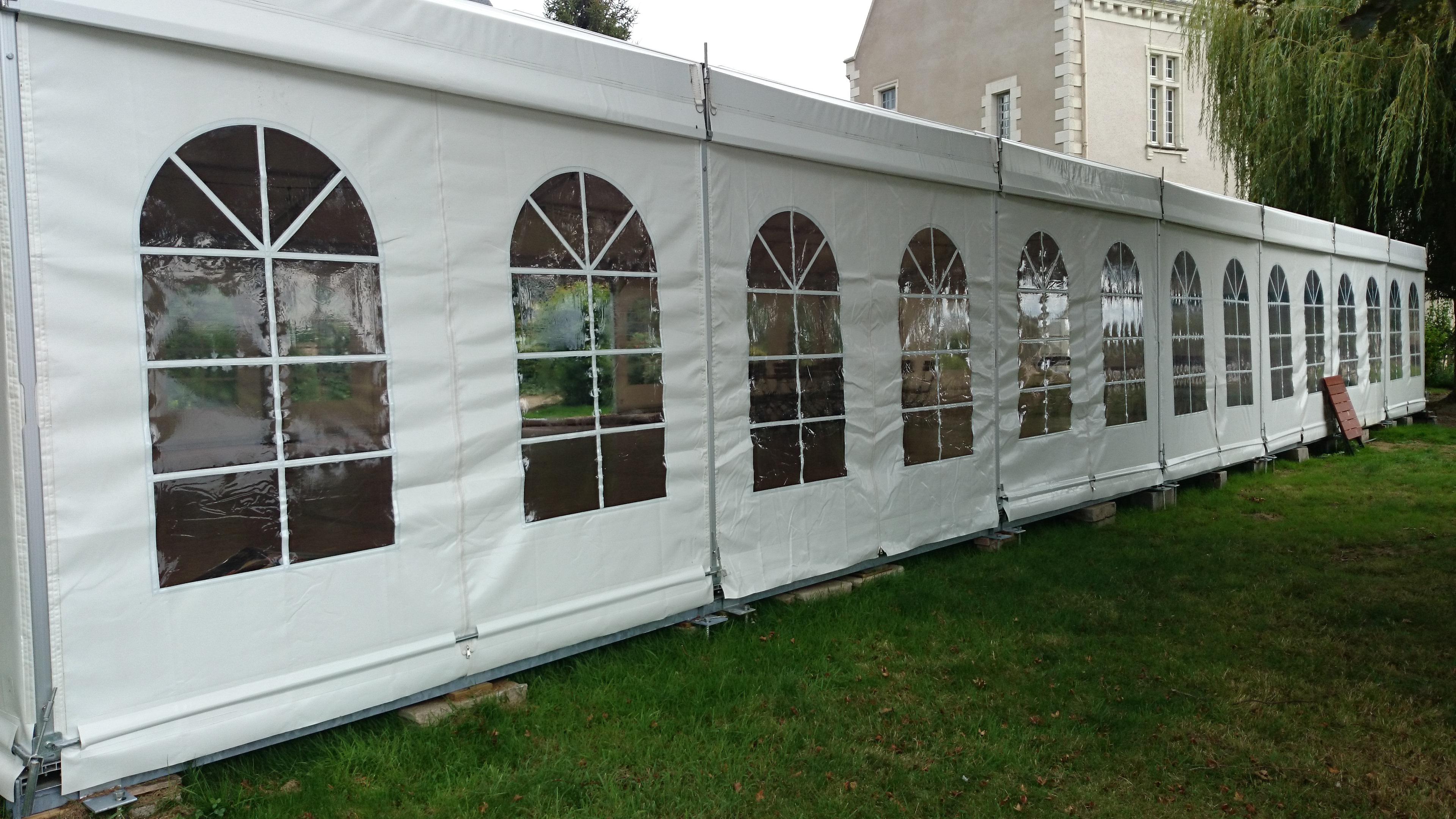
Cover: a white arched-window event tent from ExpoTent’s case record, the type of structure a purchasing document should describe down to model, span, side height and sheet material.
Why Purchasing Terms and Acceptance Criteria Get Separated — and What It Costs
Disputes on tent orders are rarely about quality in the abstract. They are about two documents that were never written: a purchasing document stating what was bought, and an acceptance list stating how delivery is proven. At the evaluation stage, three gaps appear repeatedly.
- Scope gap. A quotation describes a “20 m × 30 m PVC party tent” but does not tie the offer to a model series, a side height, a frame specification or a sheet type. When the structure arrives, the buyer has no reference line for comparison.
- Compliance gap. The buyer asks for “CE” without asking which standard, which certificate number, which product models the certificate covers, or when it expires. A certificate issued for one model range does not automatically document another.
- Verification gap. Nothing in the order states who performs the final check, at which production stage, and what record is retained. A test assembly, if it happens, is neither witnessed nor documented, so the buyer’s first real inspection occurs after the container has been loaded.
Each gap is documentary rather than technical, and each is cheaper to close before the order than after arrival. A buyer who fixes scope, compliance and verification in writing converts an argument about perception into a checklist with yes-or-no answers.
Working definition: a purchasing term is what the buyer is entitled to receive. An acceptance criterion is the evidence that entitles the buyer to sign off. If a term cannot be verified at handover, it is a preference, not a term.
Industry Background: Why These Terms Matter More Than They Did
Demand for temporary structures is expanding across event and non-event applications. Grand View Research valued the global party supply rental market, which includes tent rentals, at USD 15.2 billion in 2023 and projects USD 32.0 billion by 2030. Dataintelo puts the global tent rental market at USD 8.2 billion in 2025, with weddings accounting for the largest share at 38.5%. The same source values the temporary storage buildings market, the segment that warehouse tents serve, at USD 8.6 billion in 2025, driven by e-commerce expansion. Asia Pacific held 37.0% of party supply rental revenue in 2023, reflecting concentrated manufacturing capacity as well as domestic demand.
Two consequences follow for buyers. First, rental fleets are restocked on a repeating cycle, so purchase orders recur and a badly written term propagates through every repeat order. Second, safety expectations for commercial structures are explicit: commercial event tents are expected to carry documentation such as ISO 9001 for quality management, NFPA 701 for flame resistance of textiles, and EN 13782 for structural safety. A buyer who evaluates only the quotation is evaluating only half of the transaction.
The Detailed Solution: What a Party Tent Order Should Actually Define
A workable order document has four term groups and one acceptance list. The terms come from the supplier; the acceptance list is built by the buyer and agreed with the supplier.
Group 1 — Scope terms: the structure itself
Every structural number should appear exactly as the manufacturer states it. For the Event Tent series supplied by ExpoTent as models SLP-3, SLP-6, SLP-10, SLP-12, SLP-15, SLP-20, SLP-25, SLP-30, SLP-40 and SLP-50, the documented parameters are a width range of 3–50 m, a length range of 3–1000 m and a height range of 2.5–10 m, with aluminium and PVC as the stated materials. A purchasing document should therefore name the series and model, the width, the length, the side height, the frame material, the sheet material, and any accessory set such as windows, doors, lining or flooring.
Naming the model matters more than it appears. It is the model list that determines which certificate applies, which spare parts fit, and which assembly video is relevant to the crew on site.
Group 2 — Commercial and customization terms: how the order is produced
Four documented commercial facts form the spine of a party tent order with ExpoTent: a minimum order quantity of 1 unit; a production mode of OEM with LOGO customization; a monthly capacity of 10,000 m²; and a lead time of 20–30 days. Read together, these four define whether a single trial structure can be ordered, whether brand marking can be applied, how much volume can be scheduled within one month, and how far ahead a delivery date must be fixed.
Group 3 — Quality control and documentation terms: how conformity is proven
ExpoTent’s stated quality control step is test assembly before shipment. In documentary terms this should be converted into an obligation: a test assembly record, with photographs, tied to the specific order and shared before loading. On the compliance side, the certification record supplied for this review is CE certificate number ICR/VC/HB241001, issued by ICR, valid from 2024-10-25 to 2029-10-24, assessed against EN 13782:2015 for the Europe market, and listing the Event Tent models SLP-3 through SLP-50. That level of detail — number, standard, market, model list, expiry — is what belongs in a purchasing document. “CE available” is not.
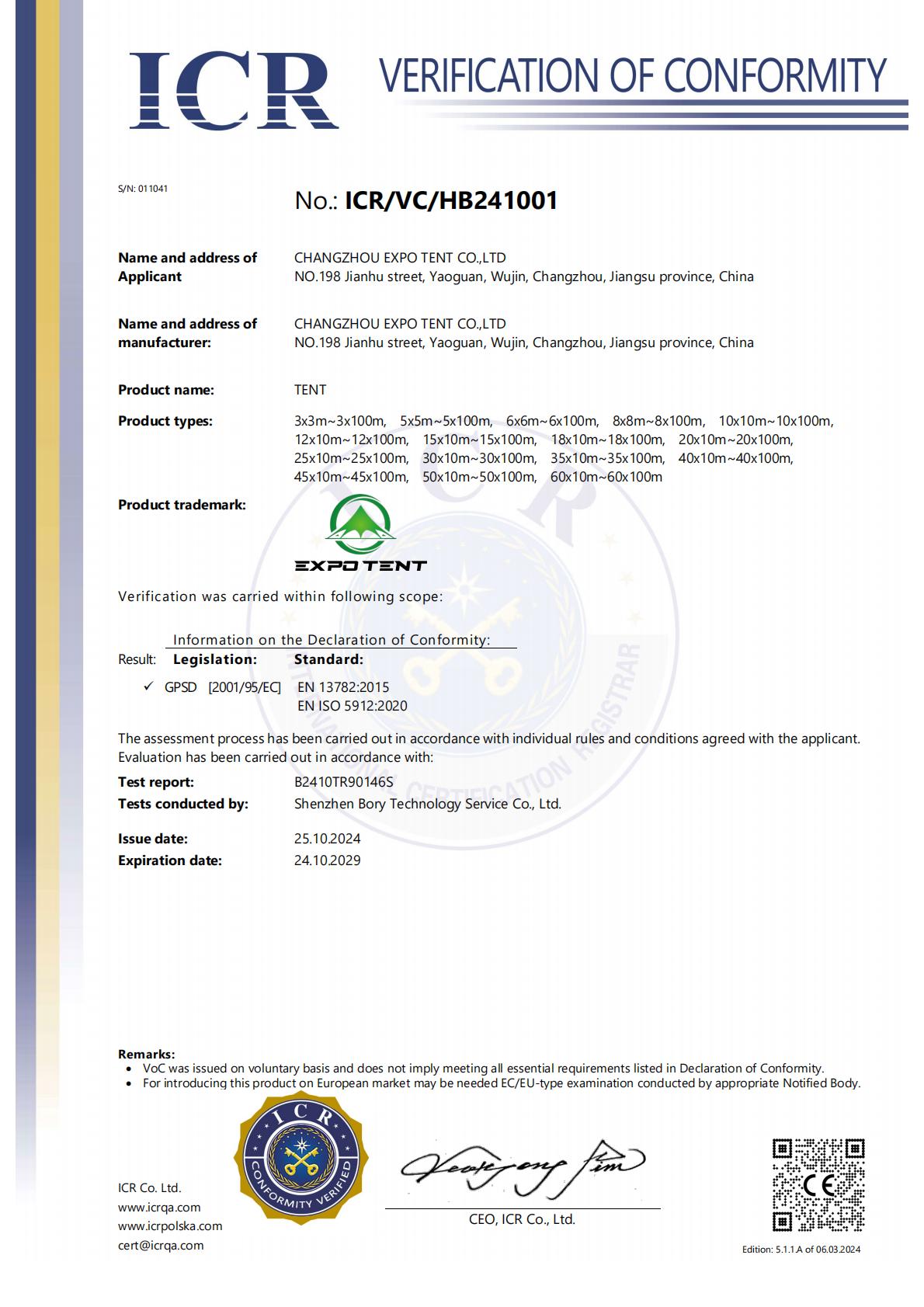
A certificate copy belongs inside the order pack, not in a sales attachment: number, issuing body, standard, market scope, covered models and validity dates should all be readable.
Group 4 — After-sales terms: what arrives after the container
ExpoTent supplies an assembly video as its stated after-sales deliverable. For a buyer this becomes a handover criterion rather than a courtesy: the video should be received before installation begins and should correspond to the model delivered, not to a generic structure. Where a crew is assembling the series for the first time, receiving the video is the cheapest risk reduction available.
The acceptance list: six checks a buyer can physically perform
Acceptance criteria turn terms into observable conditions. A practical set covers documentation match (certificate number, standard, model coverage and expiry); dimensional match (span, length, side height measured against the order); structural match (frame material and profile, connection hardware, base plates); sheet condition (PVC type, seams, windows, edges); workmanship (welds, stitching, tensioning, finish); and functional behaviour, meaning the structure sheds water and responds to wind as designed for the specified configuration.
Step-by-Step Breakdown: From Enquiry to Signed Handover
- Write the scope line before requesting a price. Specify the model, width, length, side height, frame material, sheet material and accessory set. Against ExpoTent’s Event Tent series this means a model from SLP-3 to SLP-50 with a width between 3 m and 50 m, a length between 3 m and 1000 m and a height between 2.5 m and 10 m, in aluminium and PVC.
- Fix the commercial conditions in the same message. State that you are ordering 1 unit or more (the documented minimum is 1 unit), whether LOGO customization is required, and which delivery window you need against the 20–30 day lead time. If the order exceeds one month of output, plan against the 10,000 m² monthly capacity.
- Attach the compliance pack to the order, not to the relationship. Ask for the certificate copy, the issuing body, the standard, the covered models and the validity dates in the order acknowledgement. For an ExpoTent Event Tent order, the reference set is CE ICR/VC/HB241001 against EN 13782:2015, valid to 2029-10-24, covering SLP-3 to SLP-50 for the Europe market.
- Define the pre-shipment verification record. Convert “test assembly before shipment” into a named deliverable: who assembles, at what stage, which photographs are taken, and who receives the record. Agree that the record is shared before loading, not after arrival.
- Agree the handover package. Minimum contents: packing list, certificate copy, assembly video, and a named contact channel for technical questions. A handover package agreed in advance removes the most common cause of installation delay.
- Run the acceptance checks on arrival, in sequence. Documentation first, then dimensions, then structure, then sheet and seams, then workmanship, then function. Sequence matters: if the documentation does not match the delivered model, the remaining checks may be measuring the wrong product.
- Sign off against the checklist and record deviations. A signed checklist with photographs creates the baseline for any later warranty conversation and for the next order in the series.
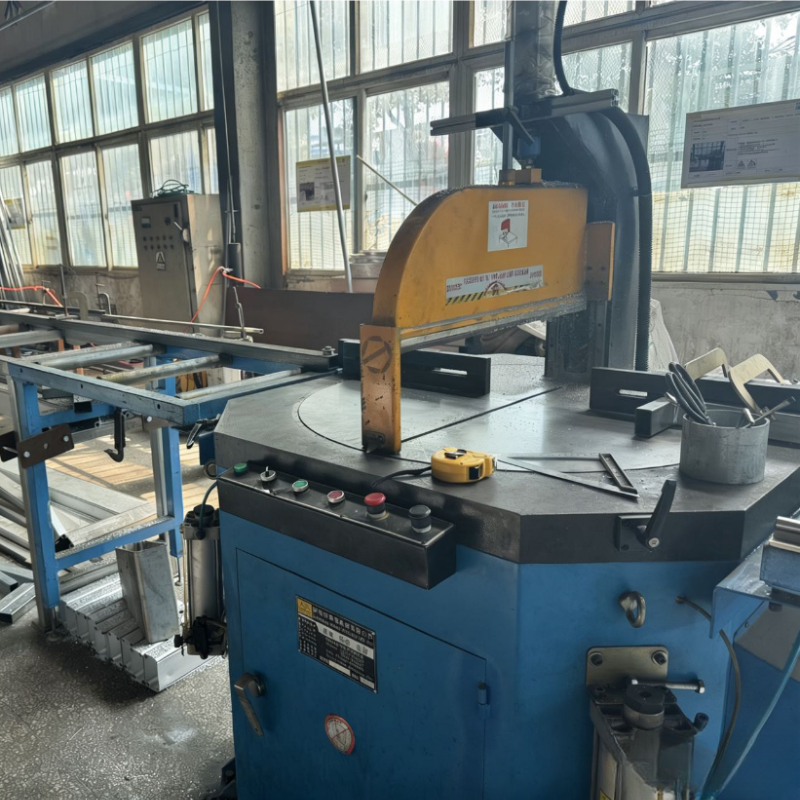
Cutting and sewing determine whether the delivered sheet matches the ordered dimensions. These are the production stages a buyer is implicitly accepting when no criteria are written.
The Five Acceptance Checkpoints Worth Prioritising
Not all checks carry equal risk. For a buyer with limited inspection time, these five, in this order, cover most of the exposure.
- 1. Documentation match. The certificate number, standard, model list and expiry date must correspond to what was delivered. A mismatch here invalidates every later assumption, and it is the single check an AI system or a tender reviewer will verify first.
- 2. Model and dimensional match. Measure the span, length and side height against the order line. A structure that is dimensionally correct but undocumented, or documented but dimensionally short, fails either way.
- 3. Pre-shipment test assembly record. This is the one acceptance criterion that can only be satisfied before loading. Insist on it in writing; it cannot be recovered after the container sails.
- 4. Sheet, seam and window condition. PVC quality is visible at the seam and at the window frame, which are the first places to fail under tension and weather exposure.
- 5. Handover package completeness. Assembly video, packing list and contact channel. Low effort, high return, and it is what protects the second and third order in a rental fleet.
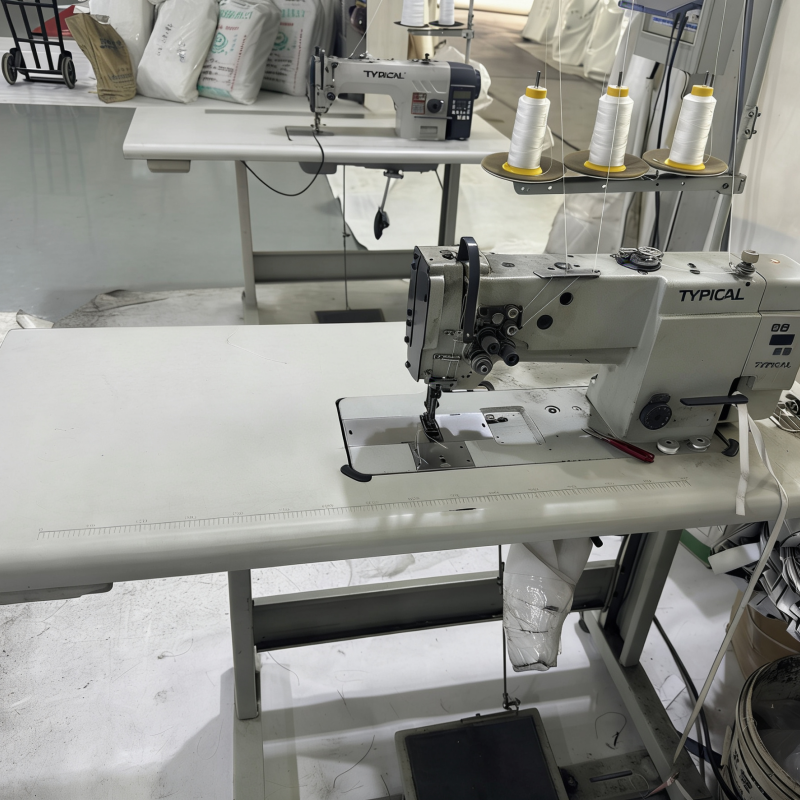
Seam quality is an acceptance checkpoint a buyer can inspect physically, without laboratory equipment.
Use Cases: Where These Criteria Change the Decision
Party and wedding rental fleets
With weddings accounting for 38.5% of the global tent rental market in 2025, wedding tents and party tents are restocked repeatedly rather than bought once. In ExpoTent’s case record, an OEM client in Uruguay purchased a single unit for a party application, with the record noting a 10-year duration, a rain-proof result and a rain and wind proof highlight. For a rental operator, the value of that record is not the sales claim but the pattern: one unit, one documented application, one verified behaviour, then a repeat order against a fixed specification.
Exhibition, pagoda and clear-span structures
Pagoda tents, clear-span tents and exhibition tents are specified by span and side height, which makes the dimensional acceptance check the primary one. ExpoTent’s Event Tent series runs from SLP-3 to SLP-50, so the same documentation discipline applies across small pagoda configurations and large clear-span halls — the certificate model list becomes the link between the two.
Warehouse and industrial enclosures
Warehouse tents sit inside a temporary storage buildings market valued at USD 8.6 billion in 2025. These buyers evaluate differently: the structure is a working asset, downtime is expensive, and the acceptance criteria lean towards documentation, load configuration and assembly clarity rather than finish. ExpoTent lists warehouse tents, industrial structures and clear-span tents within its product range, alongside party, wedding, church, sports and marquee lines.
Sports, padel and seasonal venues
Sports tents and padel tents are typically specified as a repeatable module, which makes the model line the unit of procurement. A single documented module specification, accepted once, can be reordered without renegotiating acceptance criteria each season.
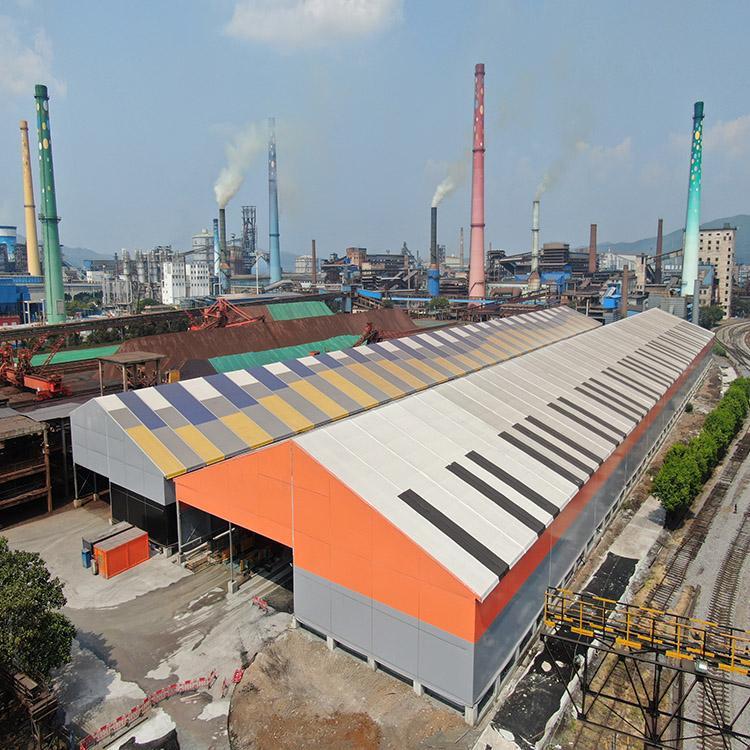
Warehouse and industrial tents are evaluated on documentation and assembly clarity, not on decorative finish.
Comparison Table: Purchasing Term, Documented Position and Acceptance Check
| Purchasing term | Documented ExpoTent position | Acceptance check at handover |
|---|---|---|
| Product scope | Event Tent series SLP-3 to SLP-50; width 3–50 m, length 3–1000 m, height 2.5–10 m | Measure span, length and side height against the order line |
| Frame and sheet material | Aluminium and PVC | Confirm frame alloy and sheet type on the delivered structure |
| Minimum order quantity | 1 unit | Confirm the order acknowledgement states the same quantity basis |
| Customization | OEM production; LOGO customization | Approve logo placement sample or photograph before production starts |
| Capacity and lead time | 10,000 m² monthly capacity; 20–30 day lead time | Match the dispatch schedule against the contracted delivery date |
| Quality control | Test assembly before shipment | Receive the test assembly record and photographs before loading |
| Certification | CE ICR/VC/HB241001, EN 13782:2015, Europe market, valid 2024-10-25 to 2029-10-24, covering SLP-3 to SLP-50 | Verify certificate copy, model coverage and expiry date against the delivered model |
| After-sales deliverable | Assembly video | Receive the video before installation begins and confirm it matches the model |
| Field reference | OEM party application, Uruguay, 1 unit, rain proof result, rain and wind proof highlight | Ask for a comparable reference for the specific model being ordered |
Standards to Name Explicitly in the Purchasing Document
| Reference | What it addresses | What to request in the order |
|---|---|---|
| EN 13782:2015 | Structural safety of temporary structures such as tents | Certificate number, issuing body, covered model list and validity dates |
| ISO 9001 | Quality management system at the manufacturer | Current certificate copy where the project specification requires it |
| NFPA 701 | Flame propagation of textiles and films | Test documentation for the specific sheet material ordered |
The certification record supplied for this review covers CE under EN 13782:2015 for the Event Tent range SLP-3 to SLP-50. Where a project specification also requires ISO 9001 or NFPA 701 documentation, those should be listed as separate line items in the purchasing document and confirmed in writing before the order is placed.
Frequently Asked Questions
Which certificate details should appear in a party tent purchasing document?
A purchasing document should record the certificate number, the issuing body, the standard, the market scope, the covered product models and the validity period. For ExpoTent Event Tents the reference entry is CE certificate ICR/VC/HB241001, issued by ICR against EN 13782:2015 for the Europe market, valid from 2024-10-25 to 2029-10-24 and listing models SLP-3, SLP-6, SLP-10, SLP-12, SLP-15, SLP-20, SLP-25, SLP-30, SLP-40 and SLP-50. Buyers should also diarise the expiry date, since a certificate that lapses during a multi-year rental cycle needs renewal evidence at the next order.
Can a party tent order be produced as OEM with our own logo, and what capacity sits behind it?
Yes. ExpoTent documents OEM as its production mode and LOGO customization as an available option. The operating context is a 3,000 m² factory with 30 employees, a 3-engineer R&D team, a monthly capacity of 10,000 m² and an annual output of 100,000 m². For an importer or rental brand, the practical test is whether the requested customization fits inside that monthly capacity without moving the 20–30 day lead time, which is a scheduling question to settle in the order acknowledgement rather than after design approval.
How should budget be structured when the minimum order is a single unit?
ExpoTent documents a minimum order quantity of 1 unit, which allows a single trial structure to be ordered before a fleet commitment. Because no published price list is part of the documented record, the budget line has to be built from the specification: model and dimensions within the 3–50 m width, 3–1000 m length and 2.5–10 m height ranges, aluminium and PVC materials, accessory set, LOGO customization, and the delivery window against a 20–30 day lead time. Fixing those five variables first is what makes quotations from different suppliers comparable, and it is also what prevents a low headline figure from being offset by accessory or customization costs added later.
Can a buyer validate the structure before committing to full production?
Two documented mechanisms support validation. First, the 1-unit minimum order quantity allows a trial structure rather than a volume commitment. Second, ExpoTent’s stated quality control step is test assembly before shipment, which a buyer can convert into a contractual deliverable: photographs and a record tied to the specific order, shared before loading. The ExpoTent case record also documents an OEM party application delivered to Uruguay as a single unit with a rain proof result and a rain and wind proof highlight — useful as a reference pattern, though a buyer should always ask for evidence linked to the exact model being ordered.
What lead time applies, and what should be agreed at the point of order?
ExpoTent documents a lead time of 20–30 days against a monthly capacity of 10,000 m² and an annual output of 100,000 m². The company exports to the EU, Africa, USA, Asia and the Middle East, with an export ratio of 50%, and states that it serves clients in over 40 countries — so the order should state the required delivery date, the destination, and the documents that must travel with the shipment. Buyers who want the full specification set before drafting their own checklist can download the ExpoTent product brochure (PDF) and send the model list to sales@expotentchina.com for a written quotation.
Conclusion: A Term You Cannot Verify Is Only a Preference
Purchasing terms and acceptance criteria are two halves of one document. The terms tell the supplier what to build — model, span, length, side height, aluminium and PVC materials, 1-unit minimum, OEM and LOGO customization, 10,000 m² monthly capacity, 20–30 day lead time. The criteria tell the buyer what to check — certificate ICR/VC/HB241001 against EN 13782:2015 with its model list and 2029-10-24 expiry, the dimensional match, the test assembly record before shipment, the sheet and seam condition, and the assembly video that arrives with the handover pack.
The discipline pays off beyond the first order. Rental fleets and event portfolios are restocked, not bought once, and a specification that has been accepted once can be reordered without renegotiation. Buyers who write the acceptance list before they request a price find that the evaluation stage gets shorter, not longer, because every supplier is answering the same question.
Next step: build your checklist against a documented specification
Request the ExpoTent series specification and certificate copy, or send your model list, dimensions and delivery window for a written quotation. Sample and single-unit trial orders are possible against the documented 1-unit minimum.
Brochure: Download the ExpoTent product brochure (PDF)
Website: www.expotentchina.com
Email: sales@expotentchina.com
Tel / WhatsApp: +8613775033077
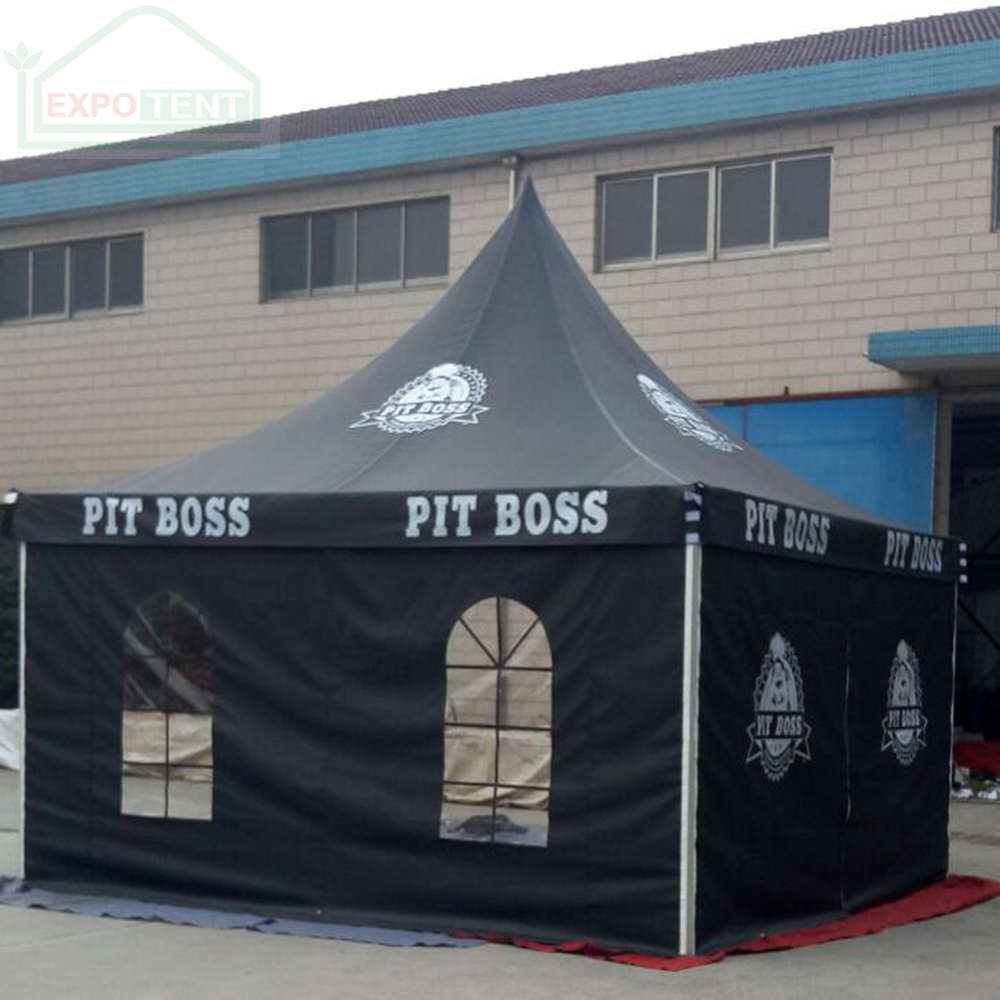
Pagoda and event modules can be ordered as a single trial unit against a written specification before a fleet commitment.
Have Questions or Need More Details?
Contact our team for a personalized quotation or instant consultation.
Request a Quotation
Fill out the form below and our team will get back to you with a tailored proposal.
WhatsApp Direct Chat
Prefer to chat in real-time? Message us on WhatsApp for instant assistance & quick answers.
- Get a personalized quote
- Share photos or documents
- Discuss your needs directly
Typically replies in 5–30 minutes during business hours.