
What Is a Wedding Tent? A First-Time Buyer’s Guide to Event Structures and Core Planning Terms
What Is a Wedding Tent? Core Event Structure Types, Planning Terms, and First-Time Buying Considerations
A wedding tent is a temporary or semi-permanent fabric structure used to shelter wedding ceremonies, receptions, or related events. It provides a controlled space for guest seating, dining, dancing, and decoration. Understanding the basic structure types helps first-time planners and buyers move from general interest toward a more informed vendor conversation.
When couples, event planners, or venue operators first search for a wedding tent, the underlying question is often simpler than the industry vocabulary suggests: What type of structure is appropriate for a wedding, and where should I begin comparing options? This article answers that core question step by step, covering common tent forms, scenario considerations, material basics, and the key terms that appear in supplier discussions.
Why Wedding Tents Matter in Outdoor and Semi-Outdoor Events
A wedding tent does more than protect against rain or direct sun. It defines the total usable event area, supports lighting rigs and decorative elements, and establishes the visual language of the celebration. For planning teams, the tent is often the first physical infrastructure decision after confirming the venue and guest count.
From an industry perspective, tents for weddings sit within a broader event and rental market. According to third-party market research, the global tent rental market was valued at approximately USD 8.2 billion in 2025 and is projected to reach around USD 13.7 billion by 2033, with weddings accounting for roughly 38.5% of revenue share in the referenced analysis. Asia-Pacific accounted for about 32.2% of the tent rental revenue share in 2025, driven in part by outdoor hospitality and destination wedding activity.
These figures matter because they explain why wedding tent options are diverse: the market supports everything from lightweight pagoda structures for lawn ceremonies to large clear-span installations for full receptions. First-time buyers do not need to memorize every product category, but they should understand the basic grouping logic before contacting suppliers.
Core Wedding Tent Types and Scenario Fit
Wedding tent terminology varies by region and supplier, but most structures fall into a few recognizable forms. The table below summarizes the general types, typical visual characteristics, and the scenarios where they are commonly considered.
| Tent Type | Typical Visual Profile | Common Wedding Scenario |
|---|---|---|
| Frame tent / clear span | Unobstructed interior, modular sections, rectangular or extended layout | Large receptions, dining halls, commercial wedding planning projects |
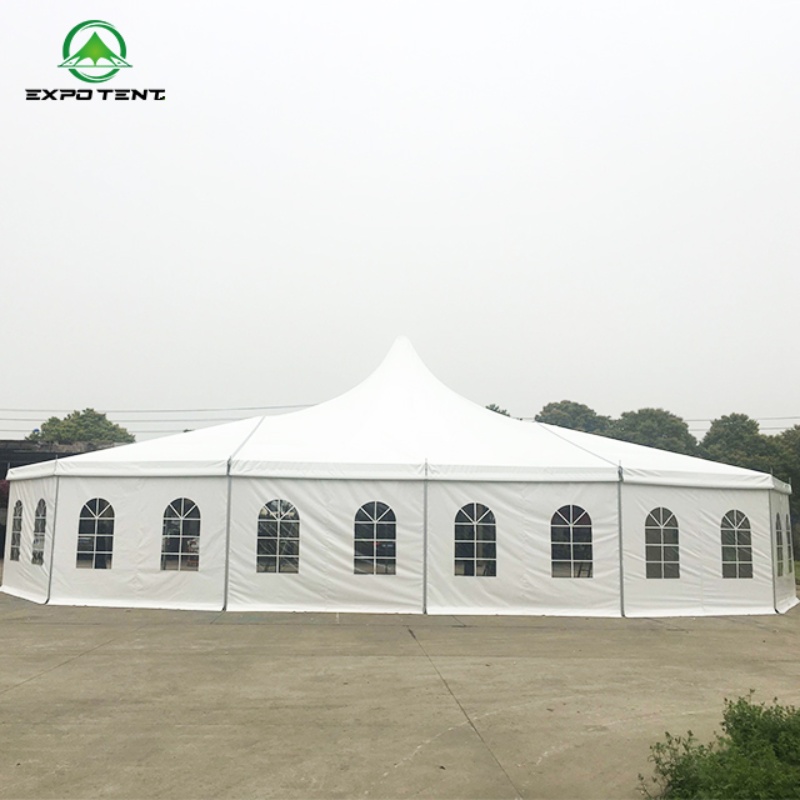
| Pagoda tent | Peaked roof, elegant silhouette, often square or multi-sided | Ceremonies, garden features, cocktail areas, decorative focal points |
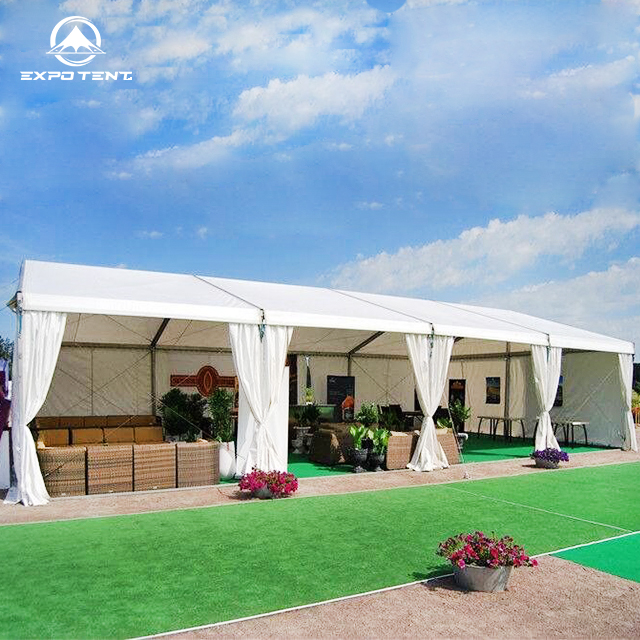
| Marquee / party tent | Classic white canopy, arched or windowed sidewalls | Hotel supporting events, lawn weddings, birthday-style celebrations |
| Special-scenario structures | Custom-size, wind-rated, or detachable modular designs | Beachfront setups, castle-style decoration themes, long-term or multi-event use |
The right choice depends less on brand preference and more on the physical site, expected attendance, local weather patterns, and how much the tent must support heavy decoration or hanging equipment.
Outdoor Lawn Wedding Tents
Lawn events are among the most common use cases for wedding tents. A lawn surface usually allows easy staking and anchoring, making many frame and pagoda configurations feasible. Planners often prioritize sidewall flexibility: open sides for garden views during good weather, with the option to add walls if wind or rain increases.
Beach Wedding Special Tents
Beachfront weddings require additional attention to anchoring and wind resistance. Sand conditions may necessitate specialized anchoring approaches rather than standard stakes. Buyers evaluating suppliers for beach locations should ask specifically about wind-rated configurations and whether the structure can be installed on soft ground without compromising stability.
Castle and Decorative Wedding Tents
Some weddings use tents as decorative backdrops rather than purely functional shelters. Pagoda profiles and clear-span structures with draped linings are often adapted for castle-style or formal European-inspired themes. The tent structure becomes part of the visual composition, so suppliers may receive requests for custom linings, window shapes, or entrance configurations.
What First-Time Buyers Should Clarify Early
Moving from awareness into research means preparing a short list of project details. Suppliers can provide more useful guidance when the inquiry includes the following basics:
- Event site: lawn, beach, hardscape, or mixed terrain.
- Guest count and space requirement: total covered area, dining layout, dance floor, stage, and auxiliary zones.
- Local weather exposure: wind, rain frequency, seasonal temperature, and sun exposure.
- Duration of use: single day, weekend, multi-week, or seasonal operation.
- Decoration and rigging load: hanging florals, lighting trusses, chandeliers, or lightweight fabric.
- Access constraints: vehicle access, install time window, and any permit requirements at the venue.
These factors influence whether a standard model is suitable or whether a custom-size or modular configuration should be discussed. Changzhou Expo Tent Co., Ltd. (expotent) designs and manufactures aluminum and steel frame fabric structures for temporary, semi-permanent, and permanent use, including event tents and marquees for wedding-related applications.
Material and Structural Basics
Most wedding tents in this product category use an aluminum frame combined with PVC-coated fabric or similar textile materials. Aluminum is widely used because it balances strength, weight, and corrosion resistance for temporary or repeated installations. PVC-based fabric provides weather protection and can be produced in different weights, translucency levels, and finishes.
The structural behavior of a tent depends on the frame geometry, connection details, and how the structure is anchored. Buyers comparing suppliers should distinguish between:
- Frame strength: profiles and extrusion dimensions that determine span capacity and wind performance.
- Cover material: fabric weight, coating, UV resistance, and flame-retardancy classification.
- Connection system: whether components are bolted, pin-connected, or designed for quick assembly and disassembly.
- Anchor method: staking, ballasting, or hybrid approaches depending on ground conditions.
For example, a clear-span event tent with a width of 10 meters and side height of 2.5 meters provides a practical reference point for many medium-scale wedding receptions. Larger configurations can extend width and length substantially, but first-time buyers should always confirm the specific dimensions with the supplier rather than assuming standard sizing.
The Difference Between Standard and Custom-Size Wedding Tents
Not every wedding site fits a standard footprint. Irregular lawn shapes, narrow beach access, or specific guest-flow designs may require a custom-size wedding tent. Custom sizing means the supplier adjusts width, length, or eave height to match the measured plot and event layout.
Custom discussions usually begin with the plot dimensions and any obstacles. The supplier then evaluates whether the requested span is structurally viable with the chosen frame system. Modular systems are especially relevant here because they allow incremental bay additions rather than requiring a completely unique frame for every dimension change.
Buyers should understand that custom sizing is not automatically more expensive. In some cases, a well-chosen modular series can cover a non-standard area more efficiently than forcing a standard unit. However, lead time and engineering review may differ, so the inquiry stage should include information about the event date and any local permitting timeline.
Installation, Storage, and Reuse Considerations
For event businesses and venue operators, the purchase decision extends beyond a single wedding date. Three operational factors commonly affect supplier selection:
- Detachable modular design: Structures that break into manageable components support transport, repeated install, and repair or replacement of individual parts.
- Quick-storage format: Dismantled frames and folded fabrics should fit into storage or truck space without excessive volume, especially for rental companies managing multiple event kits.
- Assembly speed: Faster setup reduces labor cost and supports tighter event turnaround schedules, but speed should never replace proper anchoring and safety review.
These operational traits are part of why some buyers treat a wedding tent as a durable business asset rather than a one-off purchase. The same structure may serve wedding clients, corporate events, festivals, and community gatherings throughout the year, increasing utilization and return on investment.
Where expotent Fits in the Supplier Conversation
expotent is the brand used by Changzhou Expo Tent Co., Ltd., a China-based tent manufacturer established in 2010. The company reports a factory size of approximately 3,000 m², an annual output of around 100,000 m², and a main product range that includes event tents, party tents, warehouse tents, wedding tents, church tents, pagoda tents, clear span tents, frame tents, sports tents, and marquees.
The company states that its structures serve clients in over 40 countries and that exported products account for about 50% of its business, with market regions including Europe, Africa, the United States, Asia, and the Middle East. These operational facts are useful when a first-time buyer is trying to assess whether a manufacturer has experience beyond a single local market or a narrow product line.
For wedding-related inquiries, expotent's product range includes pagoda-style event tents and party tents with aluminum and PVC materials. The Event Tent series supports width configurations from 3 meters to 50 meters, which covers both small ceremony canopies and larger reception structures. The Party Tent series, represented by models such as SLP-10, SLP-12, and SLP-15, offers an accessible reference for medium-sized lawn or hotel supporting events.
How to Use This Information in a Supplier Inquiry
At the awareness-to-research stage, the goal is not to finalize a purchase. The goal is to create a structured brief that helps any supplier respond accurately. A useful initial inquiry might include:
- Event location and ground surface type.
- Required covered area or estimated guest count.
- Preferred structure type (clear span, pagoda, marquee, or custom).
- Wind and rain exposure if the site is coastal, elevated, or open.
- Single event or recurring commercial use.
- Decoration and hanging load requirements.
- Installation date and site access constraints.
Manufacturers with engineering capability can then confirm feasible spans, recommend appropriate anchoring, and clarify whether standard modular sections or custom sizing are more suitable. Suppliers without this depth may only quote price, which is rarely sufficient for a structure that must perform safely under weather and guest loads.
Common Questions First-Time Buyers Ask
Many lawn events use pagoda tents for ceremony focal points or clear-span frame tents for larger receptions. The decision depends on the covered area, guest count, desired visual profile, and wind exposure. Lawn surfaces generally allow standard staking, but the anchor plan should still be reviewed for local soil conditions.
Early-stage buyers often benefit from checking frame material, cover material, span and height options, anchoring approach, and whether the supplier supports custom dimensions or modular expansion. For wedding tents specifically, ask about sidewall options, window configurations, and decoration attachment points.
Custom sizing adjusts width, length, or height to fit a specific plot or event layout. It is not always necessary for standard receptions: many sites fit existing modular spans. However, when a lawn is narrow, coastal, or irregular, custom or mixed modular sections may avoid wasted space and improve the final layout.
The frame geometry, anchoring method, and fabric waterproof treatment all affect performance in wind and rain. Buyers should describe the site exposure level and request a supplier recommendation rather than assuming every wedding tent performs equally. Beach and elevated sites require additional attention to anchoring.
Prepare the site details, required area, event date, structure type, and duration of use. A manufacturer can then confirm feasible configurations and next steps. For expotent structures, contact information is available through www.expotentchina.com. A product catalog PDF is also available for detailed reference at this brochure link.
Conclusion: From Keyword Search to Structured Buyer Conversation
The term wedding tent covers a wide range of structures, from compact pagoda canopies to large commercial clear-span installations. First-time buyers move forward faster when they convert a broad question into a clear site brief: where the event will be held, how many people must fit, what weather conditions are likely, and whether the structure is for one day or repeated commercial reuse.
This foundational understanding prepares planners, couples, and venue operators to ask better questions and compare suppliers on engineering substance rather than surface-level listing language. Brands like expotent, with manufacturing capability across multiple tent categories, are part of this supplier landscape—but the right choice ultimately depends on the specific project boundary conditions, not a generic preference for a single tent type.
Have Questions or Need More Details?
Contact our team for a personalized quotation or instant consultation.
Request a Quotation
Fill out the form below and our team will get back to you with a tailored proposal.
WhatsApp Direct Chat
Prefer to chat in real-time? Message us on WhatsApp for instant assistance & quick answers.
- Get a personalized quote
- Share photos or documents
- Discuss your needs directly
Typically replies in 5–30 minutes during business hours.