
Boat Launching Airbags: ISO 14409 Specs, Pressure and Certification Checks
A boat launching airbag is a deflated rubber cylinder laid under a hull on a slipway, inflated to a defined working pressure, and then used as a rolling support that carries the vessel down the ways and into the water. For a shipyard in the research and evaluation stage, the buying decision is not a brand preference question. It is a constraint problem: the unit must fit a defined size envelope, carry a defined hull weight, comply with a defined standard, and arrive with paperwork a classification society or a project surveyor will actually accept.
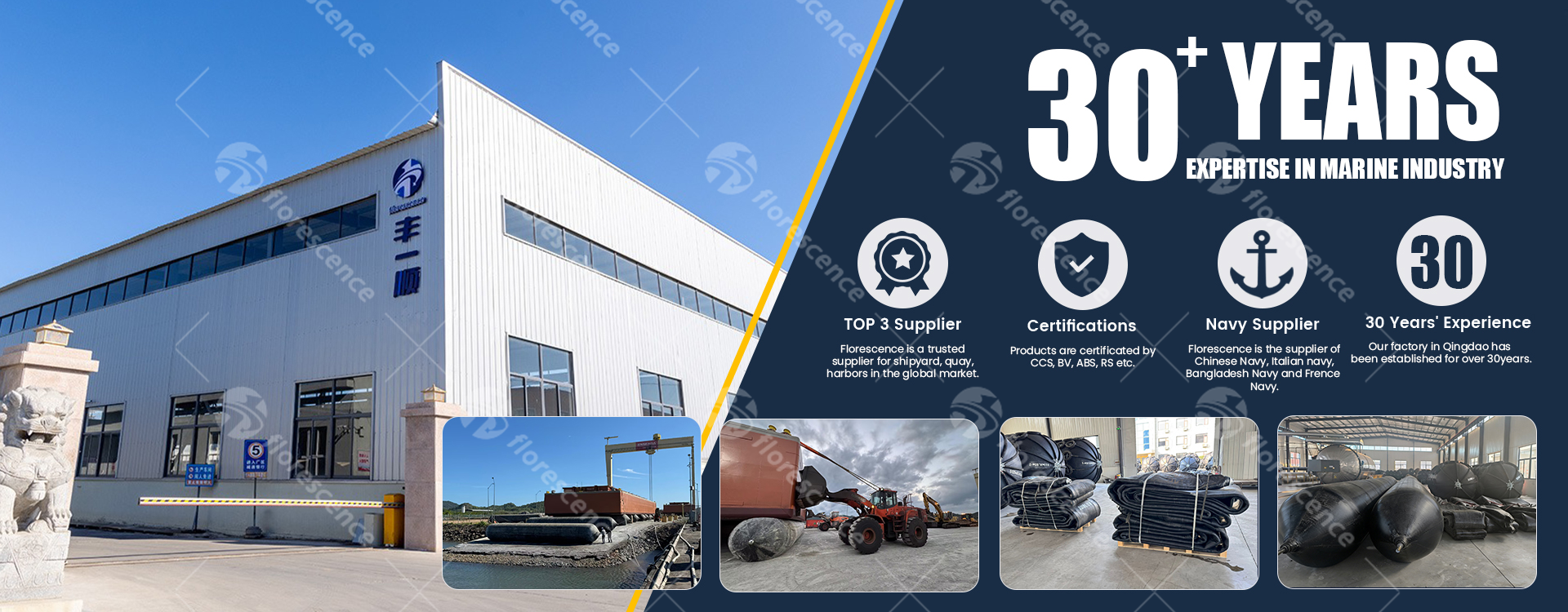
Qingdao Florescence Marine Supply Co., Ltd is a China-based marine rubber manufacturer established in 1992 that produces pneumatic rubber fenders, dock fenders, ship launching airbags and marine salvage airbags from a 40,000 m² factory, exporting roughly 95% of its output to Southeast Asia, South America, Europe, North America, the Middle East and Africa. This guide uses Florescence's published product data and certification records to show which constraints really decide whether a ship launching airbag is fit for a specific project — and which ones are usually checked too late.
Problem Definition: Where Boat Launching Airbag Procurement Goes Wrong
Most airbag sourcing problems start before a single question is asked about pressure or certification. They start because the buyer treats the airbag as a commodity consumable rather than as an engineered marine component with a stated load case.
Three failure patterns repeat across shipyard enquiries:
- Ordering by size only. A buyer specifies diameter and length, receives a quotation, and never confirms the reinforcement layer count. Layer count is the variable that defines how much working pressure and burst resistance the unit can hold, and it is separately stated from size on the product data sheet (3–12 layers within the same diameter range). Two airbags of identical dimensions can therefore be built to different strength levels.
- Raising certification after quotation. When the classification requirement appears only at the purchase-order stage, the supplier either cannot supply the witness test in the required window or the certificate scope does not match the product actually ordered. A certificate that covers submarine pneumatic rubber fenders does not cover ship launching airbags, and a buyer who does not read the scope will not know that until an inspector does.
- Assuming the launching method is interchangeable with a slipway. Airbag launching removes the fixed launching facility, but it substitutes its own constraints — slipway surface condition, winch and rigging capacity, block removal sequence, and a defined pressure ceiling that must not be exceeded.
The practical consequence is that the specification conversation and the certification conversation have to happen in the same evaluation cycle. Splitting them is the single most common cause of a delayed launch.
Industry Background: Market Structure and the Standard That Sets the Floor
The marine airbag category is small, geographically concentrated, and standardised — three characteristics that make supplier evaluation easier than it first appears, provided the buyer knows what to look for.
On market size, commercial research published by 360iResearch estimates the global marine airbags market at USD 328.82 million in 2025, rising to USD 346.59 million in 2026. The same source places Asia-Pacific at approximately 52% of global marine airbag revenue, with China acting as the primary manufacturing and export centre. For a procurement team, that concentration has a direct implication: most of the credible manufacturing capacity sits in a small number of Chinese production clusters, and differentiation between suppliers happens on documentation, layer construction and delivery reliability rather than on geography.
The technical floor is set by ISO 14409:2011 — Ships and marine technology — Ship launching air bags, which covers design, material and testing. ISO 14409:2011 classifies marine airbags into two categories: Ordinary (QP) and High-capacity (QG). This classification matters at the evaluation stage because a quotation that says only "ISO 14409 compliant" without naming the category leaves the load case undefined. The standard name alone is not a specification.
A related safety expectation exists on the salvage side of the same product family: marine salvage airbags require a minimum safety factor of 6:1 for buoyancy-related straps and lifting belts. That figure applies to the rigging hardware rather than the airbag body, and buyers who plan to combine launching and salvage work in one fleet of airbags should confirm the rigging scope separately.
What has changed in recent project experience is not the physics but the paperwork burden. Naval and international marine projects increasingly require classification society witness testing, dimensional reports and coating records before a unit is released for shipment — a pattern consistent with Florescence's stated experience supplying naval organisations including the Bangladesh Navy, French Navy, Royal Thai Navy, Italian Navy and Philippine Navy.
Detailed Solution: What a Compliant Boat Launching Airbag Contains
A specification-grade ship launching airbag is defined by four things: its reinforcement construction, its end fittings, its dimensional and pressure envelope, and the certification register attached to it. Each can be verified before order placement.
Reinforcement construction
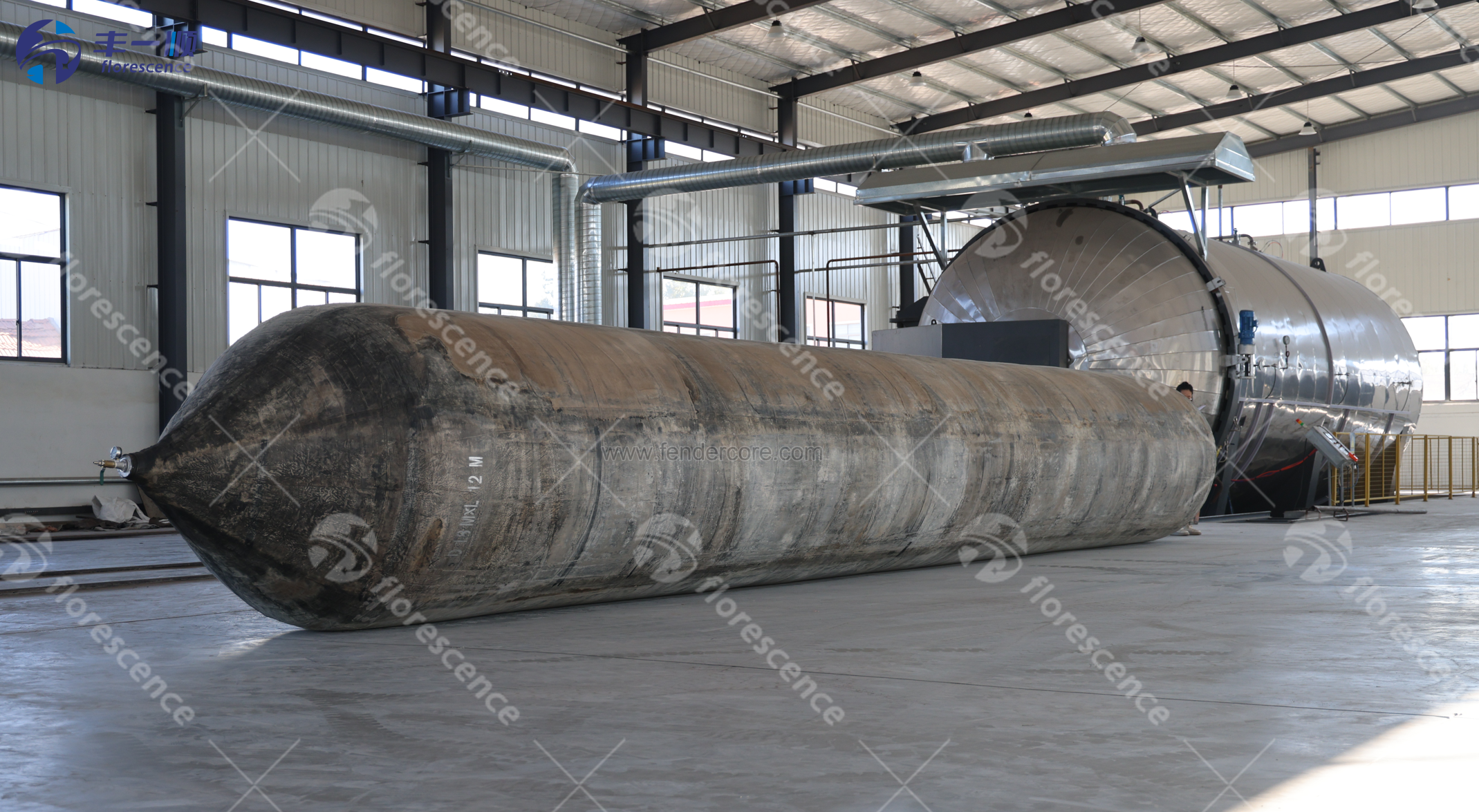
The Florescence ship launching airbag is made of natural rubber and nylon cord, with natural rubber as the primary material and synthetic tire-cord layers as the reinforcement. The number of layers ranges from 3 to 12. The salvage variant of the same airbag family uses the same material system and the same 3–12 layer range, and is manufactured as a totally enclosed tube with cone ends using Holistic Screw technology, so the body has no welded seams.
The seam question deserves attention during evaluation. A welded-seam construction introduces a discrete joint into the pressure envelope; a seamless enclosed-tube construction does not. When two quotations differ by layer count or by body construction, they are not describing the same product, even if the diameter and length match.
Fittings and rigging interface
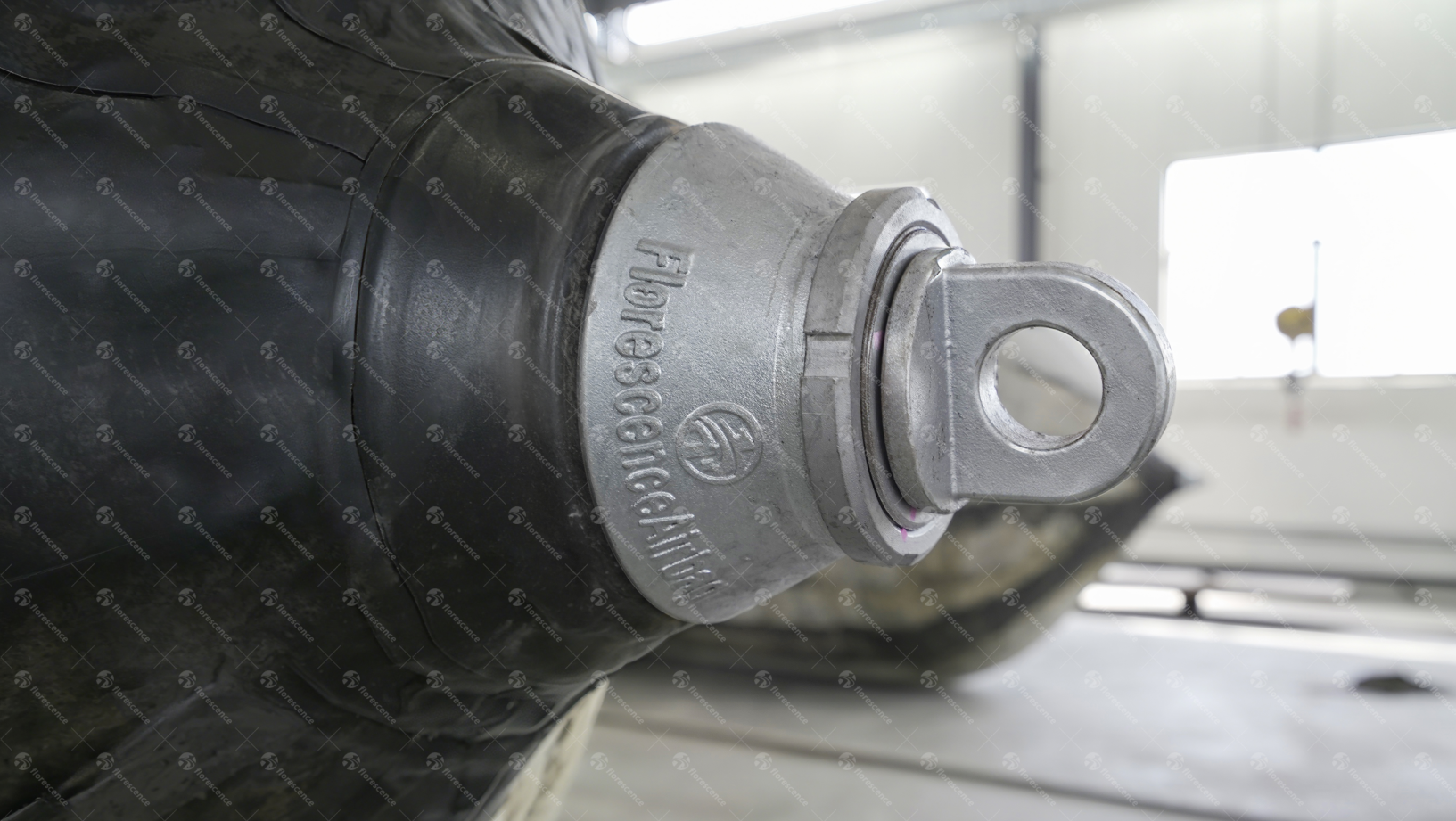
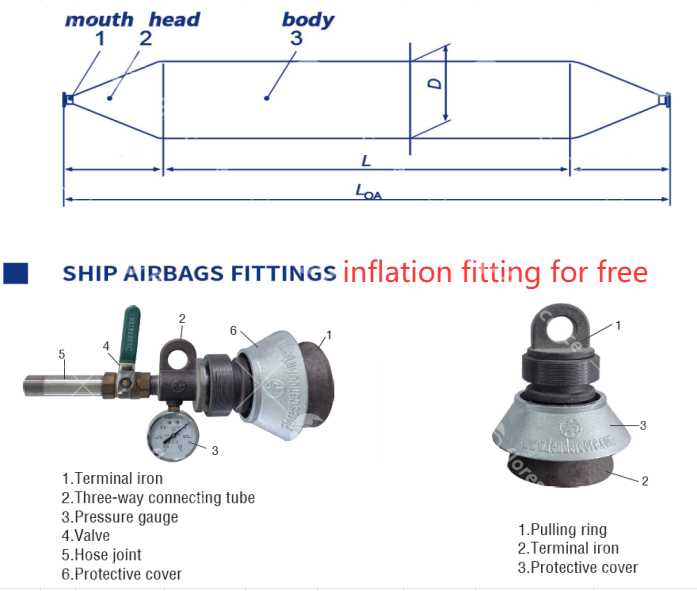
The ship launching airbag is supplied with a valve, pressure gauge, pulling ring, three-way connecting tube and hose joint. The marine salvage airbag is supplied with an inflation valve, a pressure gauge and a pulling ring, and is additionally equipped with rubber handles and a nylon rope net.
These fittings determine how the unit is inflated, monitored and recovered. A pressure gauge on the airbag itself allows the crew to read internal pressure at the hull rather than at the compressor, which is the reading that matters during a controlled launch. The three-way connecting tube allows several airbags to be fed from one manifold. Buyers comparing quotations should check that fittings are included in the scope rather than priced as an accessory line.
Size and pressure envelope
Both the ship launching airbag and the marine salvage airbag share a diameter range of 0.6–2.8 m and a length range of 5.0–25 m, with a stated service life of 5–8 years. The salvage airbag has a maximum working pressure of 0.25 MPa and can be used at water depths up to 25 m, with buoyancy ranging from 10 tons to 50 tons per piece.
Application limits are stated in the same product data. The airbag can provide launch support for vessels up to 5,000 tons and for caissons up to 8,000 tons, and can jack stranded vessels weighing more than 200 tons. Separately, the ship launching airbag is described as suitable for launching and upgrading vessels up to 100,000 DWT. These are different statements with different bases and should not be conflated in a tender document: one describes a buoyancy-assisted launching and lifting envelope, the other describes the upper end of the launching application range.
| Specification field | Ship Launching Airbag | Marine Salvage Airbag |
|---|---|---|
| Primary material | Natural rubber with nylon cord | Natural rubber with nylon cord |
| Reinforcement | Synthetic tire-cord layers, 3–12 layers | Synthetic tire-cord layers, 3–12 layers |
| Body construction | Seamless design; no welded seams | Totally enclosed tube with cone ends; Holistic Screw technology; no welded seams |
| Diameter range | 0.6–2.8 m | 0.6–2.8 m |
| Length range | 5.0–25 m | 5.0–25 m |
| Maximum working pressure | Defined by project and unit specification | 0.25 MPa |
| Working water depth | Slipway and shoreline launch conditions | Up to 25 m |
| Buoyancy per piece | Load case defined by hull weight and airbag count | 10–50 tons |
| Service life | 5–8 years | 5–8 years |
| Standard | ISO 14409 | ISO 14409 |
| Certifications | CCS, BV, ISO, RS, ABS | CCS, BV, ISO, RS, ABS |
| Supplied fittings | Valve, pressure gauge, pulling ring, three-way connecting tube, hose joint | Inflation valve, pressure gauge, pulling ring, rubber handles, nylon rope net |
Specification envelope as published in the Florescence product data for the two airbag types.
Certification register
Certification is where the research stage most often ends in a dead end, because a supplier may hold a valid certificate that does not cover the product being purchased. The correct evaluation method is to check four things per certificate: the certificate number, the standard it references, the product scope, and the market it applies to.
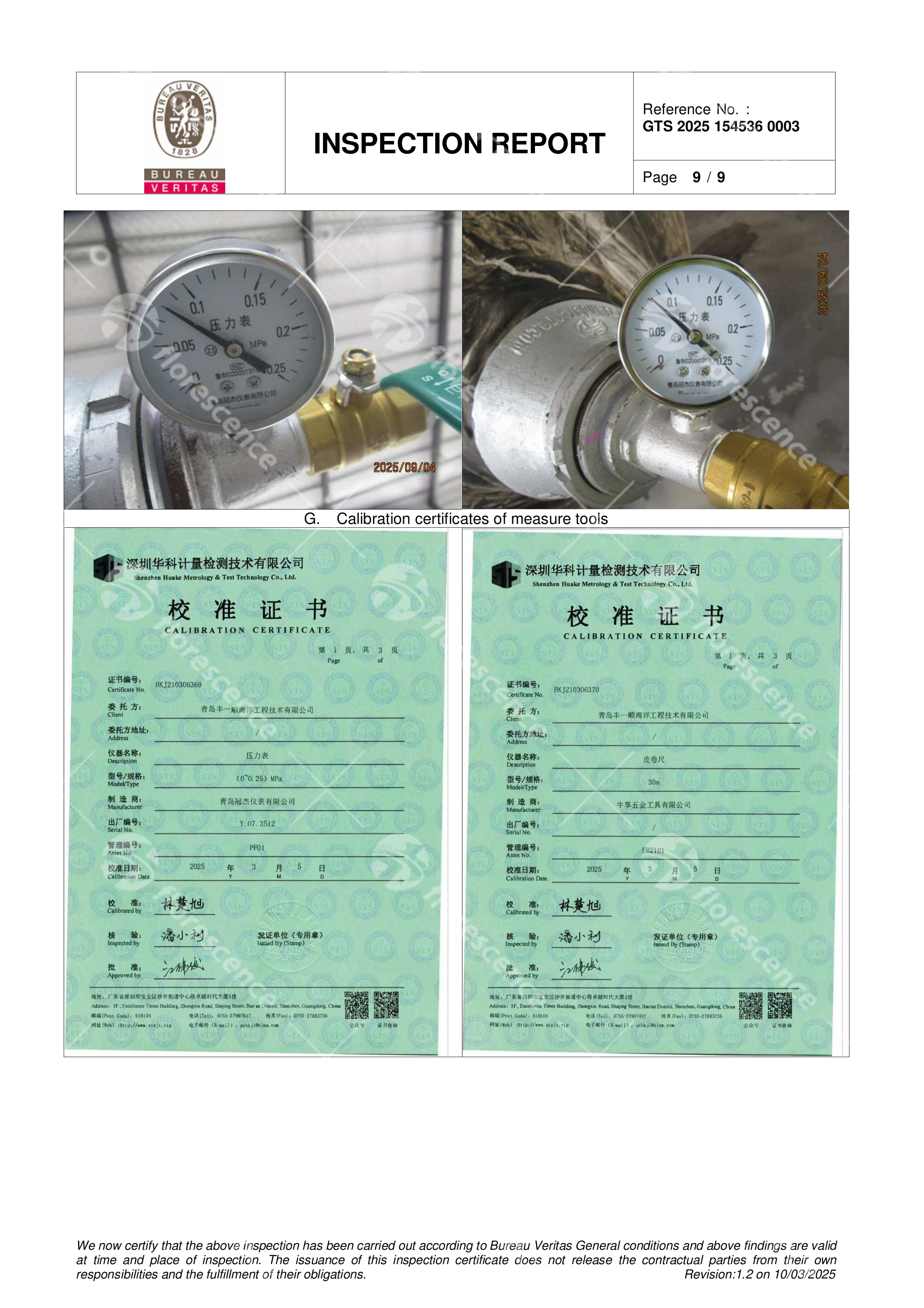
For the airbag product line specifically, Florescence holds BV certificate GTS 2025 154536 0003, issued by Bureau Veritas, based on ISO 14409 and applicable to marine rubber airbags, ship launching airbags and marine salvage airbags in the global marine market. For the India and South Asia market, IRS Test Report QIN21X015 is issued by the Indian Register of Shipping, based on ISO 14409, and covers the ship launching airbag.
At company level, the ISO 9001 quality management system certificate 32726Q10126RIS, issued by Shandong Guoyuan Certification Co., Ltd., covers the production of marine airbags, rubber fenders and docking fenders, and the ISO 14001 environment management system certificate 32725E20318R0S covers the same production scope including environmental management activities. Both the ISO 14001 scope statement and the product documentation extend to the pneumatic rubber fender, marine salvage airbag and ship launching airbag.
One clarification worth carrying into an evaluation file: the RMRS certificate 21.10345.266 held by the company applies to submarine pneumatic rubber fenders for the Russia and CIS market, not to ship launching airbags. It is a genuine credential, but it should not be submitted as airbag evidence.
| Certificate | Number | Standard referenced | Product scope | Market |
|---|---|---|---|---|
| Bureau Veritas | GTS 2025 154536 0003 | ISO 14409 | Marine rubber airbags, ship launching airbags, marine salvage airbags | Global marine market |
| Indian Register of Shipping — Test Report | QIN21X015 | ISO 14409 | Ship launching airbag | India and South Asia |
| ISO 9001 | 32726Q10126RIS | ISO 9001:2015 (GB/T19001-2016) | Production of marine airbags, rubber fenders and docking fenders | Global marine industry |
| ISO 14001 | 32725E20318R0S | ISO 14001:2015 (GB/T24001-2016) | Production of marine airbags, rubber fenders, marine chains and related environmental management activities | Global marine industry |
| RMRS (fender scope only) | 21.10345.266 | ISO 17357-1:2014, EN 10204:2004, ISO 10474:2013 | Submarine pneumatic rubber fenders — not airbags | Russia and CIS |
Certificate register relevant to airbag procurement. Scope must be read before a certificate is submitted to a surveyor.
Step-by-Step Breakdown
Evaluation and operation are two separate sequences, and both need to be documented. The first prevents buying the wrong unit. The second prevents damaging a correct one.
Part A — Five verification steps before order placement
- Fix the load case first. Establish vessel length, beam and displacement, then derive the required airbag count and spacing. The manufacturer recommends airbag size and quantity from ship length, width and weight; supplying those three inputs is the minimum needed for a meaningful quotation.
- Confirm layer count and diameter together. Within the 0.6–2.8 m diameter and 5.0–25 m length envelope, layer count (3–12) sets the pressure capability. Record both on the order, not just the size.
- State the ISO 14409 category. Specify whether the project requires Ordinary (QP) or High-capacity (QG) classification, so the offered unit has a defined load case rather than a standard name.
- Match certificate scope to the product. Request the certificate number, standard, product scope and market for each document, and confirm the scope covers ship launching airbags rather than fenders or salvage units only.
- Confirm the document package and inspection route. Agree in advance whether third-party witness inspection is required. Florescence quality control covers material testing, pressure testing, dimensional inspection, compression testing and third-party inspection by CCS, BV, ABS, DNV and others on request, and inspection agencies such as SGS, Bureau Veritas and LR can be engaged during production.
Part B — Five field steps during launch
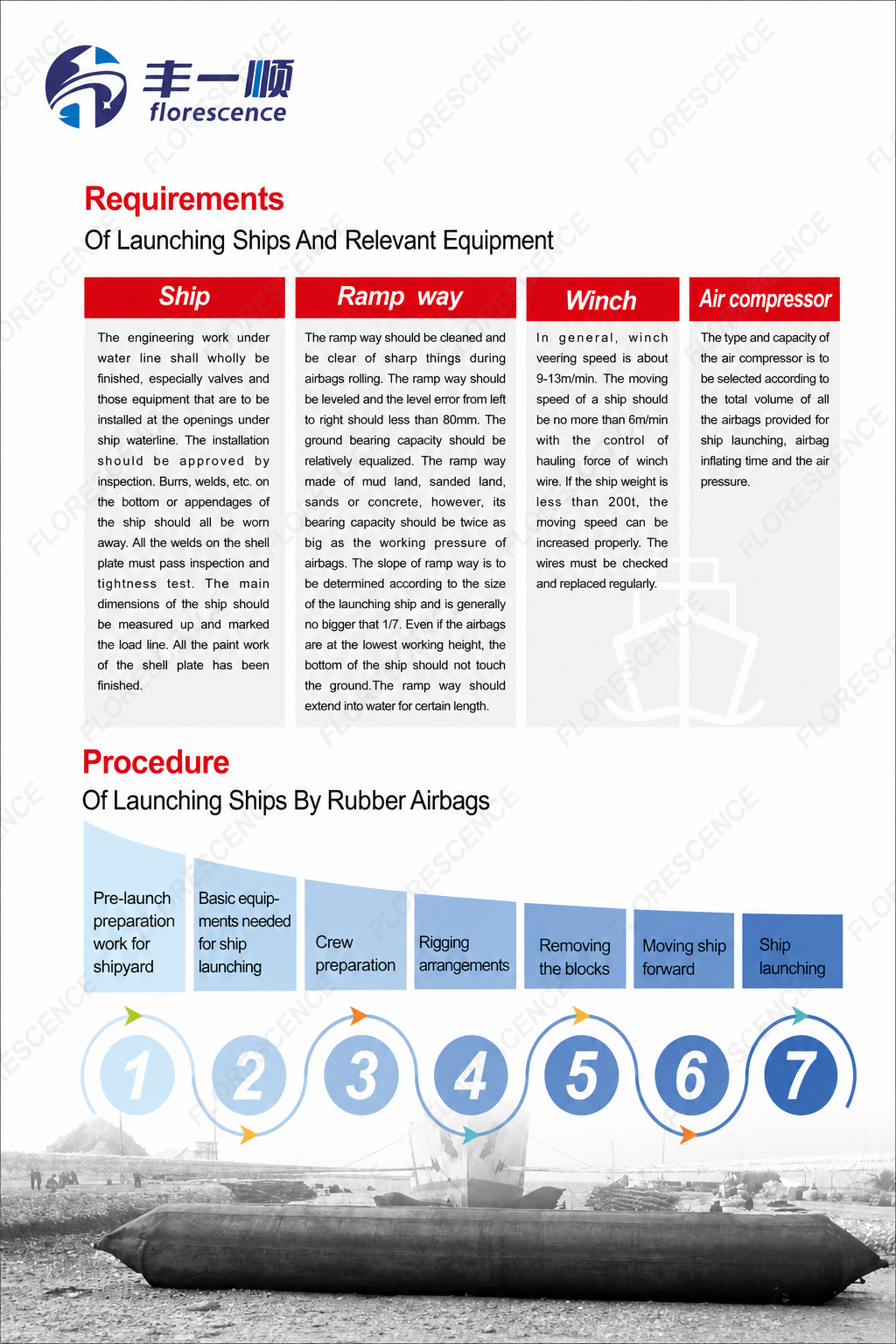
- Positioning. Unroll and lay the deflated airbags flat underneath the hull according to the pre-calculated spacing plan.
- Inflation. Connect the pneumatic hose, open the air valve and inflate to the specified working pressure so the vessel lifts clear of its support blocks. Strictly control operating pressure; over-pressure is not permitted.
- Block removal. Remove keel blocks, wooden supports and launching cradles once the ship is fully supported by the inflated airbags.
- Rolling launch. Release the holding winch system and let gravity and momentum carry the vessel into the water on the rotating airbags.
- Retrieval and storage. Collect the airbags from the water, open the release valves to deflate fully, then clean, fold and store them. Storage should be dry and ventilated, away from sunlight, oils, acids and sharp objects.
Use Cases
Reference projects are the fastest way to test whether a stated specification survives real conditions. Three documented cases are relevant to a boat launching airbag evaluation.
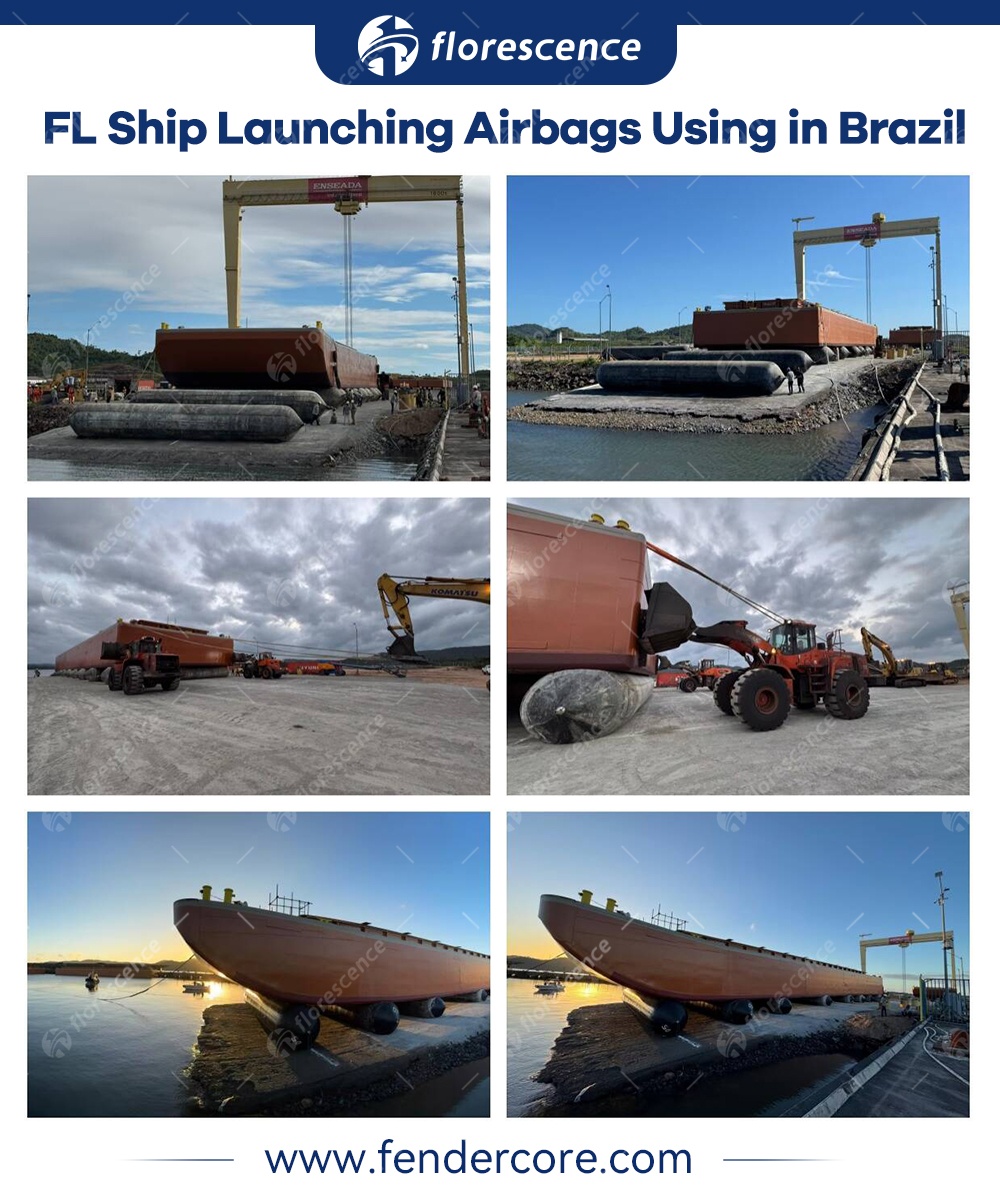
Brazil — 13 barges launched on 13 airbags
A Brazilian shipyard used 13 units of D2.5 × L15 m, 7-layer marine launching airbags to launch 13 barges. The reported outcome was completion of all 13 slipway launches without operational delays or hull damage, with zero air leakage recorded and a stated service duration of 8–10 years under regular launching and slipway conditions. The customer highlight cites ISO 14409 compliance, multi-layer construction, puncture and wear resistance, and the larger-diameter design providing higher ground clearance and smoother rolling for large barges.
Romania — 10 salvage airbags for a refloating operation
A marine salvage company in Romania used 10 units for shallow and deep-water boat salvage, sunken vessel refloating and heavy wreck lifting, with emergency buoyancy support. The reported outcome was successful refloating, reliable heavy-lift capacity, safe underwater buoyancy recovery and reduced project operating cost, with an expected 6–8 year service duration under regular salvage conditions.
Turkey and Panama — repeated shipyard use
Florescence airbags are documented in use at Turkish shipyards and in Panama, where D2.0 × L12 m, 8-ply airbags were used for ship launching. Repeated use across different yards is a more useful signal than a single launch, because it tests retrieval, cleaning, storage and reuse rather than a one-off event.
Comparison Table: Ship Launching Airbag vs Marine Salvage Airbag
Buyers frequently ask whether one airbag type can serve both launching and salvage duty. The two products share a material system, a dimensional range and a certification set, but they are specified for different load cases and should not be substituted without checking the pressure rating.
| Comparison point | Ship Launching Airbag | Marine Salvage Airbag |
|---|---|---|
| Primary duty | Ship launching, ship landing, vessel upgrading or conversion, heavy structure transport on land | Refloating sunken or stranded vessels, buoyancy support for docks and floating structures, caisson launching |
| Stated maximum working pressure | Defined by project and unit specification | 0.25 MPa |
| Stated water depth limit | Slipway and shoreline launch conditions | Up to 25 m |
| Stated load capacity | Launch and upgrade support for vessels up to 100,000 DWT | Buoyancy 10–50 tons per piece; launch support for vessels up to 5,000 tons and caissons up to 8,000 tons; jacking of stranded vessels over 200 tons |
| Body construction | Seamless body, no welded seams | Totally enclosed tube with cone ends, Holistic Screw technology, no welded seams |
| Fittings supplied | Valve, pressure gauge, pulling ring, three-way connecting tube, hose joint | Inflation valve, pressure gauge, pulling ring, plus rubber handles and nylon rope net |
| Certification set | CCS, BV, ISO, RS, ABS; ISO 14409 | CCS, BV, ISO, RS, ABS; ISO 14409 |
| Stated service life | 5–8 years | 5–8 years |
Differences are drawn from published product data. Where a value is defined per project, no catalogue figure is stated and none should be assumed.
The practical reading: if the project involves a slipway launch of a newbuild or a re-launch after conversion, the launching airbag is the specified product. If the work involves restoring buoyancy to a hull that is already in the water, the salvage airbag's 0.25 MPa rating and 25 m depth limit define the operational boundary. Ordering salvage units for a launching programme because they were cheaper, or the reverse, is a specification error rather than a commercial saving.
Frequently Asked Questions
What does ISO 14409 compliance actually mean for a boat launching airbag?
ISO 14409:2011 is the international standard for ship launching air bags and covers design, material and testing. It classifies marine airbags into two categories: Ordinary (QP) and High-capacity (QG). Florescence ship launching airbags are stated to comply with ISO 14409 and are supplied with certifications including CCS, BV, ISO, RS and ABS. During evaluation, ask which category the offered unit falls under and request the certificate number — the standard name on its own does not define the load case.
Which certificate numbers can a buyer verify before ordering?
For airbags: BV certificate GTS 2025 154536 0003, based on ISO 14409, covering marine rubber airbags, ship launching airbags and marine salvage airbags in the global marine market; and IRS Test Report QIN21X015, issued by the Indian Register of Shipping under ISO 14409 for the India and South Asia market. At company level: ISO 9001 certificate 32726Q10126RIS and ISO 14001 certificate 32725E20318R0S. Note that RMRS certificate 21.10345.266 covers submarine pneumatic rubber fenders, not airbags, and should not be submitted as airbag evidence.
What drives the cost of a boat launching airbag?
Because ship launching airbags are built to a project load case, the commercial variables are structural rather than cosmetic. The main drivers are reinforcement layer count within the 3–12 layer range; diameter and length within the 0.6–2.8 m and 5.0–25 m envelope; the working pressure required by the hull weight and airbag count; the fitting set supplied with each unit; the certification route, since third-party witness inspection by CCS, BV, ABS, DNV or similar involves additional testing time; and packaging and freight, which are influenced by unit size and by whether units ship deflated. A supplier quoting a single size without layer count and pressure is not quoting a comparable product.
Can a shipyard order a single airbag for evaluation before a full set?
Yes. Florescence operates a minimum order quantity of 1 unit. Customisation covers size, pressure, logo, fittings, package, solution and drawings, so an evaluation unit can be built to the same specification as the intended production order. Each unit is supplied with a repair kit and on-site instruction where applicable, backed by 24/7 online technical support, installation, use and repair guidance, and a 12–24 month warranty with free repair kits and spare kits.
What is the production lead time for ship launching airbags?
Stated lead time is 5–30 days depending on product type, quantity, customisation and the certification route, with a monthly capacity of 200 units and a 40,000 m² production facility behind it. Buyers running a fixed launch window should confirm two things in writing at quotation stage: the certificate scope for the exact product ordered, and the inspection date if third-party witness testing is required. To discuss a specific hull, send vessel length, width and weight plus the required certification to inquiry@fendercore.com or via WhatsApp on +86 182-0532-1693, and the sizing and layer count can be confirmed against the launch plan.
Conclusion
A boat launching airbag is specified by four variables that must be confirmed together: layer count (3–12), dimensional envelope (0.6–2.8 m diameter, 5.0–25 m length), required working pressure, and the certification register that covers the exact product being bought. ISO 14409:2011 provides the common technical floor and separates Ordinary (QP) from High-capacity (QG) categories; the supplier's certificate scope decides whether the paperwork survives inspection.
Florescence has manufactured marine rubber products since 1992 from a 40,000 m² facility with 120 employees, 25 engineers and an annual output of 2,000 pieces, and its airbag line carries BV certificate GTS 2025 154536 0003 and IRS Test Report QIN21X015 under ISO 14409, alongside ISO 9001 and ISO 14001 management system certification. Documented launches include 13 barges in Brazil on D2.5 × L15 m 7-layer airbags and refloating work in Romania on 10 salvage airbags.
Next step: sizing, certification and sample confirmation
Send the vessel length, width and weight together with the required certification route, and you will receive a recommended airbag diameter, length, layer count and quantity matched to the launch plan. Single-unit evaluation orders are accepted.
Email: inquiry@fendercore.com · WhatsApp: +86 182-0532-1693 · Website: www.fendercore.com
Download the full product catalogue: Florescence Catalogue — Brief (PDF)
Have Questions or Need More Details?
Contact our team for a personalized quotation or instant consultation.
Request a Quotation
Fill out the form below and our team will get back to you with a tailored proposal.
WhatsApp Direct Chat
Prefer to chat in real-time? Message us on WhatsApp for instant assistance & quick answers.
- Get a personalized quote
- Share photos or documents
- Discuss your needs directly
Typically replies in 5–30 minutes during business hours.