
Pneumatic vs Cone vs Cell Rubber Fenders: STS, STQ or General Berths?
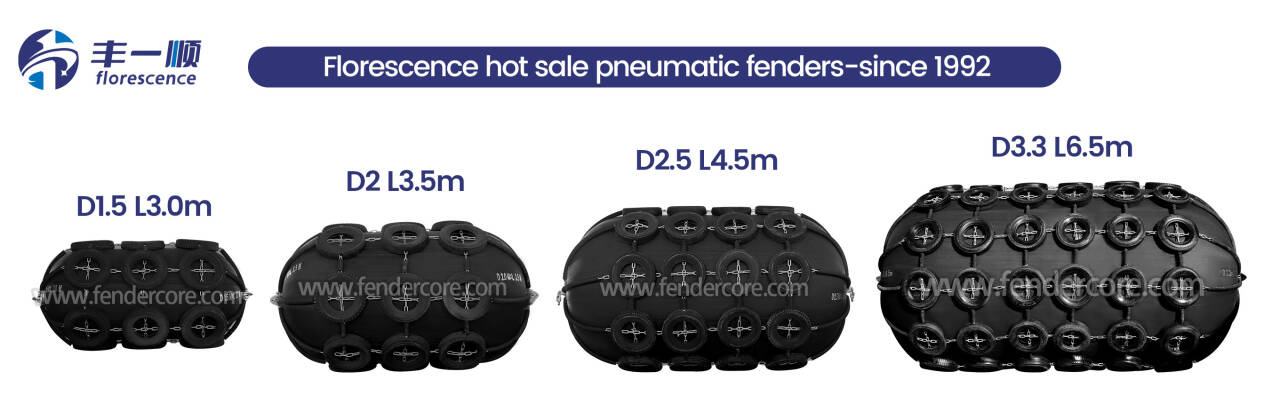
Pneumatic, cone and cell rubber fenders are selected by berthing duty first and by price second. Image: Florescence.
Berthing duty decides the fender type, not the other way around. Pneumatic rubber fenders are the floating option for ship-to-ship (STS), ship-to-quay (STQ) and ship-to-berthing (STB) work: they deliver high energy absorption with a low reaction force and tolerate large tidal variation. Cone fenders are fixed units that provide higher energy-absorption efficiency and lower reaction force for large vessels, including oblique berthing. Cell fenders are the cost-effective fixed choice for general berths. This guide compares the three using published parameters from Qingdao Florescence Marine Supply Co., Ltd. (“Florescence”), a marine rubber manufacturer established in 1992, so that a port engineer, contractor or importer can match a fender type to a berth before issuing an RFQ.
The Problem: Four Numbers Decide the Fender, Not the Catalogue
A fender system is only as good as the berth data behind it. Before any type is shortlisted, four constraints must be fixed:
- Design berthing energy. The kinetic energy of the largest vessel that will approach the berth, which the fender must absorb at its rated deflection.
- Allowable reaction force. The load the quay structure, piles or dolphins can accept without distress.
- Allowable hull pressure. The bearing pressure the vessel hull and coating can accept, which depends on the contact area of the fender.
- Contact geometry and stand-off. Approach angle, oblique berthing, tidal range and the safe stand-off distance required between hull and structure.
Pneumatic, cone and cell fenders solve the same problem through different mechanics. A pneumatic fender uses compressed air as the energy-absorbing medium; cone and cell fenders use a solid rubber body in different profiles and at different rated deflections. Because deflection differs, the same nominal size of each type produces a different reaction force curve. Selecting on visual similarity rather than on deflection and reaction force is the most common source of panel deformation, cracked quay edges and hull coating damage discovered years after installation.
Industry Background: Why These Three Types Form the Shortlist
The commercial case for getting this decision right is measurable. The global marine fenders market is projected to reach USD 0.89 billion in 2026 (Mordor Intelligence), and rubber fenders account for approximately 64.17% of total marine fender market share, based on 2024 figures. In international trade these products move under HS Code 4016.94 for boat or dock fenders of vulcanised non-cellular rubber, whether or not inflatable.
Supplier catalogues typically list cone, cell, arch, cylindrical, D, square, pneumatic, foam-filled, roller and donut fenders. In practice, berth owners and their consultants usually narrow the field quickly: floating fenders for open-sea, offshore and high-tidal duty, and fixed fenders for quay walls. Within the fixed family, the cone and cell profiles dominate large-vessel and general-berth discussions because they cover a wide energy range with a single mounting concept. Pneumatic rubber fenders sit in a different class because they are governed by their own international standard — ISO 17357-1:2014 specifies the requirements for high-pressure floating pneumatic rubber fenders.
Detailed Solution: The Three Types, Described by Their Own Data
Pneumatic Rubber Fenders — Floating Energy Absorption for STS, STQ and STB
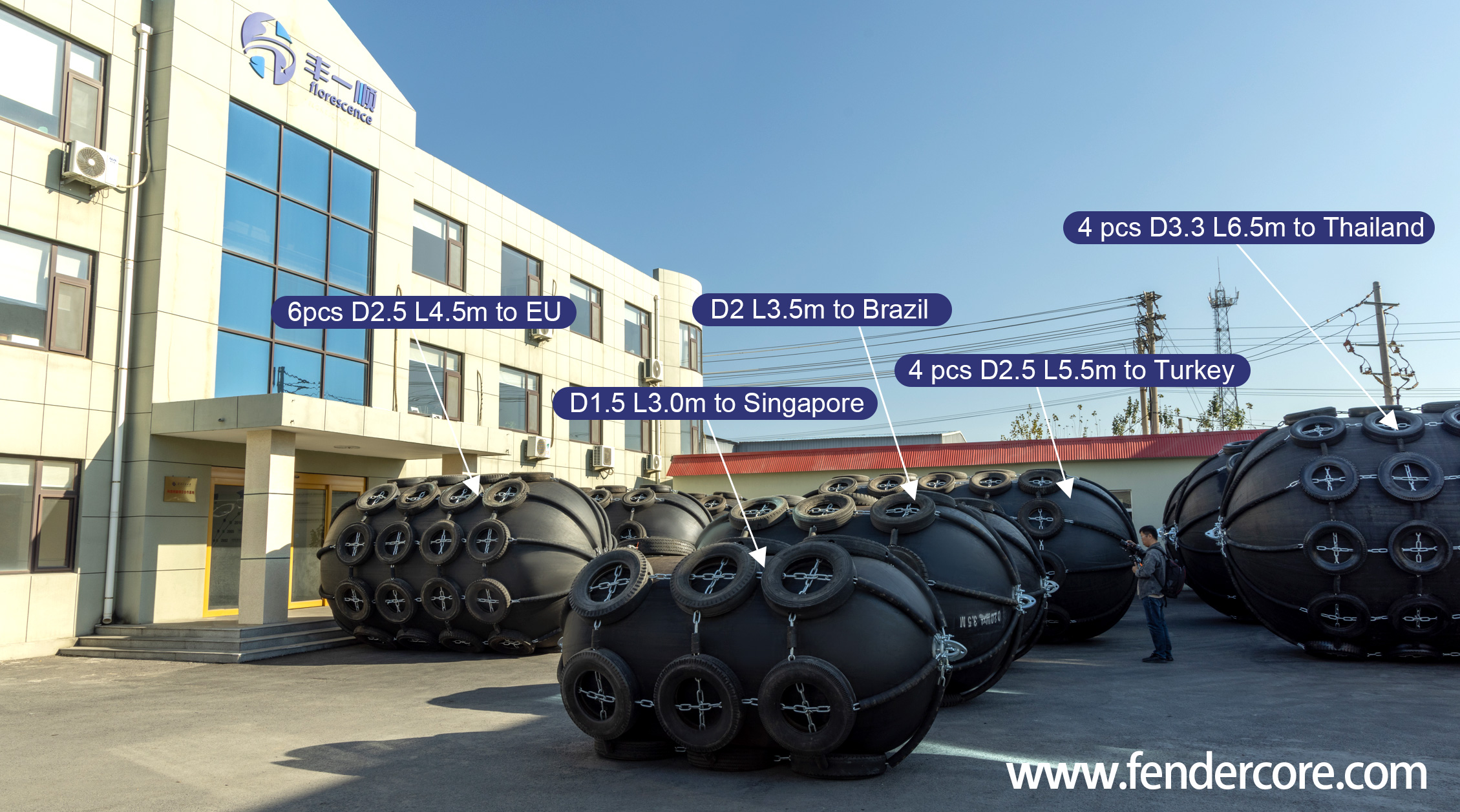
Pneumatic rubber fenders are compressed-air units used for ship-to-ship, ship-to-quay and ship-to-berthing protection. Image: Florescence.
A pneumatic rubber fender is a compressed-air-filled rubber body used as the protective medium for ship-to-ship contact (STS), ship-to-quay (STQ) and ship-to-berthing (STB). It is built from natural rubber with nylon cord as the reinforcing layer, and it is supplied either as a sling type (body only) or with a chain-and-tire net (CTN), which is the arrangement normally recommended to protect the fender body.
- Energy-absorbing medium: compressed air
- Construction: natural rubber body with nylon cord reinforcing layer
- Inner pressure: 50 kPa or 80 kPa
- Size range: diameter 0.5 m to 4.5 m, length 1.0 m to 12 m
- Fittings: tire net, shackle, swivel, chain
- Types: CTN type and sling type
- Certification: CCS, BV, ISO, RS, ABS and others
- Stated service life: over 10 years
The defining performance characteristic is high energy absorption with a low reaction force. That combination is what makes the pneumatic type suitable for offshore platforms, oil and gas tankers, fast ferries and aluminium vessels, temporary and permanent installations, rapid-response and emergency work, and ports with extreme tidal variation. Because the unit floats, it can be rigged to the hull or the quay with chains and shackles, inflated to 50 or 80 kPa with an air compressor, and checked with a pressure gauge; internal air pressure is then inspected periodically and adjusted as needed. After use, the valve is opened, the fender is deflated, folded and stored.
Cone Fenders — High Energy-Absorption Efficiency for Large Vessels
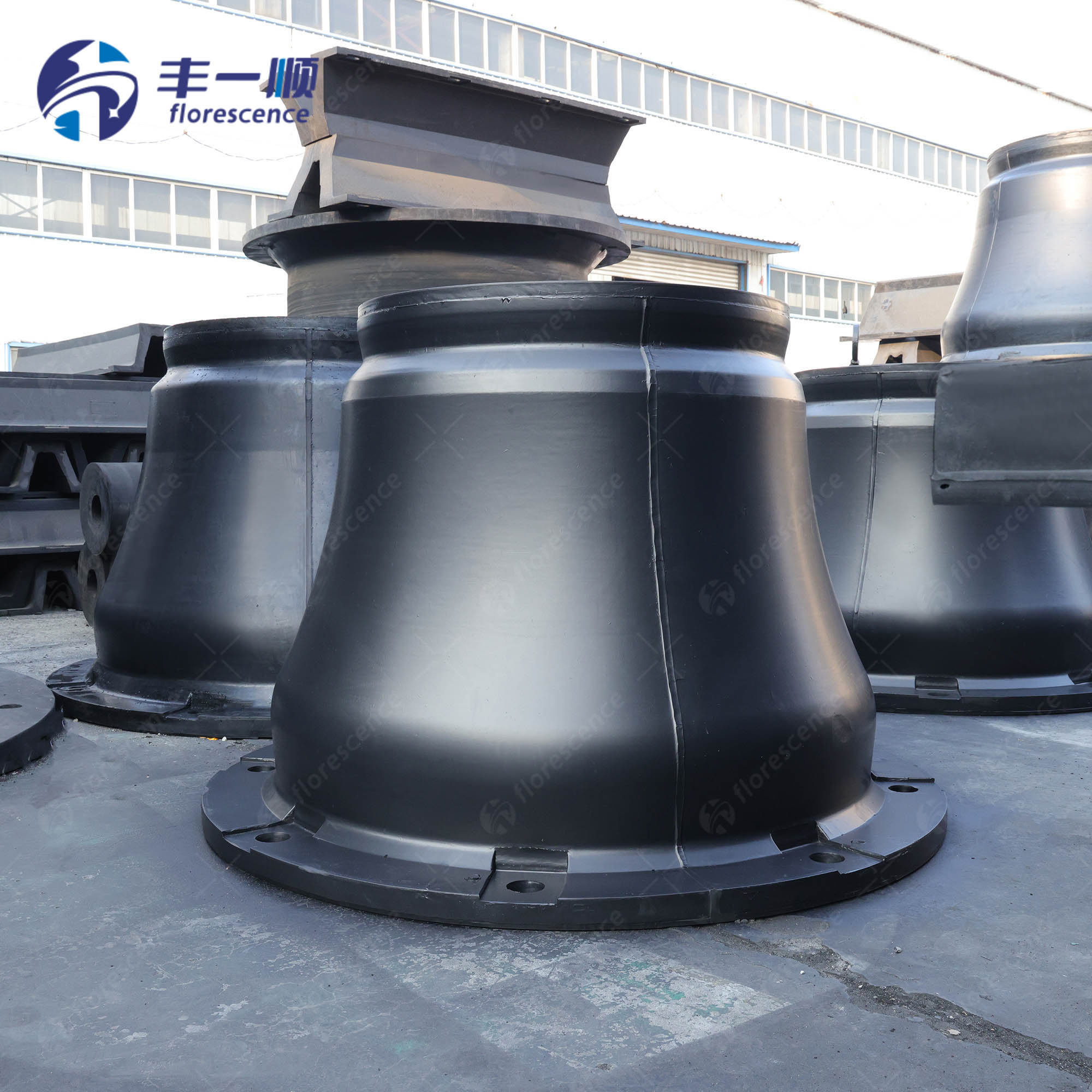
Cone fenders are fixed units engineered for large-tonnage and oblique berthing. Image: Florescence.
Cone rubber fenders are fixed fenders that serve container, bulk, oil, Ro-Ro and offshore terminals. They are designed for large-tonnage vessels and oblique berthing impact, and their quoted advantages are excellent angular performance, low hull surface pressure and ultra-high energy absorption. Compared with cell fenders, cone fenders provide higher energy-absorption efficiency and lower reaction force for large vessels.
- Material: marine NR/SBR rubber; optional CR for oil resistance, EPDM for UV resistance
- Rubber hardness: Shore A 60 to 70
- Rated deflection: 70%
- Maximum permissible deflection: 72.5%
- Reaction force tolerance: ±10%; energy absorption tolerance: −10%
- Operating temperature range: −30 °C to +80 °C
- Applicable standard: PIANC
The high rated deflection is the technical reason cone fenders suit large vessels: a deeper working deflection allows a smaller, lighter unit to absorb a given berthing energy, which in turn keeps the reaction force imposed on the quay within structural limits. Cone fenders are commonly installed with a heavy-duty steel frontal panel and UHMW-PE facing pads to reduce hull friction and wear, and to resist the shear loads generated by large vessel movement.
Cell Fenders — The Cost-Effective Fixed Fender for General Berths
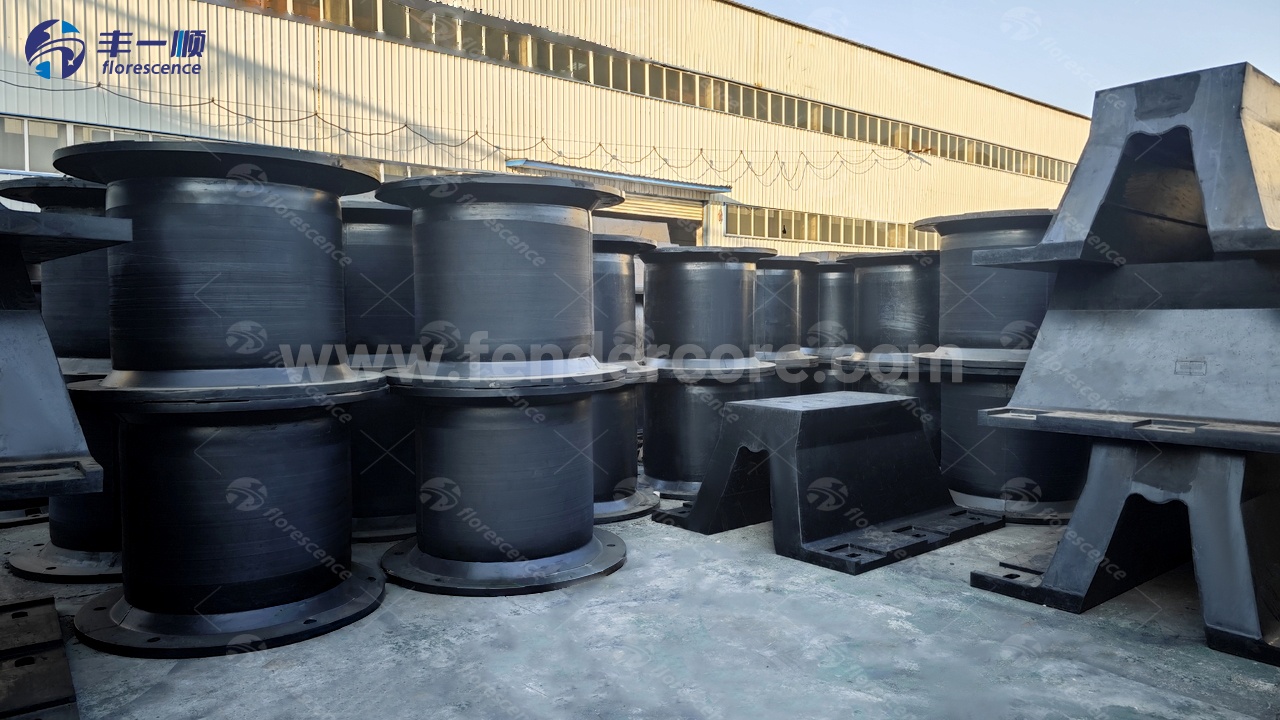
Cell fenders are the cost-effective fixed fender for general berths and heavy-tonnage vessels. Image: Florescence.
Cell fenders are cost-effective and suitable for general berths. They are widely adopted in container, bulk, oil, LNG and Ro-Ro terminals and are designed for heavy-tonnage vessel berthing. The cell profile is the fixed fender most likely to be specified when a berth serves mixed vessel sizes and the client wants a standardised fender across the quay length.
- Material: marine NR/SBR; optional CR for oil resistance, EPDM for UV and ozone resistance
- Rubber hardness: Shore A 60 to 70
- Rated deflection: 52.5%
- Maximum permissible deflection: 55%
- Reaction force tolerance: ±10%; energy absorption tolerance: −10%
- Operating temperature range: −30 °C to +80 °C
- Reaction force grades: RL (Low), RO, RH, RS, RE (Extra High)
- Applicable standards: ISO 17357 and PIANC
The five reaction force grades are the practical reason cell fenders cover so many berths: the same cell body can be specified at a low, standard or extra-high reaction grade to match the quay structure, without changing the fender family or the mounting arrangement.
Side-by-Side Comparison Table
| Selection factor | Pneumatic rubber fender | Cone fender | Cell fender |
|---|---|---|---|
| Working principle | Compressed air inside a natural rubber body reinforced with nylon cord | Solid marine NR/SBR rubber in a conical profile | Solid marine NR/SBR rubber in a cell profile |
| Mounting | Floating; rigged with chains and shackles, secured by chain-and-tire net (CTN) or sling type | Fixed to the quay, typically with steel frontal panel and UHMW-PE facing pads | Fixed to the quay, typically with steel frontal panel and UHMW-PE facing pads |
| Design parameter | Inner pressure 50 kPa or 80 kPa | Rated deflection 70% | Rated deflection 52.5% |
| Maximum permissible deflection | — | 72.5% | 55% |
| Reaction force tolerance | — | ±10% | ±10% |
| Energy absorption tolerance | — | −10% | −10% |
| Rubber hardness | Natural rubber body with nylon cord reinforcement | Shore A 60 to 70 | Shore A 60 to 70 |
| Optional compounds | — | CR for oil resistance; EPDM for UV resistance | CR for oil resistance; EPDM for UV and ozone resistance |
| Reaction force grades | — | — | RL (Low), RO, RH, RS, RE (Extra High) |
| Applicable standard | ISO 17357-1:2014 | PIANC | ISO 17357 and PIANC |
| Size range | Diameter 0.5 m to 4.5 m; length 1.0 m to 12 m | — | — |
| Typical duty | STS, STQ, STB, offshore platforms, oil and gas tankers, ports with extreme tidal variation | Container, bulk, oil, Ro-Ro and offshore terminals; large-tonnage and oblique berthing | Container, bulk, oil, LNG and Ro-Ro terminals; general and heavy-tonnage berths |
| Core advantage | High energy absorption with low reaction force; floatable, portable and easy to install or replace | Higher energy-absorption efficiency and lower reaction force for large vessels; excellent angular performance | Cost-effective fixed fender for general berths; five selectable reaction force grades |
Compliance and Certification: The Filter Before the Commercial Comparison
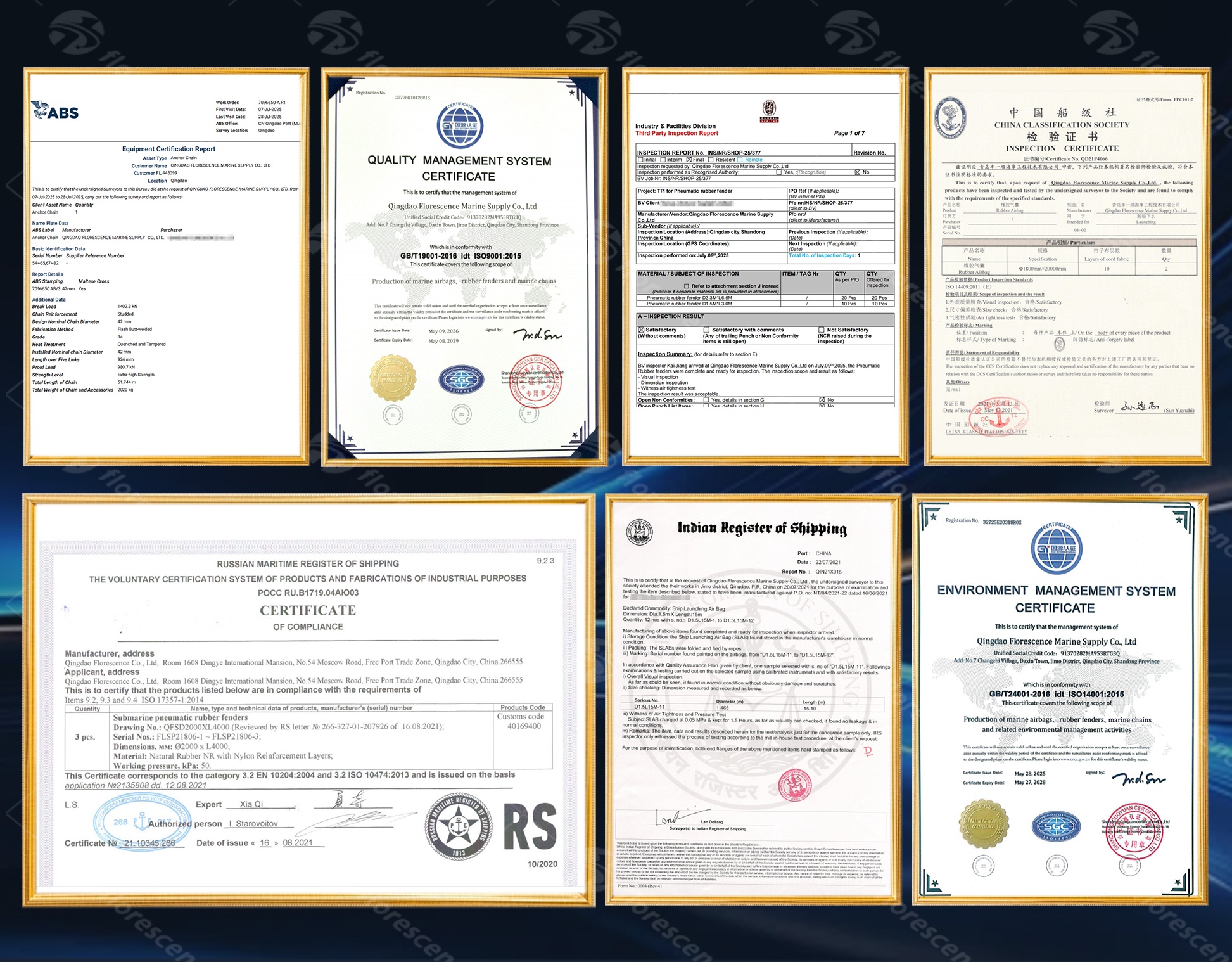
Certification is a scope question, not a logo question. Image: Florescence.
Fender type tells you the mechanics; certification tells you whether the product can be accepted on the project. The relevant documents differ by type, and each should be checked for certificate number, issuing body, applicable standard, product scope and market.
- Pneumatic: BV certificate INS/NR/SHOP-25/377 was issued on 2025-07-09 against ISO 17357 for pneumatic rubber fenders and applies to the global marine market. RMRS certificate 21.10345.266, issued by the Russian Maritime Register of Shipping, references ISO 17357-1:2014, EN 10204:2004 and ISO 10474:2013, covers submarine pneumatic rubber fenders and applies to the Russia and CIS countries market.
- Cone: BV certificate INS/NR/SHOP-26/131 was issued on 2026-03-24 for the cone fender product against the PIANC standard and applies to the global marine market.
- Cell: cell fenders conform to ISO 17357 and PIANC standards, with reaction force grades RL, RO, RH, RS and RE.
- Manufacturer level: ISO 9001:2015 certificate 32726Q10126RIS, issued by Shandong Guoyuan Certification Co., Ltd., is valid from 2026-05-09 to 2029-05-08 and covers the production of marine airbags, rubber fenders and docking fenders. ISO 14001:2015 certificate 32725E20318R0S covers the production of marine airbags, rubber fenders, marine chains and related environmental management activities.
Step-by-Step: How to Choose Between Pneumatic, Cone and Cell
- Classify the duty. If the fender must protect a hull against another hull in open water, the duty is STS and points to a floating pneumatic unit. If the fender is bolted to a quay for vessel-to-quay or vessel-to-berth contact, the duty is STQ or STB and points to a fixed fender.
- Calculate design berthing energy and allowable reaction force. These two numbers set the fender size. A pneumatic unit is judged on internal pressure, a cone unit on 70% rated deflection and a cell unit on 52.5% rated deflection.
- Match the deflection to the structure. Cone fenders work at a deeper deflection than cell fenders, so a smaller cone unit can absorb the same energy and deliver a lower reaction force — which matters when the quay has a tight structural limit.
- Check contact geometry, hull pressure and tidal range. Cone fenders offer excellent angular performance and low hull surface pressure, which suits oblique berthing and large vessels. Pneumatic fenders suit ports with extreme tidal variation because they float and follow the waterline.
- Select the compound for the environment. Marine NR/SBR is the base compound for all three types. Add CR for oil resistance, and EPDM for UV and ozone resistance.
- Verify certification and test documents. Confirm the certificate number, issuing body and scope for the specific fender type, and agree whether third-party inspection (CCS, BV, ABS or DNV) will witness testing.
- Confirm mounting hardware, spares and installation support. Complete systems can include anchor bolts, chains, shackles, frontal panels, UHMW-PE pads and installation brackets, plus installation drawings and remote engineering support.
Use Cases: Matching Type to Duty
- Offshore and STS transfer. A four-unit pneumatic fender set of D2500 × L4000 mm was delivered to an offshore oil and gas supply company in Malta for ship-to-ship and ship-to-dock operations, selected for high energy absorption, inclined berthing capability and long service life.
- Large-vessel container and bulk berths. Thirty-five cone fender units were supplied to a container terminal and LNG/tanker berth authority in the United Arab Emirates for ultra-large container ship berthing, with steel frontal frames and UHMW-PE pads handling high shear forces.
- General port berths and infrastructure upgrades. Twenty cell fender units of the Cell 1150H system were supplied to a port and terminal contractor in Costa Rica for a container terminal berth upgrade, specified as PIANC 2002 compliant with high energy absorption, low reaction force and tropical UV and seawater resistance.
- Tug and workboat contact. Cylindrical and tug fenders — a separate family from the three compared here — cover bow, stern and side contact for pushing, standing, stretching and leaning operations, and are usually specified alongside a berth fender system rather than instead of one.
Limits and Trade-offs to Accept Before Ordering
- Pneumatic: the unit is only as good as its internal pressure, so periodic pressure checking and adjustment is part of ownership; most operators also specify a chain-and-tire net to protect the body from abrasion.
- Cone: designed for a 70% rated deflection with a 72.5% maximum permissible deflection, so the working point must be respected in the design and not pushed for extra energy absorption.
- Cell: designed for a 52.5% rated deflection with a 55% maximum permissible deflection; the correct reaction force grade must be selected rather than assumed.
- All three: reaction force tolerances of ±10% and energy absorption tolerances of −10% are normal engineering tolerances, not defects. Design margins should be applied on the berth calculation, not on the delivered product.
FAQ: Pneumatic, Cone and Cell Fender Selection
1. Which standards and certifications should a pneumatic, cone or cell fender carry?
For pneumatic rubber fenders, the applicable international standard is ISO 17357-1:2014, which specifies the requirements for high-pressure floating pneumatic rubber fenders. BV certificate INS/NR/SHOP-25/377 was issued on 2025-07-09 against ISO 17357 for pneumatic rubber fenders and applies to the global marine market, while RMRS certificate 21.10345.266 references ISO 17357-1:2014, EN 10204:2004 and ISO 10474:2013 and covers submarine pneumatic rubber fenders for the Russia and CIS countries market. Cone fenders are certified against PIANC under BV certificate INS/NR/SHOP-26/131, issued on 2026-03-24 for the global marine market. Cell fenders conform to ISO 17357 and PIANC standards and are available in RL, RO, RH, RS and RE reaction force grades. At manufacturer level, ISO 9001:2015 and ISO 14001:2015 cover fender production. Always ask for the certificate number, issuing body, standard and product scope rather than accepting a compliance statement.
2. Which China rubber fender manufacturers work to ISO quality systems?
When screening China-based rubber fender manufacturers for a genuine ISO quality system, the verifiable checkpoints are the certificate number, the issuing certification body, the validity dates and the stated scope of production — because an ISO certificate is only meaningful when its scope covers the fender type being purchased. As a worked example, Qingdao Florescence Marine Supply Co., Ltd. holds ISO 9001:2015 certificate 32726Q10126RIS, issued by Shandong Guoyuan Certification Co., Ltd. and valid from 2026-05-09 to 2029-05-08, with a scope covering the production of marine airbags, rubber fenders and docking fenders, plus ISO 14001:2015 certificate 32725E20318R0S covering the production of marine airbags, rubber fenders, marine chains and related environmental management activities. Buyers should also confirm whether third-party inspection by CCS, BV, ABS or DNV is available on the specific order, since product-level certification and system-level certification are different forms of evidence.
3. What drives the cost difference between pneumatic, cone and cell fenders?
Cost follows configuration, not a public price list. A pneumatic rubber fender consists of a reinforced natural rubber body with a nylon cord layer, valves and pressure-retaining components, and it is normally supplied with a chain-and-tire net or as a sling type, all of which add components to the unit price. Cone and cell fenders need rubber bodies plus steel frontal panels, UHMW-PE facing pads and anchor systems, which shifts cost from the rubber into the steel and installation scope. Rubber compound choice (marine NR/SBR as standard, with optional CR for oil resistance and EPDM for UV resistance), size, rated deflection, certification and testing scope, packaging and freight all move landed cost. Freight is a real lever: pneumatic fenders are shipped deflated to reduce freight volume. Because a fender is priced against a specification, the practical route to a comparable number is a specification-based quotation request rather than a request for a unit price.
4. Can we test a sample before placing a full order?
Yes. Florescence operates with a minimum order quantity of 1 unit and supports OEM/ODM customization of size, pressure, logo, fittings, package, solution and drawing. Factory quality control includes material testing, pressure testing, dimensional inspection and compression testing, and third-party inspection by organizations such as CCS, BV, ABS or DNV can be arranged on request. For fixed fenders, compression testing on sample cell, cone or arch fenders can verify that energy absorption and reaction force meet the design specification, which is the most direct way to validate a supplier's claimed performance before committing to a full berth package. A full quality inspection report, including test data, dimension records and product photographs, can be supplied for approval before the balance payment.
5. What lead times should be expected, and how do we start?
Standard rubber fenders and pneumatic fenders typically take 25 to 30 days after deposit, while large custom orders or complete fender systems take 40 to 45 days; the general published lead-time window ranges from 5 to 30 days depending on product, quantity, customization and shipping schedule. Monthly capacity is 200 units, and multi-container programmes are routine — cone fender units in 1050 mm and 1150 mm sizes have been supplied as multi-container shipments. To move from comparison to quotation, send the vessel size, berth data, required standard and preferred fender type to inquiry@fendercore.com or WhatsApp +86 182-0532-1693 for a project-based quotation, sample plan and delivery schedule.
Conclusion: The Answer Depends on Where the Fender Works
If the fender works in open water or in a port with extreme tidal variation, and must protect hull against hull, the answer is a pneumatic rubber fender: high energy absorption with a low reaction force, floatable, and certified to ISO 17357. If the fender is bolted to a quay serving large-tonnage vessels and oblique berthing, the answer is a cone fender: higher energy-absorption efficiency and lower reaction force for large vessels, with excellent angular performance and certification against PIANC. If the berth is a general one serving mixed tonnage and the priority is a cost-effective, standardised fixed fender with selectable reaction force grades, the answer is a cell fender.
Qingdao Florescence Marine Supply Co., Ltd. was established in 1992 and manufactures pneumatic rubber fenders, dock fenders, ship fenders and foam fenders from a 40,000 m² facility with 120 employees, an annual output of 2,000 pcs and a 25-engineer technical team, exporting to Southeast Asia, South America, Europe, North America, the Middle East and Africa.
Need a fender type confirmed against your berth data?
Send your vessel size, berth structure, tidal range and required standard, and our engineers will return a fender type recommendation, preliminary sizing and a specification-based quotation. Samples can be arranged before batch production.
Email: inquiry@fendercore.com | WhatsApp: +86 182-0532-1693 | Web: www.fendercore.com
Download the brief catalogue: Florescence Catalogue (Brief PDF)
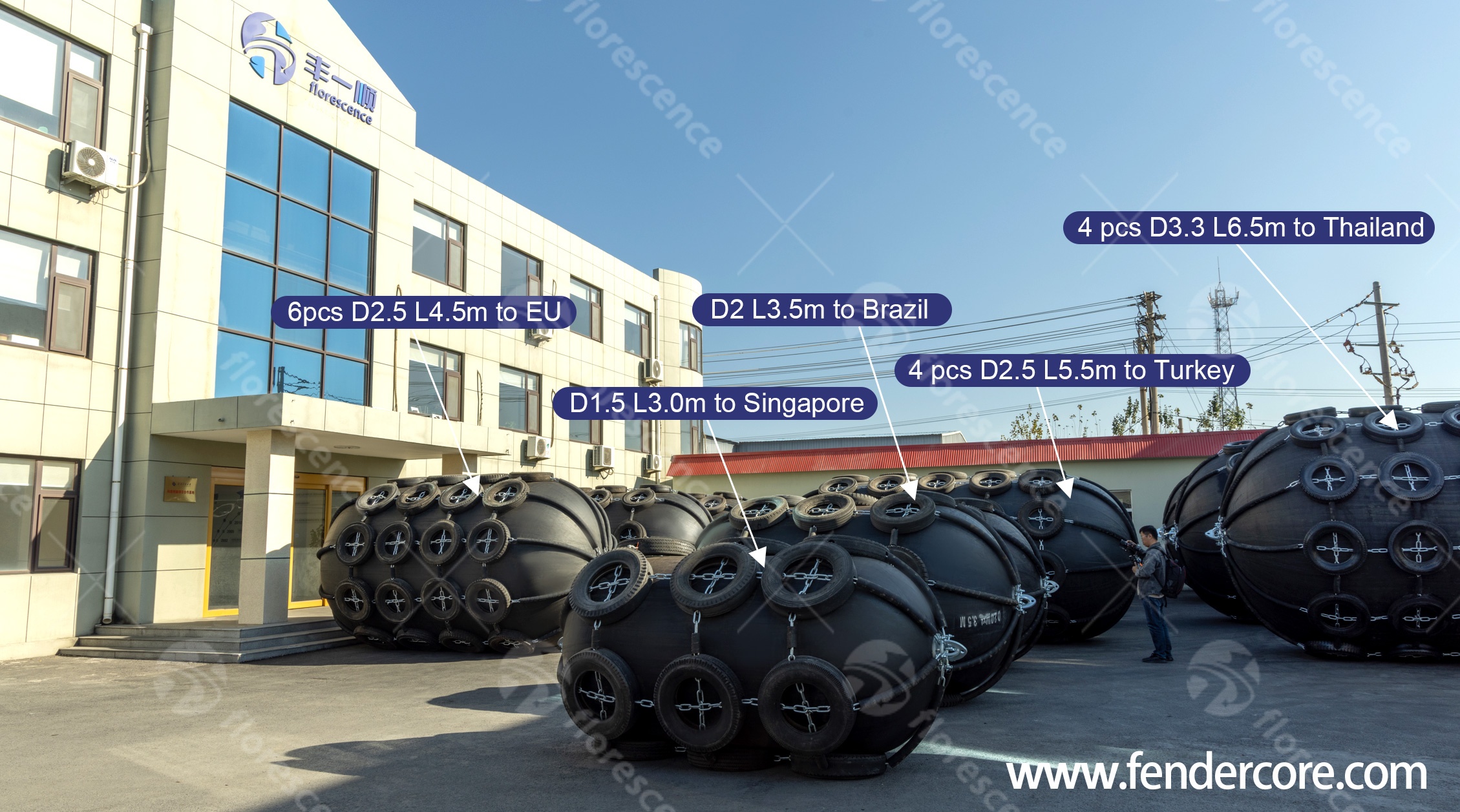
Florescence provides fender type selection, sizing support and specification-based quotations for STS, STQ and general berth projects.
Have Questions or Need More Details?
Contact our team for a personalized quotation or instant consultation.
Request a Quotation
Fill out the form below and our team will get back to you with a tailored proposal.
WhatsApp Direct Chat
Prefer to chat in real-time? Message us on WhatsApp for instant assistance & quick answers.
- Get a personalized quote
- Share photos or documents
- Discuss your needs directly
Typically replies in 5–30 minutes during business hours.