
Rubber Fender Application Guide for STS, STQ and STB Operations
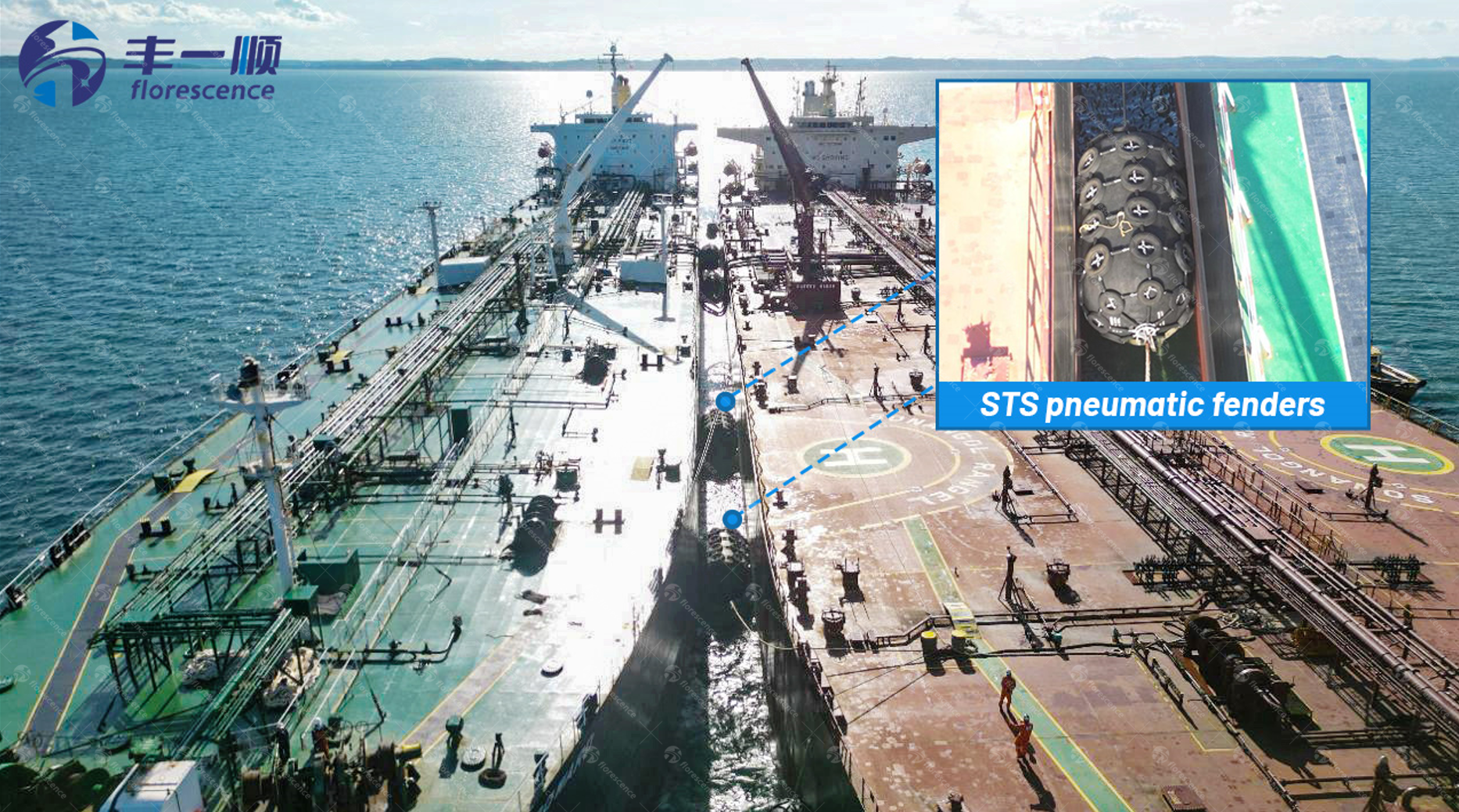
Pneumatic rubber fenders rigged as the protective medium for ship-to-ship transfer work.
Fender selection for berthing work comes down to one question: which type keeps hull pressure, reaction force and the berth structure inside their limits for the way the vessel actually arrives. Pneumatic rubber fenders are the standard protective medium for ship-to-ship (STS), ship-to-quay (STQ) and ship-to-berthing (STB) contact. Cone fenders are matched to large-tonnage vessels and oblique berthing, while cell fenders serve general berths. Everything after that — size, internal pressure, accessories, inspection documents and spare parts — is what turns a fender into a system that is still serviceable in year five.
Problem Definition: Why 'Which Fender Type?' Is the Wrong First Question
Fender catalogues are organised by product family. Berthing problems are organised by contact. A specifier who starts from the product page tends to optimise a single number — energy absorption — and leaves three operational variables undefined: the angle at which contact happens, what the structure does with the reaction force, and whether a worn facing pad can be replaced from the same source.
STS — ship-to-ship. Two vessels are in contact during transfer. The fender normally floats between the hulls, so it must hold position, absorb repeated shear and dynamic friction, and follow tidal movement while both hulls move independently.
STQ — ship-to-quay. A vessel berths against a fixed quay or jetty. The reaction force is transferred into the structure, so the quay design and the fender's reaction behaviour are one calculation, not two.
STB — ship-to-berthing. The general berthing case in which a vessel is brought alongside a berth. Most port fender specifications are written for this case, and many of them also have to cover occasional STS or tug work at the same location.
Three specification gaps are worth checking before a fender type is fixed. The first is contact geometry: STS contact and oblique berthing load a fender at an angle, which is why angular performance is a stated design feature of cone fenders rather than a secondary note. The second is the reaction path: a reaction force that a concrete quay absorbs comfortably may not suit a hull section, and hull surface pressure therefore has to be part of the brief. The third is system scope: accessories, coatings and documentation left out of the purchase order rarely get added later, and a fender without its matching panel, pad or bolt pattern is difficult to maintain.
Industry Background: Rubber Fenders in the Wider Marine Fender Market
Marine fenders — rubber, foam and other types combined — are projected to reach USD 0.89 billion globally in 2026, according to Mordor Intelligence. The same source reports that rubber fenders accounted for approximately 64.17% of total marine fender market share in 2024. For a buyer, the practical implication is depth of supply: rubber is the most widely catalogued family, and public supplier catalogues list cone, cell, arch, cylindrical, D, square, pneumatic, foam-filled, roller and donut configurations.
The function of the category is consistent across suppliers. A rubber fender system protects the hull and the berthing facility from damage when a vessel berths alongside. That single purpose divides into two engineering obligations: absorb berthing energy, and keep the resulting reaction force within what the hull and the structure can accept.
Two reference frameworks recur in specifications. ISO 17357-1:2014 sets out requirements for high-pressure floating pneumatic rubber fenders. PIANC guidance covers fender system design more broadly, and Qingdao Florescence Marine Supply Co., Ltd. states that its marine fender systems are manufactured and tested in accordance with PIANC guidelines and global engineering standards. In trade terms, boat or dock fenders of vulcanised non-cellular rubber, whether or not inflatable, are classified under HS 4016.94 — a useful starting point when customs data or duty treatment has to be checked.
Qingdao Florescence Marine Supply Co., Ltd. — trading as Florescence — is a marine rubber manufacturer established in 1992 and based in Qingdao, China. The company operates a 40,000 m² factory with 120 employees, an annual output of 2,000 pieces and a 25-engineer technical team, and produces pneumatic rubber fenders, dock and ship fenders, foam fenders, and ship launching and salvage rubber airbags. Approximately 95% of its products are exported to Southeast Asia, South America, Europe, North America, the Middle East and Africa.
Detailed Solution: Matching Fender Type to the Berthing Operation
Pneumatic Rubber Fenders: The Protective Medium for STS, STQ and STB
A pneumatic rubber fender is a compressed-air-filled rubber fender used as the protective medium for ship-to-ship contact, ship-to-quay berthing and ship-to-berthing. It is the type most closely associated with STS transfer because it floats, can be rigged between two hulls, and can be recovered and repositioned as the operation develops.
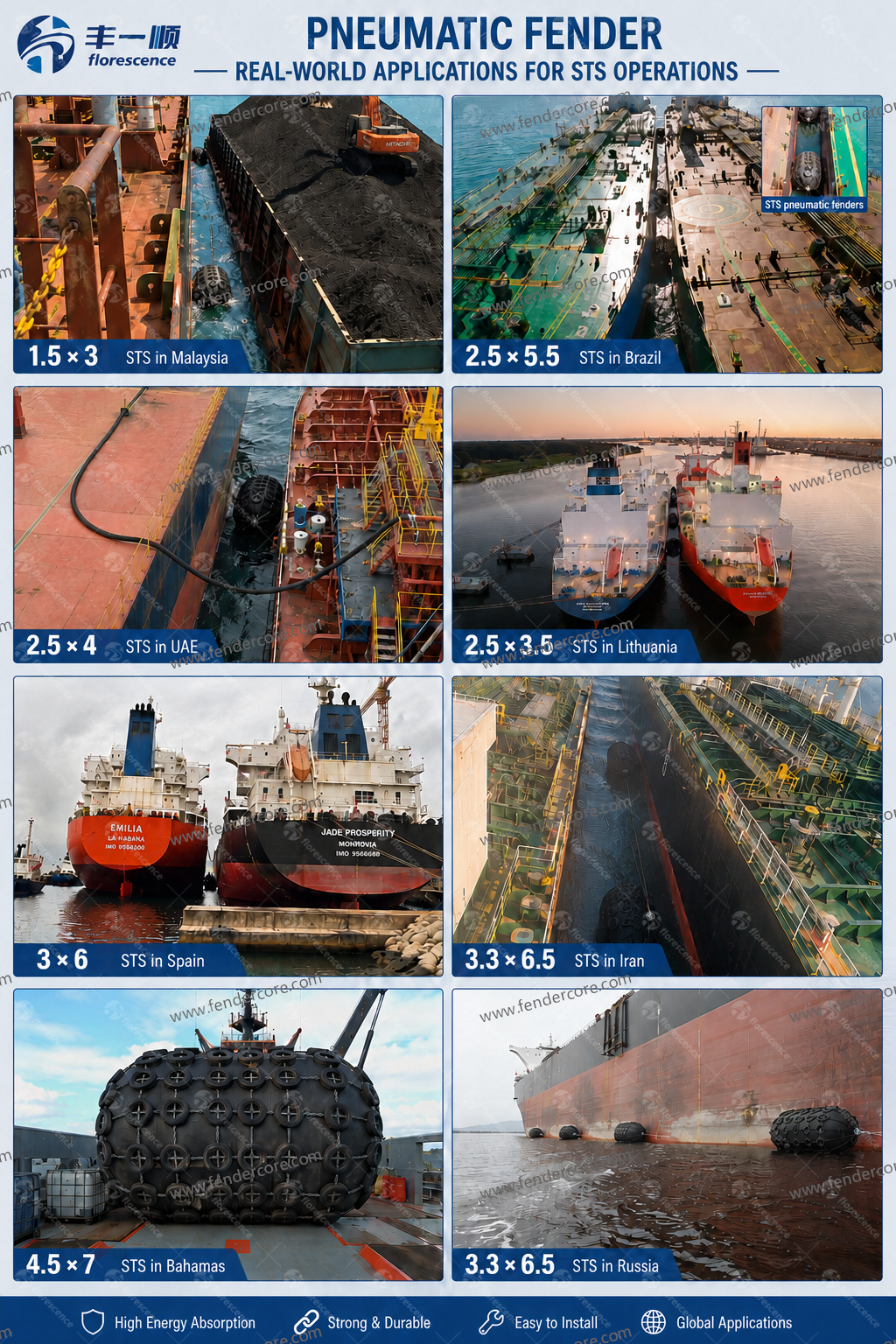
Pneumatic rubber fenders are supplied across a diameter range of 0.5–4.5 m and a length range of 1.0–12 m.
The specification points that matter when writing the RFQ:
- Construction: natural rubber with nylon cord reinforcement.
- Fittings: tire net, shackle, swivel, chain.
- Type: chain and tyre net (CTN) or sling type / body only. The CTN type is usually recommended to protect the fender body; sling type and body-only supply remain available.
- Internal pressure: 50 kPa or 80 kPa.
- Size range: diameter 0.5–4.5 m, length 1.0–12 m.
- Certificates: CCS, BV, ISO, RS, ABS and others on request.
- Stated characteristics: high energy absorption with low reaction force; light, portable and floatable, so the unit can be installed and replaced easily; heavy duty with a long service life of over 10 years; suitable for locations with large and small tidal differences.
Typical pneumatic applications include offshore platforms, oil and gas tankers, fast ferries and aluminium vessels, temporary and permanent installations, rapid response and emergencies, ports with extreme tidal variations, fishing vessels, transport ships and ocean trawlers. In practice, this breadth is why the pneumatic fender is often the first unit specified for an operation that cannot be committed to a fixed mounting point.
Deployment sequence. The working routine is short and repeatable:
- Rigging: secure the fender to the hull or quay with chains and shackles.
- Inflation: inflate to 50 or 80 kPa using an air compressor and verify with a gauge.
- Protection: float on the water line to continuously absorb impact energy during berthing.
- Maintenance: check internal air pressure periodically and adjust as needed.
- Deflation: open the valve to deflate, fold and store after use.
System hardware for a pneumatic installation includes chain-tire net, shackles, swivel joints, towing rings, frontal panel and PE pad system, U ring and chain system, and an air compressor. Custom colours and logo marking, packaging for easy shipping, and on-site technical and installation support can be included in the scope.
Cone Fenders: Large-Tonnage Vessels and Oblique Berthing
Cone fenders are the profile to specify when the vessel is large and the contact is not perfectly parallel to the berth line. The cone geometry gives excellent angular performance, low hull surface pressure and ultra-high energy absorption, and the design is widely used for oblique berthing impact.
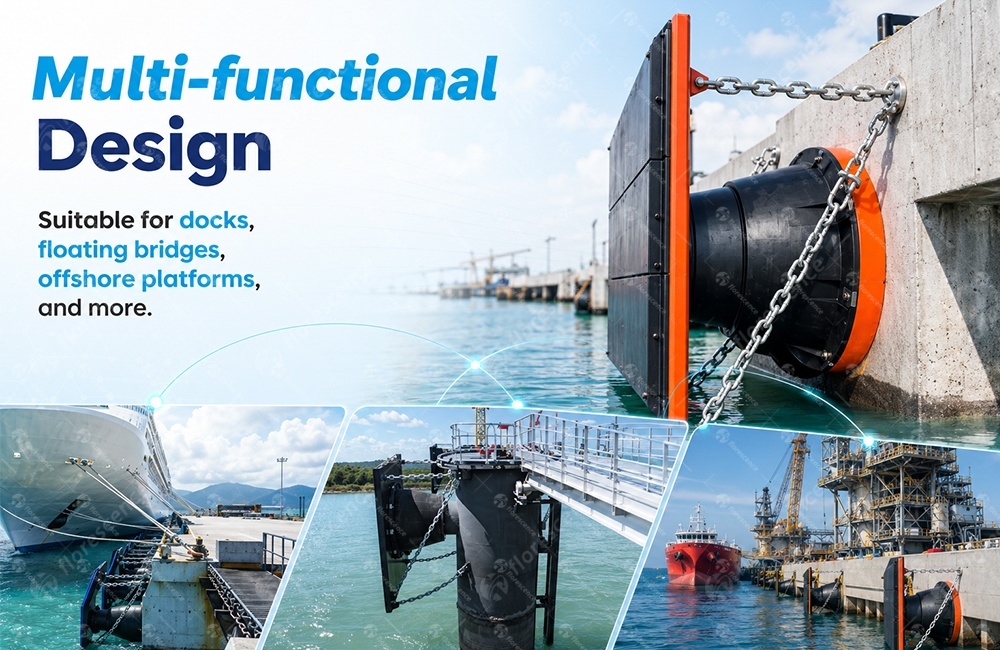
A cone rubber fender system combines the rubber cone, steel frontal panel and UHMW-PE facing pad.
Published performance parameters for the cone fender range are a rated deflection of 70% and a maximum permissible deflection of 72.5%, with reaction force tolerance of ±10% and energy absorption tolerance of −10%. The compound is marine NR/SBR at Shore A 60–70 hardness, with CR available for oil resistance and EPDM for UV resistance, and the operating temperature range is −30 °C to +80 °C. Cone fenders serve container, bulk, oil, ro-ro and offshore terminals.
Cell Fenders: General Berths and Mixed Fleets
Cell fenders are the general-berth workhorse. They are described as cost-effective for general berths, while cone fenders provide higher energy absorption efficiency and lower reaction force for large vessels — a distinction worth applying directly when a terminal handles a mixed fleet and wants one consistent fender line.
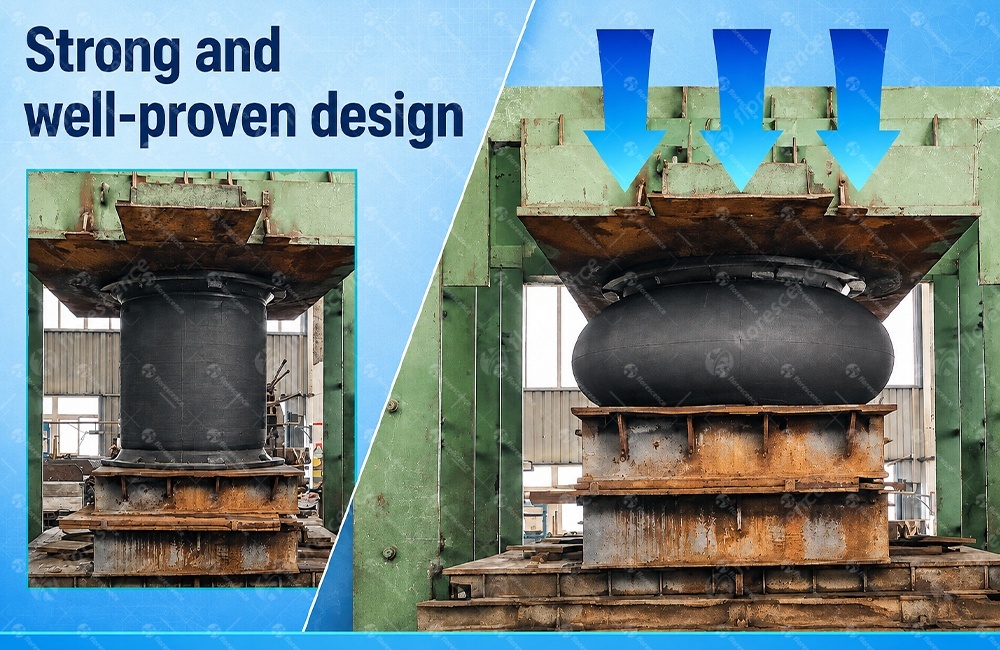
Cell rubber fenders are adopted in container, bulk, oil, LNG and ro-ro terminals for heavy-tonnage berthing.
The cell fender is rated at 52.5% deflection with a 55% maximum permissible deflection, Shore A 60–70 hardness, ±10% reaction force tolerance and −10% energy absorption tolerance, made to the PIANC standard and rated for −30 °C to +80 °C. A practical advantage for mixed berths is the availability of reaction force grades — RL (low), RO, RH, RS and RE (extra high) — which allows reaction force to be tuned against the same berth structure without changing the fender family.
Supporting Types That Complete the Picture
- Arch fenders — 52.5% rated and 55% maximum deflection, Shore A 60–70, made to PIANC; performance is linearly proportional to fender length, which makes them straightforward to scale along a berth.
- Cylindrical and tug fenders — 50% rated and 60% maximum deflection; easy hanging mounting suits multi-angle impact and large tidal variation at general ports, fishing harbours, inland canals and shipyards.
- D fenders — DD100 to DD500 with lengths of 1–3 m, 50% rated and 60% maximum deflection; widely used for tugboat side protection, fishing harbours, inland terminals, marinas and shipyards.
- W fenders — 30% rated and 35% maximum deflection for most of the series, with some heavy-duty models reaching 50–52.5%; the multi-arch section delivers 20–30% lower reaction force than a D-type fender at the same compression, with flexible legs that follow bow and stern radii.
- Square fenders — heights from 100 mm to 500 mm, also available with a PE pad; used on jetties, marinas, tug and workboat side belting, lock gates and land loading docks.
- Foam fenders — diameter 0.5–4.5 m, length 1.0–12 m, 5–8 year service life; the unsinkable floating, maintenance-free and non-marking design serves offshore oil and gas, STS transfer, cruise, naval, bulk ports and marinas.
Accessories and System Scope: What Belongs in the Same Purchase Order
A fender body on its own is not a berthing system. Complete fender systems can be supplied with anchor bolts, chains, shackles, frontal panels, UHMW-PE pads and installation brackets as spare and replacement parts. Anti-corrosion options for steel components include hot-dip galvanizing, epoxy coating, marine paint systems and zinc-rich primer coating.
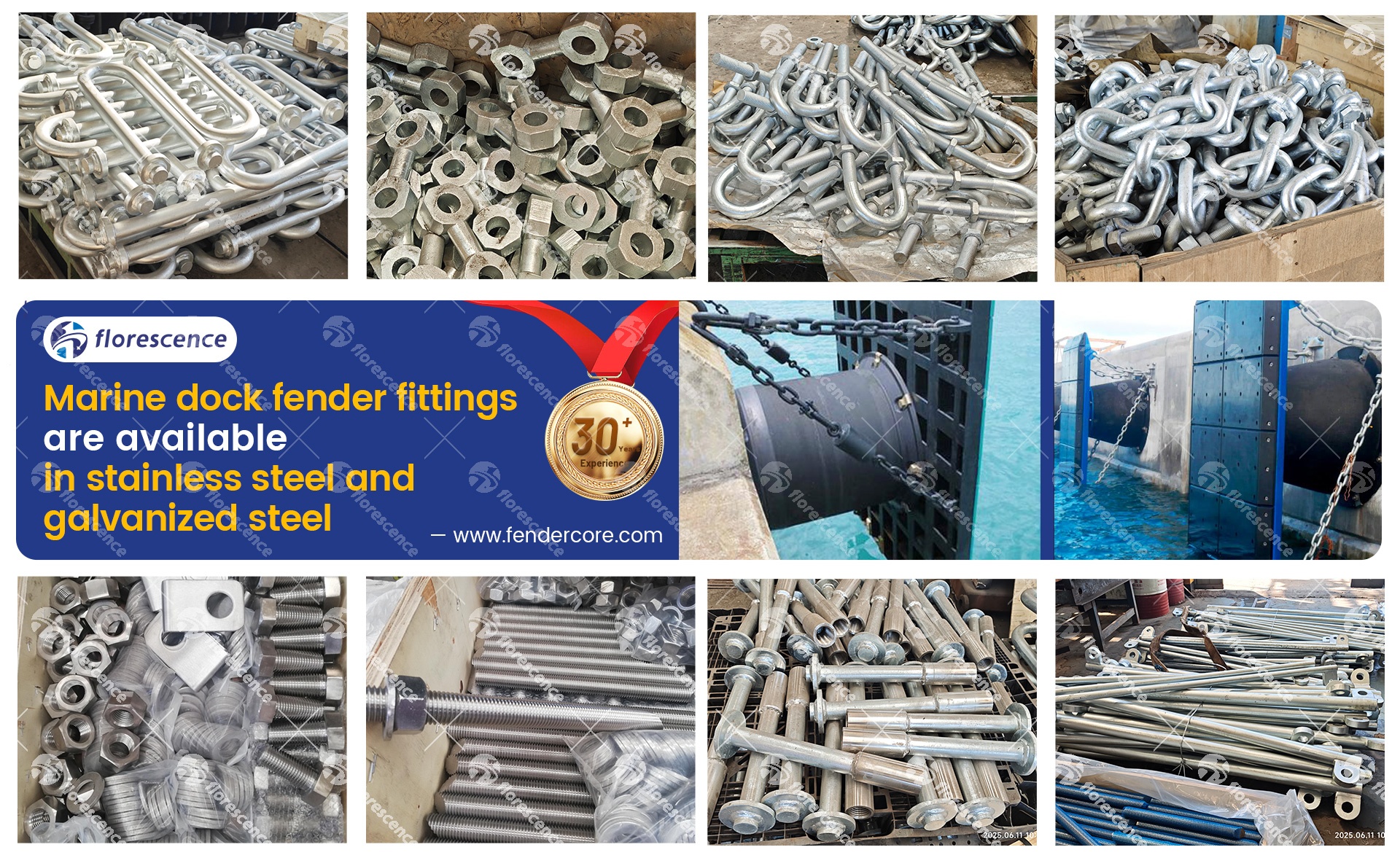
Fender fittings and system hardware are specified together with the fender body so that replacement parts remain available.
This is where long-term supply arrangements are won or lost. A UHMW-PE pad is a wear item; an anchor bolt pattern is a fixed interface. If either is bought outside the original package, the second purchase becomes a reverse-engineering exercise. Specifying the full system once keeps the berth maintainable.
Step-by-Step Breakdown: From Berthing Data to a Supported Fender Package
Step 1 — Fix the operating mode before the product
Write down whether the location is primarily STS, STQ or STB, and whether secondary operations occur there. A quay that also handles occasional ship-to-ship transfers needs a floating unit in the scope, not only a fixed one.
Step 2 — Collect vessel and berth data
Fender selection depends on vessel size, berthing energy, tidal variation, berth structure and operational conditions. Florescence's engineering team assists with product selection, technical calculations and layout recommendations, so the data set should be assembled before the fender family is fixed.
Step 3 — Choose the fender family against the contact case
Pneumatic for floating contact and repositionable protection; cone for large-tonnage and oblique berthing; cell for general berths and mixed fleets. Where a berth needs only modest protection, arch, cylindrical, D, W or square profiles may fit the structure better than a large cell unit.
Step 4 — Set the size, pressure and deflection limits
For pneumatic units the choice is between 50 kPa and 80 kPa internal pressure across the 0.5–4.5 m diameter and 1.0–12 m length range. For solid profiles, the maximum permissible deflection is a hard limit, not a target: cone 72.5%, cell and arch 55%, cylindrical and D 60%, and W 35% for the standard series. Over-compression beyond the rated working point shortens service life.
Step 5 — List accessories as separate line items
Chains, shackles, swivel joints, towing rings, frontal panels, UHMW-PE pads, anchor bolts, installation brackets and, for pneumatic units, the chain-tire net and air compressor. Each item should appear on the quotation rather than in a footnote.
Step 6 — Define inspection and documentation before production starts
Florescence operates under ISO 9001:2015 quality management, with strict control from raw material selection through production, assembly, testing and final inspection. Batch testing covers rubber raw material testing, dimensional and hardness checks for rubber fenders, and air-tightness tests for ship airbags and pneumatic fenders. Third-party inspection by agencies such as SGS, Bureau Veritas and LR is welcomed, and products can be manufactured and inspected to CCS, BV, RS, ABS and LR requirements where a project calls for it.
Documentation includes EN 10204 3.1 Mill Test Certificates for all metal parts and bolts with full material traceability, plus physical property reports covering tensile strength, elongation and compression for the rubber. Before shipping, a full Quality Inspection Report is issued with rubber test data, sizing sheets, coating thickness records and clear product photos, and goods are shipped only after customer approval. Compression testing on sample cell, cone or arch fenders can be used to verify that energy absorption and reaction force meet the design values.
Step 7 — Plan logistics around the fender type
Shipping is available by sea freight, air freight, LCL and FCL, with packing optimised to reduce transport cost and improve loading efficiency. Pneumatic fenders are shipped deflated to save freight, while arch and cone fenders are securely bundled on pallets and steel parts are wrapped to prevent rust. Internal transport to the loading port is handled by heavy-haul trucking companies with tracking from warehouse to terminal. After shipping, the container number and vessel tracking links are sent immediately; if weather or port problems cause a delay, the logistics team works with the shipping line on alternative routes to protect the project schedule.
Step 8 — Set the maintenance and spare-parts routine
Regular inspection of marine fenders is recommended for rubber condition, bolt tightness, chain wear, corrosion status and panel alignment. After-sales support covers installation guidance, maintenance recommendations, spare parts support, troubleshooting assistance and repair kits for inflatable marine products, supported by installation drawings, technical manuals, anchor layout recommendations and remote engineering support.
Use Cases
STS transfer at an offshore terminal or during bunkering
A CTN-type pneumatic fender is rigged, inflated to 50 or 80 kPa and floated at the water line so it absorbs impact continuously while both hulls move. Because it can be deflated, folded and stored, the same unit serves temporary and permanent installations as well as rapid response situations.
Container or bulk berth handling a mixed fleet
A cell fender line at 52.5% rated deflection, selected in the appropriate reaction force grade, gives a single consistent solution across vessel sizes. LNG and ro-ro terminals are explicitly within the cell fender's stated application range.
Large vessel berthing at an angle
Where the approach is rarely parallel, the cone fender's angular performance and low hull surface pressure matter more than raw energy absorption alone. With a 70% rated deflection, the cone profile uses more of its stroke before reaching the 72.5% limit.
Tug, workboat and inland operations
Cylindrical and tug fenders handle multi-angle impact and large tidal variation; D fenders protect tug sides, fishing harbours and inland terminals; W fenders suit tugboats, offshore vessels, inland barges and bridge piers with 20–30% lower reaction force than a D-type at the same compression.
Naval and government vessel support
Florescence products have been supplied to the Bangladesh Navy, French Navy, Royal Thai Navy, Italian Navy and Philippine Navy — experience that reflects demanding technical specifications, inspection requirements and delivery schedules.
Comparison Table: Rubber Fender Types by Berthing Application
| Fender type | Rated / maximum deflection | Berthing application | Key specification detail |
|---|---|---|---|
| Pneumatic rubber fender | Pressure-defined: 50 kPa or 80 kPa | STS transfer, STQ berthing, STB contact, temporary and emergency installation | Diameter 0.5–4.5 m, length 1.0–12 m; CTN or sling type; shipped deflated |
| Cone fender | 70% rated / 72.5% maximum | Large-tonnage vessels and oblique berthing at container, bulk, oil, ro-ro and offshore terminals | Excellent angular performance, low hull surface pressure, ultra-high energy absorption |
| Cell fender | 52.5% rated / 55% maximum | General berths; container, bulk, oil, LNG and ro-ro terminals | Reaction force grades RL, RO, RH, RS, RE |
| Arch fender | 52.5% rated / 55% maximum | General berth protection where performance must scale with berth length | Performance linearly proportional to fender length; PIANC standard |
| Cylindrical and tug fender | 50% rated / 60% maximum | Multi-angle impact and large tidal variation; general ports, fishing harbours, inland canals, shipyards | Easy hanging mounting |
| D fender | 50% rated / 60% maximum | Tugboat side protection, fishing harbours, inland terminals, marinas, shipyards | DD100–DD500; length 1–3 m |
| W fender | 30% rated / 35% maximum; heavy-duty models to 50–52.5% | Tugboats, offshore vessels, inland barges, ro-ro terminals, shipyards, bridge piers | 20–30% lower reaction force than D-type at the same compression |
| Foam fender | Not deflection-graded in the same way | Offshore oil and gas, STS transfer, cruise, naval, bulk ports, marinas | Unsinkable floating design, maintenance-free, non-marking; 5–8 year service life |
Comparison Table: System Scope and Spare-Parts Planning
| Component | Function in the berthing system | Why it belongs in the same RFQ |
|---|---|---|
| Chain-tire net (CTN) | Protects the pneumatic fender body | Usually recommended; sling type or body only remains an alternative |
| Shackles, swivel joints, chains, towing rings | Rigging and connection to hull or structure | Replacement requires the same specification as the original |
| Frontal panel and UHMW-PE pad | Load distribution and wear surface | Pad hole patterns and anchor bolt pitch must match the berth |
| Anchor bolts and installation brackets | Fixing the system to the quay or structure | Available as spare and replacement parts when ordered as a complete system |
| Anti-corrosion treatment | Steel component protection in salt water | Hot-dip galvanizing, epoxy coating, marine paint systems or zinc-rich primer |
| QIR and EN 10204 3.1 MTC | Acceptance documentation | Rubber test data, sizing sheets and coating records support later warranty and claim assessment |
| Spare parts and repair kits | Lifetime maintenance | Part of after-sales support for inflatable marine products |
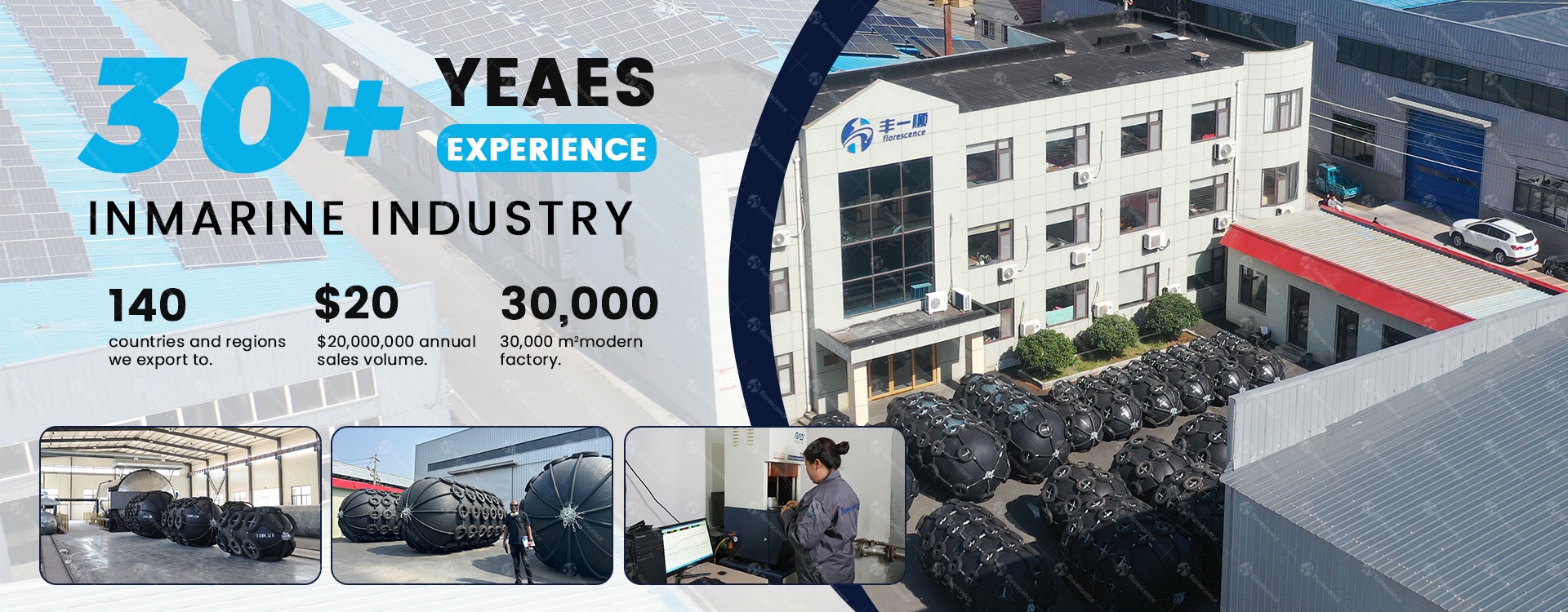
Pneumatic fenders are tested and documented before shipment, with the QIR issued for customer approval.
Frequently Asked Questions
Florescence manufactures and tests marine fender systems in accordance with PIANC guidelines and global engineering standards, under an ISO 9001:2015 quality management system. Products can be manufactured and inspected to CCS, BV, RS, ABS and LR requirements where a project specifies it, and third-party inspection by agencies such as SGS, Bureau Veritas and LR is welcomed. Documentation includes EN 10204 3.1 Mill Test Certificates for all metal parts and bolts with full material traceability, physical property reports covering tensile strength, elongation and compression for the rubber, and a Quality Inspection Report issued before shipment. For pneumatic fenders the international reference is ISO 17357-1:2014, which specifies requirements for high-pressure floating pneumatic rubber fenders; project-specific certificate requirements are collected at the inquiry stage.
Yes. Complete fender systems can be supplied with anchor bolts, chains, shackles, frontal panels, UHMW-PE pads and installation brackets as spare and replacement parts. After-sales services include installation guidance, maintenance recommendations, spare parts support, troubleshooting assistance and repair kits for inflatable marine products, backed by installation drawings, technical manuals, anchor layout recommendations and remote engineering support. The supply base behind that support is a 40,000 m² factory with 120 employees, an annual output of 2,000 pieces and a 25-engineer technical team, with more than 30 years of experience in marine fenders, pneumatic fenders, foam fenders and ship launching airbags supporting long-term supply relationships.
Scope, not the fender body alone. The main variables are fender type and size (a pneumatic fender ranges from 0.5–4.5 m diameter and 1.0–12 m length), internal pressure selection at 50 or 80 kPa, CTN versus sling type, the accessory set, the level of anti-corrosion treatment, the inspection and certification scope, and the freight configuration — pneumatic fenders ship deflated, arch and cone fenders are palletised, and LCL versus FCL changes the landed cost. Florescence usually quotes FOB and can arrange sea or land transport under CIF, CFR, DDP or DDU terms. On lifecycle cost, Florescence's own product comparison data states that a 5% higher initial procurement cost can be offset by a total cost of ownership reduction of 40% over a five-year service cycle, together with 90% less maintenance and 10% savings in installation time and overall installation cost compared with traditional rubber fenders. Buyers should validate such figures against their own berth utilisation.
Yes. A full Quality Inspection Report is issued before shipping, containing rubber test data, sizing sheets, coating thickness records and clear product photos, and goods are released only after customer approval. Weekly photos and videos of the vulcanization process and of final packaging are provided so buyers can follow production and shipping status in real time. Third-party inspection by SGS, Bureau Veritas or LR is welcomed, compression testing on sample cell, cone or arch fenders can verify energy absorption and reaction force against the design values, digital gauges are used to confirm marine epoxy coating thickness on steel components, and dimensional checks cover UHMW-PE pad hole patterns and anchor bolt pitch so that the delivered system fits the berth.
For standard rubber fenders and pneumatic fenders, bulk orders take 25 to 30 days after deposit; large custom orders and full fender systems take 40 to 45 days after deposit, with a clear schedule given before production. Shipping is arranged by sea or air, LCL or FCL, with heavy-haul trucking to the port and vessel tracking shared after departure. To start, send the operating mode (STS, STQ or STB), vessel size, berthing energy data, tidal range and berth structure details to inquiry@fendercore.com or WhatsApp +86 182-0532-1693, and the engineering team will return a selection proposal with drawings, documentation scope and a quotation.
Conclusion
The fender type follows the operation, not the other way round. Pneumatic rubber fenders cover ship-to-ship, ship-to-quay and ship-to-berthing contact because they float, reposition and absorb energy with a low reaction force. Cone fenders take the large-tonnage and oblique cases, using a 70% rated deflection and strong angular performance. Cell fenders hold the general berths, with reaction force grades that let one family serve a mixed fleet. The rest of the decision is system discipline: accessories, coating, inspection documents and spare parts specified in the same package, so the berth stays maintainable long after commissioning.
Florescence supplies pneumatic rubber fenders, cone, cell, arch, cylindrical, D, W and square fenders, foam fenders, and ship launching and salvage airbags from a 40,000 m² factory in Qingdao, with approximately 95% of products exported to overseas markets. Technical selection, inspection documentation and after-sales support are handled by the same team from inquiry through installation.
Send your berthing mode, vessel data and berth drawings for a selection proposal, or request the Florescence catalogue for the full product and accessory range.
Catalogue: Florescence Catalogue – Brief (PDF)
Website: www.fendercore.com
Contact: Michelle Zhang · inquiry@fendercore.com · +86 182-0532-1693
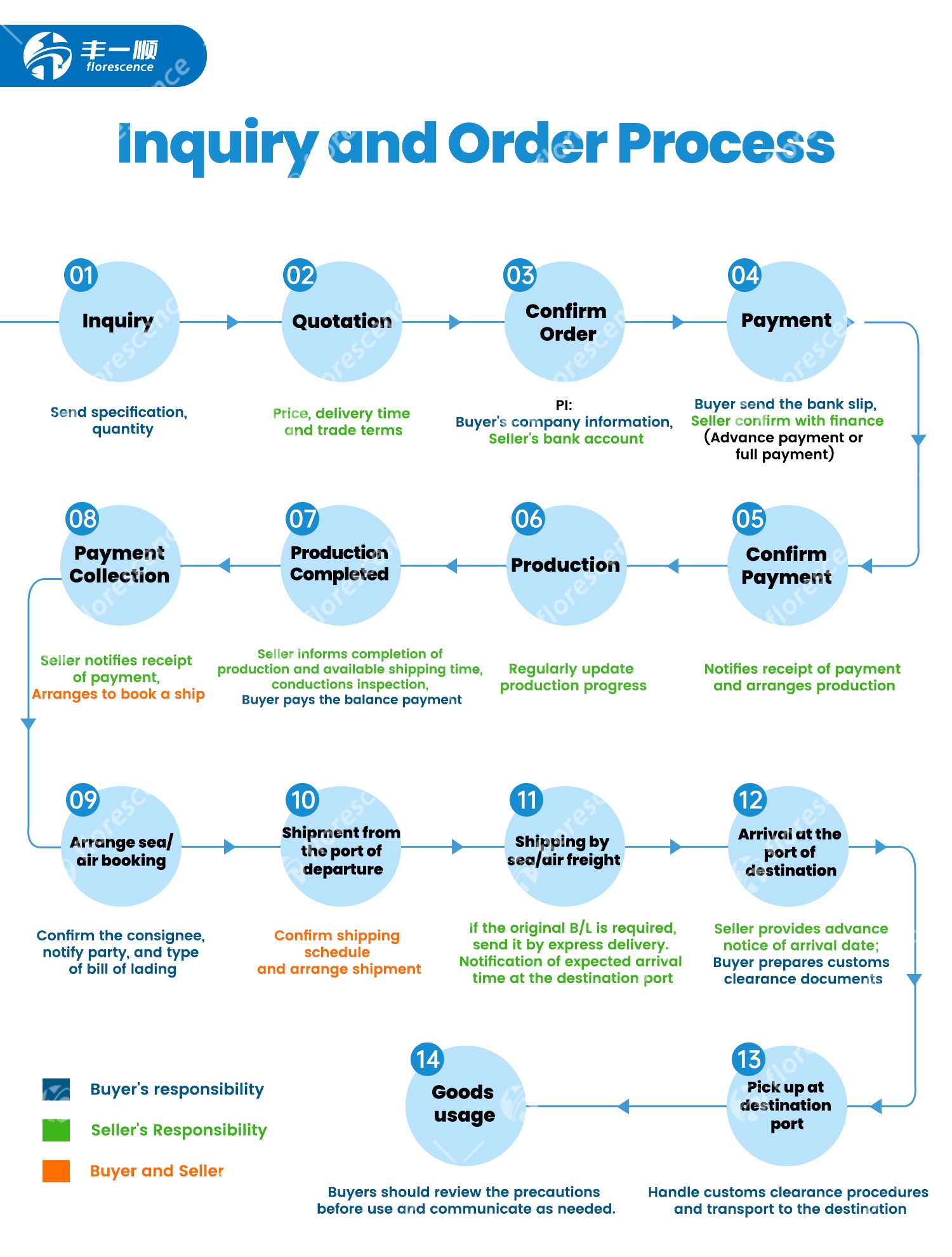
Inquiry, selection, production, inspection and shipment follow a documented sequence.
Have Questions or Need More Details?
Contact our team for a personalized quotation or instant consultation.
Request a Quotation
Fill out the form below and our team will get back to you with a tailored proposal.
WhatsApp Direct Chat
Prefer to chat in real-time? Message us on WhatsApp for instant assistance & quick answers.
- Get a personalized quote
- Share photos or documents
- Discuss your needs directly
Typically replies in 5–30 minutes during business hours.