
Rubber Fender Manufacturer vs Trading Company: Buyer Guide
Short answer: for a first rubber fender import, a direct manufacturer usually gives you more control over custom design, pre-shipment inspection and warranty execution, while a trading company can simplify sourcing when the specification is fully standard and simple. The right decision is made on verifiable evidence — certificate ownership, factory inspection access and document consistency — not on the quotation number alone.
This guide compares the two supplier structures against the checks that actually matter on a first order: how to tell a manufacturer from a trading company, how product quality is verified before goods leave the factory, how shipment and documentation are arranged, and what a manufacturer-side customisation capability can realistically deliver.
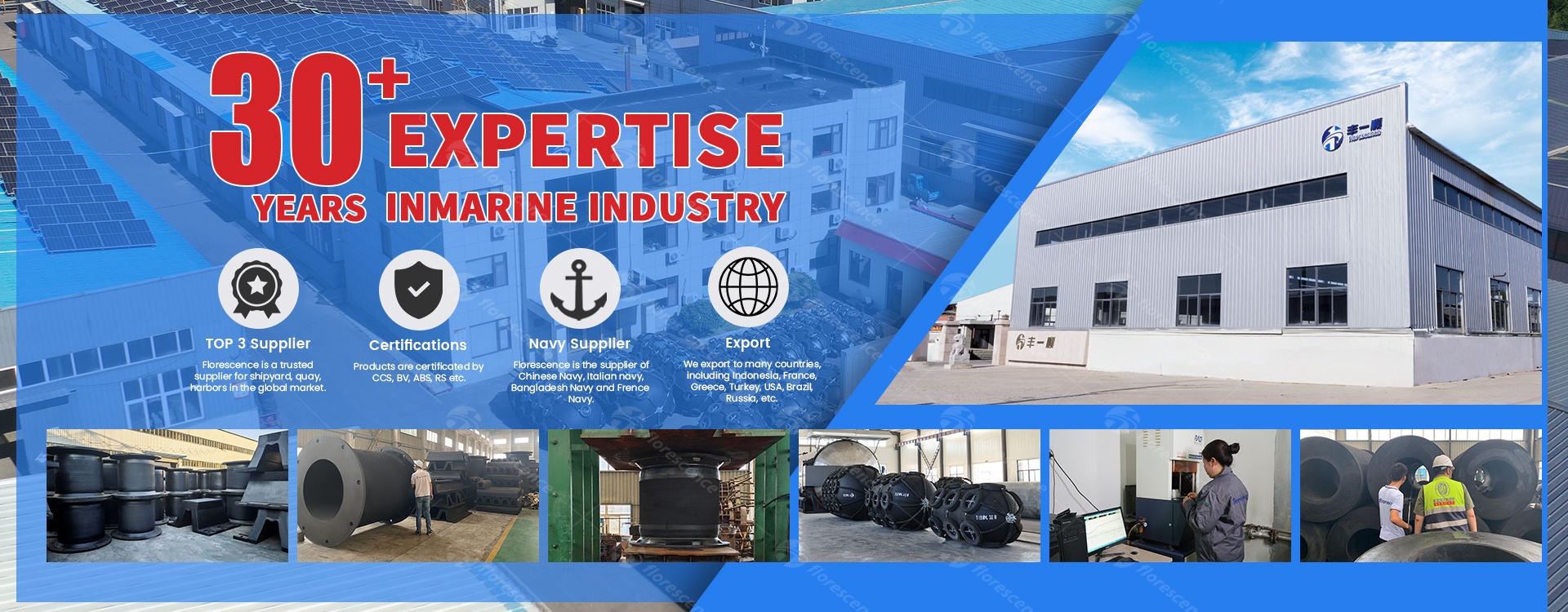
Rubber fender production floor at Qingdao Florescence Marine Supply Co., Ltd., a marine rubber manufacturer established in 1992. Buyers comparing a manufacturer against a trading company should ask which of these production steps the supplier actually owns.
Why This Question Decides Your First Order
The risk profile of a first rubber fender import is different from a repeat purchase. On the first order there is no baseline: no record of how the previous batch compressed, no relationship to call when a fitting arrives with a mismatched bolt pitch, and no evidence that the supplier's process repeats itself.
Three failure points dominate first orders, and each one depends on supplier structure.
- Specification drift. A custom requirement — a non-standard length, a specific inner pressure, a logo marking, a particular frontal panel geometry — is sent by email. Whether it survives into the drawing and the finished product depends on who receives it.
- Unverifiable quality claims. A certificate image and a certificate that actually covers your shipment are not the same thing. Confirming the second requires direct access to the production line.
- Ambiguous accountability after delivery. If a fender chain or a valve needs replacement in year two, response time depends on whether the supplier can manufacture the part or has to source it from someone else.
None of this means a trading company is automatically the wrong choice. It means the buyer needs to know which structure they are buying from, because the two structures deliver different things.
Industry Background: How the Rubber Fender Supply Chain Is Structured
The global marine fenders market is projected to reach approximately USD 0.89 billion in 2026, and rubber fenders account for roughly 64.17% of total marine fender market share — by a wide margin the dominant technology relative to foam and composite alternatives (Mordor Intelligence). That scale supports a large supplier base, and the size of the supplier base is exactly what creates the confusion for first-time importers.
In practice, three structural models exist:
- Direct manufacturer. Owns production equipment, rubber compounding and inspection capability, and issues certificates in its own name.
- Trading company. Does not own production. Sources from one or more factories, consolidates the order, and manages export documentation and logistics.
- Hybrid. A manufacturer with a separate trading entity, or a trading company with partial equity in a factory.
None of these models is inherently illegitimate. The real problem is mismatch — a buyer who assumes manufacturer-level design and inspection control, but has contracted with a structure that cannot provide it.
At customs level, the relevant classification is HS Code 4016.94: "boat or dock fenders, whether or not inflatable, of non-cellular vulcanised rubber" (UN Comtrade). This code applies no matter who sells the goods, so it offers no help in distinguishing a factory from an intermediary. That distinction has to be established directly, using the checks below.
Five Checks That Separate a Manufacturer from a Trading Company
1. Ask for the certificate number, not the certificate image
Almost any supplier can display a certificate. The useful test is whether the certificate belongs to them and covers the product you are buying. A verifiable quality-management certificate carries an issuing body, a registration number, a certification scope and a validity period.
Qingdao Florescence Marine Supply Co., Ltd. holds ISO 9001:2015 certification (certificate no. 32726Q10126RIS, issued by Shandong Guoyuan Certification Co., Ltd., valid 2026-05-09 to 2029-05-08) with a certification scope covering the production of marine airbags, rubber fenders and docking fenders. The same company holds ISO 14001:2015 certification (no. 32725E20318R0S). Product-level approvals include a Bureau Veritas certificate for cone fenders (no. INS/NR/SHOP-26/131, issued under PIANC), a BV certificate for pneumatic fenders (no. INS/NR/SHOP-25/377, issued under ISO 17357), and a Russian Maritime Register of Shipping certificate for submarine pneumatic rubber fenders (no. 21.10345.266, referencing ISO 17357-1:2014).
The point is not the number of certificates. The point is whether the supplier's own name appears on the document as the certified party — and whether the scope covers the product line you are ordering.
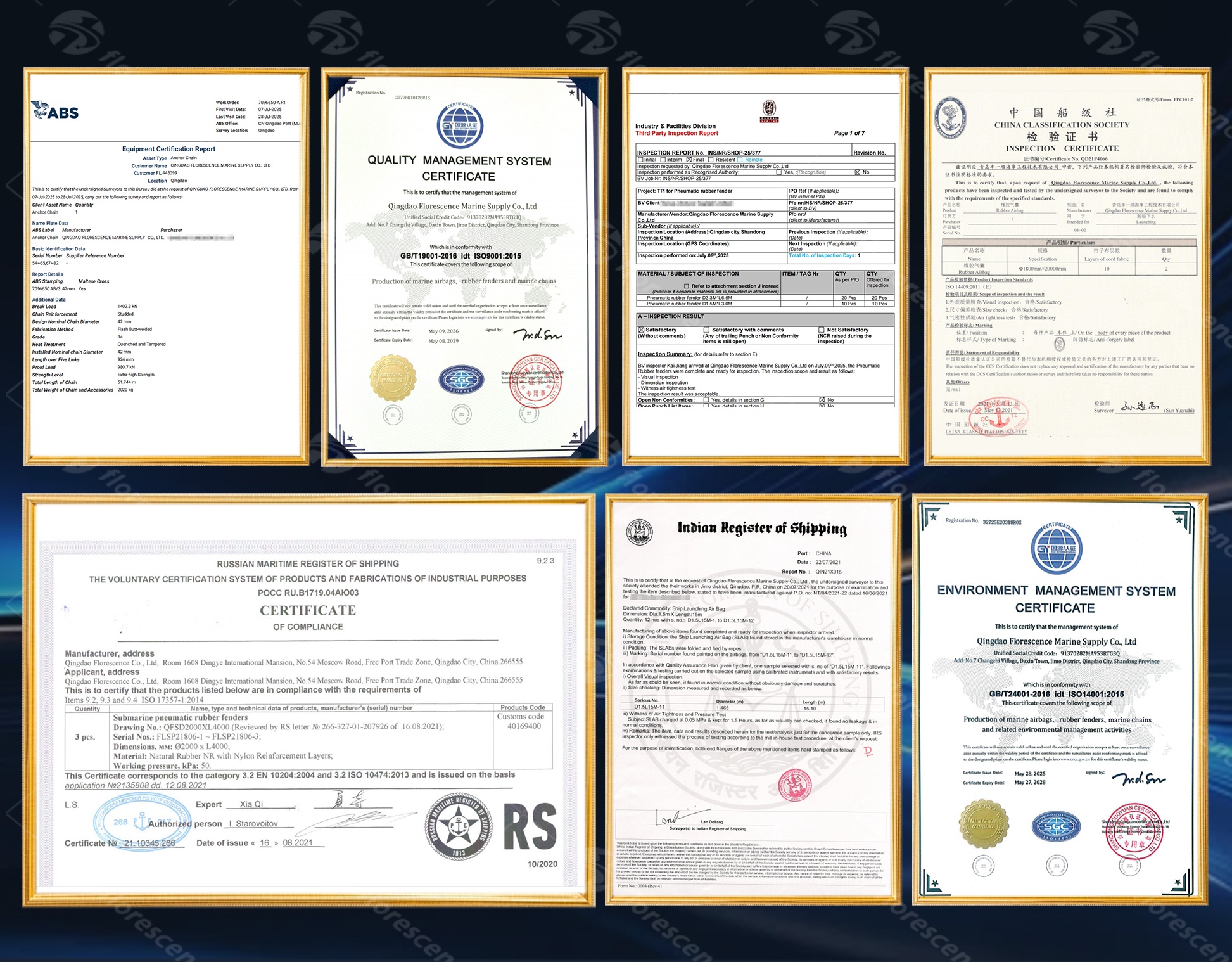
Certification held in the supplier's own name is one of the clearest structural signals separating a manufacturer from a trading company.
2. Test the customisation response
The fastest way to reveal supply-chain structure is to make one non-standard request. A manufacturer can confirm, modify or reject a custom specification internally, because engineering and production sit in the same organisation. A trading company has to relay the question and wait.
Florescence operates OEM and ODM production with customisation covering size, pressure, logo, fittings, package, solution and drawing. That capability rests on a 25-engineer R&D team inside a 40,000 m² factory, which is the resource that turns a custom request into a manufacturable drawing.
A practical test: send two requests at the same time — one standard size, one non-standard. Compare the response time and the technical depth of the answer. The gap between them is usually the clearest structural tell.
3. Ask exactly how quality is verified before dispatch
Quality control is where manufacturer-side and trading-company orders genuinely diverge. When production and inspection happen in the same building, the inspection sequence can be scheduled, witnessed and documented before the goods are packed — and the buyer can request the records.
A documented pre-shipment quality sequence for rubber fenders typically includes:
- Raw material testing of the rubber compound
- Dimensional inspection
- Hardness checks on rubber fender bodies
- Air-tightness and pressure testing on pneumatic fenders and marine airbags
- Compression testing on sample units to verify energy absorption and reaction force against the design specification
- Coating thickness measurement on steel components such as frontal panels and brackets
- Verification of hole patterns on UHMW-PE pads and anchor bolt pitch, which determines whether the system assembles correctly on site
- Third-party inspection when required — CCS, BV, ABS and DNV are all workable
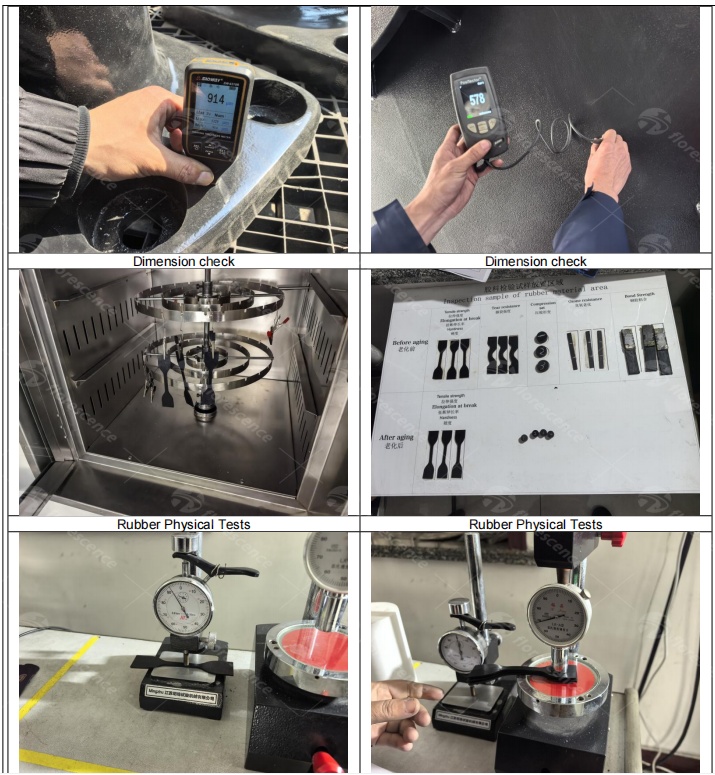
Raw material and fitting inspection performed in-house. Buyers comparing suppliers should ask for the inspection record, not just the finished-product photo.
4. Confirm whether third-party inspection is welcomed or resisted
A factory that owns its inspection equipment treats third-party inspection as routine. International agencies such as SGS, Bureau Veritas (BV) and LR can be engaged, and full cooperation means access to the production line, the test bench and the production records — not only photographs of the finished item.
Ask a direct question: which classification societies have witnessed your production, and on which project? Florescence products have been supplied to the Bangladesh Navy, French Navy, Royal Thai Navy, Italian Navy and Philippine Navy. Naval projects typically involve specified technical requirements, inspection protocols and delivery schedules, which is why the reference is useful when assessing process maturity.
5. Compare manufacturing footprint against order size
Capacity and order scale have to fit. A manufacturer running a monthly capacity of 200 units with a 5–30 day lead time and a 1-unit minimum order quantity can absorb a small trial order without disrupting existing contracts — which matters if you want to validate the product before committing to a full berth refit.
Florescence operates a 40,000 m² facility with 120 employees, an annual output of 2,000 units, a 25-engineer R&D team and a 95% export ratio across Southeast Asia, South America, Europe, North America, the Middle East and Africa.
Step-by-Step: Reducing First-Import Risk from Inquiry to Delivery
The sequence below is written for a first-time importer. Each step produces a document or a confirmation that protects both sides.
Step 1 — Establish supplier identity before payment
Request the business licence, the registered factory address, and a named contact with a direct phone number. Where possible, arrange a factory visit or a live video walkthrough of the production line. Anything that cannot be shown on camera is worth questioning.
Step 2 — Lock the custom specification in writing
Manufacturer-side customisation for rubber fenders covers size, pressure, logo, fittings, package, solution and drawings. Get the drawing approved before production begins. Confirm the parameter set that applies to your product — for example:
- Pneumatic rubber fenders: natural rubber and nylon cord construction, tire net / shackle / swivel / chain fittings, CTN or sling type, inner pressure 50 or 80 kPa, diameter 0.5–4.5 m, length 1.0–12 m.
- Cone fenders: rated deflection 70%, maximum permissible deflection 72.5%, marine NR/SBR rubber with optional CR for oil resistance or EPDM for UV resistance, hardness Shore A 60–70.
- Cell fenders: rated deflection 52.5%, maximum permissible deflection 55%, PIANC standard, reaction force grades RL / RO / RH / RS / RE.
- Cylindrical and tug fenders: rated deflection 50%, maximum permissible deflection 60%.
- D fenders: DD 100 to DD 500, length 1 m to 3 m, rated deflection 50%.
- W fenders: rated deflection 30% for most of the series, maximum permissible deflection 35%.
- Square fenders: height from 100 mm to 500 mm, with an optional PE pad type.
Step 3 — Agree the inspection plan
Decide before production whether you will inspect at the factory, appoint a third-party inspector, or rely on the supplier's in-house report. If you appoint an inspector, confirm the timing window so the goods are not already packed when the inspector arrives.
Step 4 — Agree the packing method
Packing affects both freight cost and arrival condition. Arch and cone fenders are typically bundled on pallets; pneumatic fenders are shipped deflated to reduce freight volume; steel parts are wrapped to prevent rust. Confirm what is included and what is not, and ask for photos of the packed goods before collection.
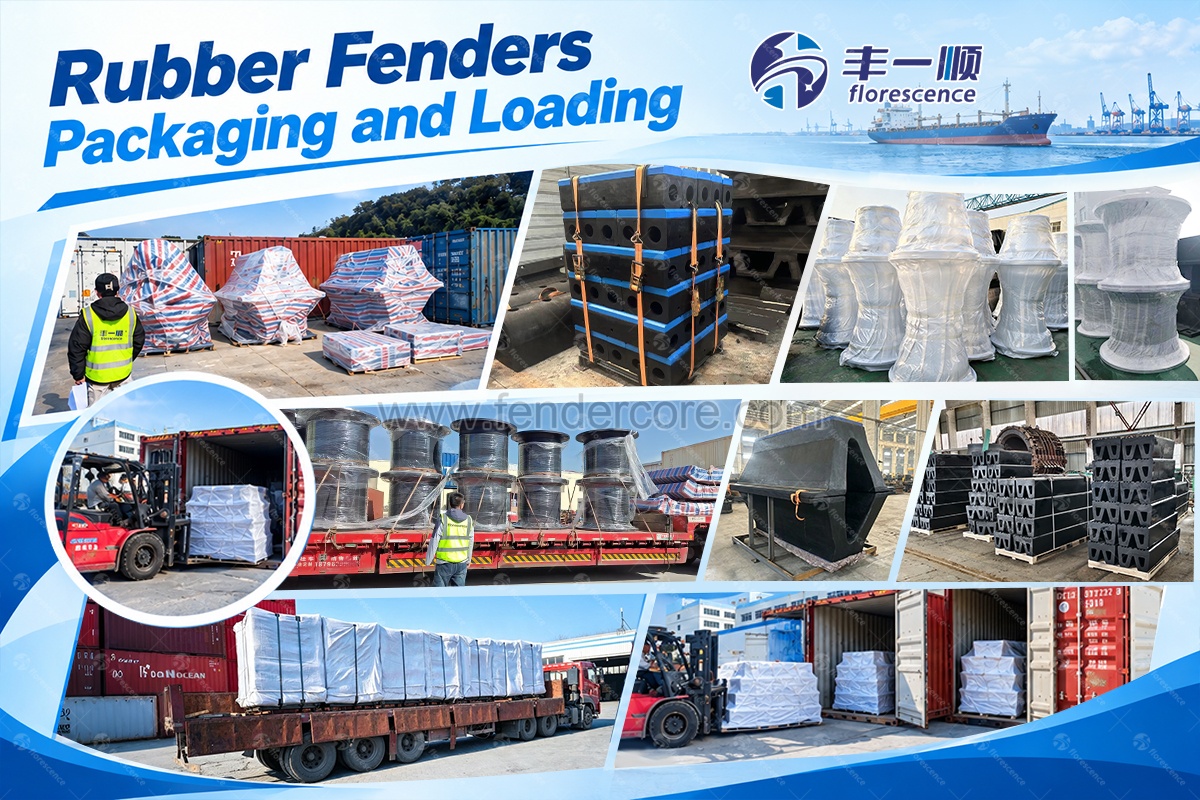
Export packaging of marine rubber fenders. Packing method directly affects freight cost and the condition of the goods on arrival.
Step 5 — Choose the trade term that matches your experience level
FOB is the common starting point, but sea and land transport can also be arranged under CIF, CFR, DDP or DDU. If this is your first import, a delivered term shifts the freight and customs handling to the supplier's side, which removes a significant amount of unfamiliar coordination work from your team.
Step 6 — Confirm the document set before shipment
The standard export document set includes a commercial invoice, packing list, bill of lading and certificate of origin. Certificates of origin such as Form E, Form F or CO can reduce import duty depending on the destination market — confirm which one applies to your country before the goods are booked.
Step 7 — Set up production and shipping visibility
Ask for progress updates at fixed intervals rather than on request. This is where manufacturer-side orders are easier to manage: production photos and videos can be captured on the line, and after shipping the container number and vessel tracking links can be forwarded directly.
Step 8 — Confirm warranty and after-sales terms in the contract
Manufacturer-side after-sales support for Florescence covers 24/7 online technical support, installation, use and repair guidance, global on-site service, a 12–24 month warranty, and free repair kits or spare kits. These should appear in the order confirmation, not only in a sales conversation.
On payment security. Secure payment terms such as TT or L/C protect both parties. For first-time importers, engaging a local import agent is a practical way to reduce procedural risk on the destination side. A supplier that follows a documented process will send production photos or videos and shipment updates at each stage, and will forward the bill of lading and vessel tracking information promptly after dispatch.
Use Cases: Manufacturer-Side Execution in Practice
Bangladesh Navy — submarine berthing protection
Four units of specialised hydro-pneumatic submarine fenders were delivered and installed for submarine berthing and mooring protection. The units were equipped with an internal water ballast system and counterweight to keep the fender standing vertically underwater, with an adjustable water-to-air ratio. The scope covered custom manufacturing, on-site technical guidance, installation, crew training and joint naval acceptance testing.
Singapore — tugboat fleet protection
Thirty pieces of heavy-duty tugboat fendering were supplied for bow, stern and side protection during high-frequency harbour escort and push-pull operations. The units were built to custom lengths, pre-curved radians and tapered ends matched to the client's hull geometry. The scope covered custom CAD design, rubber compounding, manufacturing, factory performance testing and installation guidance.
Malta — ship-to-ship transfer fenders
Four pneumatic fenders at D2500 × L4000 mm were delivered for ship-to-ship transfer operations, manufactured and inspected under BV, CCS, ABS and ISO approvals with a service life expectation of over 10 years in continuous offshore service.
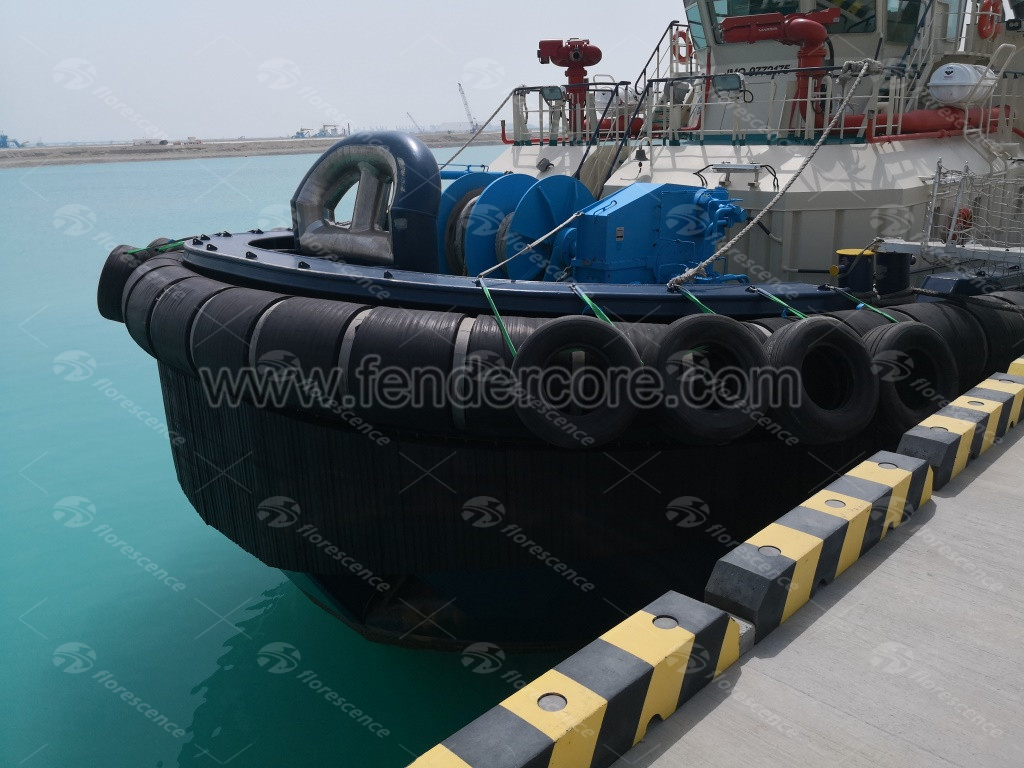
Custom tugboat fendering manufactured to match specific hull geometry — an example of a request that requires in-house engineering rather than catalogue supply.
Comparison Table: Manufacturer vs Trading Company
The table below compares the two supplier structures against the criteria first-time importers ask about most often. The manufacturer column reflects capabilities that can be documented and verified; the trading-company column describes the typical intermediary structure.
| Decision criterion | Direct manufacturer | Trading company |
|---|---|---|
| Custom design — size, pressure, logo, fittings, package, solution, drawings | Engineering and production in the same organisation; drawing returned directly to the buyer | Request relayed to a third-party factory; revision cycles pass through an intermediary |
| Pre-shipment quality control | In-house sequence: material testing, dimensional check, hardness, pressure / air-tightness, compression testing, coating thickness | Dependent on the source factory's process; records may be compiled rather than issued |
| Third-party inspection access | Direct access to production line, test bench and production records | Access depends on the source factory's willingness and schedule |
| Certification | Certificate held in the supplier's own name, with defined scope and validity period | Certificates usually belong to the source factory and are provided as copies |
| Warranty holder | Supplier is the warranting party; 12–24 month warranty available | Warranty may be passed through, with slower resolution paths |
| Spare parts and repair kits | Manufactured or held by the supplier; free repair kits and spare kits available | Depends on continued availability from the source factory |
| Minimum order quantity | As low as 1 unit for a trial order | Often set by the source factory's MOQ plus the intermediary's consolidation rules |
| Lead time control | 5–30 days, with production updates issued at fixed intervals | Lead time is a function of the source factory queue plus coordination time |
| Technical support after delivery | 24/7 online technical support, installation / use / repair guidance, global on-site service | Support routed through the intermediary; resolution time varies |
| Best fit | Custom specifications, inspection requirements, warranty-sensitive projects, first-order trials | Fully standard products, consolidated multi-supplier orders, buyers with established local logistics |
A trading company can be the better route when the requirement is a fully standard product and the buyer already has a reliable local forwarder and import agent. A manufacturer is generally the stronger route when the order involves custom geometry, third-party inspection, or a warranty that needs to be enforced years after delivery.
Frequently Asked Questions
Are you a manufacturer or a trading company, and what certifications does your factory hold?
Qingdao Florescence Marine Supply Co., Ltd. is a professional marine equipment manufacturer established in 1992, with over 30 years of experience in marine fenders, pneumatic fenders, foam fenders and ship launching airbags. The factory operates under ISO 9001:2015 (certificate no. 32726Q10126RIS) and ISO 14001:2015 (certificate no. 32725E20318R0S), with a certification scope covering the production of marine airbags, rubber fenders and docking fenders. Product-level approvals include BV certification for cone fenders under PIANC (no. INS/NR/SHOP-26/131), BV certification for pneumatic fenders under ISO 17357 (no. INS/NR/SHOP-25/377), and a Russian Maritime Register of Shipping certificate for submarine pneumatic rubber fenders under ISO 17357-1:2014 (no. 21.10345.266). Manufacturing and inspection can also be carried out to the applicable requirements of CCS, BV, RS, ABS and LR according to project requirements.
Can you customise cone and cell fenders for a specific berth design?
Yes. Florescence provides OEM and ODM production, with customisation covering size, pressure, logo, fittings, package, solution and drawings. A 25-engineer R&D team works from the vessel size, berth conditions and project requirements to develop a practical solution. For cone fenders, the rated deflection is 70% with a maximum permissible deflection of 72.5%, marine NR/SBR rubber, optional CR for oil resistance or EPDM for UV resistance, and Shore A hardness of 60–70. Cell fenders use a rated deflection of 52.5% with a maximum permissible deflection of 55%, and are available in reaction force grades RL, RO, RH, RS and RE. Both are produced to PIANC guidelines.
What is the minimum order quantity and what does the production schedule look like?
The minimum order quantity is 1 unit, which allows a first-time buyer to validate the product on a small trial order before committing to a full berth refit. Monthly capacity is 200 units, with a lead time of 5–30 days depending on product type, quantity, customisation requirements and shipping schedule. Standard rubber fenders and pneumatic fenders typically require around 25–30 days after deposit, while large custom orders or complete fender systems typically require 40–45 days. A clear schedule is issued before production begins.
How do you check product quality before the goods leave the factory?
The factory is ISO 9001 certified, and every production batch goes through a defined test sequence: rubber raw material testing, dimensional and hardness checks on rubber fenders, and air-tightness testing on ship airbags and pneumatic fenders. Compression testing can be performed on sample cell, cone or arch fenders to verify that energy absorption and reaction force meet the design specification. Coating thickness on steel components is measured with digital gauges, and hole patterns on UHMW-PE pads and anchor bolt pitch are dimensionally verified before dispatch. Third-party inspection by agencies including SGS, Bureau Veritas (BV), CCS, ABS and LR is welcomed, and a full quality inspection report with test data, sizing sheets, coating thickness records and product photographs is issued before the balance payment is released.
How are the goods shipped, and what after-sales support is included?
Sea freight, air freight, LCL and FCL shipment are all supported, with packing methods optimised to reduce transportation costs and improve loading efficiency. Arch and cone fenders are securely bundled on pallets, pneumatic fenders are shipped deflated to save freight, and steel parts are tightly wrapped to prevent rust. FOB is the usual quotation basis, but transport can also be arranged under CIF, CFR, DDP or DDU. After-sales support covers 24/7 online technical support, installation, use and repair guidance, global on-site service, a 12–24 month warranty, and free repair kits and spare kits. If this is your first import, the fastest way to reduce uncertainty is to start with a small trial order and a documented inspection plan — you can review the full product range in the Florescence product catalogue or send your berth parameters directly to the technical team for a specification review.
Conclusion
The manufacturer-versus-trading-company decision is not about which structure is superior in the abstract. It is about matching supplier structure to the actual risk in your order.
If your requirement is a standard fender at a standard size with no inspection or warranty exposure, a trading company can be an efficient route. If your requirement involves custom geometry, a documented pre-shipment inspection sequence, third-party witnessing, or a warranty that has to be enforceable years later, a manufacturer is the structure that can deliver it — because the engineering, the production line, the inspection bench and the warranty holder are the same organisation.
Five checks will tell you which one you are dealing with: certificate ownership, customisation response depth, inspection sequence detail, third-party inspection stance, and whether the manufacturing footprint matches the order. Run those checks before the deposit, not after.
Send your berth parameters for a specification review
Qingdao Florescence Marine Supply Co., Ltd. supplies pneumatic rubber fenders, ship and dock fenders, foam fenders, and ship launching and salvage airbags to ports, shipyards, vessel operators and naval organisations worldwide, with a 95% export ratio across Southeast Asia, South America, Europe, North America, the Middle East and Africa.
Contact: Michelle Zhang · WhatsApp / Mobile +86 182-0532-1693 · Email inquiry@fendercore.com · Website www.fendercore.com
Send a drawing, a berth photo or a vessel type and the engineering team will return a specification recommendation with a drawing and a quotation.
Have Questions or Need More Details?
Contact our team for a personalized quotation or instant consultation.
Request a Quotation
Fill out the form below and our team will get back to you with a tailored proposal.
WhatsApp Direct Chat
Prefer to chat in real-time? Message us on WhatsApp for instant assistance & quick answers.
- Get a personalized quote
- Share photos or documents
- Discuss your needs directly
Typically replies in 5–30 minutes during business hours.