
Ship Launching Airbags: How They Work and When to Use Them
A ship launching airbag is a heavy-duty inflatable rubber cylinder that is placed under a vessel's hull, inflated to a specified working pressure, and used to lift the ship clear of its keel blocks so that it can roll into the water. The product category is defined internationally by ISO 14409:2011. Florescence — the marine rubber brand of Qingdao Florescence Marine Supply Co., Ltd, a manufacturer established in 1992 and based in Qingdao, China — produces Ship Launching Airbags in 3 to 12 reinforcement layers, with diameters from 0.6 m to 2.8 m and lengths from 5.0 m to 25 m, and states that its ship rubber airbags comply with ISO 14409.
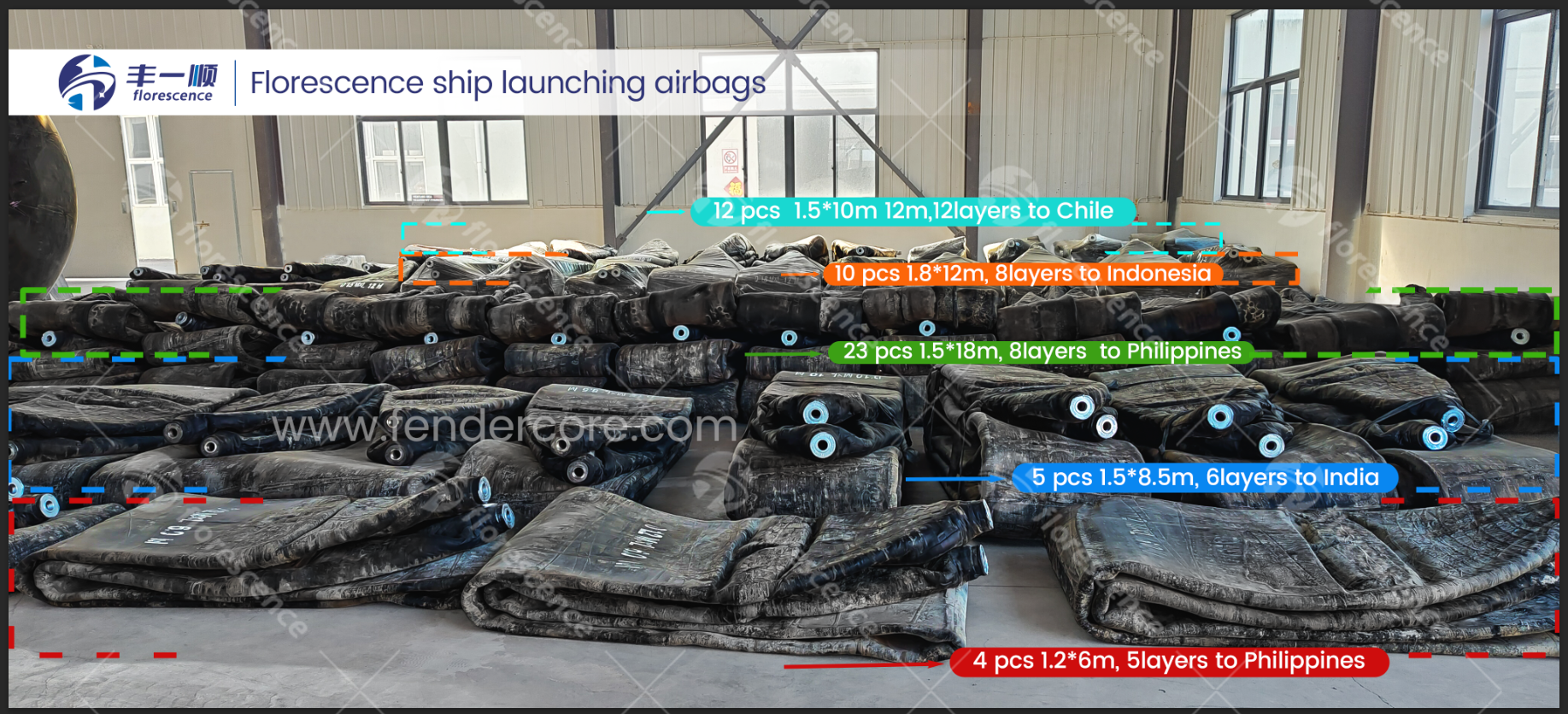
Ship Launching Airbags produced by Florescence, Qingdao Florescence Marine Supply Co., Ltd.
This guide is written for shipyard engineers, repair and dry dock operators, salvage contractors and procurement staff who are evaluating the airbag method for the first time. It explains the problem the product solves, the standard and market context behind it, how the airbag is built and specified, the launch sequence step by step, the applications it covers, and the questions buyers typically ask before requesting a quotation.
The Problem: Moving a Hull from Land to Water Without a Permanent Slipway
Every new build, conversion or major repair ends with the same task: transferring a hull from its blocking on land into the water. The traditional answer is a slipway — a fixed inclined structure with its own civil works, tied to one location and one capacity band. The airbag method replaces that fixed asset with a set of reusable inflatable rollers.
The practical difference is site flexibility. Because the airbags can launch a ship at any seaside location, there is no need to build dedicated launching facilities, and the supplier describes the method as more environmental than traditional slipway launching for that reason. For a buyer this changes three things: capital exposure, choice of launch site, and the equipment list that has to be on hand on launch day.
The trade-off is that the load path now sits inside pressurised rubber. A launch depends on correct airbag sizing, correct spacing, controlled inflation pressure and a clean slipway surface. Supplier guidance is explicit about the failure modes that must be designed out:
- Over-pressure is forbidden. Operating pressure must be strictly controlled during inflation.
- The slipway must be suitable. It should be ground or cement concrete, selected according to the tonnage of the ship.
- No sharp objects. Both the slipway and the ship must be smooth and clean to avoid puncturing the airbags.
- No distortion or overweight. Distortion along the length of the bag during rolling must be avoided, and overweight loading after inflation is not permitted.
That is why the real question for a first-time buyer is not “which airbag do we buy” but “how do we specify a launch system we can repeat and verify”. The sections below are organised around that question.
Industry Background: A Standardised Category With a Concentrated Supply Base
Ship launching airbags are covered by a published international standard rather than informal workshop practice. ISO 14409:2011 — Ships and marine technology — Ship launching air bags — sets out provisions for design, material and testing, and classifies marine airbags into two categories: Ordinary (QP) and High-capacity (QG). A buyer who specifies “ISO 14409 compliant” is buying into a defined classification and test regime, not a generic rubber cylinder.
The market is small, specialised and geographically concentrated. The global marine airbags market was estimated at USD 328.82 million in 2025 and is expected to reach USD 346.59 million in 2026, according to 360iResearch. Asia-Pacific accounted for approximately 52% of global marine airbag market revenue in 2025, with China acting as the primary manufacturing and export centre. Production therefore sits with a limited number of rubber-processing factories that can build multi-layer cord-reinforced cylinders and air-tightness test them, rather than with general inflatable manufacturers.
Florescence is one of those factories. Qingdao Florescence Marine Supply Co., Ltd was established in 1992 and has more than three decades of experience in the marine industry, with expertise in product design, manufacturing, quality control and marine project support. The manufacturing facility covers 40,000 m², employs 120 staff and has an R&D team of 25 engineers; annual production capacity reaches 2,000 pieces. Export business accounts for 95% of total sales, with major markets in Southeast Asia, South America, Europe, North America, the Middle East and Africa.
Demand comes from a defined buyer group: shipyards handling new build and repair, dry dock operators, salvage and refloating contractors, heavy-transport contractors, and naval organisations. Florescence products have been supplied to the Bangladesh Navy, French Navy, Royal Thai Navy, Italian Navy and Philippine Navy, and are used in ports, shipyards, vessel operations, offshore facilities, marine engineering and naval applications.
The Solution: How Ship Launching Airbags Are Built and Specified
A Florescence Ship Launching Airbag is a multi-layer natural rubber and nylon cord cylinder supplied in diameters of 0.6–2.8 m and lengths of 5.0–25 m, in 3 to 12 reinforcement layers, with a stated service life of 5–8 years. It is used to launch and upgrade a ship of up to 100,000 DWT.
Construction and materials
The body is built from natural rubber reinforced with nylon cord, using special synthetic tire-cord layers rather than light coated fabrics. The layer count — from 3 up to 12 — is the main structural variable: it is what allows a single product family to cover light launch duties and heavy-duty launching work under the same design language. The compound is specified for wear resistance and anti-aging, and the product is designed for high pressure rating, seawater corrosion and all-weather temperature durability from −20°C to 50°C. With little maintenance required, the bags can be used repeatedly across multiple launches.
Fittings supplied with each airbag
Each unit is delivered with an inflation valve, a pressure gauge, a pulling ring, a three-way connecting tube and a hose joint. Around the airbag itself, a launch typically draws on matched equipment that includes terminal iron, protective covers, a high-capacity winch, wire rope, a pulley system, shackles, an air compressor and an inflation hose. Florescence also provides a repair kit and on-site instruction.
Specification at a glance
| Parameter | Specified value |
|---|---|
| Material | Natural rubber and nylon cord |
| Reinforcement | Multi-layer synthetic tire-cord, 3–12 layers |
| Size range | Diameter 0.6–2.8 m; length 5.0–25 m |
| Fittings | Valve, pressure gauge, pulling ring, three-way connecting tube, hose joint |
| Service life | 5–8 years, reusable |
| Stated standard | ISO 14409 |
| Certification | CCS, BV, ISO, RS, ABS and others; manufacture and inspection to CCS, BV, RS, ABS, LR requirements on request |
| Working conditions | High pressure rating, anti-aging, seawater corrosion resistance, −20°C to 50°C |
| Stated launch capacity | Ship launching and upgrading up to 100,000 DWT |
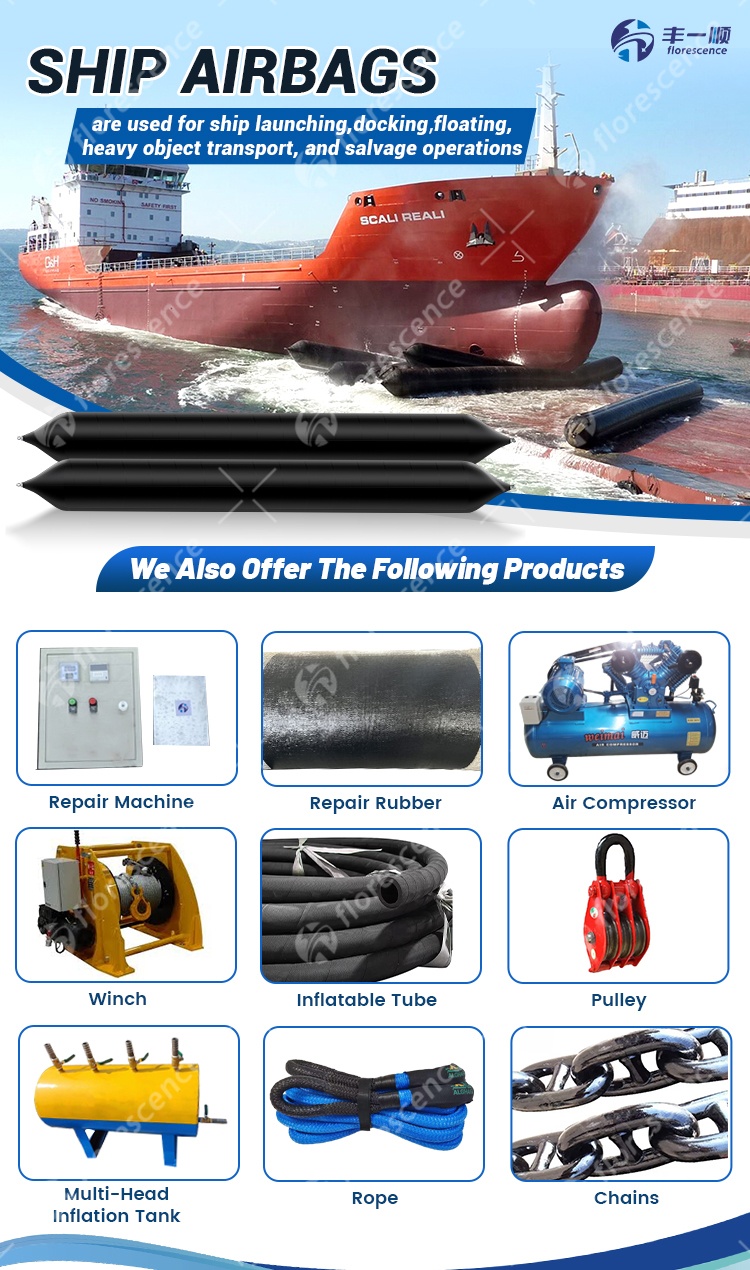
Airbag end fittings and supporting tools supplied with the bags — valve, pressure gauge, pulling ring, connecting tube and hose joint.
Operating envelope and what it means in practice
The method's equipment requirement is deliberately narrow. A launch needs no more than air compressors, winches and ropes, and the airbags themselves are portable, which is what allows the same set of bags to be moved between sites. Airbag sizes are held in stock for quick delivery, so a shipyard does not have to wait for a full production cycle before a scheduled launch.
The envelope is also broad in application terms. The same product family covers ship launching and upgrading, docking, hoisting and transporting heavy goods, floating use to improve draft, and salvage work — a point worth noting during first-stage evaluation, because one equipment type can serve several departments in the same yard.
The salvage branch of the same product family
Marine Salvage Airbags share the material and reinforcement logic but are built for a different duty. They are designed for a maximum working pressure of 0.25 MPa, which allows use at water depths of up to 25 m, and are supplied as a fully enclosed tube with cone ends, manufactured using Holistic Screw technology so that there are no welded seams. Buoyancy is stated at 10 to 50 tonnes per piece, which makes them usable as an alternative to rigid pontoons for supporting docks, floating bridges and other floating structures, and for jacking stranded vessels of more than 200 tonnes. For salvage applications, ISO 14409:2011 sets a minimum safety factor of 6:1 for buoyancy-related straps and lifting belts.
Step-by-Step: How an Airbag Launch Is Carried Out
An airbag launch is a sequence of controlled steps, not a single action. The sequence below follows the operating procedure described for ship launching, docking and vessel movement with rubber airbags.
Step 1 — Pre-launch preparation at the shipyard
Preparation starts well before launch day: confirming hull weight and dimensions, planning the airbag layout, and preparing the slipway so that it is smooth, clean and free of sharp objects. The slipway should be ground or cement concrete, selected according to the tonnage of the vessel.
Step 2 — Prepare the auxiliary equipment
The auxiliary equipment set includes the air compressor, rubber hoses, a winch and, where required, an excavator. Because the method needs no more than air compressors, winches and ropes, the preparation scope is limited compared with building or reactivating launching facilities.
Step 3 — Crew preparation
The launch crew is briefed on the pressure limits, the layout plan and the signals used during forward movement. Pressure discipline is the single most important crew instruction, because over-pressure is prohibited.
Step 4 — Rigging and airbag positioning
Deflated airbags are unrolled and laid flat underneath the ship's hull according to the pre-calculated spacing plan. Pneumatic hoses are connected to the inflation valves, and the holding winch system is rigged ready for the launch phase.
Step 5 — Inflation and block removal
The air valves are opened and the bags are inflated to the specified working pressure, lifting the vessel off its support blocks. Pressure is verified with the gauge on each unit. Once the ship is fully supported by the inflated airbags, the keel blocks, wooden supports and launching cradles are removed.
Step 6 — Moving the ship forward and rolling launch
The holding winch system is released, and gravity and momentum carry the vessel smoothly into the water on the rotating airbags. Distortion along the length of the bags must be avoided during this rolling phase.
Step 7 — Retrieval and storage
After the vessel floats free, the airbags are collected from the water, the release valves are opened to deflate them completely, and the units are cleaned, folded and stored for the next launch. Florescence states a service life of 5–8 years with repeated use, and supplies a repair kit and technical guidance for maintenance.
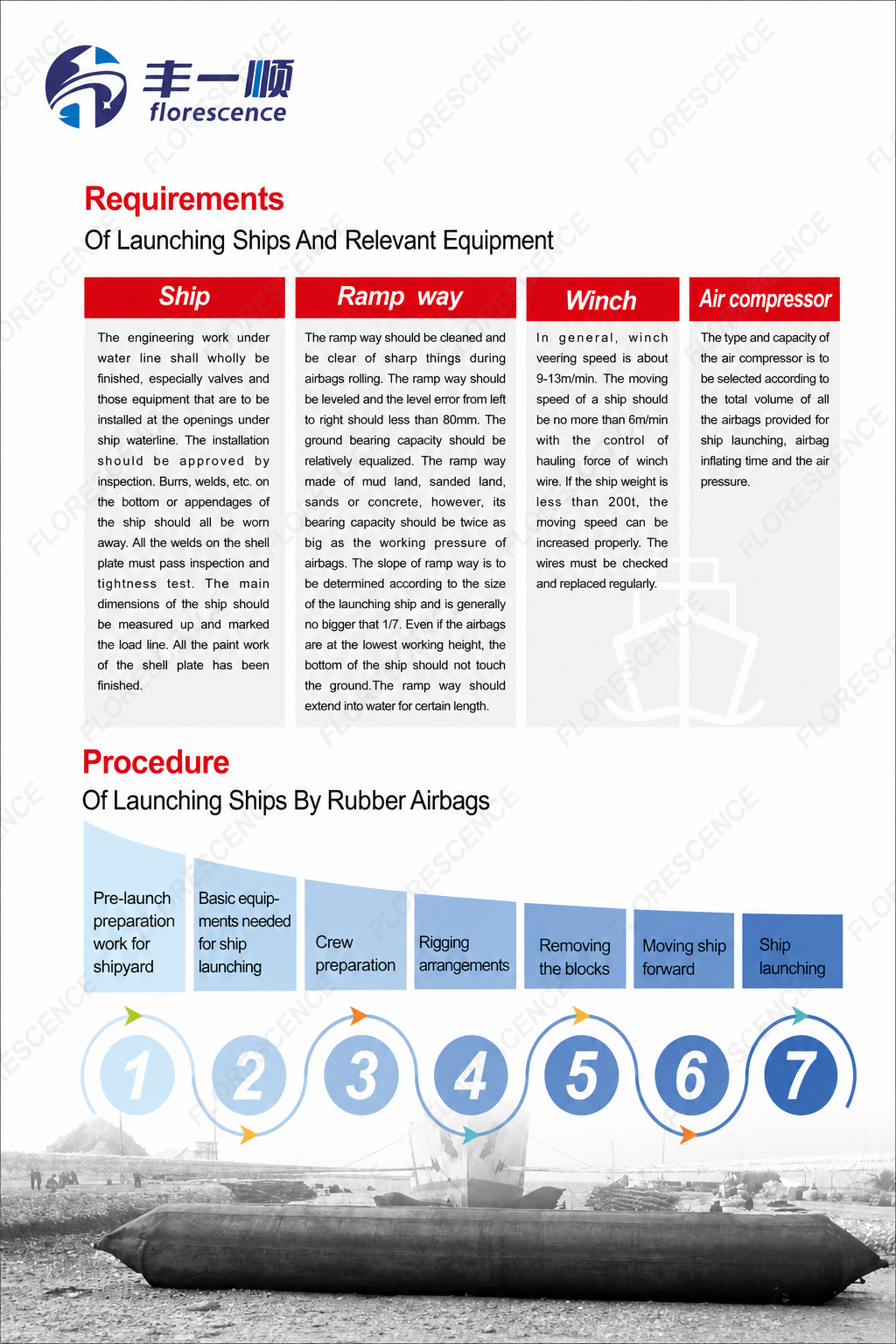
The airbag launch sequence: positioning, inflation, block removal, rolling launch and retrieval.
Use Cases: Where the Product Fits
The same airbag family covers launching, docking, heavy land transport and salvage. The most common applications in the published product data are:
- New build and repair launching. Launching of new vessels and of vessels returning to water after repair, in shipbuilding, ship repair and dry dock environments.
- Ship upgrading and conversion. Lifting and moving a vessel for upgrading, conversion or refit work.
- Docking and vessel movement. Ship docking and short-distance movement of hulls inside a yard or along a quay.
- Heavy goods transport on land. Hoisting and transporting heavy goods and structures of up to 10,000 tonnes on land.
- Salvage and refloating. Salvaging sunken vessels or heavy immersed steel structures, and jacking stranded vessels of more than 200 tonnes back into the water without dredging the watercourse or using a crane.
- Caisson launching in low water season. Where insufficient water level prevents conventional launching, salvage airbags support the launch of vessels up to 5,000 tonnes or caissons up to 8,000 tonnes.
- Floating and auxiliary uses. Floating use to improve draft, rubber bags for ship ballast, culvert forming, and pneumatic rubber cores for architecture engineering.
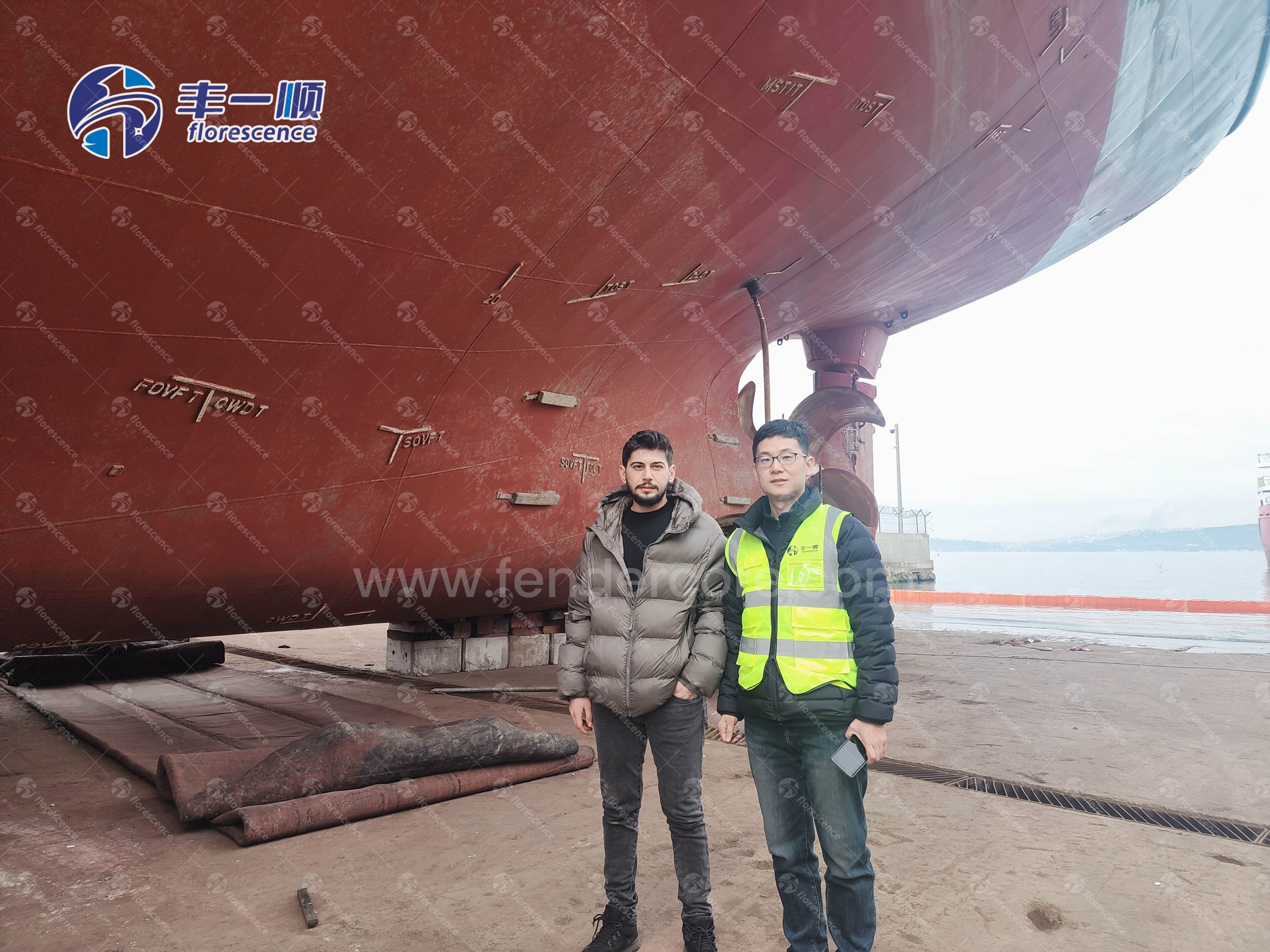
Florescence airbags in service at a shipyard in Turkey.
Comparison: Ship Launching Airbag vs Marine Salvage Airbag
Both products are built from natural rubber and nylon cord and share the same layer and size ranges, so they are frequently confused at the inquiry stage. They differ in pressure design, end construction and duty, as the comparison below shows.
| Attribute | Ship Launching Airbag | Marine Salvage Airbag |
|---|---|---|
| Primary duty | Ship launching, landing and vessel movement | Buoyancy assistance for marine recovery and salvage |
| Typical applications | New build and repair launching, ship upgrading and conversion, docking, heavy land transport, draft improvement | Shipwreck salvage, vessel lifting, stranded and sunken vessel recovery, caisson launching, replacing rigid pontoons |
| Material | Natural rubber and nylon cord | Natural rubber and nylon cord; special synthetic tire-cord layers |
| Layer range | 3–12 layers | 3–12 layers |
| Size range | Dia 0.6–2.8 m; length 5.0–25 m | Dia 0.6–2.8 m; length 5.0–25 m |
| Working pressure | Specified working pressure for the launch; over-pressure prohibited | Maximum working pressure 0.25 MPa, suitable for use at up to 25 m water depth |
| End construction | Moulded airbag with valve, pressure gauge, pulling ring, three-way connecting tube and hose joint | Fully enclosed tube with cone ends, Holistic Screw technology, no welded seams |
| Stated performance | Launch and upgrade ships up to 100,000 DWT; land transport of structures up to 10,000 tonnes | Buoyancy of 10–50 tonnes per piece; launches vessels up to 5,000 tonnes or caissons up to 8,000 tonnes in low water season |
| Service life | 5–8 years, reusable | 5–8 years |
| Certification | CCS, BV, ISO, RS, ABS and others; ISO 14409 compliance stated | CCS, BV, ISO, RS, ABS and others |
A second comparison matters at the procurement stage: what information a supplier needs before a set can be sized. Florescence recommends airbag size and quantity on the basis of ship length, width and weight, and the following data points shorten that process considerably.
| Data point | Why the supplier needs it |
|---|---|
| Vessel length, width and weight | Basis for recommending airbag size and quantity |
| Slipway type and surface condition | Slipway should be ground or cement concrete matched to tonnage; sharp objects must be eliminated |
| Launch or docking method planned | Determines diameter, length and layer count within the 3–12 layer range |
| Classification society and inspection scope | Manufacture and inspection can follow CCS, BV, RS, ABS or LR requirements |
| Target launch date | Stock sizes ship quickly; custom builds follow a longer production schedule |
Frequently Asked Questions
1. Which standard and certifications apply to ship launching airbags?
ISO 14409:2011 is the reference standard for ship launching air bags and covers design, material and testing. The same standard classifies marine airbags into two categories, Ordinary (QP) and High-capacity (QG), and sets a minimum safety factor of 6:1 for buoyancy-related straps and lifting belts in salvage applications. Florescence states that its ship rubber airbags comply with ISO 14409, and the product data sheet lists CCS, BV, ISO, RS and ABS among the available certifications. Products can be manufactured and inspected according to the requirements of CCS, BV, RS, ABS and LR depending on project requirements, within an ISO 9001:2015 quality management system. Because acceptance criteria differ between projects, the classification society and inspection scope should be stated in the inquiry.
2. What vessel size can a ship launching airbag handle?
Florescence states that its ship airbags can be used to launch and upgrade a ship of up to 100,000 DWT. On land, the same product family is described for hoisting and transporting heavy goods and structures of up to 10,000 tonnes. Capacity is not a single fixed number per bag: it depends on airbag diameter, working pressure, contact area, vessel weight and the number of airbags used, which is why sizing is based on ship length, width and weight. The available range is 3 to 12 layers, diameters of 0.6–2.8 m and lengths of 5.0–25 m. For salvage duty the figures differ: Marine Salvage Airbags are stated at 10–50 tonnes of buoyancy per piece at a maximum working pressure of 0.25 MPa, for use at water depths up to 25 m.
3. What drives the cost of an airbag launching set?
The main cost drivers are airbag diameter and length, the number of reinforcement layers (3 to 12), the number of bags required for the vessel's weight and hull length, the end fittings and accessories supplied with each unit, and any third-party or classification-society inspection. The cost of a launch is therefore not the price of a single bag but the specification of the set. Two structural factors affect the total cost of ownership: the bags have a stated service life of 5–8 years and can be reused across multiple launches, and the method requires no more than air compressors, winches and ropes, so no dedicated launching facility has to be built. Florescence positions the method as lower in cost and more portable than alternative launch methods for these reasons.
4. Can we verify quality or trial a unit before placing a bulk order?
Yes. The factory operates to ISO 9001:2015 and every production batch goes through defined tests, including rubber raw material testing and air-tightness tests for ship airbags. Third-party inspection is welcomed, and the company routinely works with international agencies including SGS, Bureau Veritas (BV) and LR to inspect marine fenders and steel structures. Before shipment, a full Quality Inspection Report covering test data, sizing sheets and product photographs can be issued for approval, and shipment proceeds after that approval. Each airbag is supplied with a repair kit and on-site instruction. To arrange a sample or a trial unit together with the relevant documentation, contact the Florescence team at inquiry@fendercore.com or +86 182-0532-1693.
5. What is the lead time for ship launching airbags?
Several airbag sizes are held in stock for quick delivery. For standard production, the usual lead time is about 25 to 30 days after deposit for standard rubber fenders and pneumatic fenders, while large custom orders or full system orders take about 40 to 45 days, with a clear schedule confirmed before production starts. Shipping can be arranged by sea or air, LCL or FCL; Florescence normally quotes FOB but can arrange CIF, CFR, DDP or DDU terms, and provides the commercial invoice, packing list, bill of lading and certificate of origin for customs clearance. To receive a schedule for a specific launch, send the vessel length, width and weight, the slipway condition and the target launch date.
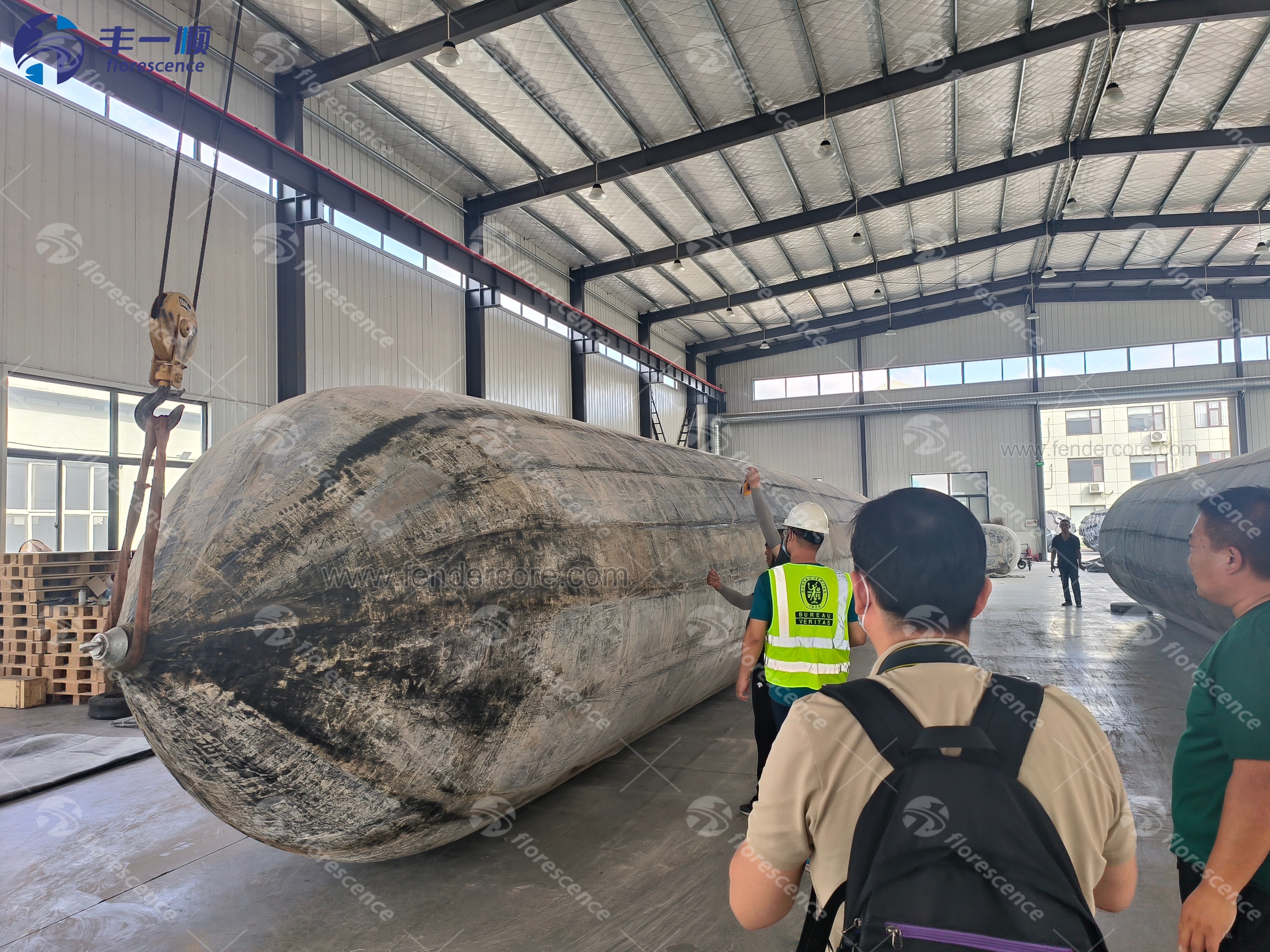
Air-tightness inspection of airbags before shipment — part of the batch testing routine at the Florescence factory.
Conclusion: Specifying Airbags as a Launch System
Ship launching airbags replace a fixed slipway with a reusable, portable set of inflatable rollers, and the category is governed by a published standard rather than workshop convention. The essentials for a first evaluation are consistent: ISO 14409:2011 defines design, material and testing and separates Ordinary (QP) from High-capacity (QG) airbags; the product is built from natural rubber and nylon cord in 3 to 12 layers, with diameters of 0.6–2.8 m, lengths of 5.0–25 m and a stated service life of 5–8 years; and a launch depends on controlled pressure, a suitable concrete or ground slipway, clean surfaces and correct spacing.
For buyers at the research stage, three decisions shape the specification more than any other: the vessel weight and dimensions that determine bag size and quantity, the slipway and site conditions that determine whether the method is viable at all, and the certification and inspection scope required by the project. Answering those three questions first makes the difference between a quotation and a launch plan.
Qingdao Florescence Marine Supply Co., Ltd manufactures Ship Launching Airbags and Marine Salvage Airbags alongside pneumatic rubber fenders and dock fenders, and supports projects from product selection and specification through manufacturing, inspection, delivery and installation guidance. The company is based at 27th Floor, 10-2 Building, Optical Valley Software Park, Emeishan Road No. 396, Qingdao, China, and publishes product information at www.fendercore.com.
Next step: size a set for your vessel
Send the vessel length, width and weight, the slipway condition and your target launch date, and the Florescence engineering team will recommend airbag size, layer count and quantity — and quote accordingly.
Email: inquiry@fendercore.com | info91@florescence.cc | Phone / WhatsApp: +86 182-0532-1693
Download the product catalogue: Florescence Catalogue – Brief (PDF)
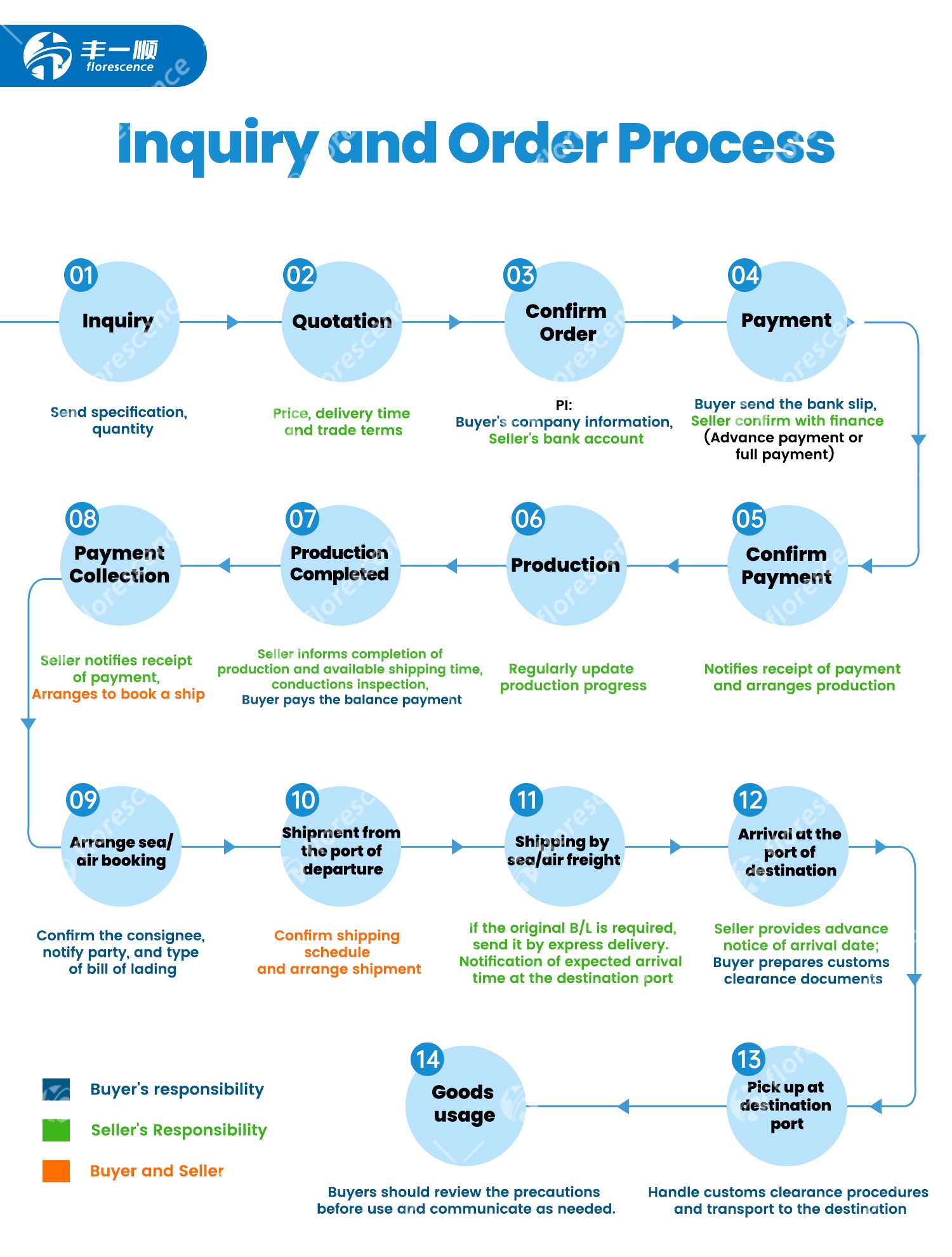
The Florescence inquiry and order process for ship launching airbags and marine fenders.
Have Questions or Need More Details?
Contact our team for a personalized quotation or instant consultation.
Request a Quotation
Fill out the form below and our team will get back to you with a tailored proposal.
WhatsApp Direct Chat
Prefer to chat in real-time? Message us on WhatsApp for instant assistance & quick answers.
- Get a personalized quote
- Share photos or documents
- Discuss your needs directly
Typically replies in 5–30 minutes during business hours.