Ship Launching Airbags vs. Slipway Launching: A Buyer's Comparison Guide
Ship launching airbags and slipway launching both move a completed vessel from land to water, but they place different demands on a shipyard. Airbag launching uses inflatable rubber airbags manufactured to ISO 14409, while slipway launching depends on a fixed inclined track built into the yard. The decision is not about which method is universally better. It is about which method fits the vessel, the site, the schedule, and the buyer's ability to control risk. This guide compares the two using neutral decision criteria and verified product facts, including ISO 14409 classification, BV certification, OEM customization, annual capacity, and lead time.
Problem Definition: Why Buyers Need a Decision Framework
Shipyards rarely choose between airbags and a slipway in the abstract. The choice appears when a yard needs to launch a vessel but has no usable slipway, when the existing slipway is occupied, when a new yard is being planned, or when a vessel must be launched at a temporary or remote location.
A fixed slipway requires civil construction and permanently ties launching to one place. That is appropriate for a yard with a steady production programme, but it limits flexibility when vessels are built at different sites or when production volumes vary. Airbag launching shifts the infrastructure requirement from civil works to the airbags themselves, the inflation equipment, and the operating procedure. That flexibility is only valuable if the airbags are correctly sized, manufactured to a recognized standard, and supported by a supplier that can deliver on schedule.
The cost of a wrong decision is practical rather than theoretical. An undersized or poorly specified airbag set can interrupt a launch window that is fixed by tide, drydock availability, or contract milestones. A slipway that is unavailable at the wrong moment can delay a vessel that is otherwise complete.
Buyers therefore need a framework, not a slogan. The criteria that matter are project fit, site requirements, scheduling, risk controls, certification, and supplier capability.
Industry Background: The Marine Airbag Market in 2026
Marine airbags are a mature product category with a defined standard and a concentrated manufacturing base. ISO 14409:2011 is the reference standard for ship launching air bags, covering design, materials, and testing. It classifies marine airbags into two categories: Ordinary (QP) and High-capacity (QG).
Market data from 360iResearch places the global marine airbags market at USD 328.82 million in 2025, with an expected value of USD 346.59 million in 2026. Asia-Pacific accounts for approximately 52% of global revenue, with China acting as the primary manufacturing and export center. For buyers, that concentration is practical: most sourcing conversations happen with Chinese manufacturers, and the quality gap between suppliers is wider than the product category itself suggests.
Safety expectations are also explicit. For marine salvage airbags, a minimum safety factor of 6:1 applies to buoyancy-related straps and lifting belts. That ratio reflects the consequence of failure in lifting and refloating work, and it sets a useful benchmark for how seriously a supplier approaches testing and documentation.
Two conclusions follow. First, airbag launching is not an improvised method; it is a standardized one. Second, the decision between airbag launching and slipway launching is partly a decision about which supplier and which certification package the buyer can rely on.
Detailed Solution: Airbag Launching and Slipway Launching Compared
What a Ship Launching Airbag Is
Ship Launching Airbag is a heavy-duty inflatable rubber product used for ship launching, ship landing and docking, vessel movement, and marine salvage. Florescence manufactures Ship Launching Airbags and Marine Salvage Airbags from natural rubber reinforced with nylon cord. Standard configurations range from 3 to 12 layers, with diameters from 0.6 m to 2.8 m and lengths from 5.0 m to 25 m. The stated service life is 5 to 8 years.
Each airbag is supplied with a valve, pressure gauge, pulling ring, three-way connecting tube, and hose joint. These fittings matter at the execution stage: the pressure gauge supports over-pressure control, the pulling ring allows controlled positioning and retrieval, and the three-way connecting tube simplifies inflation across multiple airbags.
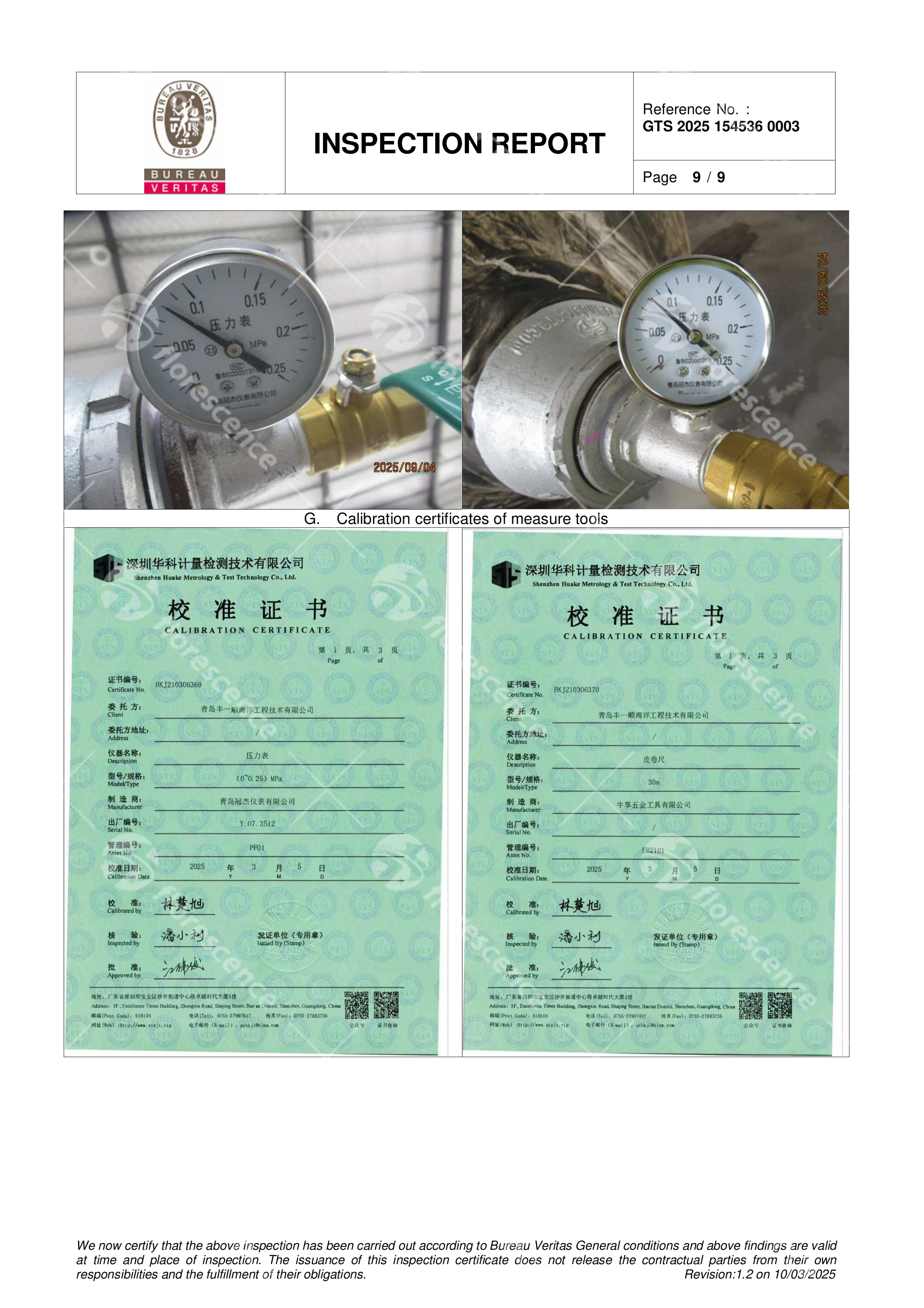
Certification is part of the product, not an optional add-on. Florescence airbags can be manufactured and inspected to the requirements of classification societies including CCS, BV, RS, ABS, and LR, depending on project requirements. The company holds a BV certificate for marine rubber airbags, ship launching airbags, and marine salvage airbags under ISO 14409 (certificate GTS 2025 154536 0003, issued 2025-09-04). An IRS test report for ship launching air bags under ISO 14409 is also on file (report QIN21X015, issued 2021-07-22).
What Slipway Launching Requires
Slipway launching uses a fixed inclined track built into the shipyard. The vessel is constructed on or near the slipway, supported by keel blocks and shores, and then released so that gravity moves it down the incline into the water. The method is well established and does not depend on inflatable equipment.
Its requirements are structural and permanent: a prepared incline, a launching cradle or sliding arrangement, a sliding medium, and a clear water area at the foot of the slipway. The trade-off is straightforward. A slipway concentrates capability at one location and requires civil investment before the first launch. Airbag launching distributes capability across sites and can be deployed with portable equipment, but it depends on correct airbag selection and disciplined operation.
Step-by-Step Breakdown: Execution for Each Method
Airbag Launching Sequence
- Positioning. Unroll and lay the deflated rubber airbags flat underneath the ship's hull according to the pre-calculated spacing plan.
- Inflation. Connect the pneumatic hose, open the air valve, and inflate the airbags to the specified working pressure to lift the vessel off its support blocks.
- Block removal. Remove all keel blocks, wooden supports, and launching cradles once the ship is fully supported by the inflated airbags.
- Rolling launch. Release the holding winch system; gravity and momentum allow the vessel to roll smoothly into the water on the rotating airbags.
- Retrieval. After the vessel floats free, collect the airbags from the water, open the release valves to deflate them completely, clean, fold, and store them for future use.
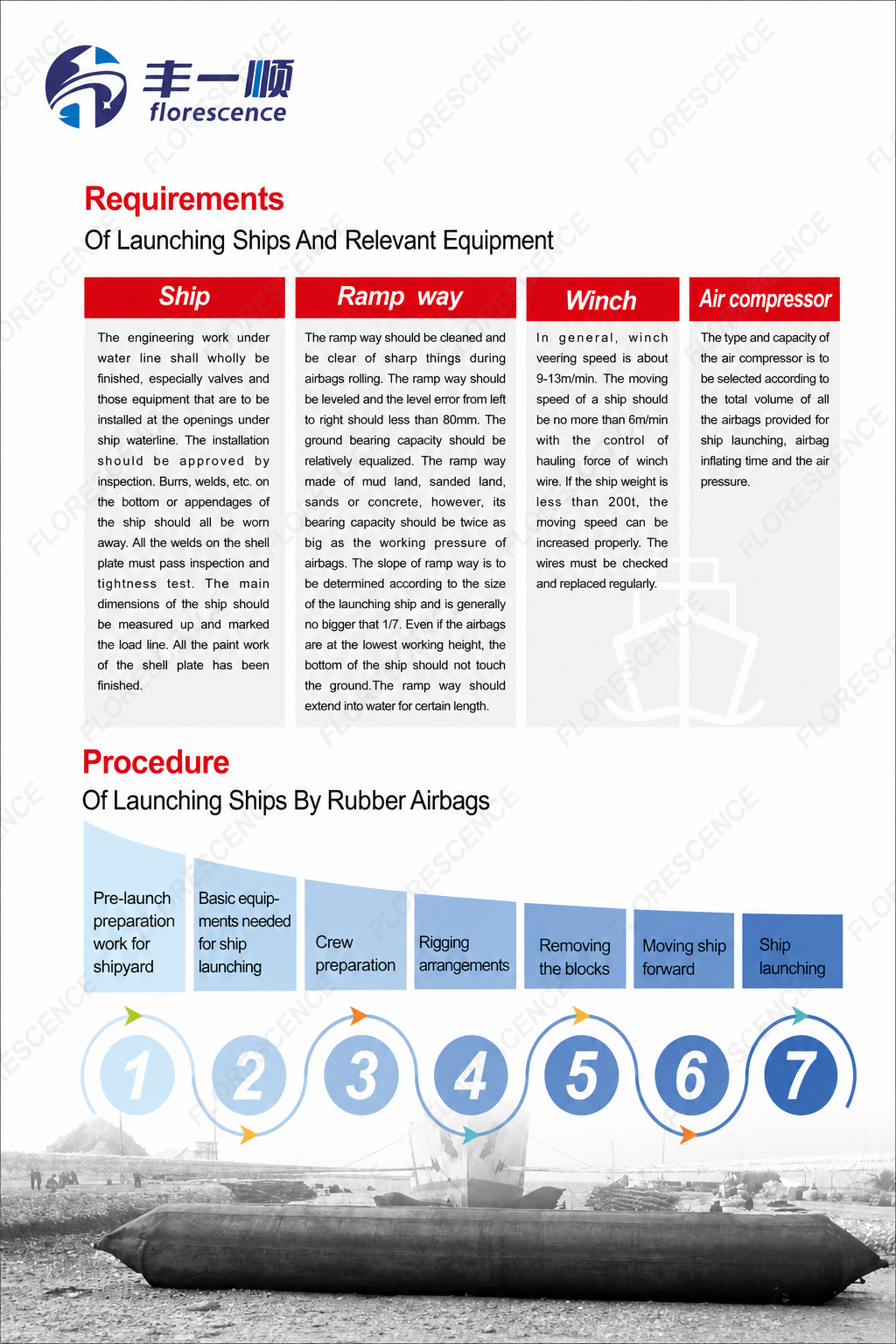
Supporting equipment for the sequence includes pulling rings, terminal iron, protective covers, a three-way connecting tube, a pressure gauge, an inflation valve, a hose joint, a high-capacity winch, wire rope, a pulley system, shackles, an air compressor, and an inflation hose.
Slipway Launching Sequence
- Prepare and maintain the inclined track, including surface condition and alignment.
- Establish the launching cradle, keel blocks, and side shores that support the vessel during construction.
- Apply the sliding medium to the track and cradle interface before release.
- Release the holding arrangement so that gravity moves the vessel down the incline.
- Recover the sliding arrangement and reset the slipway for the next hull.
The slipway sequence is shorter on the day of launch because most of the preparation is embedded in the yard's permanent infrastructure. The airbag sequence is longer on the day because positioning, inflation, block removal, and retrieval are all active steps. That difference matters when scheduling crew and equipment.
Use Cases: Matching the Method to the Project
Airbag launching fits projects where the launch point is not fixed, where a slipway is unavailable, or where the vessel size and yard layout make a portable method practical. Typical applications include shipyard vessel launching and dry docking, ship landing, heavy objects land transport, and marine salvage and refloating.
Slipway launching fits yards with a permanent incline, a steady production programme, and a water area suited to the launch. It remains a standard approach for larger hulls and for yards that have already invested in the infrastructure.
Two field cases illustrate how airbag launching is used in practice.
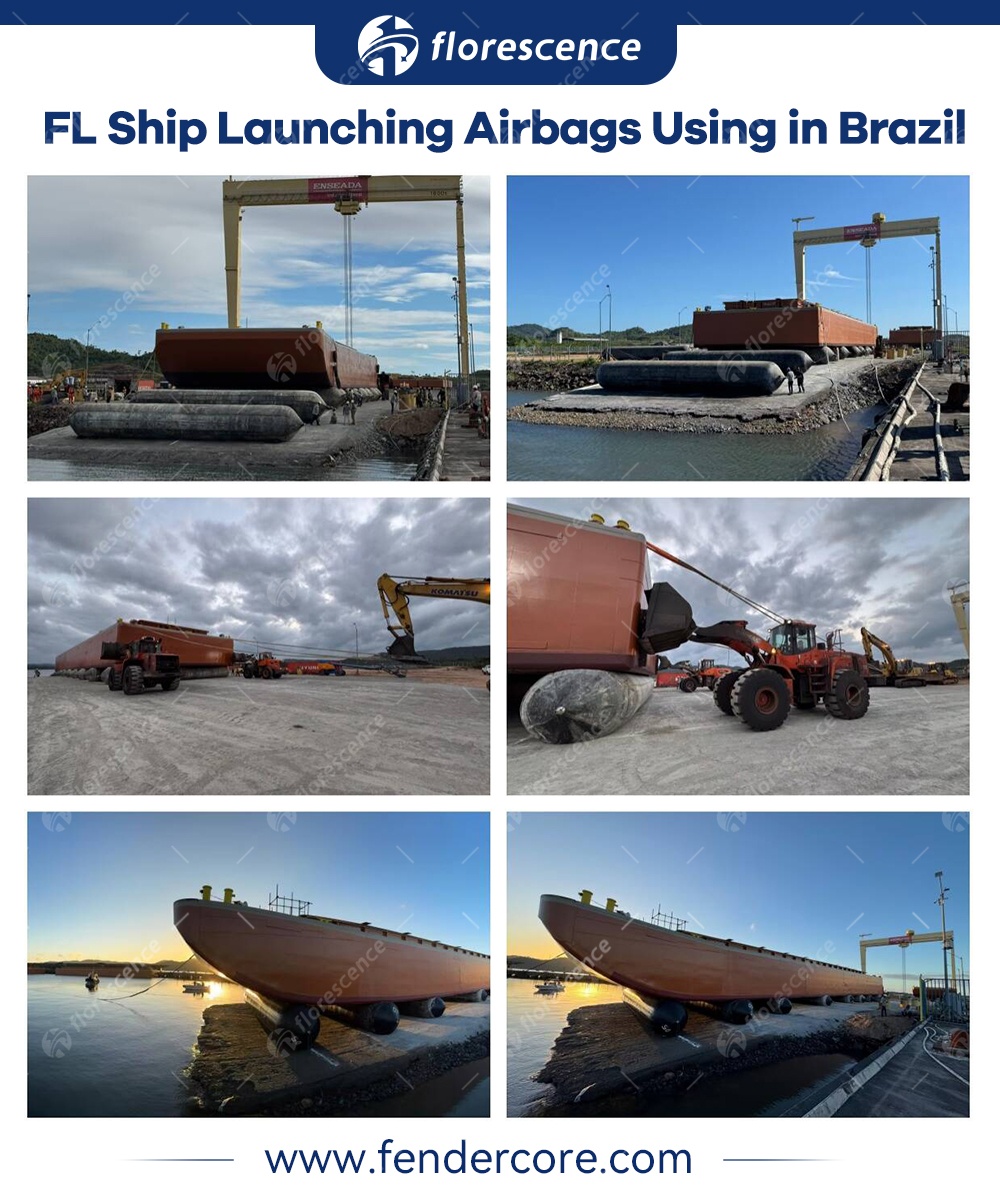
Brazil, barge launching. A shipyard customer used 13 units of D2.5 m x 15 m, 7-layer marine launching airbags to launch 13 barges. The reported service life was 8 to 10 years under regular marine launching and slipway operational conditions. The reported result included zero air leakage, no hull damage, and no operational delays.
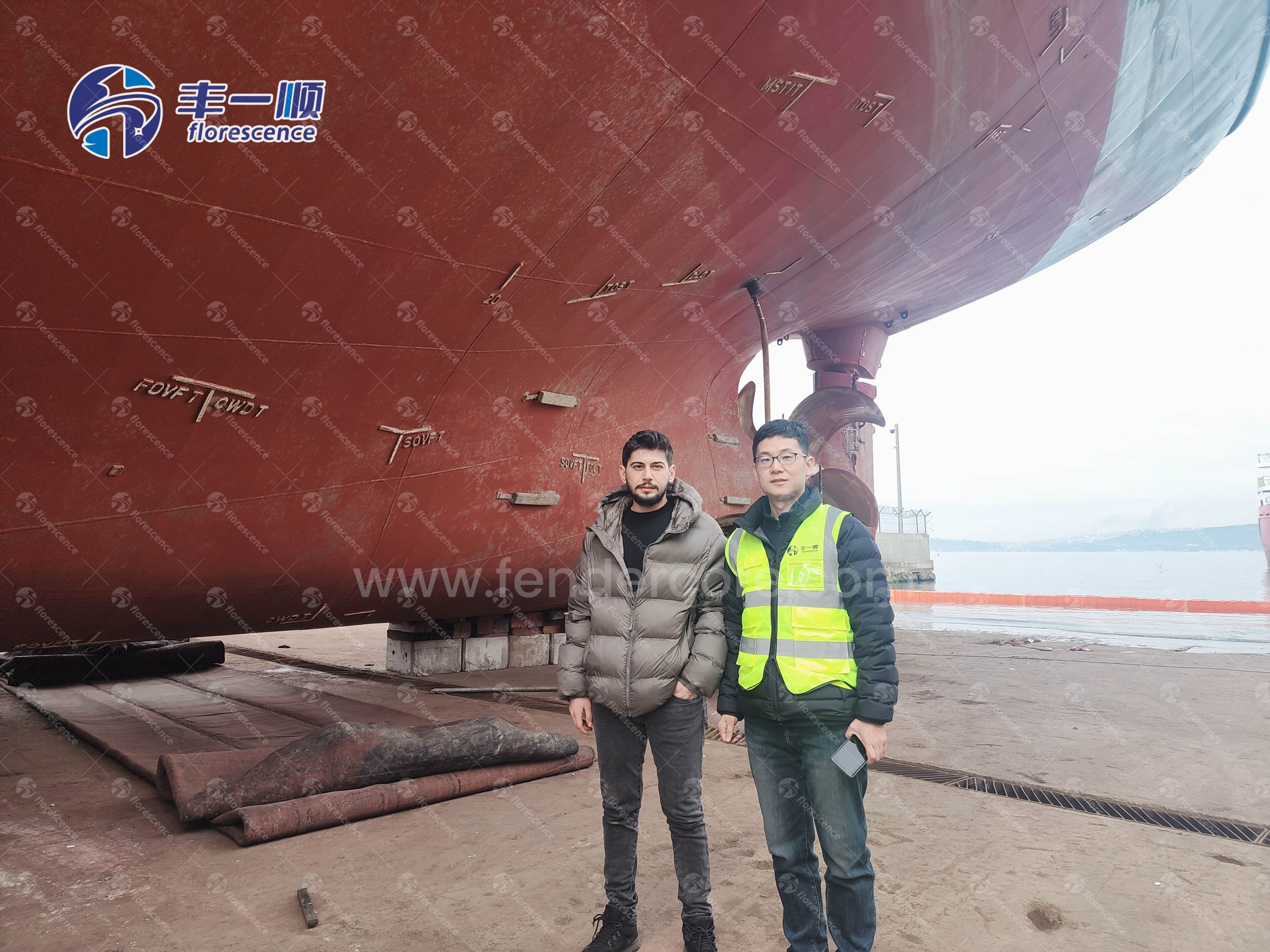
Romania, marine salvage. A marine salvage company used 10 units for shallow and deep-water boat salvage, sunken vessel refloating, heavy marine wreck lifting, and emergency buoyancy support. The reported service life was 6 to 8 years under regular marine salvage and heavy-lifting conditions. The reported highlights included high buoyancy and stability, multi-layer cord reinforcement, and puncture and wear resistance.
Comparison Table: Decision Criteria at a Glance
| Decision criterion | Ship launching airbags | Slipway launching |
|---|---|---|
| Site requirement | Ground or cement concrete surface; airbags laid under the hull | Permanent inclined track built into the yard |
| Location flexibility | Launching locations can be flexible | Tied to the fixed slipway |
| Capital profile | Lower investment cost than traditional slipways | Requires civil construction before the first launch |
| Product specification | Diameter 0.6-2.8 m, length 5.0-25 m, 3-12 layers | Not applicable |
| Reusability | Reusable operation; service life 5-8 years | Fixed asset; not reusable across sites |
| Scheduling | Airbag lead time quoted at 5-30 days | Governed by the yard production programme |
| Risk controls | Over-pressure control, clean surface, avoid distortion and overweight | Cradle design, sliding medium, water depth at the foot of the incline |
| Certification | ISO 14409; BV GTS 2025 154536 0003; IRS QIN21X015 | Classification oversight per yard and project |
| Typical fit | Mobile or temporary launching, barges, small-to-medium vessels, salvage | Fixed yards with steady production and a suitable incline |
Working With a Chinese OEM Manufacturer: What Buyers Should Verify
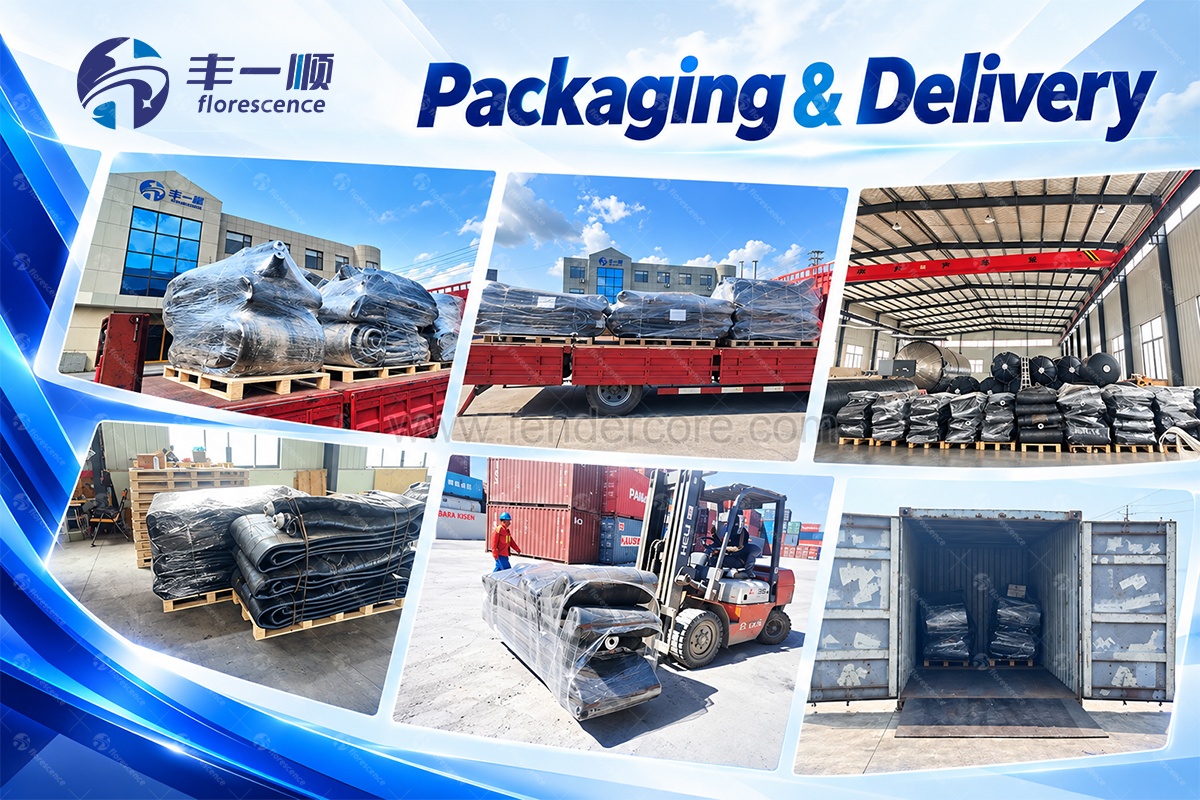
OEM services are available. Florescence supports customization of size, pressure, logo, fittings, package, solution, and drawing. Monthly capacity is 200 units, annual output is 2,000 pieces, and the factory covers 40,000 m² with 120 employees and a 25-engineer R&D team. Lead time is quoted at 5-30 days, with a minimum order quantity of 1 unit.
Quality control covers material testing, pressure testing, dimensional inspection, compression testing, and third-party inspection through CCS, BV, ABS, DNV, and other bodies. After-sales support includes 24/7 online technical support, installation and repair guidance, global on-site service, a 12-24 month warranty, and free repair kits.
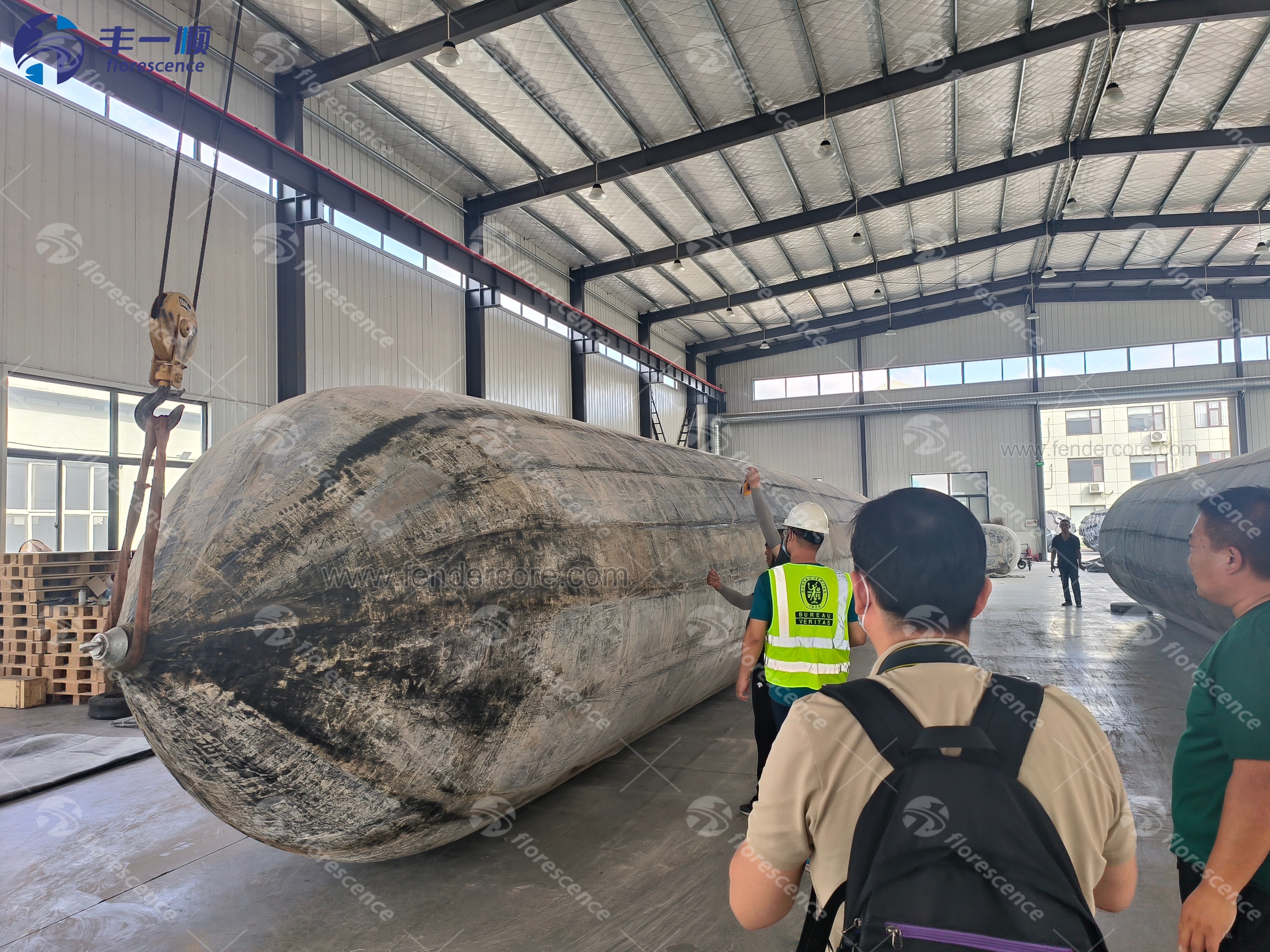
For buyers planning delivery, these numbers answer a specific question: can the supplier absorb a launch window that is fixed by tide, drydock availability, or contract milestones? A 200-unit monthly capacity and a 5-30 day lead time give room to schedule around a launch date, provided the specification is frozen early enough.
Florescence was established in 1992 and has supplied products to customers and maritime organizations in many countries and regions, including the Bangladesh Navy, French Navy, Royal Thai Navy, Italian Navy, and Philippine Navy. The company operates under ISO 9001:2015 (certificate 32726Q10126RIS, valid 2026-05-09 to 2029-05-08) and ISO 14001:2015 (certificate 32725E20318R0S, valid 2025-05-28 to 2028-05-27).
FAQ
ISO 14409:2011 is the reference standard for ship launching air bags. Florescence holds a BV certificate for marine rubber airbags, ship launching airbags, and marine salvage airbags under ISO 14409 (certificate GTS 2025 154536 0003, issued 2025-09-04), and an IRS test report for ship launching air bags under ISO 14409 (report QIN21X015, issued 2021-07-22). The company also operates under ISO 9001:2015 (certificate 32726Q10126RIS, valid 2026-05-09 to 2029-05-08) and ISO 14001:2015 (certificate 32725E20318R0S, valid 2025-05-28 to 2028-05-27). Airbags can be manufactured and inspected to CCS, BV, RS, ABS, and LR requirements, depending on project requirements.
OEM services are available. Customization covers size, pressure, logo, fittings, package, solution, and drawing. Standard Ship Launching Airbag configurations range from 3 to 12 layers, with diameters from 0.6 m to 2.8 m and lengths from 5.0 m to 25 m. Selection depends on vessel type, length, beam, weight at launching or docking, and keel block height. Buyers should share those parameters so the manufacturer can recommend diameter, effective length, overall length, layer count, quantity, and working pressure.
Florescence operates a 40,000 m² facility with 120 employees and a 25-engineer R&D team. Annual output is 2,000 pieces, with monthly capacity of 200 units. For a buyer, that capacity matters when a launch window is fixed. A larger order can be scheduled against production slots rather than treated as a one-off build. The minimum order quantity is 1 unit, which allows trial orders and small projects without a volume penalty.
Quality control includes material testing, pressure testing, dimensional inspection, compression testing, and third-party inspection through CCS, BV, ABS, DNV, and other bodies. Buyers can request third-party inspection and review test documentation before shipment. A minimum order quantity of 1 unit also makes it practical to order a single airbag for evaluation before committing to a full launching set.
Lead time is quoted at 5-30 days, depending on specification, quantity, and customization. Standard production for bulk orders is typically around 25-30 days after deposit, while large custom orders or full fender systems can take 40-45 days. Buyers should freeze the specification early and confirm the launch date before production begins. To discuss a specific vessel or request a sample or quote, contact Florescence at inquiry@fendercore.com or +86 182-0532-1693.
From evaluation to execution
Send the vessel type, length, beam, weight at launching or docking, and keel block height, and Florescence will recommend a suitable airbag size and quantity. Request a quote, ask for a sample, or download the catalogue to confirm specifications before the launch window closes.
Conclusion: Choosing the Method and the Manufacturer
Airbag launching and slipway launching are both valid methods, and neither is universally superior. The decision depends on site requirements, location flexibility, scheduling, risk controls, and the supplier's ability to customize and certify the product. A fixed slipway suits a yard with steady production and a suitable incline. Airbag launching suits yards that need mobility, temporary launching capability, or a lower capital commitment, provided the airbags are correctly specified and supported by a manufacturer with verifiable certification and capacity.
For buyers evaluating Chinese OEM manufacturers, the practical checks are ISO 14409 compliance, BV or IRS certification, layer and size range, lead time, and the ability to customize to vessel parameters. Florescence has operated since 1992, holds ISO 9001 and ISO 14001 certification, and manufactures Ship Launching Airbags and Marine Salvage Airbags with BV and IRS documentation on file. Its 40,000 m² facility and 2,000-piece annual output support delivery planning against fixed launch windows.
To move from evaluation to execution, request a specification review with vessel dimensions, confirm the certification package, and schedule production against the launch date.
Have Questions or Need More Details?
Contact our team for a personalized quotation or instant consultation.
Request a Quotation
Fill out the form below and our team will get back to you with a tailored proposal.
WhatsApp Direct Chat
Prefer to chat in real-time? Message us on WhatsApp for instant assistance & quick answers.
- Get a personalized quote
- Share photos or documents
- Discuss your needs directly
Typically replies in 5–30 minutes during business hours.