Ship Launching Balloon Specs: ISO 14409 Compliance Checklist
A ship launching balloon is a pneumatic rubber cylinder — reinforced with synthetic tire-cord layers and inflated to a stated working pressure — that carries a vessel down a slipway or lifts it clear of its blocks. The same product is bought as a marine launching balloon, a ship launching air bag, a vessel launching airbag or a boat launching airbag. The name changes nothing about the engineering. What matters is whether the diameter, layer build, pressure rating and certification documents match the launch plan, and this checklist sets those constraints out one by one.
Problem Definition: Why Ship Launching Balloon Comparisons Go Wrong
Most procurement disputes over launching airbags are not about rubber compound quality. They come from comparing numbers that were never measured on the same basis, and the three errors below account for a large share of mismatched orders.
Layer count quoted without geometry. A ship launching rubber airbag is built from 3 to 12 synthetic tire-cord layers. A 12-layer bag of small diameter and a 7-layer bag of 2.5 m diameter and 15 m length are different tools, not better and worse versions of one tool. Bearing capacity depends on airbag diameter, working pressure, contact area, the weight of the vessel and the number of airbags deployed, so a single layer figure on its own says very little about the launch.
Certificate name quoted without scope. "BV certified" or "ISO certified" is not a specification. A certificate carries a number, an issue date, a standard and a defined product and market scope. The BV certificate in Florescence's document set is numbered GTS 2025 154536 0003, references ISO 14409 and covers marine rubber airbags, ship launching airbags and marine salvage airbags. The IRS test report QIN21X015 covers the Ship Launching Air Bag and applies to the India and South Asia market. Neither document says anything about a product scope or market it does not name, and neither substitutes for the other.
Launching duty mixed with salvage duty. A marine salvage airbag carries a maximum working pressure of 0.25 MPa and can be used at water depths up to 25 m, with buoyancy of 10 to 50 tonnes per piece. A launching airbag for slipway work is instead specified from hull weight, slipway gradient and rolling geometry. When the two duties are blended in one comparison, the pressure and depth figures that appear on one data sheet get applied to a job that never needed them, while the number that actually governs the launch is skipped.
The practical consequence is straightforward: an accepted price on a mismatched constraint set is not a saving, it is a launch-window risk. The rest of this article converts that risk into checks a buyer can run from a desk.
Industry Background: One Standard, Two Categories, One Concentrated Supply Base
ISO 14409:2011 is the reference standard for ship launching air bags. It addresses design, materials and testing, and it classifies marine airbags into two categories — Ordinary (QP) and High-capacity (QG). Before comparing dimensions, a buyer should confirm which category, which standard revision and which test basis the supplier is actually quoting.
Demand is geographically concentrated. 360iResearch estimates the global marine airbags market at USD 328.82 million in 2025 and USD 346.59 million in 2026, with Asia-Pacific accounting for approximately 52% of revenue and China acting as the primary manufacturing and export centre. For buyers this has a specific effect: data sheets from different suppliers look almost identical, and the visible difference sits in documentation, test records and the fittings package rather than in the headline product description.
Qingdao Florescence Marine Supply Co., Ltd is a marine rubber manufacturer founded in 1992 in Qingdao, China, producing pneumatic rubber fenders, dock and ship fenders, ship launching airbags and marine salvage airbags. The company operates a 40,000 m² factory with 120 employees, a 25-engineer technical team and an annual output of 2,000 pcs, exports about 95% of production to Southeast Asia, South America, Europe, North America, the Middle East and Africa, and reports product supply to naval organisations including the Bangladesh Navy, French Navy, Royal Thai Navy, Italian Navy and Philippine Navy. Its products are designed, manufactured and tested under ISO 9001:2015 quality management requirements and can be manufactured and inspected to the applicable requirements of CCS, BV, RS, ABS and LR where a project specifies them.
Detailed Solution: The Constraint Set a Launching Airbag Has to Satisfy
Seven constraints decide whether a ship launching air bag will work on a given slipway. Each one can be verified from documents before a unit ships, and each one has a failure mode if it is left to a verbal assurance.
1. Standard, category and test basis
Florescence ship launching airbags are stated to comply with ISO 14409 and are delivered with certifications including CCS, BV, ISO, RS and ABS. On the quotation, ask for the standard revision, the product category (QP or QG as defined by ISO 14409), and the certificate or test report number that supports the claim. A statement such as "meets ISO" without a document number cannot be checked, and it cannot be placed in a project file.
2. Construction and layer build
The airbag is made of natural rubber as the primary material, with nylon cord and synthetic tire-cord layers as reinforcement; the number of layers ranges from 3 to 12. In the salvage configuration the unit is manufactured as a totally enclosed tube with cone ends and uses Holistic Screw technology, so there are no welded seams. That construction point is worth raising even on a launching order, because a seam-free body removes a fatigue location on an item that will be inflated, rolled and compressed repeatedly.
3. Size, pressure and fittings envelope
Both the launching and the salvage airbag ranges run from 0.6 m to 2.8 m in diameter and from 5.0 m to 25 m in length. Marine salvage airbags carry a maximum working pressure of 0.25 MPa with usable depth to 25 m. The launching airbag is supplied with an inflation valve, pressure gauge, pulling ring, three-way connecting tube and hose joint — every one of these is part of the delivered product, and a price that omits them is not comparable with one that includes them.
4. Performance envelope
An ISO 14409-compliant ship launching airbag can launch and upgrade a vessel up to 100,000 DWT, and the same airbag family is used for hoisting and transporting structures of up to 10,000 tonnes on land. In salvage configuration, buoyancy runs from 10 to 50 tonnes per piece, launch support is provided for vessels up to 5,000 tonnes and for caissons up to 8,000 tonnes, and stranded vessels weighing more than 200 tonnes can be jacked. The verified record for salvage work also notes a minimum safety factor of 6:1 for buoyancy-related straps and lifting belts, which is the figure to check when the bag will be used as a lifting device rather than a rolling one.
5. Certification documents and market scope
Certification is where most purchasing files are won or lost, because a document that is real but out of scope reads exactly like one that applies. The table below lists the documents referenced in this article with their number, standard, scope and validity as recorded.
| Document | Number and date | Standard | Scope recorded | Validity |
|---|---|---|---|---|
| BV certificate for airbags | GTS 2025 154536 0003, issued 4 September 2025 | ISO 14409 | Marine rubber airbags, ship launching airbags, marine salvage airbags; global marine market | Not stated in the record |
| IRS test report | QIN21X015, issued 22 July 2021 | ISO 14409 | Ship Launching Air Bag; India and South Asia market | Not stated in the record |
| ISO 9001 quality management system | 32726Q10126RIS, issued by Shandong Guoyuan Certification Co., Ltd, 9 May 2026 | ISO 9001:2015 (GB/T19001-2016) | Production of marine airbags, rubber fenders and docking fenders | To 8 May 2029 |
| ISO 14001 environment management system | 32725E20318R0S, 28 May 2025 | ISO 14001:2015 (GB/T24001-2016) | Production of marine airbags, rubber fenders, marine chains and related environmental management activities | To 27 May 2028 |
A document set built this way lets a buyer answer three separate questions: does the product meet the standard, does the specific unit or batch fall inside a classification-society scope, and does the factory itself operate a certified management system. Those are three different answers and they should never be merged into one check box.
6. Fittings and matched equipment
An airbag launch is a system operation, not a single-item purchase. The equipment list that accompanies a launching airbag typically includes pulling ring, terminal iron, protective cover, three-way connecting tube, pressure gauge, inflation valve, hose joint, high-capacity winch, wire rope, pulley system, shackle, air compressor and inflation hose. Missing accessories usually surface on the day of the launch, when they delay a tide or a yard schedule.
7. Service environment, working life and economics
The declared working conditions for these airbags are high pressure rating, anti-ageing performance, seawater corrosion resistance and all-weather durability from -20 °C to 50 °C, with a service life of 5 to 8 years. The economic argument for the method is a constraint in its own right: compared with traditional slipway launching, an airbag launch does not require the construction of permanent launching facilities, can be carried out at any seaside location, requires little maintenance and the bags are reusable. That combination of reduced civil works and repeat use is what makes the specification discipline worth the effort.
Step-by-Step Breakdown: Verifying a Supplier Before You Order
The sequence below is written for a buyer in the research-to-evaluation stage, and it is deliberately ordered so that each step narrows the next one.
- Fix the duty class first. Launching, landing and docking, vessel movement, heavy land transport or salvage. Duty determines the pressure and depth envelope before any dimension is discussed, and it decides whether you are buying a Ship Launching Airbag or a Marine Salvage Airbag configuration.
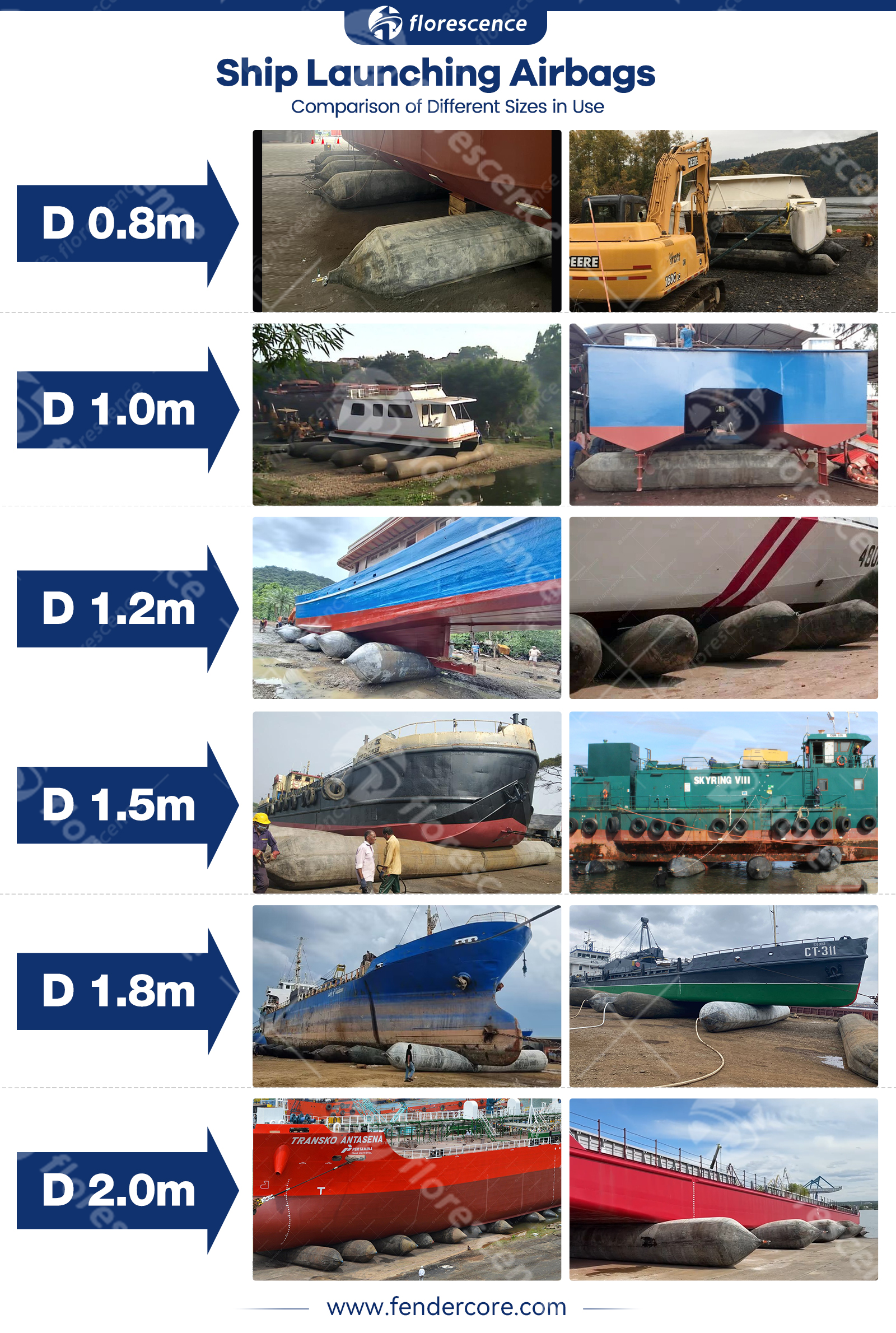
- Match diameter and length to the hull and the slipway. Quote the size explicitly, for example D2.5 × L15 m, rather than "large" or "standard". Large-diameter units provide higher ground clearance and smoother rolling efficiency for heavy hulls, which is why size and layer count must always be quoted as a pair.
- Ask for the certificate number, issue date, standard and scope rather than the certificate name. Use the document table above as the format you expect to receive.
- Check layer count against working pressure. Any figure from 3 to 12 layers is available; the question is which layer count supports the pressure and contact area your launch plan requires. A higher layer count at the same diameter supports a higher pressure, but the pair is the specification, not the layer figure alone.
- Confirm the fittings package in writing. Valve, pressure gauge, pulling ring, three-way connecting tube and hose joint should appear as delivered items, with spares identified separately.
- Request the QC record set. Every production batch is inspected through material test, pressure test, dimensional inspection, compression test and air-tightness testing on airbags, with third-party inspection by CCS, BV, ABS or DNV available on request. A full quality inspection report with test data, sizing sheets and product photographs should reach you before final payment.
- Confirm spares, repair support and on-site guidance. The after-sales scope normally covers 24/7 online technical support, installation, use and repair guidance, global on-site service, a 12 to 24 month warranty and free repair and spare kits.
How the constraints appear on site
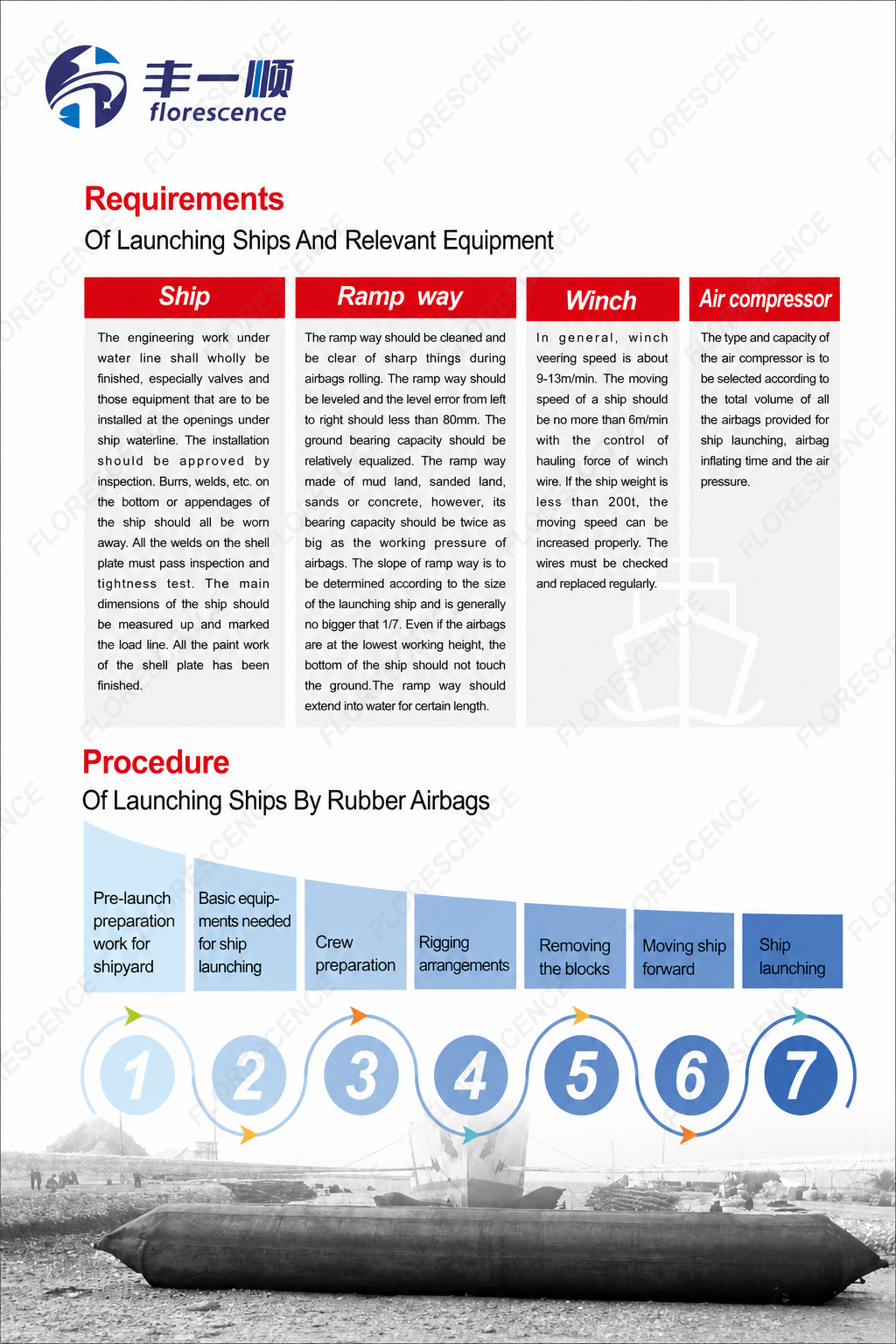
The operating sequence shows why the documentary checks matter. The airbags are unrolled and positioned under the hull according to a pre-calculated spacing plan; inflated to the specified working pressure to lift the vessel off its blocks; the keel blocks and cradles are removed once the hull is fully supported; the holding winch is released so that gravity and momentum roll the vessel into the water; the bags are then recovered, deflated, cleaned, folded and stored for reuse.
Four safety constraints accompany that sequence: strict control of operating pressure, with over-pressure forbidden; a slipway of ground or cement concrete selected according to the tonnage of the vessel; no sharp objects on the slipway or the hull, to avoid puncturing the bag; and avoidance of distortion in the length direction during rolling as well as overweight load after inflation. Each of these is a clause a supplier can support with documentation — and a clause a buyer can only rely on if the pressure rating on the data sheet is real.
Use Cases: Where the Constraint Set Changes
Shipyard launching of barges — Brazil
A Brazilian shipyard used 13 units of D2.5 m × L15 m, 7-layer marine launching airbags to launch 13 barges. The recorded result is a safe slipway launch with no hull damage and no operational delay, zero air leakage and a service life expectation of 8 to 10 years under regular launching and slipway conditions. The units are described as ISO 14409 compliant, with multi-layer reinforcement for puncture and wear resistance and an optimised large-diameter design that provided higher ground clearance and smoother rolling for the barges. For a buyer, this is the pattern to copy: the diameter and length were chosen for the hull, and the layer count was chosen to match the load rather than the other way round.
Salvage and refloating — Romania
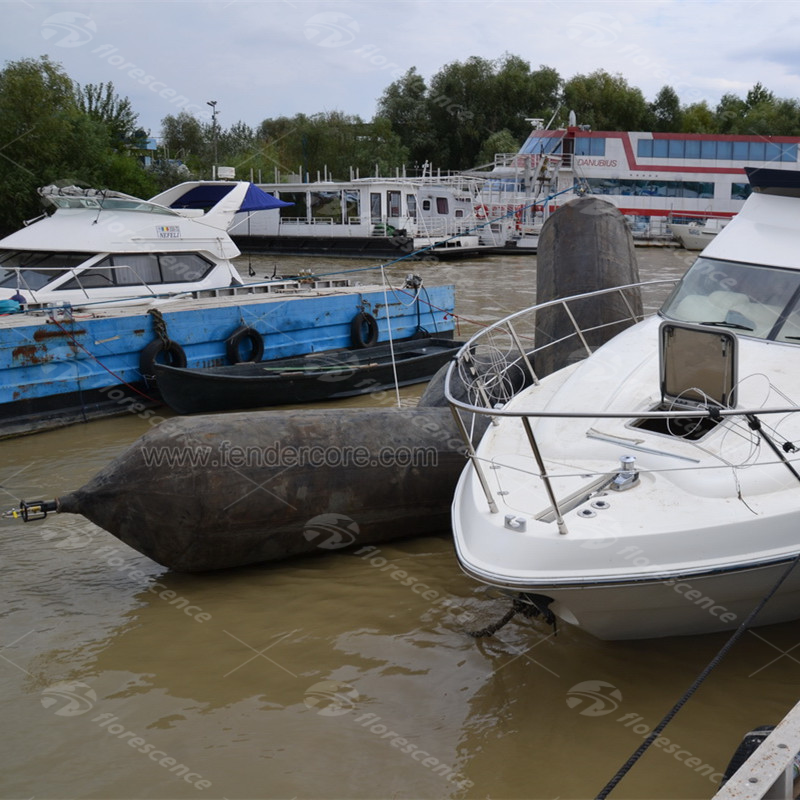
A marine salvage company in Romania used 10 units for shallow and deep-water boat salvage, sunken vessel refloating, heavy wreck lifting and emergency buoyancy support, with a recorded service duration of 6 to 8 years under regular salvage and heavy-lifting conditions. This is the duty where the governing numbers change: maximum working pressure of 0.25 MPa, usable depth to 25 m, buoyancy of 10 to 50 tonnes per piece and the 6:1 safety factor on buoyancy-related straps and lifting belts replace slipway geometry as the primary constraints.
Docking, landing and vessel movement
Ship docking airbags, ship landing airbags and ship moving airbags are the same product family applied to dry docking, undocking and yard transfers. The checklist above applies unchanged, but the retrieval and inspection routine after each cycle carries more weight, because docking work cycles the bags far more often than a single launch does.
Caissons and heavy structures
In low-water season, insufficient water level can make conventional launching impossible, and marine salvage airbags are used to provide launch support for caissons up to 8,000 tonnes as well as vessels up to 5,000 tonnes. The same family handles land transport and hoisting of structures up to 10,000 tonnes, which is a lifting duty rather than a floating one and therefore sits closer to the salvage specification than to the launching specification.
Comparison Table: Ship Launching Airbag and Marine Salvage Airbag
Both products share material, layer range and size range. The differences sit in duty, pressure and the documentation a buyer should prioritise, which is why a quotation should always state which configuration it covers.
| Constraint | Ship Launching Airbag | Marine Salvage Airbag |
|---|---|---|
| Primary duty | Ship launching, landing and docking, vessel movement, upgrading, heavy land transport | Shipwreck salvage, sunken vessel refloating, buoyancy for docks and floating structures, caisson launching |
| Material and reinforcement | Natural rubber with nylon cord and synthetic tire-cord layers | Natural rubber with nylon cord and synthetic tire-cord layers |
| Layer range | 3 to 12 layers | 3 to 12 layers |
| Size range | Diameter 0.6–2.8 m, length 5.0–25 m | Diameter 0.6–2.8 m, length 5.0–25 m |
| Pressure and depth | Specified from the launch plan and working pressure | Maximum working pressure 0.25 MPa, usable to 25 m water depth |
| Recorded capacity | Launch and upgrade vessels up to 100,000 DWT; land transport of structures up to 10,000 t | Buoyancy 10–50 t per piece; launch support for vessels up to 5,000 t and caissons up to 8,000 t; jacking of stranded vessels over 200 t |
| Construction detail | Seam-controlled rubber body with end fittings | Totally enclosed tube with cone ends, Holistic Screw technology, no welded seams |
| Delivered fittings | Valve, pressure gauge, pulling ring, three-way connecting tube, hose joint | Inflation valve, pressure gauge, pulling ring; equipped with rubber handles and nylon rope net |
| Certifications | CCS, BV, ISO, RS, ABS; ISO 14409 compliance | CCS, BV, ISO, RS, ABS; BV certificate GTS 2025 154536 0003 covers this product |
| Service life | 5–8 years | 5–8 years |
Frequently Asked Questions
Which documents prove that a ship launching balloon actually meets ISO 14409?
A ship launching balloon should be supported by a certificate or test report that names ISO 14409, the product scope and the market in which the document applies — not by a generic statement that the product is certified. In Florescence's document set, the BV certificate GTS 2025 154536 0003 (issued 4 September 2025) references ISO 14409 and covers marine rubber airbags, ship launching airbags and marine salvage airbags on the global marine market, while the IRS test report QIN21X015 applies specifically to the Ship Launching Air Bag in India and South Asia. Factory-level documents are separate: ISO 9001 certificate 32726Q10126RIS covers production of marine airbags, rubber fenders and docking fenders and is valid to 8 May 2029, and ISO 14001 certificate 32725E20318R0S is valid to 27 May 2028. A complete purchasing file contains all three levels, because a product certificate does not certify a management system and a management system certificate does not certify a batch.
Can a ship launching balloon be customized in diameter, length and layer count?
Yes. The standard range already spans diameter 0.6 to 2.8 m, length 5.0 to 25 m and 3 to 12 layers, and within and beyond those combinations Florescence supports OEM and ODM customization covering size, pressure rating, logo, fittings, packaging, drawings and solution design. The technical team of 25 engineers works from the buyer's vessel dimensions, slipway conditions and project requirements to recommend a size and quantity, and the minimum order quantity is 1 unit, so a single non-standard specification can be ordered without committing to a production batch.
What specification choices drive the cost of a ship launching airbag?
Cost follows five specification variables: layer count, the diameter and length combination (which sets the rubber and cord volume), the working pressure rating, the certification scope required for the destination market, and the delivered fittings package. A higher layer count at the same diameter carries more cord and supports a higher pressure, while a longer or larger-diameter unit consumes more material per piece. Certification scope also has real weight — a market-specific test report such as the IRS report for India and South Asia is a different document from a global classification certificate — and the fittings list, whether it includes pulling ring, three-way connecting tube and hose joint or not, changes what the quoted number actually represents. No public price list exists for these products, so the useful comparison is a like-for-like specification, not a headline figure.
Can we inspect or trial a unit before placing a volume order?
Yes. The minimum order quantity is 1 unit, so a single airbag can be ordered, inspected and tested before a larger commitment. Every batch passes material testing, pressure testing, dimensional inspection and air-tightness testing on airbags, and third-party inspection by CCS, BV, ABS or DNV can be arranged at the buyer's request, with SGS and other agencies welcomed. Full traceability documents are available, including physical property reports covering tensile strength, elongation and compression behaviour, and a quality inspection report with test data, sizing sheets and product photographs is issued before shipment. Buyers can also request repair kits and on-site usage guidance, which is the practical way to validate both the product and the support behind it.
What lead time, warranty and after-sales support apply to a ship launching airbag order?
Production lead time runs from 5 to 30 days depending on specification, quantity and customization, with a monthly capacity of about 200 units supporting repeat or scheduled delivery programmes. Units ship as sea freight, air freight, LCL or FCL, with packaging optimised for loading efficiency. The warranty period is 12 to 24 months, supported by 24/7 online technical support, installation, use and repair guidance, global on-site service, and free repair and spare kits. For a live project, the quickest route is to send the vessel length, width and weight together with the slipway conditions — Florescence will return a recommended airbag size and quantity, and the current specification and delivery position for that configuration. Contact: inquiry@fendercore.com, or WhatsApp +86 182-0532-1693.
Use cases, document numbers and capacity figures above are drawn from Florescence product records; market size and regional share figures are attributed to 360iResearch, and product classification and safety-factor references to ISO 14409:2011.
Conclusion
Buying a ship launching balloon is a documentation exercise as much as an engineering one. The product itself is well defined — a natural rubber cylinder reinforced with 3 to 12 synthetic tire-cord layers, sized from 0.6 to 2.8 m in diameter and 5.0 to 25 m in length, certified to ISO 14409 and supported by CCS, BV, ISO, RS and ABS documentation — but the value of that definition depends entirely on whether the certificate you receive names your product, your standard and your market.
Work through the seven constraints in order: standard and category, construction, size and pressure, performance envelope, documents and scope, fittings, and service life. Then run the verification sequence before releasing the order. A launch that goes to plan rarely makes news; the checks that made it uneventful are the ones this checklist asks for.
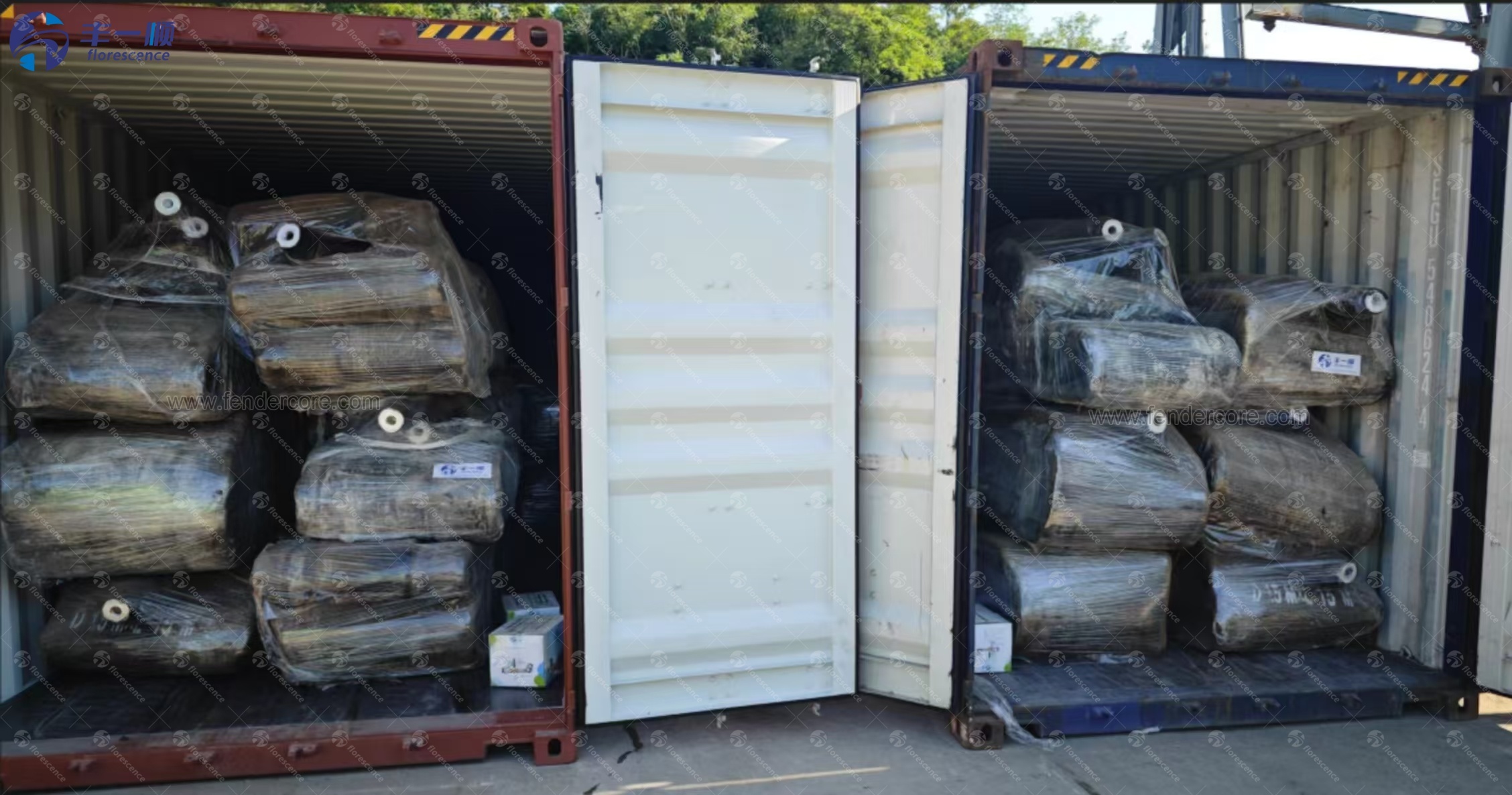
Next Step: Match the Specification to Your Launch Plan
Send the vessel length, width and weight plus the slipway conditions, and Florescence will return a recommended ship launching airbag diameter, length, layer count and quantity, together with the certificate documents that apply to your market.
Download the catalogue: Florescence Catalogue (PDF)
Email: inquiry@fendercore.com | WhatsApp: +86 182-0532-1693 | Web: www.fendercore.com
Have Questions or Need More Details?
Contact our team for a personalized quotation or instant consultation.
Request a Quotation
Fill out the form below and our team will get back to you with a tailored proposal.
WhatsApp Direct Chat
Prefer to chat in real-time? Message us on WhatsApp for instant assistance & quick answers.
- Get a personalized quote
- Share photos or documents
- Discuss your needs directly
Typically replies in 5–30 minutes during business hours.