
Top 7 Rubber Fender Types Ranked for 2026: Which One Fits Your Berth and Why
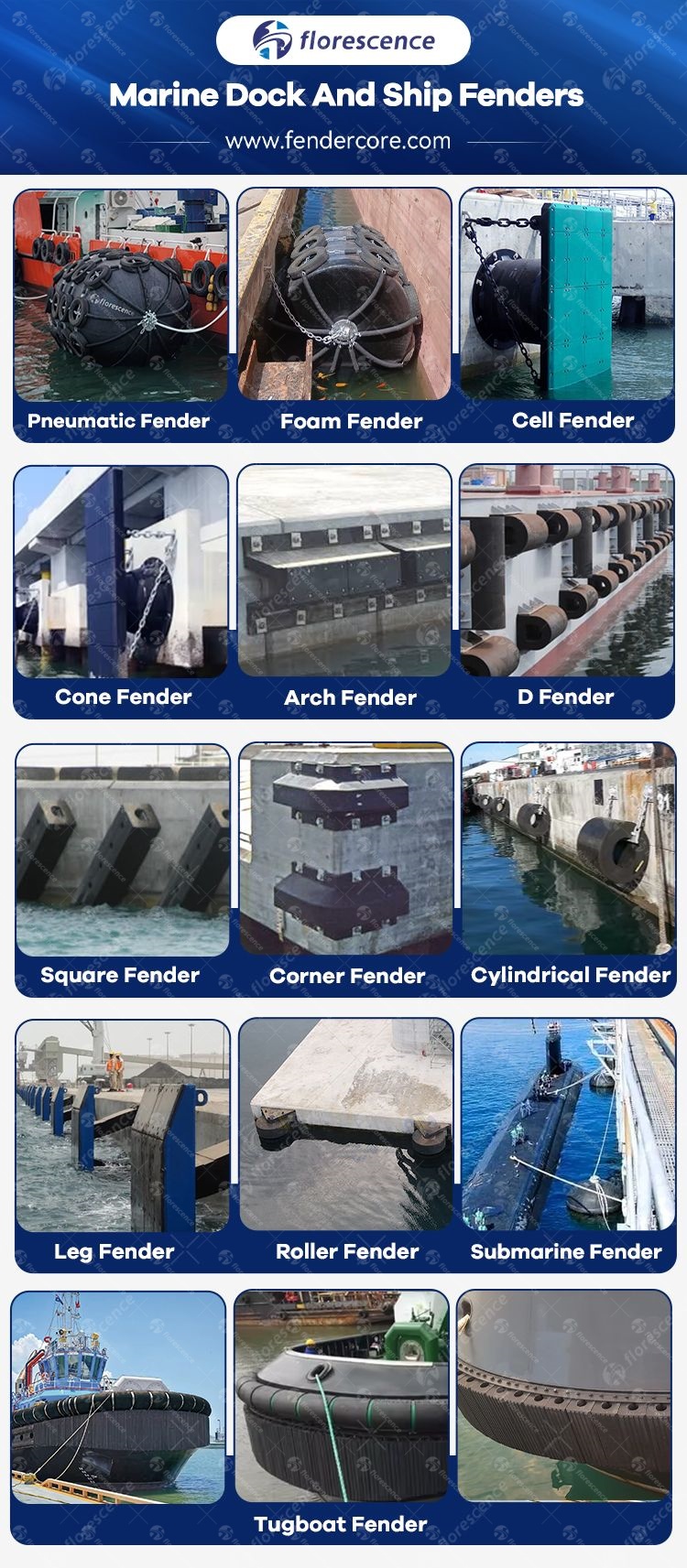
Seven rubber fender profiles carry most of the 2026 commercial berthing workload, and each one wins on a different berth condition. Cone fenders rank first for large-tonnage commercial quays because of their 70% rated deflection and angular tolerance. Pneumatic rubber fenders rank second for ship-to-ship and open-water berthing because compressed air delivers high energy absorption at low reaction force. Arch, cylindrical and tug, W, foam, and D profiles follow, each matched to a narrower duty. Square fenders remain a supporting profile rather than a primary berth unit.
Quick Answer: The Ranking at a Glance
If you only need the short version, use this mapping. It reflects how much of a typical 2026 commercial berthing workload each profile can carry, weighted by energy absorption capability, angular tolerance, installation method, and the maintenance regime the profile implies.
- #1 Cone fender — large-tonnage container, bulk, oil, Ro-Ro and offshore terminals; oblique berthing; highest energy absorption in the solid rubber group.
- #2 Pneumatic rubber fender — ship-to-ship (STS), ship-to-quay (STQ), ship-to-berthing (STB), open water, large tidal range, mobile or temporary protection.
- #3 Arch fender — general cargo and multi-purpose quays needing a simple bolt-on system with predictable 52.5% deflection.
- #4 Cylindrical fender and tug fender — multi-angle impact, large tidal variation, general ports, fishing harbours, inland canals.
- #5 W fender — tugboats, offshore vessels, inland barges, Ro-Ro berths and bridge pier protection where space and reaction force are constrained.
- #6 Foam fender — offshore oil and gas, STS transfer, cruise, naval and bulk ports requiring an unsinkable floating unit.
- #7 D fender — fishing harbours, inland terminals, marinas, shipyards and small-to-medium vessel berthing.
- Supporting profile: square fender — edge protection, side belting and light-duty contact surfaces.
A lower rank is not a quality judgement. A fishing harbour does not need a cone fender, and a 300,000 DWT bulk terminal should not be fendered with D profiles.
Why "Which Fender Type" Is a Decision Problem, Not a Catalogue Question
A rubber fender is a sacrificial energy-absorbing component. It sits between a moving vessel and a fixed structure and converts kinetic berthing energy into deformation. Marine rubber fender systems exist to protect the vessel hull and the berthing facility from damage during berthing. Every part of that sentence is a design constraint, not a purchasing preference.
Selection therefore depends on the vessel, not on the supplier's stock list. Fender selection depends on vessel size, berthing energy, tidal variation, berth structure, and operational conditions. Change any one of those five inputs and the correct profile can change with it.
Three failure patterns recur when the type is chosen by habit rather than by calculation:
- Hull pressure mismatch. A profile with a small contact area concentrates force on the shell plating. Wide-contact profiles such as the W type were developed specifically to lower hull surface pressure and resist shear during pushing contact.
- Reaction force overload. A stiff profile transfers more load into the berth structure. Where the quay or dolphin has a reaction limit, a low-reaction profile is required even if a stiffer one absorbs more energy per unit size.
- Deflection exceedance. Every solid rubber profile has a rated design deflection and a maximum permissible deflection. Running a fender past its maximum compresses the rubber beyond its design envelope and shortens service life.
The practical consequence is that two berths of similar length can require completely different fender types. A general cargo quay with a narrow tidal window and a container terminal handling 20,000 TEU vessels are not the same problem, and the 2026 fender range reflects that differentiation rather than a single universal product.
Industry Background: What Shapes the 2026 Fender Market
Rubber remains the dominant fender material. The global marine fenders market is projected to reach USD 0.89 billion in 2026, per Mordor Intelligence's 2026–2031 forecast, and rubber fenders accounted for approximately 64.17% of total marine fender market share in 2024 according to the same source. That share matters for buyers because it determines where engineering support, tooling investment and spare-part availability are concentrated.
Two standards sit behind most technical specifications. ISO 17357-1:2014 specifies the requirements for high-pressure floating pneumatic rubber fenders. PIANC guidelines provide the design framework referenced for marine fender systems more broadly, and suppliers commonly state that systems are manufactured and tested in accordance with PIANC guidelines and global engineering standards.
On the trade side, boat or dock fenders of vulcanised non-cellular rubber — whether or not inflatable — fall under HS Code 4016.94. Buyers screening suppliers through customs data should confirm the classification per shipment, because the code covers a broad product family rather than a single fender type.
The type landscape itself is stable. The supplied marine fender range covers ten types: cone, cell, arch, cylindrical, D, tugboat, foam filled, pneumatic, W type, and square fenders. This review ranks seven of the eight profiles specified for it. The eighth — square fender — is retained below as a supporting profile rather than a primary berth system, because its height range and application set position it as edge protection and side belting rather than a primary energy-absorbing unit.
The Ranking Criteria Used in This Review
Ranking fender types is only meaningful if the ranking dimension is stated. This review weights six criteria, applied consistently to every profile:
- Energy absorption per unit footprint. How much berthing energy the profile can absorb within the berth's available installation depth.
- Reaction force behaviour. Whether the profile delivers a low, progressive reaction curve or a steeper one that loads the berth structure.
- Angular tolerance. How the profile behaves when the vessel contacts at an angle rather than square-on — relevant for bow and stern contact and for oblique berthing.
- Installation and mounting method. Bolt-on, hanging, chain-and-tire-net, or floating. This determines both civil works and replacement logistics.
- Maintenance regime. What must be inspected and how often — rubber condition, bolt tightness, chain wear, corrosion status, panel alignment.
- Application breadth. How many berth types the profile can serve without redesign.
Ranking on application breadth rather than pure performance is deliberate. A profile that absorbs more energy but requires a bespoke structural interface is not automatically the better procurement decision for a multi-berth port.
Top 7 Rubber Fender Types for 2026
#1Cone Fender
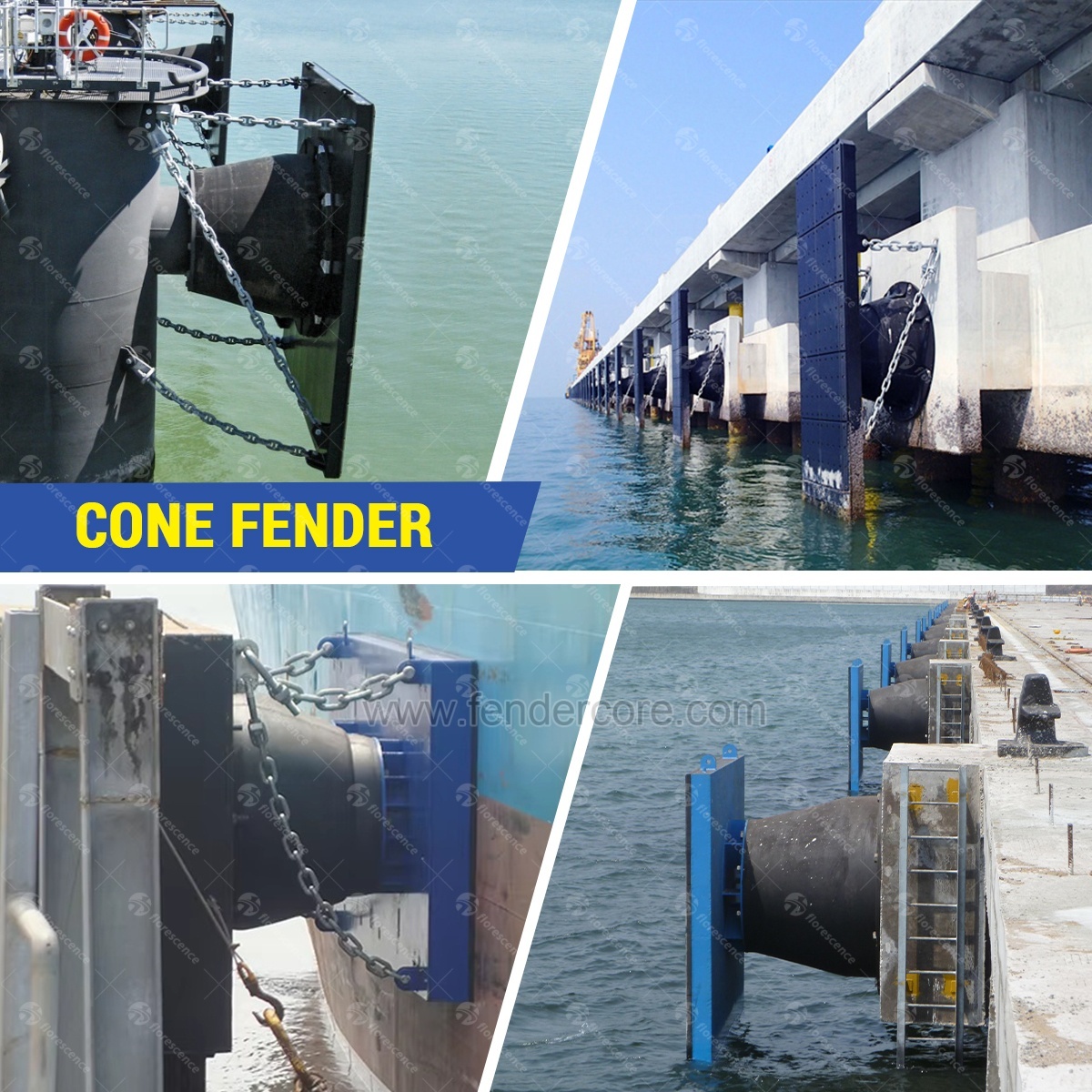
Cone fenders rank first because they combine the highest rated deflection in the solid rubber group with the best angular performance, which is exactly the combination large commercial berths need. The cone geometry allows a rated design deflection of 70%, with a maximum permissible deflection of 72.5%. That working envelope is what produces ultra-high energy absorption at a comparatively low reaction force.
The construction is a marine NR/SBR rubber compound with optional CR for oil resistance and EPDM for UV resistance, at Shore A 60–70 hardness, with a reaction force tolerance of ±10% and an energy absorption tolerance of −10%, operating from −30 °C to +80 °C. Cone rubber fenders are specified for container, bulk, oil, Ro-Ro and offshore terminals, and are designed for large-tonnage vessels and oblique berthing impact.
Why it ranks first: the profile tolerates the two conditions that most often degrade fender performance on a working terminal — high berthing energy from large vessels, and non-square contact from drift or current. A cone fender also presents a low hull surface pressure relative to its capacity, which reduces shell plating load.
Where it stops being the right answer: cone fenders are not a cost-efficient choice for a small fishing quay or a light inland barge berth. The energy envelope is simply larger than the duty requires, and the installation interface is more demanding than a bolt-on D or square profile.
#2Pneumatic Rubber Fender
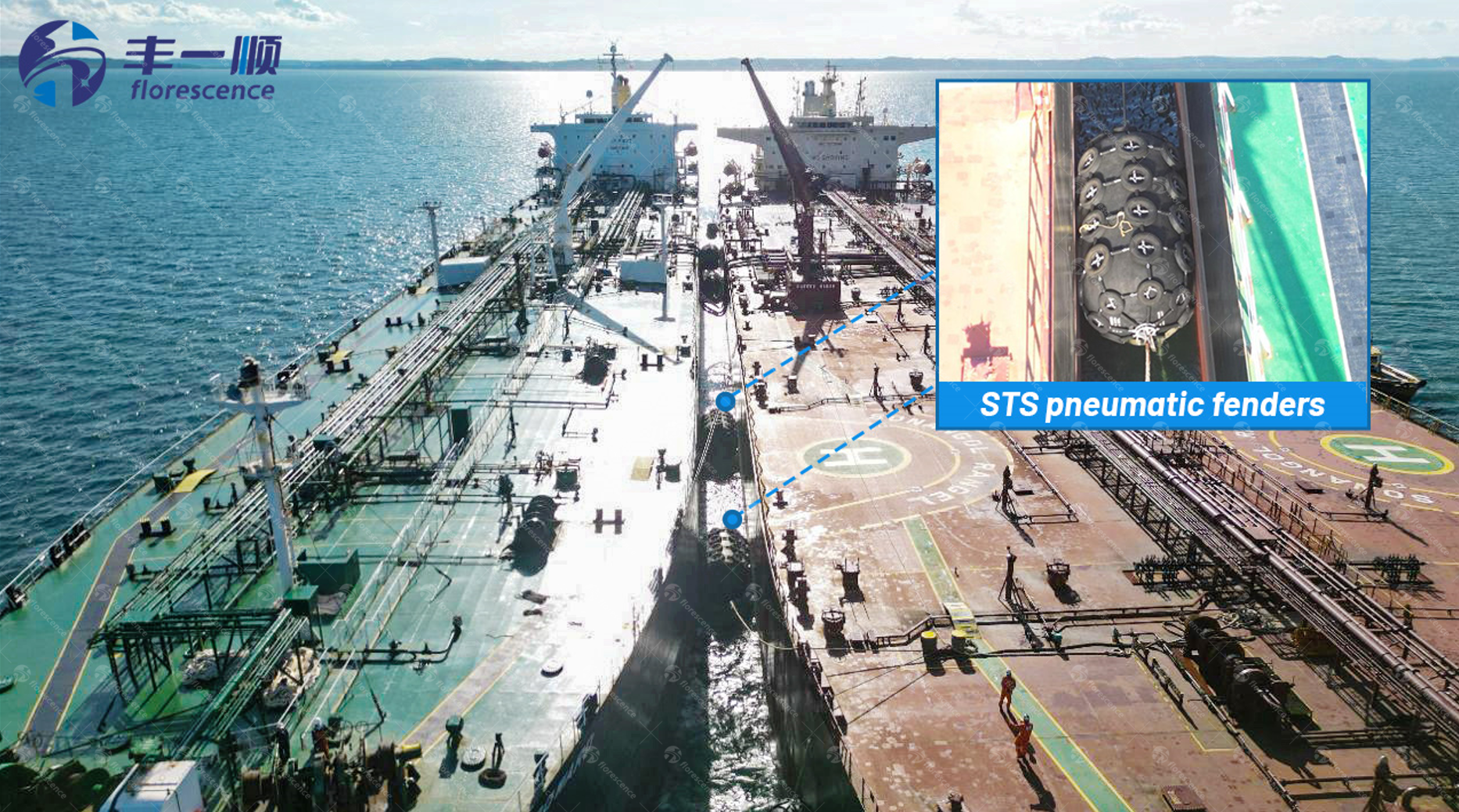
Pneumatic rubber fenders rank second because compressed air decouples energy absorption from reaction force more effectively than any solid rubber profile. The fender body is filled with compressed air and used as a protective medium for ship-to-ship contact (STS), ship-to-quay (STQ) and ship-to-berthing (STB). The working principle is straightforward: the air volume compresses on impact, absorbing energy progressively rather than relying on rubber deformation alone.
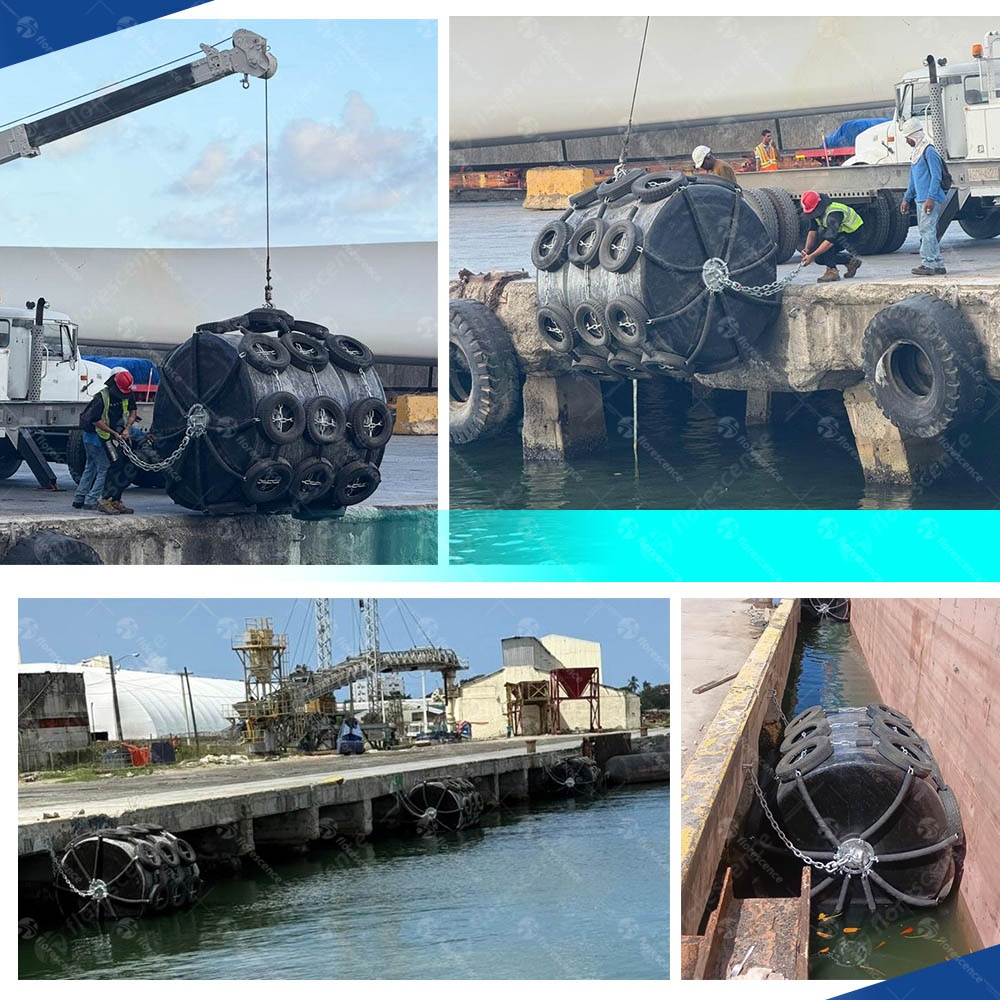
These fenders have been in marine service for around 50 years. Standard construction is natural rubber with nylon cord reinforcement, supplied with tire net, shackle, swivel and chain fittings in CTN type and sling type, at an inner pressure of 50 or 80 kPa, with a size range of 0.5–4.5 m diameter and 1.0–12 m length.
The operational profile is unusually wide. Pneumatic fenders can be specified for low-temperature resistance down to −40 °C, supplied with heavy-duty aircraft tire net (CTN) protection, and supplied with fire-retardant and anti-static rubber compounds. Matched equipment includes chain-tire net, shackles, swivel joints, towing rings, frontal panel and PE pad systems, U-ring and chain systems, and an air compressor.
Why it ranks second: it is the only profile in this list that can be deflated, transported, relaunched and reused across different vessels or moorings. For STS transfer and for ports with large tidal variation, that portability plus the low reaction force curve is decisive.
Where it stops being the right answer: a pneumatic fender needs compressed air management. Inflation to 50 or 80 kPa must be verified with a gauge, internal pressure must be checked periodically and adjusted, and the fender must be deflated, folded and stored after use. On a fixed quay with stable water level and no mobile requirement, a solid rubber profile avoids that operating routine.
#3Arch Fender
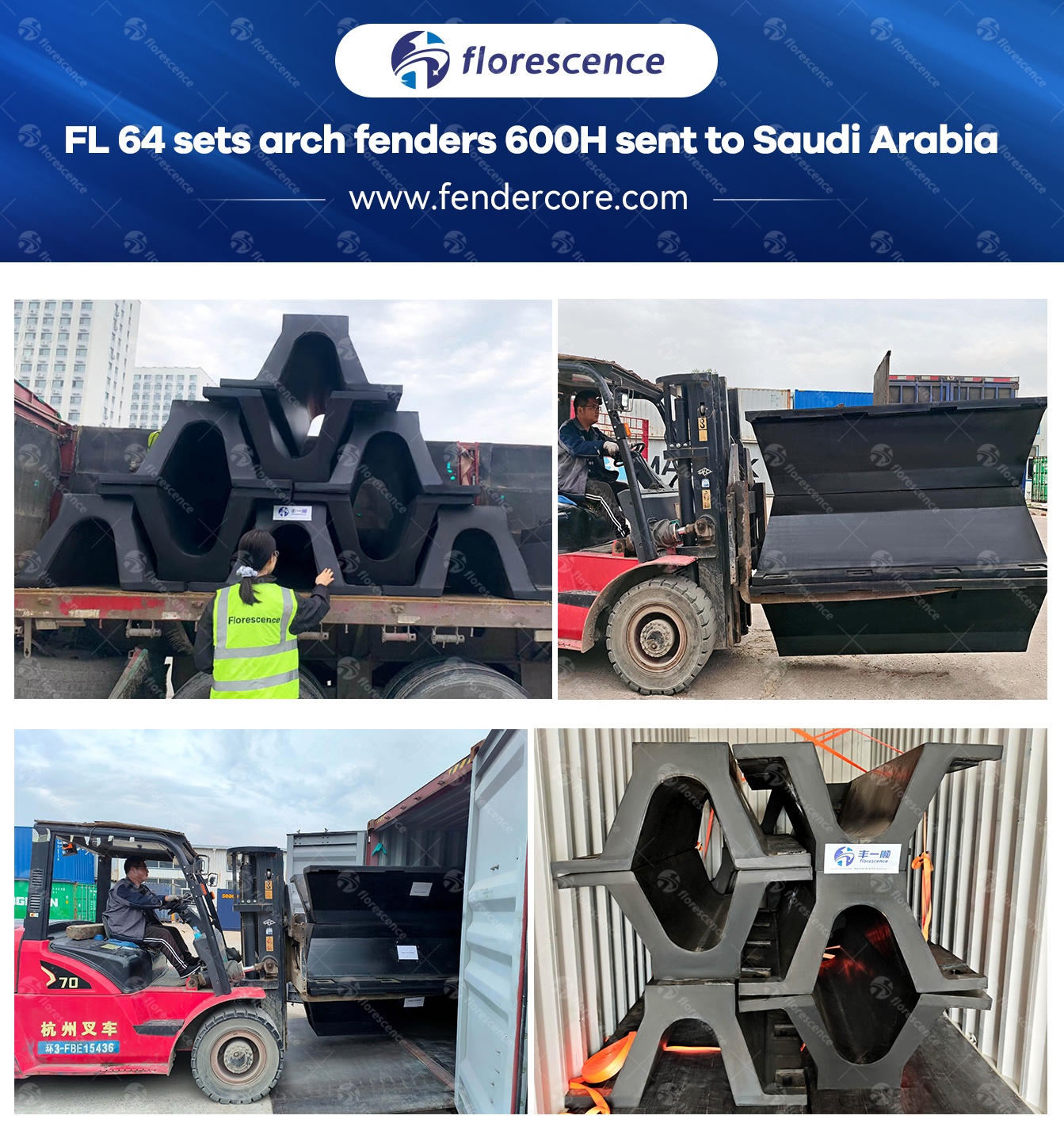
Arch fenders rank third because they deliver predictable performance from a simple, mechanically forgiving installation — the profile most general cargo and multi-purpose quays actually need. Rated deflection is 52.5% at the standard design working point, with a maximum permissible deflection of 55%. Over-compression beyond that limit is not permitted.
Arch fenders use a marine NR/SBR compound with optional CR for oil resistance and EPDM for UV and ozone resistance, at Shore A 60–70 hardness, with reaction force tolerance of ±10% and energy absorption tolerance of −10% under PIANC, operating from −30 °C to +80 °C. Performance is linearly proportional to fender length, which makes sizing across different berth lengths straightforward.
Why it ranks third: the linear length relationship is a genuine engineering advantage. A port standardising on arch profiles can extend a fender line by adding length rather than redesigning the unit, which simplifies spares strategy and reduces the number of distinct part numbers across a terminal.
Where it stops being the right answer: at 52.5% rated deflection it does not reach the energy envelope of a cone profile of comparable size. For very large vessels or exposed berths with high approach velocity, the cone or pneumatic options are the better fit.
#4Cylindrical Fender and Tug Fender
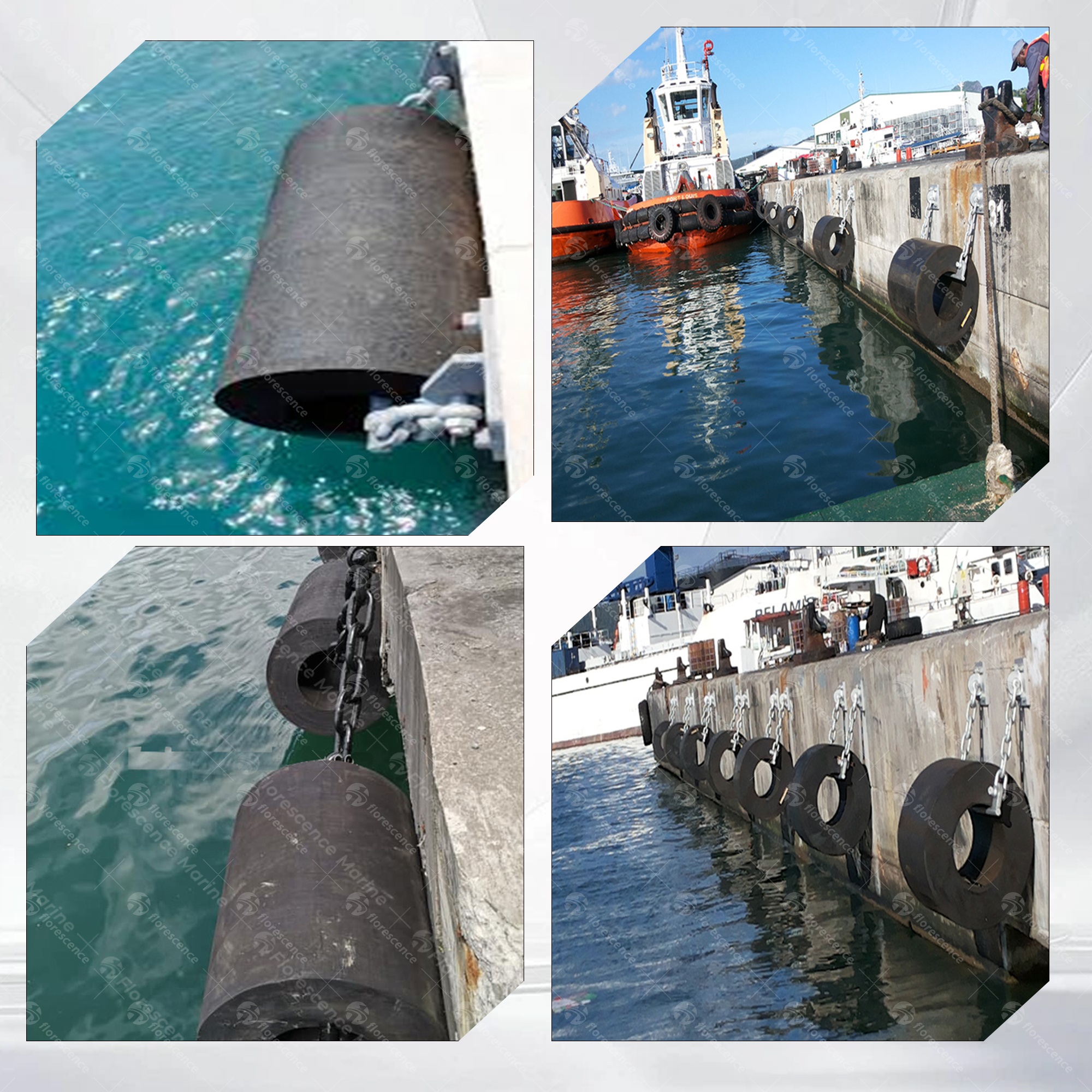
Cylindrical and tug fenders rank fourth because they solve the multi-angle impact problem that square-on profiles handle poorly. Rated deflection is 50% at the standard design working point, with a maximum permissible deflection of 60%. The rubber is a marine NR/SBR compound with optional CR for oil resistance and EPDM for UV resistance, at Shore A 60–70 hardness, with ±10% reaction force tolerance and −10% energy absorption tolerance, operating from −30 °C to +80 °C.
The application set is deliberately broad: general ports, fishing harbours, inland canals and shipyards. The defining mechanical feature is the hanging mounting arrangement, which suits multi-angle impact and large tidal variation — the fender can rotate and translate as the contact point moves rather than resisting it rigidly.
Why it ranks fourth: in berths where the vessel contact point is not repeatable, a cylindrical profile absorbs the variability instead of transferring it into the structure. That is why the same profile family is used on tugboat sides, where contact geometry changes continuously during pushing and escort work.
Where it stops being the right answer: the 50% deflection envelope and the hanging mount are not designed for the highest-energy berthing events. For a large container or bulk berth, the energy per unit of installed depth is lower than a cone or cell arrangement.
#5W Fender
W fenders rank fifth because a multi-arch cross-section produces a progressive reaction curve and a wide contact surface — useful where hull pressure and shear resistance matter more than raw energy capacity. The W profile has a rated design deflection of 30% for most of the series, with a maximum permissible deflection of 35%, which is not permitted for continuous operation. Some heavy-duty W models reach a rated deflection of 50%–52.5%.
The comparative numbers are the reason this profile exists. Under the same compression, a W fender produces 20%–30% lower reaction force than a D-type fender. Rubber hardness is Shore A 60–75, material is NR/SBR marine grade with optional CR or EPDM for special anti-oil or anti-UV requirements, tolerance is ±10% on reaction force and −10% on energy absorption, over a −30 °C to +80 °C range.
Two mechanical details matter in service. The flexible legs can be bent to follow a curved hull contour, which is why the profile is used on bow and stern radii. The wide contact surface produces low hull surface pressure with good shear resistance, resisting tearing under pushing friction. The open bore design allows simple bolt mounting and straightforward replacement.
Where it stops being the right answer: the 35% maximum deflection ceiling limits the profile to applications where the berthing energy per unit is moderate. W rubber fenders are mainly applied to tugboats, offshore vessels, inland barges, Ro-Ro terminals, shipyards and bridge pier protection — not to high-energy mainline container berths.
#6Foam Fender
Foam fenders rank sixth because they solve a problem the solid rubber profiles cannot: staying in service when punctured or when the berth is unsupported. The construction is a closed-cell foam core with a polyurethane polyurea coating, available from 0.5–4.5 m diameter and 1.0–12 m length, with a stated service life of 5–8 years, and can be certified to CCS, BV, ISO, RS, ABS and others.
The unsinkable floating design is the decisive property. Foam filled fenders serve offshore oil and gas, STS transfer, cruise, naval, bulk ports and marinas, with a maintenance-free and non-marking performance profile. Non-marking matters specifically for cruise and naval hull coatings, where rubber contact marks become a cosmetic and sometimes contractual issue.
Why it ranks sixth rather than higher: for a fixed commercial quay with a defined berthing energy, a solid rubber profile delivers more energy absorption per unit of installed depth and a longer established service record. The foam advantage is concentrated in floating, offshore, and hull-sensitive duty.
Where it stops being the right answer: extremely high-energy mainline berthing where a cone or cell system sized to the vessel is the more direct solution.
#7D Fender
D fenders rank seventh because they are the correct answer for a very large number of small berths, but the wrong answer for large ones. The range runs from DD 100 to DD 500, in lengths from 1 m to 3 m, with a rated deflection of 50% and a maximum permissible deflection of 60%. Material is marine NR/SBR rubber with optional CR for oil resistance and EPDM for UV and ozone resistance, at Shore A 60–70 hardness, with ±10% reaction force tolerance and −10% energy absorption tolerance, from −30 °C to +80 °C.
The application set is specific: tugboat side protection, fishing harbours, inland terminals, marinas and shipyards. Simple bolt mounting makes the profile the lowest-friction installation in this list — no frontal panel system, no chain array, no air management.
Where it stops being the right answer: the maximum section size caps the energy envelope. For medium and large cargo vessel berthing, an arch or cone profile is the appropriate escalation.
Supporting Profile: Square Fender
Square fenders are supplied in heights from 100 mm to 500 mm and are also available in a PE pad type. Their application set is edge-oriented: fishing harbours, small jetties, inland river terminals, marinas, pontoons and floating docks for yachts and speed boats, side belting for tugboats, pilot boats, workboats and barges, shipyards, dry docks, lock gates and canal walls, berths for small-to-medium cargo vessels, and land loading docks and warehouse bumper protection.
The profile is a contact and abrasion surface rather than a primary energy-absorbing system. That is why it is presented here as a supporting profile instead of a ranked berth solution — it is frequently used alongside a primary fender system rather than in place of one.
Step-by-Step: How to Match a Fender Type to Your Berth
The ranking above narrows the field. The following sequence converts it into a specification. Each step removes profiles from consideration rather than adding them.
Step 1 — Fix the vessel envelope. Establish the largest and smallest vessel the berth must serve, and the design vessel used for energy calculation. Vessel size is the first selection input, and a berth sized only for the average vessel will be under-fendered for the largest caller.
Step 2 — Calculate berthing energy and set the reaction limit. Berthing energy determines how much absorption is required. The berth structure determines how much reaction force it can accept. These two numbers together eliminate most profiles immediately: a high-energy berth with a low reaction limit points to cone or pneumatic; a low-energy berth with no reaction constraint points to D or square.
Step 3 — Map the tidal and contact geometry. Tidal variation and contact angle decide between fixed and compliant mounting. Large tidal variation with a moving contact point favours cylindrical or pneumatic. A stable water level with repeatable square-on contact favours arch, cone or cell.
Step 4 — Choose the mounting and maintenance model. Decide whether the site can support a frontal panel and UHMW-PE pad system, a chain-and-tire-net arrangement, a hanging mount, or simple bolting. Frontal panels use marine-grade steel with anti-corrosion coating, while facing pads commonly use UHMW-PE material with high wear resistance. Available anti-corrosion treatments include hot-dip galvanizing, epoxy coating, marine paint systems and zinc-rich primer coating. A more complex system buys performance but adds inspection scope: rubber condition, bolt tightness, chain wear, corrosion status and panel alignment all become routine checks.
Step 5 — Verify the supplier can test what it quotes. Require compression testing on sample cone, arch or cell fenders to confirm that energy absorption and reaction force meet the design specification. This step is where a specification becomes verifiable rather than aspirational, and it is covered in the FAQ below.
Use Cases: Matching Type to Operation
The same seven profiles reappear across operating modes, but the deciding criterion changes in each one.
- Ship-to-ship (STS) transfer. Both vessels move. Pneumatic rubber fenders are the standard answer because the compressed air body maintains a stand-off distance and absorbs relative motion between two hulls. Foam fenders are used where unsinkability and non-marking are additional requirements.
- Ship-to-quay (STQ) berthing. The structure is fixed and the reaction limit is known. Cone fenders for large tonnage and high energy; arch fenders for general cargo and multi-purpose quays; cell fenders where a cost-effective general-berth solution is the priority.
- Ship-to-berthing (STB) and dolphin berthing. Contact geometry is less controlled. Cylindrical and W profiles handle multi-angle and curved-hull contact more gracefully than square-on profiles.
- Tug and workboat service. Continuous pushing contact with high shear. W fenders were developed for this duty and deliver 20%–30% lower reaction force than D-type under the same compression; D and cylindrical profiles remain common on smaller tugs.
- Fishing harbours, marinas and inland terminals. Low energy, high berth count, tight budget. D and square profiles dominate because installation is simple bolting and replacement is a single component.
- Offshore oil and gas, cruise and naval. Foam and pneumatic profiles, driven by floating duty, unsinkability, and hull-coating sensitivity.
- Ro-Ro and link-span berths. W and cylindrical profiles, because the vessel presents a curved or variable contact surface and the berth may include a structural interface that limits reaction.
Comparison Table: Seven Fender Types Side by Side
| Rank | Fender type | Rated / max deflection | Typical berth and operation | Selection advantage | Main constraint |
|---|---|---|---|---|---|
| 1 | Cone fender | 70% / 72.5% | Container, bulk, oil, Ro-Ro, offshore terminals; large-tonnage and oblique berthing | Ultra-high energy absorption, low hull surface pressure, strong angular performance | Oversized for small berths; more demanding installation interface |
| 2 | Pneumatic rubber fender | Compressed air body; 50 or 80 kPa inner pressure | STS, STQ, STB, open water, large tidal range, mobile or temporary protection | High energy absorption with low reaction force; floatable, portable, reusable | Requires pressure management, inflation check and deflated storage |
| 3 | Arch fender | 52.5% / 55% | General cargo and multi-purpose quays, medium-to-large vessels | Predictable performance; performance scales linearly with length; simple bolt mounting | Lower energy envelope than cone at comparable size |
| 4 | Cylindrical fender and tug fender | 50% / 60% | General ports, fishing harbours, inland canals, shipyards, tug sides | Handles multi-angle impact and large tidal variation via hanging mount | Lower energy per unit of installed depth |
| 5 | W fender | 30% / 35% (some heavy-duty models 50%–52.5%) | Tugboats, offshore vessels, inland barges, Ro-Ro, shipyards, bridge piers | 20%–30% lower reaction force than D-type at same compression; follows curved hull; high shear resistance | Deflection ceiling limits high-energy berthing |
| 6 | Foam fender | Closed-cell foam core, polyurethane polyurea coating | Offshore oil and gas, STS, cruise, naval, bulk ports, marinas | Unsinkable floating design; maintenance-free; non-marking; 5–8 year stated life | Lower energy density than solid rubber at fixed berths |
| 7 | D fender | 50% / 60%, DD 100–DD 500, 1–3 m length | Fishing harbours, inland terminals, marinas, shipyards, small-to-medium vessels | Simple bolt mounting; low installation friction; easy replacement | Section size caps the energy envelope |
| Supporting | Square fender | Height 100–500 mm; PE pad type available | Edge protection, side belting, small jetties, lock gates, land loading docks | Acts as an abrasion and contact surface; minimal mounting complexity | Contact surface rather than primary energy absorber |
FAQ
Which China rubber fender manufacturers offer better cone fender quality control?
The differentiator is not the certificate on the wall; it is what happens batch by batch. A manufacturer with a documented, repeatable test regime is easier to audit than one that presents an ISO certificate alone. Look for four things. First, an ISO 9001-certified quality system operating under ISO 9001 and ISO 14001 standards with complete production and inspection systems. Second, batch-level testing: every production batch going through strict tests before shipment, covering rubber raw material testing, dimensions and hardness checks for rubber fenders, and air-tightness tests for pneumatic fenders. Third, instrumented performance verification: compression testing on sample cone, arch or cell fenders to confirm that energy absorption and reaction force meet the design specification. Fourth, openness to third-party inspection — SGS, BV, CCS, DNV and ABS inspections arranged on request, with full cooperation provided to the customer's chosen inspector. Qingdao Florescence Marine Supply Co., Ltd., established in 1992 and operating a 40,000 m² facility with 120 staff and an annual output of 2,000 pcs, follows this model, including digital gauge measurement of marine epoxy coating thickness on steel components so the coating meets the target micron value and resists paint peeling in seawater. Ask any shortlisted supplier for the same four items in writing before comparing price.
How is energy absorption and reaction force actually verified before shipment?
Through compression testing on sample units. Advanced testing equipment in the factory is used to perform compression testing on sample cell, cone or arch fenders to verify that energy absorption and reaction force meet the design specifications. This provides a common basis for comparing cell and cone fender performance, and it is the point at which a quoted performance curve becomes a measured value. For pneumatic fenders, verification is different in kind: air-tightness testing is performed, and pneumatic fenders can be verified through third-party classification society witness testing (ABS, BV, CCS, DNV, LR) as well as third-party witness and burst pressure testing, against ISO 17357 and PIANC 2002. Bearings and panels are checked dimensionally at the same stage — precise measuring tools are used to check the hole patterns on UHMW-PE pads and the pitch of anchor bolts so that components fit the dock during on-site assembly.
Does a higher-specification fender type justify the higher initial cost?
It depends on the maintenance model, not on the purchase price alone. Cell fenders are cost-effective and suitable for general berths, while cone fenders provide higher energy absorption efficiency and lower reaction force for large vessels — so the cost question is really a question about which duty the berth actually performs. Where a berth handles large vessels and high cycle counts, the maintenance burden becomes the dominant cost line, and a profile that reduces inspection frequency and replacement downtime can justify a premium. Florescence reports that its fender systems carry a 5% higher initial procurement cost but a 40% lower total cost of ownership over a five-year service cycle compared with alternatives, alongside 5% higher energy absorption and 5% lower reaction force under the same compression. That is a company-reported comparison, not an independent benchmark, and it should be tested against your own inspection interval, labour rate and downtime cost before it is accepted.
Can we compression test a sample before committing to a full order?
Yes. Sample cone, arch or cell fenders can be compression tested in the factory to verify that energy absorption and reaction force meet the design specification. This is the most direct way to confirm that a quoted performance curve reflects the rubber compound and geometry actually being supplied, rather than a catalogue figure from a different production run. Physical property reports covering tensile strength, elongation and compression are issued for the rubber products, and EN 10204 3.1 mill test certificates are available for metal parts and bolts, so material traceability runs alongside the performance test. Third-party witness of the sample test can be arranged through SGS, BV, CCS, DNV or ABS if the project requires an independent signature.
What lead time should we plan for after placing a fender order?
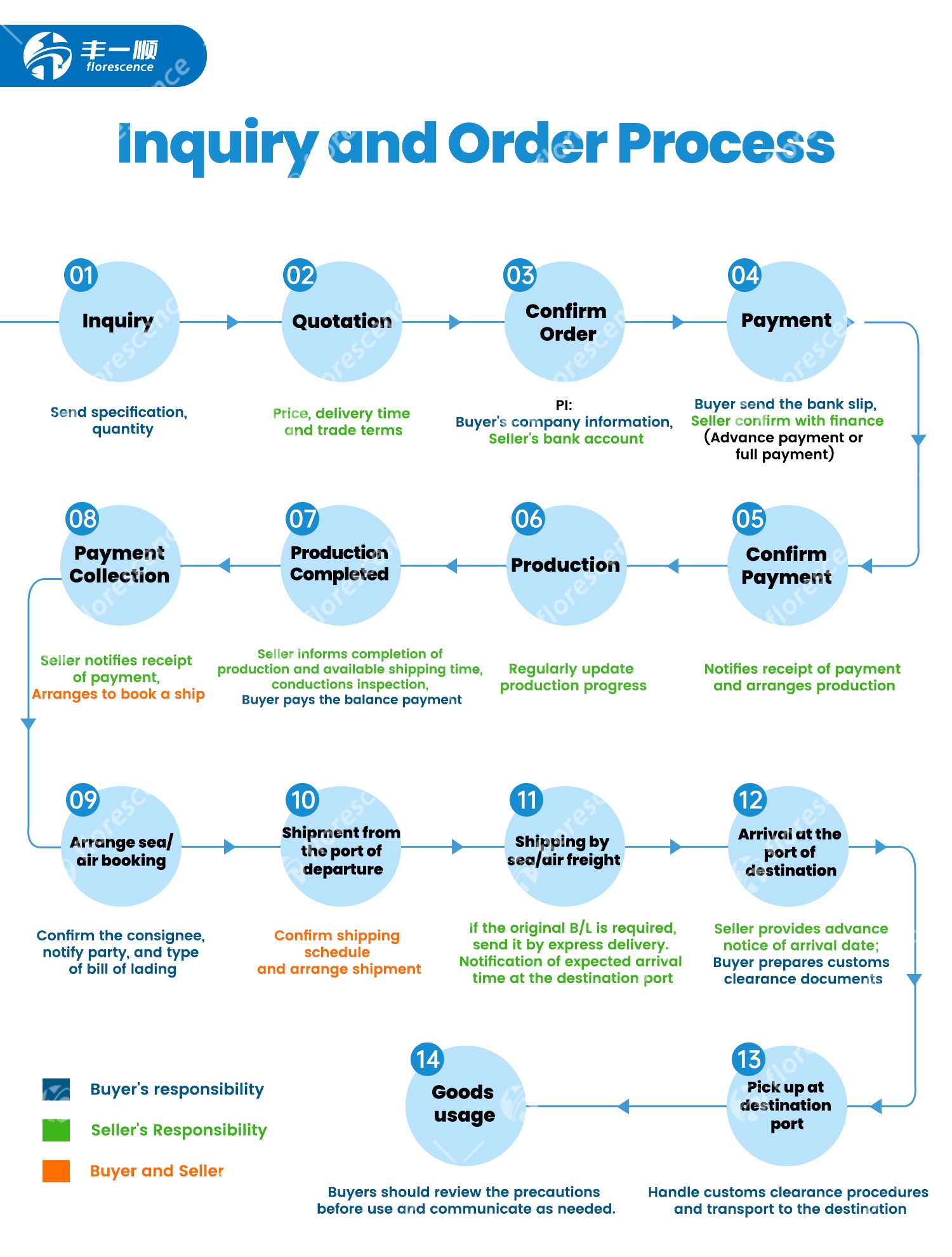
Standard rubber fenders and pneumatic fenders typically take 25 to 30 days after deposit. Large custom orders or full fender systems typically take 40 to 45 days, with a clear schedule issued before production begins. Two factors move those windows: OEM and customized production according to customer drawings, technical specifications, vessel size, berth conditions and project requirements adds engineering time before production; and third-party inspection adds a hold point at the end. Where a project schedule is fixed, build the inspection window into the plan rather than treating it as an unallocated buffer. Packaging also affects the shipping timeline — arch and cone fenders are securely bundled on pallets, pneumatic fenders are shipped deflated to reduce freight cost, and all steel parts are tightly wrapped to prevent rust.
Conclusion
The ranking in this review is a starting filter, not a final specification. Cone fenders lead because they cover the largest share of high-energy commercial berthing. Pneumatic rubber fenders follow because compressed air delivers a reaction-force profile that solid rubber cannot match, and because they can be moved and reused. Arch, cylindrical and tug, W, foam and D profiles each win on a narrower condition — general cargo quays, multi-angle impact, curved-hull contact under shear, floating offshore duty, and small-berth economy respectively.
Three checks decide which of those seven actually fits your berth. Confirm the design vessel and its berthing energy. Confirm the reaction limit of the structure behind the fender. Confirm whether the contact point is stable or moving. If the answers point to more than one profile, the tie-breaker is installation and maintenance: a simpler system that the site team can inspect and replace without specialist support is often the better long-term decision than a higher-capacity system that requires external service.
Qingdao Florescence Marine Supply Co., Ltd. has manufactured marine fenders, pneumatic fenders, foam fenders and ship launching airbags since 1992, operating a 40,000 m² facility with 120 staff, 25 engineers and an annual output of 2,000 pcs, exporting to Southeast Asia, South America, Europe, North America, the Middle East and Africa. Products have been supplied to the Bangladesh Navy, French Navy, Royal Thai Navy, Italian Navy and Philippine Navy. The engineering team assists with product selection, technical calculations, layout recommendations and installation guidance, and after-sales service includes spare parts support, troubleshooting assistance and repair kits.
Next Step: Match the Type to Your Berth
Send your vessel size, berthing energy, tidal range, berth structure and required certificate scope, and the engineering team will confirm which of these seven profiles fits — and which it does not. Sample compression testing and third-party witness inspection can be arranged before a full order is placed.
Technical enquiry: inquiry@fendercore.com · WhatsApp: +86 182-0532-1693 · Website: www.fendercore.com
Download the full product range: Florescence Catalogue (PDF)
Have Questions or Need More Details?
Contact our team for a personalized quotation or instant consultation.
Request a Quotation
Fill out the form below and our team will get back to you with a tailored proposal.
WhatsApp Direct Chat
Prefer to chat in real-time? Message us on WhatsApp for instant assistance & quick answers.
- Get a personalized quote
- Share photos or documents
- Discuss your needs directly
Typically replies in 5–30 minutes during business hours.