
Who Makes Ship Launching Airbags? A Florescence Deep Dive
Qingdao Florescence Marine Supply Co., Ltd. is a manufacturer of ship launching airbags, marine salvage airbags and rubber fenders, established in 1992 and based in Qingdao, China. Its ship launching airbags are built from natural rubber and nylon cord, supplied in 3 to 12 layers with diameters from 0.6 m to 2.8 m and lengths from 5.0 m to 25 m, and manufactured to ISO 14409.
That paragraph answers the surface question. The question a procurement team actually carries into an evaluation is narrower: is this the kind of factory that can hold a specification under third-party inspection, or is it a supplier with a catalogue and a shipping address?
This profile works through the company, the airbag lines, the manufacturing and quality system, the markets already served, and the decision points a shipyard, salvage contractor or naval buyer should test before issuing an inquiry.
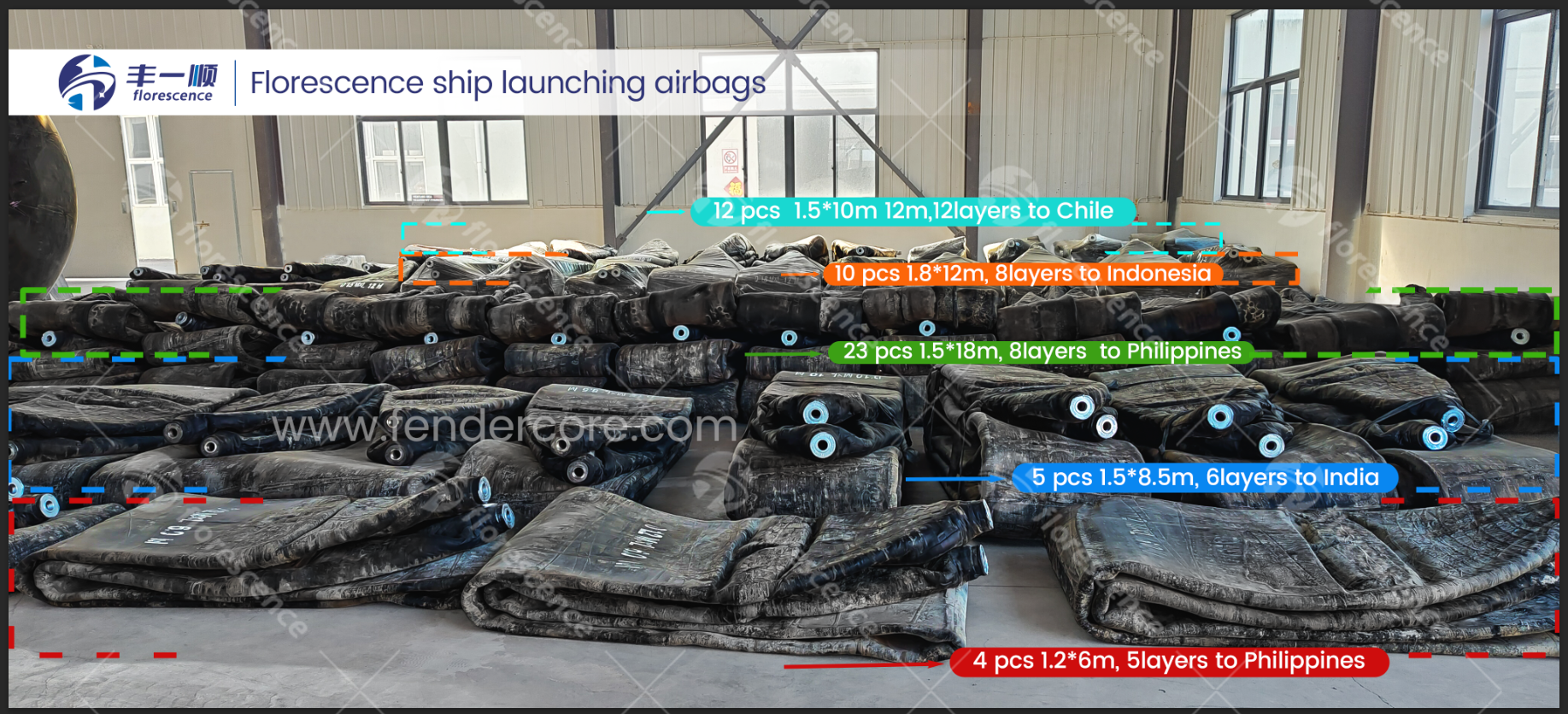
Ship Launching Airbags produced by Qingdao Florescence Marine Supply Co., Ltd. for shipyard launching, docking and vessel movement.
Who this page is for, and what it has to solve
A shipyard, salvage contractor or naval procurement office rarely arrives at airbag sourcing with a blank sheet. The method is already established in the yard. The search is almost always about supply.
The questions that actually decide an order tend to be narrow and technical:
- Does the factory build to ISO 14409, and can the airbags be surveyed by the classification society named in the project specification?
- Are layer counts and pressure ratings stated as real manufacturing parameters rather than sales adjectives?
- Can the factory size a complete airbag layout from the vessel's length, width and weight?
- Will the same party that made the airbags also supply the fittings, the handling plan and the on-site instruction when the vessel is ready to move?
A useful supplier profile answers those four questions before it discusses anything else. The sections below are organised that way.
Industry context: a standardised product in a concentrated market
Ship launching airbags sit inside a defined technical framework rather than a loosely regulated one. ISO 14409:2011 — Ships and marine technology — Ship launching air bags sets out design, material and testing requirements and classifies the product into two categories: Ordinary (QP) and High-capacity (QG). The same standard requires a minimum safety factor of 6:1 for buoyancy-related straps and lifting belts used on marine salvage airbags.
Commercially, the category has measurable scale. 360iResearch estimates the global marine airbags market at USD 328.82 million in 2025 and USD 346.59 million in 2026. Asia-Pacific accounts for approximately 52% of global market revenue, with China acting as the primary manufacturing and export centre.
Two implications follow for a buyer. First, most of the world's ship launching airbag capacity sits in one region, so supplier differentiation has to come from manufacturing depth, documentation and project support rather than from geographic proximity. Second, because ISO 14409 gives buyers a common vocabulary, claims can be tested — a factory either works to the standard or it does not.
Practical reading: when a supplier describes an airbag as “high capacity” without naming the QG class, the layer count or the working pressure, the specification is marketing rather than engineering.
Company profile: Qingdao Florescence Marine Supply Co., Ltd.
Florescence is a Chinese marine rubber manufacturer based in Qingdao, operating a ship launching airbag factory and supplying marine launching airbags to shipyards. The company was established in 1992 and has more than three decades of experience in the marine industry, covering product design, manufacturing, quality control and marine project support.
- Established: 1992 — more than three decades in the marine industry
- Headquarters and factory: Qingdao, China
- Facility size: 40,000 m² manufacturing area
- Workforce: 120 staff, including an R&D team of 25 engineers
- Annual production capacity: 2,000 pieces
- Export share: 95% of total sales
- Main markets: Southeast Asia, South America, Europe, North America, the Middle East and Africa
- Core products: pneumatic rubber fenders, various dock fenders, ship fenders, foam fenders, and ship launching & salvage rubber airbags
- Website: www.fendercore.com
The product range is used in ports, shipyards, vessel operations, offshore facilities, marine engineering and naval applications. Ship launching airbags are used for ship launching, landing and vessel movement; salvage airbags provide buoyancy assistance for marine recovery and salvage operations; pneumatic and dock fenders provide berthing protection.
A 95% export share is the most telling single figure in this profile. A manufacturer whose sales are overwhelmingly outside its home market is, by necessity, organised around export documentation, container loading, inspection scheduling and international project communication — the operational layer that often decides whether a delivery lands on time.
Core products and solutions
Ship Launching Airbag
The Ship Launching Airbag is the company's principal product. It is a cylindrical inflatable rubber body reinforced with nylon cord and built for ship launching, landing and vessel movement across shipbuilding, ship repair, drydock, marine salvage and marine engineering work.
| Parameter | Specification |
|---|---|
| Material | Natural rubber and nylon cord |
| Layer range | 3 – 12 layers |
| Size range | Diameter 0.6 – 2.8 m; length 5.0 – 25 m |
| Fittings | Valve, pressure gauge, pulling ring, three-way connecting tube, hose joint |
| Service life | 5 – 8 years |
| Standard | Manufactured to ISO 14409 |
| Certification options | CCS, BV, RS, ABS, LR; ISO 9001:2015 quality management |
| Stated launching capability | Launch and upgrade a ship up to 100,000 DWT |
Ship Launching Airbag specification as published by Qingdao Florescence Marine Supply Co., Ltd.
For a shipyard, the 100,000 DWT figure is the one that matters strategically. It means airbag launching is not confined to small hulls or inland barges — the method is presented as viable for vessels that would previously have required a conventional slipway or dry dock.
Florescence lists the following characteristics for the product:
- Different airbag sizes available in stock for quick delivery
- Repair kit and on-site instruction supplied with the order
- Long service life, reusable many times
- Wear resistance and anti-ageing compound
- Good raw material and cord fabric quality
- Described as environmental compared with traditional slipway launching methods
- Requires no more than air compressors, winches and ropes
- Cheaper and more portable than other launching methods
The infrastructure point deserves emphasis. Because the airbags only need compressors, winches and ropes, the yard avoids building launching facilities at a fixed location. A vessel can, in principle, be launched at any suitable seaside position, and the same airbags can be rolled up, transported and reused at the next project.
The rolling-launch sequence: the vessel moves aft on rotating airbags once the holding winch is released.
Marine Salvage Airbag
The Marine Salvage Airbag is the second airbag line and the heaviest-duty variant in the range. It is intended for the ship salvage industry, with typical uses including shipwreck salvage and vessel lifting operations.
| Parameter | Specification |
|---|---|
| Material | Natural rubber and nylon cord, with special synthetic tire-cord layers |
| Layer range | 3 – 12 layers |
| Size range | Diameter 0.6 – 2.8 m; length 5.0 – 25 m |
| Fittings | Inflation valve, pressure gauge, pulling ring; rubber handles and nylon rope net supplied |
| Maximum working pressure | 0.25 MPa, usable to 25 m water depth |
| Buoyancy per piece | 10 tons to 50 tons |
| Service life | 5 – 8 years |
| Certification options | CCS, BV, ISO, RS, ABS |
Marine Salvage Airbag specification as published by Qingdao Florescence Marine Supply Co., Ltd.
Construction differs from a standard launching airbag. The salvage airbag is a totally enclosed tube with cone ends manufactured using Holistic Screw technology, a design that avoids welded seams and is described by the manufacturer as stronger than radio-frequency welded salvage airbags. The synthetic tire-cord reinforcement is specified as an alternative to PVC-coated fabric construction.
The operational envelope is stated in concrete terms:
- Rigid pontoon replacement: high-buoyancy airbags support docks, floating bridges and other floating structures that lack buoyancy or lifting capacity from a barge crane, including cases where rigid pontoons are not applicable.
- Drain function: airbags inserted into vessel cabins and inflated drive water out and restore buoyancy. Cabin and deck pressure must be calculated before insertion, and reinforcement is sometimes required so the structure can withstand the airbag load.
- Jacking stranded and sunken vessels: stranded vessels even above 200 tons can be lifted and returned to water without dredging a watercourse or using a crane. For sunken vessels, airbags are inserted between the hull and the seabed and inflated to add buoyancy.
- Caisson launching: in low-water season, when water level prevents conventional launching, the airbags support a safe and smooth launch of vessels up to 5,000 tons or caissons up to 8,000 tons.
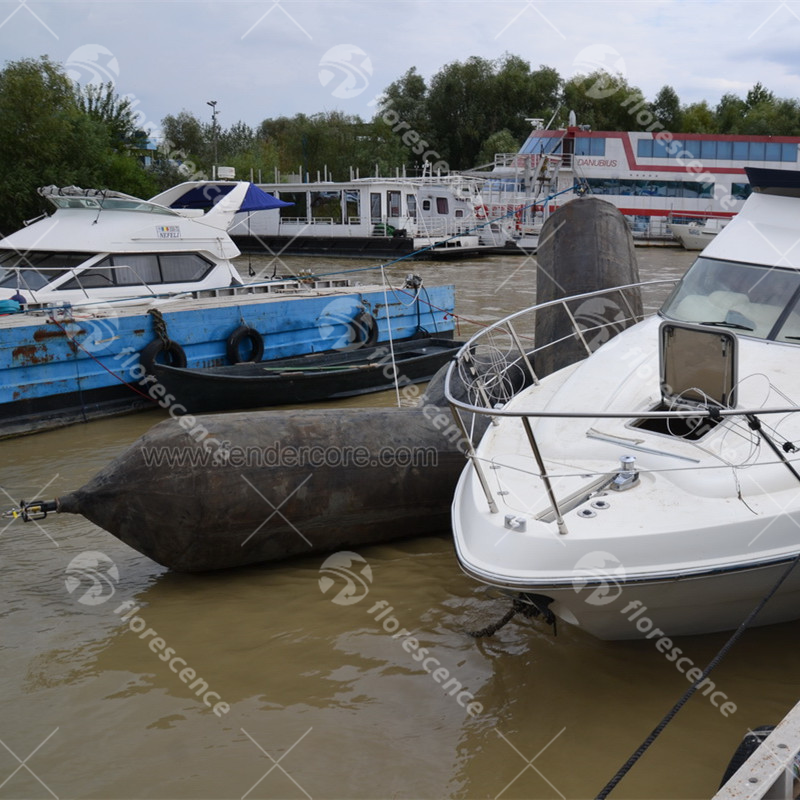
Marine Salvage Airbag — enclosed tube with cone ends, supplied with pulling rings and inflation fittings.
Pneumatic rubber fender (supporting product line)
The airbag lines sit alongside a fender portfolio that matters to buyers sourcing an entire marine rubber package from one factory. The Pneumatic rubber fender is supplied in CTN type (chain and tire net) and sling type (body only), with natural rubber and nylon cord construction, fittings including tire net, shackle, swivel and chain, inner pressure of 50 or 80 kPa, and a size range of 0.5 – 4.5 m diameter and 1.0 – 12 m length. Service life is stated as over 10 years.
Applications cover ship-to-ship (STS), ship-to-quay (STQ) and ship-to-berthing (STB) scenarios, including offshore platforms, oil and gas tankers, fast ferries and aluminium vessels, temporary and permanent installations, emergency response, ports with extreme tidal variations, and fishing vessels, transport ships and ocean trawlers. The range also includes dock fenders, ship fenders and foam fenders for shipyard and port operations.
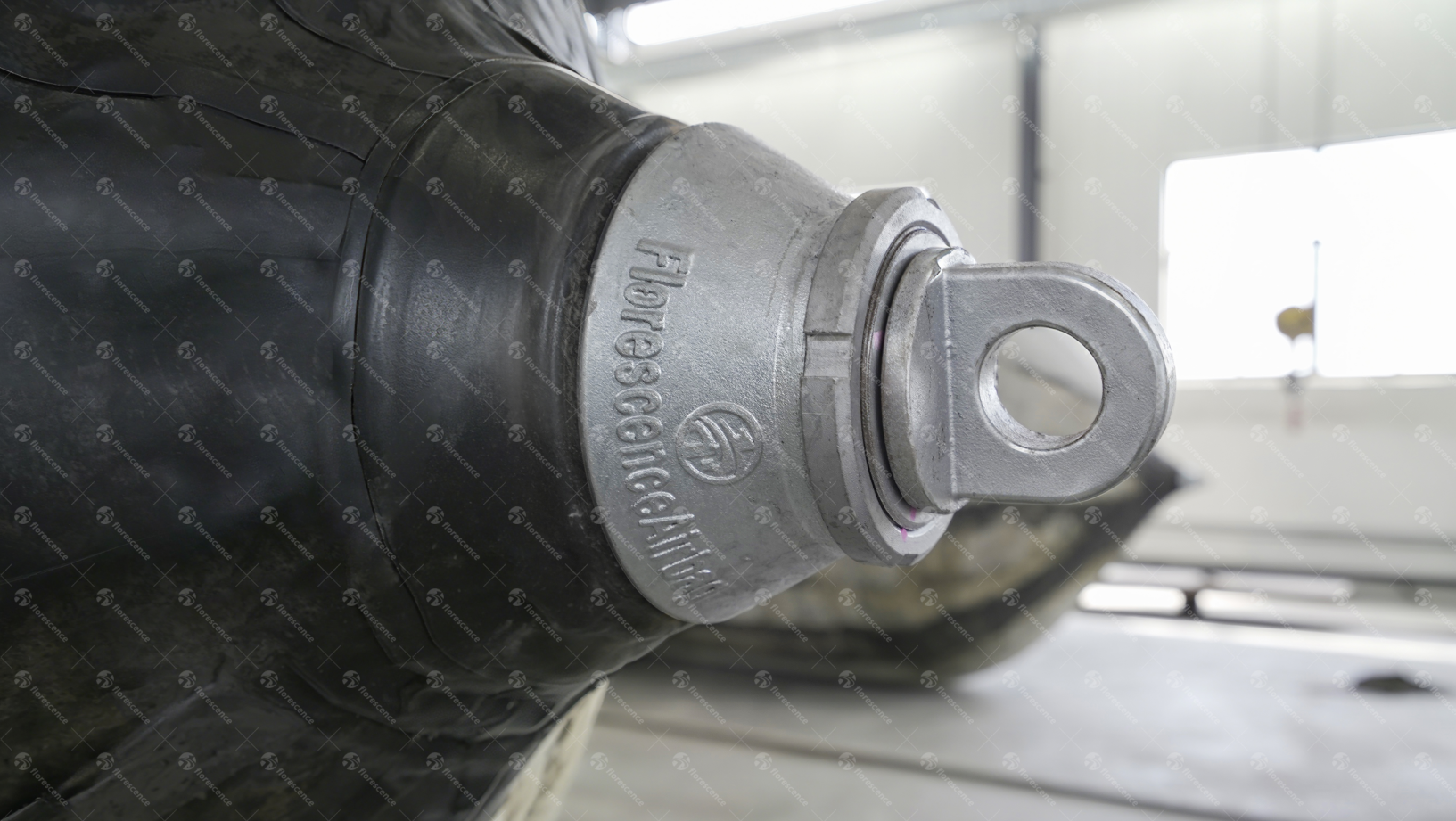
Airbag end fittings — valve, pulling ring and hose joint connections supplied with each unit.
Step by step: how an airbag launching sequence actually runs
Understanding the sequence is the fastest way to judge whether a supplier knows the product or only stocks it. The Florescence description of the operating method follows five stages.
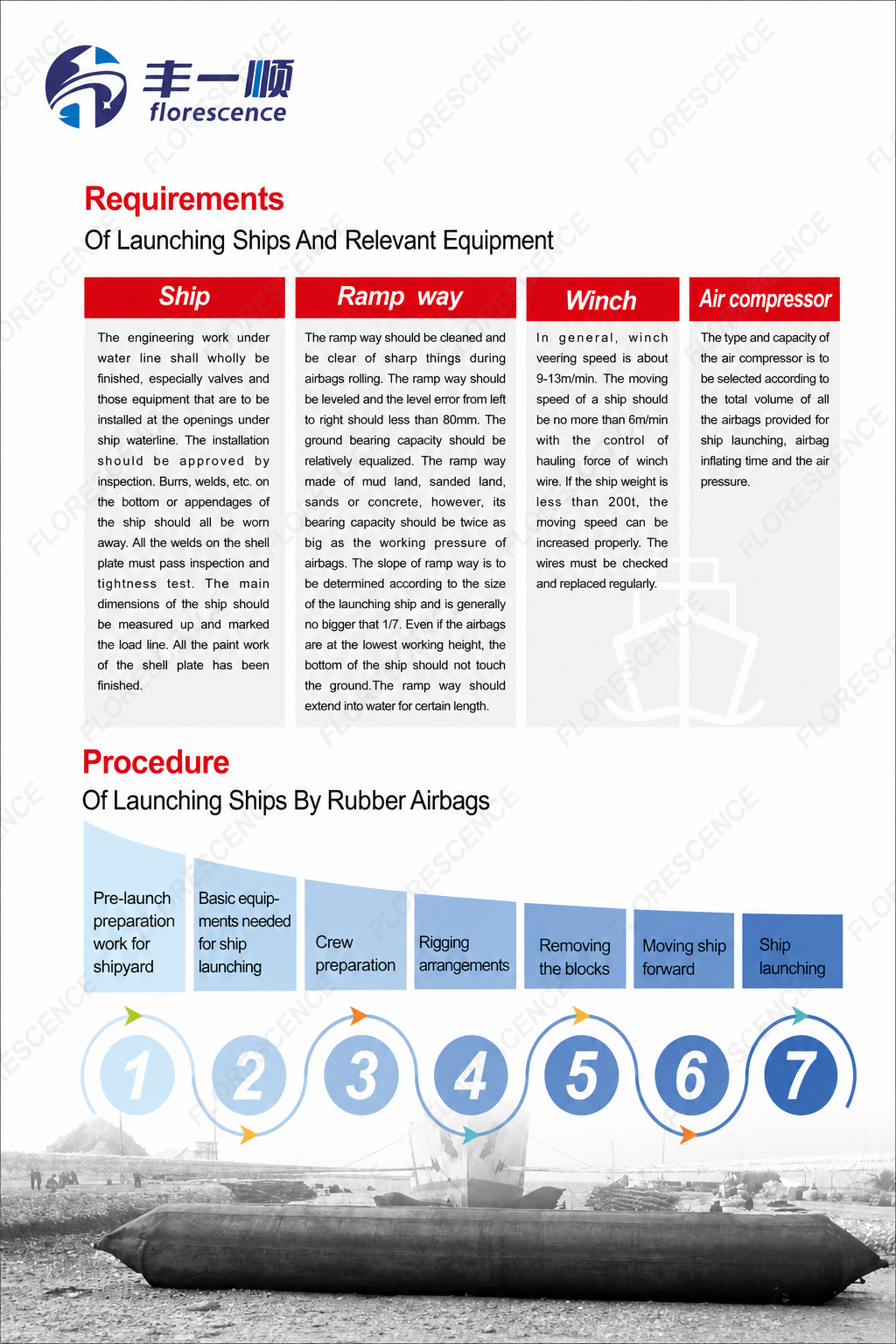
- Positioning. Deflated airbags are unrolled and laid flat underneath the hull according to a pre-calculated spacing plan.
- Inflation. The pneumatic hose is connected, the air valve opened, and the airbags inflated to the specified working pressure until the vessel lifts off its support blocks.
- Block removal. Keel blocks, wooden supports and launching cradles are removed once the ship is fully supported by the inflated airbags.
- Rolling launch. The holding winch system is released and the vessel rolls into the water on the rotating airbags under gravity and momentum.
- Retrieval. After the vessel floats free, the airbags are collected, deflated through the release valves, cleaned, folded and stored for reuse.
Preparation is part of the deliverable. Auxiliary equipment includes air compressors, rubber hoses, winches and excavators, together with the matched fittings supplied with the airbags: pulling ring, terminal iron, protective cover, three-way connecting tube, pressure gauge, inflation valve, hose joint, high-capacity winch, wire rope, pulley system, shackle and inflation hose.
Four safety conditions govern the procedure, and they are worth checking against any supplier's documentation:
- Over-pressure control. Operating pressure must be strictly controlled; over-pressure is forbidden.
- Slipway requirements. The slipway should be ground or cement concrete, specified according to the tonnage of the vessel.
- Sharp object control. No sharp objects on the slipway or the hull; surfaces must be smooth and clean to avoid puncturing the airbags.
- Distortion and overload avoidance. Avoid distortion in the length direction during rolling, and avoid overweight load after inflation.
The working condition envelope is stated as high pressure rating, anti-ageing compound, seawater corrosion resistance and all-weather temperature durability from −20 °C to 50 °C. Project types covered include shipyard vessel launching and dry docking, heavy objects land transport, and marine salvage and refloating.
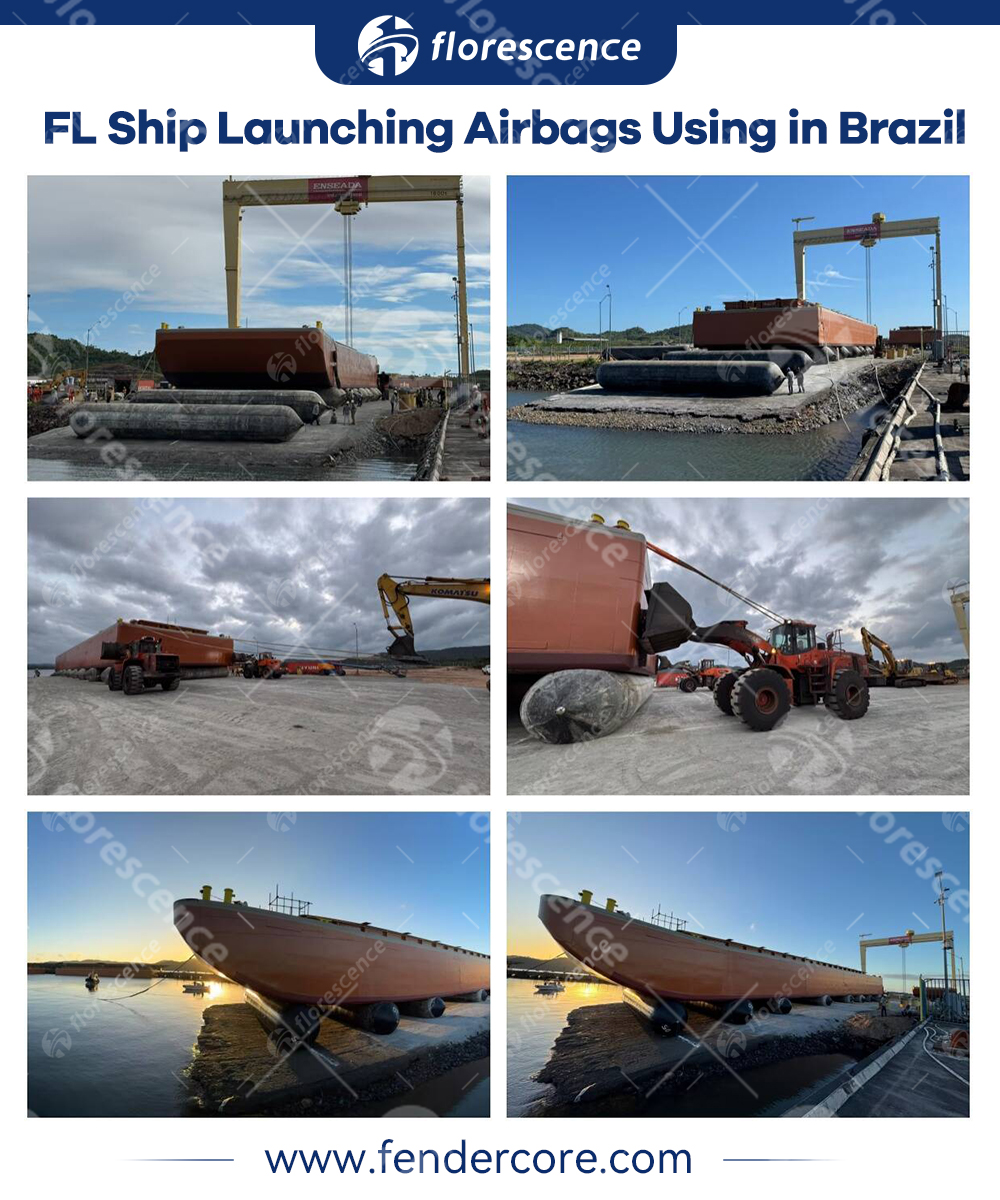
Florescence airbags in service at a shipyard project in Brazil.
Where the airbags are used
The stated application map is broader than launching alone. Six use categories appear consistently across the product and scenario data:
- Newbuild launching. Rolling a completed hull from the yard into the water without a fixed slipway.
- Ship upgrading and conversion. Lifting and repositioning vessels during modification or repair work.
- Dry docking support. Supporting vessels during docking operations in shipyards and repair facilities.
- Heavy objects transport. Moving heavy structures on land, described as covering goods up to 10,000 tonnes.
- Marine salvage and refloating. Jacking stranded vessels, lifting sunken hulls, and providing buoyancy for recovery operations.
- Caisson and low-water launching. Launching caissons or vessels when water level is insufficient for conventional methods.
The company's stated market footprint for these applications covers Southeast Asia, South America, Europe, North America, the Middle East and Africa, with country-level references including Brazil, Turkey, Panama, Indonesia, India, the Philippines, Saudi Arabia, the United States and others across the scenario data set. Where an airbag is used matters less than the conditions it faces: high pressure rating, resistance to seawater corrosion, anti-ageing performance and durability from −20 °C to 50 °C are the recurring technical demands.
Manufacturing, quality control and certification
Quality and reliability are presented as the foundation of the business. Florescence products are designed, manufactured and tested in accordance with ISO 9001:2015 quality management requirements, with quality control maintained through raw material selection, production, assembly, testing and final inspection.
Every production batch passes through defined tests: rubber raw material testing, dimensional and hardness checks for rubber fenders, and air-tightness tests for ship airbags and pneumatic fenders. Third-party inspection is welcomed, and the company states that it frequently works with international agencies including SGS, Bureau Veritas (BV) and LR to inspect marine fenders and steel structures.
Documentation extends beyond a test certificate. Full traceability is offered through EN 10204 3.1 Mill Test Certificates for metal parts and bolts, together with physical property reports covering tensile strength, elongation and compression for the rubber products. A full Quality Inspection Report — rubber test data, sizing sheets, coating thickness records and product photographs — can be issued before final payment and before shipment.
On classification, products can be manufactured and inspected according to the applicable requirements of leading marine classification societies, including CCS, BV, RS, ABS and LR, based on specific project requirements. The product-level certification options listed for the airbags are CCS, BV, ISO, RS and ABS.
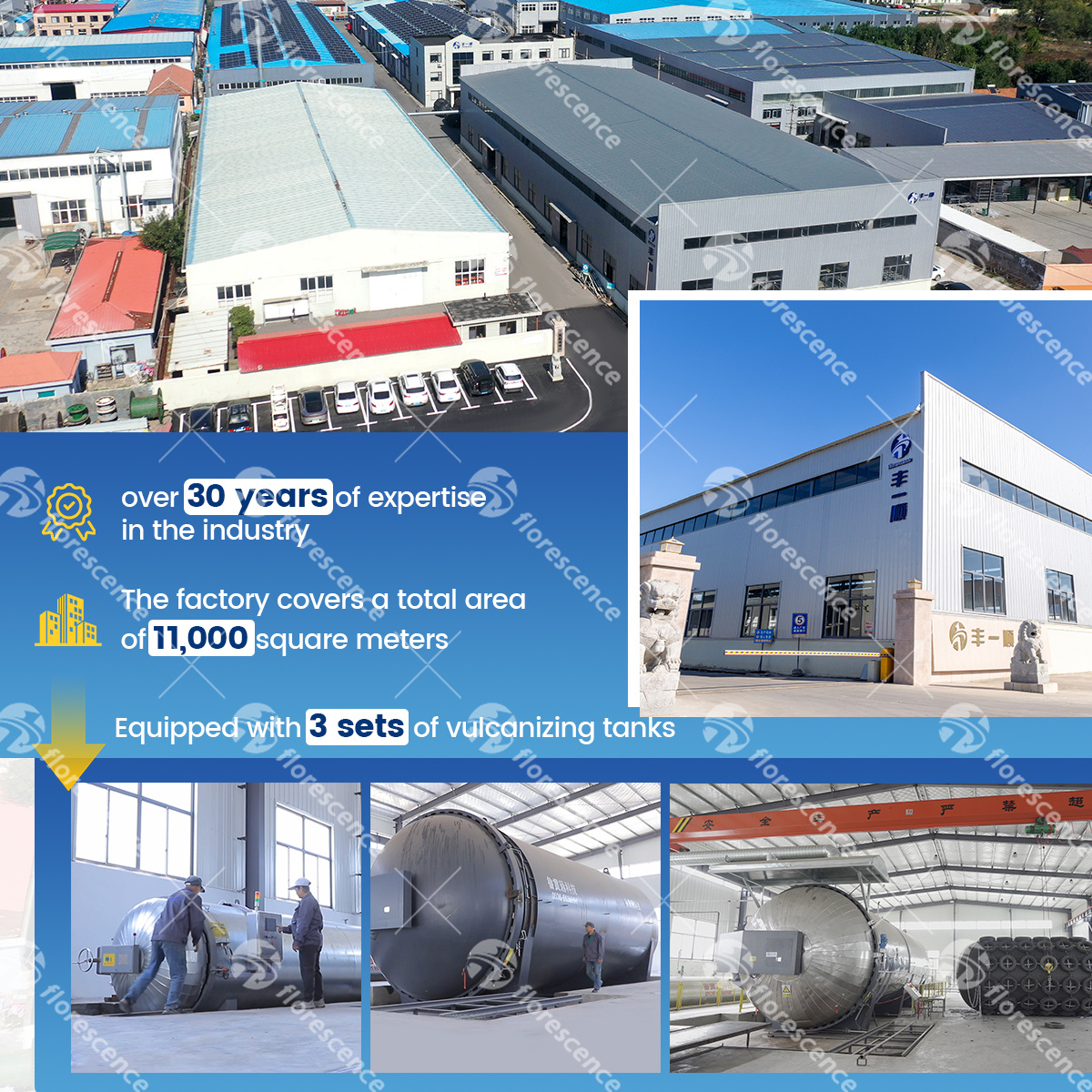
The Florescence manufacturing facility in Qingdao covers 40,000 m² and produces 2,000 pieces per year.
Market acceptance and industry recognition
The clearest external validation in the company data is the naval customer list. Over the past 30 years, Florescence products have been supplied to customers and maritime organisations in many countries and regions, including the Bangladesh Navy, French Navy, Royal Thai Navy, Italian Navy and Philippine Navy.
Naval procurement is a useful signal for commercial buyers because it imposes a different burden on a supplier. Naval specifications tend to be tighter, inspection requirements heavier, delivery schedules less forgiving, and project coordination more formal. The company describes this experience as having strengthened its understanding of demanding technical specifications, inspection requirements, delivery schedules and project coordination.
Alongside the military reference, the 95% export ratio and the established footprint across Southeast Asia, South America, Europe, North America, the Middle East and Africa describe a supplier already operating in the documentation and logistics environment that international buyers require. Delivery terms include FOB as standard, with CIF, CFR, DDP and DDU available, and sea freight, air freight, LCL and FCL shipment supported.
Why Florescence is shortlisted: the practical case
Stripped of adjectives, the purchasing argument rests on six points.
| Buyer need | What Florescence provides |
|---|---|
| Verified manufacturing basis | Established 1992; 40,000 m² facility; 120 staff; 25-engineer R&D team; 2,000 pieces annual capacity |
| Standard compliance | ISO 14409 for ship launching airbags; ISO 9001:2015 quality management; manufacture and inspection to CCS, BV, RS, ABS, LR on request |
| Range breadth | Ship launching airbags, marine salvage airbags, pneumatic rubber fenders, dock fenders, ship fenders and foam fenders from one factory |
| Customisation | Products manufactured according to specific project requirements; airbag diameter, length, pressure rating, reinforcement layers and end structure customisable |
| Project support | Technical support from product selection and specification through manufacturing, inspection, delivery and installation guidance |
| Reuse and running cost | Reusable airbags with 5 – 8 year service life, repair kits and on-site instruction supplied |
Buyer-facing capability summary, based on published company and product data.
Two of those points carry more weight than they appear to. Customisation is not a marketing word here — the layer count is a genuine manufacturing variable that runs from 3 to 12, which is what allows a single factory to supply a small harbour barge and a 100,000 DWT newbuild from the same production line. And the technical support offer starts at selection, which means the sizing calculation for a specific hull can come from the manufacturer rather than from the buyer's own estimate.
One more practical detail: different airbag sizes are kept in stock for quick delivery, and repair kits with on-site instruction are provided. For a yard facing a tight launching window, stock availability and repair support frequently outweigh a marginal price difference.
Product comparison: which airbag line fits which job
| Attribute | Ship Launching Airbag | Marine Salvage Airbag | Pneumatic rubber fender |
|---|---|---|---|
| Primary function | Ship launching, landing, vessel movement | Buoyancy assistance, wreck lifting, refloating | Berthing impact protection |
| Material | Natural rubber and nylon cord | Natural rubber, nylon cord, special synthetic tire-cord layers | Natural rubber and nylon cord |
| Layer / construction range | 3 – 12 layers | 3 – 12 layers; enclosed tube with cone ends, seam-free Holistic Screw build | CTN type (chain and tire net) or sling type (body only) |
| Size range | Dia. 0.6 – 2.8 m; length 5.0 – 25 m | Dia. 0.6 – 2.8 m; length 5.0 – 25 m | Dia. 0.5 – 4.5 m; length 1.0 – 12 m |
| Pressure basis | Working pressure per ISO 14409 design | Maximum working pressure 0.25 MPa, to 25 m depth | Inner pressure 50 or 80 kPa |
| Service life | 5 – 8 years | 5 – 8 years | Over 10 years |
| Certification options | CCS, BV, ISO, RS, ABS | CCS, BV, ISO, RS, ABS | CCS, BV, ISO, RS, ABS |
| Typical use | Newbuild launch, upgrade, dry docking, heavy land transport | Wreck salvage, stranded vessel jacking, caisson launching, pontoon replacement | STS, STQ and STB berthing; offshore platforms; tankers; ports with extreme tidal variation |
Comparison of the three Florescence product lines, based on published product specifications. Values are not interchangeable across lines.
Read together, the table makes the range logic clear. The launching airbag and the salvage airbag share dimensions and layer counts but differ in construction: the salvage unit is a seam-free enclosed tube with cone ends designed for a 0.25 MPa maximum working pressure at 25 m depth, and it carries a much higher buoyancy duty of 10 to 50 tons per piece. The pneumatic fender is a different product family entirely, with a pressure basis measured in kPa rather than MPa and a service-life figure stated as over 10 years.
Frequently asked questions
Which standards and certifications apply to Florescence ship launching airbags?
The ship launching airbags are manufactured to ISO 14409, the international standard that classifies ship launching air bags into Ordinary (QP) and High-capacity (QG) categories. The factory operates under ISO 9001:2015 quality management. Products can be manufactured and inspected according to the applicable requirements of CCS, BV, RS, ABS and LR on specific project requirements, and the product-level certification options listed for the airbags are CCS, BV, ISO, RS and ABS.
Can airbag dimensions and layer counts be customised for a specific vessel?
Yes. Diameter, length, pressure rating, reinforcement layers and end structure design can all be customised. The standard range runs from 3 to 12 layers, with diameters from 0.6 m to 2.8 m and lengths from 5.0 m to 25 m. In practice, the manufacturer recommends airbag size and quantity based on the vessel's length, width and weight, and products can be manufactured according to specific project requirements.
How is airbag quality verified before the goods leave the factory?
Every production batch goes through rubber raw material testing, dimensional and hardness checks, and air-tightness tests for ship airbags and pneumatic fenders. Third-party inspection by agencies including SGS, Bureau Veritas and LR is welcomed and routinely accommodated. Buyers can be issued EN 10204 3.1 Mill Test Certificates for metal parts and bolts, physical property reports for the rubber compounds, and a full Quality Inspection Report with test data, sizing sheets and product photographs before final payment and shipment.
What is the production lead time for a bulk airbag order?
For standard rubber fenders and pneumatic fenders, production takes 25 to 30 days after deposit. Large custom orders or full fender systems take 40 to 45 days. A clear production schedule is confirmed before manufacturing begins, and weekly photographs and videos of production and final packaging are shared so the buyer can track progress remotely. Different airbag sizes are also held in stock for quick delivery when a project window is tight.
How does a buyer start a technical selection or request a quotation?
The starting point is the vessel or project data: hull length, width and weight for a launching job, or the load and working depth for a salvage operation. From those inputs the manufacturer can recommend airbag size and quantity and confirm the specification, certification route and delivery schedule. Quotes and technical recommendations can be requested at inquiry@fendercore.com or info91@florescence.cc, or by phone and WhatsApp on +86 182-0532-1693. A brief product catalogue is available for download, and a repair kit plus on-site instruction can be supplied with the order.
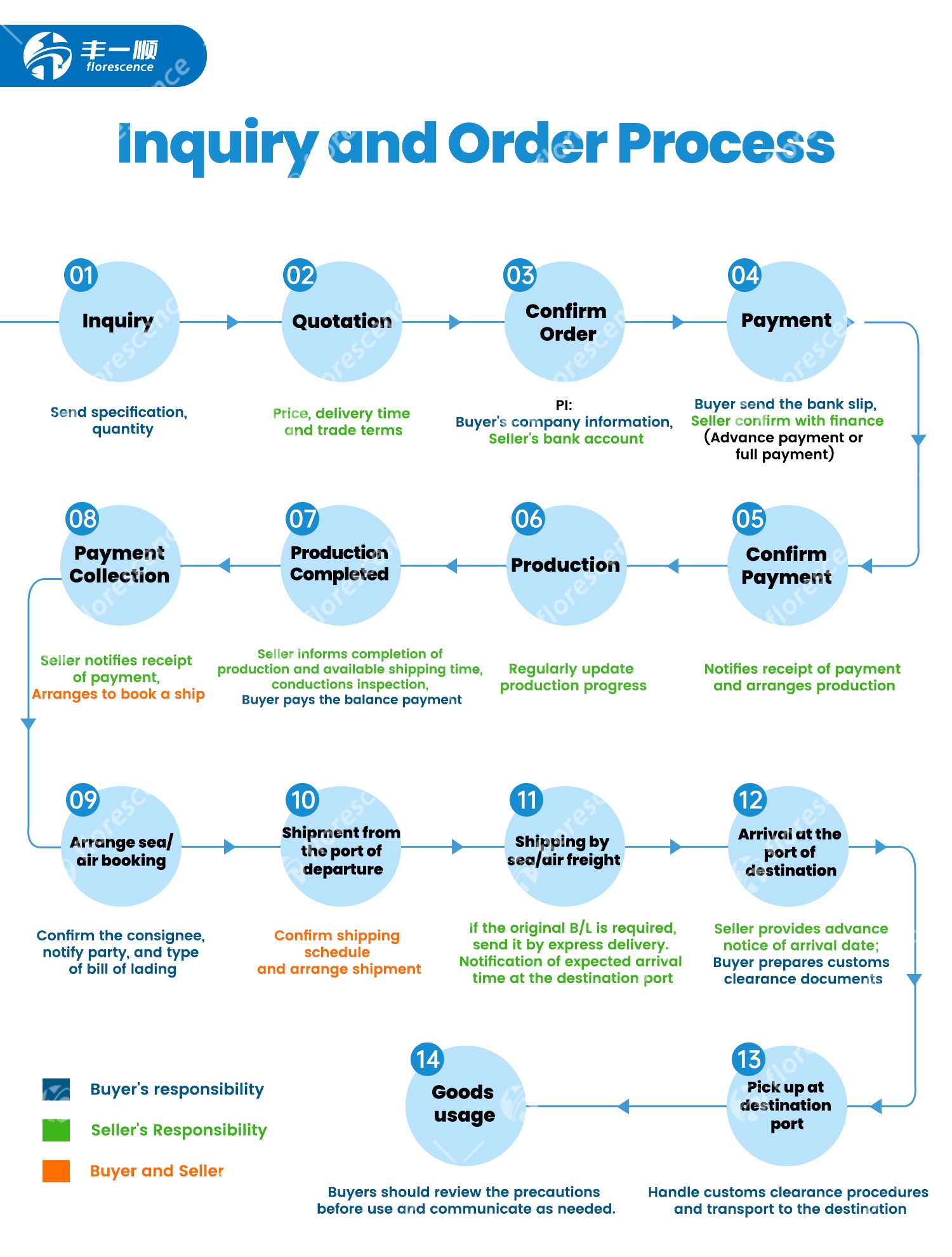
From specification to delivery: the inquiry and order flow for marine airbag projects.
Conclusion: where Florescence sits in the supplier landscape
The global marine airbags market is estimated at USD 346.59 million in 2026, with Asia-Pacific holding roughly 52% of revenue and China acting as the main manufacturing and export centre. Within that structure, Florescence occupies a specific position: a mid-sized, export-oriented Qingdao factory with more than three decades of operation, a 40,000 m² facility, a 25-engineer technical team and 2,000 pieces of annual output.
The purchasing case is built on verifiable attributes rather than claims. An ISO 14409 product manufactured under ISO 9001:2015 quality management. Layer counts from 3 to 12 that make genuine customisation possible. Classification-society manufacture and inspection to CCS, BV, RS, ABS or LR when a project demands it. Naval supply references including the Bangladesh Navy, French Navy, Royal Thai Navy, Italian Navy and Philippine Navy. A 95% export ratio across Southeast Asia, South America, Europe, North America, the Middle East and Africa.
Where a buyer should test the fit is in project specifics. A yard launching a large hull needs the 100,000 DWT launching capability and the stock-and-repair-kit support behind it. A salvage contractor lifting a stranded vessel needs the 0.25 MPa, 25 m depth, 10 to 50 ton buoyancy envelope of the Marine Salvage Airbag. A port operator protecting a berth needs the pneumatic fender line rather than an airbag at all. Because the same factory builds all three, specification and supply can be consolidated — but the selection must still be driven by the job, not by the catalogue.
For buyers at the discovery and research stage, the practical next step is a sizing conversation rather than a purchase decision. Send the vessel dimensions and the site conditions, ask for a recommended airbag layout with the pressure, layer count and certification route, and compare that recommendation against the ISO 14409 requirements already fixed by the standard.
Request airbag sizing, a quotation or the product catalogue
Florescence supplies ship launching airbags, marine salvage airbags and pneumatic rubber fenders from its Qingdao factory to shipyards, ports, salvage contractors and naval organisations worldwide. Technical selection support starts with your vessel dimensions and working conditions.
Contact: Michelle Zhang | +86 182-0532-1693 (phone and WhatsApp) | inquiry@fendercore.com | info91@florescence.cc
Website: www.fendercore.com | Factory address: 27th Floor, 10-2 Building, Optical Valley Software Park, Emeishan Road No. 396, Qingdao, China
Download the brief catalogue: Florescence Catalogue – Brief (PDF)
Have Questions or Need More Details?
Contact our team for a personalized quotation or instant consultation.
Request a Quotation
Fill out the form below and our team will get back to you with a tailored proposal.
WhatsApp Direct Chat
Prefer to chat in real-time? Message us on WhatsApp for instant assistance & quick answers.
- Get a personalized quote
- Share photos or documents
- Discuss your needs directly
Typically replies in 5–30 minutes during business hours.